Quotulatiousness

November 27, 2012

The missing generation

Filed under: Business, Media — Tags: , , , — Nicholas @ 09:42

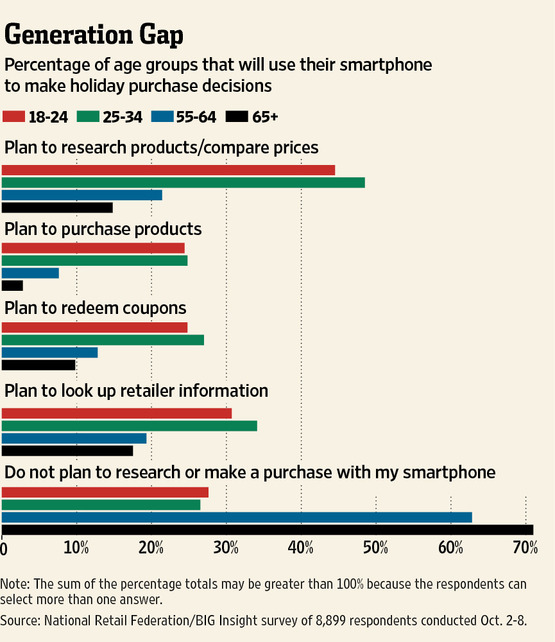
Chris Myrick posted a link to a Wall Street Journal article on differences among the age cohorts regarding shopping habits, pointing out that his (and my) generation didn’t even show up in the graphic:

Hmmm. We can tell the shopping habits of folks from age 18 up to 34, then from 55 upwards. I wonder why the invisible folks aged 35-54 didn’t qualify? Perhaps because their behaviour would ruin the message the article is trying to push?

October 16, 2012

Early Baby Boomers had it much easier than those who followed

Filed under: Cancon, Economics, USA — Tags: , , , , , — Nicholas @ 10:44

Depending on where you draw the demographic line, I’m either a (very) late Baby Boomer or an early arrival from the next generation. I “get” the anger that some younger folks feel about the BB’s, because I came along too late to benefit in the same way that the early boomers did:

But, have baby-boomers really enjoyed a cozy ride through life? The truly lucky were their parents, who worked in the post-Second World War “Golden Age” of low unemployment, rapidly rising real wages, rising house prices, and expanding public and private pension plans.

The postwar boom was petering out by the late 1970s and early 1980s, just as many baby boomers were entering the job market. The 1980s and 1990s were marked by two severe recessions, and by an increase in jobs which often did not provide steady wages or a decent pension.

The unemployment rate for the baby-boomers, then mainly in their early thirties (age 30-34), was more than 10 per cent from 1983 to 1985, and over 8 per cent for the boomers in their late thirties during the recession years of 1992 to 1994.

Many baby-boomers never managed to find the secure and well-paid jobs characteristic of the 1960s and 1970s that lay the basis for a decent retirement. A recent study by former Statscan assistant chief statistician Michael Wolfson found that one-in-four middle-income baby boomers face at least a 25 per cent fall in their standard of living in retirement. (He looked at persons born between 1945 and 1970, and earning between $35,000 and $80,000 per year.)

The proportion of all persons age 65 to 70 who are still working bottomed out at 11 per cent in 2000 and is now 24 per cent, and about one half of persons aged 60 to 65 are still working today.

In my entire career, I’ve worked for only one company that provided a pension plan — and I was laid off before my contributions vested anyway. I don’t expect to ever voluntarily retire: I won’t be able to afford it. And I’m far from alone in that.

October 2, 2012

The Baby Boomers are turning into the New Victorians

Filed under: Liberty, Media, USA — Tags: , , , , — Nicholas @ 13:20

As usual, Gregg Easterbrook manages to squeeze in lots of non-football items into his weekly NFL column:

The entertaining aspect of the fizzled Newt Gingrich presidential campaign was that Gingrich still blames the 1960s for everything. The 1960s were half a century ago. In the year 2012, blaming the 1960s makes about as much sense as someone during the 1960s blaming events on the 1910 appearance of Halley’s Comet.

Since Gingrich put the 1960s into play, note that during that decade the mainstream media advocated what was then called “free love,” and looked down with scorn upon those who backed traditional views of marriage and lovemaking. Yet today when people engage in free love, graying Boomers who run the MSM get all squeamish.

Here, The New York Times treats as shocking that an unmarried yoga instructor had “a penchant for women” and liked “partying and fun.” Man likes women — arrest him! The unmarried instructor faces “accusations of sexual impropriety,” which means “yoga’s enlightened façade” is tainted by “scandal.” And the scandal is what? That unmarried adults are having consensual sex. This “penchant” must be stopped — it can lead to fun.

Worse, yoga can “promote sexual arousal” by causing “emotional closeness” that leads to “increased blood flow” which makes “pelvic regions more sensitive,” resulting in “debauchery.” Who wrote this, Queen Victoria?

All news organizations, including ESPN, sometimes publish ill-thought-through articles. What’s compelling about this one is the sociological change reflected. When they were young, the Baby Boomers who now run big news organizations extolled free love and mocked the older generation’s conventional expectations about sexuality. Now that the Boomers have aged and are not getting any themselves, they evince shock that younger people are fooling around.

August 22, 2012

Kicking the Baby Boomers while they’re down

Filed under: Media, Technology, USA — Tags: , , — Nicholas @ 09:49

P.J. O’Rourke laments the America that was, before the Baby Boomers came along and ruined everything:

The United States has set itself on a course of willful self-diminishment. Seventy-four years ago the perfect American was Superman, who happened to have been, like many of our forefathers, an undocumented alien. If Superman arrived today — assuming he could get past the INS and Homeland Security — he would be faster than the postal service, more powerful than a New York Times blogger, and able to ascend tall buildings in a single elevator.

[. . .]

America has had plenty of reasons to abdicate the crown of accomplishment and marry the Wallis Simpson of homely domestic concerns. Received wisdom tells us that, in the matter of great works and vast mechanisms, all is vanity. The Nurek Dam probably endangers some species of Nurek newt and will one day come crashing down in a manner that will make the aftermath of Japan’s Fukushima tsunami look like an overwatered lawn. And we have better things to spend our country’s money on, like putting a Starbucks on every city block. But I suspect there’s a sadder reason for America’s post-eminence in things tremendous, overwhelming, and awesome.

My sad generation of baby boomers can be blamed. We were born into an America where material needs were fulfilled to a degree unprecedented in history. We were a demographic benison, cherished and taught to be self-cherishing. We were cosseted by a lush economy and spoiled by a society grown permissive in its fatigue with the strictures of depression and war. The child being father to the man, and necessity being the mother of invention, we wound up as the orphans of effort and ingenuity. And pleased to be so. Sixty-six years of us would be enough to take the starch out of any nation.

The baby boom was skeptical about America’s inventive triumphalism. We took a lot of it for granted: light bulb, telephone, television, telegraph, phonograph, photographic film, skyscraper, airplane, air conditioning, movies. Many of our country’s creations seemed boring and square: cotton gin, combine harvester, cash register, electric stove, dishwasher, can opener, clothes hanger, paper bag, toilet paper roll, ear muffs, mass-produced automobiles. Some we regarded as sinister: revolver, repeating rifle, machine gun, atomic bomb, electric chair, assembly line. And, ouch, those Salk vaccine polio shots hurt.

The Soviet Union’s 1957 launch of Sputnik caused a blip in chauvinistic tech enthusiasm among those of us who were in grade school at the time. But then we learned that the math and science excellence being urged upon us meant more long division and multiplying fractions.

H/T to Jon, my former virtual landlord, for the link.

July 13, 2012

Wake up kids: it’s your folks that are screwing you over

Filed under: Liberty, Politics, USA — Tags: , , , , , — Nicholas @ 00:28

Nick Gillespie on the many, many ways that the baby boomers are screwing their own kids:

Hey kids, wake up! Stop playing your X-Box while listening to your Facebooks on the iPod and wearing your iPad with the cap turned backwards with the droopy pants and the bikini underwear listening to Snoopy Poopy Poop Dogg and the Enema Man and all that!

Take a break from getting yet another tattoo on your ass bone or your nipples pierced already! And STFU about the 1 Percent vs. the 99 Percent!

You’re not getting screwed by billionaires and plutocrats. You’re getting screwed by Mom and Dad.

Systematically and in all sorts of ways. Old people are doing everything possible to rob you of your money, your future, your dignity, and your freedom.

Here’s the irony, too (in a sort of Alanis Morissette sense): You’re getting hosed by the very same group that 45 years ago was bitching and moaning about “the generation gap” and how their parents just didn’t understand what really mattered in life.

[. . .]

Oddly, back in the actual 1960s, one of the few things that hippies and Barry Goldwater and Ronald Reagan could all agree on was that conscription was a really bad thing. For god’s sake, Richard Nixon created a commission to end the draft. But that was then, and this is now.

And right now, old people are not going gentle into that good night. They know they’re going to need younger people to change their diapers and pay their bills for them, literally and figuratively. As Hillary Clinton put it in 1999, nobody’s going to do that if they have any option not to. Speaking to a National Education Association meeting, she explained one of the great benefits of old-age entitlements was that they meant you didn’t have to live with your goddamn parents.

June 8, 2012

A Gen-X lament: “none of these “experts” … even agree on when we were born”

Filed under: Media, Randomness — Tags: , , , — Nicholas @ 09:46

By any reckoning, I just missed being in Gen-X, as the earliest date anyone seems to use is 1961 (so my sister is a Gen X’er, but I’m a very-very-very-late boomer, apparently). In spite of that, most of my friends seem to identify much more with Gen X than the plutocratic fat cats of the early Baby Boom generation. Kathy Shaidle explains the three biggest myths about Generation X:

… the term “Generation X” was popularized by our contemporary Douglas Coupland’s titular 1991 novel. (And Coupland swiped his title from the name of Billy Idol’s old pop-punk band; my fellow ex-punk Kinsella should know that, too.)

There are lots of things “great minds” got wrong about Generation X since they started writing and worrying about them. (I mean, us.)

After Coupland’s novel — about over-educated, underemployed pop culture addicts who’ve formed an ad hoc “family” of friends – swept the planet, countless “consultants” (including, briefly, Coupland himself) started marketing themselves as experts on my demographic.

These consultants made a whole lot of money, keynote-speaking to job-for-life CEOs about why we Gen-Xer’s were all so broke and unemployed.

And the most irritating (and yeah, ironic) thing is, none of these “experts” (“X-perts”?) even agree on when we were born.

[. . .]

The takeaway for pundits and other “experts” is:

“Generation X” isn’t synonymous with “young people today.”

I’m gonna be 50 soon. Dammit.

[. . .]

Like the Y2K “experts” who came after them, all those demographic gurus and futurists who got rich theorizing about Generation X ended up looking pretty foolish. (But never had to give their money back.)

When we Gen-Xers were trying to get our first jobs out of college or high school, we did indeed contend with an economy burdened by a triple-feature of double digit horrors: inflation, unemployment and interest rates were all way over 10%.

We blamed those damn yuppie Baby Boomers. They’d beaten us to all the good jobs and were never gonna give them up.

(In the same way hippies had used up all the safe-ish drugs and free sex, and left us with crack and AIDS.)

May 30, 2012

Boomers versus Millennials

Filed under: Economics, Education, Politics — Tags: , , , — Nicholas @ 09:09

Barbara Kay on an insight into the generational conflict triggered after a waiter dumps a glass of water into her lap:

We were dining at a good bistro. The waiter — early 20s — accidentally knocked a glass of water onto my lap. Suppressing annoyance, I was summoning a gracious smile to acknowledge his forthcoming apology when instead he chirped, “It’s okay, stuff happens.” Stung, I responded, “You’re unclear on the concept. You’re supposed to say ‘I’m sorry,’ and I’m supposed to say ‘It’s okay, stuff happens.’ ”

Our narrowed eyes locked: the Senior and the Millennial (a.k.a Gen Y or Echo Boomers). I was thinking: Your teflon complacency comes from a lifetime of helicopter parents and teachers ensuring you were failure-proofed to protect your precious self-esteem. He was probably thinking: Why aren’t you dead yet so I can get a decent job and afford the meal I’m serving you.

He would have a point.

We’re witnessing an unprecedented generational social tussle. In 1950, people my age were doddering retirees. Today, we’re healthier longer, enjoying still-productive lives. By clinging to our jobs, or starting new ones, we’re blocking the natural economic pipeline. Yet we’re also hanging on to our untenably expensive government benefits, because politicians genuflect before our massive voting numbers, not to mention our tendency to vote in higher proportions than the already far less numerous 18-34s.

But I have a point too. Cossetted, self-satisfied millennials lack humility and competitive drive. They think real life will echo their easy ride through high school and the artificially inflated grades they got for their dumbed-down university courses. An October 2011 National Report Card on Youth Financial Literacy polled 3,000 recent high school grads on their expectations. More than 70% erroneously assumed they’d own their own home in 10 years. The average respondent over-estimated his future earnings by 300%.

March 28, 2012

The “Greatest Generation”, then the “Luckiest Generation”, and now the bill comes due

Filed under: Economics, Government, Politics — Tags: , , , , , — Nicholas @ 10:01

John Kay on the luck of the Baby Boomers:

I belong to a lucky generation: too young to have experienced the Depression, or the second world war, or postwar austerity. The first political figure I recognised was Harold Macmillan, who told voters they had never had it so good.

His statement was true, if foolish, and my contemporaries and I benefited. The government paid us to go to university. We took for granted we would choose between attractive job offers. I was quickly appointed to a post from which it was practically impossible to be fired and which offered a pension scheme with generous, index-linked benefits. I bought a flat with a mortgage whose value was wiped out by inflation. By the time I was paying a higher rate of income tax, the level had been cut from 83 per cent to 40 per cent. My life expectancy is several years longer than my father’s, and I have already considerably exceeded the age at which his father died.

If young people today want to attend university, they will have to pay for tuition and borrow to meet living expenses. When they graduate, they face a much more competitive job market. Few careers will offer the job security once characteristic of middle-class employment. Defined benefit schemes have almost disappeared from the private sector, and public sector pensions are to be substantially less generous. Tax rates must rise, partly to pay for the care and medical treatment I will demand as senility advances. The only financial consolation for the next generation is the windfall when we leave them our houses.

The first half of the baby boom generation certainly were the luckiest cohort in human history. The second half of that generation didn’t do quite as well, the Gen X kids and the Millennials are going to be stuck with most of the bill for all the government-provided goodies that the early boomers have arranged for themselves. Pensions and healthcare, in particular, will have to be reined in for younger workers … just as the bulk of the early boomers have squeezed all the juice out of the system.

Aside from retroactively cutting back the benefits to baby boomers, the only other way to mitigate the financial burden is growth, but most governments in the west are pursuing goals that will not help and in many cases will retard economic growth.

March 23, 2012

Millennial generation not following the script

Filed under: Economics, History, Liberty, USA — Tags: , , , , — Nicholas @ 11:57

They’ve been subjected to more “sharing/caring” and “we are the world” propaganda than any group of youngsters since the Young Pioneers and the Hitler Youth, yet they appear to be shrugging off the programming in double-quick time:

Young Amer­i­cans care less and less about the the en­vi­ron­ment, pol­i­tics, and the world around them in gen­er­al, a study has found; even the idea of seek­ing a mean­ing­ful life is out of fash­ion.

In­stead, mon­ey, im­age and fame are the idols of our time.

“Pop­u­lar views of the mil­len­ni­al genera­t­ion, born in the 1980s and 1990s, as more car­ing, com­mun­ity-oriented and pol­i­tic­ally en­gaged than pre­vi­ous genera­t­ions are largely in­cor­rect, par­tic­u­larly when com­pared to ba­by boomers and Genera­t­ion X at the same age,” said the stu­dy’s lead au­thor, Jean Twenge, a psy­chol­o­gist at San Die­go State Uni­vers­ity and au­thor of the book Genera­t­ion Me. “These da­ta show that re­cent genera­t­ions are less likely to em­brace com­mun­ity mind­ed­ness and are fo­cus­ing more on mon­ey, im­age and fame.”

[. . .]

The wish to save the en­vi­ron­ment, an ar­ea of par­tic­u­lar con­cern to mil­len­ni­als, showed some of the larg­est de­clines, with three times as many mil­len­ni­als as ba­by boomers at the same age say­ing they made no per­son­al ef­fort to help the en­vi­ron­ment. Fif­ty-one per­cent of mil­len­ni­als said they made an ef­fort to cut down on elec­tri­city use to save en­er­gy, com­pared to 68 per­cent of boomers in the 1970s.

[. . .]

In the Amer­i­can Fresh­man sur­vey, the pro­por­tion of stu­dents who said be­ing wealthy was very im­por­tant to them rose from 45 per­cent for ba­by boomers (sur­veyed be­tween 1966 and 1978) to 70 per­cent for Genera­t­ion Xers (sur­veyed be­tween 1979 and 1999) and 75 per­cent for mil­len­ni­als (sur­veyed be­tween 2000 and 2009).

The frac­tion who said it was im­por­tant to keep up to date with pol­i­tics dropped, from 50 per­cent for boomers to 39 per­cent for Genera­t­ion Xers and 35 per­cent for mil­len­ni­als. “Be­com­ing in­volved in pro­grams to clean up the en­vi­ron­ment” fell from 33 per­cent for boomers to 20 per­cent for mil­len­ni­als. “De­vel­op­ing a mean­ing­ful phi­los­o­phy of life” de­creased the most across genera­t­ions, from 73 per­cent for boomers to 45 per­cent for mil­len­ni­als.

December 9, 2011

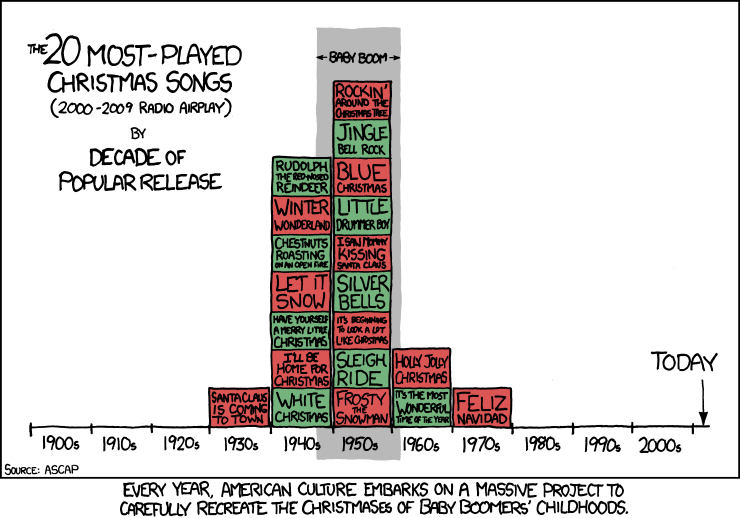
“An ‘American tradition’ is anything that happened to a baby boomer twice”

Filed under: Humour, Media, Randomness — Tags: , , — Nicholas @ 08:30

Hard to refute the latest xkcd take on Christmas music:

November 14, 2011

Beating up on the Boomer generation

Filed under: Economics, History, Media, USA — Tags: , , , — Nicholas @ 12:03

Walter Russell Mead has a bit of vitriol to spit at the Baby Boomers:

But at the level of public policy and moral leadership, as a generation we have largely failed. The Boomer Progressive Establishment in particular has been a huge disappointment to itself and to the country. The political class slumbered as the entitlement and pension crisis grew to ominous dimensions. Boomer financial leadership was selfish and shortsighted, by and large. Boomer CEOs accelerated the trend toward unlimited greed among corporate elites, and Boomer members of corporate boards sit by and let it happen. Boomer academics created a profoundly dysfunctional system that systemically shovels resources upward from students and adjuncts to overpaid administrators and professors who by and large have not, to say the least, done an outstanding job of transmitting the cultural heritage of the past to future generations. Boomer Hollywood execs created an amoral morass of sludge — and maybe I’m missing something, but nobody spends a lot of time talking about the towering cultural accomplishments of the world historical art geniuses of the Boomer years. Boomer greens enthusiastically bet their movement on the truly idiotic drive for a global carbon treaty; they are now grieving over their failure to make any measurable progress after decades spent and hundreds of millions of dollars thrown away. On the Boomer watch the American family and the American middle class entered major crises; by the time the Boomers have finished with it the health system will be an unaffordable and dysfunctional tangle — perhaps the most complicated, expensive and poorly designed such system in the history of the world.

All of this was done by a generation that never lost its confidence that it was smarter, better educated and more idealistic than its Depression-surviving, World War-winning, segregation-ending, prosperity-building parents. We didn’t need their stinking faith, their stinking morals, or their pathetically conformist codes of moral behavior. We were better than that; after all, we grokked Jefferson Airplane, achieved nirvana on LSD and had a spiritual wealth and sensitivity that our boorish bourgeois forbears could not grasp. They might be doers, builders and achievers — but we Boomers grooved, man, we had sex in the park, we grew our hair long, and we listened to sexy musical lyrics about drugs that those pathetic old losers could not even understand.

What the Boomers as a generation missed (there were, of course and thankfully, many honorable individual exceptions) was the core set of values that every generation must discover to make a successful transition to real adulthood: maturity. Collectively the Boomers continued to follow ideals they associated with youth and individualism: fulfillment and “creativity” rather than endurance and commitment. Boomer spouses dropped families because relationships with spouses or children or mortgage payments no longer “fulfilled” them; Boomer society tolerated the most selfish and immature behavior in its public and cultural leaders out of the classically youthful and immature belief that intolerance and hypocrisy are greater sins than the dereliction of duty. That the greatest and most effective political leader the Baby Boom produced was William Jefferson Clinton tells you all you need to know.

October 11, 2011

What the “Occupy #LOCATION” folks should really be protesting

Filed under: Economics, Liberty, Politics, USA — Tags: , , , , , , — Nicholas @ 12:09

Caroline Baum puts her finger on the real looming crisis that the folks out in all the various Occupy Wall Street/Bay Street/Seattle/Edmonton gatherings should really be agitating about:

Oh, sure, some protesters have posted lists of pie-in-the-sky demands. (The occupywallst.org website insists there is no official list of demands.) One of these includes a $20 minimum wage regardless of employment, tariffs on all imports, trillions of dollars in new spending on alternative energy and infrastructure, and debt forgiveness — all debt “on the entire planet.”

In other words, lots of benefits and no consideration of the cost. You’d think one of these kids — and that’s how they come across — would have taken an economics course along the way. Where do they think the government gets the money for its largesse? Imposing usurious taxes on the top 1 percent of earners won’t yield enough money to provide for the other 99 percent. (One of the protesters’ slogans is, “We are the 99 percent that will no longer tolerate the greed and corruption of the 1 percent.”)

It’s not as if young adults couldn’t find good targets for their anger. If these protesters are looking for something to get exercised about, they might want to wander into Chris McHugh’s Monetary Economics class at Tufts University in Medford, Massachusetts, and learn about “generational economics,” the idea that government is going to stick the younger generation with the bill for supporting the retiring baby boomers. McHugh asked his students to identify grass-roots youth groups that are agitating about this, but all they found were a couple of minor groups that tended to be Tea Party and Ron Paul spinoffs.

Talk about haves and have-nots. The debt burden that the younger generation is staring at almost guarantees it will have a reduced standard of living. After all, if more dollars are directed at keeping Granny alive until age 102, that means fewer dollars for productivity-enhancing investments.

This idea clearly hasn’t resonated with today’s youth.

Maybe that’s because the numbers — tens of trillions of dollars in unfunded Social Security liabilities, for example — are hard to fathom. It’s much easier to vent their anger at bank bailouts and preferential treatment for corporate interests, much of which is justified. They seem to be ignoring Capitol Hill, where the rules are made by our bought-and-paid-for government.

July 29, 2011

Boomer bashing: how the idea evolved

Filed under: Economics, History, Media — Tags: , , , , , , — Nicholas @ 10:20

Frank Furedi looks at the evolution of the “bash the boomers” meme, and how it differs from more traditional generational conflict:

Gone are the days when the baby boomers were perceived as the personification of a relaxed but enlightened 1960s live-and-let-live lifestyle.

This cohort of people, generally defined as those born between 1945 and 1965, are globally pathologised as the source of most forms of economic and environmental distress. Constantly accused of living way beyond their means, the baby boomers are blamed for depriving the young of opportunities for a good life. They are condemned for thoughtlessly destroying the environment through their mindless pursuit of material possessions and wealth, as well as resisting change, hanging on to their power and preventing the younger generations from progressing.

[. . .]

The idea that ‘it’s all their fault’ captures the intense sense of cultivated immaturity of the parent-basher. A sentiment that is usually associated with the intellectual universe of a truculent five-year-old is now embraced in earnest by biologically mature generational warriors. Paul Begala’s Esquire article ‘The Worst Generation’ captures this sense of uncontained resentment. ‘I hate the baby boomer’, he wrote, concluding that ‘they’re the most self-centred, self-seeking, self-interested, self-absorbed, self-indulgent, self-aggrandising generation in American history’.

[. . .]

The guilt-tripping of boomers is underwritten by an unusually philistine interpretation of the way society works. The 18th-century Malthusian obsessions about natural limits has been recycled as a warning to human ambition. From this standpoint, resources are fixed and the consumption of one generation reduces what’s available to the next. Accordingly, the flipside of boomer wealth is the poverty of the generations coming of age today. Catastrophic accounts of how young people have been deprived of opportunities for a comfortable life have fostered a cultural climate where the moral status of the elderly is continually questioned.

[. . .]

One of the most distinctive feature of the denunciation of the baby boomers is that it lacks any hint of a future-oriented idealism. It is principally driven by a sense of resentment against a generation that apparently had a really good time.

Instead of tackling the question of how to create a prosperous future, anti-boomers are more interested in gaining a larger slice of the wealth created in the past. Baby boomer self-indulgence pales into insignificance in comparison to the low horizons of their unambitious critics.

Never has the term ‘rebels without a cause’ had more meaning than today. At least Bazarov’s nihilism was in part motivated by the cause of ridding Russia of its feudal autocracy. Even the Lost Generation of the inter-war period were responding to a very real event that shaped their existence. Today’s anti-boomers are freed from the burden of a cause to fight for. As Tyler Durden remarked in the 1999 film Fight Club: ‘Our generation has had no Great Depression, no Great War’, before adding that ‘our depression is our lives’.

May 13, 2011

QotD: The financial legacy of the Baby Boomers

Filed under: Economics, Quotations — Tags: , , , , , — Nicholas @ 00:05

Greg Mankiw links to a WSJ piece about our negative bequest to our children. It’s a point I’ve made many times myself (and am sometimes accused of bashing the elderly because of this). A good quote from the WSJ piece:

     [R]egardless of how much they have contributed, the hard reality is that the federal government has already spent it. No matter how deserving they are, it is younger generations of workers who have to come up with the money.

It is morally wrong to force young people to make good on false promises made before they were even born. It is an outrage, a scandal, a shame on our society. A society that invests in the old at the expense of (actually, to the large detriment of) the young cannot survive. A caring and kind society cares for the weak and elderly and helpless; a dynamic and just society allows the young to grow and prosper on their own merits. If America is to prosper as a nation, the young must be given room to build families and careers. To build lives, without the onerous, crushing burden of debt run up by their forebears.

Never mind questions of ethics or “fairness”: it’s just math. The numbers do not, cannot, and will not ever even up, no matter what accounting tricks the government uses. Until we fundamentally change how the Big Three entitlement programs (SS, Medicare, Medicaid) work, we will continue to load up our young people with a crippling load of debt they had no hand in accruing.

“Monty”, “A hot cup of DOOM!, no cream, no sugar”, Ace of Spades H.Q., 2011-05-12

April 19, 2011

Things that keep on rising in price … like healthcare costs

Kevin Libin points out that Michael Ignatieff may have been even more accurate than he himself realized:

The politicians are finally talking about it, but if you listened to what Mr. Ignatieff said during last week’s English-language debate, you might have found yourself feeling a bit depressed. Perhaps because the Liberal leader effectively argued that if Canadians wanted to keep getting decent medical treatment, they were going to have to learn to live without lots of other things.

“This comes down to a moment of choice,” Mr. Ignatieff intoned. Canadians could either vote for personal income tax breaks, planned corporate income tax cuts, new equipment for the Canadian Forces, all promised by the Conservatives, or, he said, “you can support health care.”

To be accurate, he used language that was far more politically loaded (“multi-million dollar expenditure on prisons … big gifts to upper-middle class Canadians”), but his message was the same: affording public health care means sacrificing other possible priorities.

There’s certainly much to suggest he’s got a point.

If our healthcare costs keep rising, unbounded by any kind of cost control, it will either consume the economy, or cause its collapse. And, of course, the large number of soon-to-retire Baby Boomers are about to need much higher health spending as the natural aging process starts taking its inevitable toll. Fun times ahead, folks.

Already, nine out of 10 provinces spend the majority of their own source revenues (which excludes federal transfers) on health care, according to the Fraser Institute’s report “Canada’s Medicare Bubble.” Only Alberta is just barely under 50%; Nova Scotia spends 88%.

With all the good will in the world, the government can’t keep increasing their healthcare spending . . . they’re almost out of money already.

« Newer PostsOlder Posts »

Powered by WordPress