We lecture the [West Point] cadets on professionalism but we practice bureaucracy. To summarize the difference, professional cultures debate, discuss, and continually innovate to stay effective in the changing world. Bureaucracies churn out ever-restrictive rules and seek to capture every eventuality in codified routines.
Consider this: From day one at the academy every possible situation that a cadet could conceivably encounter is accounted for by strict regulations. Not sure how many inches should be between your coat hangers, whether you can hold your girlfriend’s hand on campus, or how your socks should be marked? Consult the regulations. Moreover, all activity is subjected to the cadet performance system, which essentially assigns a grade to every measurable event in a cadet’s life (think shoe shines, pushups and pop quizzes) then ruthlessly ranks the entire class from first to last. Cadets at the top of the list get the jobs and postings they want after graduation. Those near the bottom end up driving trucks at Fort Polk, Louisiana.
The result is two-fold: First, cadets have very little experience adapting to unfamiliar environments. After all, what happens when the regulations don’t describe what’s going on around you? Second, cadets devote zero attention to activities that “don’t count.” If it’s not on the syllabus, and it’s not for a grade, the cadets aren’t learning it. Ask a cadet to spend a few minutes writing up a list of the skills, traits, and knowledge that he wishes he’d have when he finally takes over his first platoon in combat. Then compare this to his four-year curriculum and summer training plans. There will be surprisingly little overlap between the two lists, and the cadet has neither the time nor the incentive to learn what’s missing. In the end, we graduate far too many cadets that are more bureaucrat than professional, lacking the expert knowledge of their trade and the flexibility to be effective in the complex environments they’ll soon encounter.
Major Fernando Lujan, U.S. Army, quoted in “West Point faculty member worries it is failing to prepare tomorrow’s officers”, Foreign Policy, 2010-06-11
August 11, 2014
QotD: The decay of the profession of arms
August 3, 2014
The Princess Patricia’s Canadian Light Infantry at 100
The Ottawa Citizen notes the centennial of one of Canada’s three regular force infantry regiments, the PPCLI:
During four years of war, from August 1914 to November 1918, Canada contributed some 620,000 men to the fight against Germany. By war’s end, 61,000 — about 1o per cent — of those who served in the Canadian Overseas Expeditionary Force had been killed. Another 172,000 had been wounded, gassed, crippled or psychologically damaged by the war. For a country of not yet eight million, it was an enormous undertaking, and an enormous sacrifice. The proportional loss for Canada a war today, with a population of about 34 million, would be more than 250,000 killed and 550,00 wounded.
The Canadian Corps acquired a reputation for battlefield prowess. British prime minister David Lloyd George referred to the C.E.F. as “the shock army of the British Empire.” This reputation was in some ways the making of the country, historians say. Canada’s contribution to the war effort — men, munitions and food supplies — fostered a deeper sense of national identity and led to greater political sovereignty. Canada went from being a subordinate member of the British Empire to a nation in its own right on the world stage.
[…]
When Britain declared war on Germany on Aug. 4, 1914, Canada, as a Dominion within the Empire, was automatically at war, too. Canadians, by and large, responded with enthusiastic support. Within days of the declaration of war the country was mobilizing. One Montreal businessman, Andrew Hamilton Gault offered $100,000 of his own money — about $2 million in today’s currency — to finance and equip a regiment.
Prime minister Robert Borden’s government was only too happy to accept the offer, having committed itself to raising an army division of 25,000 men as Canada’s initial contribution to the war. The Patricias received their official charter on Aug. 10. Gault, joined by Lt-Col. Francis Farquhar, a British Army veteran and military secretary to the governor-general, the Duke of Connaught, launched a cross-country recruitment campaign.
More than 3,000 men responded to the call to arms, and headed for Ottawa. “Prospectors, trappers, guides, cow-punchers, prize-fighters, farmers, professional and businessmen, above all old soldiers, poured into Ottawa by every train,” writes regimental historian, Ralph Hodder-Williams. By Aug. 19, 1,098 men were chosen — the Originals, as they became known —- and Farquhar was named regimental commander.
The PPCLI officially formed up on Aug. 23 at Ottawa’s Lansdowne Park. Gault had asked the governor-general’s daughter, Princess Patricia, if he could name the regiment after her. She agreed and offered to design a regimental Colour. “I have great pleasure in presenting you with these colours, which I have worked myself. I hope they will be associated with what I believe will be a distinguished corps,” the princess told the assembled soldiers. “I shall follow the fortunes of you all with the deepest interest, and I heartily wish every man good luck and a safe return.”
It was a naive hope, as it turned out. The Patricias boarded the R.M.S. Royal George for England in late September 1914. On Dec. 20, after a few months training in Britain, they arrived in Le Havre. Two weeks later, on Jan. 6 and 7, 1915, the Patricias moved into the Ypres Salient, the first Canadian regiment to go into the field.
[…]
The Camp Colour presented by Princess Patricia in August of 1914 was consecrated in a religious ceremony in Belgium in late January 1919. A month later, the princess, who had returned to England in 1916, attached a commemorative silver gilt laurel wreath to the Colour’s staff in a ceremony before the regiment’s return to Canada. “My thoughts have been continually with you during the years of suffering and trial through which you have passed,” she told the assembled regiment, “and I think with mingled sorrow and pride of your many and gallant comrades who so willingly laid down their lives in the greatest of all causes.”
Such sentiments may sound alien to contemporary ears, but to dismiss them as deluded or naive is to presume that those who lived through the Great War couldn’t possibly have understood what they were doing as well as we can with our historical hindsight and sophisticated post-modern worldview.
But that is an arrogant and condescending assumption, as Philip Child, a Canadian army officer who served with a howitzer battery in the trenches, suggests in his 1937 novel, God’s Sparrow. Child tells the story of Daniel Thatcher, a veteran of the trenches. At one point, reflecting on the dead, Thatcher reaches this conclusion: “The thousands went into battle not ignobly, not as driven sheep or hired murderers … but as free men with a corporate if vague feeling of brotherhood because of a tradition they shared and an honest belief that they were doing their duty in a necessary task.”

H/T to Steve Paikin for the link.
& for us born here too. "@HDrakeUK: For any guest like me living in this great country, I think this is a must-read http://t.co/LnpegOEUjg”"
— Steve Paikin (@spaikin) August 3, 2014
July 27, 2014
QotD: Qui veut tout défendre ne sauve rien (Who defends everything defends nothing)
This is an elementary and self-evident Principle. Indeed, it is so axiomatic that few examples of it will be given in these pages. The only point to stress is that it is useless to hope to obtain complete security in passive defense. It is also unsound. “He who tries to defend everything saves nothing.” declared Marshal Foch, echoing Frederick the Great. It should be noted that the very act of assuming the offensive imparts a certain degree of security. Make as if to strike a man, and he instinctively assumes a defensive attitude. As General Rowan Robinson expresses it in his Imperial Defence, “The highest form of strategic security is that obtained through the imposition of our will upon the enemy, through seizing the initiative and maintaining it by offensive action.” There may sometimes be an element of risk in this, but, as we have seen, war in its nature involves risk.
Lt. Colonel Alfred H. Burne, The Art of War on Land, 1947.
July 24, 2014
The current organization of the Canadian Army
 I posted a link about a military exercise to be held next month in the Niagara Peninsula, and it mentioned the 31st Brigade, which reminded me I’d lost track of the current organization of the Canadian Army (which back in my day was still hiding under the name “Mobile Command”). In common with other allied armies, the units and organizations have changed significantly since the end of the Cold War — in the case of the Canadian Army, many of the changes were triggered earlier by unification in 1968. In the case of the regular infantry regiments, Wikipedia has this to say about the post-WW2 era:
Niagara Peninsula to host brigade-level military exercise in August
A report in Niagara This Week by Paul Forsyth discusses a major Canadian military exercise to be held in the area next month:
Called Stalwart Guardian 14, the exercise is an annual one for troops across Ontario. But unlike many other training exercises that typically take place on military bases, this one will be much more visible to the public.
Col. Brock Millman, commander of the London, Ont.-based 31 Canadian Brigade Group, said in a letter to Thorold Mayor Ted Luciani earlier this year that the exercise will be “massive,” but will be conducted in a “safe, respectful and environmentally sound manner.”
At the July 15 meeting of Thorold city council, Millman and Maj. Paul Pickering — who is co-ordinating the exercise — said conducting the operation off-base makes it more realistic, because foreign bad guys are likely to hit infrastructure in populated areas.
“The terrain (on bases) is not complex, there are not big buildings, there are not roads, there is not a civilian population,” said Millman. “The training is not as effective as it can be.
“We’re coming here because it’s much more effective.”
Millman’s brigade, which is the reserve Canadian army in southwestern Ontario, is part of the 12,000-strong 4th Canadian division. He said more than 2,000 soldiers — a mix of reservists and veterans of missions in Afghanistan and Bosnia — will descend on Niagara for the exercise running from Aug. 16 to 24.
Back in my day, we’d have a camp established just outside Niagara-on-the-Lake and unless something went wrong, most of the civilian population in the area wouldn’t know we were there except for the unusually high number of short-haired guys in the bars after 6pm. In the mid-1970s, short hair was an unusual fashion statement…
While the soldiers take their soldiering seriously, Millman said there will be civil-military co-operation personnel to arrange interaction between soldiers and Niagara residents.
“Kids will get a chance to climb on their vehicles,” he said. “We’re not going to discourage (residents) from engaging with the soldiers” if it doesn’t conflict with the training, he said.
He told St. Catharines city council on Monday night that people simply find military vehicles fascinating
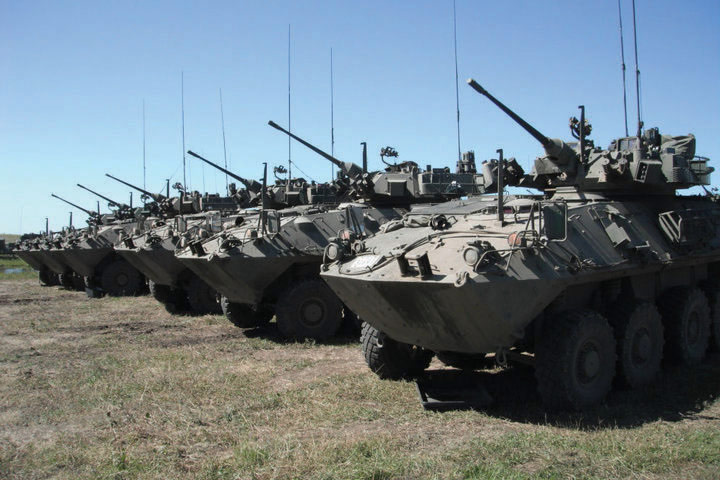
“There’s a five-year-old child in all of us who thinks…Thomas the Tank (Engine) is pretty cool,” he said. “Thomas the Coyote surveillance vehicle is super cool.”
Thorold city councillor Becky Lott said she hopes there is plenty of publicity about the exercise before soldiers arrive so people don’t fear the worst.
“I can see people calling and saying ‘why is there a tank rolling down my street?’” she said.
Coyotes? In my day we were just getting rid of the Korean War-vintage trucks and jeeps… get off my lawn, you kids!
July 23, 2014
Closing the Eastern Ukraine pocket
CDR Salamander links to a recent Ukrainian report that seems to show how far the Ukraine forces have come since May in reclaiming territory from the “separatists”:
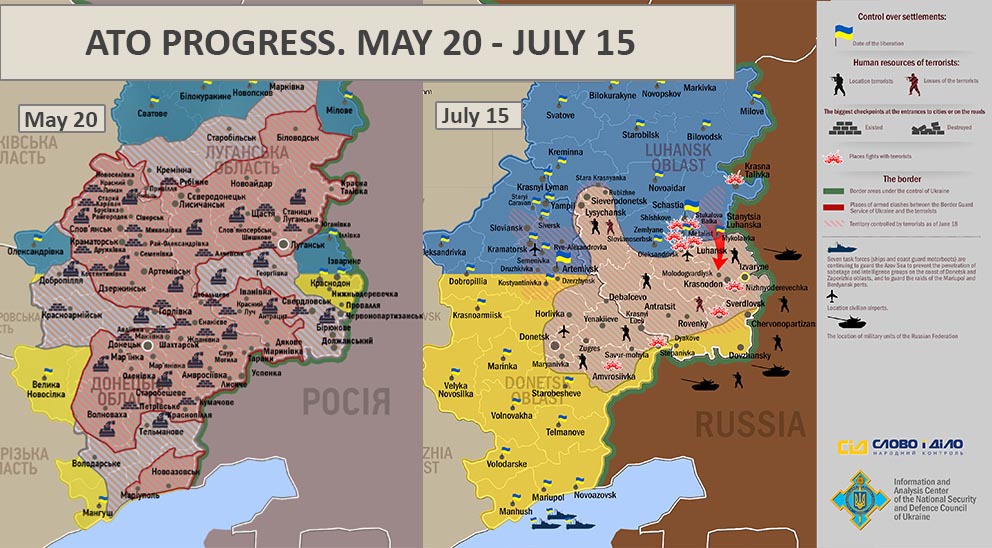
Click to see full-size image
Look at what has happened in the last two months.
1. Ukraine secured its maritime territory.
2. Ukraine managed to re-establish control over most of its borders – though in a thin salient in some places. Not firm control as we know traffic is getting through, but at least partial control to the point they are willing to claim it.
3. They are pushing to widen the salient in the south while increasing its SE bulge, pushing north along the Russian border.
4. From the north, they are pushing south along the Russian border.
5. Yes kiddies, we have a classic pincer movement to envelope a pocket of the enemy, nee – a double envelopment at that. As a matter of fact, a secondary double envelopment is about to take place in that middle thumb centered on Lysychansk – or at least there is an opportunity for one.Cut off the Lysychansk based separatists there while at the same time cutting off their unopposed access to the Russian border – and then you can destroy the pro-Russian separatists piecemeal at your leisure.
A quick Google search for “ATO progress map” also turned up this map posted to Twitter a couple of days ago by Viktor Kovalenko:
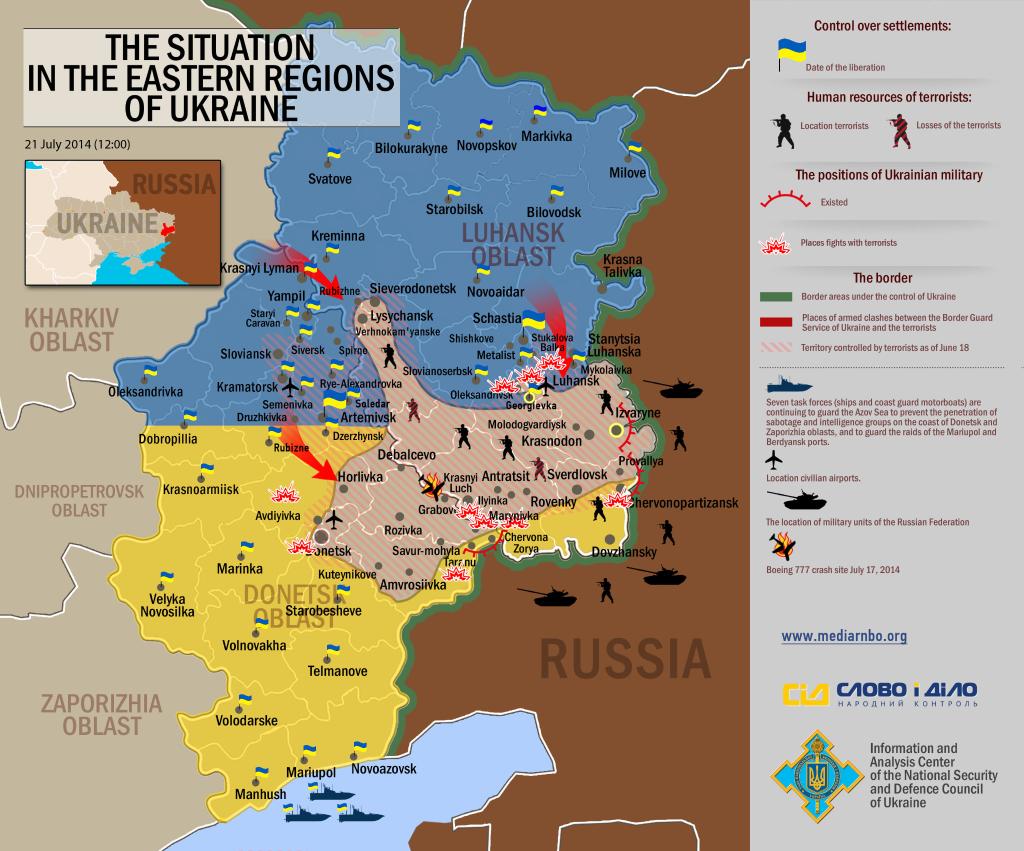
Click to see full size image
As the original CDR Salamander post points out, these are based on claims by one side so apply whatever filters you feel are needed to counteract any PR or propaganda bias.
July 21, 2014
The science of ballistics, the art of war, and the birth of the assault rifle
Defence With A “C” summarizes the tale of how we got to the current suite of modern military small arms. It’s a long story, but if you’re interested in firearms, it’s a fascinating one.
To understand why we’ve arrived where we are now with the NATO standard 5.56mm calibre round you have to go all the way back to the war of 1939-1945. Much study of this conflict would later inform decision making surrounding the adoption of the 5.56, but for now there was one major change that took place which would set the course for the future.
The German Sturmgewehr 44 is widely accepted as the worlds first true assault rifle. Combining the ability to hit targets out to around 500 yards with individual shots in a semi-automatic mode, as well as the ability to fire rapidly in fully automatic mode (almost 600 rounds per minute) the StG 44 represented a bridge between short ranged sub-machine guns and longer ranged bolt action rifles.
[…]
After the second world war the US army began conducting research to help it learn the lessons of its previous campaigns, as well as preparing it for potential future threats. As part of this effort it began to contract the services of the Operations Research Office (ORO) of the John Hopkins University in Baltimore, Maryland, for help in conducting the scientific analysis of various aspects of ground warfare.
On October 1st, 1948, the ORO began Project ALCLAD, a study into the means of protecting soldiers from the “casualty producing hazards of warfare“. In order to determine how best to protect soldiers from harm, it was first necessary to investigate the major causes of casualties in war.
After studying large quantities of combat and casualty reports, ALCLAD concluded that first and foremost the main danger to combat soldiers was from high explosive weapons such as artillery shells, fragments from which accounted for the vast majority of combat casualties. It also determined that casualties inflicted by small arms fire were essentially random.
Allied troops in WW2 had been generally armed with full-sized bolt action rifles (while US troops were being issued the M1 Garand), optimized to be accurate out to 600 yards or more, yet most actual combat was at much shorter ranges than that. Accuracy is directly affected by the stress, tension, distraction, and all-around confusion of the battlefield: even at such short ranges, riflemen required many shots to be expended in hopes of inflicting a hit on an enemy. The ORO ran a series of tests to simulate battle conditions for both expert and ordinary riflemen and found some unexpected results:
A number of significant conclusions were thus drawn from these tests. Firstly, that accuracy — even for prone riflemen, some of them expert shots, shooting at large static targets — was poor beyond ranges of about 250 yards. Secondly, that under simulated conditions of combat shooting an expert level marksman was no more accurate than a regular shot. And finally that the capabilities of the individual shooters were far below the potential of the rifle itself.
This in turn — along with the analysis of missed shots caught by a screen behind the targets — led to three further conclusions.
First, that any effort to try and make the infantry’s general purpose weapon more accurate (such as expensive barrels) was largely a waste of time and money. The weapon was, and probably always would be, inherently capable of shooting much tighter groups than the human behind it.
Second, that there was a practical limit to the value of marksmanship training for regular infantry soldiers. Beyond a certain basic level of training any additional hours were of limited value*, and the number of hours required to achieve a high level of proficiency would be prohibitive. This was particularly of interest for planning in the event of another mass mobilisation for war.
July 18, 2014
QotD: The duty of the soldier
Every young American today is subject to military service; most of them, as shown by the Mayer Report, et al., are not prepared for it, either emotionally or by formal schooling…
He doesn’t see why he should expose himself to death; nothing in his experience justifies it. The whole thing is wildly implausible and quite unfair — like going to sleep in your own bed and waking up in a locked ward of an insane asylum. It strikes him as rank injustice.
And it is … [sic] the rankest sort of injustice.
My basic purpose, then, was to promote in that prototype youth-in-a-foxhole a better understanding of the nature, purpose and function of the ridiculous and dangerous predicament he found himself in.
There were various ancillary purposes but this was the main one … I was forced to limit my scope to: “Why in hell should a young man in good health be willing to fight and perhaps die for his country?” …
I do not expect you to like the book, nor to speak approvingly of it, since you quite clearly do not like it and do not approve of it. But, in fairness, I ask that you, in published criticism of it, (a) read more carefully what I did say and not impute to it things which I did not say, and (b) judge it within its obvious limitations as a short first-person commercial novel and not expect it to unscrew the inscrutable with respect to every possible facet of an extremely complex philosophical question (i.e., don’t expect of me more than you require of yourself).
Robert A. Heinlein, letter to Theodore Cogswell 1959-12-04, quoted in William H. Patterson Jr., Robert A. Heinlein, In Dialogue with His Century Volume 2: The Man Who Learned Better, 2014).
July 12, 2014
Canadians fighting in foreign wars – idealists, mercenaries … and jihadis
In the Globe and Mail, Jack Granatstein remembers many occasions where individual Canadians have chosen to get involved in other peoples’ wars:
Some historical perspective might suggest that Canadians serving in foreign armies is not new to our times. Many Canadians served in the U.S. Army during the Civil War, fighting for the Union and against slavery. Upward of 50,000 Canadians are estimated to have enlisted in the Union forces, and a few hundred wore Confederate grey. Union recruiters operated openly in the Canadas during the war, and many Canadians went south to join up. Even Calixa Lavallée, the composer of O Canada, served as a Union officer. No one objected strenuously.
A few years later, Bishop Ignace Bourget and the Roman Catholic Church in Quebec raised troops to help defend the Papal States against the forces seeking unification of Italy. More than 500 well-educated francophones enlisted in the Papal Zouaves, ready to sail to Italy to defend the Vatican’s territory. Not all the Zouaves made it to Rome by the time the struggle ended in 1870, but eight died. Once again there were few complaints, although Protestants were surely annoyed at this ultramontane Catholic fervour.
In the 1930s, the Spanish Civil War pitted General Francisco Franco’s Nationalists against the Republican government of Spain. Hitler’s Germany and Mussolini’s Italy supported the Nationalists. The Soviet Union backed the Republicans; so did at least 1,300 Canadians who volunteered to fight against fascism and went to Spain to serve in what went on to become the Mackenzie-Papineau Battalion, while another 300 fought in the American Abraham Lincoln Brigade.
The worry about today’s Canadians-fighting-in-foreign-wars revolves primarily around young Muslim men going abroad to fight religious wars. Thus far, few of them have come back to Canada with an obvious intent to bring the war back with them:
None of those war veterans brought jihad home to Canada, a legitimate concern we live with today, although some communists who fought in Spain might have had attitudes inimical to the Canadian capitalist state. Most of the Islamist volunteers, if they survive to return to Canada, will likely settle down to a “normal” life. But so long as ideology, religion, adventurism and a soldier’s pay still matter, Canadians will likely continue going off to fight in other people’s wars.
July 6, 2014
QotD: The inherent weakness of the defence
At first sight the chances would appear to favor the defender; for he can remain still, he can dig, he can shoot accurately; whereas the assailant, while on the move, is dangerously exposed and can do none of these things. The latter, however has important advantages on his side. The forward rush, the excitement, a goal to win, combine to give him a moral uplift wholly lacking in the defender, who is always looking to right and left, anxious lest his flanks be turned and communications severed. The assailant, especially against a passive defense, has freedom of action and power of maneuver and can accordingly concentrate superior forces against any selected point of his adversary’s line, or where the front is not continuous against his flanks and rear.
Major-General H. Rowan Robinson, quoted in The Art of War on Land by Lt. Colonel Alfred H. Burne, 1947.
June 21, 2014
New Zealand’s Defense Capability Plan
At The Diplomat, Ankit Panda reports on the recent Defense Capability Plan (DCP) released by the New Zealand government:
The DCP emphasizes enhancing the NZDF’s “proficiency at joint operations and growing its combat, combat support and combat service support capabilities.” The shortest term goal for the NZDF as explained in the DCF is to achieve Joint Taskforce Capability by 2015. In the medium term, by 2020, the NZDF will focus on enhancing its combat capability. According to the DCP, the NZDF will be charged with:
- defending New Zealand’s sovereignty;
- discharging [New Zealand’s] obligations as an effective ally of Australia;
- contributing to and, where necessary, leading peace and security operations in the South Pacific;
- making a credible contribution in support of peace and security in the Asia-Pacific region;
- protecting New Zealand’s wider interests by contributing to international peace and security, and the international rule of law;
- contributing to whole of Government efforts to monitor the international strategic environment; and
- being prepared to respond to sudden shifts and other disjunctions in the strategic environment.
The DCP sets out some of New Zealand’s longer term procurement concerns. The country will have to replace its aging C-130H and Boeing 757 fleets “in the early 2020s.” Additionally, ANZAC frigates and the highly versatile P-3K2 Orion maritime surveillance aircraft “will also reach the end of their service life in the 2020s.”
The DCP can be read here.
June 18, 2014
Is the RCN “kicking the tires” of the Mistral?
The French navy is visiting Canada’s East coast this week, taking part in Exercise LION MISTRAL. David Pugliese reported on the operation a few days ago:
Approximately 200 Canadian Army soldiers from 5 Canadian Mechanized Brigade Group in Valcartier, Quebec will take part in Exercise LION MISTRAL alongside members of the French Navy and Royal Canadian Air Force from June 16-23, 2014, in Gaspé, Quebec, according to a news release from the DND.
- Canadian Army soldiers, primarily from the 1st Battalion, Royal 22e Régiment (1 R22eR), will board The Mistral, the French amphibious assault ship and helicopter carrier in Halifax on June 18;
- Canadian Army troops will conduct littoral operations, including running air-land operations and battle procedures, and establishing a helicopter landing site and a beachhead. Ex LION MISTRAL will also feature a humanitarian assistance air evacuation operation that will help train expeditionary forces to respond to humanitarian disasters;
- Ex LION MISTRAL will culminate in two disembarkation operations on a Gaspé beach on June 20-21 marking the end of the amphibious exercise. In response to a request by the town of Gaspé, the members of the 1 R22eR will also be offering a static display of their vehicles and equipment on June 21;
- More than 400 French Navy members of The Mistral and 175 of La Fayette will be participating alongside some 200 Canadian soldiers, including 20 engineers from 5 Combat Engineer Regiment from Valcartier;
On Flickr a couple of photos from yesterday, as equipment was being loaded onto Mistral in Halifax:
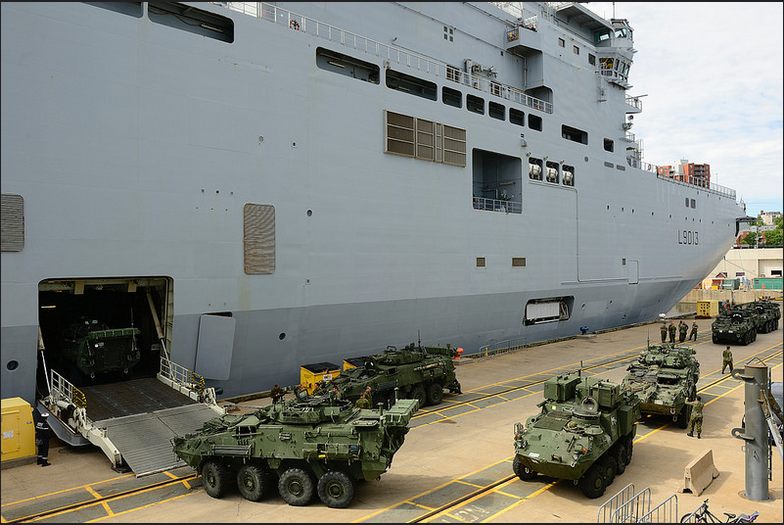
Members of the 1st Battalion, Royal 22e Regiment load light armored vehicles onboard the French Navy amphibious ship Mistral as part of Exercise LION MISTRAL 2014 in Halifax, Nova Scotia, June 17, 2014.
Photo: MCpl Patrick Blanchard, Canadian Forces Combat Camera IS2014-3030-06
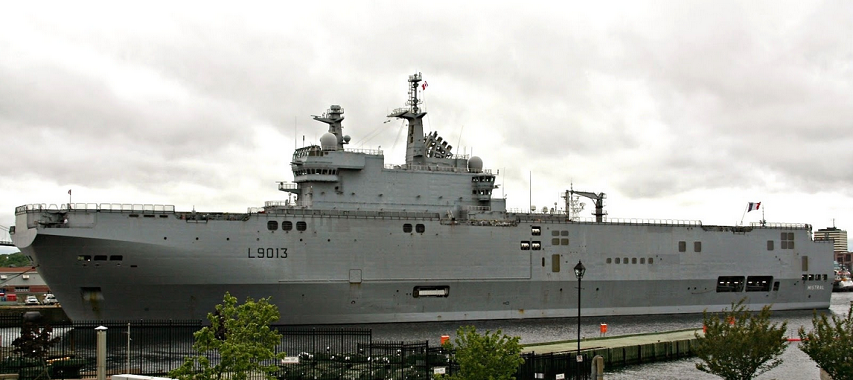
Halifax, Nova Scotia.
FS Mistral (L-9013) is an Amphibious assault ship, and lead ship of her class. She was commissioned in 2006. She features a landing craft dock, and Helicopter facilities.
Photo: Halifax Shipping News
Additional photos by M/Cpl Blanchard were posted on the Ottawa Citizen website.
June 9, 2014
June 8, 2014
Modern weapons would make a D-Day style landing almost impossible
At The Diplomat, Zachary Keck looks at how the evolution of military technology would make future D-Day style invasions much more difficult:
Seaborne invasions are one of, if not the most, difficult kind of military operation. That is partially why, as Mearsheimer points out, the great stopping power of water is so consequential in international politics. At first glance, it might seem like the innovations in transportation and communication technology that have triggered globalization would make contemporary amphibious assaults easier
Not so, however. To begin with, many of the basic challenges that have always plagued seaborne invasions are rooted in geography, which remains relatively fixed. Namely, the defending force in amphibious invasions are usually heavily fortified while the landing force typically has to initially fight in the open. The landing force also remains extremely vulnerable before actually reaching land, especially since the defending force can rely on land-based defense systems.
In fact, as Stratfor, a private global intelligence firm, points out, modern defense technologies have made amphibious assaults much more difficult. The most “significant development” since World War II, Stratfor points out, is precision-guided munitions (these did exist in rudimentary form during the conflict). The analysis goes to explain:
“A contemporary landing force would approach the beachhead in an amphibious landing vehicle such as the U.S. Assault Amphibious Vehicle, which moves at around 13 kph (8 mph). This would be vulnerable to anti-tank guided missiles fired from positions onshore. On D-Day, ships in the Allied invasion fleet were also able to come relatively close to shore to deploy landing craft. The deadly threat of anti-ship cruise missiles in modern warfare would force a modern fleet to remain farther out to sea, leaving amphibious vehicles even more exposed.”
This last point is especially important. As Sydney Freedberg noted back in April, “The new [Marine] Corps concept, Expeditionary Force 21, predicts long-range threats will force the fleet to stay at least 65 nautical miles offshore, a dozen times the distance that existing Marine amphibious vehicles are designed to swim.”
Smaller invasions against undefended coastline — think of both the initial Argentinian attack on the Falkland Islands and the British counter-attack as examples — are still possible, especially in bolt-from-the-blue surprise fashion, but an attack against an active defence with modern weapons might well be unacceptably hard for even the US Marine Corps.
June 7, 2014
China’s Taiwan military end-game options
At Business Insider, Armin Rosen examines what might happen if China decided to resolve the status of Taiwan by military force:
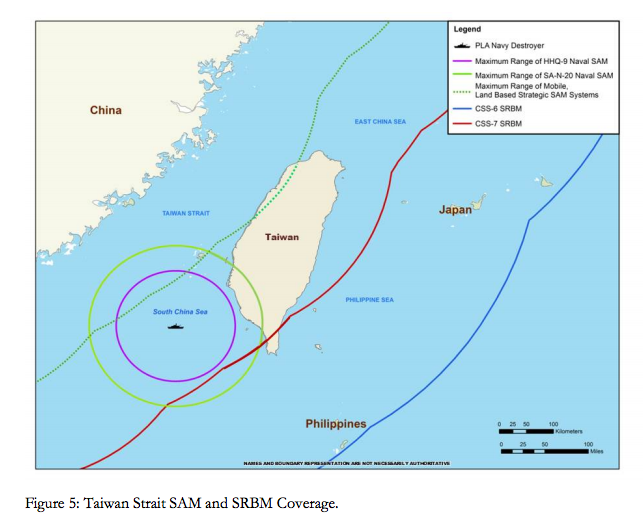
War from the air. The entire island sits within range of Chinese surface to air and short-range ballistic missile systems:
Taiwan Strait SAM and SRBM coverage
Constant air attacks could “degrade Taiwan’s defenses, neutralize Taiwan’s leadership, or break the Taiwan people’s will to fight.”
A full-scale invasion. Chinese military thinkers have published numerous texts thinking through the realities of an amphibious landing in Taiwan. One, entitled the Joint Island Landing Campaign, “envisions a complex operation relying on coordinated, interlocking campaigns for logistics, air, and naval support, and electronic warfare.”
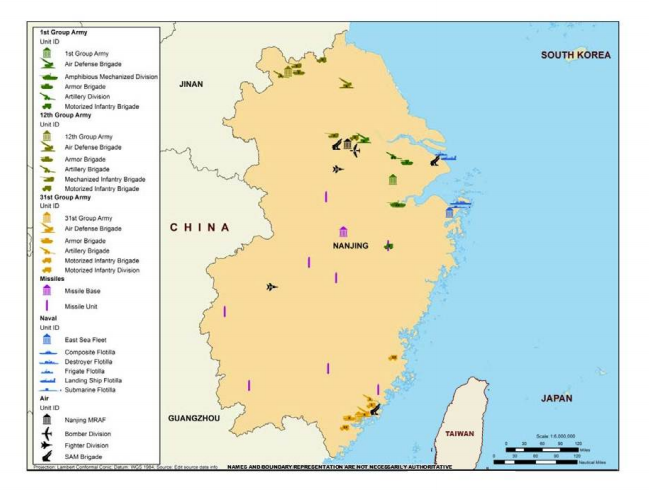
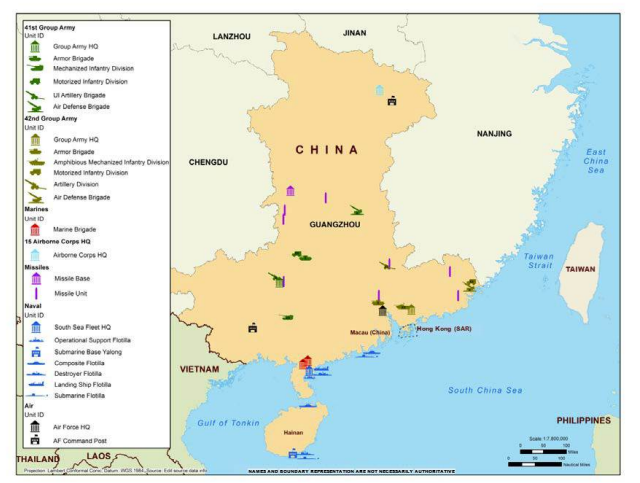
The report doesn’t think that an invasion is necessarily within China’s current capabilities, and notes that China is mindful of the international scorn that such aggression would invite. But China could seize smaller inhabited Islands that Taiwan claims. And the country maintains numerous military assets in and around the Strait:
PLA forces in Nanjing
PLA forces in Guangzhou
And if China establishes a beach head, it would enjoy a substantial manpower advantage over the Taiwanese military: China has 400,000 troops positioned around the Strait, compared to 130,000 total combat soldiers in Taiwan’s standing army.