
Published on 20 Nov 2014
The commanders of the German army blame each other for the missing victories. Falkenhayn and Hindenburg both believe that they have the only solution to the problems. The German emperor feels more and more excluded when it comes to military decisions. His soldiers become pieces on a chessboard and the war of the 20th century also takes it’s toll on some of the best commanders. The situation at the Western Front stays unaltered: the French and Germans fight each other between the trenches. On the contrary, at the Eastern Front the Russians and the Germans are battling in a heavy fight.
November 21, 2014
The Enemy Within – The German Army’s Power Play I THE GREAT WAR Week 17
Comments Off on The Enemy Within – The German Army’s Power Play I THE GREAT WAR Week 17
November 18, 2014
Excavating the trenches of Flanders, 100 years on
In the Telegraph, Tim Rowley reports from Ypres:
In Flanders fields, dozens of men are digging trenches. From dawn to sunset, they force their shovels through the soil, even when the temperature plunges below freezing. When it rains, their clothes cling to their bodies. They were told it would be over by Christmas; now, they are not so sure.
This is Belgium, 2014, and the men are archaeologists, not soldiers – but in one regard their experiences are not so far removed from those of their forebears a century ago. The foes of the Great War have long been reconciled, but the weather is as harsh as ever.
“The cold is not the problem, it’s the rain,” says Simon Verdegem, one of the 30 archaeologists excavating land touched by only a plough for decades. “By the end of the day, our shoes are full of mud and we can’t walk straight because we slip all the time. And, this time, nobody’s firing at us.”
Verdegem’s great uncle fought on these fields 100 years ago. Now the 31-year-old is learning a little of the conditions he had to endure. “The first thing I do when I get home is take a shower and hang my clothes up by the fire. But they didn’t have the chance. They had to stay in a water-filled trench. I know how we feel after a day out here in the rain – we’re just miserable – and I can’t imagine it.”
All these years later, Belgium’s war wounds have still to heal. In the years following the Armistice 96 years ago today, vast mounds of earth were shovelled into the trenches. In the great cemeteries of Belgium, the row upon row of Portland stone stood as testament to the sacrifice of the men; the authorities were less keen to remember the inglorious squalor to which each side subjected the other.
If only that were so easy. For decades now, Flanders farmers have turned up a deadly harvest of unexploded bombs, shells and grenades. They all know the bomb squad’s phone number, and some have reinforced their tractors against explosion.
Yet archaeologists rarely get the chance to mine this rich seam of history. Under European Union regulations, they can only excavate these fields when there is an external threat to the artefacts buried beneath, such as a housing development.
Which is why Verdegem is so excited by this latest dig, the largest-ever excavation of First World War battlefields. Next year, Fluxys, a Belgian energy company, will lay a new £120 million gas pipeline across the country, snaking through 18 miles of land that formed the frontline for four years, as both sides inched from Ypres to Passchendaele then back to Ypres – each time, shuffling just far enough to bury their dead.
Comments Off on Excavating the trenches of Flanders, 100 years on
November 16, 2014
QotD: James Brudenell, Earl of Cardigan
The 11th Light Dragoons at this time were newly back from India, where they had been serving since before I was born. They were a fighting regiment, and — I say it without regimental pride, for I never had any, but as a plain matter of fact — probably the finest mounted troops in England, if not in the world. Yet they had been losing officers, since coming home, hand over fist. The reason was James Brudenell, Earl of Cardigan.
You have heard all about him, no doubt. The regimental scandals, the Charge of the Light Brigade, the vanity, stupidity, and extravagance of the man — these things are history. Like most history, they have a fair basis of fact. But I knew him, probably as few other officers knew him, and in turn I found him amusing, frightening, vindictive, charming, and downright dangerous. He was God’s own original fool, there’s no doubt of that — although he was not to blame for the fiasco at Balaclava; that was Raglan and Airey between them. And he was arrogant as no other man I’ve ever met, and as sure of his own unshakeable rightness as any man could be — even when his wrongheadedness was there for all to see. That was his great point, the key to his character: he could never be wrong.
They say that at least he was brave. He was not. He was just stupid, too stupid ever to be afraid. Fear is an emotion, and his emotions were all between his knees and his breastbone; they never touched his reason, and he had little enough of that.
For all that, he could never be called a bad soldier. Some human faults are military virtues, like stupidity, and arrogance, and narrow-mindedness. Cardigan blended all three with a passion for detail and accuracy; he was a perfectionist, and the manual of cavalry drill was his Bible. Whatever rested between the covers of that book he could perform, or cause to be performed, with marvellous efficiency, and God help anyone who marred that performance. He would have made a first-class drill sergeant — only a man with a mind capable of such depths of folly could have led six regiments into the Valley at Balaclava.
However, I devote some space to him because he played a not unimportant part in the career of Harry Flashman, and since it is my purpose to show how the Flashman of Tom Brown became the glorious Flashman with four inches in Who’s Who and grew markedly worse in the process, I must say that he was a good friend to me. He never understood me, of course, which is not surprising. I took good care not to let him.
George MacDonald Fraser, Flashman, 1969.
Comments Off on QotD: James Brudenell, Earl of Cardigan
November 13, 2014
It was the tank that won WW2 in the west … and a deathtrap
Last month, Paul Richard Huard did a brief tribute to one of the iconic tanks of the Second World War, the M-4 Sherman. It was not a good tank, but it was good enough (if you ignore the survivability of the crews):
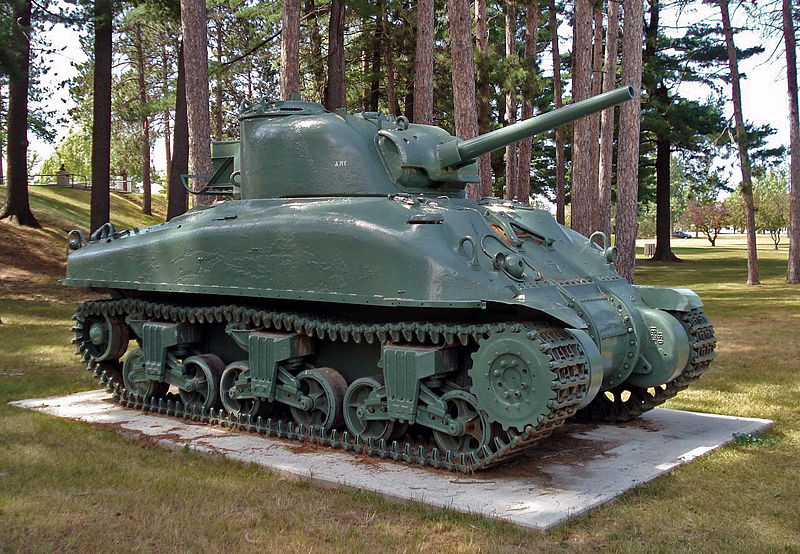
M4A1 Sherman tank at Canadian Forces Base Borden (via Wikipedia)
The M-4 Sherman was the workhorse medium tank of the U.S. Army and Marine Corps during World War II. It fought in every theater of operation — North Africa, the Pacific and Europe.
The Sherman was renown for its mechanical reliability, owing to its standardized parts and quality construction on the assembly line. It was roomy, easily repaired, easy to drive. It should have been the ideal tank.
But the Sherman was also a death trap.
Most tanks at the time ran on diesel, a safer and less flammable fuel than gasoline. The Sherman’s power plant was a 400-horsepower gas engine that, combined with the ammo on board, could transform the tank into a Hellish inferno after taking a hit.
All it took was a German adversary like the awe-inspiring Tiger tank with its 88-millimeter gun. One round could punch through the Sherman’s comparatively thin armor. If they were lucky, the tank’s five crew might have seconds to escape before they burned alive.
Hence, the Sherman’s grim nickname — Ronson, like the cigarette lighter, because “it lights up the first time, every time.”
Commonwealth units were allocated a proportion of Sherman tanks with the original 75mm or 76mm main gun replaced by a British 17-pounder anti-tank gun that gave Sherman Firefly tanks nearly the same punch as German Tiger tanks (and better than Panthers). There weren’t enough to go around, so they were parcelled out to allow a few Fireflies per troop or squadron. The 17-pounder gun also lacked a high explosive round for use against thin-skinned or unarmoured targets, so including one or two Fireflies among a group of conventionally armed Shermans was a good trade-off.

Sherman Firefly on display at Bovington Tank Museum (via Wikipedia)
November 11, 2014
In memoriam
A simple recognition of some of our family members who served in the First and Second World Wars:
The Great War
 Private William Penman, Scots Guards, died 1915 at Le Touret, age 25
(Elizabeth’s great uncle)- Private David Buller, Highland Light Infantry, died 1915 at Loos, age 35
(Elizabeth’s great grandfather) - Private Walter Porteous, Northumberland Fusiliers, died 1917 at Passchendaele, age 18
(my great uncle) - Corporal John Mulholland, Royal Tank Corps, died 1918 at Harbonnieres, age 24
(Elizabeth’s great uncle)
The Second World War
- Flying Officer Richard Porteous, RAF, survived the defeat in Malaya and lived through the war
(my great uncle) - Able Seaman John Penman, RN, served in the Defensively Equipped Merchant fleet on the Murmansk Run (and other convoy routes), lived through the war
(Elizabeth’s father) - Private Archie Black (commissioned after the war and retired as a Major), Gordon Highlanders, captured at Singapore (aged 15) and survived a Japanese POW camp
(Elizabeth’s uncle) - Elizabeth Buller, “Lumberjill” in the Women’s Land Army in Scotland through the war.
(Elizabeth’s mother) - Trooper Leslie Taplan Russon, 3rd Royal Tank Regiment, died at Tobruk, 19 December, 1942 (aged 23).
A recently discovered relative. Leslie was my father’s first cousin, once removed (and therefore my first cousin, twice removed).
In Flanders fields the poppies blow
Between the crosses row on row,
That mark our place; and in the sky
The larks, still bravely singing, fly
Scarce heard amid the guns below.We are the Dead. Short days ago
We lived, felt dawn, saw sunset glow,
Loved and were loved, and now we lie
In Flanders fields.Take up our quarrel with the foe:
To you from failing hands we throw
The torch; be yours to hold it high.
If ye break faith with us who die
We shall not sleep, though poppies grow
In Flanders fields.Lieutenant Colonel John McCrae, MD Canadian Army Medical Corps (1872-1918)
Comments Off on In memoriam
October 26, 2014
Canadians’ ambivalent views on the Canadian Armed Forces
In Maclean’s, Jonathon Gatehouse reflects on the reaction of bystanders just after Corporal Nathan Cirillo was shot while standing guard at the Tomb of the Unknown Soldier in Ottawa, and how Canadians are still uneasy about the role of the military in Canadian society:
They came together with haste and purpose. Three civilians and two members of Canadian Forces, all working frantically to save the life of Cpl. Nathan Cirillo.
In the first minutes after the Hamilton reservist was shot twice at Canada’s National War Memorial on Oct. 22, it was passersby who joined in the challenge of trying to staunch the bleeding and keep his heart beating. Photos captured their desperation. A red-headed woman, her legs stretched out across the Tomb of the Unknown Soldier, administering artificial respiration while a uniformed man performs CPR. A man in a dark business suit helping to keep the blood where it was needed by holding the kilted Cirillo’s bare legs in the air. And two more — a grey-haired lady and a man in an army beret — applying pressure to his wounds. All of them as anonymous as the fallen combatant inside the granite sarcophagus that the soldier was guarding.
A discarded backpack leans against the tomb, next to a Thermos mug of morning coffee. A black attaché case has been tossed to the flagstones. Right beside that lie the two military assault rifles—one belonging to Cirillo, the other his regimental partner—perfectly stacked, stocks tucked tight against the brass foot of the monument. By the book, even though they were never loaded, per standard honour detail practice.
[…]
The Canadian public and its military have been out of sync over duties and mission for more than a decade. It is a gap that doesn’t make much sense. In the aftermath of 9/11, we have come to venerate first-responders — those who run toward danger — as local police, the RCMP and Parliament Hill security did in their shoot-out with Zehaf-Bibeau. But we remain slightly suspicious of the motives of people who volunteer to serve in the army, navy and air force, as if there is something nobler — and more Canadian — in playing defence than being on the offensive.
The events of the past week illustrate that we live in an age where such distinctions have been rendered meaningless. First the murder of Warrant Officer Patrice Vincent, run down by ersatz jihadi Martin Couture-Rouleau in a shopping mall parking lot in St-Jean-sur-Richelieu, Que. And now the death of Cpl. Cirillo at the hands of another “self-radicalized” fellow citizen. Like it or not, Canada is in this fight, abroad and at home. Facing enemies who don’t give credit for past good deeds, and have few, if any scruples about whom they target.
There’s a tradition that has sprung up in Ottawa over the past years. After the conclusion of the official Remembrance Day ceremony, members of the public approach the War Memorial, remove the poppy from their lapels, and lay them on the Tomb of the Unknown Soldier. It’s a small act of respect, and an attempt to connect with our fading, black and white past.
This year will be different. Not just because Nathan Cirillo died at that very spot, but because of what happened in his final moments. When a red-headed lawyer, a grey-haired nurse and a suit-clad government bureaucrat joined with a colonel and a corporal to try and save a soldier’s life, a page turned. The sacrifice, in full colour and public view, can’t be ignored. Everyone has become a witness. It is part of our present, and our uncomfortable future too.
Comments Off on Canadians’ ambivalent views on the Canadian Armed Forces
October 14, 2014
Reason.tv – 3 Reasons the US MILITARY Should NOT Fight Ebola
Published on 14 Oct 2014
President Obama is sending thousands of U.S. troops to West Africa to fight the deadly Ebola virus. Their mission will be to construct treatment centers and provide medical training to health-care workers in the local communities.
But is it really a good idea to send soldiers to provide this sort of aid?
Here are 3 reasons why militarizing humanitarian aid is a very bad idea
Comments Off on Reason.tv – 3 Reasons the US MILITARY Should NOT Fight Ebola
October 12, 2014
Changes to Canadian Army promotion ladder
On the Army News page, this change in policy was posted on October 8:
This fall, the Canadian Army (CA) will implement an innovative program whereby Combat Arms promotions from Corporal to Master Corporal will be managed at the unit – instead of the national – level. This change, a positive outcome of the CA Renewal effort, is expected to save time and money and help the CA accelerate the progression of its “shining stars.”
The drive to work smarter and be more efficient can lead to a fresh examination of why things are done in a certain way. Such a review process may end up standing the status quo on its head, as was the case with Corporal-to-Master Corporal appointments in the Canadian Army (CA) Combat Arms trades.
The CA has four Combat Arms trades: infantry, armoured, artillery, and combat engineers. The majority of the personnel in these trades are privates or corporals located in field units where they perform their baseline jobs.
On the basis that no one knows their soldiers’ strengths and leadership qualities better than their own unit, authority to determine which corporals will be promoted to the appointment of Master Corporal is now given to the unit Commanding Officer (CO). The COs will now also be the ones to select soldiers with leadership potential for Primary Leadership Qualification (PLQ) training, which is a pre-cursor to promotion to Master Corporal.
This was achieved by eliminating the requirement to hold National-level promotion boards for Corporals in the Combat Arms. As a result, the CA will save time, reduce paperwork, simplify the selection process, cut back on costly postings and – most importantly – enhance the process of ensuring the right soldier is in the right place at the right time and with the right qualifications.
I can’t think of a more ridiculous way of managing the promotion process than managing it directly from the national level. The army sets standards for promotion to each rank nationally, and that makes sense, as soldiers can be detached from their parent unit for particular operations or short-term local requirements, so you want to see a certain level of standardization in training and education to make those detachments work as well as possible. But there’s a huge difference between setting standards and actually directly managing the promotions. You could make a case for it with senior NCOs and officers, but for junior ranks that seems an over-abundance of centralization.
Comments Off on Changes to Canadian Army promotion ladder
October 7, 2014
Israel’s “Battlefield Internet” at work
Strategy Page talks about the Israeli deployment of the first reliable Battlefield Internet for ground, sea, and air combat:
The July-August 2014 war in Gaza created some very unpleasant surprises for Hamas, which thought it could risk another war with Israel and come out the winner (to the Arab world at least). Hamas knew that Israel had been working at discovering and countering Hamas tactics, but Hamas was confident they had enough new tricks to stay ahead of the Israelis. Hamas quickly discovered that the Israelis were a lot quicker and better coordinated than in the past. This time around the Israelis learned more from their earlier clashes with Hamas and Hezbollah.
This has happened before, to both the Israelis but mainly to the Arabs. It was only after that war ended that Hamas learned details of what they were up against. It turned out that Israel had managed to create an effective and reliable “Battlefield Internet”. This has been the goal of military communications experts for over a decade. The United States was long the leader, but in mid-2014 Israel was the first to demonstrate a Battlefield Internet that consistently worked under combat conditions. This breakthrough development was largely ignored by the media but military leaders worldwide are paying attention.
[…]
What the Israelis have done with the Battlefield Internet is link everyone involved (pilots, UAV operators, tank commanders and infantry unit commander, plus people at C4i Teleprocessing Branch that managed the flow of data) so all can all see was what each other was seeing of the Hamas commandos. These multiple views eliminated the uncertainty often present when only one view was available. It made all the Israelis involved more confident and that led to speedier interpretation of the situation and decisive action to deal with it. This capability also reduces the risk of friendly fire.
Comments Off on Israel’s “Battlefield Internet” at work
September 18, 2014
No women in the infantry, says female USMC officer
You have to admire the courage of Captain Lauren F. Serrano for publishing this opinion article in the Marine Corps Gazette. She clearly states why women do not belong in the infantry, and explains the few exceptions (Israel and the Kurds have female infantry troops). This may mark the moment at which she stopped progressing toward her next promotion, however, as what she says will be incredibly unpopular politically:
While reading the February issue of the Marine Corps Gazette, I skimmed past the “Be Bold” advertisement calling for readers to submit articles that challenge a Marine Corps policy or way of doing business. Immediately a current “hot topic” came to mind, but as usual I quickly discarded it because I have purposely avoided publicly disagreeing with the passionate opinions of many of my female peers and friends. After weeks of contemplation and debate, I am “being bold” and coming clean: I am a female Marine officer and I do not believe women should serve in the infantry. I recognize that this is a strong statement that will be vehemently challenged by many. I have not come to this opinion lightly and I do not take joy in taking a stance that does not support equal opportunity for all. I have spent countless hours discussing this topic with many civilians and Marines and have discovered that a large number of people agree with the arguments in this article but do not wish to get involved in the public discussion. Interestingly, most of the people who want to incorporate women into infantry are civilians or young, inexperienced Marines. Most of the more seasoned Marines with whom I have spoken tend to oppose the idea of women in infantry—perhaps this is failure to adapt or perhaps it is experienced-based reasoning. National Public Radio’s recent segment, “Looking for a Few Good (Combat-Ready) Women,” stated, “Col Weinberg admits there’s anecdotal evidence that female Marines, who make up 7 percent of the force, aren’t rushing to serve in ground combat.” If the infantry had opened to women while I was still a midshipman or second lieutenant I probably would have jumped at the opportunity because of the novelty, excitement, and challenge; but, to my own disappointment, my views have drastically changed with experience and knowledge. Acknowledging that women are different (not just physically) than men is a hard truth that plays an enormous role in this discussion. This article addresses many issues regarding incorporating women into the infantry that have yet to be discussed in much of the current discourse that has focused primarily on the physical standards.
Before you disagree, remember that war is not a fair business. Adversaries attempt to gain an advantage over their enemies by any means possible. Enemies do not necessarily abide by their adversary’s moral standards or rules of engagement. Although in today’s world many gory, violent war tactics are considered immoral, archaic, and banned by international law or the Geneva Conventions, adversaries still must give themselves the greatest advantage possible in order to ensure success. For the Marine Corps, this means ensuring that the infantry grunt (03XX) units are the strongest, most powerful, best trained, and most prepared physically and mentally to fight and win. Although perhaps advantageous to individuals and the national movement for complete gender equality, incorporating women into infantry units is not in the best interest of the Marine Corps or U.S. national security.
Update: Forgot to H/T The Armorer for the link.
Comments Off on No women in the infantry, says female USMC officer
September 3, 2014
Britain’s shrinking armed forces
The Secretary of State for Defence was asked in Parliament for a breakdown of the members of the British army, Royal Navy and Royal Air Force. The detailed reply shows some significant changes:
Royal Navy/Royal Marines
| Year | Total, all ranks |
|---|---|
| 2010 | 38,730 |
| 2011 | 37,660 |
| 2012 | 35,540 |
| 2013 | 33,960 |
| 2014 | 33,330 |
| Year | Total, all ranks |
|---|---|
| 2010 | 108,920 |
| 2011 | 106,240 |
| 2012 | 104,250 |
| 2013 | 99,730 |
| 2014 | 91,070 |
| Year | Total, all ranks |
|---|---|
| 2010 | 44,050 |
| 2011 | 42,460 |
| 2012 | 40,000 |
| 2013 | 37,030 |
| 2014 | 35,230 |




