
The fall of the Roman Empire in the West (please, right now, just mentally add the phrase “in the west” next to every “the fall of Rome” and similar phrase here and elsewhere) is complicated. I don’t mean it is complicated in its causes or effects (though it is that too), I mean it is complicated in its raw events: the who, what, where and when of it. Most students are taught a fairly simple version of this because most of what they need to actually learn is the cause and the effects and so the actual “fall” part is a sort of black box where Huns, Vandals, Goths, plague, climate and economic decline go in and political fragmentation, more economic decline and the European Middle Ages come out. The fall itself ends up feeling like an event rather than a process because it is compressed down to a single point, the black box where all of the causes become all of the effects. That is, frankly, a defensible way to teach the topic at a survey level (where it might get at most a lecture or two either at the end of a Roman History survey or the beginning of a Medieval History survey) and it is honestly more or less how I teach it.
But if you want to actually try to say something intelligent about the whole thing, you need to grapple with what actually happened, rather than the classroom black-box model designed for teaching efficiency rather than detail. We are … not going to do that today … though I will have some bibliography here for those who want to. The key thing here is that the “Fall of Rome” (in the West) is not an event, but a century long process from 376 to 476. Roman power (in the West) contracts for a lot of that, but it expands in periods as well, particularly under the leadership of Aetius (433-454) and Majorian (457-461); there are points where it would have really looked like the Romans might actually be able to recover. Even in 476 it was not obvious to anyone that Roman rule had actually ended; Odoacer, who had just deposed what was to be the last Roman emperor in the west promptly offered the crown to Zeno, the Roman emperor in the East (there is argument about his sincerity but James O’Donnell argues – very well, though I disagree on some key points – that this represented a real opportunity for Rome to rise from defeat in a new form yet again).
Glancing even further back historically, this wasn’t even the first time the Roman Empire had been on the brink of collapse. Beginning in 238, the Roman Empire had suffered a long series of crippling civil wars and succession crises collectively known as the Crisis of the Third Century (238-284). At one point, the empire was de facto split into three, with one emperor in Britain and Gaul, another in Italy, and the client kingdom of Palmyra essentially running the Eastern half of the empire under their queen Zenobia. Empires do not usually survive those kinds of catastrophes, but the Roman Empire survived the Crisis, recovered all of its territory (save Dacia) and even enjoyed a period of relative peace afterwards, before trouble started up again.
The reason that empires do not generally survive those kinds of catastrophes is that generally when empires weaken, they find that they contain all sorts of people who have been waiting, sometimes patiently, sometimes less so, for any opportunity to break away. The rather sudden collapse of the (Neo-)Assyrian Empire (911-609 BC) is a good case study. After having conquered much of the Near East, the Assyrians fell into a series of succession wars beginning in 627; their Mesopotamian subjects smelled blood and revolted in 625. That was almost under control by 620 when the Medes and Persians, external vassals of the Assyrians, smelled blood too and invaded, allying with the rebelling Babylonians in 616. Assyria was effectively gone by 612 with the loss and destruction of Ninevah; they had gone from the largest empire in the world at that time or at any point prior to non-existent in 15 years. While the Assyrian collapse is remarkable for its speed and finality, the overall process is much the same in most cases; once imperial power begins to wane, revolt suddenly looks more possible and so the downward slope of collapse can be very steep indeed (one might equally use the case study of decolonization after WWII as an example: each newly independent country increased the pressure on all of the rest).
Yet there is no great rush to the doors for Rome. Instead, as Guy Halsall puts it in Barbarian Migrations and the Roman West (2007), “The West did not drift hopelessly towards its inevitable fate. It went down kicking, gouging and screaming”. Among the kicked and gouged of course were Attila and his Huns. Fought to a draw at the Battle of the Catalaunian Plains, his empire disintegrated after his death two years later under pressure from both Germanic tribes and the Eastern Roman Empire (and the standard tendency for Steppe empires to fragment); of his three sons, Ellac was killed by revolting Germanic peoples who had been subject to the Huns, Dengizich by the (Eastern) Romans (we’re told his head was put on display in Constantinople) and the last, Ernak just disappears in our narrative after the death of Dengizich. The Romans, it turns out, did eventually get down to business to defeat the Huns. But the Romans doing all of that kicking, gouging and screaming were not the handful of old families from the early days of the Repulic; most of those hard-fighting Romans were people who in 14 AD would have been provincials. And indeed, the Roman Empire would survive, in the East, where Rome wasn’t, making for a Roman Empire that by 476 consisted effectively entirely of “provincial” Romans.
Instead what we see are essentially three sets of actions by provincial elites who in any other empire would have been leading the charge for the exits. There were the kickers, gougers and screamers, as Halsall notes. There were also, as Ralph Mathisen, Roman Aristocrats in Barbarian Gaul (1993) has noted, elites who – seeing the writing on the wall – made no effort to hasten the collapse of the empire but instead retreated into their estates, their books and their letters; these fellows often end up married into and advising the new “barbarian” kings who set up in the old Roman provinces (which in turn contributes quite a bit to the preservation and continued influence of Roman law and culture in the various fragmented successor states of the early Middle Ages). Finally, there were elites so confident that the empire would survive – because it always had! – that they mostly focused on improving their position within the empire, even at the cost of weakening it, not because they wanted out, but because “out” was inconceivable to them; both Halsall and also James O’Donnell, The Ruin of the Roman Empire (2009) document many of these. If I may continue my analogy, when the exit door was yawning wide open, almost no one walked through; some tried to put out the burning building they were in, others were content to be at the center of the ruins. But no one actually left.
During the Crisis of the Third Century, that set of responses had been crucial for the empire’s survival and for brief moments in the 400s, it looked like they might even have saved it again. For all of the things that brought the Roman Empire down, it is striking that “internal revolts” of long-ruled peoples weren’t one of them. And that speaks to the power of Rome’s effective (if, again, largely unintentional) management of diversity. The Roman willingness to incorporate conquered peoples into the core citizen body and into “Roman-ness” meant that even by 238 to the extent that the residents of the Empire could even imagine its collapse, they saw that potentiality as a disaster, rather than as a liberation. That gave the empire tremendous resiliency in the face of disaster, such that it took a century of unremitting bad luck to bring it down and even then, it only managed to take down half of it.
(As an aside, those provincial Romans were correct in the judgement that the collapse of the empire would mean disaster. The running argument about the fall of the Roman Empire is generally between the “decline and fall” perspective, which presents the collapse of the Roman Empire as a Bad Thing and the “change and continuity” perspective, which both stresses continuity after the collapse but also tends to try minimize the negative impacts of it, even to the point of suggesting that the average Roman peasant might have been better off in the absence of heavy Roman taxes. That latter view is particularly common among many medievalists, who are understandably quite tired of the unfairly poor reputation their period gets. This is an argument that for some time lived in the airy space of narrative and perspective where both sides could put an argument out. Unfortunately for some of the change-and-continuity arguments about living standards, archaeology has a tendency to give us data that is somewhat less malleable. That archaeological data shows, with a high degree of consistency, that while there is certainly some continuity between the Late Antique and the early Middle Ages the fall of Rome (in the West) killed lots of people (precipitous declines in population in societies without reliable birth control; probably this is mostly food scarcity, not direct warfare) and that living standards also declined to a degree that the results are archaeologically visible. As Brian Ward-Perkins notes in The Fall of Rome and the End of Civilization (2005), the collapse causes cows to shrink, speaking to sudden scarcity of winter fodder (which in turn likely speaks to a general reduction in available nutrition). Some areas were worse hit than others; Robin Flemming, Britain After Rome (2010) notes, for instance, that in post-Roman Britain, pot-making technology was lost (because ceramic production had been focused in cities which had been largely depopulated out of existence). The fall of Rome might have been good for some people, but the evidence is, I think, at this point inescapable that it was quite bad for most people. Especially, one assumes, all of the people who got depopulated.)
Bret Devereaux, “Collections: The Queen’s Latin or Who Were the Romans, Part V: Saving and Losing and Empire”, A Collection of Unmitigated Pedantry, 2021-07-30.
September 10, 2025
QotD: “The [western Roman Empire] did not drift hopelessly towards its inevitable fate. It went down kicking, gouging and screaming”
August 7, 2025
QotD: The lost-then-found-again Hittite civilization
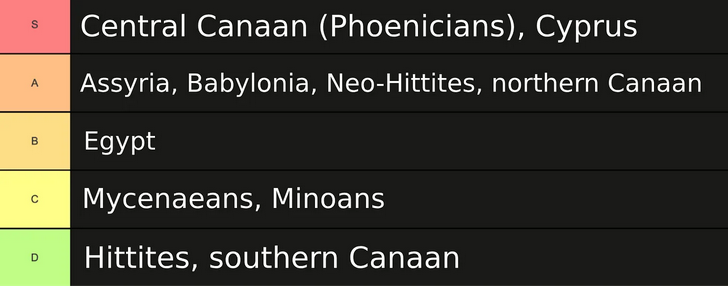
… Mycenaean Greece was as much an outlier as sub-Roman Britain: the civilizational collapse in the Aegean was unusually prolonged and severe compared to the fates of many of the other peoples of the Late Bronze Age. Here I have helpfully reformatted Cline’s chart of how resilient the various societies proved:
Let’s take a brief tour through the various fates of these societies. I’ll come back to the Phoenicians at the end, because their example raises interesting questions when considered in contrast with the Mycenaeans. For the moment, though, let’s begin like civilization itself: in Mesopotamia.
Before the Late Bronze Age Collapse, the Assyrian and Babylonian empires had numbered among the Great Powers of the age: linked by marriage, politics, war, and trade to the other mighty kings, they spent much of their time conducting high-level diplomacy and warfare. As far as we can tell, they did well in the initial collapse: there’s a brief hiatus in Assyrian royal inscriptions running from about 1208 to 1132 BC, but records resume again with the reign of Aššur-reša-iši I and his repeated battles with his neighbor to the south, the Babylonian king Nebuchadnezzar I (no relation). But although the kings of the late twelfth century continued much as their Bronze Age predecessors had — waging war, building palaces, going hunting, accepting tribute, collecting taxes, and ordering it all recorded in stone and clay — the world had changed around them. No longer were there huge royal gifts sent to and from fellow great kings, “My Majesty’s brother”1 overseas; now their diplomatic world consisted of tiny petty kings of nearby cities who could be looted or extorted at will.
Mesopotamia didn’t escape unscathed forever: beginning around 1080 BC, texts begin to record severe droughts, invading Aramaeans, and total crop failures. There was a major drought in 1060 BC, and then both the Assyrian and Babylonian records record further drought every ten years like clockwork — sometimes accompanied by plague, sometimes by “troubles and disorder” — until the end of the eleventh century BC. Most of the tenth century was equally dire, with chronicles recording grain shortages, invasions, and a cessation of regular offerings to the gods.
But unlike the Mycenaeans, and in spite of real suffering (ancient Babylonia is estimated to have lost up to 75% of its population in the three hundred years after the Collapse), both Mesopotamian empires were able to hang on to civilization. There were still kings, there were still scribes, and there were still boundary stones on which to record things like “distress and famine under King Kaššu-nadin-ahhe”. And when conditions finally improved, Assyria and Babylonia were both able to bounce back. When at last the Assyrian recovery began under Aššur-dan II (934-912 BC), for example, he (or more realistically, his scribe) was able to write: “I brought back the exhausted people of Assyria who had abandoned their cities and houses in the face of want, hunger, and famine, and had gone up to other lands. I settled them in cities and homes which were suitable and they dwelt in peace”. Clearly, Assyria still retained enough statehood to effect the sort of mass population transfer that had long been a feature of Mesopotamian polities.2
Over the next few centuries, the Neo-Assyrian Empire would come to dominate the Near East, regularly warring with (and eventually conquering) Babylon and collecting tribute from smaller states all over the region. At its peak, it was the largest empire history had ever known, covering a geographic extent unsurpassed until the Achaemenids. The Babylonians had to wait a little longer for their moment in the sun, but near the end of the seventh century they overthrew their Assyrian overlords and ushered in the Neo-Babylonian Empire. (Less than a century later, Cyrus showed up.)
So how did Babylon and Assyria hold on to civilization — statehood, literacy, monumental architecture, and so forth — when the Greeks lost it and had to rebuild almost from scratch? Unfortunately, Cline doesn’t really answer this. He offers extensive descriptions of all the historical and archaeological evidence for the diverse fates of various Late Bronze Age societies, but only at the very end of the book does he briefly run through the theories (and even then it’s pretty lackluster). He does have a suggestion about the timing — the ninth century Assyrian resurgence lines up almost perfectly with the abnormally wet conditions during the Assyrian megapluvial — but why was it the Assyrians who found themselves particularly well-positioned to take advantage of the shift in the climate? Why not, say, the Hittites?
Sometime around 1225 BC, the Hittite king Tudhaliya IV wrote to his brother-in-law and vassal, Shaushgamuwa of Amurru, that only the rulers of Egypt, Babylonia, and Assyria were “Kings who are my equals in rank”.3 A mere thirty years later, though, his capital city of Hattusa would lie abandoned and destroyed. Modern excavators describe ruins reduced to “ash, charred wood, mudbricks and slag formed when mud-bricks melted from the intense heat of the conflagration”.
And with that, the Hittites essentially vanished from history.
They were so thoroughly forgotten, in fact, that when nineteenth-century archaeologists discovered the ruins of their civilization in Anatolia, they had no idea who these people were. (Eventually they identified the new sites with the Hittites of the Bible, who lived hundreds of years later and hundreds of miles to the south, out of sheer ¯\_(ツ)_/¯.)4
What happened to the Hittites? Well, Cline suggests the usual mélange of drought, famine, and interruption of international trade routes, as well as a potential usurpation attempt from Tudhaliya’s cousin Kurunta, but the actual answer is that we’re not sure. Given the timing, they may have been the first of the Late Bronze Age dominos to fall; given the lack of major rivers in central Anatolia, they may have been uniquely susceptible to drought. Hattusa may have been abandoned before the fire — its palaces and temples show little sign of looting, suggesting they [may] already have been emptied out — but many other sites in the Hittites’ central Anatolian heartland were destroyed around the same time, and some of those have bodies in the destruction layer. But whatever the order of events, Hittite civilization collapsed as thoroughly and dramatically as the Mycenaeans’ had done, and with a similar pattern of depopulation and squatters in the ruins. Unlike the Mycenaeans, though, the Hittites would never be followed by successors who inherited their culture; the next civilization of Anatolia was the Phrygians, who probably arrived from Europe in the vacuum following the Hittites’ fall.
There was one exception: in the Late Bronze Age, cadet branches of the Hittite royal family had ruled a few small satellite statelets in what is now northern Syria, and many of these “Neo-Hittite” polities managed to survive the Collapse. A tiny, far-flung corner of a much greater civilization, they nevertheless outlasted the destruction of their metropole and maintained Hittite-style architecture and hieroglyphic inscriptions well into the Iron Age.5 (They would be swallowed up by the Neo-Assyrian Empire in the late eighth century BC.) And though the Neo-Hittite kings ruled over tiny rump states, we’re now able to translate inscriptions in which they referred themselves by the same titles the Bronze Age Hittite “Great Kings” had employed. The records of their larger neighbors, which had a much greater historical impact, seem to have followed suit: the Neo-Hittites in Syria probably actually were the Hittites of the Bible! Chalk up another one for nineteenth century archaeology.
Jane Psmith, “REVIEW: After 1177 B.C., by Eric H. Cline”, Mr. and Mrs. Psmith’s Bookshelf, 2024-07-08.
1. I really think we should bring back monarchs referring to themselves as “my Majesty”. So much cooler than the royal “we”. Or combine them: “our Majesty”!
2. The Babylonian Captivity, much later in the Iron Age, was far from historically unique.
3. The list actually reads, “the King of Egypt, the King of Babylonia, the King of Assyria,
and the King of Ahhiyawa” — the strikethrough appears in the original clay tablet! A generation earlier, under Tudhaliya’s father Hattusili III, the Hittite texts had consistently referred to the king of Ahhiyawa as a “great King” and a “brother”, but apparently the geostrategic position of the Mycenaean ruler had degraded substantially.4. We now know that the Hittites spoke an Indo-European language and referred to themselves “Neshites”, but the name has stuck.
5. I went looking for a good historical analogy for the Neo-Hittite kingdoms and discovered, to my delight, the Kingdom of Soissons, which preserved Romanitas for a few decades after the fall of the Western Roman Empire. The Neo-Hittites lasted a lot longer.
July 6, 2025
QotD: After the Bronze Age Collapse
But what surprised me most about After 1177 B.C. is how short this era was. In some places, anyway.
We have a vague picture of what happens after a civilizational collapse, but it’s been disproportionately influenced by two particularly dramatic examples: sub-Roman Britain and the Greek Dark Ages. This was perfectly sensible coming from the Anglo historians and archaeologists who have dominated the public conception of the field — after all, the only thing more interesting than the history of your own island is that of the classical world you’ve been studying since you got your first Latin grammar at age six — but it turns out that neither of these are the general rule. Foggy, faraway Britain, so reliant on imported goods and troops, was far more seriously impacted by the withdrawal of Rome than was most of the Empire and saw a longer and more significant reduction in cultural complexity, standards of living, average stature, and of course population. (Imagine what would happen to a Mars colony if the connections to the home planet stopped working.)
Greece after the fall of the Mycenaeans suffered an even more striking decline. As Austrian archaeologist Sigrid Deger-Jalkotzy summarizes:
The impressive palatial structures were not rebuilt, and very little of the representational arts and crafts of the palaces seems to have survived. The complex forms of political, social, and economic organization fell into oblivion. Palaces, kings, and royal families became matter for Greek myths. The art of writing was lost for centuries. In short, Greek civilization was reduced to the level of a prehistoric society.
The Greeks of the classical era had little conception that the Mycenaeans had even existed, let alone that they were their own ancestors: they retained a vague mythological tradition of past kings, but they attributed the few surviving Mycenaean structures to the work of cyclopes. In fact, the disconnect between the civilization of the Late Bronze Age and the later classical world was so great that until Michael Ventris deciphered Linear B, it was an open question whether the people responsible for the Lion Gate and the Treasury of Atreus were even Greeks at all. (The answer, in case you’re wondering, is yes: Linear B turns out to be a syllabic script for the most ancient attested form of Greek. It features a number of uniquely Greek words and deity names even in the limited surviving corpus. More recently, ancient DNA has confirmed the linguistic evidence: the classical Greeks were the descendants of the Mycenaeans.)1
But the more you look at the archaeological record, the more you can pick out signs of cultural continuity. Agricultural practices don’t seem to have changed much, nor did Mycenaean pottery styles, and the names and attributes of the gods preserved in Linear B are close if not identical to their forms as codified in Homer and Hesiod. Even the cyclopean architecture continued to provide shelter: the Mycenaean palace at Pylos was almost completely destroyed in the Collapse, but the few rooms that survived intact show signs of having been inhabited by squatters over the next century or two.
Homer too is chock full of details that turn out to be distant memories of the Mycenaean world, somehow preserved in the oral tradition until writing was reintroduced to Greece.2 For instance, he describes a kind of boar’s tusk helmet that, by his time, no one had worn for centuries, but which archaeologists have since regularly discovered in Mycenaean shaft graves throughout the Aegean. But my favorite example, which is of course linguistic, is the word for “king”: Homer describes Menelaus, Agamemnon, Odysseus and others with the word anax, which is recognizably the Linear B word 𐀷𐀙𐀏, wa-na-ka, used in the Bronze Age to describe the supreme rulers of the Mycenaean palatial societies. (The w sound was lost with the tragic death of the digamma.) By the classical era, however, anax had fallen out of use in preference for basileus (Linear B 𐀣𐀯𐀩𐀄, qa-si-re-u), which in the Mycenaean period had referred to a much lower-level chieftain.
This all paints an evocative picture of a post-apocalyptic world. You can imagine it transplanted to an American context, with the scattered survivors of some great cataclysm huddled around fires built in the corners of a crumbling Lincoln Memorial. You can picture them passing on stories of the great men of the past with their tall tube-shaped hats and the shiny black stones they carried in their pockets. And by the time this remnant rebuilt, they might well have forgotten the word “President” except as an archaism; after centuries of as a small-scale society, “Mayor” might become so deeply engrained as the highest title that two thousand years later they would still use it to refer to their emperor.
Jane Psmith, “REVIEW: After 1177 B.C., by Eric H. Cline”, Mr. and Mrs. Psmith’s Bookshelf, 2024-07-08.
1. It’s slightly more complicated than that, because of course it is; see here for more detail from Razib Khan.
2. A reasonable ballpark guess is that the poems traditionally attributed to Homer were composed in something like their current forms around 750 BC and written down for the first time shortly before 525 BC, although like the dating of Beowulf there’s a great deal of argument.
May 24, 2025
History of Britain, II: Stonehenge; The Druids, Vates, and Celtic Religion
Thersites the Historian
Published 15 Jan 2025In this episode, I briefly examine the presence of prehistorical megaliths on the British Isles and talk about the religion of the Celts, which was ascendant at the time that Britain entered entered the historical record.
May 16, 2025
A Very Basic Introduction To Ancient Carthage
MoAn Inc.
Published 1 Jan 2025Images Used
Hamilcar Barca and The Oath of Hannibal – Benjamin West (1738–1820) – https://en.wikipedia.org/wiki/Ancient…
Ancient Carthage. (2024, December 27). In Wikipedia. https://en.wikipedia.org/wiki/Ancient…
Numerius Fabius Pictor (antiquarian). (2023, October 11). In Wikipedia. https://en.wikipedia.org/wiki/Numeriu…)
Aristotle. (2024, December 27). In Wikipedia. https://en.wikipedia.org/wiki/Aristotle
Herodotus. (2024, December 30). In Wikipedia. https://en.wikipedia.org/wiki/Herodotus
Cassius Dio. (2024, November 28). In Wikipedia. https://en.wikipedia.org/wiki/Cassius…
Plutarch. (2024, December 23). In Wikipedia. https://en.wikipedia.org/wiki/Plutarch
Polybius. (2024, December 31). In Wikipedia. https://en.wikipedia.org/wiki/Polybius
Livy. (2024, November 23). In Wikipedia. https://en.wikipedia.org/wiki/Livy
File:Death Dido Cayot Louvre MR1780.jpg. In Wikipedia. https://commons.wikimedia.org/wiki/Fi…
Colosseum. (2024, December 21). In Wikipedia. https://en.wikipedia.org/wiki/Colosseum
Carthage Ports Puniques, https://commons.wikimedia.org/wiki/Fi…
File:Bardo National Museum tanit-edit.jpg. In Wikipedia. https://commons.wikimedia.org/wiki/Fi…
File:Bardo Baal Thinissut.jpg. In Wikipedia. https://commons.wikimedia.org/wiki/Fi…
File:Ginnasium Solunto.jpg. In Wikipedia. https://commons.wikimedia.org/wiki/Fi…
File:Carthage 323 BC.png. In Wikipedia. https://commons.wikimedia.org/wiki/Fi…A Bit About MoAn Inc. –
Trust me, the ancient world isn’t as boring as you may think. In this series, I’ll be walking you through a VERY basic idea of what happened during Rome’s famous Punic Wars.Donate Here: https://www.ko-fi.com/moaninc
Free Marble Image Photo by Henry & Co.thanks to https://unsplash.com/wallpapers/desig…
#AncientRome #AncientHistory #PunicWars
April 13, 2025
History Hit Expert BLEW My MIND On Ancient Roman History
Metatron
Published 14 Dec 2024Link to the original video
• Historian Answers Google’s Most Popul…
Pompaia, on the River Sarnus — a river which both takes the cargoes inland and sends them out to sea — is the port-town of Nola, Nuceria, and Acherrae.
Strabone, Geografia, IV, 81 – Factors in the Establishment of Pompeii. Let’s begin by well what we know. How did it all start? Like many cities of the classical world, Pompeii also has its founding myth: according to Servius, the city was supposedly founded by none other than the demigod Hercules, and its name would have originated from “a Pompa Herculis”, meaning “from the triumph of Hercules”. However, the most recent archaeological discoveries confirm a foundation dating back to around the 8th century BC by the Oscan people, an Italic tribe, corroborating what Strabo reported in his Geography. The Oscans were part of the large linguistic family of Umbro-Sabellian or Osco-Umbrian peoples, distinct from the Latins, who probably arrived in Italy in the 12th century BC. While some Hellenists have proposed that the etymology of Pompeii should be sought in the Greek Πεμπo (Pempo), meaning “to send”, due to the thriving commercial activity, the original linguistic root is likely this Oscan word “pumpè“, from which comes the archaic name Pumpàiia. The Oscan “pumpè“, analogous to the Greek “penta” and Latin “quinque“, means “five”, and most likely refers to a proto-urban reality formed by the progressive fusion of five distinct residential centers, five small Oscan villages that were scattered on the southern slopes of mount Vesuvius, next to the course of the Sarno river.
2. Natural resources: Volcanic areas often provide access to valuable resources like obsidian, sulfur, and various minerals used in ancient crafts and trade.
3. Lack of geological understanding: Ancient people didn’t fully understand the mechanisms of volcanic eruptions or their potential for catastrophic destruction. The last major eruption of Vesuvius before 79 AD was likely prehistoric, so there was no living memory of its danger.
4. Infrequent eruptions: Many volcanoes, including Vesuvius, can remain dormant for long periods. This can create a false sense of security among nearby populations.
5. Strategic location: Pompeii was located in a prime spot for trade, with access to the sea and inland routes. The benefits of this location may have outweighed perceived risks.
6. Religious and cultural significance: Volcanoes were often seen as sacred in ancient cultures, associated with deities or supernatural forces. This could make living near them culturally desirable.
7. Limited mobility: Ancient societies were less mobile than modern ones. Once established, it was difficult to relocate entire cities, even if dangers became apparent.
8. Economic investments: As cities grew and prospered, the economic and social costs of abandoning them became increasingly high.
9. Adaptation and mitigation: Over time, societies living near volcanoes often developed strategies to cope with minor volcanic activity, like earthquakes or ash falls.
10. Lack of alternatives: In some regions, volcanic areas might have been among the best available locations for settlement, despite the risks.
It’s worth noting that while the destruction of Pompeii was catastrophic, the city had thrived for centuries before the eruption of 79 AD. From the perspective of the ancient inhabitants, the benefits of their location likely seemed to outweigh the potential for a disaster that might never occur in their lifetimes. This balance of risk and reward in choosing settlement locations is not unique to ancient times. Even today, many major cities are located in areas prone to natural disasters, demonstrating that humans often prioritize immediate benefits over long-term, uncertain risks
#pompeii #ancientrome #documentary
April 6, 2025
The Last Pagan Temple in Egypt
Scenic Routes to the Past
Published 6 Dec 2024The Temple of Isis at Philae, on Egypt’s southern edge, survived until the reign of Justinian, long after every other temple had been shut down.
February 2, 2025
Hierapolis: a city encased in stone
Scenic Routes to the Past
Published 18 Oct 2024Hierapolis — modern Pamukkale, Turkey — was built over hot springs. During the Middle Ages, these encased much of the city in gleaming travertine.
See my upcoming trips to Turkey and other historical destinations: https://trovatrip.com/host/profiles/g…
January 21, 2025
Claim – First Nations lived sustainably and harmoniously with their natural environment. Reality – “Head-Smashed-In Buffalo Jump”
Pim Wiebel contrasts how children are taught about how First Nations before contact with Europeans were living fully sustainable lives in a kind of Garden of Eden until the white snakes man arrived and the rather less Edenic reality:

Head-Smashed-In Buffalo Jump near Fort McLeod, Alberta.
Photo by Mike via Wikipedia Commons.
Among the many “proofs” offered in First Nations circles to support the claim of a pre-contact Eden imbued with an ethos of environmental harmony, is the idea that before the Europeans arrived, the buffalo was considered sacred, treated with great respect, and killed only in numbers that would sustain it in perpetuity.
Each of these notions require scrutiny.
For the Great Plains tribes, the buffalo was an essential source of food and of materials for tools, clothing and lodges. It is unsurprising that the buffalo featured prominently in tribal mythology. Among the Blackfoot, the animal was considered Nato’ye (of the Sun) sacred and to have great power. Buffalo skulls were placed at the top of the medicine lodges and prominently featured at communal ceremonies.
It is ubiquitously asserted that the tribes only killed as many buffalo as they needed for their sustenance between hunts, and that every part of the animal was used. A Canadian history website suggests, “The buffalo hunt was a major community effort and every part of the slaughtered animal was used“. An American publication states, presumptuously: “It’s one of the cliches of the West; Native Americans used all the parts of the buffalo. It’s something that almost everyone knows, whether you are interested in history or not.” The Assembly of First Nations weighs in, teaching Canadian school children in their heavily promoted “Learning Modules”, that “Hunters took only what was necessary to survive. Every part of the animal was used.”
But was the Indigenous relationship with the buffalo in reality one of supreme reverence? Was every part of the animal used, and were the buffalo always killed only in numbers that would satisfy immediate needs while ensuring the sustainability of the herds?
The evidence suggests something quite different.
Archaeologists have studied ancient buffalo “jump sites”, places where Indigenous bands hunted buffalo herds by driving them over high cliffs. Investigations of sites from the Late Archaic period (1000 B.C. to 700 A.D.) reveal that many more buffalo than could be used were killed and that rotting heaps of only partially butchered bison carcasses were left behind.
Buffalo jumps continued to be used as a hunting method long after first contact with Europeans. Early Canadian fur trader and explorer Alexander Henry, made the following entry on May 29th, 1805 in his diary of travels in the Missouri country: “Today we passed on the Stard. (starboard) side the remains of a vast many mangled carcasses of Buffaloe which had been driven over a precipice of 120 feet by the Indians and perished; the water appeared to have washed away a part of this immense pile of slaughter and still there remained the fragments of at least a hundred carcasses they created a most horrid stench. In this manner the Indians of the Missouri distroy vast herds of buffaloe at a stroke.”
Alexander Henry described how the buffalo jump unfolded. The hunters approached the herd from the rear and sides, and chased it toward a cliff. A particularly agile young man disguised in a buffalo head and robe positioned himself between the herd and the cliff edge, luring the animals forward. Henry was told on one occasion that the decoy sometimes met the same fate as the buffalo: “The part of the decoy I am informed is extremely dangerous if they are not very fleet runers the buffaloe tread them under foot and crush them to death, and sometimes drive them over the precipice also, where they perish in common with the buffaloe.”
The Blackfoot called their jump sites Pishkun, meaning “deep blood kettle”. It is not difficult to imagine the horrendous bawling of the animals that suffered physical trauma from the fall but did not immediately succumb. Did the hunters have the ability, or even make an attempt, to put them out of their misery with dispatch? We do not know.
December 30, 2024
What was a Viking Funeral really like?
Tasting History with Max Miller
Published 20 Aug 2024Multigrain flatbread strung on a metal ring in the style of findings at Viking funeral sites
City/Region: Various Viking Sites
Time Period: 9th-11th CenturiesWhile there is evidence of bread being laid beside the dead during Viking funerals, we have no written recipe. Analysis of the ingredients of fragments from various Viking funeral sites shows that there was no one way of making funeral bread, so you can either follow my recipe or make up your own using a combination of barley, oat, wheat, rye, peas, flaxseeds, water, milk, butter, whey, and blood. Any version is just as likely as being accurate as another.
In my version, the mix of rye, whole wheat, and oat flour bring more complexity and depth to an otherwise very pita-like flatbread. You could cook the bread longer to get a drier, more cracker-like bread, and I think that they would be great with butter (a period-accurate accompaniment).
(more…)
December 13, 2024
The influence of Mesopotamian cultures on ancient Greece
James Pew and Scott Miller begin their series on the history of western education by looking at the way Greek civilization was influenced by the Mesopotamian cultures who used cuneiform writing for three thousand years:

An example of a clay tablet inscribed with cuneiform text (in this case, a portion of the Epic of Gilgamesh)
In the 19th century, three new discoveries began to militate against “the image of pure, self-contained Hellenism”. They were: “the reemergence of the ancient Near East and Egypt through the decipherment of cuneiform and hieroglyphic writing, the unearthing of Mycenaean civilization, and the recognition of an Orientalizing phase in the development of archaic Greek art”.
To sketch the significance of just one of these discoveries, what the discovery of cuneiform writing means for the history of writing and literature, we have with cuneiform not only the first writing system in human history, but also the longest running (it was in use for over 3,000 years); cuneiform texts are, at the same time, the best preserved and most numerous textual records from the ancient world by far (there are hundreds of thousands of cuneiform documents in museum archives today because the signs were inscribed on clay tablets which preserve better across time than other materials used for writing in ancient times). This complex writing system, consisting of thousands of signs, was developed first in Mesopotamia by the Sumerians and, subsequently, it was adopted by the Akkadians, Babylonians and Assyrians in the same area. It emerged c. 3200 B.C. as a response to social and economic complexities generated by the world’s first cities: invariably, the impetus to create a writing system comes down to the need to document and track the transfer of food stuffs, material goods, temple offerings, and so forth, the administration of complex urban society. On the other hand, written literature in the form of myth, poetry and the like, are secondary developments that may follow a long time later (if at all). In centuries to follow, Mesopotamian scribes would begin to write down epic tales telling the exploits of heroic kings, such as Gilgamesh, along with hymns and prayers to the Mesopotamia gods, incantations to ward off demons and diseases, texts containing lists of known phenomena, proverbs, reports of astrological phenomena and their omens, medical and magical texts to be used by the healing expert, and many text types besides.
On the Question of Greek Borrowing from the more ancient East: This series will delve into the work of many of these cutting-edge historical scholars who follow the evidence from Orient to Occident. Academic’s like Albin Lesky, M.L. West, Walter Burkert, Margalit Finkelberg, Harald Haarmann, Daniel Ogden, Mark Griffith, and more.
It is no easy task to establish links between Greece and ancient Near Eastern civilizations, and the difficulty has to do with more than vast expanses of time and space. Typically, modern scholars of classical Greece have a tendency to “transform ‘oriental’ and ‘occidental’ into a polarity, implying antithesis and conflict”. According to Burkert, it was not until the Greeks fought back the Persian Empire that they became aware of their distinct identity (as separate from the orient). In addition, it was not until many years later, during the crusades, that “the concept and the term ‘Orient’ actually enter(ed) the languages of the West”. The reluctance on the part of many scholars to accept a universal conception of cultural development which involved “borrowing”, “loan words”, and “cultural diffusion” amongst the different ancient peoples living in both the Near East and the Aegean regions, is due to intellectual currents that first took shape in Germany over two centuries ago. In Burkert’s words, “Increasing specialization of scholarship converged with ideological protectionism, and both constructed an image of a pure, classical Greece in splendid isolation”.
It was essentially a trio of academic fads that “erected their own boundaries and collectively fractured the Orient-Greece axis”. The first was the breaking apart of theology and philology. Until well into the 18th century, “the Hebrew Bible naturally stood next to the Greek classics, and the existence of cross-connections did not present any problems”. The second was the rise of the ideology of Romantic Nationalism, “which held literature and spiritual culture to be intimately connected with an individual people, tribe, or race. Origins and organic development rather than reciprocal cultural influences became the key to understanding”. And the third was the discovery by linguistic scholars of “Indo-European”, the “common archetype” of most European languages (as well as Persian and Sanskrit).
Ulrich von Wilamowitz-Moellendorff offered a “scornful assessment” indicative of the faddish and far more isolated conception of ancient Greece in 1884: “the peoples and states of the Semites and the Egyptians which had been decaying for centuries and which, in spite of the antiquity of their culture, were unable to contribute anything to the Hellenes [the Greeks] other than a few manual skills, costumes, and implements of bad taste, antiquated ornaments, repulsive fetishes for even more repulsive fake divinities …” A common take at the time which would later prove to be quite incomplete. It should be noted that Romantic Nationalism, coupled with the discovery of Indo-European (which demonstrates no link between European and Semitic languages) seems to have contributed to what gave “anti-Semitism a chance”. Tragically, it was at the point when the Jews were finally being granted full legal equality in Europe when national-romantic consciousness and the rejection of orientalism helped set the stage for the escalation in Jewish persecution that eventually led to the horror of horrors: the Holocaust.
The Mesopotamians would never, as the later Greeks did c. 600 B.C., formulate an abstract concept of “nature” and analyze phenomena as having a natural developmental explanation rather than the traditional explanation (that being, e.g. the gods made it so). Thus, they would never develop philosophy or science as we think of it, and so there are certain categories of analysis and knowledge that are uniquely Greek in the ancient world. However, as the innovators of a form of agrarian society that was productive and sophisticated enough to sustain the world’s first cities, Mesopotamians needed to be able to examine and quantify time (in order to know when to plant) and so they developed the lunar calendar of 12 months, they developed the 12 double-hour day, they gave names to the observable planets and charted the night sky into constellations; They needed to be able to measure physical space and allot pieces of land to land owners, and so they created the world’s earliest form of basic geometry. The types of knowledge just named are the types of knowledge that scholars believe would have been of interest to the Greeks, and, indeed, many suspect that iron age Greeks borrowed these insights from the Babylonians. Whether the Greek story of Heracles could have been influenced by Mesopotamian hero epics such as the Epic of Gilgamesh is a more contentious — though intriguing — topic.
So, how did Greece find itself in a position to receive the baton of civilization and even to carry it further forward? Because of the great work of modern scholars, we know that an informal but early (proto) archetypal version of education (not yet organized education) begins in the Mediterranean, in archaic Greece, before the classical period. Even before this, although it is not exactly clear as to the extent, it has been determined that Bronze Age Greek cultures located around the area of the Aegean sea (also known as Aegean Civilization) – the Mycenaean on mainland Greece, the Minoan on the island of Crete and the Cyclades (also known as the Aegean Islands) – were not only in contact with each other, but also with neighboring civilizations: Egypt, Mesopotamia, Asia Minor, and the Levant.
November 8, 2024
Highlights of Herculaneum (Part II)
Scenic Routes to the Past
Published Jul 12, 2024This second part of my survey of Herculaneum explores some of the site’s incredibly well-preserved houses.
(more…)
November 7, 2024
Highlights of Herculaneum (Part I)
Scenic Routes to the Past
Published Jul 9, 2024An introduction to Herculaneum, buried and preserved by the eruption of Vesuvius in 79 AD. This video surveys the site and some of its public monuments. Part II explores Herculaneum’s incredibly well-preserved houses.
Check out my other channels, @toldinstone and @toldinstonefootnotes
October 27, 2024
Reading the Herculaneum Papyri
Toldinstone Footnotes
Published Jul 5, 2024On this episode of the Toldinstone Podcast, Dr. Federica Nicolardi and I discuss the challenges of reading scrolls charred and buried by the eruption of Vesuvius in 79 AD.
Chapters:
00:00 Discovery of the scrolls
03:23 Opened and unopened
05:17 How to handle charred papyrus
09:11 New texts
13:17 Philodemus of Gadara
16:04 Epicurean philosophy
20:20 The library in the Villa of the Papyri
24:05 The Vesuvius Challenge
25:56 Progress so far …
28:44 The newest text
30:06 What comes next
34:20 What’s still buried?
October 26, 2024
Secrets of the Herculaneum Papyri
toldinstone
Published Jul 5, 2024The Herculaneum papyri, scrolls buried and charred by Vesuvius, are the most tantalizing puzzle in Roman archaeology. I recently visited the Biblioteca Nazionale in Naples, where most of the papyri are kept, and discussed the latest efforts to decipher the scrolls with Dr. Federica Nicolardi.
My interview with Dr. Nicolardi: https://youtu.be/gs1Z-YN1aQMChapters:
0:00 Introduction
0:40 Opening the scrolls
1:47 A visit to the library
2:38 A papyrologist at work
4:00 The Vesuvius Challenge
4:46 What the scrolls say
5:40 Contents of the unopened scrolls
6:28 The other library
7:12 An interview with Dr. Nicolardi
(more…)


