
I should note here at the outset that we’re not going to be quite done with the system here – when we start looking at the third and second century battle record, we’re going to come back to the system to look at some innovations we see in that period (particularly the deployment of an enallax or “articulated” phalanx). But we should see the normal function of the components first.
No battle is a perfect “model” battle, but the Battle of Raphia (217BC) is handy for this because we have the two most powerful Hellenistic states (the Ptolemies and Seleucids) both bringing their A-game with very large field armies and deploying in a fairly standard pattern. That said, there are some quirks to note immediately: Raphia is our only really good order of battle of the Ptolemies, but as our sources note there is an oddity here, specifically the mass deployment of Egyptians in the phalanx. As I noted last time, there had always been some ethnic Egyptians (legal “Persians”) in the phalanx, but the scale here is new. In addition, as we’ll see, the position of Ptolemy IV himself is odd, on the left wing matched directly against Antiochus III, rather than on his own right wing as would have been normal. But this is mostly a fairly normal setup and Polybius gives us a passably good description (better for Ptolemy than Antiochus, much like the battle itself).
We can start with the Seleucid Army and the tactical intent of the layout is immediately understandable. Antiochus III is modestly outnumbered – he is, after all, operating far from home at the southern end of the Levant (Raphia is modern-day Rafah at the southern end of Gaza), and so is more limited in the force he can bring. His best bet is to make his cavalry and elephant superiority count and that means a victory on one of the wings – the right wing being the standard choice. So Antiochus stacks up a 4,000 heavy cavalry hammer on his flank behind 60 elephants – Polybius doesn’t break down which cavalry, but we can assume that the 2,000 with Antiochus on the extreme right flank are probably the cavalry agema and the Companions, deployed around the king, supported by another 2,000 probably Macedonian heavy cavalry. He then uses his Greek mercenary infantry (probably thureophoroi or perhaps some are thorakitai) to connect that force to the phalanx, supported by his best light skirmish infantry: Cretans and a mix of tough hill folks from Cilicia and Caramania (S. Central Iran) and the Dahae (a steppe people from around the Caspian Sea).
His left wing, in turn, seems to be much lighter and mostly Iranian in character apart from the large detachment of Arab auxiliaries, with 2,000 more cavalry (perhaps lighter Persian-style cavalry?) holding the flank. This is a clearly weaker force, intended to stall on its wing while Antiochus wins to the battle on the right. And of course in the middle [is] the Seleucid phalanx, which was quite capable, but here is badly outnumbered both because of how full-out Ptolemy IV has gone in recruiting for his “Macedonian” phalanx and also because of the massive infusion of Egyptians.
But note the theory of victory Antiochus III has: he is going to initiate the battle on his right, while not advancing his left at all (so as to give them an easier time stalling), and hope to win decisively on the right before his left comes under strain. This is, at most, a modest alteration of Alexander-Battle.
Meanwhile, Ptolemy IV seems to have anticipated exactly this plan and is trying to counter it. He’s stacked his left rather than his right with his best troops, including his elite infantry (the agema and peltasts, who, while lighter, are more elite) and his best cavalry, supported by his best (and only) light infantry, the Cretans.1 Interestingly, Polybius notes that Echecrates, Ptolemy’s right-wing commander waits to see the outcome of the fight on the far side of the army (Polyb. 6.85.1) which I find odd and suggests to me Ptolemy still carried some hope of actually winning on the left (which was not to be). In any case, Echecrates, realizing that sure isn’t happening, assaults the Seleucid left.
I think the theory of victory for Ptolemy is somewhat unconventional: hold back Antiochus’ decisive initial cavalry attack and then win by dint of having more and heavier infantry. Indeed, once things on the Ptolemaic right wing go bad, Ptolemy moves to the center and pushes his phalanx forward to salvage the battle, and doing that in the chaos of battle suggests to me he always thought that the matter might be decided that way.
In the event, for those unfamiliar with the battle: Antiochus III’s right wing crumples the Ptolemaic left wing, but then begins pursuing them off of the battlefield (a mistake he will repeat at Magnesia in 190). On the other side, the Gauls and Thracians occupy the front face of the Seleucid force while the Greek and Mercenary cavalry get around the side of the Seleucid cavalry there and then the Seleucid left begins rolling up, with the Greek mercenary infantry hitting the Arab and Persian formations and beating them back. Finally, Ptolemy, having escaped the catastrophe on his left wing, shows up in the center and drives his phalanx forward, where it wins for what seem like obvious reasons against an isolated Seleucid phalanx it outnumbers almost 2-to-1.
But there are a few structural features I want to note here. First, flanking this army is really hard. On the one hand, these armies are massive and so simply getting around the side of them is going to be difficult (if they’re not anchored on rivers, mountains or other barriers, as they often are). Unlike a Total War game, the edge of the army isn’t a short 15-second gallop from the center, but likely to be something like a mile (or more!) away. Moreover, you have a lot of troops covering the flanks of the main phalanx. That results, in this case, in a situation where despite both wings having decisive actions, the two phalanxes seem to be largely intact when they finally meet (note that it isn’t necessarily that they’re slow; they seem to have been kept on “stand by” until Ptolemy shows up in the center and orders a charge). If your plan is to flank this army, you need to pick a flank and stack a ton of extra combat power there, and then find a way to hold the center long enough for it to matter.
Second, this army is actually quite resistive to Alexander-Battle: if you tried to run the Issus or Gaugamela playbook on one of these armies, you’d probably lose. Sure, placing Alexander’s Companion Cavalry between the Ptolemaic thureophoroi and Gallic mercenaries (about where he’d normally go) would have him slam into the Persian and Medean light infantry and probably break through. But that would be happening at the same time as Antiochus’ massive 4,000-horse, 60-elephant hammer demolished Ptolemaic-Alexander’s left flank and moments before the 2,000 cavalry left-wing struck Alexander himself in his flank as he advanced. The Ptolemaic army is actually an even worse problem, because its infantry wings are heavier, making that key initial cavalry breakthrough harder to achieve. Those chunky heavy-cavalry wings ensure that an effort to break through at the juncture of the center and the wing is foolhardy precisely because it leaves the breakthrough force with heavy cavalry to one side and heavy infantry to the other.
I know this is going to cause howls of pain and confusion, but I do not think Alexander could have reliably beaten either army deployed at Raphia; with a bit of luck, perhaps, but on the regular? No. Not only because he’d be badly outnumbered (Alexander’s army at Gaugamela is only 40,000 infantry and 7,000 cavalry) but because these armies were adapted to precisely the sort of army he’d have and the tactics he’d use. Even without the elephants (and elephants gave Alexander a hell of a time at the Hydaspes), these armies can match Alexander’s heavy infantry core punch-for-punch while having enough force to smash at least one of his flanks, probably quite quickly. Note that the Seleucid Army – the smaller one at Raphia – has almost exactly as much heavy infantry at Raphia as Alexander at Gaugamela (30,000 to 31,000), and close to as much cavalry (6,000 to 7,000), but of course also has a hundred and two elephants, another 5,000 more “medium” infantry and massive superiority in light infantry (27,000 to 9,000). Darius III may have had no good answer to the Macedonian phalanx, but Antiochus III has a Macedonian phalanx and then essentially an entire second Persian-style army besides (and his army at Magnesia is actually more powerful than his army at Raphia).
This is not a degraded form of Alexander’s army, but a pretty fearsome creature of its own, which supplements an Alexander-style core with larger amounts of light and medium troops (and elephants), without sacrificing much, if any, in terms of heavy infantry and cavalry. The tactics are modest adjustments to Alexander-Battle which adapt the military system for symmetrical engagements against peer armies. The Hellenistic Army is a hard nut to crack, which is why the kingdoms that used them were so successful during the third century, to the point that, until the Romans show up, just about the only thing which could beat a Hellenistic army was another Hellenistic army.
Bret Devereaux, “Collections: Phalanx’s Twilight, Legion’s Triumph, Part Ib: Subjects of the Successors”, A Collection of Unmitigated Pedantry, 2024-01-26.
1. You can tell how much those Cretans are valued, given that they get placed in key positions in both armies.
February 23, 2025
QotD: The Hellenistic army system as a whole
February 10, 2025
QotD: The Roman Republic versus the heirs of Alexander the Great
Well, I hope you got your fill of Hellenistic armies winning battles because it is all downhill from here (even when we’re fighting uphill). For the first half of the second century, from 200 to 168, the Romans achieve an astounding series of lopsided victories against both (Antigonid) Macedonian and Seleucid Hellenistic armies, while simultaneously reducing several other major players (Pergamon, Egypt) to client states. And unlike Pyrrhus, the Romans are in a position to “convert” on each victory, successfully achieving their strategic objectives. It was this string of victories, so shocking in the Greek world, that prompted Polybius to write his own history, covering the period from 264 to 146 to try to explain what the heck happened (much of that history is lost, but Polybius opens by suggesting that anyone paying attention to the First Punic War (264-241) ought to have seen this coming).
That said, this series of victories is complex. Of the five major engagements (The River Aous, Cynoscephalae, Thermopylae, Magnesia, and Pydna) Rome commandingly wins all of them, but each battle is strange in its own way. So we’re going to look at each battle and also take a chance to lay out a bit of the broader campaigns, asking at each stage why does Rome win here? Both in the tactical sense (why do they win the battle) and also in the strategic sense (why do they win the war).
We’re going to start with the war that brought Rome truly into the political battle royale of the Eastern Mediterranean, the Second Macedonian War (200-196). Rome was acting, in essence, as an interloper in long-running conflicts between the various successor dynasties of Alexander the Great as well as smaller Greek states caught in the middle of these larger brawling empires. Briefly, the major players are the Ptolemaic Dynasty, in Egypt (the richest state), the Seleucid Dynasty out of Syria and Mesopotamia (the largest state) and the Antigonid Kingdom in Macedonia (the smallest and weakest state, but punching above its weight with the best man-for-man army). The minor but significant players are the Attalid dynasty in Pergamon, a mid-sized Hellenistic power trapped between the ambitions of the big players, two broad alliances of Greek poleis in the Greek mainland the Aetolian and Achaean Leagues, and finally a few freewheeling poleis, notably Athens and Rhodes. The large states are trying to dominate the system, the small states trying to retain their independence and everyone is about to get rolled by the Romans.
Bret Devereaux, “Collections: Phalanx’s Twilight, Legion’s Triumph, Part IVa: Philip V”, A Collection of Unmitigated Pedantry, 2024-03-15.
February 6, 2025
Historian Answers Google’s Most Popular Questions About Ancient Greek Warfare
History Hit
Published 2 Oct 2024Was the Trojan War real? Did the Greeks dig ditches? Why did the Greeks fight the Persians?
Ancient Greek historian Roel Konijnendijk Answers Google’s Most Popular Questions About Ancient Greek Warfare.
00:00 Intro
00:46 Who did the Greeks fight?
01:47 How did the Greeks fight?
02:59 What weapons did the Greeks fight with?
04:25 Did the Greeks fight on chariots?
05:08 Did the Greeks have cavalries?
06:51 Did the Greeks have navies?
08:24 Did the Greeks do sieges?
09:46 Did the Greeks dig ditches?
10:47 Who was the best Greek warrior?
12:05 Was the Trojan War real?
14:04 Who started the trojan war?
15:34 Who was Helen of troy?
16:15 Did the gods fight in the trojan war?
17:02 Which heroes fought in the trojan war?
18:21 What was the trojan horse?
19:16 Who won the trojan war?
20:20 Why was the Trojan war important?
21:28 Why did the Greeks fight the Persians?
23:09 Where was the Persian war?
24:59 Who won the Persian war?
26:50 Why was the Persian war important?
28:26 Did the Spartans fight the Athenians?
28:58 Why was it called the Peloponnesian war?
29:50 Who won the Peloponnesian war?
31:51 What happened after the Peloponnesian war?
(more…)
January 17, 2025
QotD: Foraging for supplies in pre-modern armies
We should start with the sort of supplies our army is going to need. The Romans neatly divided these into four categories: food, fodder, firewood and water each with its own gathering activities (called by the Romans frumentatio, pabulatio, lignatio and aquatio respectively; on this note Roth op. cit. 118-140), though gathering food and fodder would be combined whenever possible. That’s a handy division and also a good reflection of the supply needs of armies well into the gunpowder era. We can start with the three relatively more simple supplies, all of which were daily concerns but also tended to be generally abundant in areas that armies were.
For most armies in most conditions, water was available in sufficient quantities along the direction of march via naturally occurring bodies of water (springs, rivers, creeks, etc.). Water could still be an important consideration even where there was enough to march through, particularly in determining the best spot for a camp or in denying an enemy access to local water supplies (such as, famously at the Battle of Hattin (1187)). And detailing parties of soldiers to replenish water supplies was a standard background activity of warfare; the Romans called this process aquatio and soldiers so detailed were aquatores (not a permanent job, to be clear, just regular soldiers for the moment sent to get water), though generally an army could simply refill its canteens as it passed naturally occurring watercourses. Well organized armies could also dig wells or use cisterns to pre-position water supplies, but this was rarely done because it was tremendously labor intensive; an army demanded so much water that many wells would be necessary to allow the army to water itself rapidly enough (the issue is throughput, not well capacity – you can only lift so many buckets of so much water in an hour in a single well). For the most part armies confined their movements to areas where water was naturally available, managing, at most, short hops through areas where it was scarce. If there was no readily available water in an area, agrarian armies simply couldn’t go there most of the time.
Like water, firewood was typically a daily concern. In the Roman army this meant parties of firewood forages (lignatores) were sent out regularly to whatever local timber was available. Fortunately, local firewood tended to be available in most areas because of the way the agrarian economy shaped the countryside, with stretches of forest separating settlements or tended trees for firewood near towns. Since an army isn’t trying to engage in sustainable arboriculture, it doesn’t usually need to worry about depleting local wood stocks. Moreover, for our pre-industrial army, they needn’t be picky about the timber for firewood (as opposed to timber for construction). Like water gathering, collecting firewood tends to crop up in our sources when conditions make it unusually difficult – such as if an army is forced to remain in one place (often for a siege) and consequently depletes the local supply (e.g. Liv. 36.22.10) or when the presence of enemies made getting firewood difficult without using escorts or larger parties (e.g. Ps.-Caes. BAfr. 10). Sieges could be especially tricky in this regard because they add a lot of additional timber demand for building siege engines and works; smart defenders might intentionally try to remove local timber or wood structures to deny an approaching army as part of a scorched earth strategy (e.g. Antioch in 1097). That said apart from sieges firewood availability, like water availability is mostly a question of where an army can go; generals simply long stay in areas where gathering firewood would be impossible.
Then comes fodder for the animals. An army’s animals needed a mix of both green fodder (grass, hay) and dry fodder (barley, oats). Animals could meet their green fodder requirements by grazing at the cost of losing marching time, or the army could collect green fodder as it foraged for food and dry fodder. As you may recall, cut grain stalks can be used as green fodder and so even an army that cannot process grains in the fields can still quite easily use them to feed the animals, alongside barley and oats pillaged from farm storehouses. The Romans seem to have preferred gathering their fodder from the fields rather than requisitioning it from farmers directly (Caes. BG 7.14.4) but would do either in a pinch. What is clear is that much like gathering water or firewood this was a regular task a commander had to allot and also that it often had to be done under guard to secure against attacks from enemies (thus you need one group of soldiers foraging and another group in fighting trim ready to drive off an attack). Fodder could also be stockpiled when needed, which was normally for siege operations where an army’s vast stock of animals might deplete local grass stocks while the army remained encamped there. Crucially, unlike water and firewood, both forms of fodder were seasonal: green fodder came in with the grasses in early spring and dry fodder consists of agricultural products typically harvested in mid-summer (barley) or late spring (oats).
All of which at last brings us to the food, by which we mostly mean grains. Sources discussing army foraging tend to be heavily focused on food and we’ll quickly see why: it was the most difficult and complex part of foraging operations in most of the conditions an agrarian army would operate. The first factor that is going to shape foraging operations is grain processing. [S]taple grains (especially wheat, barley and later rye) make up the vast bulk of the calories an army (and it attendant non-combatants) are eating on the march. But, as we’ve discussed in more detail already, grains don’t grow “ready to eat” and require various stages of processing to render them edible. An army’s foraging strategy is going to be heavily impacted by just how much of that processing they are prepared to do internally.
This is one area where the Roman army does appear to have been quite unusual: Roman armies could and regularly did conduct the entire grain processing chain internally. This was relatively rare and required both a lot of coordination and a lot of materiel in the form of tools for each stage of processing. As a brief refresher, grains once ripe first have to be reaped (cut down from the stalks), then threshed (the stalks are beaten to shake out the seeds) and winnowed (the removal of non-edible portions), then potentially hulled (removing the inedible hull of the seed), then milled (ground into a powder, called flour, usually by the grinding actions of large stones), then at last baked into bread or a biscuit or what have you.
It is possible to roast unmilled grain seeds or to boil either those seeds or flour in water to make porridge in order to make them edible, but turning grain into bread (or biscuits or crackers) has significant nutritional advantages (it breaks down some of the plant compounds that human stomachs struggle to digest) and also renders the food a lot tastier, which is good for morale. Consequently, while armies will roast grains or just make lots of porridge in extremis, they want to be securing a consistent supply of bread. The result is that ideally an army wants to be foraging for grain products at a stage where it can manage most or all of the remaining steps to turn those grains into food, ideally into bread.
As mentioned, the Romans could manage the entire processing chain themselves. Roman soldiers had sickles (falces) as part of their standard equipment (Liv. 42.64.2; Josephus BJ 3.95) and so could be deployed directly into the fields (Caes. BG 4.32; Liv. 31.2.8, 34.26.8) to reap the grain themselves. It would then be transported into the fortified camp the Romans built every time the army stopped for the night and threshed by Roman soldiers in the safety of the camp (App. Mac. 27; Liv. 42.64.2) with tools that, again, were a standard part of Roman equipment. Roman soldiers were then issued threshed grains as part of their rations, which they milled themselves (or made into a porridge called puls) using “handmills”. These were not small devices, but roughly 27kg (59.5lbs) hand-turned mills (Marcus Junkelmann reconstructed them quite ably); we generally assume that they were probably carried on the mules on the march, one for each contubernium (tent-group of 6-8; cf. Plut. Ant. 45.4). Getting soldiers to do their own milling was a feat of discipline – this is tough work to do by hand and milling a daily ration would take one of the soldiers of the group around two hours. Roman soldiers then baked their bread either in their own campfires (Hdn 4.7.4-6; Dio Cass. 62.5.5) though generals also sometimes prepared food supplies in advance of operations via what seem to be central bakeries. This level of centralization was part and parcel of the unusual sophistication of Roman logistics; it enabled a greater degree of flexibility for Roman armies.
Greek hoplite armies do not seem generally to have been able to reap, thresh or mill grain on the march (on this see J.W. Lee, op. cit.; there’s also a fantastic chapter on the organization of Greek military food supply by Matthew Sears forthcoming in a Brill Companion volume one of these years – don’t worry, when it appears, you will know!). Xenophon’s Ten Thousand are thus frequently forced to resort to making porridge or roast grains when they cannot forage supplies of already-milled-flour; they try hard to negotiate for markets on their route of march so they can just buy food. Famously the Spartan army, despoiling ripe Athenian fields runs out of supplies (Thuc. 2.23); it’s not clear what sort of supplies were lacking but food and fodder seems the obvious choice, suggesting that the Spartans could at best only incompletely utilize the Athenian grain. All of which contributed to the limited operational endurance of hoplite armies in the absence of friendly communities providing supplies.
Macedonian armies were in rather better shape. Alexander’s soldiers seem to have had handmills (note on this Engels, op. cit.) which already provides a huge advantage over earlier Greek armies. Grain is generally (as noted in our series on it) stored and transported after threshing and winnowing but before milling because this is the form in which has the best balance of longevity and compactness. That means that granaries and storehouses are mostly going to contain threshed and winnowed grains, not flour (nor freshly reaped stalks). An army which can mill can thus plunder central points of food storage and then transport all of that food as grain which is more portable and keeps better than flour or bread.
Early modern armies varied quite a lot in their logistical capabilities. There is a fair bit of evidence for cooking in the camp being done by the women of the campaign community in some armies, but also centralized kitchen messes for each company (Lynn op. cit. 124-126); the role of camp women in food production declines as a product of time but there is also evidence for soldiers being assigned to cooking duties in the 1600s. On the other hand, in the Army of Flanders seems to have relied primarily on external merchants (so sutlers, but also larger scale contractors) to supply the pan de munición ration-bread that the army needed, essentially contracting out the core of the food system. Parker (op. cit. 137) notes the Army of Flanders receiving some 39,000 loaves of bread per day from its contractors on average between April 1678 and February of 1679.
That created all sorts of problems. For one, the quality of the pan de munición was highly variable. Unlike soldiers cooking for themselves or their mess-mates, contractors had every incentive to cut corners and did so. Moreover, much of this contracting was done on credit and when Spanish royal credit failed (as it did in 1557, 1560, 1575, 1596, 1607, 1627, 1647 and 1653, Parker op. cit. 125-7) that could disrupt the entire supply system as contractors suddenly found the debts the crown had run up with them “restructured” (via a “Decree of Bankruptcy”) to the benefit of Spain. And of course that might well lead to thousands of angry, hungry, unpaid men with weapons and military training which in turn led to disasters like the Sack of Antwerp (1576), because without those contractors the army could not handle its logistical needs on its own. It’s also hard not to conclude that this structure increased the overall cost of the Army of Flanders (which was astronomical) because it could never “make the war feed itself” in the words of Cato the Elder (Liv 34.9.12; note that it was rare even for the Romans for a war to “feed itself” entirely through forage, but one could at least defray some costs to the enemy during offensive operations). That said this contractor supplied bread also did not free the Army of Flanders from the need to forage (or even pillage) because – as noted last time – their rations were quite low, leading soldiers to “offset” their low rations with purchase (often using money gained through pillage) or foraging.
Of course added to this are all sorts of food-stuffs that aren’t grain: meat, fruits, vegetables, cheeses, etc. Fortunately an army needs a lot less of these because grains make up the bulk of the calories eaten and even more fortunately these require less processing to be edible. But we should still note their importance because even an army with a secure stockpile of grain may want to forage the surrounding area to get supplies of more perishable foodstuffs to increase food variety and fill in the nutritional gaps of a pure-grain diet. The good news for our army is that the places they are likely to find food (small towns and rural villages) are also likely to be sources of these supplementary foods. By and large that is going to mean that armies on the march measure their supplies and their foraging in grain and then supplement that grain with whatever else they happen to have obtained in the process of getting that grain. Armies in peacetime or permanent bases may have a standard diet, but a wartime army on the march must make do with whatever is available locally.
So that’s what we need: water, fodder, firewood and food; the latter mostly grains with some supplements, but the grain itself probably needs to be in at least a partially processed form (threshed and sometimes also milled), in order to be useful to our army. And we need a lot of all of these things: tons daily. But – and this is important – notice how all of the goods we need (water, firewood, fodder, food) are things that agrarian small farmers also need. This is the crucial advantage of pre-industrial logistics; unlike a modern army which needs lots of things not normally produced or stockpiled by a civilian economy in quantity (artillery shells, high explosives, aviation fuel, etc.), everything our army needs is a staple product or resource of the agricultural economy.
Finally we need to note in addition to this that while we generally speak of “forage” for supplies and “pillage” or “plunder” for armies making off with other valuables, these were almost always connected activities. Soldiers that were foraging would also look for valuables to pillage: someone stealing the bread a family needs to live is not going to think twice about also nicking their dinnerware. Sadly we must also note that very frequently the valuables that soldiers looted were people, either to be sold into slavery, held for ransom, pressed into work for the army, or – and as I said we’re going to be frank about this – abducted for the purpose of sexual assault (or some combination of the above).
And so a rural countryside, populated by farms and farmers is in essence a vast field of resources for an army. How they get them is going to depend on both the army’s organization and capabilities and the status of the local communities.
Bret Devereaux, “Collections: Logistics, How Did They Do It, Part II: Foraging”, A Collection of Unmitigated Pedantry, 2022-07-29.
January 13, 2025
The “Thucydides Trap”
At History Does You, Secretary of Defense Rock provides a handy explanation of the term “the Thucydides Trap”:

In the world of international relations, few concepts have captured as much attention — and sparked as much debate — as the “Thucydides Trap”. Brought to prominence by Harvard political scientist Graham Allison, the term suggests that conflict is almost inevitable when a rising power threatens to displace an established one, a dynamic often invoked to frame the strategic rivalry between the United States and China. Lauded as a National Bestseller and praised by figures like Henry Kissinger and Joe Biden, Allison’s Destined for War: Can America and China Escape Thucydides’s Trap? has become a staple of policy discussions and academic syllabi. Yet beneath the widespread acclaim lies a deeply flawed analysis, one that risks oversimplifying history and perpetuating a fatalistic narrative that could shape policy in dangerous ways. Far from an inescapable destiny, the lessons of history and the nuances of modern geopolitics suggest that the so-called “trap” may be more myth than inevitability.
The term “Thucydides Trap” is derived from a passage in the ancient Greek historian Thucydides’ work History of the Peloponnesian War, where he explained the causes of the conflict between Athens (the rising power) and Sparta (the ruling power) in the 4th century BC. Thucydides famously wrote
It was the rise of Athens and the fear that this instilled in Sparta that made war inevitable.
Allison defines the “Thucydides Trap” as “the severe structural stress caused when a rising power threatens to upend a ruling one”.1 More articles by Allison using this term previously appeared in Foreign Policy and The Atlantic. The book, published in 2017, was a huge hit, being named a notable book of the year by the New York Times and Financial Times while also receiving widespread bipartisan acclaim from current and past policymakers. Historian Niall Ferguson described it as a “must-read in Washington and Beijing”.2 Senator Sam Nunn wrote, “If any book can stop a World War, it is this one”.3 A brief search on Google Scholar reveals the term “Thucydides Trap” has been cited or used nearly 19,000 times. In 2015, Australian Prime Minister Malcolm Turnbull even publicly urged President Xi and Chinese Premier Li Keqiang to avoid “falling into the Thucydides Trap”.4 One analyst observed that the term had become the “new cachet as a sage of U.S.-China relations”.5 The term has become so prominent that it is almost guaranteed to appear in any introductory international politics course when discussing U.S.-China relations.
Allison wrote in his essay “The Thucydides Trap: Are the U.S. and China Headed for War?” in The Atlantic published in 2015, “On the current trajectory, war between the United States and China in the decades ahead is not just possible, but much more likely than recognized at the moment” forewarning, “judging by the historical record, war is more likely than not”.6 A straightforward analysis of the 16 cases in the book and previous essays might indicate that, based on historical precedent, there is approximately a 75 percent likelihood of the United States and China engaging in war within the next several decades. Adding the additional cases from the Thucydides Trap Website would still leave a 66 percent chance, more likely than not, that two nuclear-armed superpowers will go to war with one another, a horrifying and unprecedented proposition.7
With such alarm, it’s no surprise that the concept gained such widespread attention. The term is simple to understand and in under 300 pages, Allison delivers a sweeping historical narrative, drawing striking parallels between events from ancient Greece to the present day.8 International Relations as a field often struggles to break through in the public discourse, but Destined for War broke through, making a broad impact on academic and popular discourse.
1. Graham Allison, Destined For War: Can America and China Escape Thucydides’s Trap? (Boston: Houghton Mifflin Harcourt, 2017), 29.
2. Ibid., iii.
3. Ibid., vi.
4. Quoted by Alan Greeley Misenheimer, Thucydides’ Other “Traps”: The United States, China, and the Prospect of “Inevitable” War (Washington: National Defense University, 2019), 8.
5. Misenheiemer, 1.
6. “Thucydides’s Trap Case File” Belfer Center for Science and International Affairs, Harvard Kennedy School, accessed December 31, 2024
7. Graham Allison, “The Thucydides Trap: Are the U.S. and China Headed for War?” The Atlantic, September 24, 2015.
8. Misenheimer details what Thucydides actually said about the origins of the Peloponnesian War, 10-17.
The Writings of Cicero – Cicero and the Power of the Spoken Word
seangabb
Published 25 Aug 2024This lecture is taken from a course I delivered in July 2024 on the Life and Writings of Cicero. It covers these topics:
• Introduction – 00:00:00
• The Deficiencies of Modern Oratory – 00:01:20
• The Greeks and Oratory – 00:06:38
• Athens: Government by Lottery and Referendum – 00:08:10
• The Power of the Greek Language – 00:17:41
• The General Illiteracy of the Ancients – 00:21:06
• Greek Oratory: Lysias, Gorgias, Demosthenes – 00:28:38
• Macaulay as Speaker – 00:34:44
• Attic and Asianic Oratory – 00:36:56
• The Greek Conquest of Rome – 00:39:26
• Roman Oratory – 00:43:23
• Cicero: Early Life – 00:43:23
• Cicero in Greece – 00:46:03
• Cicero: Early Legal Career – 00:46:03
• Cicero: Defence of Roscius – 00:47:49
• Cicero as Orator (Sean Reads Latin) – 00:54:45
• Government of the Roman Empire – 01:01:16
• The Government of Sicily – 01:03:58
• Verres in Sicily – 01:06:54
• The Prosecution of Verres – 01:11:20
• Reading List – 01:24:28
(more…)
January 11, 2025
We Produced a Video with 22 Students from the University of Zürich (Hoplite Revolution Debate)
SandRhoman History
Published 22 Sept 2024In this video, we will look at the core arguments in the hoplite revolution debate to provide you with 1) an overview of the debate itself, 2) a glimpse into warfare in ancient Greece, and 3) evidence of why historical revisionism is necessary. To achieve this, we will follow a similar overview used in a seminar we taught at the University of Zürich in the spring of 2024. Throughout the video, the participants of this seminar will contribute the expertise they have acquired by providing critical information about the ancient primary sources they analysed during the seminar.
Chapters:
00:00 Revisionism, really?!
04:21 19th Century Germany and Ancient Greece
05:39 A Hoplite Revolution?
11:53 Political Implications
16:19 Agonal Warfare (Fair War?)
22:49 Training and Discipline
25:53 Phalanx Formation
30:13 Exclusivity of Hoplites
33:04 Revisionist Battle
36:46 History is not the past.
(more…)
December 22, 2024
QotD: “Sparta Is Terrible and You Are Terrible for Liking Sparta”
In the immediate moment of August, 2019 I opted to write the series – as I note at the beginning – in response to two dueling articles in TNR and a subsequent (now lost to the ages and only imperfectly preserved by WordPress’ tweet embedding function) Twitter debate between Nick Burns (the author of the pro-Sparta side of that duel) and myself. In practice however the basic shape of this critique had been brewing for a lot longer; it formed out of my own frustrations with seeing how Sparta was frequently taught to undergraduates: students tended to be given Plutarch’s Life of Lycurgus (or had it described to them) with very little in the way of useful apparatus to either question his statements or – perhaps more importantly – extrapolate out the necessary conclusions if those statements were accepted. Students tended to walk away with a hazy, utopian feel about Sparta, rather than anything that resembled either of the two main scholarly “camps” about the polis (which we’ll return to in a moment).
That hazy vision in turn was continually reflected and reified in the popular image of Sparta – precisely the version of Sparta that Nick Burns was mobilizing in his essay. That’s no surprise, as the Sparta of the undergraduate material becomes what is taught when those undergrads become high school teachers, which in turn becomes the Sparta that shows up in the works of Frank Miller, Steven Pressfield and Zack Snyder. It is a reading of the sources that is at once both gullible and incomplete, accepting all of the praise without for a moment thinking about the implications; for the sake of simplicity I’m going to refer to this vision of Sparta subsequently as the “Pressfield camp”, after Steven Pressfield, the author of Gates of Fire (1998). It has always been striking to me that for everything we are told about Spartan values and society, the actual spartiates would have despised nearly all of their boosters with sole exception of the praise they got from southern enslaver-planter aristocrats in the pre-Civil War United States. If there is one thing I wish I had emphasized more in “This. Isn’t. Sparta.” it would have been to tell the average “Sparta bro” that the Spartans would have held him in contempt.
And so for years I regularly joked with colleagues that I needed to make a syllabus for a course simply entitled, “Sparta Is Terrible and You Are Terrible for Liking Sparta”. Consequently the TNR essays galvanized an effort to lay out what in my head I had framed as “The Indictment Against Sparta”. The series was thus intended to be set against the general public hagiography of Sparta and its intended audience was what I’ve heard termed the “Sparta Bro” – the person for whom the Spartans represent a positive example (indeed, often the pinnacle) of masculine achievement, often explicitly connected to roles in law enforcement, military service and physical fitness (the regularity with which that last thing is included is striking and suggests to me the profound unseriousness of the argument). It was, of course, not intended to make a meaningful contribution to debates within the scholarship on Sparta; that’s been going on a long time, the questions by now are very technical and so all I was doing was selecting the answers I find most persuasive from the last several decades of it (evidently I am willing to draw somewhat further back than some). In that light, I think the series holds up fairly well, though there are some critiques I want to address.
One thing I will say, not that this critique has ever been made, but had I known that fellow UNC-alum Sarah E. Bond had written a very good essay for Eidolon entitled “This is Not Sparta: Why the Modern Romance With Sparta is a Bad One” (2018), I would have tried to come up with a different title for the series to avoid how uncomfortably close I think the two titles land to each other. I might have gone back to my first draft title of “The Indictment Against Sparta” though I suspect the gravitational pull that led to Bond’s title would have pulled in mine as well. In any case, Sarah’s essay takes a different route than mine (with more focus on reception) and is well worth reading.
Bret Devereaux, “Collections: This. Isn’t. Sparta. Retrospective”, A Collection of Unmitigated Pedantry, 2022-08-19.
December 13, 2024
The influence of Mesopotamian cultures on ancient Greece
James Pew and Scott Miller begin their series on the history of western education by looking at the way Greek civilization was influenced by the Mesopotamian cultures who used cuneiform writing for three thousand years:

An example of a clay tablet inscribed with cuneiform text (in this case, a portion of the Epic of Gilgamesh)
In the 19th century, three new discoveries began to militate against “the image of pure, self-contained Hellenism”. They were: “the reemergence of the ancient Near East and Egypt through the decipherment of cuneiform and hieroglyphic writing, the unearthing of Mycenaean civilization, and the recognition of an Orientalizing phase in the development of archaic Greek art”.
To sketch the significance of just one of these discoveries, what the discovery of cuneiform writing means for the history of writing and literature, we have with cuneiform not only the first writing system in human history, but also the longest running (it was in use for over 3,000 years); cuneiform texts are, at the same time, the best preserved and most numerous textual records from the ancient world by far (there are hundreds of thousands of cuneiform documents in museum archives today because the signs were inscribed on clay tablets which preserve better across time than other materials used for writing in ancient times). This complex writing system, consisting of thousands of signs, was developed first in Mesopotamia by the Sumerians and, subsequently, it was adopted by the Akkadians, Babylonians and Assyrians in the same area. It emerged c. 3200 B.C. as a response to social and economic complexities generated by the world’s first cities: invariably, the impetus to create a writing system comes down to the need to document and track the transfer of food stuffs, material goods, temple offerings, and so forth, the administration of complex urban society. On the other hand, written literature in the form of myth, poetry and the like, are secondary developments that may follow a long time later (if at all). In centuries to follow, Mesopotamian scribes would begin to write down epic tales telling the exploits of heroic kings, such as Gilgamesh, along with hymns and prayers to the Mesopotamia gods, incantations to ward off demons and diseases, texts containing lists of known phenomena, proverbs, reports of astrological phenomena and their omens, medical and magical texts to be used by the healing expert, and many text types besides.
On the Question of Greek Borrowing from the more ancient East: This series will delve into the work of many of these cutting-edge historical scholars who follow the evidence from Orient to Occident. Academic’s like Albin Lesky, M.L. West, Walter Burkert, Margalit Finkelberg, Harald Haarmann, Daniel Ogden, Mark Griffith, and more.
It is no easy task to establish links between Greece and ancient Near Eastern civilizations, and the difficulty has to do with more than vast expanses of time and space. Typically, modern scholars of classical Greece have a tendency to “transform ‘oriental’ and ‘occidental’ into a polarity, implying antithesis and conflict”. According to Burkert, it was not until the Greeks fought back the Persian Empire that they became aware of their distinct identity (as separate from the orient). In addition, it was not until many years later, during the crusades, that “the concept and the term ‘Orient’ actually enter(ed) the languages of the West”. The reluctance on the part of many scholars to accept a universal conception of cultural development which involved “borrowing”, “loan words”, and “cultural diffusion” amongst the different ancient peoples living in both the Near East and the Aegean regions, is due to intellectual currents that first took shape in Germany over two centuries ago. In Burkert’s words, “Increasing specialization of scholarship converged with ideological protectionism, and both constructed an image of a pure, classical Greece in splendid isolation”.
It was essentially a trio of academic fads that “erected their own boundaries and collectively fractured the Orient-Greece axis”. The first was the breaking apart of theology and philology. Until well into the 18th century, “the Hebrew Bible naturally stood next to the Greek classics, and the existence of cross-connections did not present any problems”. The second was the rise of the ideology of Romantic Nationalism, “which held literature and spiritual culture to be intimately connected with an individual people, tribe, or race. Origins and organic development rather than reciprocal cultural influences became the key to understanding”. And the third was the discovery by linguistic scholars of “Indo-European”, the “common archetype” of most European languages (as well as Persian and Sanskrit).
Ulrich von Wilamowitz-Moellendorff offered a “scornful assessment” indicative of the faddish and far more isolated conception of ancient Greece in 1884: “the peoples and states of the Semites and the Egyptians which had been decaying for centuries and which, in spite of the antiquity of their culture, were unable to contribute anything to the Hellenes [the Greeks] other than a few manual skills, costumes, and implements of bad taste, antiquated ornaments, repulsive fetishes for even more repulsive fake divinities …” A common take at the time which would later prove to be quite incomplete. It should be noted that Romantic Nationalism, coupled with the discovery of Indo-European (which demonstrates no link between European and Semitic languages) seems to have contributed to what gave “anti-Semitism a chance”. Tragically, it was at the point when the Jews were finally being granted full legal equality in Europe when national-romantic consciousness and the rejection of orientalism helped set the stage for the escalation in Jewish persecution that eventually led to the horror of horrors: the Holocaust.
The Mesopotamians would never, as the later Greeks did c. 600 B.C., formulate an abstract concept of “nature” and analyze phenomena as having a natural developmental explanation rather than the traditional explanation (that being, e.g. the gods made it so). Thus, they would never develop philosophy or science as we think of it, and so there are certain categories of analysis and knowledge that are uniquely Greek in the ancient world. However, as the innovators of a form of agrarian society that was productive and sophisticated enough to sustain the world’s first cities, Mesopotamians needed to be able to examine and quantify time (in order to know when to plant) and so they developed the lunar calendar of 12 months, they developed the 12 double-hour day, they gave names to the observable planets and charted the night sky into constellations; They needed to be able to measure physical space and allot pieces of land to land owners, and so they created the world’s earliest form of basic geometry. The types of knowledge just named are the types of knowledge that scholars believe would have been of interest to the Greeks, and, indeed, many suspect that iron age Greeks borrowed these insights from the Babylonians. Whether the Greek story of Heracles could have been influenced by Mesopotamian hero epics such as the Epic of Gilgamesh is a more contentious — though intriguing — topic.
So, how did Greece find itself in a position to receive the baton of civilization and even to carry it further forward? Because of the great work of modern scholars, we know that an informal but early (proto) archetypal version of education (not yet organized education) begins in the Mediterranean, in archaic Greece, before the classical period. Even before this, although it is not exactly clear as to the extent, it has been determined that Bronze Age Greek cultures located around the area of the Aegean sea (also known as Aegean Civilization) – the Mycenaean on mainland Greece, the Minoan on the island of Crete and the Cyclades (also known as the Aegean Islands) – were not only in contact with each other, but also with neighboring civilizations: Egypt, Mesopotamia, Asia Minor, and the Levant.
November 29, 2024
Greek History and Civilization, Part 8 – The Hellenistic Age
seangabb
Published Jul 17, 2024This eighth lecture in the course covers the Hellenistic Age of Greece — from the death of Alexander in 323 BC to about the death of Cleopatra in 30 BC.
(more…)
November 26, 2024
QotD: Hesiod’s five ages of man
Hesiod is the seventh century BC management book writer. He didn’t write about digital strategy, but his poems drone on in the earnest monotone of an old-school sociology lecturer who — after years of correcting student papers — decides to try his hand at fine letters. Hesiod is ace at conveying fact, but not at re-inventing it. This makes him a fine chronicler, but not a poet. I cannot imagine anyone reading Works and Days today for anything other than anthropological curiosity.
I don’t remember all eight hundred lines of Works and Days — just five stanzas: one for each of the Five Ages of Men. First came the Golden Age, in which the land was bounteous, the forests were rich with game, and men were decent, happy, and favoured by the gods. But this state of bliss didn’t last. Cracks began to appear during the next generation with the emergence of the Silver Race — small crooks and delinquents who “could not keep from sinning and from wrongdoing one another”. Zeus didn’t like them and eventually killed them off. The third generation, the Bronze Race, managed to be an even greater disgrace, a bunch of hoodlums of great physical strength with “unconquerable arms which grew from their shoulders on their strong limbs.” (I find this image rather powerful. It reminds me of my gym on a Friday night.) Things looked up momentarily during the subsequent Heroic Age, as Zeus created a “god-like race of hero-men called demi-gods”. But everything went definitively, irrevocably tits-up in the fifth and final age: the Iron Age. Land became barren, crops wilted, stock died of disease; men were poor, men were bitter, son betrayed father, neighbour killed neighbour, chaos and treachery ruled.
As a story of decline and fall, it’s a nice one (although I’ve seen better). In terms of literary merit, it’s nowhere near Homer. So why am I harping on Hesiod? (Now do pay attention, as here comes the point of this essay.) The key variable between the time when men were happy and the time when they were not, according to Hesiod, is work. “In the Golden Age,” he writes, men “lived like gods … remote and free from … hard toil …” But in the Iron Age, “men never rest from labour …” Writing about the Iron Age — the age of hard work and misery — Hesiod wrote about his own time, but he also wrote about our time. We live in the Iron Age. It is a sad age. It is the age when people have to work. And work kills the spirit.
Elena Shalneva “Work — the Tragedy of Our Age”, Quillette, 2020-01-29.
November 18, 2024
Changing the way “our leaders” speak to us
Ted Gioia says that the old rules of communicating to the public are undergoing a major shift.
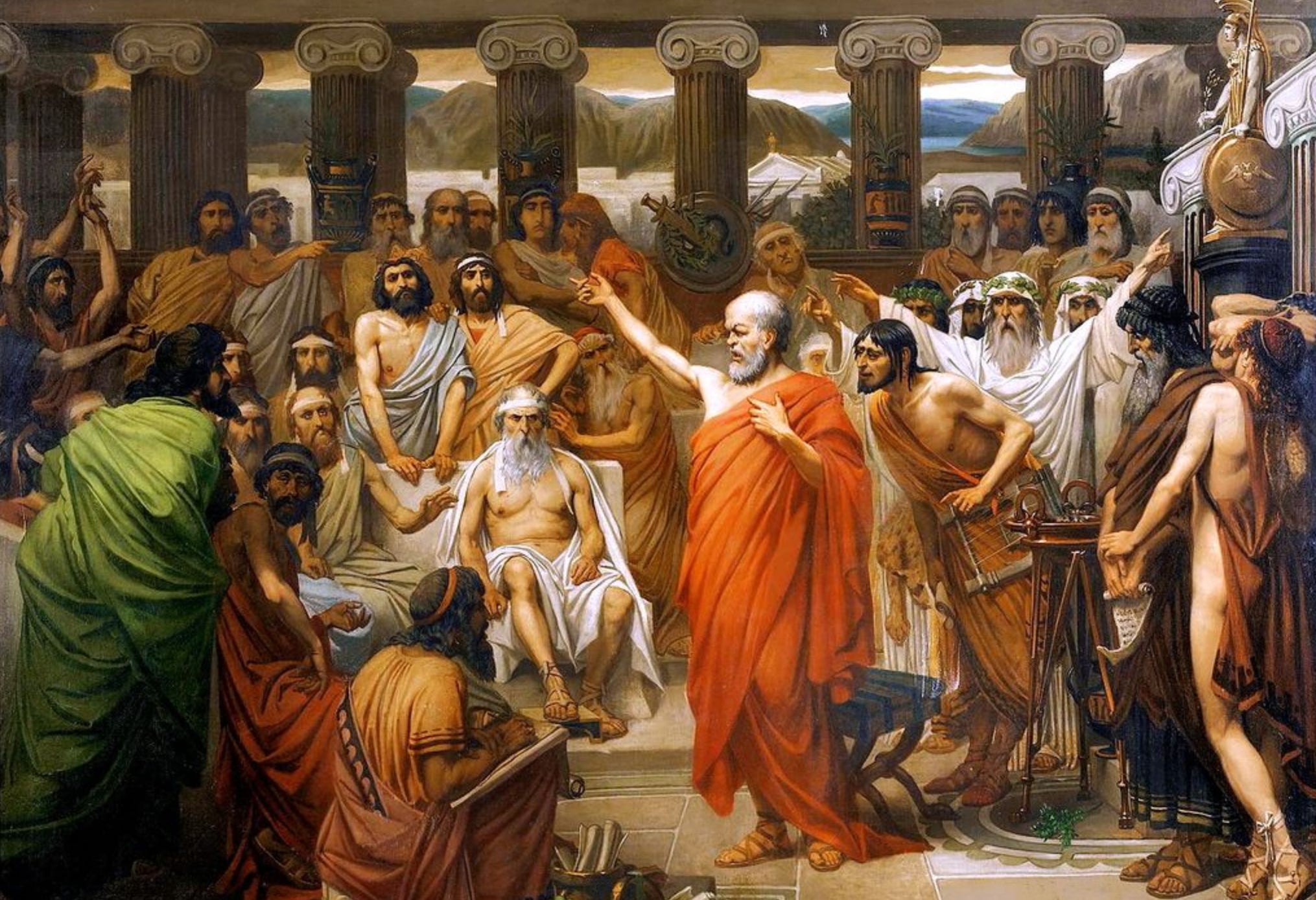
Before they executed Socrates in the year 399 BC — on charges of impiety and corrupting youth — the philosopher was given a chance to defend himself before a jury.
Socrates started his defense with an unusual plea.
Socrates defends himself at his trial (painting by Louis Joseph Lebrun, 1867)
He told his listeners that he had no skill at making speeches. He just knew the everyday language of the common people.
Socrates explained that he had never studied rhetoric or oratory. He feared that he would embarrass himself by speaking so plainly in his trial defense.
“I show myself to be not in the least a clever speaker,” Socrates told the jurors, “unless indeed they call him a clever speaker who speaks the truth.”
He knew that others in his situation would give “speeches finely tricked out with words and phrases”. But Socrates only knew how to use “the same words with which I have been accustomed to speak” in the marketplace of Athens.
Socrates wasn’t exaggerating. His entire reputation was built on conversation. He never wrote a book — or anything else, as far as we can tell.
Spontaneous talking was the basis of his famous “Socratic method” — a simple back-and-forth dialogue. You might say it was the podcasting of its day. He aimed to speak plainly — seeking the truth through open and unfiltered conversation.
That might get you elected President in the year 2024. But it didn’t work very well in Athens, circa 400 BC.
Socrates received the death penalty — and was executed by poisoning.
Is that shocking? Not really.
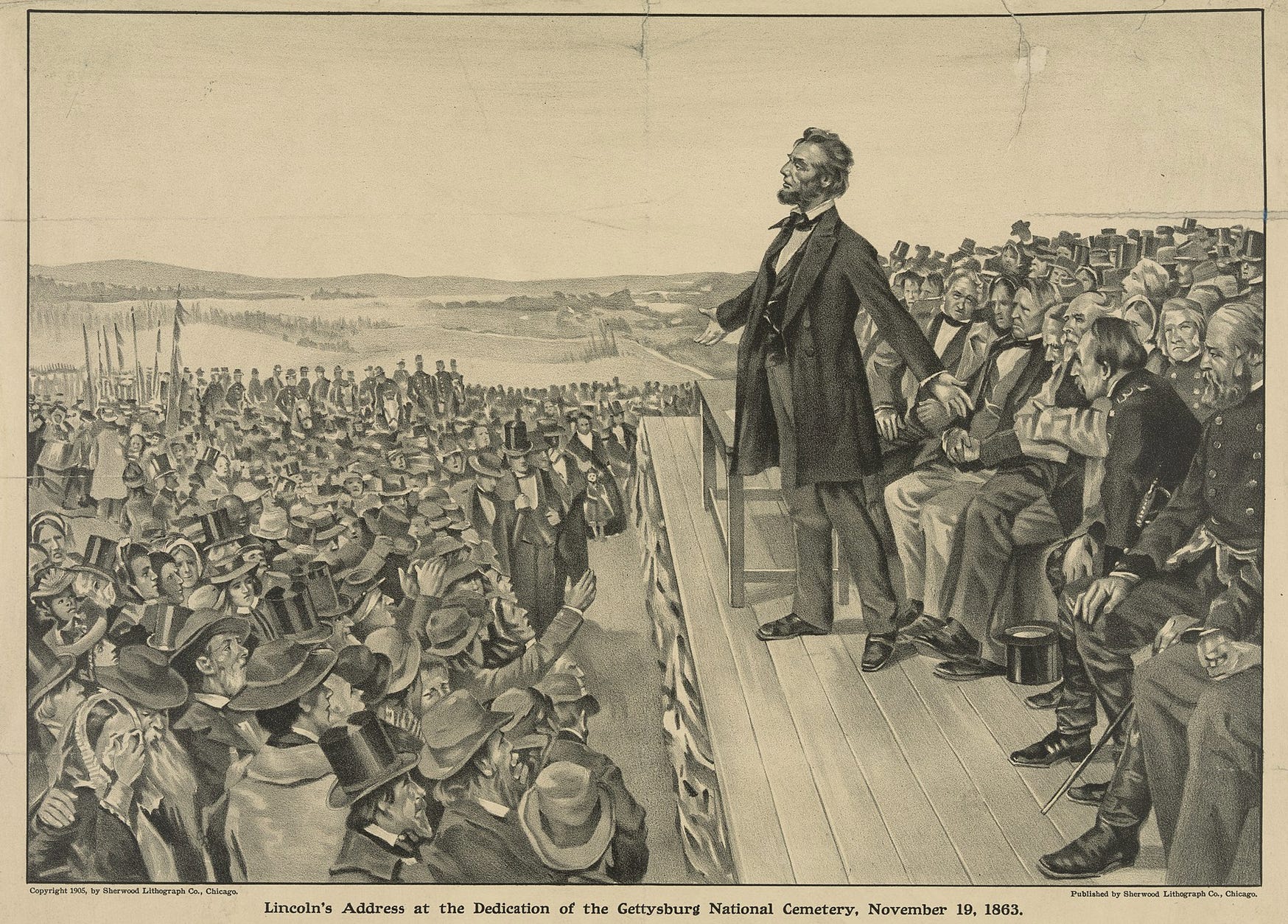
Western culture was built on one-way communication. Leaders and experts speak — and the rest of us listen.
This is how leaders once spoke to the people — but it’s now changing.
Socrates was the last major thinker to rely solely on conversation. After his death, his successors wrote books and gave lectures.
That’s what powerful people do. They make decisions. They give orders. They deliver speeches.
But not anymore.
In the aftermath of the election, the new wisdom is that giving speeches from a teleprompter doesn’t work in today’s culture. Citizens want their leaders to sit down and talk.
And not just in politics. You may have seen the same thing in your workplace — or in classrooms and other group settings. People now resist one-way orders from the top.
The word “scripted” is now an insult. Plainspoken dialogue is considered more trustworthy. This is part of the up-versus-down revolution I’ve written about elsewhere — a conflict that, I believe, may have even more impact on society than Left-versus-Right.
For better or worse, the hierarchies we’ve inherited from the past are toppling. To some extent, they are even reversing.
This is now impacting how leaders are expected to speak. Events of the last few days have raised awareness of this to a new level — but the “experts” should have expected it. That’s especially true because the experts will be those most impacted by this shift.
November 3, 2024
Ancient Sparta Historian Breaks Down 300 Movie | Deep Dives
History Hit
Published Jul 8, 2024Ancient Greek historian Roel Konijnendijk takes a deep dive into the historical accuracy of one of the most iconic and ridiculous depictions of the Spartans – 300 (2006).
00:00 Introduction
00:33 Spartan Society and Customs
02:34 Xerxes’ Messenger
06:56 The Ephors, the Oracle and the Carneia
10:30 The 300
15:39 The Persian Fleet
16:14 Thermopylae, the “Hot Gates”
17:17 Spartan Battle Technique
19:12 The Persian Army
24:42 Xerxes
28:28 Ephialtes
32:01 Dilios – Why Did the Spartans Stay?
34:18 The Final Stand
38:44 Aftermath of Thermopylae and Delios
40:53 Movie Quotes: Fact or Fiction?
(more…)
October 17, 2024
Historian Answers Google’s Most Popular Questions About Ancient Sparta
History Hit
Published Jun 26, 2024Were the Spartans actually the best warriors? Did they really throw their babies off cliffs? Did they … HUNT their slaves? Ancient Greek historian Roel Konijnendijk answers your most googled questions about the Spartans.
00:00 Intro
00:35 When did the Spartans live?
01:00 Were the Spartans Greek?
01:30 Were the Spartans a professional army?
03:00 Were the Spartans the best warriors?
04:46 How did the Spartans train?
06:43 Did the Spartans throw babies off cliffs?
07:42 Did the Spartans practise eugenics?
09:55 Did the Spartans steal food?
10:21 Were the Spartans vegetarian?
11:18 Were the Spartans better than Athens?
12:54 Did Sparta have a navy?
13:15 Why didn’t Sparta have walls?
14:22 Did the Spartans hunt their slaves?
15:30 Did the Spartans get their slaves drunk?
16:42 Did the Spartans have a king?
17:57 Was Sparta a democracy?
19:13 Why did the Spartans fight at Thermopylae?
19:45 Why did the Spartans only send 300?
21:30 Were the Spartans betrayed at Thermopylae?
22:42 Did the Spartans beat the Persians?
24:00 Were the Spartans muscular?
25:40 Did the Spartans have long hair?
26:25 Did the Spartans have same sex relationships?
28:27 Were the Spartan women equal?
(more…)
QotD: Soldiers and warriors
[…]
But why? The etymologies of the words can actually help push us a bit in the right direction. Warrior has a fairly obvious etymology, being related to war (itself a derivative of French guerre); as guerre becomes war, so Old French guerreieor became Middle English werreior and because that is obnoxious to say, modern English “warrior” (which is why it is warrior and not “warrer” as we might expect if it was regularly constructed). By contrast, soldier comes – it has a tortured journey which I am simplifying – from the sold/sould French root meaning “pay” which in turn comes from Latin solidus, a standard Late Roman coin. So there is clearly something about pay, or the lack of pay involved in this distinction, but clearly it isn’t just pay or the word mercenary would suit just as well.
So here is the difference: a warrior is an individual who wars, because it is their foundational vocation, an irremovable part of their identity and social position, pursued for those private ends (status, wealth, place in society). So the core of what it is to be a warrior is that it is an element of personal identity and also fundamentally individualistic (in motivation, to be clear, not in fighting style – many warriors fought with collective tactics, although I think it fair to say that operation in units is much more central to soldiering than the role of a warrior, who may well fight alone). A warrior remains a warrior when the war ends. A warrior remains a warrior whether fighting alone or for themselves.
By contrast, a soldier is an individual who soldiers (notably a different verb, which includes a sense of drudgery in war-related jobs that aren’t warring per se) as a job which they may one day leave behind, under the authority of and pursued for a larger community which directs their actions, typically through a system of regular discipline. So the core of what it is to be a soldier is that it is a not-necessarily-permanent employment and fundamentally about being both in and in service to a group. A soldier, when the war or their term of service ends, becomes a civilian (something a warrior generally does not do!). A soldier without a community stops being a soldier and starts being a mercenary.
Incidentally, this distinction is not unique to English. Speaking of the two languages I have the most experience in, both Greek and Latin have this distinction. Greek has machetes (μαχητής, lit: “battler”, a mache being a battle) and polemistes (πολεμιστής, lit: “warrior”, a polemos being a war); both are more common in poetry than prose, often used to describe mythical heroes. Interestingly the word for an individual that fights out of battle order (when there is a battle order) is a promachos (πρόμαχος, lit: “fore-fighter”), a frequent word in Homer. But the standard Greek soldier wasn’t generally called any of these things, he was either a hoplite (ὁπλίτης, “full-equipped man”, named after his equipment) or more generally a stratiotes (στρατιώτης, lit: “army-man” but properly “soldier”). That general word, stratiotes is striking, but its root is stratos (στρατός, “army”); a stratiotes, a soldier, for the ancient Greeks was defined by his membership in that larger unit, the army. One could be a machetes or a polemistes alone, but only a stratiotes in an army (stratos), commanded, presumably, by a general (strategos) in service to a community.
Latin has the same division, with similar shades of meaning. Latin has bellator (“warrior”) from bellum (“war”), but Roman soldiers are not generally bellatores (except in a poetic sense and even then only rarely), even when they are actively waging war. Instead, the soldiers of Rome are milites (sing. miles). The word is related to the Latin mille (“thousand”) from the root “mil-” which indicates a collection or combination of things. Milites are thus – like stratiotes, men put together, defined by their collective action for the community (strikingly, groups acting for individual aims in Latin are not milites but latrones, bandits – a word Roman authors also use very freely for enemy irregular fighters, much like the pejorative use of “terrorist” and “insurgent” today) Likewise, the word for groups of armed private citizens unauthorized by the state is not “militia”, but “gang”. The repeated misuse by journalists of “militia” which ought only refer to citizens-in-arms under recognized authority, drives me to madness).
(I actually think these Greek and Latin words are important for understanding the modern use of “warrior” and “soldier” even though they don’t give us either. Post-industrial militaries – of the sort most countries have – are patterned on the modern European military model, which in turn has its foundations in the Early Modern period which in turn (again) was heavily influenced by how thinkers of that period understood Greek and Roman antiquity (which was a core part of their education; this is not to say they were always good at understanding classical antiquity, mind). Consequently, the Greek and Roman understanding of the distinction probably has significant influence on our understanding, though I also suspect that we’d find distinctions in many languages along much the same lines.)
Bret Devereaux, “Collections: The Universal Warrior, Part I: Soldiers, Warriors, and …”, A Collection of Unmitigated Pedantry, 2021-01-29.


