
The Best Film Archives
Published on 6 Oct 2015● Please SUPPORT my work on Patreon: https://bit.ly/2LT6opZ
✚ Watch my “Military Training Films” PLAYLIST: https://bit.ly/2G6XIrN
FLAK is German acronym of Fliegerabwehrkanone / Flugabwehrkanone (“aeroplane defence cannon”).
This US Air Force training film (1944) provides an in-depth look at the German anti-aircraft gun (Flak) system, and highlight the evasive maneuvers utilized by US pilots during their missions.
German Anti-Aircraft Gun System | Flak | US Air Force Training Film | 1944
TBFA_0019 (DM_0005)
NOTE: THE VIDEO REPRESENTS HISTORICAL EVENTS. SINCE IT WAS PRODUCED DECADES AGO, IT HAS HISTORICAL VALUES AND CAN BE CONSIDERED AS A VALUABLE HISTORICAL DOCUMENT. THE VIDEO HAS BEEN UPLOADED WITH EDUCATIONAL PURPOSES. ITS TOPIC IS REPRESENTED WITHIN HISTORICAL CONTEXT. THE VIDEO DOES NOT CONTAIN SENSITIVE SCENES AT ALL!
September 26, 2018
German Anti-Aircraft Gun System | Flak | US Air Force Training Film | 1944
September 25, 2018
Is the UK military situation really as dire as this new book portrays?
In the Daily Mail, there’s an excerpt from a new book on the British military by Michael Ashcroft and Isabel Oakeshott, White Flag? An Examination Of The UK’s Defence Capability:
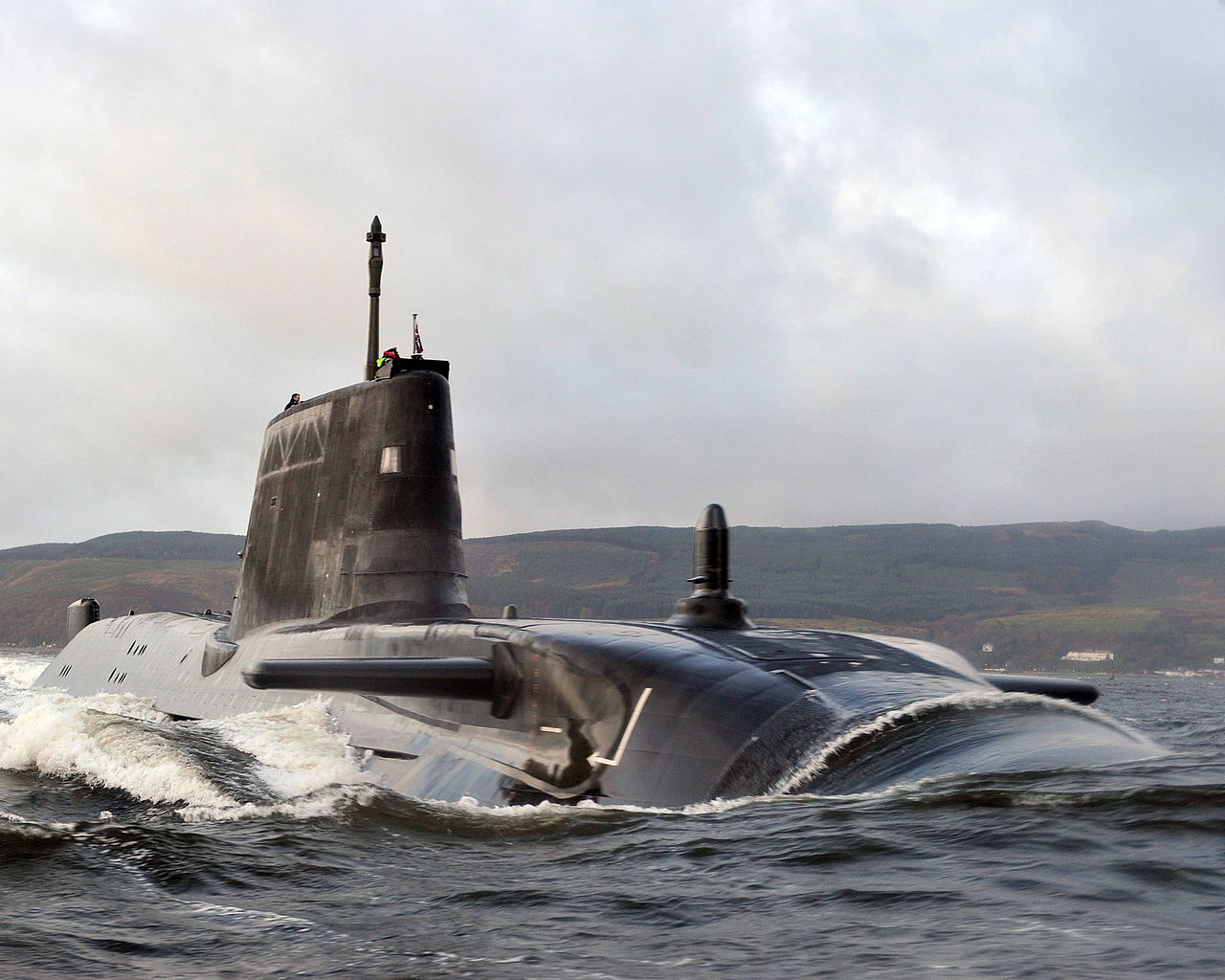
HMS Astute (S119), lead ship of her class, sails up the Clyde estuary into her home port of Faslane, Scotland.
MOD photo, via Wikimedia Commons.
Bluntly, at a time of international crisis, when the prime minister wanted to take a stand against the illegal use of chemical weapons, our Armed Forces did not have what was needed for a full-throttle response.
Naturally, ministers preferred voters to imagine that submarines were on their way to the action. The truth about our limited capability might have fuelled creeping fears that the UK has run up the white flag.
This was one of the many shocks we had during our wide-ranging investigation into the state of this country’s defence capabilities. Thanks to remorseless cuts imposed by successive governments, the Army, Navy and RAF all struggle to meet day-to-day commitments to protect this country and play their part in collective security through Nato and other defence alliances — let alone prepare for serious potential new threats.
The particular problem this time was probably down to maintenance issues.
Hulls need cleaning to stop them rusting, engines need overhauling and nuclear reactors need to be flushed.
When you don’t have very many ships, taking one or two out of circulation leaves quite a gap — in this case, one that could not be filled.
And the fact is that we don’t have enough ships any more. Or aircraft. Or tanks. Or military personnel. Not since Defence became a soft target for governments looking to cut spending.
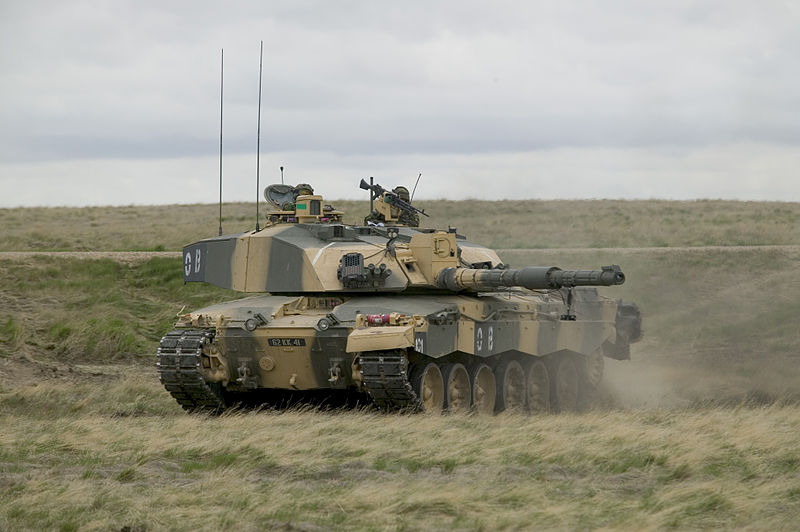
A British army Challenger 2 Main Battle Tank, of 1 Royal Regiment of Fusiliers (1RRF), is shown returning to base after completing a firing mission as part of Exercise MedMan.
1RRF Battle group were based at the British Army Training Unit Suffield (BATUS) in Canada.
MOD photo by Mike Weston via Wikimedia Commons.
What this means on the front line is illustrated by the small but fierce battalion of 800 UK troops stationed at a remote base in the Baltic state of Estonia as a crucial part of Nato’s defences against a Russian attack. They are on their guard at all times, scouring the bleak horizon for anything suspicious.
Inside a vast metal hangar is a fleet of Challenger tanks. The Army wanted to send 18 but the MoD cut this back to ten, of which only eight can be operational because two will always be in for repairs.
Asked if this would be enough if the Russians came over the border, the men we met there shrugged and laughed. They know full well that the Russians could throw as many as 22 tank battalions — that’s more than 650 tanks — at them.
A war-gaming exercise concluded that Nato forces would be ‘woefully inadequate’ in the event of an invasion: the Russians would be in Tallinn, the Estonian capital, within 60 hours.
No wonder the men themselves refer to their assignment as ‘Operation Tethered Goat’. Hopelessly outnumbered, they would be brushed aside, sacrificed to the predatory Putin, like the goat swallowed by the T. rex in Jurassic Park.
September 23, 2018
The Nimrod MRA4 – the world’s most expensive bad aircraft
Back in 2011, I posted an article about the retirement of the Hawker Siddeley Nimrod from the Royal Air Force inventory. I referred to the Nimrod as
… expensive to buy, eye-wateringly expensive to upgrade, but it must be cheap to operate, right? No:
[…] our new fleet of refurbished De Havilland Comet subhunters (sorry, “Nimrod MRA4s”) will cost at least £700m a year to operate. If we put the whole Nimrod force on the scrapheap for which they are so long overdue right now, by the year 2019 we will have saved […] £7bn
The Register certainly got in the right ballpark with this helpful graphic:

Earlier this month, the Nimrod saga was detailed at Naval Gazing, if only as a way to show that someone can have worse procurement experiences than the United States military. Despite being a military development of a passenger jet famous for crashes, the initial marks of the Nimrod were able to meet the RAF’s needs. The problems began when a requirement was generated for a British AWACS aircraft and the Nimrod was deemed to be the best candidate for conversion (“best” probably meaning “only British competitor”):
Things began to go wrong in the mid-70s, when the British decided to introduce an AWACS aircraft to support their air defense efforts. They had several options. The E-2 Hawkeye and E-3 Sentry were both about to enter service, and were rapidly proving themselves to have excellent radar systems during trials. The British could have had either aircraft, or bought their radar systems to integrate into an aircraft of their own. Or they could have only bought a few subcomponents, like the antenna or the radar transmitter itself, and built the rest domestically.
They decided to take none of these options. Instead, they would produce an entirely new radar system. Instead of an American-style radome, separate antennas would be installed in the nose and tail, and the system would sweep through one, and then the other. This was far more expensive and much riskier than buying from the Americans, but it did produce a lot more jobs in the British defense industry, which was apparently the government’s prime concern. In 1977, a contract was placed, making BAE and GEC-Marconi co-leads on the project to convert 11 surplus Nimrod MR1 airframes to the new configuration.
As might be expected based on that kind of decision-making, the resulting airplane had problems. The computer system chosen wasn’t powerful enough to integrate all of the data, particularly the area where the nose and tail radars overlapped. It was also horribly unreliable, with a mean time between failures of only two hours, in a system which took 2.5 hours to load the mission data from the tape. The Nimrod, considerably smaller than the American Sentry, was unable to carry more equipment to solve this problem. Different electronics racks were earthed to different points in the airframe, and the resulting potential differences caused false tracks to appear, overloading the computer even more. To make matters worse, most of the electronics units weren’t interchangeable for reasons that were never entirely clear. If one unit failed, several spares had to be tried before one that worked was found. The only system that functioned reliably was the IFF system, which could only track friendly aircraft and airliners. This was a major handicap in an aircraft intended to detect incoming Soviet bombers.
It probably isn’t a surprise to hear that the planes were delayed. A lot. And delaying military projects tends to drive the overall price higher. What was anticipated to be a £200-300 million project was over £1 billion before the government of the day came to their fiscal senses and pulled the plug (they ended up buying Boeing E-3 Sentry aircraft instead).
A few years later, the RAF ran a competition to replace the Nimrod MR2 maritime patrol aircraft. Lockheed, Dassault and Airbus entered the competition, but somehow, the RAF ended up selecting BAE’s bid which involved rebuilding 30-year-old Nimrod frames with new electronics and all the modern conveniences.
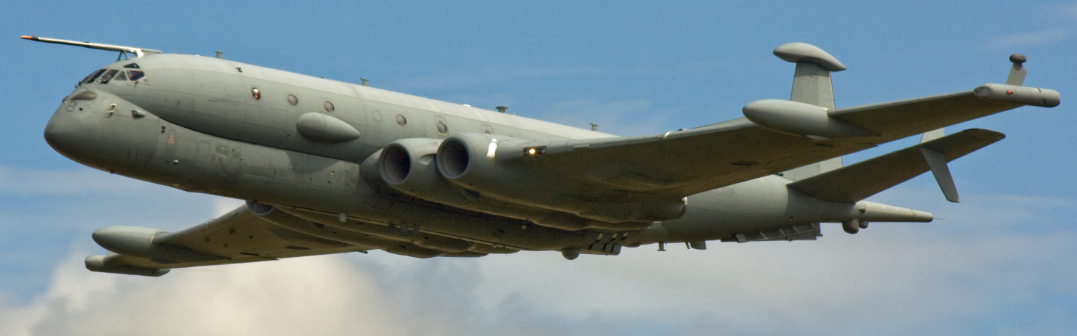
RAF Nimrod MRA4 on 18 July 2009.
Detail of original photo by Ronnie Macdonald, via Wikimedia Commons.
In 1996, a contract was issued for the new aircraft, designated Nimrod MRA4. 21 aircraft were to be produced at a cost of £2.8 billion, and they would be essentially new airplanes, with only the fuselage structure being retained. The antique Spey engines would be replaced with modern BR700s. These engines were significantly larger, and required much more air, forcing BAE to design a new, larger wing. The combined effect of these two changes was to double the Nimrod’s range and improve performance. Inside, the flight deck was replaced with one derived from the A340 airliner, and the mission systems were to be all-new.
A fuselage was sent to be reverse-engineered for the design of the new wing, and BAE designed and built it, then pulled in another aircraft to make the modification. And discovered that the wing didn’t fit. Apparently, the problem dated back to the initial construction of the aircraft. When positioning the frames, Hawker Siddeley had not done what all sensible manufacturers did, and measured from a common baseline. Instead, they had positioned each frame with a tolerance relative to the previous one, which meant that the position of the wings varied by as much as a foot across the fleet. Worse, the aircraft they had designed the wings for was one of the most extreme in wing position, so the new wings didn’t fit most of the other aircraft. This forced a redesign of the wings, further delaying the program.
Spoiler: they missed their delivery deadline. By nearly a decade. And the original plan to build 21 aircraft shrank to only 4 … but the budget continued to grow, from the original £2.8 billion to over £4.1 billion at cancellation. Each of the surviving airframes had literally cost more than £1 billion. That’s why Bean gave the Nimrod his “Naval Gazing Worst Procurement Ever” trophy, and I think it was very well-deserved.
September 21, 2018
Declassified: The Old RAF Base Bringing Hollywood To Upper Heyford | Forces TV
Forces TV
Published on 30 Aug 2018Upper Heyford was one of the largest US Air Force bases in Europe, housing bombers that carried NATO’s intermediate-range nuclear weapons… now it’s attracting Hollywood A-listers…
Read more: https://www.forces.net/news/declassif…
August 25, 2018
Why was Italy so Ineffective in WWII? | Animated History
The Armchair Historian
Published on 27 Jul 2018Potential History’s Video: https://youtu.be/QB2GINNs3Aw
Our Patreon: https://www.patreon.com/armchairhistory
Our Twitter: https://twitter.com/ArmchairHist
Sources:
The Rise and Fall of the Third Reich, William L. Shirer
Fascist Italy’s Military Struggles from Africa and Western Europe to the Mediterranean and Soviet Union 1935-45, Frank Joseph
Hitler’s Italian Allies: Royal Armed Forces, Fascist Regime, and the War of 1940-1943, MacGregor Knox
August 3, 2018
Australian women and the military
Like many other western nations, the Australian government has mandated higher quotas for women in the Australian Defence Forces (ADF), and it’s the military’s job to make it work:
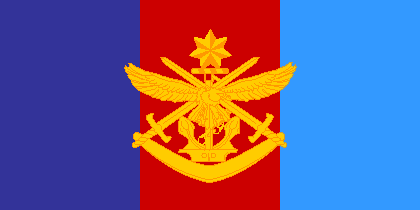
The Australian Defence Force (ADF) is comprised of the three military services: the Royal Australian Navy, the Australian Army, and the Royal Australian Air Force, all of which have been subject to increasing criticism in recent years for being dominated by straight white men. This, it is alleged, makes them, ipso facto, a petri dish for ‘toxic masculinity.’ That allegation has been lent apparent weight by the reporting of multiple gender-related scandals including the ADFA sex scandal, Jedi Council, various hazing rituals, death symbols, and HMAS Success, to name a few.
Some of this criticism has been so strident that past and present military leaders have had no choice but to commission reports and inquiries into standards and practices within the ADF, and to implement various culture change initiatives including Pathway to Change, New Generation Navy, Adaptive Army, and New Horizon. All of these initiatives place significant emphasis on greater integration of women into the respective services but offer limited reasoning other than catch-phrases like ‘diversity,’ ‘equity,’ and ‘modernising.’
All three services are now working toward a target of female representation by 2023. The Navy and Air Force are working toward 25 percent, and the Army is working toward 15 percent. The progress toward these targets, among other commentary on gender issues in the ADF, is detailed in the annual “Women in the ADF” report.
[…]
Concerns with preferential treatment do not end at the recruitment process. Fitness standards for service personnel also differ according to gender, as well as service and age. This means equally-aged men and women in each service are expected to attain different standards of fitness. This, in itself, represents a challenge since both genders complete fitness tests together and are therefore directly exposed to this double-standard from their first day of service. In spite of this policy, many servicewomen elect to continue their fitness assessment to the same level as their male colleagues which is one small contribution to reducing the cultural divide.
The rejection of preferential treatment in the ADF is not just isolated to annual fitness tests. In fact, the 2012 “Review into the Treatment of Women in the Australian Defence Force” led by then-Australian Sex Discrimination Commissioner Elizabeth Broderick includes the following passage:
ADF women strongly believe that when they are singled out, it makes it harder for them to fit in. Highly resistant to any initiative being directed solely at them, ADF women view identical—not differential—treatment as the path to delivering equality. This is most likely in part to avoid the backlash that inevitably trails any treatment perceived as ‘preferential’…
Despite acknowledging this, many of Broderick’s recommendations included gender-specific initiatives that risk being perceived as further preferential treatment, driving a greater wedge between male and female ADF personnel. Perhaps the most troubling recommendation is the targeted recruitment and transfer of women to male-dominated professions that have less female uptake. In practise, this risks techniques akin to coaxing in the recruitment process if these roles are not the preferred choice of female candidates.
July 16, 2018
Monty Python RAF Banter
bakerco502
Published on 30 Apr 2007secretly why I put a RAF impression together hahah
I’ve also disabled comments because people were starting to turn it into a pissing contest over who did what during the war.
July 8, 2018
Postal Service – Trench Deployment – US Air Force I OUT OF THE TRENCHES
The Great War
Published on 7 Jul 2018Chair of Wisdom Time!
Western Approaches – the bunker from which they won the war
Lindybeige
Published on 17 Jun 2018The command bunker ‘Western Approaches’ is now a museum in Liverpool. I was invited to take a look before it re-opened.
Support me on Patreon: https://www.patreon.com/LindybeigeThe Museum’s website: http://www.liverpoolwarmuseum.co.uk
Many thanks to Richard MacDonald for inviting me and showing me around (you saw him plugging the big fuse in).
Lindybeige: a channel of archaeology, ancient and medieval warfare, rants, swing dance, travelogues, evolution, and whatever else occurs to me to make.
June 6, 2018
D-Day – I: The Great Crusade – Extra History
Extra Credits
Published on 6 Jun 2017D-Day: June 6, 1944, the day when Allied forces stormed the beaches of Normandy to retake France from the Germans. They hoped to take the Germans by surprise, and their decision to brave rough weather to make their landings certainly accomplished that, but despite these small advantages, the American forces at Utah and Omaha Beach had to overcome monumental challenges to establish a successful beachhead.
May 13, 2018
Marie Curie in WW1 – Who Killed The Red Baron? I OUT OF THE TRENCHES
The Great War
Published on 12 May 2018Chair of Wisdom Time!
April 27, 2018
The First Tank-on-Tank Battle in History – The Zeebrugge Raid I THE GREAT WAR Week 196
The Great War
Published on 26 Apr 2018At Villers-Bretonneux, German and British tanks clash marking the first tank-on-tank battle in history. In the same week, the most successful flying ace of World War 1 is shot down over France: Manfred von Richthofen dies after scoring 80 victories. Meanwhile, the British Navy attempts to eliminate the German U-Boat threat with a daring raid on Zeebrugge and Ostende.
April 20, 2018
Great Blunders of WWII: The Pilot Who Bombed London 3
Anthony Coleman
Published on 4 Nov 2016From the History Channel DVD series Great Blunders of WWII
April 7, 2018
Captain Eric ‘Winkle’ Brown discusses Luftwaffe Aircraft
spottydog4477
Published on 23 Apr 2014Captain Eric ‘Winkle’ Brown discusses Luftwaffe Aircraft
April 1, 2018
The Royal Air Force at 100
In The Register, Gareth Corfield notes the amusing detail of the RAF’s birthday happening to fall on April 1st by publishing a couple of days early (so nobody thinks he’s pulling their collective legs):

This Sunday marks the 100th birthday of the Royal Air Force – Britain’s military arm for the skies – as a separate Armed Force in its own right. The RAF has been at the forefront of many technological innovations over the last century, many of which are still in use to this day.
From the earliest days of biplanes (and triplanes), through the invention of radar, the jet engine, vertical takeoff tech, and aircraft designs that were decades ahead of their time.
While traditionally these types of “birthday journalism” articles are published on the actual birthday, we at El Reg still reckon it’s a bit weird that the RAF’s official foundation also takes place on April Fool’s Day, so here it is before smart-arses feel compelled to claim this is some kind of windup.
Going back through the history books, the RAF’s main technological achievements include developments in aerial navigation, aircraft sensing and ground-based control, and, somewhat controversially, the jet engine, though the actual milestones for that one are shared with Germany.
[…]
All in all, the RAF has been an aeronautical force for good, with the service developing the basics for many things that commercial passengers today take for granted. Its technological developments and innovations have contributed to making the world both safer and smaller, as aircraft fly ever faster, building upon the principles established and researched by the Air Force. Even those with grievous injuries have been benefited by the RAF, thanks to the pioneering work of the RAF Institute of Aviation Medicine.
Let’s just hope it manages to shrug off the problem of having its birthday on the same day as April Fool’s Day…
Update: Samizdata relates the tale of the 50th anniversary non-celebration.
Today I would like to note one incident in the RAF’s history, which came at the ‘half-way’ mark, when in 1968, (actually on 5th April) after Harold Wilson’s Labour government decided not to commemorate the RAF’s 50th anniversary with a fly-past, and this did not go down well at all. In fact, it went down so badly that one RAF pilot, the heroic Flight Lieutenant Alan Pollock, threw away his career and very nearly his freedom in the ‘Tower Bridge incident‘, when, in protest at the lack of a commemoration, in his Hawker Hunter jet, he ‘buzzed’ the Houses of Parliament. Then on the spur of the moment, going down the Thames towards the sea, he flew under the top span of Tower Bridge at around 400 mph, and also ‘beat up’ a few airfields inverted, before landing, getting arrested but avoiding a court martial after being demobilised on health grounds by superiors eager to avoid the publicity of a trial, which is a weird echo of a similar ruse used in Viktor Suvorov’s ‘The Liberators’ when a Soviet Army soldier’s conduct presented a bureaucratic embarrassment that could not be concealed from higher authority. The jet only just missed hitting the top span of Tower Bridge with its tail, so no harm was done, however, it was close, there was a double-decker bus on the bridge at the time, and a cyclist on the bridge ripped his trousers dismounting in haste. Flt-Lt Pollock gallantly offered to pay for the trousers, but the cyclist declined.
Wikipedia has more detail on the Hawker Hunter Tower Bridge incident.


