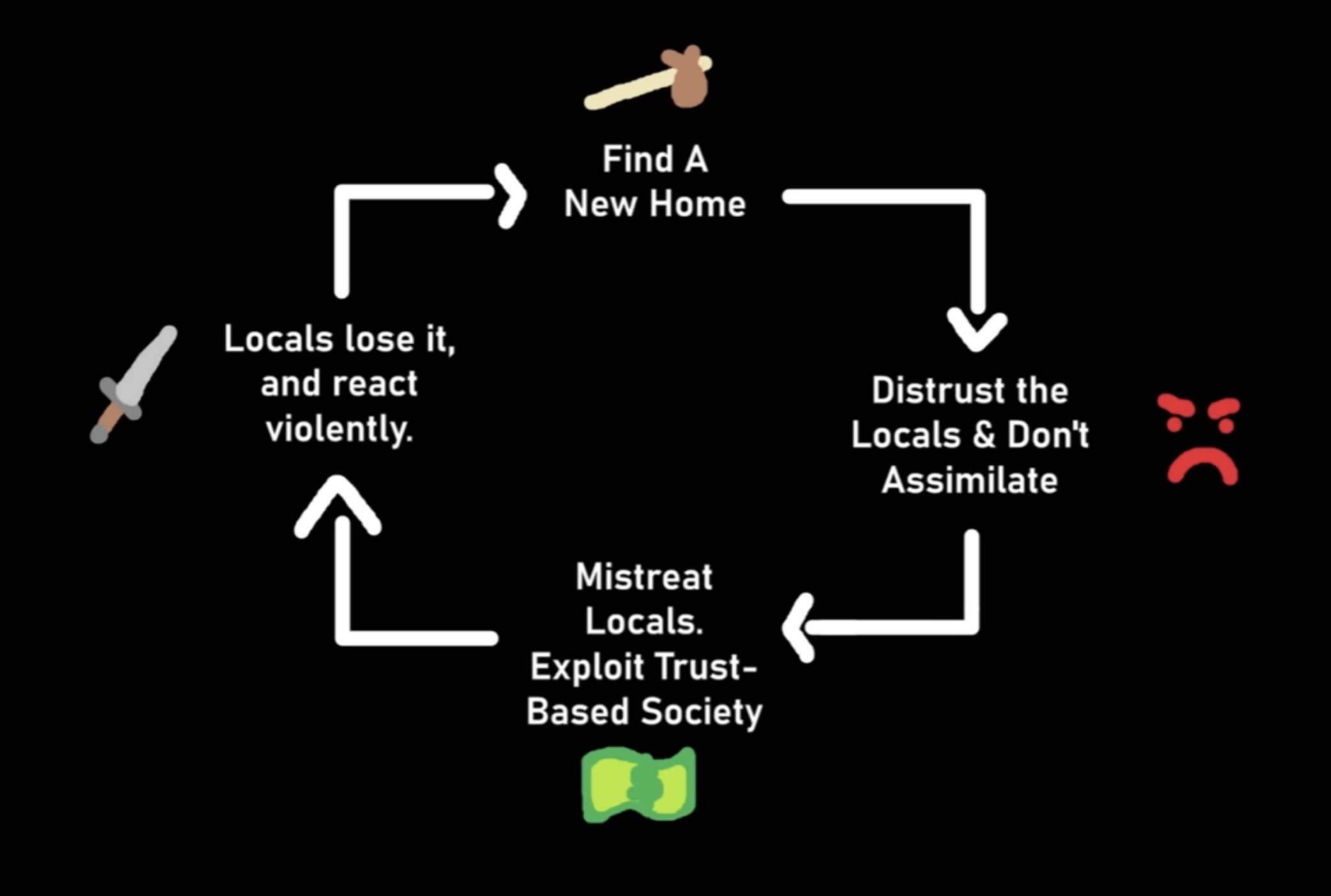
But on the flip side, those advantages can raise resentment against the minority if their social and economic position improves too obviously against that of the communities they inhabit. Lorenzo Warby finishes his short series of essays on the Marxist labels of “capitalism” and “capitalist”:
For another example of what dreadful terms capitalism and capitalist are, consider market-dominant minorities such as overseas Chinese (particularly Hakka), overseas Indians (particularly Gujaratis), overseas Lebanese (particularly Maronites), Jews, Igbos, the Sogdian diaspora … These are groups with strong internal trust and reputation networks that give them strong information — and so coordinating, anticipation and risk-management — advantages over people in the wider society. This is especially true in low-trust societies. Such market-dominant minorities have advantages in engaging in commerce and in creating and using capital.
Capital is not magical. It does not spontaneously arise or get used well. It has to be created and applied. Not only that, it is very clear that groups and polities vary greatly in their capacity to create and use capital. It is that — highly variable — creation and use that is crucial.
Capital has to be coordinated; it has to be used in service of sufficiently correct anticipation of commercial and other conditions; there has to be risk management. These things are all information and feedback questions.
Market-dominant minorities are so because of their advantages in information and feedback — including how they use that information and feedback. (If I wanted to summarise problems with contemporary Western democracies in a single phrase, it would be broken feedbacks.)
It turns out, that their human and social capital and their culture — that is, their norms, skills, outlooks and connections — are the real advantages of market-dominant minorities. None of these features are mere products of capital; not even those that count as capital.
Nor is this capital that you can just add from outside. They cannot be readily incorporated into some arithmetic function of labour and capital (such as a Cobb-Douglas production function). Since these features are so much about human agency, and information and normative landscapes, it is a open question whether calling human and social capital forms of capital is, in itself, misleading.
Part of the problem for market-dominant minorities is precisely that their use of information is “invisible” to outsiders. (It is also invisible to Marxist Theory.) It is thus easy to accuse them of “cheating”, of being “social parasites”.
As history shows again and again, convince a group of Homo sapiens that that group over there are parasites — and that you and yours would be better off without them — and one has set the scene for massacre, for mass murder. A principle that the entire history of Revolutionary Marxism, of Communism, displays even more vividly: every single Marxist mass murder was legitimated by the parasites charge. This is why the labour theory of value is a primer for mass murder.
Communism has been so murderous because it labels entire classes as parasites. Nazism was so murderous because it labelled entire races as parasites—indeed, also as toxic, exploitive parasites—and created a realm of destroyed states that stripped people of the protections of citizenship: regions where Nazi race extermination was more deadly to the population than even Stalinism. In both cases, creating the golden future required eliminating the human blocks to the same.
In the case of market-dominant minorities, the very interior clannishness that gives them information, reputation and feedback—so trust—advantages can also lead to genuinely exploitive behaviour towards outsiders. Periodic massacres and expulsions of market-dominant minorities is a pattern going back many centuries, across states and civilisations. (China provides some dramatic examples, while Chinese diasporas have also been victims of such.)
Over the centuries, various market-dominant minorities have instantiated some version of this meme.
Those strong internal connections within market-dominant minorities can be very much a two-edged sword. Whatever role capital plays in all this, it is very much derivative of the underlying dynamics of human action: especially of information and normative landscapes.