
And we ourselves? Let us not have too much hope. The chances are that, if we go to war, eager to leap superbly at the cannon’s mouth, we’ll be finished on the way by an ingrowing toenail or by being run over by an army truck driven by a former Greek bus-boy and loaded with imitation Swiss cheeses made in Oneida, N. Y. And that if we die in our beds, it will be of measles or albuminuria.
The aforesaid Crile, in one of his smaller books, A Mechanistic View of War and Peace, has a good deal to say about death in war, and in particular, about the disparity between the glorious and inspiring passing imagined by the young soldier and the messy finish that is normally in store for him. He shows two pictures of war, the one ideal and the other real. The former is the familiar print, “The Spirit of ’76,” with the three patriots springing grandly to the attack, one of them with a neat and romantic bandage around his head apparently, to judge by his liveliness, to cover a wound no worse than an average bee-sting. The latter picture is what the movie folks call a close-up of a French soldier who was struck just below the mouth by a German one-pounder shell a soldier suddenly converted into the hideous simulacrum of a cruller. What one notices especially is the curious expression upon what remains of his face an expression of the utmost surprise and indignation. No doubt he marched off to the front firmly convinced that, if he died at all, it would be at the climax of some heroic charge, up to his knees in blood and with his bayonet run clear through a Bavarian at least four feet in diameter. He imagined the clean bullet through the heart, the stately last gesture, the final words: “Therese! Sophie! Olympe! Marie! Suzette! Odette! Denise! Julie! … France!” Go to the book and see what he got … Dr. Crile, whose experience of war has soured him against it, argues that the best way to abolish it would be to prohibit such romantic prints as “The Spirit of ’76” and substitute therefore a series of actual photographs of dead and wounded men. The plan is plainly of merit. But it would be expensive. Imagine a war getting on its legs before the conversion of the populace had become complete. Think of the huge herds of spy-chasers, letter-openers, pacifist-hounds, burlesons and other such operators that it would take to track down and confiscate all those pictures!
H.L. Mencken, “Exeunt Omnes”, Prejudices: Second Series, 1920.
April 11, 2014
QotD: Romantic views of death in battle
March 23, 2014
QotD: Woodrow Wilson
The fraudulence of Wilson is now admitted by all save a few survivors of the old corps of official press-agents, most of them devoid of both honesty and intelligence. No unbiased man, in the presence of the revelations of Bullitt, Keynes and a hundred other witnesses, and of the Russian and Shantung performances, and of innumerable salient domestic phenomena, can now believe that the Doctor dulcifluus was ever actually in favor of any of the brummagem ideals he once wept for, to the edification of a moral universe. They were, at best, no more than ingenious ruses de guerre, and even in the day of their widest credit it was the Espionage Act and the Solicitor-General to the Post Office, rather than any plausibility in their substance, that got them that credit. In [Theodore] Roosevelt’s case the imposture is less patent; he died before it was fully unmasked. What is more, his death put an end to whatever investigation of it was under way, for American sentimentality holds that it is indecent to inquire into the weaknesses of the dead, at least until all the flowers have withered on their tombs. When, a year ago, I ventured in a magazine article to call attention to Roosevelt’s philosophical kinship to the Kaiser I received letters of denunciation from all parts of the United States, and not a few forthright demands that I recant on penalty of lynch law. Prudence demanded that I heed these demands. We live in a curious and often unsafe country.
H.L. Mencken, “Roosevelt: An Autopsy”, Prejudices, part 2, 1920.
March 13, 2014
“The Pity of War was a strange programme; flashy, lopsided, inconsequentially contrarian”
In a post at the History Today site, Paul Lay describes a rebroadcast of the BBC production based on Niall Ferguson’s The Pity of War:
It featured Niall Ferguson, the Harvard historian, reviving the arguments of his 1998 book of the same name: that Britain and its Empire should have stayed out of the war to leave Europe to be dominated by the economic giant that was the Kaiser’s imperium, much as the EU is now led by the wealthy, democratic Germany of Angela Merkel. After having spent almost an hour outlining his argument, Ferguson’s thesis was then quickly shot down by a phalanx of historians of the First World War, including Gary Sheffield, Heather Jones and Hew Strachan.
The Pity of War was a strange programme; flashy, lopsided, inconsequentially contrarian. At one point it ran a brief clip of A.J.P. Taylor, doyen of television historians, in his 1977 series How Wars Begin. The BBC don’t tend to produce programmes like that anymore — a single academic historian, addressing the audience with complex arguments in real time to camera — except that they do. The best, the most instructive and original television offering so far on the outbreak of the war is that of the constitutional historian Vernon Bogdanor: his lecture entitled Diplomacy: Sir Edward Grey and the Crisis of 1914, originally broadcast last year on the BBC Parliament channel and therefore, sadly, seen by few.
)
March 10, 2014
Remarkably modern headlines from 100 years ago
At Samizdata, Patrick Crozier talks about the situation in Europe exactly a century back, and the headlines might almost be run today:
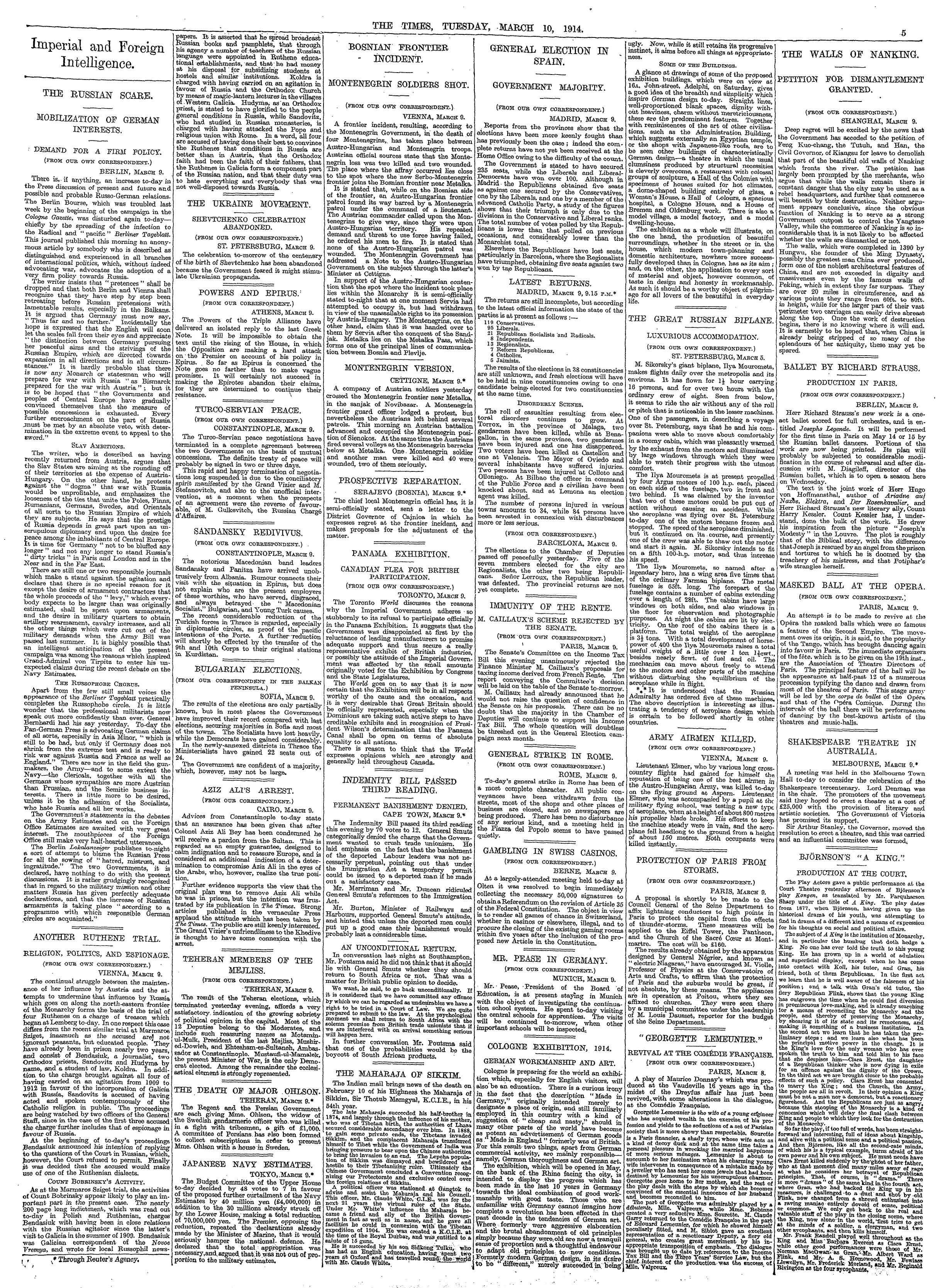
Click to see full page
Over the last few days (this is 1914 we’re talking about just in case anyone was in any doubt) a large number of articles have appeared in the German press on the threat posed by Russia. And still they come:
There is, if anything, an increase to-day in the Press discussion of present and future and possible and probable Russo-German relations. The Berlin Bourse, which was troubled last week by the beginning of the campaign in the Cologne Gazette, was disturbed again to-day – chiefly by the spreading of the infection to the Radical and “pacific” Berliner Tageblatt. This journal published this morning an anonymous article by somebody who is described as distinguished and experienced in all branches of international politics, which, without indeed advocating war, advocates the adoption of a very firm policy towards Russia.
This is co-ordinated and there’s only one body that would be doing the co-ordination: the German government. They are preparing the population for war. The argument being used is precisely the argument being used in the corridors of power: the Russians are building up their forces and in a few years they will be too strong and it will be too late. In other words: it’s now or never.
It is not just the Russians the Germans are worried about. The Russians on their own would be fairly harmless (as indeed they proved to be) but they are in alliance with France. This leads to Germany’s worst nightmare: the prospect of a war on two fronts. This in turn leads to the development of the Schlieffen Plan with its aim to eliminate one of those fronts before the other one got going.
There is an alternative. Germany could return Alsace-Lorraine to France. At a stroke they would eliminate the one and only bone of contention in the Franco-German relationship and as a consequence break up the Franco-Russian alliance. But no.
There are good reasons why the German government isn’t so keen on such a move. By accepting self-determination in Alsace-Lorraine they would be accepting the principle of democracy. This is hardly the sort of thing that a monarchy can do. There would also be the element of losing face that weak regimes are very reluctant to do.
February 16, 2014
QotD: Theodore Roosevelt’s admiration for Imperial Germany
There was in the man a certain instinctive antipathy to the concrete aristocrat and in particular to the aristocrat’s private code — the product, no doubt, of his essentially bourgeois origin and training. But if he could not go with the Junkers all the way, he could at least go the whole length of their distrust of the third order — the undifferentiated masses of men below. Here, I daresay, he owed a lot to Nietzsche. He was always reading German books, and among them, no doubt, were Also sprach Zarathustra and Jenseits von Gut und Bose. In fact, the echoes were constantly sounding in his own harangues. Years ago, as an intellectual exercise while confined to hospital, I devised and printed a give-away of the Rooseveltian philosophy in parallel columns — in one column, extracts from The Strenuous Life; in the other, extracts from Nietzsche. The borrowings were numerous and unescapable. Theodore had swallowed Friedrich as a peasant swallows Peruna — bottle, cork, label and testimonials. Worse, the draft whetted his appetite, and soon he was swallowing the Kaiser of the Garde-Kavallerie-mess and battleship-launching speeches — another somewhat defective Junker. In his palmy days it was often impossible to distinguish his politico-theological bulls from those of Wilhelm; during the war, indeed, I suspect that some of them were boldly lifted by the British press bureau, and palmed off as felonious imprudences out of Potsdam. Wilhelm was his model in Weltpolitik, and in sociology, exegetics, administration, law, sport and connubial polity no less. Both roared for doughty armies, eternally prepared — for the theory that the way to prevent war is to make all conceivable enemies think twice, thrice, ten times. Both dreamed of gigantic navies, with battleships as long as Brooklyn Bridge. Both preached incessantly the duty of the citizen to the state, with the soft pedal upon the duty of the state to the citizen. Both praised the habitually gravid wife. Both delighted in the armed pursuit of the lower fauna. Both heavily patronized the fine arts. Both were intimates of God, and announced His desires with authority. Both believed that all men who stood opposed to them were prompted by the devil and would suffer for it in hell.
If, in fact, there was any difference between them, it was all in favor of Wilhelm. For one thing, he made very much fewer speeches; it took some colossal event, such as the launching of a dreadnaught or the birthday of a colonel-general, to get him upon his legs; the Reichstag was not constantly deluged with his advice and upbraiding. For another thing, he was a milder and more modest man — one more accustomed, let us say, to circumstance and authority, and hence less intoxicated by the greatness of his state. Finally, he had been trained to think, not only of his own immediate fortunes, but also of the remote interests of a family that, in his most expansive days, promised to hold the throne for many years, and so he cultivated a certain prudence, and even a certain ingratiating suavity. He could, on occasion, be extremely polite to an opponent. But Roosevelt was never polite to an opponent; perhaps a gentleman, by American standards, he was surely never a gentle man. In a political career of nearly forty years he was never even fair to an opponent. All of his gabble about the square deal was merely so much protective coloration, easily explicable on elementary Freudian grounds. No man, facing Roosevelt in the heat of controversy, ever actually got a square deal. He took extravagant advantages; he played to the worst idiocies of the mob; he hit below the belt almost habitually. One never thinks of him as a duelist, say of the school of Disraeli, Palmerston and, to drop a bit, Blaine. One always thinks of him as a glorified longshoreman engaged eternally in cleaning out bar-rooms — and not too proud to gouge when the inspiration came to him, or to bite in the clinches, or to oppose the relatively fragile brass knuckles of the code with chair-legs, bung-starters, cuspidors, demijohns, and ice-picks.
Abbott and Thayer, in their books, make elaborate efforts to depict their hero as one born with a deep loathing of the whole Prussian scheme of things, and particularly of the Prussian technique in combat. Abbott even goes so far as to hint that the attentions of the Kaiser, during Roosevelt’s historic tour of Europe on his return from Africa, were subtly revolting to him. Nothing could be more absurd. Prof. Dr. Sherman, in the article I have mentioned, blows up that nonsense by quoting from a speech made by the tourist in Berlin — a speech arguing for the most extreme sort of militarism in a manner that must have made even some of the Junkers blow their noses dubiously. The disproof need not be piled up; the America that Roosevelt dreamed of was always a sort of swollen Prussia, truculent without and regimented within. There was always a clank of the saber in his discourse; he could not discuss the tamest matter without swaggering in the best dragoon fashion.
H.L. Mencken, “Roosevelt: An Autopsy”, Prejudices, part 2, 1920.
February 5, 2014
Drawing the rhetorical battle lines for the war over the war
Tim Stanley on the ongoing war of words over the “celebrations” planned to mark the First World War in Britain:
The reality is that WWI had nothing to do with modern ideology, yet (ironically) we constantly seek to understand it through modern ideology. It started because the 19th-century diplomatic system broke down, undermining assumptions that various powers had no interest in fighting and would not do so when tested. Its bloodiness was due to technology: industrial warfare trumped the war of fast movement that everybody expected. And it ended because the Germans ran out of food. So it was non-ideological in spirit, but it did become the catalyst for various new ideologies. Britain convinced itself it was fighting for democracy. The Russians turned into Soviets and came to see WWI as the acme of capitalist aggression. A small band of German idiots decided defeat was down to a massive conspiracy of Jews so brilliant that it was impossible to actually explain how they pulled it off. And so the Second World War — a profoundly ideological war — was spawned by a conflict that lacked philosophical justification. No wonder memories are so confused.
We continue the mistake of seeing the past as if it was today. The neoconservatives, for example, are wrong to see “Prussian militarism” as embryonic Nazism — indeed the comparison is so slight as to be offensive. And if the plucky Brits were fighting imperialism, that raises the question of why we didn’t divest ourselves of our own possessions in Africa, Asia, Australisia etc. But the Left is equally wrong to see the First World War as a class conflict, as a case of lions led by donkeys. The aristocratic class happily signed up and were almost entirely exterminated as a result, thanks in part to the fact that they tended to be taller than the average soldier and so easier to aim at in the trenches.
Well, that perhaps, but rather more that the junior officers and company commanders actually led from the front, and were visibly distinct from the mass of their troops (making themselves more attractive targets). The allies were in the position of having to attack German positions for most of the war after the front lines solidified, which meant more opportunities for officers to be come casualties. The life expectancy of a junior officer on the Western front was said to be only six weeks.
This comment rather puzzles me, though:
Second, I’m still not entirely sure what we’re commemorating about the First World War and why. Obviously, we should always remember and honour our nation’s war dead — as we do every November. But why — as a nation — pick through every battle, every fact, every detail, every controversy and turn it into a parade? What relevance does it all have to us now? And why is it so often rated as more important than the American War of Independence, the English Civil War or the Scramble for Africa? Will it overshadow the anniversary of Waterloo next year, when, incidentally, the Brits were rather pleased to have Prussian militarism on their side? As European conflicts go, the Thirty Years War also screams out for a little more attention. The population in Germany fell by between 25 and 40 per cent; the Swedish armies destroyed one third of all German towns. That was Hell, too.
The First World War was different from what came before because it literally touched everyone: there were dead and wounded from every city, town, village, and hamlet. Everyone lost family members, friends, acquaintances, business partners, church members, and so on. Unlike the Crimean War, or the Zulu War, or the Boer War, this was the first mass conflict where the entire society had to be re-oriented to support the struggle. Privation was not just a word, as civilians faced food shortages, coal shortages, unrelenting propaganda through the newspapers, and misery all around. This was the end of Britain’s view of war as being something unpleasant at a distance, to be handled by a few good men in red coats.
February 4, 2014
“Chateau” generals
Nigel Davies has written a long post about the British and American standard of generalship in the two world wars, which won’t win him very many American (or Canadian) fans. That being said, he’s certainly right about the Canadian generals of WW2:
Contention: American senior generals in World War II were as bad, and for the same reason, as British senior generals in World War I.
[…] the politicians (and I will include Kitchener here, as he was by this time a politician with a military background rather than a real general), had based their recruiting campaign on a trendy ‘new model’ citizens army, rather than use the well developed existing territorial reserve system that would have done a far better job. They new enthusiastic troops were considered incapable of the traditional fire and movement approach of professional troops (the type that the Germans reintroduced in 1918 with their ‘commando units’, and the British army was able to copy soon after with properly trained and combat experienced personnel). Instead the enthusiastic amateurs were considered too badly trained to do more than advance in long straight lines… straight into the meat grinder.
Having said that the generals blame for the results should be at the very least shared with their political masters, I am still willing to express dissatisfaction with the approach of Haig and many of his senior commanders. They were Chateau Generals in approach and in attitude. They drew lines on maps without adequately considering the terrain, issued impossible instructions without looking at the state of the ground, and ran completely inadequate communications that were far from capable of keeping track of, or controlling, a modern battlefield.
[…]
It was noticeable later in the war that the more successful armies were commanded by competent and imaginative officers who insisted on detailed planning; intensive and specific tactical planning and operational training (down to practicing assaults on purpose built life size models); and very close control of operations to ensure success. They had usually learned the hard way, and had matured as experienced and pro-active leaders.
Of course some of this improvement was simply advances in technology. Tanks to breakthrough; better artillery fire plans to support and reduce casualties; air observation to enhance control and assess responses; better communications (including radio’s) to facilitate flexibility on the ground; and a generally better trained and more experienced soldier; with much more skilled officers. It all helped. But a lot came down to the attitude of the generals who believed that you got up front, found out the truth, stayed in close contact, and reacted to changed circumstances as immediately as possible.
However, as the American army was late to the battlefront, Davies contends that the leaders merely recapitulated the first stages of the bloody learning experience as their British counterparts, but didn’t produce the innovative leadership to match the Germans:
The Americans arrived on the Western Front when the war was already won. Only a few thousand were there for the last big German push, and by the time the Allies were moving to their final offensives with real American numbers involved, the German army was a broken reed. Which means that most American officers had only a few weeks of combat experience, and almost all of it against a failing army which had little resilience left to offer the type of resistance that might have caused the inexperienced American officers to have to reconsider their theories from their quicky officer training courses. Even the professional military officers received, at best, only a couple of hints that their ideas might not be inevitably effective against a stronger opponent. Certainly not enough time to learn how to analyse and adapt to circumstances in serious combat.
Which is why the majority of highly recognised American higher commanders in World War II appear to be chateau generals.
[…]
Eisenhower’s mistakes in theatre commands in Italy and France were possibly no worse in results than Wilson’s ongoing problems with Greece (he led the ‘forlorn hopes’ of both 1941 and 1944 there), but Eisenhower failed far more spectacularly with the Italian surrender, the Broad Front strategy, and the Bulge, than Wilson ever did with far inferior resources. MacArthur’s failures are more readily compared with Percival than the successes of a man like Leese, and Nimitz is often referred to as one of the great captains of history, for defeating a navy that repeatedly sabotaged its own efforts in the Pacific theatre. (Often by people who haven’t seemed to have ever heard of Max Horton’s much harder victory against the ruthlessly efficient U-boat campaign in the Atlantic theatre).
Similarly it is fair to say that the American front line commanders most people have never heard of were hardly inferior to their famous British contemporaries. Eichelberger was as good a commander, and as good a co-operator in Allied operations, as Alexander ever was. Truscott was probably at least the equal of Montgomery, given the opportunity. (I suspect possibly even better actually, but who can say?) Simpson, in his brief few months at the front, impressed many British officers who had served for years under men as good as Slim. And Ridgway showed in his few months of active operations a level of skill and competence (not necessarily the same thing) that far more experienced men like O’Connor did not surpass.
Why do we hear about the American chateau generals in preference to their front line leaders? And why do we hear about the British front line leaders in preference to their back office superiors. I would say it is because the British had been through a learning process in WWI that the Americans had not.
And the Canadian angle? As I’ve noted before, the First Canadian Army (scroll down to the item on John A. English’s book) was not as combat-effective in WW2 as the Canadian Corps had been in the First World War. One of the most obvious failings was in the advance to Antwerp:
Note that the equivalent British debacle during that campaign was when the Canadian Army took Antwerp undamaged, but then stopped for a rest before cutting off the retreating Germans. The Germans quickly fortified the riverbanks leading to the port, keeping it out of use for months. This was a clear example of the Canadian generals inexperience, and Montgomery is at fault here for being too involved in the last attempt to break the Germans before Christmas — Market Garden — and not paying close enough attention to one of his Army commanders, who was not supervising his Corps commander, who was not chasing his divisional commander adequately. (No one is imune from such glitches in a fast moving campaign. Inexperience any where down the chain can cause big problems. But it is noticeable that Crerar’s failure did not get him the public acclaim Patton has enjoyed?) Crerar was a ‘political appointment’ by the Canadians (an ‘able administrator’, but militarily ‘mediocre’ according to most) who Montgomery considered to be as inferior in experience and attitude as many of the American ‘chateau leaders’ he would have put in the same basket. By contrast Monty was delighted when the more competent front line leaders – the Canadian Simonds and the American Simpson – were assigned to him instead. As in the cases of the Australian General Morshead or the Polish General Anders, Montgomery only cared about ability, not nationality. But as was the case with the Americans, all too many generals in most armies, including the British and German armies, lacked experience or ability.
Update, 13 February: Mark Collins linked to an earlier post that helpfully describes some of the problems with Canadian generalship in Europe:
The Canadian command style in WW II was even more stuck in the mud than the American. With a few exceptions (McNaughton, Burns, Crerar) most Canadian generals had little or no General Staff experience, and those that did were practitioners of a successful, for the earlier WW I time and place, doctrine based on set piece battles founded on the systematic and intensive use of artillery.
One virtue of the German system is that it allowed officers to make mistakes: it did not allow them to sit on their butts waiting for orders; it encouraged risk taking which often worked but sometimes ended in bloody disaster (indeed it’s amazing it didn’t in France in 1940).
Indeed comparing the Canadian Army in WWII with the German is very difficult. Both had to expand from a tiny base to their war-time peak, but the Germans began in 1933 (actually even before then); we didn’t really begin until 1940. The Germans lost the Great War and the Reichswehr gave serious thought to how to do better next time.
One thing underlying the British set piece battle approach and limited freedom for commanders – the one the Canadian Army followed – seems to have been their realization in the late 1930s that the British Army was simply not as good as its 1914 ancestor. That was partly because of the losses of promising junior officers who never made general [though that affected the Germans too], partly because of indifference to defence at the governmental level, and partly because the military lapsed all too happily back into “real soldiering” in the 20’s.
January 27, 2014
The not-so-humble torpedo and the genesis of the military-industrial complex
In the Boston Globe, Katherine C. Epstein makes a strong case for the origin of the military-industrial complex not being the era that President Eisenhower warned about, but actually in the run-up to the First World War:
The phrase [Eisenhower] popularized to describe the emerging system — the “military-industrial complex” — has since become a watchword, and Eisenhower’s account of its rise has struck most observers as accurate: It was a product of an immense war effort and the new attitudes spawned in the aftermath.
But what if Eisenhower — and others — had the origin story wrong? Although the military-industrial complex unquestionably became far larger and more deeply entrenched as a result of World War II and the Cold War, a closer reading of the history suggests that its essential dynamics were actually decades older. An armaments industry in close collaboration with the military — coping with global and national arms markets, sophisticated technology, intense geopolitical rivalries, and a government prone to expand its power in the name of national security — had its roots in the way geopolitics, industrialization, and globalization collided at the turn of the 20th century. And one key innovation that helped to tip the United States over into the national security regime that we recognize today was, of all things, the torpedo.
The torpedo didn’t just threaten to change naval warfare. It was a sophisticated new weapon so important to the US Navy that it forced the government to form a novel relationship with industry — and to introduce the trump card of national security as a rationale for demanding secrecy from private companies. The policy that developed along with the torpedo set the terms for the efforts to control information in the name of national security that we’re seeing now. To appreciate just how far back that policy runs — back to a time not of war, but of peace — gives us a new lens on our current struggles over the military-industrial complex, and perhaps a different reason to worry.
January 20, 2014
Addressing commonly held beliefs about the First World War
BBC News Magazine has an article by Dan Snow discussing some commonly held beliefs about the First World War:
3. Men lived in the trenches for years on end
Front-line trenches could be a terribly hostile place to live. Often wet, cold and exposed to the enemy, units would quickly lose their morale if they spent too much time in them.
As a result, the British army rotated men in and out continuously. Between battles, a unit spent perhaps 10 days a month in the trench system, and of those, rarely more than three days right up on the front line. It was not unusual to be out of the line for a month.
During moments of crisis, such as big offensives, the British could occasionally spend up to seven days on the front line but were far more often rotated out after just a day or two.
4. The upper class got off lightly
Although the great majority of casualties in WW1 were from the working class, the social and political elite was hit disproportionately hard by WW1. Their sons provided the junior officers whose job it was to lead the way over the top and expose themselves to the greatest danger as an example to their men.
Some 12% of the British army’s ordinary soldiers were killed during the war, compared with 17% of its officers. Eton alone lost more than 1,000 former pupils – 20% of those who served. UK wartime Prime Minister Herbert Asquith lost a son, while future Prime Minister Andrew Bonar Law lost two. Anthony Eden lost two brothers, another brother of his was terribly wounded and an uncle was captured.
[…]
7. Tactics on the Western Front remained unchanged despite repeated failure
Never have tactics and technology changed so radically in four years of fighting. It was a time of extraordinary innovation. In 1914 generals on horseback galloped across battlefields as men in cloth caps charged the enemy without the necessary covering fire. Both sides were overwhelmingly armed with rifles. Four years later, steel-helmeted combat teams dashed forward protected by a curtain of artillery shells.
They were now armed with flame throwers, portable machine-guns and grenades fired from rifles. Above, planes, that in 1914 would have appeared unimaginably sophisticated, duelled in the skies, some carrying experimental wireless radio sets, reporting real-time reconnaissance.
Huge artillery pieces fired with pinpoint accuracy — using only aerial photos and maths they could score a hit on the first shot. Tanks had gone from the drawing board to the battlefield in just two years, also changing war forever.
January 18, 2014
British army unit diaries from WW1 now online
Rather than the diaries of individual soldiers (as the original title of the video suggests), these are the formal day-to-day action records of battalions and regiments of the British army. A proportion of the diaries from the First World War have been digitized and are available on the internet:
Published on 15 Jan 2014
Diaries describing life during the First World War by British soldiers have been digitised and can be read online.
As part of the organisations centenary programme the National Archives is publishing the first batch of unit diaries from France and Flanders.
One soldier from the 4th Division, 1 Battalion Somerset Light Infantry in 1917 describes one occasion of gunfire: “The Germans quickly got their artillery into position, and a considerable amount of shelling was experienced. Our casualties in this engagement were slight.”
Another entry by Captain CJ Paterson, one of the First Battalion’s soldiers describes the horrendous reality of life in the trenches:
“As I say all should be nice and peaceful and pretty. What it actually is is beyond description.
“Trenches, bits of equipment, clothing (probably blood-stained), ammunition, tools, caps, etc., etc., everywhere.
“Poor fellows shot dead are lying in all directions. Some of ours.”
“Everywhere the same hard, grim, pitiless sign of battle and war. I have had a belly full of it.”
Maria Miller, Culture Secretary, Maria Miller, said: “The National Archives’ digitised First World War unit diaries will allow us to hear the voices of those that sacrificed their lives and is even more poignant now there are no living veterans who can speak directly about the events of the war. This new online vehicle gives a very public voice to some of these soldiers, through which we will be able to hear their thoughts and feelings.”
You can read the online war diaries on the National Archive website here: www.nationalarchives.gov.uk/first-world-war
Records for the Canadian Corps (which fought as part of the British army) are in the process of being digitized, according to the Library and Archives Canada website.
War diaries are a day-to-day description of unit activities for army units in active service, and contain information about unit location and the military operations in which it may be involved. The diaries rarely mention individuals by name, with the exception of some references to officers.
[…]
War diaries for the Army in the First World War (RG 9 IIID3) are being digitized and can be viewed online by using the Advanced Archives Search. Records not yet digitized are available on microfilm.
- Select Finding Aid Number in the pull down menu, and enter: 9-52
- Enter a keyword, for example, the unit name or battalion number: “102nd” or “Royal Canadian Dragoons”
January 10, 2014
QotD: Teddy Roosevelt
In the face of such acute military imbecility it is not surprising to discover that all of the existing biographies of the late Colonel Roosevelt — and they have been rolling off the presses at a dizzy rate since his death — are feeble, inaccurate, ignorant and preposterous. I have read, I suppose, at least ten of these tomes during the past year or so, and in all of them I have found vastly more gush than sense. Lawrence Abbott’s Impressions of Theodore Roosevelt and William Roscoe Thayer’s Theodore Roosevelt may well serve as specimens. Abbott’s book is the composition, not of an unbiased student of the man, but of a sort of groom of the hero. He is so extremely eager to prove that Roosevelt was the perfect right-thinker, according to the transient definitions of right-thinking, that he manages to get a flavor of dubiousness into his whole chronicle. I find myself doubting him even when I know that he is honest and suspect that he is right. As for Thayer, all he offers is a hasty and hollow pot-boiler — such a work as might have been well within the talents of, say, the late Murat Halstead or the editor of the New York Times. This Thayer has been heavily praised of late as the Leading American Biographer, and one constantly hears that some new university has made him Legum Doctor, or that he has been awarded a medal by this or that learned society, or that the post has brought him a new ribbon from some literary potentate in foreign parts. If, in fact, he is actually the cock of the walk in biography, then all I have said against American biographers is too mild and mellow. What one finds in his book is simply the third-rate correctness of a Boston colonial. Consider, for example, his frequent discussions of the war — a necessity in any work on Roosevelt. […]
Obviously, Roosevelt’s reaction to the war must occupy a large part of any adequate biography of him, for that reaction was probably more comprehensively typical of the man than any other business of his life. It displayed not only his whole stock of political principles, but also his whole stock of political tricks. It plumbed, on the one hand, the depths of his sagacity, and on the other hand the depths of his insincerity.
Fundamentally, I am convinced, he was quite out of sympathy with, and even quite unable to comprehend the body of doctrine upon which the Allies, and later the United States, based their case. To him it must have seemed insane when it was not hypocritical, and hypocritical when it was not insane. His instincts were profoundly against a new loosing of democratic fustian upon the world; he believed in strongly centralized states, founded upon power and devoted to enterprises far transcending mere internal government; he was an imperialist of the type of Cecil Rhodes, Treitschke and Delcasse. But the fortunes of domestic politics jockeyed him into the position of standing as the spokesman of an almost exactly contrary philosophy. The visible enemy before him was Wilson. What he wanted as a politician was something that he could get only by wresting it from Wilson, and Wilson was too cunning to yield it without making a tremendous fight, chiefly by chicane — whooping for peace while preparing for war, playing mob fear against mob fear, concealing all his genuine motives and desires beneath clouds of chautauqual rhetoric, leading a mad dance whose tune changed at every swing. Here was an opponent that more than once puzzled Roosevelt, and in the end flatly dismayed him. Here was a mob-master with a technique infinitely more subtle and effective than his own. So lured into an unequal combat, the Rough Rider got bogged in absurdities so immense that only the democratic anaesthesia to absurdity saved him. To make any progress at all he was forced into fighting against his own side. He passed from the scene bawling piteously for a cause that, at bottom, it is impossible to imagine him believing in, and in terms of a philosophy that was as foreign to his true faith as it was to the faith of Wilson. In the whole affair there was a colossal irony. Both contestants were intrinsically frauds.
H.L. Mencken, “Roosevelt: An Autopsy”, Prejudices, Second Series, 1920.
January 7, 2014
The “politicization” debate about the First World War
In sp!ked, Frank Furedi says that the row in Britain over the centennial of the start of World War 1 isn’t really about the war at all:
Somehow, the First World War has come alive. Suddenly, everyone in Britain seems to have strong views about its causes, meaning and the way it is taught in schools and represented by the entertainment industry.
Boris Johnson, the Conservative mayor of London, is certain that the Germans started the war. Michael Gove, the Conservative secretary of state for education, concurs, insisting that the ‘ruthless social Darwinism of the German elites’ and their ‘aggressively expansionist war aims’ made ‘resistance more than justified’. Gove, who believes Britain fought a ‘just war’ back in 1914, has denounced ‘left-wing academics’ and cynical TV shows like Blackadder for mocking Britain’s role in the conflict.
The Labour Opposition has dutifully done what it always does — attack Gove. Labour’s shadow education secretary, Tristram Hunt, said in response to Gove that ‘few imagined that the Conservatives would be this crass’. He also reminded his opposite number that the left played an honourable role in the Great War. Labour activist Sir Tony Robinson, who played Baldrick in Blackadder, also joined the fray, accusing Gove of ‘slagging off teachers’.
This looks and sounds like a debate about the past — but actually, its main drivers are contemporary conflicts over cultural values and political opinions.
Hunt claims Gove is using history for political ends. No doubt he is right. However, Hunt himself, and other Labour-supporting critics of Gove, fail to acknowledge their own complicity in the politicisation of the current debate on the meaning of the First World War. When they depict Gove’s attack on media cynicism about the war as just another example of him ‘slagging off teachers’, what they’re really doing is continuing today’s education debate under the guise of talking about the past.
January 6, 2014
Austria, the “laboratory of the Apocalypse”
Bethany Bell in Vienna writes about Austria just before the start of the war in 1914:
Across the road, a crowd had gathered outside a large, late 19th Century building. I walked over to have a look. It was the Embassy of what was then still Yugoslavia. An official had just pinned to the door two notices about the war that was, at that time, raging in Bosnia. Two men in front of me were talking about the siege of Sarajevo.
I shivered. History suddenly seemed very close.
A few months ago, a Viennese friend frowned as he stirred his coffee. We were sitting in Cafe Griensteidl, in the centre of town.
I’d just told him that, even after 15 years of living here, I’m still haunted by Vienna as it was just before the outbreak of World War One, before the defeat that led to the collapse of the rotting Austro-Hungarian Empire.
“But don’t lots of periods of history feel close in Vienna?” he asked. “You’ve got Mozart and the Baroque, you’ve got the 19th Century and the Ringstrasse, you’ve even got the Flak towers of the World War Two… Why not focus on them?”
I looked around at the cafe with its marble-topped tables and high white ceiling. Among the visitors and tourists, I recognised several senior Austrian civil servants, a couple of foreign diplomats and one of the country’s most distinguished historians.
“It’s partly the idea of cafe society,” I said lightly. “Just think who might have been sitting here back then!”
At the end of the 19th Century, Cafe Griensteidl was at the heart of Vienna’s dazzling intellectual life, patronised by people such as Arnold Schoenberg and Theodore Herzl. Sigmund Freud is thought to have preferred the nearby Cafe Landtmann.
“Ah, you have bought into the romance of fin-de-siecle Vienna!” he exclaimed. “You know that it was encouraged by some of Austria’s leaders after 1945. They wanted people to look back at a period of history they could be proud of — not like World War Two.”
He looked up at the Jugendstil mirror above our table.
“Even this cafe isn’t really genuine,” he said. “The original Griensteidl shut down in 1897 — this place was re-opened in the 1990s.”
“You know better than me that lots of traditions and places have survived,” I replied. “It’s not all fake — just look over there,” and I pointed through the window at the bank opposite. Built by the Modernist architect Adolf Loos, around 1910, the building had caused a scandal because of its severe lack of decoration.
“I think what haunts me is something a bit different,” I said.
“It’s the thought that this exquisite, civilised place didn’t seem to be able to stop its own collapse — and that it unleashed so many destructive ideas and people that tore Europe — and the 20th Century apart.”
The writer Karl Kraus had a phrase for it. In his obituary for Franz Ferdinand, he called Austria the laboratory of the Apocalypse.
My friend smiled wryly. “Ah, yes,” he said, “the Viennese, dancing towards destruction.”
Boris Johnson – Germany started the war
In the Telegraph Boris Johnson is exasperated by recent comments that try to obscure or minimize the German role in starting the First World War:
It is a sad but undeniable fact that the First World War — in all its murderous horror — was overwhelmingly the result of German expansionism and aggression. That is a truism that has recently been restated by Max Hastings, in an excellent book, and that has been echoed by Michael Gove, the Education Secretary. I believe that analysis to be basically correct, and that it is all the more important, in this centenary year, that we remember it.
That fact is, alas, not one that the modern Labour Party believes it is polite to mention. According to the party’s education spokesman, Tristram Hunt, it is “crass” and “ugly” to say any such thing. It was “shocking”, he said in an article in yesterday’s Observer, that we continued to have this unacceptable focus on a “militaristic Germany bent on warmongering and imperial aggression”.
He went on — in a piece that deserves a Nobel prize for Tripe — to mount what appeared to be a kind of cock-eyed exculpation of the Kaiser and his generals. He pointed the finger, mystifyingly, at the Serbs. He blamed the Russians. He blamed the Turks for failing to keep the Ottoman empire together, and at one stage he suggested that we were too hard on the bellicose Junker class. He claimed that “modern scholarship” now believes that we have “underplayed the internal opposition to the Kaiser’s ideas within the German establishment” — as if that made things any better.
[…]
Hunt is guilty of talking total twaddle, but beneath his mushy-minded blether about “multiple histories” there is what he imagines is a kindly instinct. These wars were utterly horrific for the Germans as well as for everyone else, and the Germans today are very much our friends. He doesn’t want the 1914 commemorations to pander to xenophobia, or nationalism, or Kraut-bashing; and I am totally with him on that.
We all want to think of the Germans as they are today — a wonderful, peaceful, democratic country; one of our most important global friends and partners; a country with stunning technological attainments; a place of incomparable cultural richness and civilisation. What Hunt fails to understand — in his fastidious Lefty obfuscation of the truth — is that he is insulting the immense spiritual achievement of modern Germany.
The Germans are as they are today because they have been frank with themselves, and because over the past 60 years they have been agonisingly thorough in acknowledging the horror of what they did. They don’t try to brush it aside. They don’t blame the Serbs for the 1914-18 war. They don’t blame the Russians or the Turks. They know the price they paid for the militarism of the 20th century.
December 21, 2013
The Ross Rifle
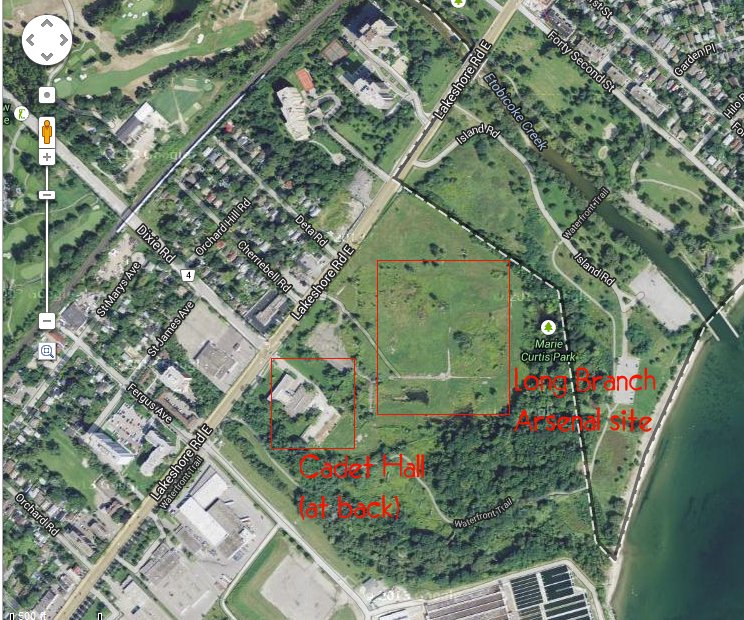
When I was an army cadet, the weapon we trained on was the Lee Enfield, an old but highly reliable British rifle. Our cadet range used Lee Enfields with .22 adapters, but due to an odd quirk of timing, the very first weapon I ever fired was a Lee Enfield .303 … I think it weighed nearly as much as I did at 12. Interestingly, our cadet hall was adjacent to the site where the Long Branch Arsenal had manufactured Lee Enfield rifles during WW2, and the building may have been part of the factory complex.

At the beginning of World War One, the Canadian army was supposed to be equipped as much as possible with Canadian-produced kit, including the infantry rifle. Canadian industrial development meant that we didn’t have factories that could immediately turn out bigger pieces of armament, but rifles were easily within reach. The government’s choice was the Ross rifle, which was already in production and was highly accurate but had a few disadvantages that were not discovered until the first Canadian troops were in Flanders. Wikipedia says:
The Ross rifle was a straight-pull bolt action .303 inch-calibre rifle produced in Canada from 1903 until 1918.
The Ross Mk.II or (“1905”) rifle was highly successful in target shooting before WWI, but the close chamber tolerances, lack of primary extraction and overall length made the Mk.III (or “1910”) Ross rifle unsuitable for the conditions of trench warfare and the often poor quality ammunition issued.
By 1916, the rifle had been withdrawn from front line service, but continued to be used by many snipers of the Canadian Expeditionary Force until the end of the war due to its exceptional accuracy.
The Ross Rifle Co. made sporting rifles from early in its production, most notably chambered in .280 Ross, introduced in 1907. This cartridge is recorded as the first to achieve over 3000 feet per second velocity, and the cartridge acquired a very considerable international reputation among target shooters and hunters.
Lickmuffin, who frequently posts comments here on the blog, recently acquired a “sporterized” version and produced a short video about the rifle:


