It’s reasonably well known that the arts of brewing and fermenting arose in nice time for the dawn of human civilization (there are ancient poems and mosaics and that sort of thing, dedicated to the celebration of the fact), but it’s at least as notorious that an open flask of alcohol is a mouth that can lead to hell as well as heaven. This being the case — and one day we shall work out the etymology that leads us to use the simple Italian word for a bottle, fiasco, in the way that we do — then it is as well to have a true Virgil to be our guide through the regions infernal as well as paradisiac.
The late Sir Kingsley Amis (who wrote these slender but thoughtful volumes before receiving his knighthood and who was also the expert to consult on things like the derivation of fiasco) was what the Irish call “your man” when it came to the subject of drink.
Christopher Hitchens, “The Muse of Booze”, Everyday Drinking: The Distilled Kingsley Amis, 2008
September 12, 2009
QotD: The Muse of Booze
September 3, 2009
Alabama belatedly bans “indecent” wine
Three years after it started being sold in the state, Alabama decided that this is indecent:
Slashfood reports:
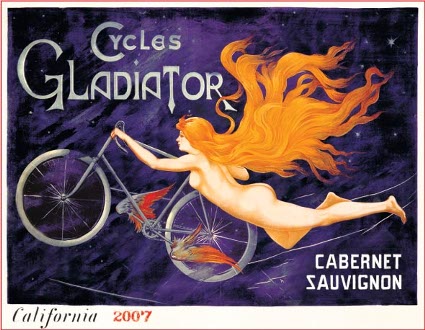
Wine and scantily clad women may sound like some cad’s idea of a good time, but the combo spells trouble in Alabama, which last week banned the sale of a California-made wine bottle adorned with a naked nymph — helping boost its sales elsewhere in the nation.
Pursuant to the state’s administrative code, the Alabama Beverage Control Board ordered Hahn Family Wines to remove its Cycles Gladiator wines from shelves throughout the state, calling its label “immodest.” According to Hahn president Bill Legion, a small state board in Alabama rejected the artwork last year, but the ruling did not catch Legion’s eye. His apparent defiance of the state’s decision — he claims the paperwork “fell through the cracks” — led to the ban.
“It’s turned out to be a great thing for us,” laughs Legion, who says he’s received calls of support from oenophiles around the world.
I haven’t tried the Cabernet Sauvignon, but I did have a few glasses of their Pinot Noir last week . . . very nice, although rather more full bodied than traditional Pinot (Burgundy, where pinot noir is the primary red wine grape, is a cool climate zone, as are most of the other well known pinot producer regions).
September 2, 2009
More on the travesty that is “Cellared in Canada” wine
Konrad Ejbich has an article in the most recent issue of Wine Spectator discussing the business and legal side of allowing large Canadian wineries to import grape juice and sell the result as “Canadian” wine:
It’s a longstanding quirk of Canadian wine law: “Cellared in Canada.” Several Canadian provinces allow wineries to import bulk wine (the popular choices today are Argentina and Chile), bottle it and call it Canadian, as long as the back label contains those three magic words. In the country’s two biggest wine regions, Ontario law requires such wines to contain 30 percent local grapes while British Columbia law requires no Canadian grapes.
But Ontario’s growing boutique wine industry is now calling for an end to “cellared” wines, arguing that the time has come for Canadian to mean Canadian. They claim the practice is tarnishing the reputation of local wine and jeopardizing the livelihood of grapegrowers. They charge that big wine companies are importing bulk wine and marketing it as “Canadian,” while domestic grapegrowers leave thousands of tons of fruit to rot on the vine.
“When we have wineries literally driving past vineyards full of Ontario grapes to pick up imported grape juice to make a blend, it is clear there is an issue,” said Jim Warren, president of the Ontario Viniculture Association. Growers and small wineries are organizing protests outside wine stores and have called for a boycott. They’ve asked the Ontario government to enact clearer labeling of “Cellared in Canada” products, increase the percentage of Ontario grapes used in blended wines and significantly increase the availability of VQA wines in Liquor Control Board of Ontario (LCBO) stores. (VQA, or Vintners’ Quality Alliance, is the appellation and quality organization that guarantees the authenticity of domestically-grown wines in Canada.)
Historical note from the old site: in a 2006 post, the name “Conrad Edgebeck” appeared in the comments. That was someone’s attempt to render Konrad Ejbich’s name from hearing it spoken on the radio. That particular post drew slow but steady Google hits showing that there were lots of others who clearly knew who Konrad was, but had no idea how to spell his name. Having now re-referenced the approximate pronunciation, I expect this post will serve the same function for this site.
Update, 9 February, 2012: Just as I suspected, this post is still showing up frequently in the search logs (161 times in the last week). To save you a bit of further work, here’s the top Google entry on Konrad — http://winewriterscircle.ca/members/ejbich-konrad and here is his Twitter feed — https://twitter.com/#!/winezone. Just trying to help.
August 25, 2009
Now I have seen everything
Visited the local outlet mall north of Zelienople today. In one of the stores was this fascinating wine:
Yep. It’s a Pennsylvania “Burgundy” — made of hybrid grapes — in a “Bordeux” style (the image doesn’t quite let me determine if Bordeaux was actually misspelled, but I thought it was).
For the vast majority of you who are not wine snobs, “Burgundy” is a reserved term for wine made exclusively with the Pinot Noir grape, and grown, pressed, and vinified in the French region of Bourgogne (aka Burgundy in English). “Bordeaux” is also a reserved term for wines grown in the region around the city of Bordeaux in southwestern France, using a blend of Cabernet Sauvignon, Cabernet Franc, Merlot, Petit Verdot, and/or Malbec grapes. None of these grapes are considered “hybrid”.
I didn’t dare taste it.
August 20, 2009
The Billionaire’s Vinegar-scented lawsuit
Mike Steinberger discusses the recent lawsuit launched by Michael Broadbent against the publishers of Benjamin Wallace’s The Billionaire’s Vinegar:
Broadbent, the legendary former head of Christie’s wine department, alleges that Wallace defamed him in his gripping whodunit about the so-called Thomas Jefferson bottles — a trove of wines initially said to have belonged to the oenophilic Virginian but now almost universally believed to have been fakes. Three of the bottles, all Bordeaux, were auctioned off by Broadbent in the 1980s, and of the many wine luminaries caught up in this saga, his reputation has suffered the most damage. Broadbent contends that he was falsely depicted in the book as being complicit in a crime. But his suit makes no claims one way or another regarding the authenticity of the wines that he sold, which can be taken as an acknowledgment that the evidence is not in his favor. Broadbent can’t undo the fact that he was at the center of what now appears to have been the greatest wine hoax ever perpetrated. By pursuing legal redress, he is simply making it harder for a more considered judgment of his actions to emerge.
[. . .]
As Wallace meticulously documents, Broadbent repeatedly and insistently vouched for Rodenstock and the Jefferson bottles. He was dismissive of the researcher at Monticello who cast doubt on the authenticity of the wines and of questions raised in the press. In addition to doing business with Rodenstock, Broadbent benefited from his largesse. Rodenstock was famous in wine circles for the marathon tastings that he held, multi-day extravaganzas that typically featured wines back to the 18th century. Broadbent attended these bacchanals, served as the authority-in-residence during them, and came away with tasting notes for many old and exceedingly rare wines. If, as now seems undeniable, Rodenstock was a con artist who trafficked in counterfeit wines, those tasting notes are worthless.
But contrary to what Broadbent is claiming in his lawsuit, The Billionaire’s Vinegar does not suggest that he was a witting accomplice to Rodenstock. Rather, the portrait that emerges is of a man who let his hopes and competitive zeal cloud his judgment.
I’ve read Wallace’s book — which I heartily recommend — and I think, based on the information presented, that Broadbent was not complicit in the apparent fraud itself, although he certainly took full advantage of the opportunity (and thereby reap the fame to go along with being associated with the “discoveries”).
August 12, 2009
Cellaring your wine in restricted spaces
Liam sent me this link, which may be of interest to wine fans who don’t have a lot of space for a proper cellar:
What is a Spiral Cellar?
It’s the quickest, cheapest and easiest way of building a wine cellar for your house.
A watertight, pre-cast cylindrical system that’s sunk into the ground, it can be located anywhere from kitchen to conservatory, workshop to study. It can be installed into an existing ground floor room, or incorporated into the build of an extension or new property.
If you’re the sort of person who never keeps any wine for more than a week or two then a cellar might not be necessary. But if you always like to have a few dozen bottles around the place and tend to keep bottles for months or years before drinking them, then you need a Spiral Cellar.
Perhaps of less use for apartment and condominium dwellers, however.
August 6, 2009
Stepping into a minefield in Buckhorn
Michael Pinkus found some unexpectedly vocal critics after he criticized the organizers of Fiesta Buckhorn over their wine and beer selections:
For once I wasn’t trying to stir up controversy, honest . . . but somehow it found me. A little over two weeks ago I wrote about Fiesta Buckhorn in my On the Road with the Grape Guy blog; amongst the wine picks and new winery news was a paragraph entitled, “Shame on Buckhorn” where I chastised them for, once again, allowing Cellared in Canada wines to be poured at an “All Ontario” wine event. There was also an aside, 2-lines within that heading, about a Mexican beer being there amongst all the Ontario craft breweries — but my main focus was the wine, the beer issue had just been pointed out to me in passing during a discussion with another attendee; I hate to say it but I hadn’t noticed them. Well, let me tell you, the mess really hit the fan, so to speak; I received letters from past organizers, current organizers, wine writers and others, weighing in on the controversy.
[. . .]
Two comments made to me (one by past the other by present organizers) concerned me, and encapsulated what is truly wrong with the Ontario wine market and consumer: “. . . quite frankly, there isn’t anyone on the committee knowledgeable enough who can identify non-Ontario wine to us.” In my opinion, this should be rectified immediately and should have been identified as a problem years ago. But it is the next comment that shows a total lack of understanding with regards to the sensitivity of this issue these days when there are websites and petitions against Cellared wines: “How were we to know that this was the case with [the wine in question]? How are we to know what any content of any wine is? Are we to conduct a privately funded research program to do so? We are a NOT FOR PROFIT ORGANIZATION raising funds for a community center.” My comment to that was quite simply: “LEARN” (capitalization begets capitalization), after all, there are plenty of sources out there, use the resources available to you. Crying ignorance is no defense.
The problem stems from the belief that I was accusing Fiesta organizers of willfully deceiving the public, which I am not. Let me state again: I am not accusing Fiesta Buckhorn organizers of deception; I have and will continue to accuse the winemakers of “cellared” wine (who shall go un-named here because this article is not about their product — this time) of deceiving the public, until such time as labeling practices change. What I am saying is that Buckhorn was merely an accomplice or, more to the point, the facilitator. “We intend to offer wine lovers a chance to taste wines from Ontario Vintors [sic]. We do not intend to deceive anyone. We also don’t hire the RCMP to forensically verify every wine served.” I was angrily informed. “And yet,” I retorted, “you offend the Vintners who pour 100% Ontario product by allowing one company to bring in the fake stuff.” And saying nothing.
It’s absolutely inexcusable for the organizers of a Canadian wine event to be unaware of the differences between VQA and “Cellared in Canada” wines . . . in simple terms, VQA is guaranteed to be Canadian wine, CiC is guaranteed to be up to 70% foreign. The wineries that do their level best to disguise foreign wine as domestic deserve to have their deceitful practices exposed and shamed. One particular no-longer-Canadian-owned wine conglomerate is quite noteworthy for this kind of deceptive marketing.
July 31, 2009
Yesterday’s wine tour
I took the day off yesterday, but not just for a wine tour (that was the bonus on the day). It was only a brief tour — three wineries — but I tried to make the most of the time available.
First stop was at one of my all-time favourite wineries, Kacaba Vineyards. They’re best known for their red wines, but I usually find their Chardonnay to be well worth trying. This visit was no exception, as they were having a sale on their unoaked Chardonnay ($100 per case, which is insanely cheap for a very pleasant summer quaffer).
After lunch at the About Thyme Bistro (one of the best new restaurants in Ontario), we headed over to Flat Rock Cellars, where Sam discovered an unexpected taste for both Reisling and heavily oaked Chardonnay (Sam didn’t think of herself as a wine drinker, but this tour may have started to change her mind). My mother really enjoyed the “Red Twisted” blend, which is primarily Pinot Noir.
The last stop on our brief visit to the area was Strewn, where the 2007 vintage hasn’t yet been released (to my disappointment), but the 2006’s are still going strong. I picked up a few bottles of the Terroir Merlot (which is drinking nicely now) and the Terroir Cabernet Sauvignon (which really needs a few more years to mellow out the tannins).
Then it was time to hit the road, in hopes of avoiding the worst of the traffic. Hopes partially fulfilled . . . the QEW was very heavy from St. Catharines to Burlington, but the 407/ETR was fast moving (as hoped).
July 30, 2009
Organic food shock: no better than non-organic
This is another one of those “someone paid money to conduct the study?” studies. Organic food has been a boon to certain producers, but it doesn’t provide the kind of benefits most purchasers expect:
But organic is certainly more expensive. A new study in the American Journal of Clinical Nutrition finds:
On the basis of a systematic review of studies of satisfactory quality, there is no evidence of a difference in nutrient quality between organically and conventionally produced foodstuffs. The small differences in nutrient content detected are biologically plausible and mostly relate to differences in production methods.
The study was commissioned by Britain’s Food Standards Agency.
I’ve been skeptical about the claims for “organic” products for quite some time. Similarly, I’m not convinced that there’s any great value in the “biodynamic” model for wine. My strong suspicion is that the same general quality of wine would be produced without all the new age woo-woo mystic crap, because the vineyard owner or manager is paying closer attention to the vines. That, IMO, is the key.