Forgotten Weapons
Published 2 Feb 2017While rifle-launched grenades date back hundreds of years, they first came into widespread use during World War One, on all sides of the conflict. The first years of the war saw the use of rod grenades, but their downsides (mediocre accuracy, bulkiness, and a propensity to damage rifle bores) led to the British adopting a 2.5” cup grenade discharger in late 1917. This new launcher used slightly modified Mills bomb hand grenades, and could launch them with significant accuracy from 80 to 200 yards. They would become a staple of WWI combined arms infantry tactics, and be used clear through WW2 until replaced by the 22mm NATO style spigot grenades.
http://www.patreon.com/ForgottenWeapons
Cool Forgotten Weapons merch! http://shop.bbtv.com/collections/forg…
If you enjoy Forgotten Weapons, check out its sister channel, InRangeTV! http://www.youtube.com/InRangeTVShow
March 18, 2020
SMLE Rifle Grenade Launcher
March 17, 2020
Tank Chats #64 Leopard 1 | The Tank Museum
The Tank Museum
Published 11 Jan 2019The Leopard 1 Main Battle Tank was built on Germany’s lessons from the Second World War. It entered service in 1965 and has since been exported worldwide.
Tank Museum Curator David Willey talks through this Cold War vehicle.
Support the work of The Tank Museum on Patreon: ► https://www.patreon.com/tankmuseum
Visit The Tank Museum SHOP: ► https://tankmuseumshop.org/
Twitter: ► https://twitter.com/TankMuseum
Tiger Tank Blog: ► http://blog.tiger-tank.com/
Tank 100 First World War Centenary Blog: ► http://tank100.com/ #tankmuseum #tanks #tankchats
March 15, 2020
M1918 BAR: America’s Walking Fire Assault Rifle
Forgotten Weapons
Published 14 Oct 2017Sold for $34,500 (transferrable).
John Browning developed the Browning Automatic Rifle for use by American troops in World War One, taking inspiration from the other light automatic weapons in service including the Chauchat, Lewis, and MG08/15. Rather than being used as a light machine gun as we would understand it today, the BAR was an “automatic rifle”, intended to be used in much the same way as the Germans would use the Sturmgewehr in WWII. It would be fired in semiautomatic mode from the shoulder or hip while advancing on the enemy, using steady fire to keep them pinned down. Once troops broke into close contact, the gun could be switched to fully automatic to provide overwhelming firepower for the final assault on a position. While the walking fire from the hip was not particularly realistic in practice, the fully automatic firepower was a huge boon to the infantry. While it filled the game role as the Chauchat, the BAR was a much more refined weapon and much easier to use effectively.
The BAR was showed to the US Ordnance Department in 1917, and the first order for them was placed with Colt in July of 1917. In short order further contracts would be placed with Winchester and Marlin-Rockwell, although it would take many months to fabricate the production tooling and perfect the design for mass production. A few hand-fitted guns were ready in February 1918 for a public demonstration, but significant quantities were not being built until July of 1918.
These guns would be shipped to France for use by the AEF, but not actually put into combat service until the Meuse-Argonne offensive in late September of 1918, due to General Pershing’s desire to keep them secret from the Germans until a large number could be used at once. As a result, the guns saw only very limited use before the war ended on November 11th. In total 102,173 BARs would be built, about half of them being finished into 1919, after the armistice. They would go on to be changed and updated for use in World War Two, but that is a discussion for another day. This particular gun is an excellent example of an M1918 BAR in correct World War One configuration, which is a rare find today.
http://www.patreon.com/ForgottenWeapons
Cool Forgotten Weapons merch! http://shop.bbtv.com/collections/forg…
If you enjoy Forgotten Weapons, check out its sister channel, InRangeTV! http://www.youtube.com/InRangeTVShow
March 12, 2020
Canadian Ross MkIII Sniper Rifle with Warney & Swasey Scope
Forgotten Weapons
Published 11 Mar 2020http://www.patreon.com/ForgottenWeapons
https://www.floatplane.com/channel/Fo…
Cool Forgotten Weapons merch! http://shop.bbtv.com/collections/forg…
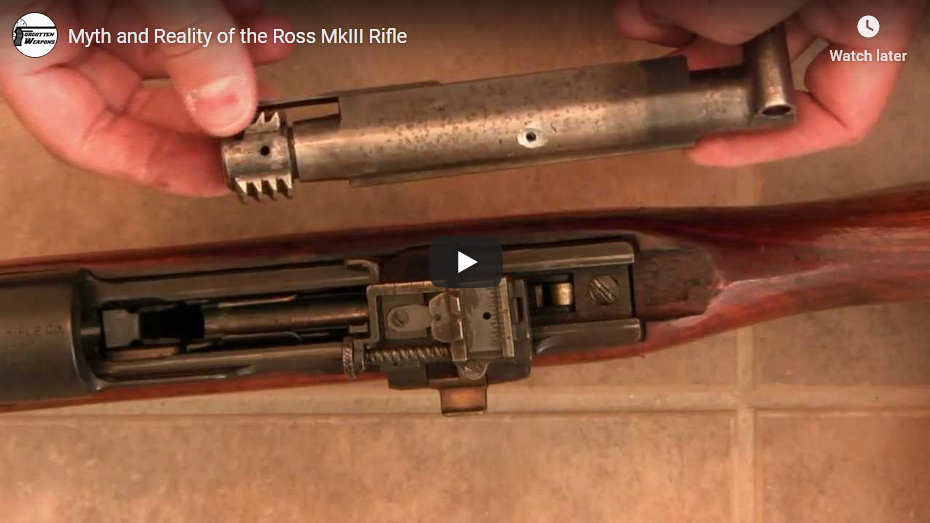
The Canadian infantry that went to Europe in the early years of World War One were equipped primarily with the Ross MkIII rifle. The Ross would become quite the scandal, and was replaced in service with the SMLE in 1916 — but as a sniper rifle the Ross excelled. Its problems in service were largely based on poor quality ammunition, and this was not an issue for the sniper corps. In addition, Great Britain was having enough trouble equipping its own snipers to have any extra scoped rifles to hand over to the dominions.
And so, the Canadians modified 500 Ross rifles into a sniper configuration using American-sourced Warner & Swasey M1913 “Musket Sight” scopes. These were 5x magnification prismatic scopes, also used by American forces on the M1903 sniper rifle and the M1909 Benet-Mercie machine guns. The scope was not very good, suffering from fogging and other issues, but it was available. The Canadian rifles were made in two batches of 250 each, one in 1915 and one in 1917. This was actually more rifles than needed, and many of them (including the two in this video) remained in Canada for training (and were used at least until 1942).
Canadian Warner & Swasey scopes can be identified by three elements. They have elevation dials marked out to 2400 yards, serial numbers between 1 and 500, and no data plate on top. Canadian scope cases are marked with the serial numbers of the scope and the rifle they were issued with.
Contact:
Forgotten Weapons
6281 N. Oracle #36270
Tucson, AZ 85740
M134 Minigun: The Modern Gatling Gun
Forgotten Weapons
Published 22 Dec 2016Minigun in slow motion: https://www.youtube.com/watch?v=XeyVr…
The General Electric M134 “Minigun” is essentially an electrically-powered Gatling gun — the conceptual operation of the gun is identical to Dr. Gatling’s original creation. What has changed, however, is the chambering (it’s in 7.62 NATO), the power source (an electric motor), and the feed mechanism (belt-feed using M60 links instead of the Gatling’s Accles, Broadwell, or Bruce feeds). The weapon was a scaled down version of a 20mm rotary powered cannon devised for aircraft armament after WW2, hence the “mini” name. It was used primarily as helicopter armament, although it has found its way only ground vehicles as well. Firing between 3000 and 6000 rounds per minute, the Minigun is ideal for aerial engagements where the gunner only has a brief moment on target and needs to fire as much as possible during that moment.
It is a truly awe-inspiring weapon, and quite an experience to fire! In addition to destroying a truck with it, we will look at disassembly and functioning of the minigun — the delinking mechanism is really the most complex part of the weapon, and a very interesting device.
Thanks to Modern Arms of Tempe, AZ for providing the Minigun for this video! They offer the gun for rental, if you are interested in trying it out yourself.
http://www.patreon.com/ForgottenWeapons
Cool Forgotten Weapons merch! http://shop.bbtv.com/collections/forg…
If you enjoy Forgotten Weapons, check out its sister channel, InRangeTV! http://www.youtube.com/InRangeTVShow
March 11, 2020
How Does It Work: Roller Locking
Forgotten Weapons
Published 10 Mar 2020http://www.patreon.com/ForgottenWeapons
https://www.floatplane.com/channel/Fo…
Cool Forgotten Weapons merch! http://shop.bbtv.com/collections/forg…
Roller locking is a system that is not used in many guns and often confused with roller-delayed blowback — which is understandable, given the similarities between the systems. Roller locking was first developed as a modification of the German G43 rifle, and it is really a sub-type of flapper locking mechanism. It was most significantly used in the MG42, and also in the Czech vz.52 pistol. In essence, it uses rollers in place of flaps to lock the bolt and barrel securely together during firing, and depends on an external system (short recoil, in the case of the MG42 and vz.52) to unlock before it can cycle.
Contact:
Forgotten Weapons
6281 N. Oracle #36270
Tucson, AZ 85740
March 9, 2020
British Submachine Gun Overview: Lanchester, Sten, Sterling, and More!
Forgotten Weapons
Published 12 Mar 2017Armament Research Services (ARES) is a specialist technical intelligence consultancy, offering expertise and analysis to a range of government and non-government entities in the arms and munitions field. For detailed photos of the guns in this video, don’t miss the ARES companion blog post:
http://armamentresearch.com/british-sub-machine-gun-development-an-overview/
Great Britain was one of the few countries that went into World War Two with virtually no submachine gun development. Not every country had an issued SMG by 1939, but virtually everyone had at least been working on experimental concepts — except the British. It was only with the outbreak of hostilities that the need for such a weapon suddenly became apparent and its acquisition became a military priority.
This was solved by acquiring and copying the German MP28/II, which was quickly followed by a simplification program that would lead to the MkI, MkI*, and ultimately MkII and MkIII Sten guns. The Stens were truly exceptional studies in simplification, getting down to a mere 5.5 man-hours of production time. Only after the threat of immediate German land invasion had subsided was the Sten allowed to become a little bit user-friendly, in the MkV guise.
At the end of WW2, the British were finally able to scrap the Sten (known to be a compromise gun all along) and replace it with something with more finesse. Tests were run on the MCEM series, on BSA guns, on interesting prototypes like the double-stack-magazine Vesely V42 — but it was George Patchett’s much improved Sten which would be chosen and come to be known as the Sterling SMG (named after its manufacturer).
A couple of corrections to the video:
— The MP28 was designed by Schmeisser, not Bergmann.
— The MCEM-2 was designed by Polish engineer Lt. Jerzy Podsendkowski. The -2 version of the MCEM was completed during WW2; it was the -4 and -6 versions that were post-war.
— George Lanchester was chief engineer at Sterling and ran the Lanchester project, but was not actually the lead designer himself.
http://www.patreon.com/ForgottenWeapons
Cool Forgotten Weapons merch! http://shop.bbtv.com/collections/forg…
If you enjoy Forgotten Weapons, check out its sister channel, InRangeTV! http://www.youtube.com/InRangeTVShow
March 6, 2020
Bren Ten: The Most Tactical Pistol!
Forgotten Weapons
Published 30 Sep 2015http://www.patreon.com/ForgottenWeapons
Hammer price: $2,500
The Bren Ten is an interesting story of handgun development and business failure. The gun was first developed by Dornaus & Dixon, with the consulting help of the iconic Col. Jeff Cooper. It was intended to be a handgun to improve upon the venerable 1911 in every way.
To satisfy the adherents to the theory of large-caliber handgun cartridges, the gun was designed around a new 10mm cartridge designed by Norma. This cartridge would propel a 200 grain bullet at 1200 fps from a 5 inch barrel, making it the most powerful service handgun cartridge in production. It would use a 10-round magazine, and also be convertible to .45ACP.
The gun itself was based on the excellent Czech CZ-75 (made at Brno, which is where the “Bren” portion of the pistol’s name came from). It had full length slide rails, a DA/SA trigger that could be carried cocked and locked, and nice big sights.
Unfortunately, a combination of production quality problems, inadequate magazine design, preorders, and other issues led to the company quickly falling into tough financial straits. The guns were only manufactured for about 2 years before bankruptcy ended production. Some had been shipped without magazines, and Bren Ten magazines remain a sought-after commodity today.
March 3, 2020
Type 89 Knee Mortar
Forgotten Weapons
Published 23 Sep 2015http://www.patreon.com/ForgottenWeapons
Hammer price: $2,500
The Type 89 grenade discharger, commonly known as the “knee mortar” was a Japanese light infantry weapon introduced in 1929 which blurs the lines between grenade launcher and mortar. Like a mortar, it fires propelled explosive bombs in a high-angle indirect fire role, but it has a rifled barrel and uses a range adjustment mechanism very different from most mortars.
The knee mortar proved to be a very capable and effective weapon in WWII against US forces. It was accurate, effective, and perhaps most importantly, light and very fast to put into action. The closest comparable US weapon was the 60mm light mortar, which had a more effective projectile but was significantly slower to use.
Of course, the “knee mortar” nickname was based on the theoretical belief that one was supposed to rest the curved baseplate of the weapon on a leg while firing, which would actually have resulted in a broken leg. The baseplate was curved to allow it to dig into soft soil and be used against objects like logs and roots.
February 29, 2020
Forced-Air Cooling in an Experimental Ross Machine Gun
Forgotten Weapons
Published 28 Feb 2020http://www.patreon.com/ForgottenWeapons
https://www.floatplane.com/channel/Fo…
Cool Forgotten Weapons merch! http://shop.bbtv.com/collections/forg…
In addition to building three main patterns of straight-pull bolt action rifle for the Canadian military and the commercial market, Sir Charles Ross also experimented with self-loading rifles. Starting with a standard Ross Mk III, this experimental rifle has a gas piston and trigger to allow automatic fire and a very neat forced-air cooling system. A one-way ratchet mechanism (now broken, unfortunately) spins the fan when the bolt cycles, pushing air into a barrel shroud similar to that of a Lewis gun. This rifle was most likely made in 1915 or 1916 with an eye to a military light machine gun or automatic rifle contract — which never happened.
Thanks to the Canadian War Museum for providing me access to film this Ross for you!
Contact:
Forgotten Weapons
6281 N. Oracle #36270
Tucson, AZ 85740
Dardick Model 1500: The Very Unusual Magazine-fed Revolver
Forgotten Weapons
Published 12 Nov 2019This is Lot 1953 in the upcoming RIA December Premier auction.
The Dardick 1500 was a magazine-fed revolver designed by David Dardick in the 1950s. His patent was granted in 1958, and somewhere between 40 and 100 of the guns were made in 1959, before the company went out of business in 1960. The concept was based around a triangular cartridge (a “tround”) and a 3-chambered, open-sided cylinder. This wasn’t really of direct benefit to a handgun, but instead was ideal for a high rate of fire machine gun, where the system did not need to pull rounds forward or backward to chamber and eject them. In lieu of military machine gun contract, Dardick applied the idea to a sidearm.
The Model 1500 held 15 rounds, inside a blind magazine in the grip. It was chambered for a .38 caliber cartridge basically the same as .38 Special ballistically. A compact Model 1100 was also made in a small numbers, with a shorter grip and correspondingly reduced magazine capacity (11 trounds). A carbine barrel/stock adapter was also made. The guns were a complete commercial failure, with low production and lots of functional problems. Today, of course, they are highly collectible because of that scarcity and their sheer mechanical weirdness.
http://www.patreon.com/ForgottenWeapons
Cool Forgotten Weapons merch! http://shop.bbtv.com/collections/forg…
Contact:
Forgotten Weapons
6281 N. Oracle #36270
Tucson, AZ 85704
I’ve always had an interest in the Dardick, from their appearance in some of L. Neil Smith’s science fiction novels. I linked to an earlier article of his, and commented:
As Neil pointed out in one of his books, the Dardick was the answer to a bad crime writer’s prayers: it was literally an automatic revolver. (For those following along at home, an “automatic” has a magazine holding the bullets which are fed into the chamber to be fired by the action of the weapon: fire a bullet, the action cycles, clearing the expended cartridge and pushing a new one into place, cocking the weapon to fire again. A “revolver” holds bullets in the cylinder, rotating the cylinder when the gun is fired to put a new bullet in line with the barrel to be fired. The Dardick is the only example I know of that combines both in one gun.)
February 26, 2020
Powell’s Cartridge Counter Luger: The First Military 9mm
Forgotten Weapons
Published 10 Nov 2019The US first tested the Luger in 1901, and it seemed potentially good enough that the government spent $15,000 to buy 1,000 of the pistols (in 7.65mm Luger; the only cartridge available at the time) for field trials. The trials resulted in a variety of complaints, but particular among them was a dislike for the small caliber. In response, Georg Luger necked the 7.65mm round up to 9mm, and the US would be the first to trial the new model. After presenting 3 samples in 1903, Luger made a deal to swap 50 of the American 7.65mm pistols for 50 new 9mm ones. The US also specified that new guns had to be fitted with a cartridge counter grip system designed by one Graham Powell. The resulting guns (s/n 22401-22450) were delivered in April of 1904.
American testing did not find the 9mm much more satisfactory than the old 7.65mm, however. At the same time, the Thompson-La Garde tests of terminal ballistics were concluding that a new service pistol should be no less than .45 caliber. Luger would make one last effort to interest the US in 9mm with a duplex load in 1906, but this would also fail. Instead, he would redesign the Luger for .45 ACP and enter that in the US 1907 pistol trials.
http://www.patreon.com/ForgottenWeapons
Cool Forgotten Weapons merch! http://shop.bbtv.com/collections/forg…
Contact:
Forgotten Weapons
6281 N. Oracle #36270
Tucson, AZ 85704
February 25, 2020
The Prototype .280 FAL from 1950s NATO Trials
Forgotten Weapons
Published 24 Feb 2020http://www.patreon.com/ForgottenWeapons
https://www.floatplane.com/channel/Fo…
Cool Forgotten Weapons merch! http://shop.bbtv.com/collections/forg…
After World War Two, the new NATO defense alliance held a series of trials to adopt a standard cartridge and infantry rifle. This would eventually devolve and the goal of a standardized rifle would be abandoned, but during the early trials there were three main contenders: the British EM-2, the American T-25, and the Belgian FAL. The Fusil Automatique Leger was designed by Dieudonne Saive and originally presented to the British government in 8mm Kurz, before being scaled up to accommodate the British request to use the .280 cartridge. A small number of these prototype FAL rifles in .280 were delivered by FN, and used in the 1950 NATO rifle trials.
Many thanks to the Royal Armouries for allowing me to film and disassemble this very scarce trials rifle! The NFC collection there — perhaps the best military small arms collection in Western Europe — is available by appointment to researchers:
https://royalarmouries.org/research/n…
You can browse the various Armouries collections online here:
https://royalarmouries.org/collection/
Contact:
Forgotten Weapons
6281 N. Oracle #36270
Tucson, AZ 85740
February 23, 2020
Chambers Flintlock Machine Gun from the 1700s
Forgotten Weapons
Published 8 Nov 2019http://www.patreon.com/ForgottenWeapons
Cool Forgotten Weapons merch! http://shop.bbtv.com/collections/forg…
Joseph Chambers invented a repeating flintlock weapon in the 1790s, and I think it is appropriate to consider it a “machine gun”. The design used a series of superposed charges in one or more barrels, with specially designed bullets that has hollow central tubes through them. This would allow the fire from a detonation charge to transit through a bullet at the rear and set off a subsequent charge. The result was a single trigger pull to use a flintlock action to start an unstoppable series of shots. Chambers made pistol and musket versions, as well as a full-on mounted machine gun.
He submitted his design to the fledgling US War Department in 1792, but it was not accepted. He brought the guns back to their attention when the War of 1812 was declared, and this time he found an eager client in the United States Navy. More than 50 of the machine guns were built and purchased to use on Navy warships. This version had 7 barrels, each loaded with 32 rounds, for a total of 224 shots, at (apparently) about a 120 round/minute rate of fire. The British found out about the guns and made some effort to reverse engineer them, and there was also interest in France, the Netherlands, and Spain. Ultimately, the potential unreliability of the system prevented more widespread adoption, but the gun is a fascinating example of early automatic firearms.
For more information, see Andrew Fagal’s article:
https://ageofrevolutions.com/2016/10/…Thanks to the Liege Arms Museum for access to film this for you! If you are in Belgium, definitely plan to stop into the museum, part of the Grand Curtius. They have a very good selection of interesting and unusual arms on display.
Contact:
Forgotten Weapons
6281 N. Oracle #36270
Tucson, AZ 85704
February 22, 2020
The FAL for British Troop Trials in 1954: X8E1 & X8E2
Forgotten Weapons
Published 21 Feb 2020http://www.patreon.com/ForgottenWeapons
https://www.floatplane.com/channel/Fo…
Cool Forgotten Weapons merch! http://shop.bbtv.com/collections/forg…
The NATO rifle trials of the early 1950s eventually chose the 7.62mm x 51mm cartridge, and the British and Belgians agreed on the FAL rifle to shoot it (and they thought the US would as well, but that’s another story). The British government formally accepted the FAL for troop trials, and in 1954 an order for 4,000 X8E1 rifles (with iron sights) and 1,000 X8E2 rifles (with SUIT 1x optical sights) was placed. These rifles were mechanically the same as what would be finalized as the L1A1 rifle, but they include a number of differing features. Both models had 3-position selector switches allowing automatic fire, and they also had manual forward assists on the bolt handles. The iron sights had top covers with integrated stripper clip guides, as there was concern that troops would have to manually reload their magazines, and stripper clips would speed this process up.
Many thanks to the Royal Armouries for allowing me to film these very scarce trials rifles! The NFC collection there — perhaps the best military small arms collection in Western Europe — is available by appointment to researchers:
https://royalarmouries.org/research/n…
You can browse the various Armouries collections online here:
https://royalarmouries.org/collection/
Contact:
Forgotten Weapons
6281 N. Oracle #36270
Tucson, AZ 85740