
Lie-Nielsen Toolworks
Published Dec 8, 2023See the process of making the Lie-Nielsen No. 62 Low Angle Jack Plane: initial pattern making; pouring the castings at the foundry; machining, grinding, and finishing all the parts; final assembly, inspection, and wrapping.
April 16, 2024
April 10, 2024
Three Joints, a Handful of Tools | Paul Sellers
Paul Sellers
Published Jan 5, 2024It was almost 35 years ago when I was about to teach my first woodworking class, and I struggled because what could be taught in a one-day workshop that would have any value? I agonised for two weeks, and one day it came to me; with three joints and a handful of hand tools, you can make just about any furniture piece you care to name.
Since then, I have used this basic tenet to teach and train hundreds of thousands of woodworkers, just like you. It’s still working!
——————–
(more…)
Comments Off on Three Joints, a Handful of Tools | Paul Sellers
March 29, 2024
Drawer Joinery Explained | Paul Sellers
Paul Sellers
Published Dec 15, 2023We should never take too much for granted, especially when it comes to which joints are used for this or that.
If no one has explained the reasoning behind drawer joint choices, this simple video will help. Drawers take a lot of stresses and strains, and the dovetail joint is the signature joint of drawers and boxes. But did you know that a housing dado can also improve the functionality of a drawer?
This video will walk you through the reasoning for both joints.
(more…)
Comments Off on Drawer Joinery Explained | Paul Sellers
March 20, 2024
Jointing on a Bandsaw | Paul Sellers
Paul Sellers
Published Dec 1, 2023This bandsaw hack is one you have never seen before because I invented it.
Planing dead flat for hand planing or power planing can take time, but this bandsaw method takes only a few short minutes to do, and you are on your way to your work faster than blinking.
(more…)
Comments Off on Jointing on a Bandsaw | Paul Sellers
March 4, 2024
Lay out Dovetails with Dividers
Lost Art Press
Published Nov 26, 2023
(more…)
Comments Off on Lay out Dovetails with Dividers
January 31, 2024
Don’t RUIN your workbench with 2x4s (use these tips instead)
Rex Krueger
Published 8 Nov 2023
(more…)
Comments Off on Don’t RUIN your workbench with 2x4s (use these tips instead)
January 10, 2024
How to Sharpen and Set up a No.80 Scraper | Paul Sellers
Paul Sellers
Published 6 Oct 2023The #80 cabinet scraper handles the wildest grain, but because of its name, it is also one of those misunderstood tools with misunderstood sharpening.
In this video, I walk you through the most unique sharpening method there is for any woodworking hand tool. Once you learn how to sharpen and set up this tool, you’ll be able to refine any hard and dense-grained wood surface you will ever encounter, bar none.
Where the hand plane might fail you, the #80 cabinet scraper takes over.
——————–
(more…)
Comments Off on How to Sharpen and Set up a No.80 Scraper | Paul Sellers
December 28, 2023
Making a Dovetail Guide | Paul Sellers
Paul Sellers
Published 22 Sept 2023Often, we woodworkers make boxes the same size over and over again, especially if or when we sell them. I designed this dovetail guide to replicate the same-sized dovetails to the four corners of the box we make and make dozens of boxes if we have a batch production run of them.
You need to lay out only once, no matter how many dovetails you make and the dovetails will even be interchangeable. Additionally, you can vary the dovetail sizes proportionally by sliding the workpiece up and down the guide for larger or smaller dovetails too.
I hope you enjoy this little nugget!
(more…)
Comments Off on Making a Dovetail Guide | Paul Sellers
December 23, 2023
DON’T GET SCREWED!!! Get the best deals on vintage handplanes
Rex Krueger
Published 22 Dec 2023When it comes to purchasing a piece of the past, a little knowledge goes a long way.
(more…)
Comments Off on DON’T GET SCREWED!!! Get the best deals on vintage handplanes
December 13, 2023
Vice-held End-grain Guide | Paul Sellers
Paul Sellers
Published 25 Aug 2023It’s true. Sometimes an idea should always be shared, and this is one I just had to tell you about.
I know that shooting boards work well, but for end-grain planing with added security vice-held stock and the guide, you add solidity and comfort. This one has no equal. You don’t have to believe me because in ten minutes and from scraps, you can make your own and check it out for yourself.
You can find the drawing of this project here: https://paulsellers.com/wp-content/up…
(more…)
Comments Off on Vice-held End-grain Guide | Paul Sellers
November 23, 2023
Quick Skills for Busy Woodworkers: Elevate Your Craft in 10 Minutes
Rex Krueger
Published 22 Nov 2023You can do real woodworking even if you’re short on time. Here are some ideas.
(more…)
Comments Off on Quick Skills for Busy Woodworkers: Elevate Your Craft in 10 Minutes
October 30, 2023
The funny side of reviewing woodworking tools
Christopher Schwarz used to be the editor of one of the big US woodworking magazines and part of the job included being inundated with free tools from manufacturers eager to get a review in an upcoming issue of the magazine. Some — and not just the marginal producers — had the misfortune of shipping tools that failed to work properly (or at all) when tested:
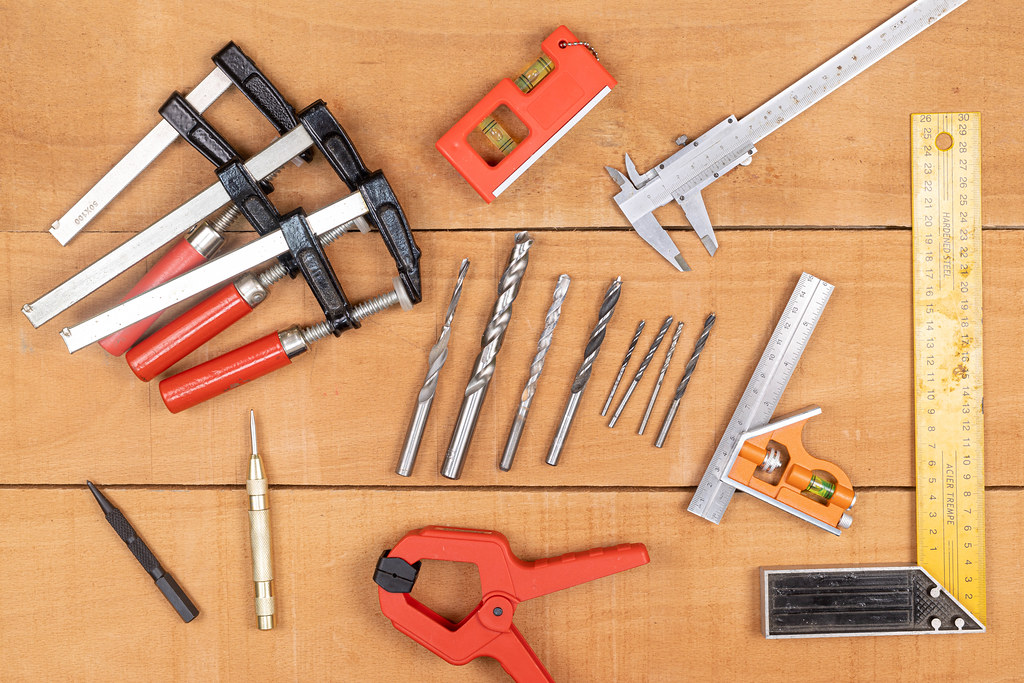
“Woodworking Tools on the wooden table” by wuestenigel is licensed under CC BY 2.0 
 .
.
… it should come as no surprise that toolmakers also make mistakes. Most readers probably think that the tools that came into our shop had been carefully tested and tuned by the manufacturers to make sure they were perfect. Based on how many goofed-up tools I saw, I doubt that’s the case.
And in fact, I took it as a mark of the toolmakers’ honesty when they sent us one right off the warehouse floor.
Here’s a small sample of some of the stuff I’ve seen:
DeWalt: The company makes good tools, but we had a jigsaw come into the shop where the blade clamping mechanism failed. It went click, click, then the blade dropped out like a rotten tooth. When DeWalt introduced its first hybrid table saw, the first rip fence we got was twisted. So was the second. The third replacement was fine.
Delta: When Delta introduced its C-arm drum sander, we were all excited in the shop. We set it up, plugged it in and cranked the puppy up. It spun up and then spun down forever. The motor burned out after three seconds.
Harbor Freight: It might sound too easy to pick on this discount seller. But they sell tools and people buy them. So here goes: When we tested the company’s plunge router, the collet failed. The bit slipped out and flew out. That was one of the days that I wished we had some Depends in the first-aid kit.
Black & Decker: Here’s every tool marketer’s worst nightmare. Black & Decker sent us its new cordless tape measure. Now let’s ignore for a moment the possibility that you do not need an electric tape measure. So Senior Editor David Thiel took it out of the box in front of the entire staff and demonstrated how it works. The tape extended about a foot and then died forever.
Metabo: Cordless drills aren’t supposed to shoot flames out the back are they?
Lobo: When we tested its edge sander the sheet metal base flexed like tin foil. You would turn the machine on, and the thing would do the twist like Chubby Checker.
Powermatic: Yes, even Powermatic. An early version of its benchtop mortiser had a flaw in the piece of metal that joined the motor to the arm mechanism. The gears on the interior stripped out. So when you pulled the arm, the motor never moved.
Tools for Working Wood: The Ray Iles mortising chisels are great, but one of my students at the Marc Adams School of Woodworking snapped the tip off one when working in poplar. I heard it from across the room. It turned out that a few of the tools had been made from A2 instead of D2. It did make for an amusing day as everyone crowded around the chisel like the victim of a car accident.
Lie-Nielsen Toolworks: I had a narrow iron shoulder plane that was an early production run. The bronze grip wouldn’t stay in place when you retracted the iron. When I turned the screw, the plane disassembled itself in my hands.
Veritas: An early version of the Veritas cabinet scraper (an adaptation of the No. 80) would clog after a few passes like Crystal Gayle’s shower’s drain. The company has since fixed that problem and the tool works great.
Stanley Tools: During a test of jack planes, we had a tool that simply would not function. It was like it was haunted. If you snugged up the frog screw to where you thought it should be, you couldn’t adjust the iron. If you loosened the frog screw so you could adjust the iron, the thing would chatter and shake like a Vega going 56 mph. We never figured that one out.
Wenzloff & Sons: While teaching a sawing class at Kelly Mehler’s School of Woodworking, one student’s carcase saw was misbehaving. It was tearing out the shoulders of his tenons something fierce. At first I thought it was user error. Turns out the saw was filed for rip when it was supposed to be crosscut.
Let me conclude by saying that mistakes slip out the door for every toolmaker (and magazine editor and book publisher). We’ve never heard of any toolmaker with zero returns. The real test of a toolmaker (and editor) is how you deal with the mistakes when they occur.
Comments Off on The funny side of reviewing woodworking tools
October 19, 2023
Build a saw-bench: transform your woodwork
Rex Krueger
Published 18 Oct 2023Building TWO traditional sawbenches. Construction lumber. Simple build.
(more…)
Comments Off on Build a saw-bench: transform your woodwork
October 18, 2023
Sharpening a Chisel in under a Minute | Paul Sellers
Paul Sellers
Published 15 Jun 2023I see more and more options for sharpening a chisel and yet, with no mechanical means at all, I go from a chisel I have dulled to surgically sharp in about a minute or less.
The fact is I never need to use a grinding wheel, and I was taught to sharpen by the masters of sharpening in my apprenticeship days 58 years ago which I have never strayed from because I found every other option too slow and, dare I say it, DULL and time consuming no matter which method or which machine!
Watch the video and see what you feel.
(more…)
Comments Off on Sharpening a Chisel in under a Minute | Paul Sellers
September 23, 2023
Sash Clamp Extension | Paul Sellers
Paul Sellers
Published 19 May 2023We all need longer clamps from time to time, especially when it comes to long tables, beds, and the like. I love my lightweight aluminium clamps and they lend themselves to a simple option for creating longer clamps from shorter ones.
This video will take out the mystery and deliver a totally practical option for you at almost zero cost. Keeping life simple is always difficult but this option is doable in a matter of minutes.
——————–
(more…)
Comments Off on Sash Clamp Extension | Paul Sellers


