
Tom Scott
Published 29 May 2017Inside the beautiful Alnwick Garden, behind a locked gate, there’s the Poison Garden: it contains only poisonous plants. Trevor Jones, head gardener, was kind enough to give a guided tour!
For more information about visiting the Castle, Garden, and poison garden: https://alnwickgarden.com/
(And yes, it’s pronounced “Annick”.)
(more…)
April 3, 2023
The poison garden of Alnwick
Comments Off on The poison garden of Alnwick
April 2, 2023
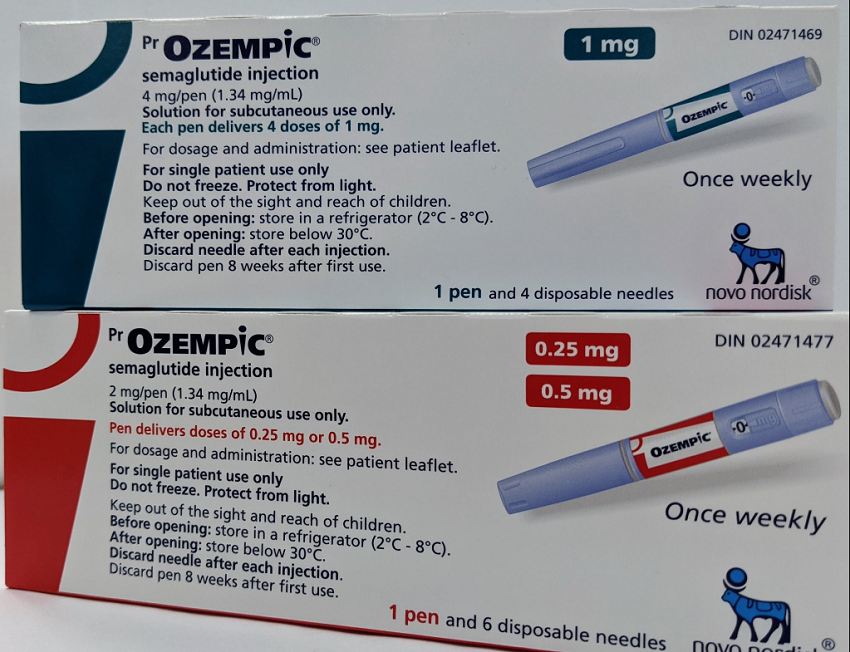
Ozempic versus the make-believe world of “Healthy at Every Size”
Poor Americans are being propagandized that being fat — even to the point of being unable to carry on ordinary tasks — is “perfectly healthy” at the same time that the glitterati, the wealthy, and the mediagenic are getting thinner thanks to diet, exercise, and (it’s an open secret) drugs and cosmetic surgery. Along comes an antidiabetic drug that was found to have an interesting off-schedule property:
If you, a commoner, encountered a feudal lord in the year 1200, the latter would likely be wearing fine armour, carrying a well-polished sword, and riding a horse. Upon seeing these visual cues, you would address him properly, lest he punish you for failing to show proper deference. But as the centuries passed, particularly in the years following the American and French revolutions, this notion of privilege faded; the rich might be a class apart, but at times they might be dressed much like you, even if their apparel was slightly better-made.
Today, however, the rich are separating themselves in perhaps the most obvious way of all: by perfecting their bodies, rather than what they put on them. The rich are fit and the poor are fat: reams of research confirms that the prevalence of obesity decreases as income increases. In the United States, where 41% of the entire population is obese — compared with 25% in the United Kingdom — it is a rare wealthy person who is morbidly overweight (blimp-sized Illinois governor J.B. Pritzker and portly former New Jersey governor Chris Christie are outliers). Increasingly, the rich in late middle age have come to resemble Jeff Bezos and Sarah Jessica Parker: ripped to shreds and almost certainly “enhanced” with various anti-ageing drugs and techniques, ranging from steroids and growth hormones to Botox injections and liposuction.
Into this mix comes semaglutide, an antidiabetic medication better known by its trade name Ozempic. Sold by pharmaceutical manufacturer Novo Nordisk, the drug, which reduces food intake by curbing appetite and slowing digestion, was approved by the US Food and Drug Administration to treat obesity in 2021. Since then, celebrities and fitness influencers have routinely shared before-and-after pics captioned with details of their courageous weight-loss journeys, which entailed jabbing themselves with a 1.5ml pen that contains a month’s worth of doses and costs roughly $900 without insurance.
Predictably, stories about Ozempic have proliferated in the tabloids and on social media. Some see the drug as a challenge to the celebrity movement that touts “fat acceptance”, and brought us the “slim-thick” era of curvy female superstars. They argue that Ozempic may work hand-in-hand with the return of the “heroin chic” look of the late Nineties. As interesting as it is to consider where these mixed messages might lead us — to a culture in which poor people are told it’s fabulous to be obese, while the rich get ever thinner and fitter — if this is a conspiracy, it’s not a new one. The rich have lusted after youth, beauty and fitness, in others and themselves, since time immemorial, always keeping the poor as downtrodden as possible while pacifying them with bromides about equality, liberty and fraternity. Ozempic, then, is not simply the key to thinness; those who pay for it are buying even more distance between themselves and the hoi polloi.
In short, this appears to be yet another sign that the elite are headed toward some sort of crude transhumanist utopia, complete with gene therapy and designer-baby selection. Some may scoff that this is science fiction, but this future looms: once they’re sufficiently fine-tuned, gene editing tools will likely eradicate heart disease, muscle wasting, neurodegenerative disorders, and other conditions in embryos that are still in utero — but their price will be nothing short of staggering. Similarly expensive gene therapies will enhance the overall performance of already-healthy humans, raising ethical questions about whether these procedures should “improve” a person or merely “fix” a condition. The rich, of course, will leave those debates to the philosophers and pay upfront for the best bodies that their considerable resources can buy. Already, news stories abound of billionaires pursuing immortality, with a few commentators trying to sanitise the pursuit by arguing that the research will somehow benefit even the least of us.
Comments Off on Ozempic versus the make-believe world of “Healthy at Every Size”
March 30, 2023
“Food insecurity” – one of the neat new benefits of our over-regulated economy
Elizabeth Nickson on how western governments (in her case, the provincial government of British Columbia) are working hand-in-glove with environmental non-governmental organizations to create “food insecurity”:
Original image from www.marpat.co.uk
In Canada, the British Columbia government in order to increase “food security” is handing out $200,000,000 to farmers in the province. Food insecurity, which means crazy high food prices, comes to us courtesy of the sequestration of the vast amounts of oil and gas in the province and the ever increasing carbon tax, which (like a VAT in Europe), as you probably know, is levied at every single step in food production. Add the hand-over-fist borrowing in which the government has indulged for the last 20 years, and you have created your own mini-disaster.
Ever since multinational environmental non-governmental organizations (ENGOs) took over public opinion in the province, our economy has been wrenched from resource extraction to tourism. Tourism is, supposedly, low-impact. The fact that it pays $15 an hour instead of $50 an hour and contributes very much less to the public purse than forestry, mining, farming, ranching, oil and gas, means we have had borrow to pay for health care and schooling. This madness spiked during Covid, and, as in every “post-industrial” state, has contributed to making food very, very much more expensive, despite the fact that British Columbia where I live, is anything but a food desert. We could feed all of Canada and throw in Washington State.
Inflation comes from a real place, it has a source, it is not mysterious and arcane. Regionally, it comes from “green” government decisions. I pay almost 70 percent more for food now than I did five years ago. Of course one cannot know with any confidence how much the real increase is. The Canadian government was caught last week hiding food price statistics and well they might. The Liberal government leads with its “compassion”, blandishing the weak and foolish, hiding the fact that in this vast freezing country they are trying to make it even colder by starving and freezing the lower 50 percent of the population.
Even the Wasp hegemony that ran this country pre-Pierre Elliot Trudeau knew not to try that. But not this crew! It doesn’t touch them. They don’t see and wouldn’t care if they did, about the single mother working in a truck stop on the Trans-Canada Highway, who steals food for her kids because all her money is going towards keeping them warm.
[…]
The region in which I live used to grow all the fruit for the province, now, well good luck with that buddy. Last year under the U.N. 2050 Plan, local government tried to ban farming and even horticulture. That was defeated so hard that the planner who introduced it was fired and the plan scrubbed from the website. Inevitably it will come again in the hopes that citizens or subjects, as we in Canada properly are, have gone back to sleep. U.N. 2050, an advance on 2030, locks down every living organism, and all the other elements that make up life, assigns those elements to multinationals, advised by ENGOs, which can “best decide” how to use them.
If the only tool you have is a hammer, it’s tempting to treat everything as if it were a nail. It is only the most arcane and numerate think tanks who bang on and on about over-regulation and how destructive it is. Regulation is so complex that most people would rather do anything than think about it, much less deconstruct it.
Comments Off on “Food insecurity” – one of the neat new benefits of our over-regulated economy
“Nothing is as permanent as a temporary government program” … except those few that make your life easier
At Astral Codex Ten, Scott Alexander reacts to the US government’s new moves to make telehealth less useful for as many people as possible:
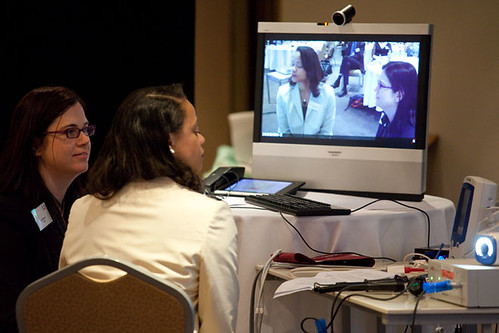


Telemedicine is when you see a doctor (or nurse, PA, etc) over a video call. Medical regulators hate new things, so for its first decade they ensured telemedicine was hard and inconvenient.
Then came COVID-19. Suddenly important politicians were paying attention to questions about whether people could get medical care without leaving their homes. They yelled at the regulators, and the regulators grudgingly agreed to temporarily make telemedicine easy and convenient.
They say “nothing is as permanent as a temporary government program”, but this only applies to government programs that make your life worse. Government programs that make your life better are ephemeral and can disappear at any moment. So a few months ago, the medical regulators woke up, realized the pandemic was over, and started plotting ways to make telemedicine hard and inconvenient again.
The first fruit of their labor is DEA-407, which makes it hard for telemedicine doctors to prescribe controlled substances. Controlled substances are drugs like Adderall, Ritalin, Xanax, or Ambien that the government has declared to be potentially addictive. The new rules say that telemedicine doctors can no longer prescribe these (or, in some cases, can prescribe them one time in an emergency).
Why don’t I like this decision? I am a telepsychiatrist. I work with about a hundred psychiatric patients who, for one reason or another, prefer online to physical appointments:
- Some live in small towns that don’t have psychiatrists of their own
- Some have agoraphobia, chronic pain, or some other condition that makes it hard for them to go to an office.
- Some move around a lot and like to be able to see their psychiatrist whether they’re in LA or SF.
- Some live hundreds of miles away from me, but know and trust me for some reason, and would rather see me than someone closer to them.
- Some appreciate the fact that I charge lower rates than psychiatrists who have offices, because I don’t have to pay for Bay Area commercial real estate and pass those costs on to my patients.
- Some work during work hours, and like being able to see me from their office instead of taking half the day off to travel to my location.
- Some like convenience and dislike inconvenience
As a psychiatrist, a big part of my job is prescribing controlled substances. For example, most guidelines agrees that the first-line treatment for severe ADHD is stimulant medications (eg Adderall or Ritalin). And although psychiatrists hate to admit it, the first-line treatment for temporary crisis anxiety, especially when it’s so bad that the patient isn’t able to listen to your clever plans to solve it with therapy, is benzodiazepines (eg Valium or Klonopin). You can’t be a good well-rounded psychiatrist without the option to sometimes prescribe these drugs.
“Well, your patients will have to find a different psychiatrist, or transition off of them”. Nobody ever finds different psychiatrists. Some of my patients are a bad match for my style or areas of expertise, and I’ve tried very hard to find them different psychiatrists, and it never works. Maybe there are no other psychiatrists in their area. Maybe the psychiatrists in their area don’t take the right insurance, or are too far away from mass transit. Maybe the psychiatrists have six month long wait lists. Sometimes it’s just that my ADHD patients get distracted and forget they were supposed to find new psychiatrists, and I can’t hold their hand literally all the time. As for transitioning off the medications, some patients absolutely cannot function at all without them. Did I mention that if you come off of some of them too quickly, you can literally die?
Comments Off on “Nothing is as permanent as a temporary government program” … except those few that make your life easier
QotD: Revealed preference in the teenage hellscape of high school
This demonization of masculinity conflicts with the reality that any boy can see with his own two eyes: The cutest girls in school are attracted to the most masculine boys, and masculine not just in terms of physical traits, but also in terms of personality traits — confidence, assertiveness, “swagger”. Here we see a problem with what Rational Male author Rollo Tomassi calls the feminine-primary social order. Every observant man knows that there is a yawning chasm between (a) what women say they value most in a man and (b) the kind of man women actually go for. Listen to what women say, and you’d think they are magnetically attracted to “sensitive” guys. Watch what women actually do, and you can see that women obviously don’t actually care about “sensitivity”. Women want men who are tall and muscular and, ceteris parabus, rich, although no amount of money is going to make a short chubby guy sexy. As for the claim that women go for “sensitive” guys, anyone with two eyes and a brain knows this is nonsense. You don’t see throngs of lovestruck college girls chasing after guys who major in sociology or English literature (unless, of course, these guys are also tall, muscular and rich). No, it’s the jocks and frat boys who get the best action on campus, and if you pay attention to the choices women make, you’ll begin to suspect that their professed preference for “sensitive” men is the exact opposite of truth. That girl who was lecturing you about your need to be more “sensitive” will, with surprising regularity, end up falling head-over-heels for some selfish creep or dimwit brute who can’t even spell the word “sensitivity”.
Robert Stacy McCain, “Conflicting Signals”, The Other McCain, 2019-05-23.
Comments Off on QotD: Revealed preference in the teenage hellscape of high school
March 27, 2023
The vicious – not virtuous – circle of green
Elizabeth Nickson thinks that our societal pursuit of green technology will be the undoing of everything we have built:
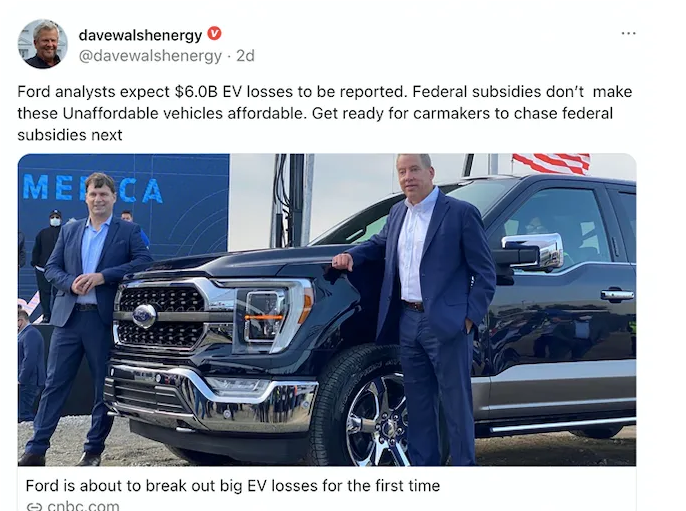
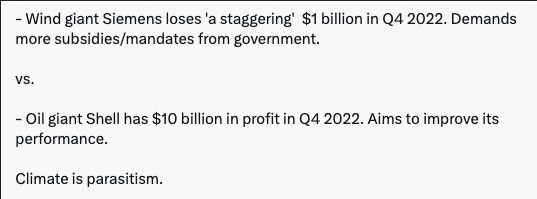
Some of us have been saying this for a very long time: green will bring down the world. Green creates a vicious circle, a term you may remember from Economics 101. It is when the serpent eats itself, no wealth is created and collapse results. That is what we are doing with ESG, with carbon taxes, with the forced adoption of unreliable vertiginously expensive green energy. It has skewed every single market. No one is investing in sound enterprise, and anything once sound is a Jenga tower, unstable, rotting from within. This. This is what threatens to bring down the world.
Green is built on subsidies. And not just government subsidy. Every mutual fund, every hedge fund, every multinational and every local or national corporation has a green monster within preventing innovative investments, sucking profits and growth. Every local, regional and state government leaks millions to green morons promising to “bring sustainable prosperity”. The only prosperity is theirs. They fiddle around in lakes and watercourses, producing “studies”, all of which are hysterical and exaggerated. They muck around in forests, buying as much as possible, shut them down, never visit again, leaving them to desertify. They buy farms and ranches, leaving them to rot. They are termites, eating us alive.
These outfits have burrowed into every level of government and every ministry. They are purely extractive. They do not produce anything of value. They leech. They move in and out of government. When in government, they identify sources of funds to plunder once out of government. In 2015, I did a cross-ministry analysis of just how much money these folks take from the government annually. It is in the hundreds of billions in the US alone. From private foundations they take more billions. All this money is used to shut down economic activity.
[…]
Here is the nasty little secret that lies at the heart of environmentalism. It has been long captured by plutocrats and WEFers, who use it to take resources once thought to belong to the people, to everyone, to use in order to innovate and develop. This freedom and access, and only this was the source of prosperity in the United States. It powered the entire world. It made America the beacon, the lighthouse of the world. It produced strong healthy brilliant young people who performed one feat of innovation, athleticism, and creation after another. All those kids today are working on ever more vicious ways to surveil, control and supress via AI.
And the interior is being cleared of people, businesses, farms, ranches, working forests, mines, and oil and gas installations.
In pursuit of 2030 goals, Biden’s agents are busily acquiring hundreds of millions of acres from private owners, from state and regional land banks, which they will then lock down. Many ranchers, including the heroic Wayne Hage, believe that government is taking that land to use as collateral for its massive debt to the Bank for International Settlements. The only people who will be able to use those resources are multinationals who pay a fee to government and to the BIS to pay down the loans. No citizens will be able to access those resources to make money for themselves, to build families and businesses and towns and cities. The environmental movement has, within 40 years, returned us to serfdom, where we eat what we are told to eat, go where we are told to go, take whatever medicine they want to give us, and eventually, fight when we are told to fight.
The environmental movement is so evil, it has twisted ethical standards to the point where we are able to kill each other with impunity. Their PR is so strong, so invasive, that every school child now believes there are too many people (this is nonsense), and population must be drastically drawn down (a genocide unrivalled in history). Every adult secretly fears this is true. This appalling lie has created a culture of death. What are the effects of this thinking, that life is no longer sacred, but a threat?
Comments Off on The vicious – not virtuous – circle of green
March 26, 2023
Plandemic? Manufactured crisis? Mass formation psychosis?
In The Conservative Woman, James Delingpole lets his skeptic flag fly:

“Covid 19 Masks” by baldeaglebluff is licensed under CC BY-SA 2.0


Tell me about your personal experiences of Covid 19. Actually, wait, don’t. I think I may have heard it already, about a million times. You lost all sense of smell or taste – and just how weird was that? It floored you for days. It gave you a funny dry cough, the dryness and ticklishness of which was unprecedented in your entire coughing career. You’ve had flu a couple of times and, boy, when you’ve got real flu do you know it. But this definitely wasn’t flu. It was so completely different from anything you’ve ever known, why you wouldn’t be surprised to learn that it had been bioengineered in a lab with all manner of spike proteins and gain-of-function additives, perhaps even up to and including fragments of the Aids virus …
Yeah, right. Forgive me for treading on the sacred, personal domain of your lived experience. But might I cautiously suggest that none of what you went through necessarily validates lab-leak theory. Rather what it may demonstrate is the power of susceptibility, brainwashing and an overactive imagination. You lived – we all did – through a two-year period in which health-suffering anecdotes became valuable currency. Whereas in the years before the “pandemic”, no one had been much interested in the gory details of your nasty cold, suddenly everyone wanted to compare notes to see whether they’d had it as bad as you – or, preferably, for the sake of oneupmanship, even worse. This in turn created a self-reinforcing mechanism of Covid panic escalation: the more everyone talked about it, the more inconvertible the “pandemic” became.
Meanwhile, in the real world, hard evidence – as opposed to anecdotal evidence – for this “pandemic” remained stubbornly non-existent. The clincher for me was a landmark article published in January 2021 by Simon Elmer at his website Architects For Social Housing. It was titled “Lies, Damned Lies and Statistics: Manufacturing the Crisis”.
In it Elmer asked the question every journalist should have asked but which almost none did: is this “pandemic” really as serious as all the experts, and government ministers and media outlets and medics are telling us it is? The answer was a very obvious No. As the Office for National Statistics data cited by Elmer clearly showed, 2020 – Year Zero for supposedly the biggest public health threat since “Spanish Flu” a century earlier – was one of the milder years for death in the lives of most people.
Let’s be clear about this point, because something you often hear people on the sceptical side of the argument say is, “Of course, no one is suggesting that Covid didn’t cause a horrific number of deaths.” But that’s exactly what they should be suggesting: because it’s true. Elmer was quoting the Age Standardised Mortality statistics for England and Wales dating back to 1941. What these show is that in every year up to and including 2008, more people died per head of population than in the deadly Covid outbreak year of 2020. Of the previous 79 years, 2020 had the 12th lowest mortality rate.
Covid, in other words, was a pandemic of the imagination, of anecdote, of emotion rather than of measured ill-health and death. Yet even now, when I draw someone’s attention to that ONS data, I find that the most common response I get is one of denial. That is, when presented with the clearest, most untainted (this was before ONS got politicised and began cooking the books), impossible-to-refute evidence that there was NO Covid pandemic in 2020, most people, even intelligent ones, still choose to go with their feelings rather with the hard data.
This natural tendency many of us have to choose emotive narratives over cool evidence makes us ripe for exploitation by the cynical and unscrupulous. We saw this during the pandemic when the majority fell for the exciting but mendacious story that they were living through a new Great Plague, and that only by observing bizarre rituals – putting strips of cloth over one’s face, dancing round one another in supermarkets, injecting unknown substances into one’s body – could one hope to save oneself and granny. And we’re seeing it now, in a slightly different variant, in which lots of people – even many who ought to know better – are falling for some similarly thrilling but erroneous nonsense about lab-leaked viruses.
It’s such a sexy story that I fell for it myself. In those early days when all the papers were still dutifully trotting out World Health Organisation-approved propaganda about pangolins and bats and the apparently notorious wet market (whatever the hell that is) in Wuhan, I was already well ahead of the game. I knew, I just knew, as all the edgy, fearless seekers of truth did that it was a lab leak wot done it. If you knew where to dig, there was a clear evidence trail to support it.
We edgy, fearless truth seekers knew all the names and facts. Dodgy Peter Daszak of the EcoHealth Alliance was in it up to the neck; so too, obviously, was the loathsomely chipper and smugly deceitful Anthony Fauci. We knew that all this crazy, Frankenvirus research had initially been conducted in Chapel Hill, North Carolina, but had been outsourced to China after President Obama changed the regulations and it became too much of a hot potato for US-based labs. And let’s not forget Ukraine – all those secret bio-research labs run on behalf of the US Deep State, but then exposed as the Russians unhelpfully overran territory such as Mariupol.
Comments Off on Plandemic? Manufactured crisis? Mass formation psychosis?
March 25, 2023
South Africa – from bad to indescribably worse
John Psmith reviews South Africa’s Brave New World: The Beloved Country Since The End Of Apartheid by R.W. Johnson. It isn’t a pretty picture at all:

The whole world had come to Pretoria to see the inauguration of Nelson Mandela as the first democratically elected South African President. It was the greatest assemblage of heads of state since John F. Kennedy’s funeral … But it was the flight of nine SAAF [South African Air Force] Mirages overhead, dipping their wings in salute, which brought tears to many eyes. It said so many things: the acceptance of, indeed, the deference to, Mandela by the white establishment, the acknowledgement that he was fully President, able to command all the levers of power — and, for many black people in the crowd, it meant that for the first time the Mirages’ awesome power and white pilots were on their side, part of the same nation … All the products of that white power, including South Africa’s sophisticated economy and infrastructure, were being handed over intact.
A little over a decade later and that same South African Air Force was no longer able to fly. It wasn’t for lack of planes: new ones were procured from European arms manufacturers in an astonishingly expensive and legendarily corrupt deal. But once purchased the planes rotted from lack of maintenance and languished in hangers for lack of anybody able to fly them. Most of the qualified pilots and technicians had been purged, and most of the remainder had resigned. The air force did technically still have pilots, after all it would be a bit embarrassing not to, but those pilots were chosen for patronage reasons and didn’t technically have any idea how to fly a fighter jet.
It isn’t just the air force. That whole “sophisticated economy and infrastructure” that got “handed over intact” now by and large no longer exists. Consider something as basic as running water: in 1994, South Africa had some of the most sophisticated water infrastructure on earth, with a whole system of dams, reservoirs, and long-distance inter-basin conduits working together to conquer the geographical challenges of having several major cities and mining centers located on an arid plateau. All of this water was safe, drinkable, and actually came out of the tap when you turned the handle. This picture was marred of course by poor delivery to black rural communities and squatter camps, but in the early 90s the government was making rapid progress towards serving more of those people too.
Like the air force, that water system is now basically non-functional. It’s estimated that something like 10 million people no longer have reliable access to running water. When the water does run, it’s frequently filthy and contaminated with human sewage. South Africa had its first urban cholera outbreak in the year 2000, and they are now a regular occurrence. Again, like the air force, this isn’t for lack of money or effort. The state has spent billions on trying to fix the water problems, and the government’s water bureaucracy has tripled in size since 1994. Something else has gone wrong.
Neither of these examples is cherry-picked. Ask about literally any of the necessities for human life, and the picture is the same: basically first-world quality under the apartheid Nationalist government, and basically post-apocalyptic today. The electric grid is failing, with rolling blackouts consuming the country on a daily basis. The rail network, once one of the finest on earth, is now so degraded that mines in the North of the country prefer to truck their products overland to ports in Mozambique rather than risk the rail journey to Durban. The medical system was once the jewel of Africa and now teeters on the brink of collapse, with qualified doctors and nurses fleeing the country in droves. As for education, one South African author notes: “When Anthony Sampson’s authorized biography of Mandela appeared one of its more embarrassing asides was that all the educational institutions which had nourished Mandela had since collapsed. A Mandela could be produced in colonial times, but no longer.”
Had enough yet? At last count between a third and a half of the population is unemployed. Public order is non-existent outside gated communities and tourist areas patrolled by private security. The murder rate in South Africa exceeds that of many active war zones. Every major city in South Africa is among the most dangerous cities on earth, and the countryside is much worse than the cities. The reported cases of rape alone establish South Africa as the worst country on earth for rape, and the vast majority of cases are likely unreported, since the police have essentially stopped prosecuting this crime.
Something has gone very wrong. What happened? That’s the subject of this book by R.W. Johnson, an ultra-detailed examination of the 10 or so years following the end of apartheid in 1994. Johnson is the right guy to write this book — he’s lived in South Africa since the 1960s, and was active in the movement against apartheid from its earliest days, so he personally knows most of the players who’ve been running the country. And now he has the bittersweet task of writing a book documenting how what happened is “just what white racists predicted and what white radicals like myself scorned”.
March 24, 2023
From “railway spine” to “shell shock” to PTSD
At Founding Questions, Severian discusses how our understanding of what we now label “Post-Traumatic Stress Disorder” evolved from how doctors visualized bodily ailments over a century ago:

A shell-shocked and physically wounded soldier in the First World War.
I mentioned “shell shock” yesterday, so let’s start there. Medicine in 1914 was still devoted to the “Paris School,” which assumed nothing but organic etiology for all syndromes. Sort of a reverse Descartes — as Descartes (implicitly) “solved” the mind-body problem by disregarding the body, so the “Paris School” of medicine solved it by disregarding the mind. So when soldiers started coming back from the front with these bizarre illnesses, naturally doctors began searching for an organic cause. (That’s hardly unique to the Paris School, of course; I’m giving you the context to be fair to the 1914 medical establishment, whose resistance to psychological explanations otherwise seems so mulish to us).
They’d noticed something similar in the late 19th century, with industrial accidents and especially train crashes. When a train crashed, the people in the first few cars were killed outright, those in the next few wounded, but the ones in the back were often physically fine. But within a few hours to weeks, they started exhibiting all kinds of odd symptoms. Hopefully you’ve never been in a train crash, but if you’ve ever been in a fender-bender you’ve no doubt experienced a minor league version of this.I hit a deer on the highway once. Fortunately I was at highway speed, and hit it more or less dead on (it jumped out as if it were committing suicide), so it got thrown away from the car instead of coming through the windshield. The car’s front end was wrecked, naturally, but I was totally fine. I don’t think the seatbelt lock even engaged, much less the airbag, since I didn’t even have time to hit the brakes.
The next few hours to days were interesting, physiologically. It felt like my body was playing catch up. I had an “oh shit, I’m gonna crash!!!” reaction about 45 minutes after I’d pulled off to the side of the road, duct-taped the bumper back on as best I could, and continued to my destination. All the stuff I would have felt had I seen the deer coming came flooding in. Had I not already been where I was going, I would’ve needed to pull over, because that out of the blue adrenaline hit had my hands shaking, and my vision fuzzed out briefly.
The next morning I was sore. I had all kinds of weird aches, as if I’d just played a game of basketball or something. I assume part of it actually was the impact — it didn’t feel like much in the moment, but if it’s enough to crumple your car’s front end (and it was trashed), it’s enough to give you a pretty good jolt. That would explain soreness in the arms, elbows, and shoulders — a stiff-armed, white-knuckle grip on the steering wheel, followed by a big boom. But I was also just kinda sore all over, plus this generalized malaise. I felt not-quite-right for the next few days. Nothing big, no one symptom I can really put my finger on, but definitely off somehow — a little twitchy, a little jumpy, and really tired.
Having done my WWI reading, I knew what it was, and that’s when I really understood the doctors’ thought processes. I really did take some physical damage, because I really did receive a pretty good full-body whack. It just wasn’t obvious to the naked eye. And since everyone has experienced odd physical symptoms from being rattled around, or even sleeping on a couch or sprung mattress, it makes sense — the impact obviously jiggled my spine, which probably accounts for a great many of the physical symptoms. Hence, “railway spine”. And from there, “shell shock” — nothing rattles your back like standing in a trench or crouching in a dugout as thousands of pounds of high explosive go off around you. It must be like going through my car crash all day, every day.
Skip forward a few decades, and we now have a much better physiological understanding of what we now call (and I will henceforth call) Post-Traumatic Stress Disorder (PTSD). There’s a hypothesis that I personally believe, that “shell shock” is also a whole bunch of micro-concussions as well as “classic” PTSD, but let’s leave that aside for now. The modern understanding of PTSD is largely about chemistry. Cortisol and other stress chemicals really fuck you up. They have systemic physical and mental effects. If those chemicals don’t get a chance to flush out of your system — if you’re in a trench for weeks on end, let’s say — the effects are cumulative, indeed exponential.
Returning to my car crash: I was “off” for a few days because my body got a huge jolt of stress chemicals. That odd not-quite-right thing I felt was those chemicals flushing through. Had I gone to a shrink at that moment, he probably would’ve diagnosed me with PTSD. But I didn’t have PTSD. I had a perfectly normal physiological reaction to a big shot of stress chemicals. If I’d gotten into car crash after car crash, though, day in and day out, that would’ve been PTSD. I’d be having nightmares about that deer every night, instead of just the once. And all that would have cumulative, indeed exponential, effects.
He then goes on to cover similar physical reactions to stimuli in modern life, so I do recommend you RTWT.
Comments Off on From “railway spine” to “shell shock” to PTSD
A very different take on the Wuhan Coronavirus pandemic
At The Conservative Woman, Dr. Mike Yeadon lays out his case for doubting that there ever actually was a novel coronavirus in the first place:

Wuhan Institute of Virology.
Wikimedia Commons.
I’ve grown increasingly frustrated about the way debate is controlled around the topic of origins of the alleged novel virus, SARS-CoV-2, and I have come to disbelieve it’s ever been in circulation, causing massive scale illness and death. Concerningly, almost no one will entertain this possibility, despite the fact that molecular biology is the easiest discipline in which to cheat. That’s because you really cannot do it without computers, and sequencing requires complex algorithms and, importantly, assumptions. Tweaking algorithms and assumptions, you can hugely alter the conclusions.
This raises the question of why there is such an emphasis on the media storm around Fauci, Wuhan and a possible lab escape. After all, the “perpetrators” have significant control over the media. There’s no independent journalism at present. It is not as though they need to embarrass the establishment. I put it to readers that they’ve chosen to do so.
So who do I mean by “they” and “the perpetrators”? There are a number of candidates competing for this position, with their drug company accomplices, several of whom are named in Paula Jardine’s excellent five-part series for TCW, Anatomy of the sinister Covid project. High on the list is the “enabling” World Economic Forum and their many political acolytes including Justin Trudeau and Jacinda Ardern.
But that doesn’t answer the question why are they focusing on the genesis of the virus. In my view, they are doing their darnedest to make sure you regard this event exactly as they want you to. Specifically, that there was a novel virus.
I’m not alone in believing that myself at the beginning of the “pandemic”, but over time I’ve seen sufficient evidence to cast strong doubt on that idea. Additionally, when considered as part of a global coup d’état, I have put myself in the position of the most senior, hidden perpetrators. In a Q&A, they would learn that the effect of a released novel pathogen couldn’t be predicted accurately. It might burn out rapidly. Or it might turn out to be quite a lot more lethal than they’d expected, demolishing advanced civilisations. Those top decision-makers would, I submit, conclude that this natural risk is intolerable to them. They crave total control, and the wide range of possible outcomes from a deliberate release militates against this plan of action: “No, we’re not going to do this. Come back with a plan with very much reduced uncertainty on outcomes.”
The alternative I think they’ve used is to add one more lie to the tall stack of lies which has surrounded this entire affair. This lie is that there has ever been in circulation a novel respiratory virus which, crucially, caused massive-scale illness and deaths. In fact, there hasn’t.
Instead, we have been told there was this frightening, novel pathogen and ramped up the stress-inducing fear porn to 11, and held it there. This fits with cheating about genetic sequences, PCR test protocols (probes, primers, amplification and annealing conditions, cycles), ignoring contaminating genetic materials from not only human and claimed viral sources, but also bacterial and fungal sources. Why for example did they need to insert the sampling sticks right into our sinuses? Was it to maximise non-human genetic sequences?
Notice the soft evidence that our political and cultural leaders, including the late Queen, were happy to meet and greet one another without testing, masking or social distancing. They had no fear. In the scenario above, a few people would have known there was no new hazard in their environment. If there really was a lethal pathogen stalking the land, I don’t believe they’d have had the courage or the need to act nonchalantly and risk exposure to the virus.
Most convincingly for me is the US all-cause mortality (ACM) data by state, sex, age and date of occurrence, as analysed by Denis Rancourt and colleagues. The pattern of increased ACM is inconsistent with the presence of a novel respiratory virus as the main cause.
If I’m correct that there was no novel virus, what a genius move it was to pretend there was! Now they want you only to consider how this “killer virus” got into the human population. Was it a natural emergence (you know, a wild bat bit a pangolin and this ended up being sold at a wet market in Wuhan) or was it hubristically created by a Chinese researcher, enabled along the way by a researcher at the University of North Carolina funded by Fauci, together making an end run around a presidential pause on such work? Then there’s the question as to whether the arrival of the virus in the general public was down to carelessness and a lab leak, or did someone deliberately spread it?
Comments Off on A very different take on the Wuhan Coronavirus pandemic
QotD: The academic specializations of the Great Library
Which means it is perhaps less surprising to learn, on examining the sources, that the Great Library was actually celebrated mainly for a specialisation which is about as far from modern science as possible: the study of poetry. This makes some sense, given that the Mouseion was dedicated to the Muses, four of whom represented forms of verse. The works of Homer, in particular, were a primary focus of study across the Greek world and his poems permeated thought, writing and everyday speech rather like the works of Shakespeare and the texts of the Bible do today. It was the scholars of the Mouseion who, on gathering and comparing copies of the Illiad and Odyssey from across the Greek-speaking world, noticed textual differences large and small and established the kind of textual analysis still used by editors to this day; working to determine the best possible text from the manuscript variants. Other works of Greek poetry, such as the odes of Pindar, were also analysed and studied in a similar way, as were the works of the great Athenian playwrights.
The importance of literary studies at the Mouseion can be seen by analysing the specialisations of the men we know were directors of the institution and therefore “librarians” of the Great Library. […] of these scholars, only Eratosthenes is known for doing anything that we would consider “science”, the others were devoted to literary and textual analysis, poetry and grammar. Of course, these scholars were polymaths and most of them would probably have ranged over many topics including areas of mathematics and natural philosophy; Eratosthenes himself was nicknamed “Beta” because he covered so many disciplines he was something of a jack of all trades and master of none, so his colleagues mocked him as “Number 2” in all subjects. That aside, the idea that the Mouseion was a major centre of scientific speculation is at best an exaggeration and largely yet another fantasy.
Tim O’Neill, “The Great Myths 5: The Destruction Of The Great Library Of Alexandria”, History for Atheists, 2017-07-02.
March 22, 2023
California – Embrace the Unicorn! No, the other Unicorn!
Chris Bray on California’s hoped-for path to transition away from fossil fuels:
California has the progressive vision to go all-electric, with laws and regulations that phase out gas water heaters, furnaces, and cars in the near future — while transitioning away from the production of electricity through the use of nuclear and natural gas technologies. Putting the teensy-weensy engineering questions aside and embracing the unicorn, this deep blue vision of the future means the state needs to build wind and solar power facilities in massive quantities, and now. California currently has about half the power it needs to do what it says it plans to do in just ten years.
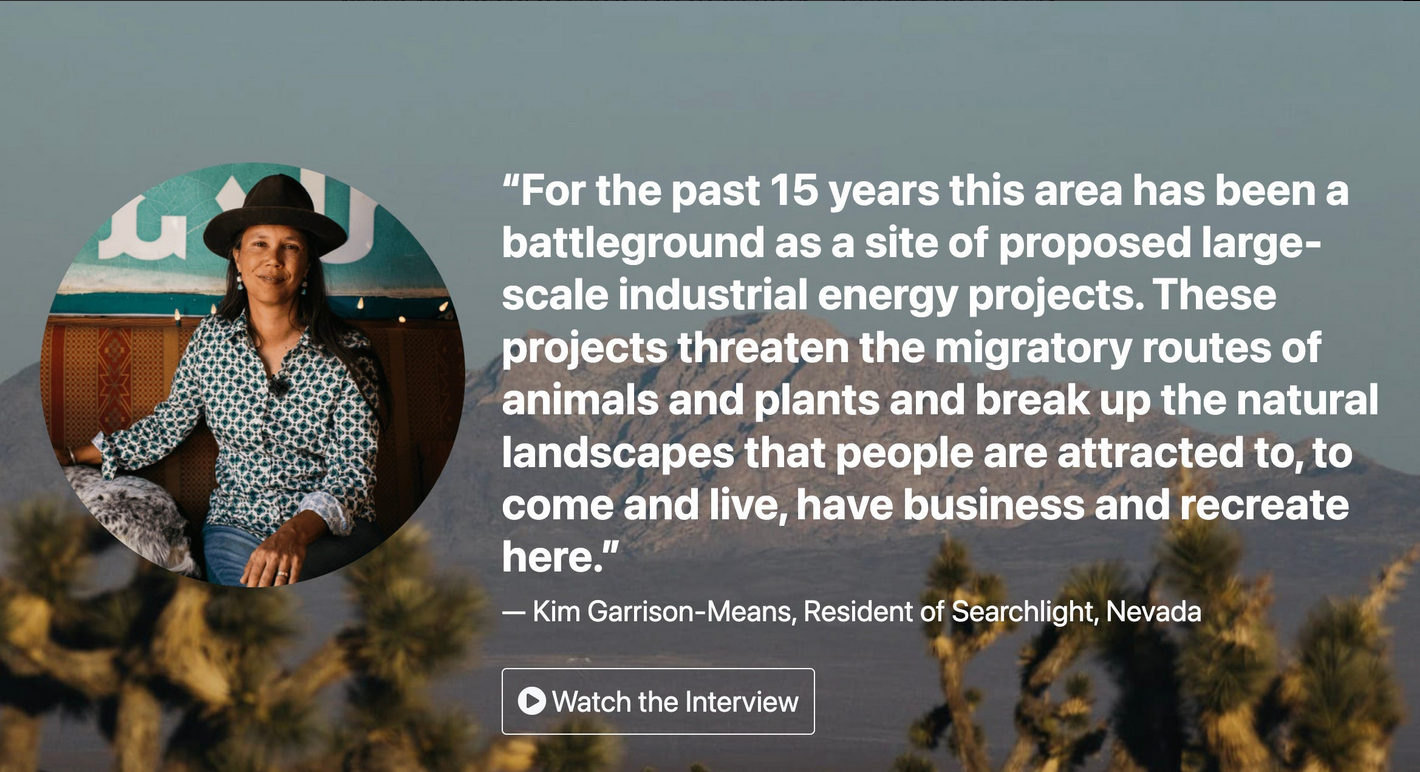
But President Joe Biden just announced a move that aggressively advances the progressive vision of preserving wilderness and preventing development, naming the Avi Kwa Ame National Monument in the Mojave Desert — preventing solar and wind development on 506,814 acres of lightly populated and federally owned desert land. The coalition of tribal and community groups that has worked to get the national monument designated make the anti-solar point explicit on their website:
Where progressive coastal urbanites see the progressive project of decarbonization, people in wilderness-adjacent areas see industrial blight, and express that view in the language of progressive conservationism. To a degree not explored by the false binary of media-defined American politics, in which good people on the left face bad people on the right, California’s future is an increasingly sharp conflict between left and left — and note what kind of permits energy companies have to get to build big wind and solar plants in the desert:
When progressive California builds its progressive energy infrastructure, it’s going to incidentally take a shit-ton of bighorns and tortoises and birds. I assume I don’t have to explain the euphemism.

Comments Off on California – Embrace the Unicorn! No, the other Unicorn!
March 18, 2023
QotD: Experts outside their field of expertise
The first time I really encountered this phenomenon (outside of obvious examples such as the political and economic opinions of Hollywood celebrities) was related to climate change. I don’t see them as often today, but for a while it used to be very common for letters to circulate in support of climate change science signed by hundreds or thousands of scientists.
The list of signatures was always impressive, but when you looked into it, there was a problem: few if any of the folks who signed had spent any time really looking at the details of climate science — they were busy happily studying subatomic particles or looking for dark energy in space. It turned out most of them had fallen for the climate alarmist marketing ploy that opposition to catastrophic man-made global warming theory was by people who were anti-science. And thus by signing the letter they weren’t saying they had looked into it all and confirmed the science looked good to them, they were merely saying they supported science.
When some of them looked into the details of climate science later, they were appalled. Many have reached the same general conclusions that I have, that CO2 is certainly causing some warming but the magnitude of that warming or in particular the magnitude and direction of its knock on effects like floods or droughts or tornadoes, is far from settled science.
So it is often the case that people who show strong support for ideas or people outside of their domain do so for reasons other than having made use of their expertise and experience to take a deep dive into the issues. Theranos is a great example from the business world. Elizabeth Holmes convinced a bunch of men (and they were mostly all men — women seemed to have more immunity to her BS) who were extraordinarily successful in their own domains (George Schultz, the Murdochs, Henry Kissinger, Larry Ellison) to become passionate believers in her vision. Which is fine, it was a lovely vision. But they spent zero time testing whether she could really do it, and worse, refused to countenance any reality checks about problems Theranos was facing because Holmes convinced them that critics were just bad-intentioned people representing nefarious interests who wanted her vision to fail.
Warren Meyer, “People Who Express Opinions Outside of their Domain Seldom Have Really Looked into it Much”, Coyote Blog, 2019-05-28.
Comments Off on QotD: Experts outside their field of expertise
March 15, 2023
Not only is the science “settled” … it’s already in the school textbooks
David Friedman on his attempts to follow up on claims made in a textbook on climate change already in use in US public schools:
Introduction to Modern Climate Change by Andrew Dessler is an elementary climate science textbook, now in its third edition. In Chapter 9, “Impacts of Climate Change”, it has:
Scientists predict that sea level will rise 47 to 73 cm (19 to 29 inches) above 1995–2014 levels by 2100. This may not sound like a significant challenge, but it is much larger than the 18 cm of sea level experienced over the twentieth century, which is already challenging for many who live near sea level. Like temperature, these predictions of sea-level rise might sound small but, also like temperature, they are not. In Florida, for example, a sea-level rise in the middle of the projected range would inundate 9 percent of Florida’s current land area at high tide. This includes virtually all of the Florida Keys as well as 70 percent of Miami-Dade County. Almost one-tenth of Florida’s current population, or nearly 2 million people, live in this vulnerable zone, and it includes residential real estate valued at hundreds of billions of dollars. It also includes important infrastructure, such as two nuclear reactors, three prisons, and 68 hospitals.
That struck me as implausible, given what else I had seen on the effect of sea level rise. The footnote for the claim was to Stanton and Ackerman (2007), which turned out to be not a peer reviewed journal article but a report commissioned by the Environmental Defense fund, an environmentalist group. It includes the same claims, but for 27 inches of sea-level rise not the 24 inches that is Dessler’s “middle of the projected range”. It refers the reader to Appendix C for “detailed sources and methodology”. Going there, I found:
To estimate the impact of sea-level rise on land area, populations, and public and private assets and infrastructure, we began with a 1:250,000 Digital Elevation Model (DEM) map of the State of Florida, and divided the state into “vulnerable” and “not vulnerable” zones demarcated by 1.5 meters of elevation and other factors described by Titus and Richman (2000) as corresponding to 27 inches of sea-level rise.
So what they are showing as the vulnerable area is not the 27 inch or 24 inch contour but the 1.5 meter (5 feet) contour. The explanation, from Titus, J.G. and C. Richman (2001). “Maps of lands vulnerable to sea level rise: modeled elevations along the US Atlantic and Gulf coasts“. Climate Research 18: 205–228, a journal article written by two EPA people and presumably peer reviewed:
Thus, at a typical site, the 1.5-meter contour would be flooded by spring high tides (i.e., high tides during new and full moons) when sea level rises 80 cm
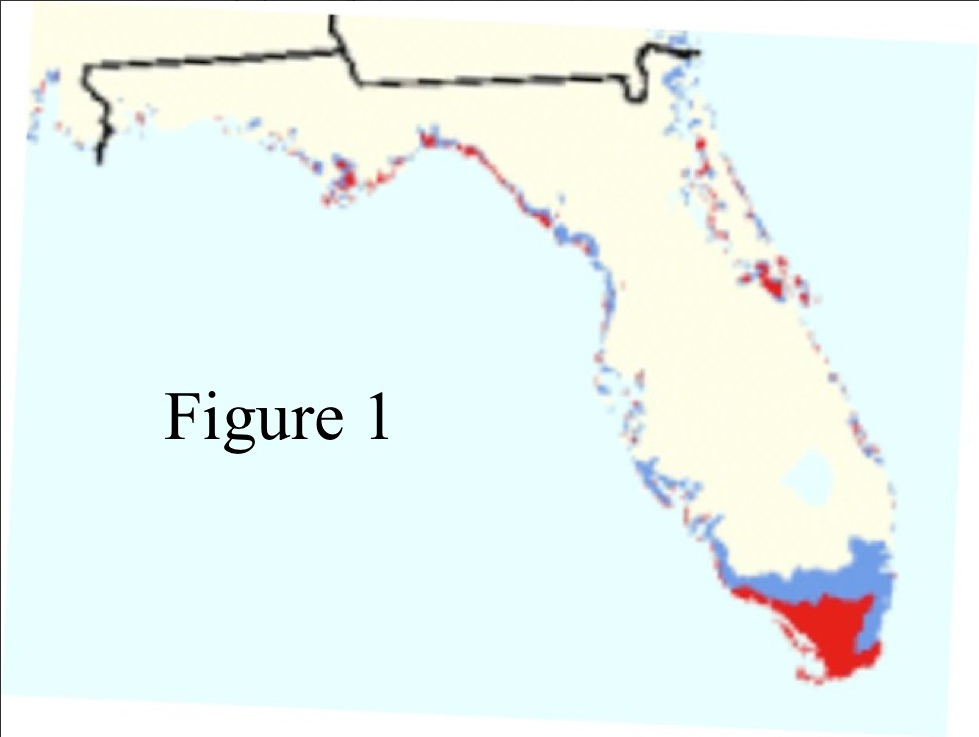
Figure 1 below (Titus and Richman Figure 4) is a map of Florida with the region within the 1.5 meter contour colored red, the region between 1.5 and 3.5 blue. Dessler’s middle of the projected range is 60 cm. Stanton and Ackerman’s 27 inches is 68.6 cm. The map shows what its authors claim would be flooded at 80cm.
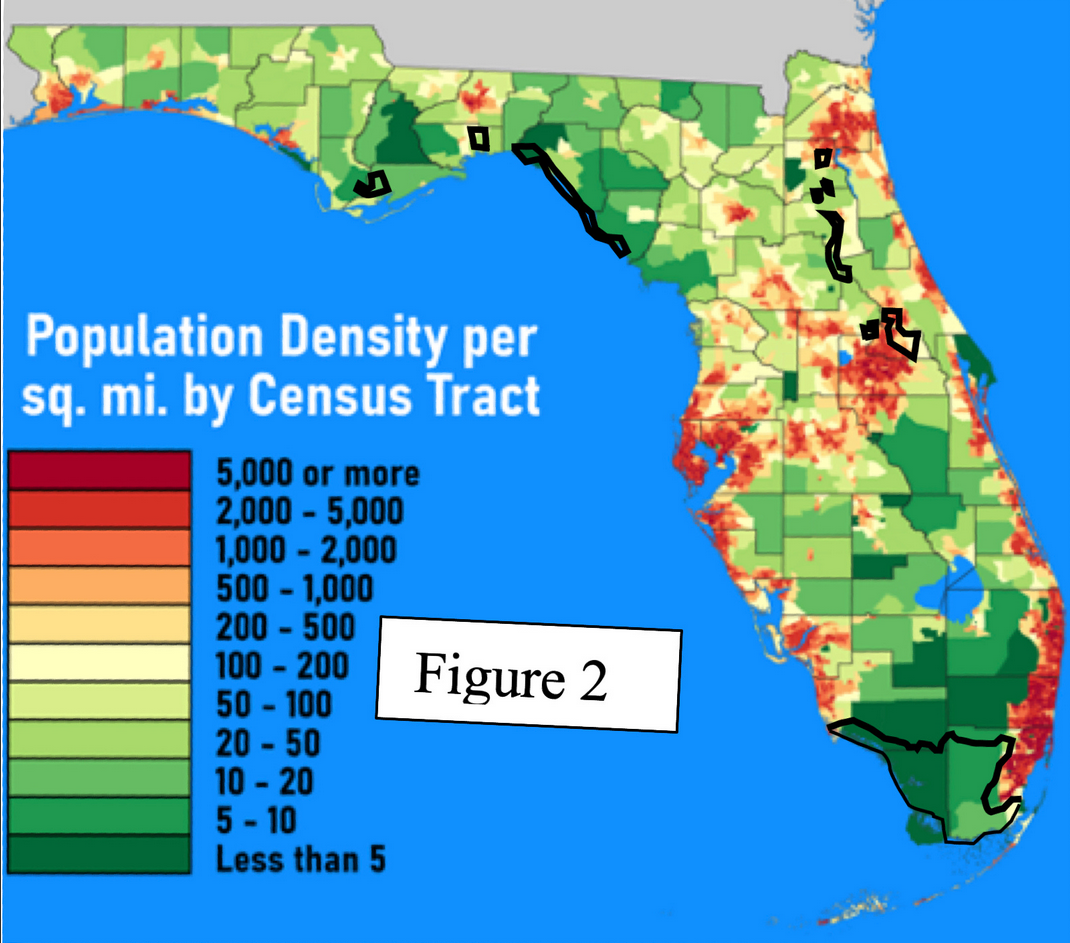
Figure 2 below is a population density map of Florida from Wikipedia to which I have added the 1.5m contours from Figure 1. The large flooded area on the southern tip of Florida includes none of the densely populated area around Miami; only one of the tiny areas farther north appears to be in part on a populated area. That is not surprising — areas very close to sea level are likely to be marsh, in this case the everglades, and poor places to build on.
Stanton and Ackerman claim that their own calculations, using data bases of elevation and population, produce a total population in the at-risk area of 1.5 million. That was the figure Dessler gave in his first edition, presumably increased to almost 2 million in the third edition to reflect the increase in Florida’s population. Figure 2 shows why I don’t believe it. The flooded areas are in places almost all of which have very low population density, making it hard to see how flooding nine percent of the land area, most of it in the everglades, can flood almost ten percent of the population. Even if all of the Florida Keys are flooded, their total population is only about 80,000.
That problem is in addition to the fact that Dessler’s claim is for 60 cm of sea level rise, Stanton and Ackerman’s, from which Dessler got his figure for how many people are flooded, is for 68.6 cm (27 inches), and Titus and Richman get the 1.5 m contour that Stanton and Ackerman say they are using by assuming 80cm of sea level rise. Further reasons for suspicion are that Stanton and Ackerman gave figures for sea level rise substantially higher than either the IPCC figure at the time or the current IPCC figure, which suggests that they were trying to make the consequences of climate change look as scary as possible, and that they write “1.5 meters of elevation and other factors described by Titus and Richman (2000) as corresponding to 27 inches of sea-level rise” when Titus and Richman actually describe 1.5 meters as corresponding to 80 cm (31.5 inches) of sea level rise.
Comments Off on Not only is the science “settled” … it’s already in the school textbooks
Mining the moon would be “harmful” to indigenous people, say activists
Among the many, many things that are said to be harmful to indigenous culture we’re now told to include any kind of Lunar exploitation as modern colonialism:
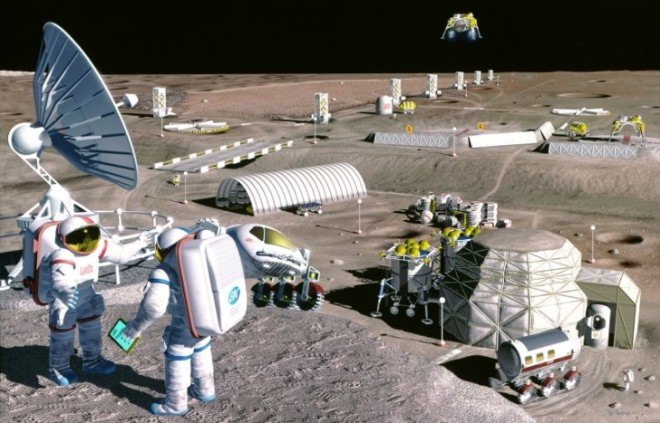
Artist’s conception of Helium-3 mining on the surface of the Moon.
Image from Inhabitat.com
Humans have boldly ventured beyond the Earth into space for more than half a century now. It’s a testament to the ambition of the modern world.
And today, humanity is still more ambitious. A new space race is underway between the US and China to mine the Moon for rare metals. NASA is even hoping to establish a long-term presence on the Moon and eventually send humans to Mars.
But it seems that some scientists-cum-activists, in hock to identity politics, want to rein in that ambition. Speaking ahead of a US conference on the ethics of space exploration, held by the American Association for the Advancement of Science (AAAS) last week, astrobiologist Dr Pamela Conrad told the Guardian that space exploration, particularly efforts to mine the Moon, is in danger of becoming an exercise in “colonialism” and “exploitation”. Conrad warned that “if something that’s not here [on Earth] is seen as a resource, just ripe to be exploited, then that [perpetuates] colonialism”.
Conrad’s fellow panellist at the conference, Dr Hilding Neilson, went even further. According to Neilson, a member of the Native American Mi’kmaq people, indigenous people have a deep connection with celestial bodies like the Moon. They therefore have a more profound and, by implication, superior “way of knowing” the Moon compared with those advocating space exploration. The latter merely see the Moon “as a dead object to be conquered”, Neilson says – meaning that those advocating space exploration are “essentially cheering on the history of colonialism”.
There are so many problems with this argument it’s difficult to know where to start. Both Conrad and Neilson appear to be using the specific and brutal practice of “colonialism” to describe – and demonise – humanity’s attempt to master nature in general. That’s a flawed enough approach to take to the history of our growing mastery of nature on Earth. But it’s even more flawed in the context of space.
After all, there’s one big difference between laying claim to the resources of other countries under colonialism and attempting to mine the Moon – nobody lives on the Moon! So no one would be “exploited” or “colonised” if humans were to mine it. Space exploration is therefore not the same as colonialism.
Comments Off on Mining the moon would be “harmful” to indigenous people, say activists


