
Explanation was the real business of medicine. What the ill patient and his family wanted most was to know the name of the illness, and then, if possible, what had caused it, and finally, most important of all, how it was likely to turn out
[…]
During the third and fourth years of [medical] school it gradually dawned on us that we didn’t know much that was really useful, that we could do nothing to change the course of the great majority of the diseases we were so busy analyzing, that medicine, for all its façade as a learned profession, was in real life a profoundly ignorant occupation
[…]
Once you were admitted [to hospital] … it became a matter of waiting for the illness to finish itself one way or the other … Medicine made little or no difference.
Lewis Thomas, The Youngest Science, 1983, quoted by John Derbyshire in “The Scariest Science”, Taki’s Magazine, 2014-11-13.
December 30, 2015
QotD: Medicine before antibiotics
December 29, 2015
QotD: The health benefits of moderate drinking
Should we consider mandatory graphic warning labels on bottles of booze? Our science reporter Tom Blackwell reviewed various Canadian discussions of the idea in these pages yesterday, suggesting that it is being looked at behind the scenes by addiction researchers. Labels with colour images of diseased esophagi on liquor labels would, of course, mimic the approach Canada has already taken toward cigarettes. So, well, why not? They say if you have a hammer, everything looks like a nail: by a similar token, if your field is addiction, no doubt everything that has addictive qualities looks like an unsolved problem.
But there is one very obvious way in which liquor is not like cigarettes: scientists are reasonably sure that light drinking has positive public-health consequences. If you don’t believe me, you can look up articles like the one I have in front of me here from a 2013 issue of Annals of Oncology: its title is “Light Drinking Has Positive Public Health Consequences.” As a layman I obviously can’t be certain I have summarized this editorial correctly, but you’ll have to trust me.
Colby Cosh, “The real problem with liquor warning labels — there’s such a thing as good drinking”, National Post, 2015-12-17.
December 26, 2015
Moderate drinking and statistical health outcomes
Aaron Carroll debunks some myths about booze and health:
Over the past year, I’ve tried to clear up a lot of the misconceptions on food and drink: about salt, artificial sweeteners, among others, even water.
Now let me take on alcohol: wine, beer and cocktails. Although I have written about the dangerous effects of alcohol abuse and misuse, that doesn’t mean it’s always bad. A part of many complex and delicious adult beverages, alcohol is linked to a number of health benefits in medical studies.
That doesn’t mean the studies provide only good news, either, or that the evidence in its favor is a slam dunk. You won’t be surprised to hear that, once again, my watchword — moderation — applies.
Research into how alcohol consumption affects health has been going on for a long time. A 1990 prospective cohort study included results of more than 275,000 men followed since 1959. Compared with those who never drank alcohol, those who consumed one to two drinks a day had a significantly reduced mortality rate from both coronary heart disease and “all causes.” Those who consumed three or more drinks a day still had a lower risk of death from coronary heart disease, but had a higher mortality rate over all.
A 2004 study came to similar conclusions. It followed about 6,600 men and 8,000 women for five years and found that compared with those who drank about one drink a day on average, those who didn’t drink at all and those who drank more than two drinks a day had higher rates of death. Results like these have been consistent across a number of studies in different populations. Even studies published in the journal Alcoholism: Clinical and Experimental Research agree that moderate drinking seems to be associated with a decreased risk of death over all.
However, alcohol seems to have different effects on different diseases. Almost all of the major benefits of drinking are seen in cardiovascular illnesses. In fact, with men, even consumption of a surprisingly large amount can seem protective.
December 23, 2015
SpaceX Falcon 9 performs successful launch and controlled landing
William Harwood reports for CBS News:
Making its first flight since a catastrophic launch failure last June, an upgraded, more powerful SpaceX Falcon 9 rocket roared to life and shot into space Monday, boosting 11 small Orbcomm data relay satellites into orbit in a major milestone for the California rocket builder.
In a significant space “first,” the Falcon 9’s first stage fell back into the atmosphere and pulled off a powered landing at the Cape Canaveral Air Force Station, settling to a smooth tail-first touchdown in a convincing demonstration of reusability, a key requirement for lowering commercial launch costs.
In a scene resembling a launch video running in reverse, the booster quickly dropped out of a cloudy sky atop a jet of flame from one of its Merlin 1D engines, heralded by twin sonic booms that rumbled across Florida’s Space Coast. Cheers erupted in company headquarters in Hawthorne, California, as the stage settled to a smooth touchdown.
In another first, the Falcon 9 used colder, denser-than-usual liquid oxygen and kerosene propellants, a significant upgrade allowing the booster’s nine first-stage engines to generate more power, increasing their combined liftoff thrust from 1.3 million pounds to 1.5 million, or 170,000 pounds of thrust per engine.
The launch, first-stage landing and satellite deployments all appeared to proceed without a hitch, a welcome success for a company returning to flight after a disheartening failure.
“Everything we’ve seen thus far in the mission appears to be perfect,” SpaceX founder Elon Musk said in a conference call with journalists. “The satellites were deployed right on target and the Falcon 9 booster came back and landed. Looks like almost dead center on the landing pad. … As far as we can see right now, it was absolutely perfect. We could not have asked for a better mission.”
There and back again pic.twitter.com/Ll7wg2hL1G
— Elon Musk (@elonmusk) December 22, 2015
December 21, 2015
QotD: Witches
It turns out that witchcraft beliefs arise in surprisingly similar forms in many parts of the world, which suggests either that there really are witches or (more likely) that there’s something about human minds that often generates this cultural institution. The Azande believed that witches were just as likely to be men as women, and the fear of being called a witch made the Azande careful not to make their neighbors angry or envious. That was my first hint that groups create supernatural beings not to explain the universe but to order their societies.
Jonathan Haidt, quoted by Scott Alexander in “List Of The Passages I Highlighted In My Copy Of Jonathan Haidt’s The Righteous Mind“, Slate Star Codex, 2014-06-12.
December 16, 2015
To lower healthcare costs, increase the competition
At Mother Jones, Kevin Drum links to an article that explicitly shows the cost of having monopoly providers in healthcare:
Regular readers of this blog should know that when it comes to the price of hospital care, it’s competition that matters, not insurance companies. In areas with only a single hospital, insurance companies have no leverage and have to accept whatever price the hospital charges. If there are lots of hospitals, they have to compete with each other to earn the insurance company’s business.
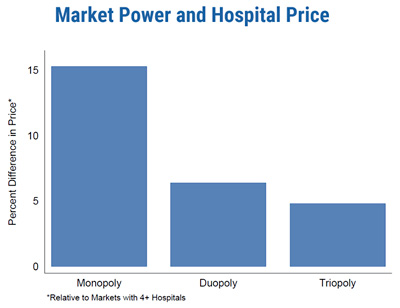
But in case you’re still skeptical, a team of researchers has analyzed a huge database of health care claims in the US to check this out. They found enormous regional variation in hospital costs for the same procedure, and one of the biggest drivers of this variation was competition:
Hospital market structure stands out as one of the most important factors associated with higher prices, even after controlling for costs and clinical quality. We find that hospitals located in monopoly markets have prices that are about 15.3 percent higher than hospitals located in markets with four or more providers. This result is robust across multiple measures of market structure and is consistent in states where the HCCI data contributors (and/or Blue Cross Blue Shield insurers) have high and low coverage rates.
Chipotle gains “green cred PR opportunities” and worse health outcomes for customers
Henry Miller on the Faustian bargain Chipotle willingly made and is now paying for:
Chipotle, the once-popular Mexican restaurant chain, is experiencing a well-deserved downward spiral.
The company found it could pass off a fast-food menu stacked with high-calorie, sodium-rich options as higher quality and more nutritious because the meals were made with locally grown, genetic engineering-free ingredients. And to set the tone for the kind of New Age-y image the company wanted, Chipotle adopted slogans like, “We source from farms rather than factories” and, “With every burrito we roll or bowl we fill, we’re working to cultivate a better world.”
The rest of the company wasn’t as swift as the marketing department, however. Last week, about 140 people, all but a handful Boston College students, were recovering from a nasty bout of norovirus-caused gastroenteritis, a foodborne illness apparently contracted while eating Chipotle’s “responsibly raised” meats and largely organic produce.
And they’re not alone. The Centers for Disease Control and Prevention has been tracking another, unrelated Chipotle food poisoning outbreak in California, Illinois, Maryland, Minnesota, New York, Ohio, Oregon, Pennsylvania and Washington, in which victims have been as young as one year and as old as 94. Using whole genome sequencing, CDC investigators identified the DNA fingerprint of the bacterial culprit in that outbreak as E. coli strain STEC O26, which was found in all of the sickened customers tested.
Outbreaks of food poisoning have become something of a Chipotle trademark; the recent ones are the fourth and fifth this year, one of which was not disclosed to the public. A particularly worrisome aspect of the company’s serial deficiencies is that there have been at least three unrelated pathogens in the outbreaks – Salmonella and E. coli bacteria and norovirus. In other words, there has been more than a single glitch; suppliers and employees have found a variety of ways to contaminate what Chipotle cavalierly sells (at premium prices) to its customers.
QotD: The truth about beauty
There are certain practical realities of existence that most of us accept. If you want to catch a bear, you don’t load the trap with a copy of Catch-22 — not unless you rub it with a considerable quantity of raw hamburger. If you want to snag a fish, you can’t just slap the water with your hand and yell, “Jump on my hook, already!” Yet, if you’re a woman who wants to land a man, there’s this notion that you should be able to go around looking like Ernest Borgnine: If you’re “beautiful on the inside,” that’s all that should count. Right. And I should have a flying car and a mansion in Bel Air with servants and a moat.
Welcome to Uglytopia — the world reimagined as a place where it’s the content of a woman’s character, not her pushup bra, that puts her on the cover of Maxim. It just doesn’t seem fair to us that some people come into life with certain advantages — whether it’s a movie star chin or a multimillion-dollar shipbuilding inheritance. Maybe we need affirmative action for ugly people; make George Clooney rotate in some homely women between all his gorgeous girlfriends. While we wish things were different, we’d best accept the ugly reality: No man will turn his head to ogle a woman because she looks like the type to buy a turkey sandwich for a homeless man or read to the blind.
There is a vast body of evidence indicating that men and women are biologically and psychologically different, and that what heterosexual men and women want in partners directly corresponds to these differences. The features men evolved to go for in women — youth, clear skin, a symmetrical face and body, feminine facial features, an hourglass figure — are those indicating that a woman would be a healthy, fertile candidate to pass on a man’s genes.
These preferences span borders, cultures, and generations, meaning yes, there really are universal standards of beauty. And while Western women do struggle to be slim, the truth is, women in all cultures eat (or don’t) to appeal to “the male gaze.” The body size that’s idealized in a particular culture appears to correspond to the availability of food. In cultures like ours, where you can’t go five miles without passing a 7-Eleven and food is sold by the pallet-load at warehouse grocery stores, thin women are in. In cultures where food is scarce (like in Sahara-adjacent hoods), blubber is beautiful, and women appeal to men by stuffing themselves until they’re slim like Jabba the Hut.
Amy Alkon, “The Truth About Beauty”, Psychology Today, 2010-11-01.
December 15, 2015
Hillary Clinton’s well-intentioned plans will make the prescription medicine market even worse
Another older post from Megan McArdle on the nice-soundbites-but-terrible-economic-notions from the Hillary Clinton campaign to fix the prescription medicine marketplace:
Hillary Clinton thinks drug development should be riskier, and less profitable. Also, your health insurance premiums should be higher. And there should be fewer drugs available.
This is not, of course, how the Clinton campaign would put it. The official line is that Americans are just paying too darn much for drugs, and she has a plan to stop that:
- Regulate direct-to-consumer advertising more heavily, and strip its tax deductibility
- Require drug companies to spend a certain percentage of revenue on research and development, or face penalty payments and the loss of their R&D tax credit (I am inferring that this is what she is talking about, since the actual language of the proposal is long on paeans to the importance of federal research funding and short on details)
- Cap out-of-pocket costs for drugs
- Reduce the exclusivity period for biologic drugs
- Prohibit companies from making side payments to generic manufacturers to keep generic competition off the market
- Allow drug reimportation
- Require that new treatments be proved to be a substantial improvement over existing treatments — i.e., eliminate the dreaded “me too” drugs
- Allow Medicare to “negotiate” drug prices
Eliminating the side payments seems eminently sensible. (Yes, yes, you can strip my libertarian card, but market-rigging contracts shouldn’t be enforced.) It also seems reasonable to require some sort of comparative effectiveness research. Other provisions will certainly drive down drug prices, at the risk of also driving down innovation.
Still other provisions, however, are simply bad economics. In what other market do we worry about having a second product available that’s merely just as good as the first? Should we really only have one antidepressant, one statin, one blood pressure medication, and so forth? Might there be variation among patients so that drugs that are statistically about equally effective in large groups are nonetheless individually more or less effective for different people? Might one drug’s side effects be better tolerated by some patients than another’s? Might having two drugs in the category help keep prices down?
Then there is notion that we should force pharmaceutical companies to spend a set percentage of their revenues on R&D. This seems to me to be … what’s the word I am looking for? Ah, I’ve got it: “insane.”
[…]
Economically, large parts of this plan make little sense. Politically, many of these items would be very difficult to pass, not least because the Congressional Budget Office would assess the likely effects and would make it sound much less appealing than it does in a gauzy stump speech. But away from those harsh realities, purely as campaign rhetoric, it probably works very well.
Asthma and the “Hygiene Hypothesis”
An older report at the BBC News website discusses recent research into childhood asthma:
Being exposed to “good bacteria” early in life could prevent asthma developing, say Canadian scientists.
The team, reporting in Science Translational Medicine, were analysing the billions of bugs that naturally call the human body home.
Their analysis of 319 children showed they were at higher risk of asthma if four types of bacteria were missing.
Experts said the “right bugs at the right time” could be the best way of preventing allergies and asthma.
In the body, bacteria, fungi and viruses outnumber human cells 10 to one, and this “microbiome” is thought to have a huge impact on health.
The team, at the University of British Columbia and the Children’s Hospital in Vancouver, compared the microbiome at three months and at one year with asthma risk at the age of three.
Children lacking four types of bacteria – Faecalibacterium, Lachnospira, Veillonella, and Rothia (Flvr) – at three months were at high risk of developing asthma at the age of three, based on wheeze and skin allergy tests.
The same effect was not noticed in the microbiome of one-year-olds, suggesting that the first few months of life are crucial.
Further experiments showed that giving the bacterial cocktail to previously germ-free mice reduced inflammation in the airways of their pups.
One of the researchers, Dr Stuart Turvey, said: “Our longer-term vision would be that children in early life could be supplemented with Flvr to look to prevent the ultimate development of asthma
“I want to emphasise that we are not ready for that yet, we know very little about these bacteria, [but] our ultimate vision of the future would be to prevent this disease.”
December 13, 2015
The TPP is pretty far from being a genuine “free trade” deal
Last week, Kevin Williamson attempted to explain why the Trans Pacific Partnership isn’t all that similar to an actual “free trade” agreement (and why that’s so):
Prominent among the reasons to look askance at TPP is that its text calls for the incorporation — sight unseen — of whatever global-warming deal is negotiated at the conference currently under way in Paris. It is one thing for a trade deal to incorporate changes to environmental practices — regulatory differences are an inhibitor of truly liberal trade — but there is a world of difference between incorporating specific environmental policies and incorporating environmental policies to be named later.
It would be preferable if we could simply enact a series of bilateral “Goldberg treaties,” so called in honor of my colleague Jonah Goldberg, who argued that an ideal free-trade pact would consist of one sentence: “There shall be free trade between …” But the unhappy reality is that the snouts of the nations’ sundry regulatory apparatuses are so far up the backsides of various industries and economic sectors that sorting them out requires thousands of pages of text. Consider, for example, the problem of defense-acquisition practices. Some countries have rules mandating that defense procurement be restricted to domestic firms, and some countries don’t. Coming up with a harmonized, one-size-fits-all approach is difficult; we Americans, accustomed as we are to operating in an economy that produces the best of almost everything in the world, sometimes forget that there are countries with no domestic aerospace industry or sophisticated manufacturers of military materiel. Of course Kuwait goes abroad for military gear; if memory serves, at one point their air force uniforms were made by Armani.
[…]
All of which is to say, we should expect trade deals, especially multi-lateral trade deals, to be complex, and we should expect environmental and labor standards, along with government procurement procedures and the like, to be part of the accord. There’s no getting around it. And, again, there is nothing wrong in principle with using trade accords, which have real economic bite, as a critical instrument for enforcing environmental rules and other regulatory reforms that are incorporated into trade relationships. But using TPP to commit the United States to whatever is cooked up in Paris, without an additional vote in Congress, is a poor tradeoff. It’s not often that I will turn up my nose at a trade deal — even far-from-perfect trade pacts are generally desirable — but here we should draw the line. TPP was negotiated, Congress and the public have had a chance to review the text, and Congress should reject it. That’s the system working, not the system failing to work. It’s why we have votes.
December 11, 2015
Mark Steyn on the “decorum” of the US Senate
Mark Steyn writes about his appearance before the Senate sub-committee on Space, Science and Competitiveness:
On the morning of the event, Senator Bill Nelson, the Florida Democrat and Ranking Member, sent a message, warning me that I was obligated to “respect the decorum of the Senate”. I’ve been invited to Buckingham Palace, the White House and parliaments around the world, and nobody has ever felt it necessary to pre-issue such a warning. In the event, the US Senate has no “decorum” worthy of respect, as we’ll get to in a moment.
[…]
I said above that the Senate had no “decorum” to disrespect. By that I mean that, when my pal Ezra Levant and I gave evidence (as we say in the Westminster tradition) in the Canadian Parliament, members from all parties turned up and asked thoughtful and engaged questions. When we run into each other in Montreal, the representatives of the Bloc Québécois and I do not even agree on what country we’re in. But that afternoon we had a pleasant and civilized exchange, and one that had some rewardingly non-partisan after-glow in the months that followed.
In the US Senate, at least on Tuesday, senators wander in and out constantly. Their five-minute “question” sessions are generally four-minute prepared statements of generalized blather followed by a perfunctory softball to “their” witness, after which they leave the room without waiting to hear the answer – and then come back in when it’s their time to speak again at which point the staffer feeds them the four-minute blather they’re supposed to be sloughing off this time round. The video doesn’t capture the fakery of the event because under Senate rules the camera is generally just on whoever’s speaking. Whether this meets the “decorum” of the Senate, it certainly doesn’t meet the decorum of life; it’s a breach of the normal courtesies – and, frankly, Americans are the chumps of the planet for putting up with it. Since the 17th Amendment, senators have been citizen-legislators like any other, and so their contempt for the citizenry who have graciously consented, at their own time and expense to appear before them, demonstrates a profound misunderstanding of the relationship.
Take this guy Brian Schatz, the Senator from Hawaii. He did his shtick, lobbed a softball at his witness, Rear Admiral Titley, and stood up to leave. I said I’d like to respond, and he demurred on the grounds that he was outta there, he had to get back to washing his hair or whatever. I said I’d still like to respond to what he said, and so I did – to an empty chair. A pseudo-parliament is a fine place in which to debate pseudo-science, but “decorum” has nothing to do with it.
There is another kind of basic rudeness, which I have never experienced in a real parliament. If you’re moderating a panel discussion on C-SPAN with five panelists, it’s generally considered polite to distribute the questions broadly. In this case, the Democrats asked no questions of anyone other than their guy – Rear Admiral Titley. For example, there was some extensive discussion of the satellite record: They have the scientist who created and developed the satellite temperature record sitting at one end of the table: John Christy. This is a remarkable scientific accomplishment. Yet they directed all their questions on the subject to the bloke down the other end – Rear Admiral Titley, who knows no more about the satellite record than I do. This is like inviting Sir Isaac Newton to a hearing on gravity and then only asking questions of Mr Timeserver sitting next to him. It may represent the “decorum” of the Senate but in any other area of life it would be regarded as insufferably ill-mannered.
December 9, 2015
SF “war in space” memes of improbability
Charles Stross explains several SF novel shibboleths that make him want to hurl the book against the nearest wall, including so many “war in space” stories:
Newton’s Second Law, for dummies. E = 1/2 * (mv2) — it’s not just a good idea, it’s the law. Notice the huge distances I alluded to above? Well, to get between planet A and planet B in anything approximating reasonable human time spans, you need to go fast. And if you go fast, your velocity relative to the bodies around you is also high. In event of an inelastic collision the kinetic energy transfer is proportional to the square of your velocity; and this has drastic consequences for space ships. Suppose you’re in low Earth orbit and you hit a piece of space junk, for example a screw that’s fallen off someone else’s ship. It’s traveling in pretty much the same orbit as you, but inclined at 30 degrees. What happens? What happens is you get a happy fun experience much like being hit by a bullet from a high-calibre sniper’s rifle, because (I can’t be bothered to do the trig here) it’s packing a velocity component angled across your path at a goodly fraction of orbital velocity, and at orbital velocity a kilogram of water packs kinetic energy equal to about ten times its mass in exploding TNT.
You know what a high-speed car crash looks like, right? Space ships travel a lot faster than that: if they hit something, it’s going to be very messy indeed. And that’s at sluggish orbital velocities; if you starship is barreling along at about 85% of the speed of light general relativity has something to say on the subject and it’s kinetic energy is equal to about half it’s rest mass — the equivalent of a 10 megaton hydrogen bomb for every kilogram of hull weight. (The pilot’s space-suited body alone packs the energetic punch of a Peak Strangelove 1980s USA/USSR strategic nuclear exchange.)
Human bodies are basically squishy sacks of goopy grease and water emulsions held together by hydrogen bonds and disulphide bridges between protein molecules and glommed onto some big lumps of high-grade chalk. We evolved in a forgiving, water-dominated low-velocity world where evolution didn’t bequeath us nervous systems able to comprehend and deal with high energy interactions other than in an “ooh, that lightning bolt was close! Where’s cousin Ugg?” kind of way. We can’t even see objects that flash across our visual field in less than 50 milliseconds — a duration in which, at orbital velocity, an object will have travelled on the order of half a kilometer.
Intuition and high energy regimes: do the math, or your space combat will be a whole bundle of nope.
(Other related cognitive errors include but are not limited to: Napoleonic navies clashing in space and firing broadsides back and forth at one another’s line of battle … spaceships with continuous high acceleration fusion-powered motors or similar that don’t glow white-hot then melt because vacuum is an insulator and shedding that much heat is a hard engineering problem (hint: a 100 ton spaceship accelerating at 1g requires 1 megaJoule of thrust: using a photon rocket for maximum efficiency that’s going to require 3 x 10¹⁵ watts of juice going in, if it’s 99.9% effective at heat dissipation that means it’s racking up around three terawatt of leakage, and that’s equivalent to about 45 kilotons of nuclear explosions per minute of waste heat) … warships using active radar to hunt for one another (hint: active sensor reach is inversely proportional to the fourth power of the emission strength, passive sensors obey the inverse square law) … warships using stealth in space (hint: infrared emissions, second hint: the background temperature you want to avoid standing out against is 2.73 degrees Kelvin, i.e. liquid Helium temperature) …
Oh for fuck’s sake, don’t get me started on war in space, we’ll be here forever unless we just throw physics to the winds of fiction and delegate all our hand-waving to magic hyperspace or cyberspace technology or something.
QotD: Masochism and the modern woman
“If He Doesn’t Hit You, He Doesn’t Love You.” So runs an African proverb. Or a Russian proverb, according to other sources. Or a Bolivian proverb, according to still others. Perhaps it is all three. A similar Latin American saying, “The more you hit me, the more I love you,” turns up over 100,000 hits on Google.
It is hardly a new idea that female sexuality has a masochistic component. Indeed, this seems to be part of the folk wisdom of the world; in other words, it corresponds the observations of many persons of both sexes across many generations. Yet it is not easy to find extended discussion of it. Within the past century, most writing on the subject has been beholden to the Freudian tradition, a circumstance that does not inspire confidence. A more hopeful sign may be the sizable feminist literature aimed at refuting “the myth of female masochism.” If nothing else, such literature is testimony to the enduring reality of the corresponding folk belief; no one writes polemics against things that have absolutely no basis in reality.
It is not hard to understand why persons of both sexes are reluctant to talk about female masochism. No one wants to appear to be condoning the abuse of women. A prime component of masculinity is the instinct to protect women. In the European tradition, this has given rise to the principle that “a gentlemen never strikes a lady.” Pushing gallantry to the point of silliness, as usual, Thomas Fleming writes in Chronicles that “there is something unmanly about beating women, unmanly and sickening.”
But what if there is something in at least some women that responds positively to male violence?
F. Roger Devlin, “The Question of Female Masochism”, Counter-Currents Publishing, 2014-09-17.
December 8, 2015
Still more to learn about the human immune system
A brief post at Real Clear Science on a recent discovery in human immunology:
Think again if you thought that doctors had long since identified and described exactly how the body defends itself against microorganisms.
Scientists have recently discovered a whole new side to the immune system: a rapid immune response that kicks in well before any of the other known mechanisms.
“I hate to use the term ‘text books will write about this’, but this [discovery] really is brand new and we will need to write a new chapter,” says co-author Søren R. Paludan, professor of virology and immunology form the Department of Biomedicine, Aarhus University, Denmark.
In collaboration with groups from the US and Germany, the scientists showed that when the body’s outer defence, the mucosa lining that surrounds certain organs, is disturbed by a virus, the underlying layer of cells are the first to react and sound the alarm. They summon the body’s cell soldiers, which attack the invading virus.
Both this alarm system and the ‘soldier’ cells operate completely separately from what were believed to be the first responders to immune system attacks.


