
BAHFest
Published on Dec 11, 2017Watch Louie Terrill at BAHFest London 2017 present his theory, “Making sure we’re all in this together: Why the Kessler Syndrome is key to humanity’s future.”
BAHFest is the Festival of Bad Ad Hoc Hypotheses, a celebration of well-researched, logically explained, and clearly wrong scientific theory. Additional information is available at http://bahfest.com/
January 3, 2018
BAHFest London 2017 – Louie Terrill: Why the Kessler Syndrome is key to humanity’s future
Comments Off on BAHFest London 2017 – Louie Terrill: Why the Kessler Syndrome is key to humanity’s future
December 27, 2017
QotD: Psychology
Psychology is nothing at all like a science and those who practice it are nothing at all like scientists. Mostly they’re liberals. No two shrinks ever agree on a diagnosis, and official definitions of various mental illnesses are a grammatical and logical laugh riot. The great truth of life is that understanding character is an art, best left to master novelists and story-tellers.
L. Neil Smith, “Why the Left-Wing Seems Insane (Mostly Because They Are)”, Libertarian Enterprise, 2016-05-08.
Comments Off on QotD: Psychology
December 21, 2017
UFOs? Again?
I must admit I share Colby Cosh’s just disproven belief that we were done with the UFO craze:
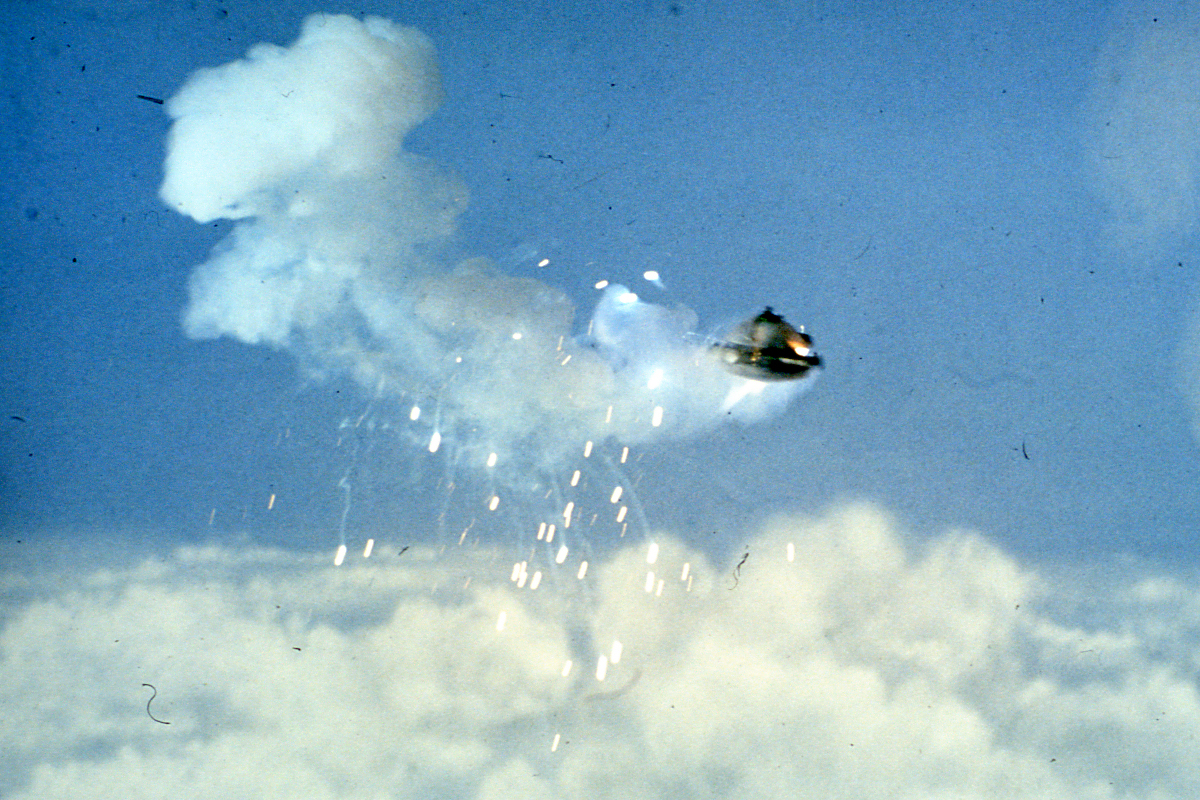
Yeah, I know: wrong UFO
There can no longer be any doubt: every fashion phenomenon does come back. I, for one, really thought we had seen the last of UFO-mania. When I was a boy, the idea of stealthy extraterrestrial visitors zooming around in miraculous aircraft was everywhere in the nerdier corners of popular culture. If you liked comic books or paperback science fiction or Omni magazine — and especially if those things were among the staples of your imaginative diet — there was no getting away from it.
Anyone remember the NBC series Project U.F.O. (1978-79), inspired by the USAF’s real Project Blue Book program? As the anthology show’s Wikipedia page observes, most episodes had the plot of a Scooby-Doo cartoon, only backwards: they would end with the investigating protagonists discovering that UFOs remained impenetrably Unidentifiable, but must be “real” craft capable of physically improbable manoeuvres. (I know citing Wikipedia will savour of pumpkin-spice holiday laziness on my part, but the Scooby thing is a truly perceptive point by some anonymous Wiki-genius.)
Then, at the end of the show, a disclaimer would appear on-screen: “The U.S. Air Force stopped investigating UFOs in 1969. After 22 years, they found no evidence of extra-terrestrial landings and no threat to national security.”
[…]
There are very good reasons for a superpower’s military apparatus to devote a little money to following up UFO sightings. “Threat Identification”? Sure, whatever. Plenty of U.S. military flyers have seen UFOs, and these people ought to be comfortable reporting odd occurrences without ridicule. But if I were American, I would definitely want most of that budget to go to Scully rather than Mulder. Don’t throw cash at someone who really, really wants to believe.
What I find vexing is that most of the response to the Times story has been in the spirit of “Whoa, aliens!” rather than “Taxpayers got robbed.” Young people may know on some level that ubiquitous good-quality cameras have all but eliminated civilian UFO sightings. But they lack the personal memory of a live, thriving UFO fad, one that bred quasi-scholarly international UFO-study associations along with a whole publishing industry devoted to UFO tales. I wonder if the Times’ piece on UFO research, by the very virtue of its flat-voiced Grey Lady objectivity, is having the same weird effect as that disclaimer they showed at the end of Project U.F.O.
December 17, 2017
QotD: Modern eco-paganism
… consider the emergence of a Nature-worshipping environmentalism that would have been viewed as a crazy luxury in the hardscrabble times of 1800 or even of 1933. The economist and student of theology Robert Nelson calls environmentalism the new religion of the West (a West that nonetheless, outside of places like Poland or the United States, imagines itself to be irreligious) […] The economist and think-tank maven Fred L. Smith, Jr. speaks of “eco-paganism”: “Most environmentalists do not, of course, see themselves as pagans,” he writes. “Yet many do espouse a watered-down form of pantheism which elevates nature to near the status of a deity.” By now the good people of rich and secular places such as Sweden, though contemptuous of the childish absurdity (as most Swedes believe it to be) of their ancestors’ worship of a Lutheran God, have found their transcendent in the worship of Nature, and spend their Sunday mornings devoutly gathering mushrooms and lingonberries in Nature’s forest.
Deirdre McCloskey, Bourgeois Equality, 2016.
Comments Off on QotD: Modern eco-paganism
December 13, 2017
Why do we have Pubic Hair? – BRITLAB
BBC Earth Lab
Published on 18 Dec 2014Contains adult themes. Greg Foot looks at why humans have pubic hair – investigating the hormones that cause growth, and the benefits of shaving vs letting it grow.
Comments Off on Why do we have Pubic Hair? – BRITLAB
December 10, 2017
QotD: Failures of scientific consensus
In past centuries, the greatest killer of women was fever following childbirth. One woman in six died of this fever. In 1795, Alexander Gordon of Aberdeen suggested that the fevers were infectious processes, and he was able to cure them. The consensus said no. In 1843, Oliver Wendell Holmes claimed puerperal fever was contagious, and presented compelling evidence. The consensus said no. In 1849, Semmelweiss demonstrated that sanitary techniques virtually eliminated puerperal fever in hospitals under his management. The consensus said he was a Jew, ignored him, and dismissed him from his post. There was in fact no agreement on puerperal fever until the start of the twentieth century. Thus the consensus took one hundred and twenty five years to arrive at the right conclusion despite the efforts of the prominent “skeptics” around the world, skeptics who were demeaned and ignored. And despite the constant ongoing deaths of women.
There is no shortage of other examples. In the 1920s in America, tens of thousands of people, mostly poor, were dying of a disease called pellagra. The consensus of scientists said it was infectious, and what was necessary was to find the “pellagra germ.” The US government asked a brilliant young investigator, Dr. Joseph Goldberger, to find the cause. Goldberger concluded that diet was the crucial factor. The consensus remained wedded to the germ theory. Goldberger demonstrated that he could induce the disease through diet. He demonstrated that the disease was not infectious by injecting the blood of a pellagra patient into himself, and his assistant. They and other volunteers swabbed their noses with swabs from pellagra patients, and swallowed capsules containing scabs from pellagra rashes in what were called “Goldberger’s filth parties.” Nobody contracted pellagra. The consensus continued to disagree with him. There was, in addition, a social factor — southern States disliked the idea of poor diet as the cause, because it meant that social reform was required. They continued to deny it until the 1920s. Result — despite a twentieth century epidemic, the consensus took years to see the light.
Probably every schoolchild notices that South America and Africa seem to fit together rather snugly, and Alfred Wegener proposed, in 1912, that the continents had in fact drifted apart. The consensus sneered at continental drift for fifty years. The theory was most vigorously denied by the great names of geology — until 1961, when it began to seem as if the sea floors were spreading. The result: it took the consensus fifty years to acknowledge what any schoolchild sees.
And shall we go on? The examples can be multiplied endlessly. Jenner and smallpox, Pasteur and germ theory. Saccharine, margarine, repressed memory, fiber and colon cancer, hormone replacement therapy. The list of consensus errors goes on and on.
Finally, I would remind you to notice where the claim of consensus is invoked. Consensus is invoked only in situations where the science is not solid enough. Nobody says the consensus of scientists agrees that E=mc2. Nobody says the consensus is that the sun is 93 million miles away. It would never occur to anyone to speak that way.
Michael Crichton, “Aliens Cause Global Warming”: the Caltech Michelin Lecture, 2003-01-17.
Comments Off on QotD: Failures of scientific consensus
December 9, 2017
QotD: Staying beautiful
To understand what it takes to be beautiful, we need to be very clear about what being beautiful means — being sexually appealing to men. And then, instead of snarling that male sexuality is evil, we need to accept that it’s just different — far more visually-driven than female sexuality. To focus our efforts, we can turn to an increasing number of studies by evolutionary psychologists on what most men seem to want. For example, the University of Texas’ Devendra Singh discovered that men, across cultures, are drawn to a woman with an hourglass figure. Men like to see a woman’s waist — even on the larger ladies — so burn those muumuus, which only reveal your girlish figure in a Category 5 hurricane, and if you don’t have much of a waist, do your best to give yourself one with the cut of your clothes or a belt.
Too many women try to get away with a bait-and-switch approach to appearance upkeep. If you spend three hours a day in the gym while you’re dating a guy, don’t think that you can walk down the aisle and say “I do…and, guess what…now I don’t anymore!” A woman needs to come up with a workable routine for maintaining her looks throughout her lifetime and avoid rationalizing slacking off — while she’s seeking a man and after she has one. Yeah, you might have to put five or ten extra minutes into prettying up just to hang around the house. And, sure, you might be more “comfortable” in big sloppy sweats, but how “comfortable” will you be if he leaves you for a woman who cares enough to look hot for him?
Like French women, we, too, need to understand that a healthy approach to beauty is neither pretending it’s unnecessary or unimportant nor making it important beyond all else. By being honest about it, we help women make informed decisions about how much effort to put into their appearance — or accept the opportunity costs of going ungroomed. The truth is, like knowledge, beauty is power. So, ladies, read lots of books, develop your mind and your character, exercise the rights the heroes of the women’s movement fought for us to have, and strive to become somebody who makes a difference in the world. And, pssst…while you’re doing all of that, don’t forget to wear lipgloss.
Amy Alkon, “The Truth About Beauty”, Psychology Today, 2010-11-01.
Comments Off on QotD: Staying beautiful
December 8, 2017
QotD: Why mid-20th century Americans ate what they did – 7
Entertaining was mandatory [in the 1950s]. Because people didn’t go to restaurants so much, they spent time having people over, or eating at someone else’s house. If someone had you over, you had to have them over. This meant people had to have “company dinners” they could make, or at least a stock of canapés they could throw together for a cocktail party, even if they weren’t very good at it. Cue the weird focus on prettying everything up, more than occasionally to the detriment of the food itself: if you can’t make it good, you can at least make it pretty, to show people you made an effort.
Megan McArdle, “Friday Food Post: The Economics Behind Grandma’s Tuna Casseroles”, Bloomberg View, 2015-10-30.
Comments Off on QotD: Why mid-20th century Americans ate what they did – 7
December 7, 2017
QotD: Why mid-20th century Americans ate what they did – 6
Look at the sources of our immigrants. Immigration is still the major way that countries get new foods (if you don’t believe me, go out for Mexican food in any European country and report back). With the notable exception of the Italians, in the 19th century, most immigrants were from places with short growing seasons and bland cuisines, heavy on the cream and carbohydrates. After we restricted immigration in the 1920s, that’s what we were left with until immigrants started coming again in the 1960s. Of course, Louisiana had good French food, California and Texas had a Mexican influence, but by and large what we ate in 1960 was about what you’d expect from a German/English/Irish/Eastern European culinary heritage, adapted for modern convenience foods. And people liked it for the same reason I like jello salad: It’s what they were used to.
Megan McArdle, “Friday Food Post: The Economics Behind Grandma’s Tuna Casseroles”, Bloomberg View, 2015-10-30.
Comments Off on QotD: Why mid-20th century Americans ate what they did – 6
December 6, 2017
QotD: Why mid-20th century Americans ate what they did – 5
There were a lot of bad cooks around. These days, people who don’t like to cook, or aren’t good at it, mostly don’t. They can serve a rich variety of prepared foods, and enjoy takeout and restaurants. Why would you labor over something you hate, when someone else will sell you something better for only slightly more than it would cost you to make something bad?
In 1950, the answer was “because we’re not made of money.” A restaurant meal was a special treat, not a nightly event, and prepared foods were not so widely available, in part because women tended not to work, but also because food processing technology was so advanced. So women had to cook whether they liked it or not. Many of them didn’t like it, so they looked for ways to reduce the labor involved. And it’s far from obvious that what they did with those shortcuts was worse than what they would have done without them. Think of the kind of casserole a bad cook might have made without canned soup and frozen vegetables. She’d probably have boiled the vegetables, because that’s the easiest way to prepare them, and boiled them to death, because she wasn’t too fussy about timing. (Out of season, those vegetables would have been limited to a few hearty root vegetables.) If there was a sauce, it probably would have been horrible. Let’s not even start on what she might have done with the meat. Canned soup and frozen vegetables start sounding pretty good.
That was the baseline most people were working off. They were not comparing what they ate to what they might have gotten at a good restaurant; they were comparing it to what they would have gotten without the shortcuts, because, to reiterate, most of them rarely ate at a good restaurant.
Modern food writing has an enormous selection bias. The median cookbook reader is a much better cook, and much more interested in food, than the median audience of recipes from decades past. The bad cooks, the indifferent cooks, the folks with the cast iron palates and Teflon stomachs, are all off doing something else. And since good cooks tend to raise good cooks, the median food writer waxing lyrical about Grandma’s homemade beef stew doesn’t realize just how many bad cooks were around. Or that recipes needed to be written for them, because however limited their talents or interest, they still had to put a meal on the table every night. A lot of terribly mediocre recipes are floating around from the era, and that’s exactly what most of the terribly mediocre cooks were looking for.
Megan McArdle, “Friday Food Post: The Economics Behind Grandma’s Tuna Casseroles”, Bloomberg View, 2015-10-30.
Comments Off on QotD: Why mid-20th century Americans ate what they did – 5
December 5, 2017
QotD: Why mid-20th century Americans ate what they did – 4
The foods of today’s lower middle class are the foods of yesterday’s tycoons. Before the 1890s, gelatin was a food that only rich people could regularly have. It had to be laboriously made from irish moss, or calf’s foot jelly (a disgusting process), or primitive gelatin products that were hard to use. The invention of modern powdered gelatin made these things not merely easy, but also cheap. Around 1900, people were suddenly given the tools to make luxury foods. As with modern Americans sticking a flat panel television in every room, they went a bit wild. As they did again when refrigerators made frozen delights possible. As they did with jarred mayonnaise, canned pineapple, and every other luxury item that moved down-market.
Of course, they still didn’t have a trained hired cook at home, so the versions that made their way into average homes were not as good as the versions that had been served at J.P. Morgan’s table in 1890. But it was still exciting to be able to have a tomato aspic for lunch, in the same way modern foodies would be excited if they found a way to pull together Nobu’s menu in a few minutes, for a few cents a serving.
Over time, the ubiquity of these foods made them déclassé. Just as rich people stopped installing wall-to-wall carpeting when it became a standard option in tract homes, they stopped eating so many jello molds and mayonnaise salads when they became the mainstay of every church potluck and school cafeteria. That’s why eating those items now has a strong class connotation.
Megan McArdle, “Friday Food Post: The Economics Behind Grandma’s Tuna Casseroles”, Bloomberg View, 2015-10-30.
Comments Off on QotD: Why mid-20th century Americans ate what they did – 4
December 4, 2017
QotD: Why mid-20th century Americans ate what they did – 3
People were poorer. Household incomes grew enormously, and as they did, food budgets shrank relative to the rest of our consumption. People in the 1960s also liked steak and chicken breasts better than frankfurters and canned meats. But most of them couldn’t afford to indulge their desires so often.
The same people who chuckle at the things done with cocktail franks and canned tuna will happily eat something like the tripe dishes common in many ethnic cuisines. Yet tripe has absolutely nothing to recommend it as a food product, except that it is practically free; almost anything you cooked with tripe would be just as good, if not better, without the tripe in it. If you understand why folks ate Trippa alla Romana, you should not be confused about the tuna casserole or the creamed chipped beef on toast.
Megan McArdle, “Friday Food Post: The Economics Behind Grandma’s Tuna Casseroles”, Bloomberg View, 2015-10-30.
Comments Off on QotD: Why mid-20th century Americans ate what they did – 3
December 3, 2017
QotD: Why mid-20th century Americans ate what they did – 2
A lot of the ingredients we take for granted were expensive and hard to get. Off-season, fresh produce was elusive: The much-maligned iceberg lettuce was easy to ship, and kept for a long time, making it one of the few things you could reliably get year round. Spices were more expensive, especially relative to household incomes. You have a refrigerator full of good-looking fresh ingredients, and a cabinet overflowing with spices, not because you’re a better person with a more refined palate; you have those things because you live in 2015, when they are cheaply and ubiquitously available. Your average housewife in 1950 did not have the food budget to have 40 spices in her cabinets, or fresh green beans in the crisper drawer all winter.
Megan McArdle, “Friday Food Post: The Economics Behind Grandma’s Tuna Casseroles”, Bloomberg View, 2015-10-30.
Comments Off on QotD: Why mid-20th century Americans ate what they did – 2
December 2, 2017
QotD: Why mid-20th century Americans ate what they did – 1
Most people are not that adventurous; they like what’s familiar. American adults ate what they did in the 1950s because of what their parents had served them in the 1920s: bland, and heavy on preserved foods like canned pineapple and mayonnaise.
Megan McArdle, “Friday Food Post: The Economics Behind Grandma’s Tuna Casseroles”, Bloomberg View, 2015-10-30.
Comments Off on QotD: Why mid-20th century Americans ate what they did – 1
December 1, 2017
QotD: The power of beauty
We consider it admirable when people strive to better themselves intellectually; we don’t say, “Hey, you weren’t born a genius, so why ever bother reading a book?” Why should we treat physical appearance any differently? For example, research shows that men prefer women with full lips, smaller chins, and large eyes — indicators of higher levels of estrogen. Some lucky women have big eyes; others just seem to, thanks to the clever application of eyeshadow. As the classic commercial says, “Maybe she’s born with it. Maybe it’s Maybelline.” (If it increases her options, who cares which it is?)
Unfortunately, because Americans are so conflicted and dishonest about the power of beauty, we approach it like novices. At one end of the spectrum are the “Love me as I am!” types, like the woman who asked me why she was having such a terrible time meeting men…while dressed in a way that advertised not “I want a boyfriend” but “I’m just the girl to clean out your sewer line!” At the other extreme are women who go around resembling porn-ready painted dolls. Note to the menopausal painted doll: Troweled on makeup doesn’t make you look younger; it makes you look like an aging drag queen.
Likewise, being 50 and trying to look 25 through plastic surgery usually succeeds in making a woman look 45 and fembot-scary — an object of pity instead of an object of desire. Plastic surgery you can easily spot is usually a sign — either of really bad work or of somebody who’s gone way over the top with it, probably because she’s trying to fill some void in her life with silicone, Juvederm, and implanted butt cutlets. There are women who just want to fix that one nagging imperfection. For others, plastic surgery is like potato chips, as in, “Betcha can’t eat just one.” A woman comes in for a lunchtime lip job — an injection of Restylane or another plumping filler — and ends up getting both sets of lips done. Yes, I’m talking about labioplasty. (Are your vagina lips pouty?)
Once women start seeing wrinkles and crow’s feet, the desperation to look like they were born yesterday often makes them act like it, too. Women want to believe there’s such a thing as “hope in a jar” — and there is: hope from the CEO selling the jars that you and millions of others will buy him a new yacht and a chateau in the south of France. There actually is hope to be found in a plastic bottle — of sunblock, the kind that protects against both UVA and UVB rays (the skin-aging ones). But the Beauty Brains, a group of blogging cosmetic scientists, write, “The sad truth is that creams that claim to be anti-aging are not much more effective than standard moisturizing lotions.”
Amy Alkon, “The Truth About Beauty”, Psychology Today, 2010-11-01.
Comments Off on QotD: The power of beauty


