
I read a lot of history and thus know a fair bit about how weather impact has been perceived by humans over time. It is a fact that the 20th century was an abnormally lucky hundred years, meteorologically speaking. The facts I managed to jam into tweets included (a) the superstorm that flooded 300 square miles of the Central Valley in California in the 1860s, (b) rainfall levels we’d consider drought conditions were normal in the U.S. Midwest before about 1905, and (c) storms of a violence we’d find hard to believe were commonly reported in the 1800s. I had specifically in mind something I learned from the book Wicked River: The Mississippi When It Last Ran Wild, which relays eyewitness accounts of thunderstorms so intense that travelers had to steeple their hands over their noses in order to breathe air instead of water; but a sense that storms of really theatrical violence were once common comes through in many other histories.
We had a quiet century geophysically as well — no earthquakes even nearly as bad as the New Madrid event of 1812, which broke windows as far north as Montreal. And no solar storms to compare with the Carrington Event of 1859, which seriously damaged the then-nascent telegraph infrastructure and if it recurred today would knock out power and telecomms so badly that we’d be years recovering and casualties would number in the hundreds of thousands, possibly the millions.
(I’m concentrating on 19th-century reports because those tended to be well-documented, but earlier records tell us it was the 20th century calm that was unusual, not the 19th-century violence.)
The awkward truth is that there are very large forces in play in the biosphere, and when they wander out of the ranges we’re adapted to, we suffer and die a lot and there really isn’t a great deal we can do about it; we don’t operate at the required energy scales. For that matter, I can think of several astronomical catastrophes that could be lurking just outside our light-cone only to wipe out all multicellular life on Earth next week. Reality is like that.
Eric S. Raymond, “Heavy weather and bad juju”, Armed and Dangerous, 2011-02-03
February 9, 2011
QotD: (Historical) weather and climate
January 24, 2011
Occasional repost: Be careful with those compact fluorescent bulbs
Reposted from 2009, but still valuable information:
Andrew Bolt wonders why the Australian government — which has banned the sale of old-fashioned incandescent light bulbs — is not being more pro-active about handling and disposing of the replacement compact fluorescents:
Tens of thousands of Australians will next month be forced to buy these new greenhouse-friendly CFLs without the Government warning them that, unlike normal light bulbs, they contain mercury and are dangerous when broken. What’s more, they shouldn’t just be thrown out with the rubbish.
How many consumers know this?
How many of them have looked up the Environment Department’s website to find what its bureaucrats falsely describe as the “simple and straightforward” precautions to take against poisoning should one of these lamps smash:
– Open nearby windows and doors to allow the room to ventilate for 15 minutes before cleaning up the broken lamp. Do not leave on any air conditioning or heating equipment which could recirculate mercury vapours back into the room.
– Do not use a vacuum cleaner or broom on hard surfaces because this can spread the contents of the lamp and contaminate the cleaner. Instead scoop up broken material (e.g. using stiff paper or cardboard), if possible into a glass container which can be sealed with a metal lid.
– Use disposable rubber gloves rather than bare hands.
– Use a disposable brush to carefully sweep up the pieces.
– Use sticky tape and/or a damp cloth to wipe up any remaining glass fragments and/or powders.
– On carpets or fabrics, carefully remove as much glass and/or powdered material using a scoop and sticky tape; if vacuuming of the surface is needed to remove residual material, ensure that the vacuum bag is discarded or the canister is wiped thoroughly clean.
– Dispose of cleanup equipment (i.e. gloves, brush, damp paper) and sealed containers containing pieces of the broken lamp in your outside rubbish bin – never in your recycling bin.
– While not all of the recommended cleanup and disposal equipment described above may be available (particularly a suitably sealed glass container), it is important to emphasise that the transfer of the broken CFL and clean-up materials to an outside rubbish bin (preferably sealed) as soon as possible is the most effective way of reducing potential contamination of the indoor environment.
“Simple and straightforward”? Peter Garrett’s department not only deceives you about global warming, but about the ease of this useful “fix”.
It doesn’t take a lot of imagination to foresee a lot of lawsuits down the road, as the majority of folks who need to change lightbulbs won’t have read these instructions, and will try to handle them the same as the ordinary light bulbs they’ve used forever.
A more recent (May 2010) source indicates:
. . . each fluorescent light bulb contains about 5 milligrams of mercury. Though the amount is tiny, 5 milligrams of mercury is enough to contaminate 6,000 gallons of drinking water, according to the Environmental Protection Agency (EPA).
Low level mercury exposure (under 5 milligrams) can cause tremors, mood shifts, sleeplessness, muscle fatigue, and headaches. High level or extended length exposure can lead to learning disabilities, altered personality, deafness, loss of memory, chromosomal damage, and nerve, brain, and kidney damage, as stated by the EPA. There is a particular risk to the nervous systems of unborn babies and young children.
January 17, 2011
Another report from Brisbane
My friend Roger is doing well (having been outside the worst of the flooding), and sent this update on the rail and transportation situation in Queensland:
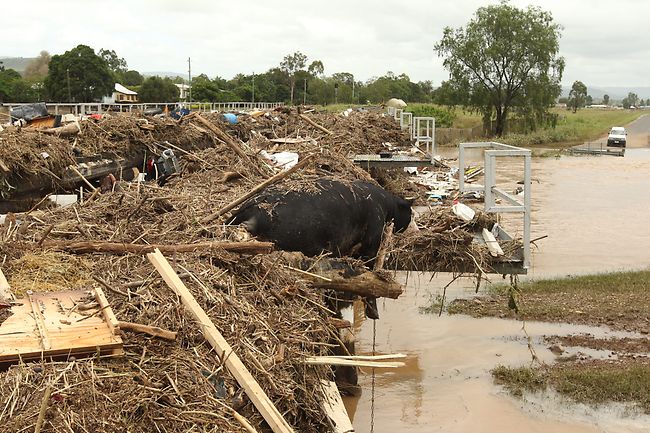
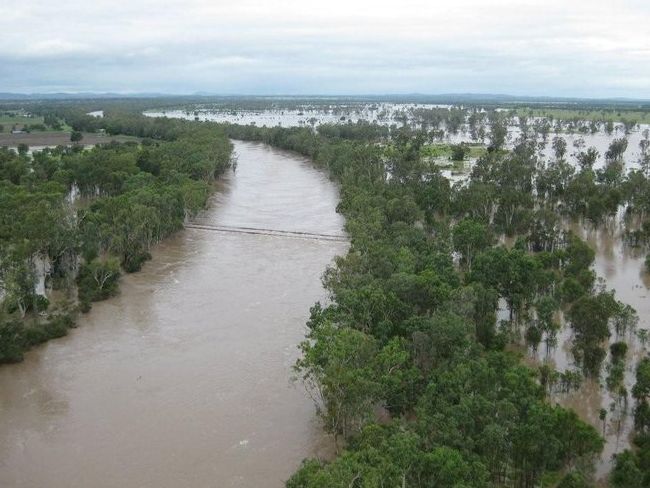
A couple of pictures of the western rail line from Brisbane to Toowoomba. The line, mostly double-track has been extensively damaged and willl probably be out of commission for over three months.
This shows flood debris, and a bull, lodged on one bridge. Some 20 people in the area are also missing so there may well be bodies in the debris as well. It is being carefully checked but there is a huge amount. One body was found in her house which had already been searched twice before.
Part of the Moura coal line in Central Queensland. There could be some delays here as well.
Meanwhile, in muddy Brisbane, in an effort to keep cars off the roads all public transport is free for the next few days. The railways parked their electric commuter trains on some tracks that were well above flood level. Unfortunately, graffiti artists, using Facebook and Twatter, called up every idiot on the East Cost that had a can of spray paint. Some even came from Melbourne. About half the train fleet was so badly overpainted that the sets could not be run. Cost estimates are in the order of a couple of million to clean.
The cops can now read Facebook etc. and feel they have enough evidence to throw at least some of the perps in the slammer. Hopefully with their private parts painted a bright blue.
Update: It’s not just flooding in Queensland . . . there’s also now flooding in Victoria. There are always idiots who try to do stupid things, especially around flooded rivers:
A bizarre decision to ride an inflatable doll down a flood-swollen Yarra River blew up in a woman’s face yesterday when she lost her latex playmate in a rough patch.
The incident prompted a warning from police that blow-up sex toys are “not recognised flotation devices’’.
Police and a State Emergency Services crew were called to the rescue when the woman and a man, both 19, struck trouble at Warrandyte North about 4.30pm yesterday.
They were floating down the river on two inflatable dolls and had just passed the Pound Bend Tunnel when the woman lost her toy in turbulent water.
January 15, 2011
Toronto really isn’t part of Canada
If Toronto was part of Canada, why would a forecast of five centimetres of snow (that’s about two inches) require a special weather statement from Environment Canada?
Really, Toronto? Five measly centimetres and you need a special “OMG! Snow!” notice from the weather folks? That’s too silly for parody.
I mentioned it to Elizabeth before starting this post, and she suggested that it’s another attempt to set up the media template for next year: “Look at the huge increase in special weather statements for the GTA over the last few years. Clearly this proves [global warming | climate change | climate chaos] is real.”
January 14, 2011
Waters starting to recede in Brisbane
Roger Henry sends another update:
Flood waters have receded far enough today that some serious cleaning up can commence. A semi-organised army of volunteers descended on the various suburbs that they could get access to and just started helping home and shop owners clean up. Tomorrow, an organized army will be available. Some 50,000 people, in two shifts, will be bussed into various efforst to do some serious cleaning. On Sunday it is expected they will do it again. An amazing community effort.
Photo from The Australian
Photo from The AustralianIn the long run though things are still serious. Everyone is going to have to pay for the damage and loses, and this includes you guys. Due to earlier bad weather in Oz, global wheat prices are at record levels, the current flooding has almost destroyed the sugar crop thus global sugar prices have almost doubled. Coal shortages will be sending steel prices up so your imports are going to be that much dearer, and so on an do on.
Individuals here have some heart-breaking decisions in front of them. One middle-aged couple we saw, had lost their rented house, their entire possessions, the car — with payments owing — and their jobs. They both told the camera that they were all right. What the Hell. How can they be all right? They are sleeping on the floor in a Church hall wearing donated clothing. Sure, they seemed fit and determined and, one hopes, they will get going again, but they were not all right. There are lots more like them.
Sadly, some looters have come out of the shadows. 18 people have been arrested so far and the cops have reminded potential perps that there is a possible ten year sentence for looting.
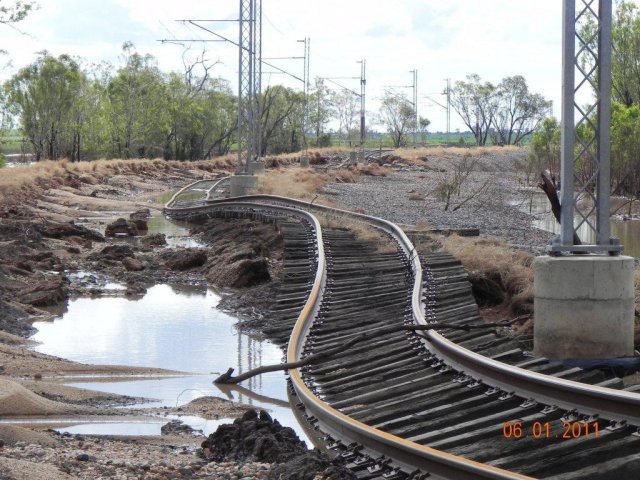
Roads and rail are badly damaged. Some pics of exposed rail tracks where miles of it has been washed out. Some major bridges are also damaged. One large, steel structure was visibly out of alignment.
By and large, much like any community does when it has had a kick in the teeth, people are regrouping and getting order restored. It might take awhile, but it will all work out.
It will be very useful if we don’t have to do it all again in the near future.
Some humour in it all. A liquor store had about 500 bottles of wine that had lost their labels. The owner was proposing a lucky dip sale or a blind auction. He had about two dozen volunteers washing, drying, and re-stacking his stock. Didn’t seem to be much fear of any of it ‘walking’.
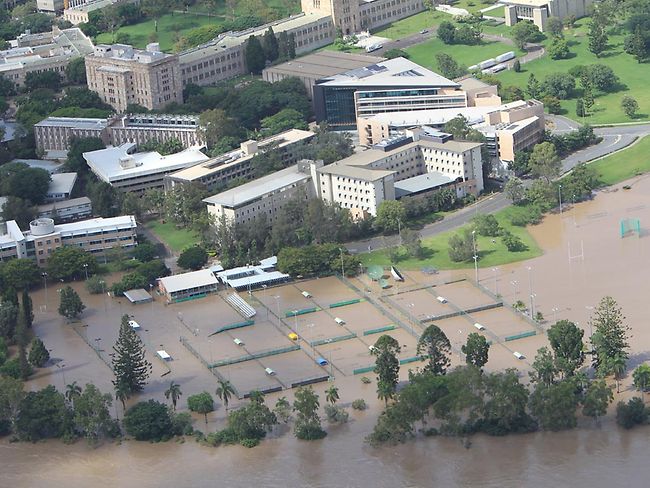
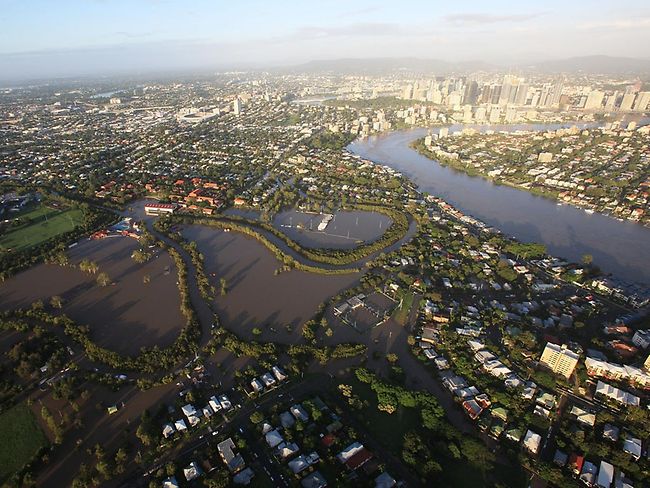
Update: Here’s an image from the Brisbane City Council, showing the extent of the flooding (flooded areas in yellow, river banks in darker yellow):
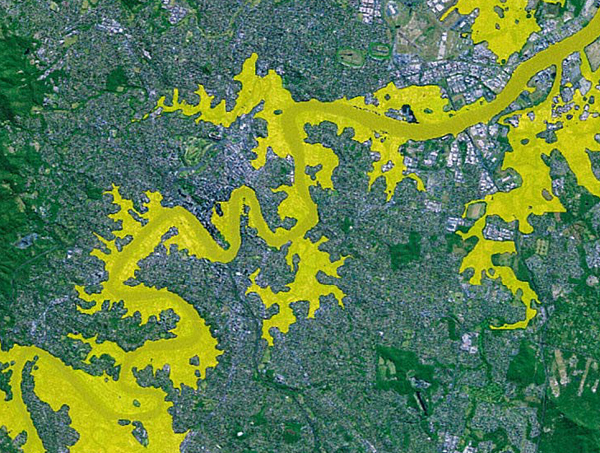
Additional information on the flood history of Brisbane at the New Scientist website.
January 13, 2011
More updates from Brisbane
Roger Henry is thankfully out of the worst of the flooded area, but he’s been sending updates:
Most of the “Southbank” recreation area has been inundated, including the ‘beach’. Shouldn’t be much of a recovery problem once the mud has been hosed off. Don’t know about the maritime museum. I imagine that the old graving dock would have flooded, but the last pictures I saw of the ship was that the bottom was sealed — maybe not sound, but it should resist a short immersion — and she was moored fore and aft. Thus I doubt if she has gone off.
The river ferries, cross-river and the cats were all moved down into Moreton Bay and secured in a marina somewhere. The pontoons, bridges, sheds etc, have been largely washed away and may take some time to replace. The Moggil vehicle ferry, a quite large vessel, was saved after a chopper was used to fly in an extra anchor. Otherwise, the military had orders to sink her.
Literally hundreds of small, and not so small, boats and pontoons washed down the river. One guy had his fore-sail up to try and get some steerage and was heading downstream at a fair clip. Don’t know how he fared, A large, floating restaurant was wrecked against a bridge piling.
A salvage firm has been doing a brisk business herding up all these wayward vessels and parking them where best they can.
Police have also caught a few thieves trying to do some ‘salvage’. One guy had winched a pontoon and speed boat on to a trailer when intercepted by the cops. They confiscated everything as ‘evidence’, gave him a summons and told him to walk home.
There has been some looting in Ipswich. The Mayor said that if they could find a lamppost that wasn’t submerged it should be put to its alternative use. Alternatively, if someone caught a looter and tied them to a tree as a flood gauge then he, the Mayor, wouldn’t be fussed.
Don’t know about the rail museum. The flood height was about three feet lower than estimated so it may have been spared. The local station had at least four foot of water in it. The platforms were covered.
The situation remains dire and there have been a couple more drownings. Otherwise it is now a waiting game. Went shopping today. A few empty shelves in the supermarket but still plenty of essentials. Stocked up on a few necessarys. Traffic was a bit thin and the nearby freeway sounded very quiet. Plenty of cars moving around but not many trucks. About one third of the small merchants in the shopping mall were closed. Probably couldn’t get their staff in.
Interesting pictures of our previous Prime Minister walking around the streets of his neighbourhoood. Up to his knees in flood water and helping people move. He was still at it after the cameras left. Very democratic.
And a further update about eight hours later:
Water levels, though high, are dropping and the weather remains fine. A clean-up plan is afoot, to start at first light tomorrow and proceed progressively until the water is out of the city. This just gets roads, power, phones etc. back on line. Individual houses and businesses will be addressed as time goes by. It all sound sensible and is really the outcome of some long considered disaster recovery planning.
I did go to another supermarket this afternoon. One would think that looters had been in. No bottled water, milk, eggs, bread, long-life milk and coffee mate, toilet paper or veges. Plenty of soft-drinks, frozen foods, meat,. Ice creams deli lines etc. All of which require refrigeration. There is now very little chance of further power cuts. It all seems a bit odd as supply routes are now re-opening and, for those not directly flooded, there is almost no need to hoard supplies.
Some of the towns and villages in the far west parts of the state are having problems both with supplies and the risk of more severe flooding. Some towns for the second or third time in almost as many weeks.
Some 62 suburbs are affected. Bulimba, which has some low-lying parts is largely underwater. TV has been showing extensive footage of the Brisbane area and there is no doubt some/many very sad stories. The most dramatic area is an agricultural valley about 70 miles to the west that was hit by very fast flash-floods. This is where most of the spectacular devastation occurred and where most of the deaths happened. There is now some 18 dead and 70+ almost certainly dead. Army, police and volunteers are searching about 200 miles of creeks and fields looking for the missing. Also the place where most of the terrifying personal stories are coming to light.
So, as a disaster, it has been awful for very many people, but I remain personally unaffected. That also feels quite odd. It is like there had been a tornado that flattened one side of town but left yours untouched.
Not the end times. Part of living near the tropics. Although the weather for the next week or so should be kind, there are two cyclones forming up in the Coral Sea and one of them is well placed to swing in to the coast and gives us a real pasting before the end of the month. Or it might drift over to New Zealand 🙂
January 12, 2011
How urban planning may have contributed to the Toowoomba flood damage
Heather Brown goes back into flood-ravaged Toowoomba:
Early yesterday morning I went back to the bruised and battered Margaret Street to support any local business that still had the heart to open. My coffee shop was handing out free coffees to the battered owners of the local businesses who had lost so much. When I went to buy my newspaper, the newsagent told me he was devastated, not because of what had happened but because the engineer who had worked on the beautification project told him he couldn’t make them listen when he pleaded for bigger pipes — “18-footers” he called them — to let the water through, because it simply didn’t suit the aesthetics of the architects and landscapers.
So that’s what happened to my city, folks, the same as happened to so much of flooded Queensland. We did stupid and really, really dumb things because we thought we could get away with them. We built the wrong sort of houses and the wrong sort of bridges. We built towns and suburbs on flood plains. And we ignored at our peril the forces of nature and the history of the great floods that have shaped this continent for thousands of years.
In our arrogance, we created towns and cities better suited to the whims of bean-counters and city-bound architects than the natural lie of the land. And for 20 years we cheerfully welcomed new settlers to Queensland with a “beautiful one day, perfect the next”.
We didn’t tell them what this place was really like when it rained. And we were wrong.
H/T to Roger Henry for the link.
Another eco-panic? Must be Wednesday, then.
James Delingpole falls for the latest cry of ecological doom:
The Zoological Society of London has drawn up a hit list of the 10 attractive coral species most likely to die quite soon. Well, of course it has. Nothing suits the ZSL’s spirit of misanthropy and catastrophism better than another mournful litany of all the species loss which is bound to occur as a result of mankind’s ongoing crime of having the temerity to exist.
Look: those of us on the other side of the argument like corals too. The difference is, we see them as something to celebrate and enjoy rather than things to be regarded solely through a prism of guilt, self-hatred and apocalyptic despair. Naturalists never used to talk this way. Until the Nazis — and, before them, the German romantics — started poisoning the wells, nature was something we could all happily appreciate without being made to feel by yet another eco-fascist that we were personally going to be the cause of its imminent demise.
If the ZSL wants to make a list of pretty corals, why can’t it just distribute it with facts about their habitats and their formation, maybe with lots of nice shiny pictures for us all to wonder at? Why must they lace their message with doom and misanthropy?
I suppose their excuse will be that these corals ARE endangered and that something must be done by YESTERDAY at the latest. But is this another of those overblown eco-panics in the manner of the floating island of plastic bags twice the size of Texas which in fact turned out to be 1/100th the size of Texas?
It’s an unfortunate fact that in order to get media attention to their cause du jour, the situation not only has to be defined as simply as possible, it also has to be positioned in such a way that the media want to get the message out. The easiest way to accomplish this is to go apocalyptic: doom, Doom, DOOM!
December 29, 2010
Recycling: it’s not economics, it’s control
Gregg Easterbrook points out the stupidities of many municipal recycling programs:
Freeze! Drop That Discarded Dishwasher or I’ll Shoot! The New York Times recently reported that unwanted appliances — old washing machines and so on — placed on the curb for disposal in New York City have been “disappearing.” With scrap metal prices strong, what the article calls “thieves” have been driving along streets scheduled for used-appliance pickups — in New York City, this happens by published schedule — and taking away the unwanted junk before the city’s officially approved recycler arrives. The “thieves” then sell the unwanted junk as scrap metal.
Set aside whether it’s theft to take an unwanted item that has been discarded in a public place. New York City bureaucrats think so; they’ve instructed police to ticket anyone engaged in recycling without government sanction. Twenty years ago, New York City bureaucrats were demanding that citizens recycle whether they wished to or not, and imposing fines for failure to comply. Now if the average person is caught recycling, it’s a police matter.
This issue is not the cleanliness of streets or the environmental benefits of recycling — it’s control of money. The New York City Sanitation Department pays a company called Sims Municipal Recycling about $65 million annually to pick up and recycle metal, glass and aluminum. Notice what’s happening here? Recycling is supposed to make economic sense. If it did, then the recycling company would be paying the city. Instead the city is paying the company. Montgomery County, Maryland, my home county, imposed recycling rules saying they made economic sense. Now the county charges homeowners $210 annually as a recycling tax. If recycling made economic sense, government would pay homeowners for the privilege of picking up their valuable materials. Instead New York City, Montgomery County and many other government bodies charge citizens for something they claim makes economic sense.
Recycling of aluminum makes good economic sense, given the energy cost of aluminum and the high quality of recycled aluminum. Depending on where you are in the country, recycling of newspapers may make sense. Recycling of steel and copper usually makes sense. But recycling of glass, most plastics and coated paper is a net waste of energy. Often the goal of government-imposed recycling program is to use lack of understanding of economics to reach into citizens’ pockets and forcibly extract money that bureaucrats can control.
Notice what else is happening here — New York City pays a company millions of dollars to do something “thieves” will do for free. The “thieves” harm no one, and could save New York City taxpayers considerable money. But then bureaucrats wouldn’t be in control. And surely no-show jobs and kickbacks have nothing, absolutely nothing, to do with New York City sanitation contracts.
December 23, 2010
Not everyone can get into the Christmas spirit
Ethan Greenhart wants to rename Christmas as “Turkey Genocide Day”:
Just as there’s nothing civilised about organising society around the wants of Gaia-mauling human beings, and nothing green about traipsing halfway across the planet to trek with donkeys in Peru (how do you know the donkeys want to trek?), so there can never be anything ethical about a holiday whose centrepiece is a dead bird sexually molested by sage; whose star turn is an obese man who drinks that imperialist tipple Coca-Cola and delivers yet more stuff to already stuffed brats; and where taking a tree from a forest, humiliating it with tinsel and sticking it in a living room is seen as a perfectly normal — nay, fun — thing to do.
This is no holiday; it’s a hell-iday for the defenceless creatures and plants of this ball of gas and air we have arrogantly labelled “Earth”. The signs were there 2000 years ago when a knocked-up teenager enslaved a donkey and forced it to carry her hundreds of miles to Bethlehem before ousting cows and sheep so she could give birth in their home.
If that weren’t bad enough, so-called “wise men” (another contradiction in terms) raided nature to find gifts for the resource-user that this young woman unthinkingly gave birth to, including myrrh, which is literally made from the blood that oozes from the wounds of the Commiphora species of trees, and frankincense, which is stolen from the Boswellia tree.
And so it was that this 2000-year-old orgy of animal enslavement, human breeding and gift-giving became an inspiration to the brainless inhabitants of Christendom, who every year ape the Holy Family by abusing animals and dishing out unnecessary gifts and calling the whole stupid shebang a celebration.
Overall, not a bad rant, although it only manages a close second to the Prince Regent’s complaint:
Edmund: So, shall I begin the Christmas story?
Prince: Absolutely! As long as it’s not that terribly depressing one about the chap who gets born on Christmas Day, shoots his mouth off about everything under the sun, and then comes a cropper with a couple of rum-coves on top of a hill in Johnny Arabland.
Edmund: You mean Jesus, sir?
Prince: Yes, that’s the fellow! Just leave him out of it — he always spoils the X-mas atmos.
H/T to Roger Henry for the link.
December 20, 2010
Boris trims his sails
James Delingpole has a bit of fun at London mayor Boris Johnson’s expense:
. . . what sounds like a fervent declaration of faith in the Warmist creed may on closer examination be a perfectly innocuous statement of the bleeding obvious cunningly calculated to appease all Boris’s rentseeking chums in the City who stand to make a fortune from the Great Carbon Scam and would be most displeased if the Mayor of London were to show signs of wobbling.
Yet wobbling is, of course, exactly what Boris is doing. Or rather — remember, this is the man so ambitious he makes Alexander The Great look like Olive from On The Buses — he is slyly repositioning himself to take advantage of the inevitable collapse of public faith in the Great Anthropogenic Global Warming Ponzi Scheme.
All those thousands of people who’ve had their Christmas ruined as a result of Heathrow airport’s pathetic inability to operate in the snow; all those thousands who have been stranded shivering for eight hours at a stretch on our motorways; all those thousands who can’t use their local municipal sports club because the staff — as is the wont of public sector workers — can’t be bothered to allow themselves to be inconvenienced by the inclement conditions; all those people who are going to look at their electricity and gas bills come the end of next quarter and be appalled beyond measure by how increasingly unaffordable they are; all those businesses big and small whose profits are going to be seriously dented by our political class’s ongoing failure to address our transport infrastructure (and no I don’t mean the irrelevant high-speed rail link to Birmingham; I mean the much bigger problem of our shortage of runways at the airports serving London).
All these thousands of people add up to a lot of disgruntled voters ready to ask hard questions about everything from the size of the state (so patently NOT being shrunk to any significant degree by Cameron’s useless Coalition of the Unwilling) to the three main parties’ position on “Global Warming”.
December 18, 2010
The day the American Falls ran dry
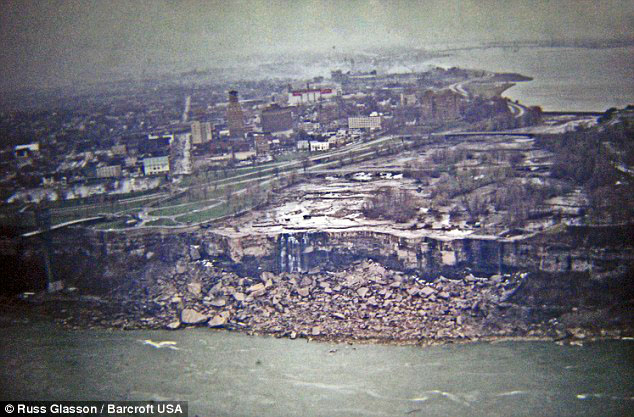
The day Niagara Falls ran dry:
“In June 1969, U.S. engineers diverted the flow of the Niagara River away from the American side of the falls for several months.
“Their plan was to remove the large amount of loose rock from the base of the waterfall, an idea which they eventually abandoned due to expense in November of that year.
[. . .]
To achieve this the army had to build a 600ft dam across the Niagara River, which meant that 60,000 gallons of water that flowed ever second was diverted over the larger Horseshoe Falls which flow entirely on the Canadian side of the border.
“The dam itself consisted of 27,800 tons of rock, and on June 12, 1969, after flowing continuously for over 12,000 years, the American Falls stopped. Over the course of the next six months thousands of visitors flocked to the falls to witness the historic occasion.
I remember seeing this, although as I was nine at the time, I can’t say with certainty that it was in person . . . I might be mistakenly remembering seeing it on TV, although my family visited Niagara Falls frequently during the late 1960s and early 1970s.
December 3, 2010
Pay no attention to the statisticians behind the curtain
James Delingpole has a handy guide to assure you that man made global warming is still happening:
“It’s all actually a sign that man made global warming is very much a live issue and that there’s more of it happening than ever,” says a top scientist, who holds the British record for securing grant-funding for global warming research projects so he must know what he’s talking about.
“Look at the Met office,” the scientist goes on. “They’ve just told us that 2010 is the hottest year since records began in 1850 and even though the stupid Central England Temperature record tells us something quite different and even though the year hasn’t actually finished yet they must know what they’re talking about and they definitely can’t have fiddled the data because the Met office is part of the government and they wouldn’t lie or get things wrong which is why that barbecue summer was such a scorcher.”
The big problem is, the scientist said, is that the public are really stupid. They think just because Dr David Viner of the Climatic Research Unit said in the Independent in 2000 that soon there’d be no snow because of global warming, when what he actually meant was that soon there’d be lots of snow and that this would be “proof” of global warming. The interviewer just missed out the word “proof” that’s all because journalists are lazy that way.
Yes, yes, confusing mere “weather” with climate again, I’m sure.
December 1, 2010
Want to buy (the remains of) an aircraft carrier?
HMS Invincible is being disposed of:
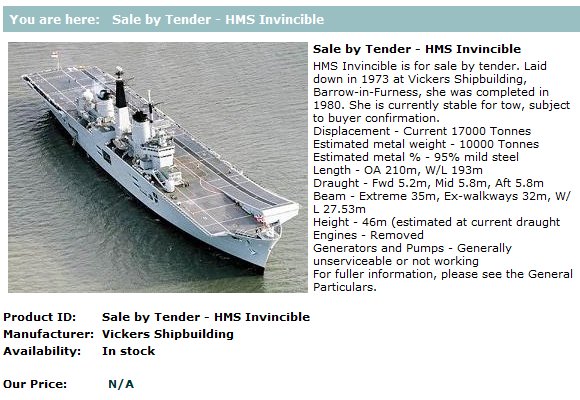
Strategy Page has more:
Britain has put its decommissioned (in 2005) 20,000 ton aircraft carrier, HMS Invincible, up for auction at edisposals.com. Five years ago, the Royal Navy said that the ship would be held in reserve until September, 2010, for possible reactivation. That process would take 18 months. However, by last year, Invincible was in a sad state, with its many components removed, and tended to by a detachment of only four sailors. Thus the auction did not come as a big surprise, and the Royal Navy hopes to obtain at least $3 million for the old ship. The Invincible entered service in 1977, and normally carried 18 Sea Harrier vertical takeoff jets, four helicopters and a crew of 1,050. The Invincible underwent a refurbishment in 2004, but cuts in the navy budget forced retirement the next year. Invincible played a vital role in the 1982 Falklands campaign.
It’s not as easy as it used to be for navies to get rid of unwanted ships:
In the past, navies would send retired ships “to the breakers” and receive a portion of the value of the scrap metal obtained when the breakers (the firm the disassembles ships) finished their work. But this is no long profitable in many cases, because taking ships apart in an environmentally correct way costs too much. This has become a problem for navies, that have no easy way to get rid of old ships. The U.S. uses many old ships for target practice and lets them sink at sea. But even this practice is under attack because of potential environmental damage.
Update, 3 December: HMS Ark Royal has just arrived in Portsmouth to be paid off. It’s not clear if the British government will try to sell the ship or if she’s headed to the breaker’s yard.
November 30, 2010
Apparently, the only solution is for us to all die off
James Delingpole has some entertainment paraphrasing the Cancun climate talks:
Professor Kevin Anderson, Director of the Tyndall Centre for Climate Change Research, said today in a quote I’ve made up but which is only slightly less absurd than what he actually said:
“Since the hacked Climategate emails, we expert Climate Scientists have come in for a lot of stick from sceptics and deniers in the pay of Big Oil who claim that we’re just a bunch of misanthropic eco-fascists for whom freedom of choice is a concept more abhorrent than a baby polar bear pickled in shale oil. But nothing could be further from the truth. We believe that it should be entirely up to the people of the earth how they choose to kill themselves. If they don’t wish to follow any of the fun suggestions outlined in the Royal Society’s latest paper ‘So you’ve decided to die for Mother Gaia?’, we’re more than happy to send round a team of our experts to do the job for them.”
Meanwhile, a spokesman for David Cameron said he believed an outbreak of mass extinction would be “Great for Britain. Great for jobs.” He pointed out that after the Black Death in the mid-fourteenth century, there had been some kind of similar economic revival as a result of there being more land, or people dying, or class barriers breaking down or some such, but that the exact details would have to wait for the forthcoming report on history teaching by Simon Schama, entitled: “Why death is the very least Britain deserves for the despicable colonial record which shames us all!”


