Quotulatiousness

March 18, 2011

West coast earthquake zones

Filed under: Cancon, Environment, Pacific, USA — Tags: , , , , , — Nicholas @ 09:44

According to an article in The Economist, the well-known San Andreas fault in California is not the most likely to cause an earthquake of the magnitude of last week’s quake in Japan. The most likely source is the Cascadia subduction zone:

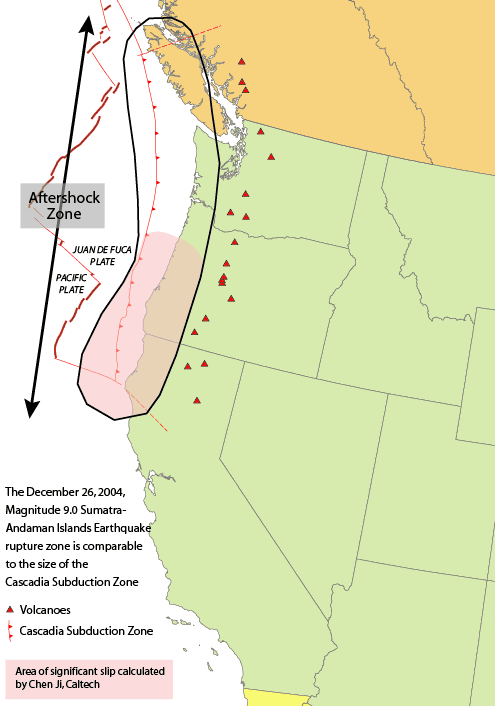
wikimedia.org - Cascadia subduction zone The most likely megaquake on the West Coast would be much further north — in fact, 50 miles off the coast between Cape Mendocino in northern California and Vancouver Island in southern British Columbia. This 680-mile strip of seabed is home to the Cascadia subduction zone, where oceanic crust known as the Juan de Fuca plate is forced under the ancient North American plate that forms the continent. For much of its length, the two sides of this huge subduction zone are locked together, accumulating stresses that are capable of triggering megaquakes in excess of magnitude 9.0 when they eventually slip. As such, Cascadia is more than a match for anything off the coast of Japan.
What makes Cascadia such a monster is not just its length, but also the shallowness of the angle with which the encroaching tectonic plate dives under the continental mass. The descending plate has to travel 40 miles down the incline before it softens enough from the Earth’s internal heat to slide without accumulating further frictional stresses. Could the fault unzip from end to end and trigger a megaquake — along with the mother of all tsunamis? You bet. By one account, it has done so at least seven times over the past 3,500 years. Another study suggests there have been around 20 such events over the past 10,000 years. Whatever, the “return time” would seem to be within 200 to 600 years.

And the last time Cascadia let go? Just 311 years ago.

Cascadia subduction zone image from wikimedia.org.

March 15, 2011

DC residents get stiffed on their solar power subsidies

David Nakamura reports on some Washington, DC folks who are feeling ripped off by their local government over solar panel reimbursements that were promised but never delivered:

It isn’t easy going green, and it may also prove costly.

Dozens of District residents who installed solar panels on their homes under a government grant program promoting renewable energy have been told they will not be reimbursed thousands of dollars as promised because the funds were diverted to help close a citywide budget gap.

In all, the city has reneged on a commitment of about $700,000 to 51 residents, according to the D.C. Department of the Environment. The agency has pledged to try to find money in next year’s budget, its director, Christophe Tulou, said.

“It just doesn’t seem fair to go through a process with them and have them make investments in solar panels under the assumption they would be reimbursed,” Tulou acknowledged. “It’s really sad we are having these economic woes when we are.”

H/T to Radley Balko for the link.

Update on the Fukushima situation

Filed under: Bureaucracy, Environment, Japan, Technology — Tags: , , , — Nicholas @ 09:04

Colby Cosh complained yesterday about the low quality of information being provided by the Tokyo Electric Power Company (TEPCO), and that has not really improved since yesterday. At The Register, Lewis Page updates the situation as best he can:

The story of the three quake- and tsunami-hit reactors at Japan’s Fukushima plant continues, with indications that one of the three worst-hit reactors has sustained further damage. A fire also broke out at another reactor, shut down at the time of the quake and not previously thought to be a problem, but this has now been put out. None of this suggests that the reactors’ crucial containment vessels could be breached, however.

World Nuclear News reported in the early hours (UK time) that a “loud noise” had been heard at the site of the No 2 reactor at Fukushima and pressure readings had fallen in the doughnut-shaped “suppression chamber” situated beneath the core. The suppression chamber holds a large quantity of water and steam from the core, released into it to be condensed, so reducing pressure in the core without the need to vent to atmosphere in some situations: though reactors 1, 2 and 3 have all been repeatedly vented to atmosphere since the quake nevertheless.

Following the apparent release from inside the suppression chamber, radiation levels at the site briefly rose to 8217 microsieverts per hour — such that an unprotected person outside would receive several years’ normal background radiation dose in a single hour. Radiation then dropped to less than 2,500 microsievert/hr. (UPDATED TO ADD: The IAEA reports that as of 6am UK time this had fallen to 600 microsievert/hr). WNN reports that a statement from TEPCO, the plant operators, stated that there had been “no significant change” to the status of the vital containment vessel surrounding the reactor core.

March 12, 2011

Earthquake, tsunami, and worse

Filed under: Environment, Japan, Pacific — Tags: , , , , — Nicholas @ 12:04

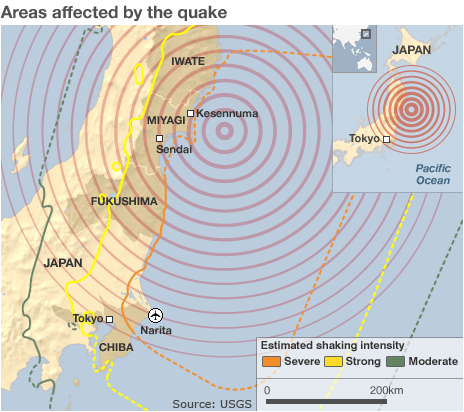
The earthquake by itself was one of the biggest ever recorded, and then the tsunami compounded the quake damage and will make relief and rescue efforts that much harder. Kevin Voigt has more:

The powerful earthquake that unleashed a devastating tsunami Friday appears to have moved the main island of Japan by 8 feet (2.4 meters) and shifted the Earth on its axis.

“At this point, we know that one GPS station moved (8 feet), and we have seen a map from GSI (Geospatial Information Authority) in Japan showing the pattern of shift over a large area is consistent with about that much shift of the land mass,” said Kenneth Hudnut, a geophysicist with the U.S. Geological Survey (USGS).

Reports from the National Institute of Geophysics and Volcanology in Italy estimated the 8.9-magnitude quake shifted the planet on its axis by nearly 4 inches (10 centimeters).

The temblor, which struck Friday afternoon near the east coast of Japan, killed hundreds of people, caused the formation of 30-foot walls of water that swept across rice fields, engulfed entire towns, dragged houses onto highways, and tossed cars and boats like toys. Some waves reached six miles (10 kilometers) inland in Miyagi Prefecture on Japan’s east coast.

Another major concern is the ongoing struggle to regain control of one of the reactors at the Fukushima Daiichi nuclear power plant:

An explosion at an earthquake-struck nuclear plant was not caused by damage to the nuclear reactor but by a pumping system that failed as crews tried to bring the reactor’s temperature down, Chief Cabinet Secretary Yukio Edano said Saturday.

Workers at the Fukushima Daiichi plant have begun flooding the reactor containment structure with sea water to bring the reactor’s temperature down to safe levels, he said. The effort is expected to take two days.

Radiation levels have fallen since the explosion and there is no immediate danger, Edano said. But authorities were nevertheless expanding the evacuation to include a radius of 20 kilometers (about 12.5 miles) around the plant. The evacuation previously reached out to 10 kilometers.

H/T to Chris Taylor for the link.

March 11, 2011

Massive earthquake in northern Japan

Filed under: Environment, Japan, Pacific — Tags: — Nicholas @ 08:27

The largest earthquake since records began hit northern Japan at about quarter to three local time, just as the rush hour was about to start. BBC News has ongoing live coverage.

The tremor, measured at 8.9 by the US Geological Survey, hit at 1446 local time (0546 GMT) at a depth of about 24km.

A tsunami warning was extended across the Pacific to North and South America.

The Red Cross in Geneva warned that the tsunami waves could be higher than some Pacific islands, Reuters news agency said.

Coastal areas in the Philippines, Hawaii and other Pacific islands were evacuated ahead of the tsunami’s expected arrival.

New Zealand later downgraded its alert to a marine threat, meaning strong and unusual currents were expected.

February 24, 2011

UK’s largest off-grid housing development

Filed under: Britain, Environment — Tags: , — Nicholas @ 07:37

If you’re really a fan of alternative energy, you might want to keep an eye on this new development in Brighton:

The six apartment buildings, to be built at the mouth of Shoreham port near Brighton, will be linked by wind turbines, and their southern face will be tiled in solar thermal and photovoltaics panels.

Batteries will be charged during the day in order to keep the lights on at night, and the apartments themselves will be heavily insulated in order to keep power use as low as possible.

But resident behaviour will also play a key role, says the developer, Colin Brace of Bohogreen, who has worked on previous low-carbon projects. “We can’t tell people that you only have so much power, and no more. But there are studies showing that if you give people renewable energy they think, oh good, it’s free, and their energy use actually goes up. So an important aspect of the project will be to educate people about their energy use.

“The apartments will be designed to encourage communal living as much as possible,” says Brace, “rather than having everyone in their own rooms using their own sources of power.” There will also be LED lights on the wind turbines which light up red, amber and green to show which block is using power most heavily, in order to foster “a healthy sense of competition between residents to keep their power use low”.

I wouldn’t want to live in a development where the neighbours are pre-selected for their “greener than thou” attitudes, frankly. The LED lights of shame would probably encourage more neighbour nosiness into the lives of the other residents.

Of course, all that healthy greenery comes at a slight premium to ordinary housing:

The apartments in Portzed will be up to 22% more expensive than an “on-grid” development, due to the extra costs of installing high-spec insulation and renewables. At current market rates, that could add £20-24,000 to the final price of a two-bedroom flat. The developers believe however that there is a high demand for this kind of home due to their rarity. The financing for the project is already in place and the project is expected to be financial viable.

February 22, 2011

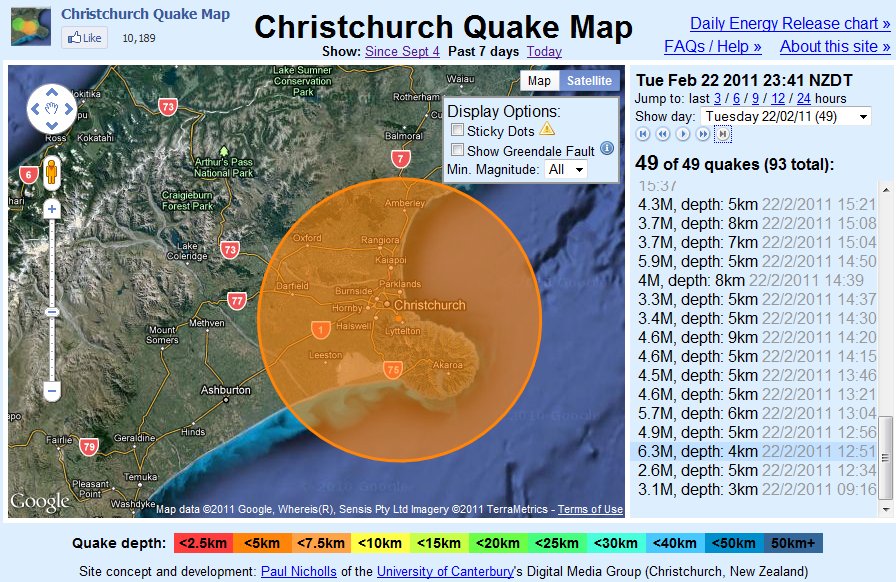
New Zealand struck by major earthquake

Filed under: Environment, Pacific — Tags: , — Nicholas @ 07:23

This quake has inflicted severe damage on downtown Christchurch, with 65 reported dead as of this morning, and the death toll almost certain to rise. The Wall Street Journal is running constant updates to this article as further news becomes available. TVNZ is also running a live feed.


Click to go to the live update page

Australia has offered whatever aid they can provide:

Australia’s Prime Minister Julia Gillard has told a press conference that Australia will give New Zealand whatever it needs to deal with the aftermath of the earthquake. She says she told her New Zealand counterpart, John Key, “anything you want that we’ve got we will get it to you.”

February 18, 2011

QotD: Drink an imported beer and make Mother Gaia cry

Filed under: Environment, Quotations — Tags: , , , — Nicholas @ 10:46

According to PricewaterhouseCoopers partner and renewables specialist Michael Timar:

    “If someone saves money from having cavity wall insulation put into their house, but then spends it on something which produces carbon emissions in its manufacturing, or takes an extra journey, then the environmental benefit is lost.

    “You have to think about what the effect is all the way down the chain — that if you use less, you might actually end up consuming more.”

    Mr Timar warned that people who had saved £100 by cutting their energy bills could use the cash to fund extra leisure activities, such as drinking imported alcoholic beverages in bars — or electronic gadgets, which are often shipped from overseas.

This is beautiful:

    It has been calculated by environmental experts that one single bottle of imported beer uses 900g of CO2 — wiping out two-thirds of the annual carbon savings made by replacing all light bulbs in an average home with energy-saving models.

Drink two and you’re in credit.

Tim Blair, “Tim Blair Blog: DON’T DO ANYTHING”, Daily Telegraph, 2011-02-18

February 10, 2011

The Netherlands go nuke, downplay wind power

Filed under: Economics, Environment, Europe, Technology — Tags: , , , , — Nicholas @ 09:50

Of all the EU states, the last one you’d expect to give up on wind power would be the one that everyone associates with windmills:

In a radical change of policy, the Netherlands is reducing its targets for renewable energy and slashing the subsidies for wind and solar power. It’s also given the green light for the country’s first new nuclear power plants for almost 40 years.

Why the change? Wind and solar subsidies are too expensive, the Financial Times Deutschland, reports.

Holland thus becomes the first country to abandon the EU-wide target of producing 20 per cent of its domestic power from renewables. This is a remarkable turnaround from a state that took the Kyoto Agreement seriously and chivvied other EU members into adopting renewable energy strategies. The FT reports that instead of the €4bn annual subsidy, it will be slashed to €1.5bn.

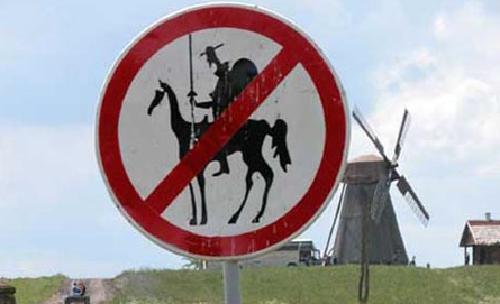
I did a quick Google image search for a typical Dutch windmill image, and decided that this one was too amusing to pass up:

February 9, 2011

QotD: (Historical) weather and climate

Filed under: Environment, History, Quotations — Tags: , , , — Nicholas @ 13:01

I read a lot of history and thus know a fair bit about how weather impact has been perceived by humans over time. It is a fact that the 20th century was an abnormally lucky hundred years, meteorologically speaking. The facts I managed to jam into tweets included (a) the superstorm that flooded 300 square miles of the Central Valley in California in the 1860s, (b) rainfall levels we’d consider drought conditions were normal in the U.S. Midwest before about 1905, and (c) storms of a violence we’d find hard to believe were commonly reported in the 1800s. I had specifically in mind something I learned from the book Wicked River: The Mississippi When It Last Ran Wild, which relays eyewitness accounts of thunderstorms so intense that travelers had to steeple their hands over their noses in order to breathe air instead of water; but a sense that storms of really theatrical violence were once common comes through in many other histories.

We had a quiet century geophysically as well — no earthquakes even nearly as bad as the New Madrid event of 1812, which broke windows as far north as Montreal. And no solar storms to compare with the Carrington Event of 1859, which seriously damaged the then-nascent telegraph infrastructure and if it recurred today would knock out power and telecomms so badly that we’d be years recovering and casualties would number in the hundreds of thousands, possibly the millions.

(I’m concentrating on 19th-century reports because those tended to be well-documented, but earlier records tell us it was the 20th century calm that was unusual, not the 19th-century violence.)

The awkward truth is that there are very large forces in play in the biosphere, and when they wander out of the ranges we’re adapted to, we suffer and die a lot and there really isn’t a great deal we can do about it; we don’t operate at the required energy scales. For that matter, I can think of several astronomical catastrophes that could be lurking just outside our light-cone only to wipe out all multicellular life on Earth next week. Reality is like that.

Eric S. Raymond, “Heavy weather and bad juju”, Armed and Dangerous, 2011-02-03

January 24, 2011

Occasional repost: Be careful with those compact fluorescent bulbs

Filed under: Australia, Environment, Technology — Tags: , — Nicholas @ 12:59

Reposted from 2009, but still valuable information:

Andrew Bolt wonders why the Australian government — which has banned the sale of old-fashioned incandescent light bulbs — is not being more pro-active about handling and disposing of the replacement compact fluorescents:

Tens of thousands of Australians will next month be forced to buy these new greenhouse-friendly CFLs without the Government warning them that, unlike normal light bulbs, they contain mercury and are dangerous when broken. What’s more, they shouldn’t just be thrown out with the rubbish.

How many consumers know this?

How many of them have looked up the Environment Department’s website to find what its bureaucrats falsely describe as the “simple and straightforward” precautions to take against poisoning should one of these lamps smash:

– Open nearby windows and doors to allow the room to ventilate for 15 minutes before cleaning up the broken lamp. Do not leave on any air conditioning or heating equipment which could recirculate mercury vapours back into the room.

– Do not use a vacuum cleaner or broom on hard surfaces because this can spread the contents of the lamp and contaminate the cleaner. Instead scoop up broken material (e.g. using stiff paper or cardboard), if possible into a glass container which can be sealed with a metal lid.

– Use disposable rubber gloves rather than bare hands.

– Use a disposable brush to carefully sweep up the pieces.

– Use sticky tape and/or a damp cloth to wipe up any remaining glass fragments and/or powders.

– On carpets or fabrics, carefully remove as much glass and/or powdered material using a scoop and sticky tape; if vacuuming of the surface is needed to remove residual material, ensure that the vacuum bag is discarded or the canister is wiped thoroughly clean.

– Dispose of cleanup equipment (i.e. gloves, brush, damp paper) and sealed containers containing pieces of the broken lamp in your outside rubbish bin – never in your recycling bin.

– While not all of the recommended cleanup and disposal equipment described above may be available (particularly a suitably sealed glass container), it is important to emphasise that the transfer of the broken CFL and clean-up materials to an outside rubbish bin (preferably sealed) as soon as possible is the most effective way of reducing potential contamination of the indoor environment.

“Simple and straightforward”? Peter Garrett’s department not only deceives you about global warming, but about the ease of this useful “fix”.

It doesn’t take a lot of imagination to foresee a lot of lawsuits down the road, as the majority of folks who need to change lightbulbs won’t have read these instructions, and will try to handle them the same as the ordinary light bulbs they’ve used forever.

A more recent (May 2010) source indicates:

. . . each fluorescent light bulb contains about 5 milligrams of mercury. Though the amount is tiny, 5 milligrams of mercury is enough to contaminate 6,000 gallons of drinking water, according to the Environmental Protection Agency (EPA).

Low level mercury exposure (under 5 milligrams) can cause tremors, mood shifts, sleeplessness, muscle fatigue, and headaches. High level or extended length exposure can lead to learning disabilities, altered personality, deafness, loss of memory, chromosomal damage, and nerve, brain, and kidney damage, as stated by the EPA. There is a particular risk to the nervous systems of unborn babies and young children.

January 17, 2011

Another report from Brisbane

Filed under: Australia, Environment, Railways — Tags: , , , , — Nicholas @ 09:49

My friend Roger is doing well (having been outside the worst of the flooding), and sent this update on the rail and transportation situation in Queensland:

A couple of pictures of the western rail line from Brisbane to Toowoomba. The line, mostly double-track has been extensively damaged and willl probably be out of commission for over three months.

This shows flood debris, and a bull, lodged on one bridge. Some 20 people in the area are also missing so there may well be bodies in the debris as well. It is being carefully checked but there is a huge amount. One body was found in her house which had already been searched twice before.

Part of the Moura coal line in Central Queensland. There could be some delays here as well.

Meanwhile, in muddy Brisbane, in an effort to keep cars off the roads all public transport is free for the next few days. The railways parked their electric commuter trains on some tracks that were well above flood level. Unfortunately, graffiti artists, using Facebook and Twatter, called up every idiot on the East Cost that had a can of spray paint. Some even came from Melbourne. About half the train fleet was so badly overpainted that the sets could not be run. Cost estimates are in the order of a couple of million to clean.

The cops can now read Facebook etc. and feel they have enough evidence to throw at least some of the perps in the slammer. Hopefully with their private parts painted a bright blue.

Update: It’s not just flooding in Queensland . . . there’s also now flooding in Victoria. There are always idiots who try to do stupid things, especially around flooded rivers:

A bizarre decision to ride an inflatable doll down a flood-swollen Yarra River blew up in a woman’s face yesterday when she lost her latex playmate in a rough patch.

The incident prompted a warning from police that blow-up sex toys are “not recognised flotation devices’’.

Police and a State Emergency Services crew were called to the rescue when the woman and a man, both 19, struck trouble at Warrandyte North about 4.30pm yesterday.

They were floating down the river on two inflatable dolls and had just passed the Pound Bend Tunnel when the woman lost her toy in turbulent water.

January 15, 2011

Toronto really isn’t part of Canada

Filed under: Cancon, Environment, Media — Tags: , , , , , — Nicholas @ 10:05

If Toronto was part of Canada, why would a forecast of five centimetres of snow (that’s about two inches) require a special weather statement from Environment Canada?

Really, Toronto? Five measly centimetres and you need a special “OMG! Snow!” notice from the weather folks? That’s too silly for parody.

I mentioned it to Elizabeth before starting this post, and she suggested that it’s another attempt to set up the media template for next year: “Look at the huge increase in special weather statements for the GTA over the last few years. Clearly this proves [global warming | climate change | climate chaos] is real.”

January 14, 2011

Waters starting to recede in Brisbane

Filed under: Australia, Economics, Environment — Tags: , , — Nicholas @ 08:53

Roger Henry sends another update:

Flood waters have receded far enough today that some serious cleaning up can commence. A semi-organised army of volunteers descended on the various suburbs that they could get access to and just started helping home and shop owners clean up. Tomorrow, an organized army will be available. Some 50,000 people, in two shifts, will be bussed into various efforst to do some serious cleaning. On Sunday it is expected they will do it again. An amazing community effort.


Photo from The Australian


Photo from The Australian

In the long run though things are still serious. Everyone is going to have to pay for the damage and loses, and this includes you guys. Due to earlier bad weather in Oz, global wheat prices are at record levels, the current flooding has almost destroyed the sugar crop thus global sugar prices have almost doubled. Coal shortages will be sending steel prices up so your imports are going to be that much dearer, and so on an do on.

Individuals here have some heart-breaking decisions in front of them. One middle-aged couple we saw, had lost their rented house, their entire possessions, the car — with payments owing — and their jobs. They both told the camera that they were all right. What the Hell. How can they be all right? They are sleeping on the floor in a Church hall wearing donated clothing. Sure, they seemed fit and determined and, one hopes, they will get going again, but they were not all right. There are lots more like them.

Sadly, some looters have come out of the shadows. 18 people have been arrested so far and the cops have reminded potential perps that there is a possible ten year sentence for looting.

Roads and rail are badly damaged. Some pics of exposed rail tracks where miles of it has been washed out. Some major bridges are also damaged. One large, steel structure was visibly out of alignment.

By and large, much like any community does when it has had a kick in the teeth, people are regrouping and getting order restored. It might take awhile, but it will all work out.

It will be very useful if we don’t have to do it all again in the near future.

Some humour in it all. A liquor store had about 500 bottles of wine that had lost their labels. The owner was proposing a lucky dip sale or a blind auction. He had about two dozen volunteers washing, drying, and re-stacking his stock. Didn’t seem to be much fear of any of it ‘walking’.

Update: Here’s an image from the Brisbane City Council, showing the extent of the flooding (flooded areas in yellow, river banks in darker yellow):

Additional information on the flood history of Brisbane at the New Scientist website.

January 13, 2011

More updates from Brisbane

Filed under: Australia, Environment — Tags: , , — Nicholas @ 08:09

Roger Henry is thankfully out of the worst of the flooded area, but he’s been sending updates:

Most of the “Southbank” recreation area has been inundated, including the ‘beach’. Shouldn’t be much of a recovery problem once the mud has been hosed off. Don’t know about the maritime museum. I imagine that the old graving dock would have flooded, but the last pictures I saw of the ship was that the bottom was sealed — maybe not sound, but it should resist a short immersion — and she was moored fore and aft. Thus I doubt if she has gone off.

The river ferries, cross-river and the cats were all moved down into Moreton Bay and secured in a marina somewhere. The pontoons, bridges, sheds etc, have been largely washed away and may take some time to replace. The Moggil vehicle ferry, a quite large vessel, was saved after a chopper was used to fly in an extra anchor. Otherwise, the military had orders to sink her.

Literally hundreds of small, and not so small, boats and pontoons washed down the river. One guy had his fore-sail up to try and get some steerage and was heading downstream at a fair clip. Don’t know how he fared, A large, floating restaurant was wrecked against a bridge piling.

A salvage firm has been doing a brisk business herding up all these wayward vessels and parking them where best they can.

Police have also caught a few thieves trying to do some ‘salvage’. One guy had winched a pontoon and speed boat on to a trailer when intercepted by the cops. They confiscated everything as ‘evidence’, gave him a summons and told him to walk home.

There has been some looting in Ipswich. The Mayor said that if they could find a lamppost that wasn’t submerged it should be put to its alternative use. Alternatively, if someone caught a looter and tied them to a tree as a flood gauge then he, the Mayor, wouldn’t be fussed.

Don’t know about the rail museum. The flood height was about three feet lower than estimated so it may have been spared. The local station had at least four foot of water in it. The platforms were covered.

The situation remains dire and there have been a couple more drownings. Otherwise it is now a waiting game. Went shopping today. A few empty shelves in the supermarket but still plenty of essentials. Stocked up on a few necessarys. Traffic was a bit thin and the nearby freeway sounded very quiet. Plenty of cars moving around but not many trucks. About one third of the small merchants in the shopping mall were closed. Probably couldn’t get their staff in.

Interesting pictures of our previous Prime Minister walking around the streets of his neighbourhoood. Up to his knees in flood water and helping people move. He was still at it after the cameras left. Very democratic.

And a further update about eight hours later:

Water levels, though high, are dropping and the weather remains fine. A clean-up plan is afoot, to start at first light tomorrow and proceed progressively until the water is out of the city. This just gets roads, power, phones etc. back on line. Individual houses and businesses will be addressed as time goes by. It all sound sensible and is really the outcome of some long considered disaster recovery planning.

I did go to another supermarket this afternoon. One would think that looters had been in. No bottled water, milk, eggs, bread, long-life milk and coffee mate, toilet paper or veges. Plenty of soft-drinks, frozen foods, meat,. Ice creams deli lines etc. All of which require refrigeration. There is now very little chance of further power cuts. It all seems a bit odd as supply routes are now re-opening and, for those not directly flooded, there is almost no need to hoard supplies.

Some of the towns and villages in the far west parts of the state are having problems both with supplies and the risk of more severe flooding. Some towns for the second or third time in almost as many weeks.

Some 62 suburbs are affected. Bulimba, which has some low-lying parts is largely underwater. TV has been showing extensive footage of the Brisbane area and there is no doubt some/many very sad stories. The most dramatic area is an agricultural valley about 70 miles to the west that was hit by very fast flash-floods. This is where most of the spectacular devastation occurred and where most of the deaths happened. There is now some 18 dead and 70+ almost certainly dead. Army, police and volunteers are searching about 200 miles of creeks and fields looking for the missing. Also the place where most of the terrifying personal stories are coming to light.

So, as a disaster, it has been awful for very many people, but I remain personally unaffected. That also feels quite odd. It is like there had been a tornado that flattened one side of town but left yours untouched.

Not the end times. Part of living near the tropics. Although the weather for the next week or so should be kind, there are two cyclones forming up in the Coral Sea and one of them is well placed to swing in to the coast and gives us a real pasting before the end of the month. Or it might drift over to New Zealand 🙂

« Newer PostsOlder Posts »

Powered by WordPress