
What’s amazing about this stuff — and believe me, there’s plenty more where this came from — is the unblushing shamelessness with which it advocates this economic insanity. Here is the world’s most powerful intergovernmental institution essentially arguing for the destruction of the global economy, enforced rationing, Marxist wealth redistribution, greater regulation, the erosion of property rights and global governance by a new world order of technocrats and bureacrats. And being so upfront about it they actually issue press releases, telling us what they’re planning to do and encouraging us to write about it.
[. . .]
As economies grow richer, so they have more money to set aside for cleaner rivers, fresher air, as well as to invest in R & D projects for ever more eco-friendly forms of energy. It’s no coincidence that quite the worst environmental damage in the last century was done in those countries behind the Iron Curtain. Free market economies tend naturally to be cleaner and healthier because clean and healthy is what people choose anyway if they can afford it. They don’t need government to step in and take their money in order to spend it inefficiently trying to achieve something which would have happened quite naturally anyway.
What this ludicrous UN report is advocating is the exact opposite of what the world needs if it is to become genuinely greener. All those people in the developing world, if they’re to live healthier, less environmentally damaging lives the very last thing they need is hand-outs from richer economies. What they need is property rights and free trade and the chance to grow their economy to the point where — cf the Kuznets Curve — they can afford the luxury of having to breed fewer children and to heat and light their homes without having to chop down the nearest trees. What they also need for us in the rich West to have thriving economies in order that we can import more of their produce.
Rationing and limits to growth are not the answer. The UN is a menace and we listen to its eco-fascist ravings at our peril.
James Delingpole, “UN reveals its master plan for destruction of global economy”, The Telegraph, 2011-07-07
July 7, 2011
Cartoon history of the global warming panic
July 6, 2011
The fine distinction between actual disaster relief and mere tokenism
In the aftermath of the earthquake and tsunami that hit the coast of Japan, many nations offered assistance and supplies to help the battered area. Some of these offers were both timely and appropriate. Others, however. . .
Stranger still was the arrival on May 11th, a full two months after the earthquake and tsunami, of Sri Lanka’s Disaster Relief Team. Some 15 officials from Colombo’s Ministry of Disaster Management came to help clear debris, via a local NGO called Peace Boat. An extremely decent gesture, likewise. But the flights to and from Japan must have cost the ministry a fortune, relatively. This follows an equally quixotic donation by the Sri Lankan government of 3m tea bags.
Then there is the matter of blankets. Since the disaster some 17 countries as well as the European Union have offered blankets as part of their emergency relief supplies. In March this made sense. Some 25,000 blankets from India, 25,000 from Canada and 30,000 from Thailand were donated within days of the disaster. But did Chile really need to deliver 2,000 blankets on May 31st, by which time the temperatures were balmy to say the least?
Earlier Chile donated 100 kilograms of rice, purchased in Japan, to the city of Minamisanriku. Yet considering the Japanese government stockpiles about one million tonnes of rice in case of a crisis—which it buys under World Trade Organisation commitments, keeps off of the market to support local farmers, and burns after it rots—Chile’s altruism was more likely symbolic than satiating.
In the aftermath of natural disasters, the media usually makes a big, hairy deal if the head of government for the region, state, province, or country isn’t immediately seen touring the area. While it makes for useful video footage for the TV news shows, it’s often counter-productive for the people whose lives have been overturned by the disaster. Heads of state, in particular, don’t just jump in a taxi and head off — there’s a huge entourage that have to precede and accompany the leader. This takes up cargo space, landing slots, and flight paths that might be more usefully devoted to providing help to the afflicted area.
It may be useful psychologically for the victims and the relief workers to see the prime minister or the governor, or whatever, but between the TV and other media folks, the dignitaries themselves, their security detachments, and the other support staff, it almost certainly delays the disaster-struck area actually recovering.
July 4, 2011
British Green activist recants opposition to nuclear power
Unlike Germany, which has announced it will be shutting down its nuclear power plants, Britain is considering a new generation of plants to provide an even greater share of their electricity needs. Even a few green activists are changing their tune:
Also, as much as Greens are enthusiastic about solar electricity, in cloudy countries such as ours it is extremely inefficient and expensive. Nuclear power, on the other hand, is one of the cheapest ways of producing electricity, and it is much safer than many environmentalists would have us believe.
The objection of environmentalists to nuclear power — fears about the dangers of nuclear waste and the cost of decommissioning it — are overblown, which explains why many people don’t like the Greens.
[. . .]
Solving many of the world’s most critical environmental challenges will, in some cases, involve doing the exact opposite of what most environmentalists want.
Rather than retreating into hair-shirt austerity, I believe that, just as technology got us into this mess, technology is vital to get us out of it.
That means embracing some things that will make a lot of Green believers choke on their organic muesli.
It has taken me a long time to reach this conclusion. I used to passionately oppose not only nuclear power but GM crops. I once even threw a pie in the face of a Danish scientist who dared to question the orthodox environmental line. So what changed?
Through research, I found that much of what I believed about environmental issues had little, if any, basis in science. Put simply, though my concerns were right, my solutions were wrong.
June 27, 2011
Stephen Gordon: The “broken window” fallacy of “green” jobs
It’s always nice to see a reference to Frédéric Bastiat in a modern day setting:
But it is possible to oversell the green jobs theme. Job creation should not be a goal of environmental policy, no more than it should be a policy goal in the fields of health or national security. If, instead of hiring people, we could use magic to stop disease, crime and environmental degradation, we would. Pointing to jobs ‘created’ to fix these problems is an error that Frédéric Bastiat identified in his ‘parable of the broken window’. Broken windows generate work for glaziers, but that doesn’t mean that breaking windows will increase national income.
An often-quoted statistic goes something like this: “wind energy produces 27 per cent more jobs per kilowatt hour than coal plants and 66 per cent more jobs than natural gas plants”. This could well be true, but it is hardly a strong argument in favour of the employment opportunities that would be generated by investing in wind energy: hiring more people to produce less energy is not a strategy for prosperity. Similar gains in employment could be obtained by outlawing mechanical excavators so that all digging must be done by hand. It may make sense to encourage the development of wind power, but increased employment is most emphatically not one of the reasons for doing so.
June 17, 2011
Sunspots and the Maunder Minimum
Don J. Easterbrook provides more background information on the historical situation at the time of the last low-to-no-sunspot period:
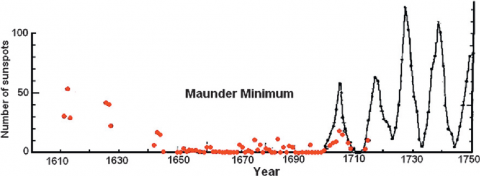
Galileo’s perfection of the telescope in 1609 allowed scientists to see sunspots for the first time. From 1610 A.D. to 1645 A.D., very few sunspots were seen, despite the fact that many scientists with telescopes were looking for them, and from 1645 to 1700 AD sunspots virtually disappeared from the sun (Fig. 1). During this interval of greatly reduced sunspot activity, known as the Maunder Minimum, global climates turned bitterly cold (the Little Ice Age), demonstrating a clear correspondence between sunspots and cool climate. After 1700 A.D., the number of observed sunspots increased sharply from nearly zero to more than 50 (Fig. 1) and the global climate warmed.
FIGURE 1. Sunspots during the Maunder Minimum (modified from Eddy, 1976).The Maunder Minimum was not the beginning of The Little Ice Age — it actually began about 1300 AD — but it marked perhaps the bitterest part of the cooling. Temperatures dropped ~4º C (~7 º F) in ~20 years in mid-to high latitudes. The colder climate that ensued for several centuries was devastating. The population of Europe had become dependent on cereal grains as their main food supply during the Medieval Warm Period and when the colder climate, early snows, violent storms, and recurrent flooding swept Europe, massive crop failures occurred. Winters in Europe were bitterly cold, and summers were rainy and too cool for growing cereal crops, resulting in widespread famine and disease. About a third of the population of Europe perished.
Glaciers all over the world advanced and pack ice extended southward in the North Atlantic. Glaciers in the Alps advanced and overran farms and buried entire villages. The Thames River and canals and rivers of the Netherlands frequently froze over during the winter. New York Harbor froze in the winter of 1780 and people could walk from Manhattan to Staten Island. Sea ice surrounding Iceland extended for miles in every direction, closing many harbors. The population of Iceland decreased by half and the Viking colonies in Greenland died out in the 1400s because they could no longer grow enough food there. In parts of China, warm weather crops that had been grown for centuries were abandoned. In North America, early European settlers experienced exceptionally severe winters.
June 14, 2011
Pack up your worries about global warming: unpack your parka and mittens
I’ve been skeptical about the whole global warming issue, and I’d like to be equally skeptical about a new ice age threat:
What may be the science story of the century is breaking this evening, as heavyweight US solar physicists announce that the Sun appears to be headed into a lengthy spell of low activity, which could mean that the Earth — far from facing a global warming problem — is actually headed into a mini Ice Age.
Lower sunspot activity translates into likely lower temperatures here on earth, just like in the “Maunder Minimum” period, also known as the “Little Ice Age”.
Early records of sunspots indicate that the Sun went through a period of inactivity in the late 17th century. Very few sunspots were seen on the Sun from about 1645 to 1715. Although the observations were not as extensive as in later years, the Sun was in fact well observed during this time and this lack of sunspots is well documented. This period of solar inactivity also corresponds to a climatic period called the “Little Ice Age” when rivers that are normally ice-free froze and snow fields remained year-round at lower altitudes. There is evidence that the Sun has had similar periods of inactivity in the more distant past.
As I wrote back in 2004, “I’ve never been all that convinced of the accuracy of the scientific evidence presented in favour of the Global Warming theory, especially as it seemed to play rather too clearly into the hands of the anti-growth, anti-capitalist, pro-world government folks. A world-wide ecological disaster, clearly caused by human action, would allow a lot of authoritarian changes which would radically reduce individual freedom and increase the degree of social control exercised by governments over the actions and movement of their citizenry. “
On the other hand, as Bjorn Lomborg has pointed out, humanity is better adapted to dealing with higher temperatures than lower ones — as are most living creatures. Given a choice between the risks of increasing temperatures globally and the risks of a new ice age, it should be pretty easy to figure out which scenario allows the better chances for all of humanity to survive and thrive.
Update: Anthony Watts has more. “If we are right, this could be the last solar maximum we’ll see for a few decades,” Hill said. “That would affect everything from space exploration to Earth’s climate.”
Update, 15 June: My skepticism is overwhelmed by the skeptic-in-this-instance New Scientist‘s Michael Marshall, who does the quick math that a Maunder Minimum for the next 90 years would only lower global temperatures by 0.3C. And New Scientist is still bullish on the global warming potential of between 2 and 4.5 degrees Celsius over that same time period. They’re science writers and I’m not, but I have to say I’m still much more worried about the potential cooling than the potential warming.
June 12, 2011
QotD: A scene from an Australian National Park
A few years ago, two National Park rangers were doing a similar service while assorted tourists looked on and took their happy-snaps. The birds, whatever they were, had moved along the road a few yards when a dingo walked out of the long grass, killed one and started to stalk the remainder.
The two Rangers became embroiled in an ideological argument as to which protected specie was to be left alone. The tourists, appalled at the slaughter, then chased the dingo away. The Rangers were instantly reconciled and started issuing citations to the offending tourists for trespassing in a National Park, threatening protected species, obstructing traffic, affray, foul language etc. The tourists were told their cars could be impounded and all, eventually, got court summonses. Fines were levied and they were warned that the offences potentially carried jail time.
One disgruntled victim opined that he should have run over the Rangers and the birds. This was overheard by ‘authority’ and he was hauled into court again.
Visitor numbers at the National Park declined dramatically.
Roger Henry, posting to Railroad_Modeling_Still_Makes_Me_Grumpy@yahoogroups.com, 2011-06-11
Bureaucratic details of the wild camel slaughter proposal
Remember the deliberate destruction of the massive bison herds that used to roam the central plains of North America? Australia’s environmentalists are looking to do an Outback version of their own. Viv Forbes looks at the details included in that Australian government “climate change” proposal:
Think this is all a hoax? Then check this out:
Yep, our bureaucrats have put together a 62 page proposal to issue carbon credits for killing feral camels. They note that there is not much use in killing an old camel so the cullers will be required to declare the age of each camel killed, so that that the Government auditors can determine how much pollution will be saved. To help this complex calculation the government is researching the average life expectancy for feral camels.
The document is full of endless dribble, including how the cullers discount the credits they will get by the amount of pollution that is created by the culling.
Here is a sample:
“There are two options for measuring fuel consumption for EVc,j,y as detailed below. Option 1 is preferred.
Option 1) Recording of all fuel purchased or pumped for use in these vehicles during the management activities.
Option 2) Recording of all ground vehicle and fuel types and odometer readings before and after management activities.
For Option 2 the amount of fuel consumed is calculated by taking the fuel consumption rating of the vehicle as a litres per kilometre figure and multiplying this by the kilometres of travel undertaken as part of the management activity, then divided by 1000 to convert to kiloLitres, as per the equation below:
Where:
GDgv,c,j,y = Ground distance travelled by vehicle gv using fuel type j in undertaking the management activities c in year y LPKgv,j = Litres of fuel type j combusted per kilometre for vehicle gv
Update: The Retronaut has some photos from the near-annihilation of the buffalo in the late 1800s.
June 11, 2011
China finally admits to (some) problems at the Three Gorges megadam
It’s been “officially” a wonderful thing with absolutely no negative attributes for so long that it’s almost refreshing that the Chinese government is finally admitting it’s not all good news around the massive Three Gorges dam and reservoir:
In private, officials have worried about the project for some time and occasionally their doubts have surfaced in the official media. But the government itself has refused to acknowledge them. When the project was approved by the rubber-stamp parliament in 1992, debate was stifled by the oppressive political atmosphere of the time, following the Tiananmen Square massacre three years earlier. Last July, with the dam facing its biggest flood crest since completion in 2006, officials hinted that they might have overstated its ability to control flooding. On May 18th, with the dam again in the spotlight because of the drought, a cabinet meeting chaired by the prime minister, Wen Jiabao, went further in acknowledging drawbacks.
Having called the dam “hugely beneficial overall”, the cabinet’s statement said there were problems relating to the resettlement of 1.4m people, to the environment and to the “prevention of geological disasters” that urgently needed addressing. The dam, it said, had had “a certain impact” on navigation, irrigation and water-supply downstream. Some of these problems had been forecast at the design stage or spotted during construction. But they had been “difficult to resolve effectively because of limitations imposed by conditions at the time.” It did not elaborate.
June 5, 2011
Brendan O’Neill goes whale watching
Where our hero gets a thrilling ride he didn’t expect, but finally gets a bit of revenge:
It’s the hippyish family of three from Norfolk that I feel sorry for. There they were at the Old Harbour in Reykjavik, their multicoloured fleeces zipped up to the chin to protect them from a light but Arctic breeze, talking gaily about going to ‘meet the whales’. I’m sure one of them had even used the word ‘commune’, as a verb, it being fashionable now to believe that humans can make a spiritual, spine-tingling connection with whales and dolphins.
Yet little did this excitable unit know that within the hour they’d be clinging to any bit of the boat’s infrastructure they could find, as we got tossed around by a pissed-off Poseidon, minke whales mocking us with their mighty tails for daring to enter into their cruel and alien world.
Admittedly it was our own fault. The woman at the whale-watching office at the harbour had warned us that the weather was unpredictable. ‘We might not go out today,’ she said, in that wonderfully weird accent that Icelandic people speak English in: part-Viking, part-Scouse. ‘It’s looking a bit patchy,’ she explained.
Now, in a country famous for its angry climate, for its spewing geysers, for having the word ‘Ice’ in its name, where tourists can buy T-shirts that say ‘Lost in Iceland’ on the front and ‘Is anybody out there?’ on the back, and where they have actually made a horror film called Reykjavik Whale Watching Massacre, you might think that we would have taken more seriously this native harbour woman’s warning of ‘patchiness’ at sea. But no. So determined were we to see the whales that, in a mish-mash of European accents, we all said: ‘Let’s go! We don’t mind if it’s a little rough.’ They would make for brilliant famous last words.
June 1, 2011
When is plastic better for the environment than paper?
The answer: when the product gets dumped in a landfill.
Stateside boffins say that, contrary to popular perception, it would often be better for the planet if people avoided using biodegradable products compliant with the recommended US government guidelines.
This is because biodegradable wastes — for instance cardboard cups, “eco friendly” disposable nappies, various kinds of shopping and rubbish bags etc — often wind up in landfill, where they will degrade and emit methane. Methane is, of course, a vastly more powerful greenhouse gas than CO2, so it is seen as important to prevent it getting into the atmosphere.
[. . .]
The answer, according to Barlaz, is to get away from the idea that rapid decomposition is always a good idea — especially on things which won’t be recycled much but will probably wind up in landfill, for instance disposable nappies, fast-food packaging etc.
“If we want to maximize the environmental benefit of biodegradable products in landfills,” Barlaz says, “we need to both expand methane collection at landfills and design these products to degrade more slowly — in contrast to FTC guidance.”
More on the Greenland settlements
In a follow-up to yesterday’s post on the end of the Viking settlements in Greenland, Sonya Porter provides more historical background:
In 891 AD. Eric The Red set off from Iceland with a few followers to explore a land to the west which they had probably spotted some time before while sailing out in their longboats, and then returned three years later with about 500 fellow Vikings. At first they settled on the south-east coast, close to the tip of this new land and then, as the population grew, created a further settlement to the south-west. They called their new home ‘Greenland’.
It has been said that this name was a ‘spin’, a publicity stunt to entice more Vikings to come to join the new settlers, but this would have been pointless if it had been impossible for them to survive. They must at least have been able to create their own dwellings, build their own fires, make their own clothes and above all, grow their own food. The settlers might have been able to trade such things as polar bear-skins and fox furs for iron and other necessities on occasional trips to Europe, but their compatriots in Denmark and Iceland would have been neither able nor willing to row their longboats out each month with groceries.
At present, the temperatures in Greenland range from a maximum of 7C in July to -9C in January. This is too cold for grain such as wheat and even rye to grow and ripen in the short summer of such northern latitudes. Nor are sheep and cattle happy at those temperatures. Hill sheep might be able to nibble away at moss and short grass, but cattle need lush meadows and hay to fatten and live through a winter. Solid wood is needed for building, boat building and warmth, but only bushes and such weak trees as birch now grow in Greenland.
In 1991, two caribou hunters stumbled over a log on a snowy Greenland riverbank, an unusual event because Greenland is now above the treeline. (1) Over the past century, further archaeological investigations found frozen sheep droppings, a cow barn, bones from pigs, sheep and goats and remains of rye, barley and wheat all of which indicate that the Vikings had large farmsteads with ample pastures. The Greenlanders obviously prospered, because from the number of farms in both settlements, whose 400 or so stone ruins still dot the landscape, archaeologists guess that the population may have risen to a peak of about five thousand. They also built a cathedral and churches with graves which means that the soil must have been soft enough to dig, but these graves are now well below the permafrost (2).
May 31, 2011
A bit of climate-change panic juxtaposition
First, the panic:
In a world of climate change, freak storms are the new normal. Newsweek‘s Sharon Begley on why we’re unprepared for the harrowing future, and how adapting to the inevitable might be our only option.
[. . .]
From these and other extreme-weather events, one lesson is sinking in with terrifying certainty. The stable climate of the last 12,000 years is gone. Which means you haven’t seen anything yet. And we are not prepared.
And, in the interests of balance, the eeeevil climate change denier:
Greenland’s early Viking settlers were subjected to rapidly changing climate. Temperatures plunged several degrees in a span of decades, according to research from Brown University. A reconstruction of 5,600 years of climate history from lakes near the Norse settlement in western Greenland also shows how climate affected the Dorset and Saqqaq cultures. Results appear in Proceedings of the National Academy of Sciences.
PROVIDENCE, R.I. [from Brown University] — The end of the Norse settlements on Greenland likely will remain shrouded in mystery. While there is scant written evidence of the colony’s demise in the 14th and early 15th centuries, archaeological remains can fill some of the blanks, but not all.
What climate scientists have been able to ascertain is that an extended cold snap, called the Little Ice Age, gripped Greenland beginning in the 1400s. This has been cited as a major cause of the Norse’s disappearance. Now researchers led by Brown University show the climate turned colder in an earlier span of several decades, setting in motion the end of the Greenland Norse.
[. . .]
The researchers also examined how climate affected the Saqqaq and Dorset peoples. The Saqqaq arrived in Greenland around 2500 B.C. While there were warm and cold swings in temperature for centuries after their arrival, the climate took a turn for the bitter beginning roughly 850 B.C., the scientists found. “There is a major climate shift at this time,” D’Andrea said. “It seems that it’s not as much the speed of the cooling as the amplitude of the cooling. It gets much colder.”The Saqqaq exit coincides with the arrival of the Dorset people, who were more accustomed to hunting from the sea ice that would have accumulated with the colder climate at the time. Yet by around 50 B.C., the Dorset culture was waning in western Greenland, despite its affinity for cold weather. “It is possible that it got so cold they left, but there has to be more to it than that,” D’Andrea said.
May 21, 2011
President of TEPCO falls on his sword a few months late
The president of the Tokyo Electric Power Co. (TEPCO) has resigned:
In a business practice that recalled the ritual seppuku suicides of samurai warriors, the president of Japan’s largest power company resigned Friday to assume responsibility for the world’s worst nuclear disaster since Chernobyl.
At a nationally televised news conference, Masataka Shimizu bowed deeply in an exhibition of remorse and declared, “I am resigning for having shattered public trust about nuclear power and for having caused so many problems and fears for the people.
“I want to take managerial responsibility and bring a symbolic close.”
Whether it’s a hearkening-back to Samurai ethos or not, he should have resigned long ago, as soon as it became clear that the company he headed was doing everything it could to conceal the extent of the actual damage both from the media and from the government.
There is a widespread feeling the government and TEPCO officials did not disclose all they knew during the early days of the crisis and have been less than forthcoming since.
In the first weeks after the earthquake, TEPCO officials received 40,000 complaints a day about the lack of information. Police had to be assigned to guard the company’s offices from anti-nuclear protesters.
This week, TEPCO released documents showing it was dealing with three simultaneous nuclear meltdowns, while reassuring people the fuel rods were safely intact in all the reactors.
“Why did it take two months to get to this point?” demanded a Wednesday editorial in the Nikkei business newspaper.
“Even a rough calculation of conditions inside the reactors would have helped in choosing the best response.”
Public confidence was shaken further when it emerged engineers at Fukushima were so unprepared for the disaster, they had to scavenge flashlights from nearby homes and used car batteries to try to reactivate damaged reactor gauges.
Nobody with an ounce of sense is criticizing the workers at the plant for their reaction to an earthquake that was far in excess of the design for the reactors, or a tsunami that was much higher than anything the designers had foreseen. Shit happens, and it was the daily double of fantastically unlikely natural disasters that struck the plant.
The company, however, deserves more than just a light dusting of shame for the way they appear to have been actively preventing the real state of the plant becoming known to the international nuclear community and the national government. A nuclear disaster is everyone’s business, and there were resources available to TEPCO that they signally failed to draw upon. Saving face is not an acceptable reaction to this kind of catastrophe.


