
Parse [the headline] carefully and one will find less overstatement than one might have hoped for. I did not use “unique” to mean “exclusive”; and “modern” may be restricted to the last half-century or so. Focus, rather, on what is plainly intended: the italicized qualification after the long dash.
Many individuals, of both sexes, do in fact take women seriously (as women). In many jurisdictions, this is now against the law, but it happens all the same. Various other “faith groups” continue to recognize women as having their own distinct nature and identity — Orthodox Jews come first to mind, then Orthodox Christians. Lots of Evangelicals.
On the other hand, most mainstream Protestant congregations, so far as they have any members left at all, formally withdraw this recognition. Too, many “modern” or “liberal” or “recovering” Catholics (nominal ones who look upon Church teaching as merely quaint) reject the notion that women could be women. But the Catholic Church cannot always be held responsible for the views of those who contradict her. (Even if, in the long run, she probably can, as I argued here.)
Certainly, the post-Christian, post-rational “secular” authorities deny that women (or men) exist, and have gone to the trouble of eliminating “father,” “mother,” “son,” “daughter,” “brother,” “sister,” “uncle,” “aunt,” and any other terms that seem to imply a sexual identity, from all legislation — making much of it retroactively quite insane. Their attack on what they call the “traditional” (i.e. normal) family is unambiguous. For it was and remains highly sexed, whereas the new State-protected “alternative families” are invariably sterile. (Some wiggle-room is still left for “breeders,” however, pending the invention of new reproductive technology.)
A good test of this — fanatic denial of the blatantly obvious — may be conducted by using the word “priestess.” Those demanding female priests (an unCatholic notion if there ever was one) are likely as not to freak at the use of that word. They do not like the connotation, and will declare that it is “sexist.” They want females to be priests the same as men. It would defeat this intention to call them “priestesses,” as well as calling attention (among the historically informed) to the very conscious decision made by the early Church to avoid the cultural and spiritual implications of the priestess function within ancient and pagan religions. For priestess cults, and their reputations, were something early Christians wanted to get away from.
David Warren, “Sexes & saxes”, Essays In Idleness, 2014-12-03.
February 10, 2016
QotD: “The Catholic Church is unique among institutions in the modern West, in taking women seriously — as women“
January 27, 2016
QotD: Are saxophones sexist?
That men and women may also have much in common — opposable thumbs come to mind — I take for granted. I like to contrast both male and female humans with other sexually-paired primates, though this is another distinction that is becoming controversial. God made them male and female, in my frankly religious understanding, but this does not mean He did not do the same for other species. It instead points to a deeper profundity: Yin and Yang created He them.
Let us not be distracted by pettifog in this matter. Those who oppose, or even propose to persecute “sexists,” themselves frequently maintain a distinction between the sexes, but it is glibly statistical, when not incomprehensible. Consider for instance an argument I heard recently, amounting to a complaint, that the ratio of male to female saxophone players is too high. Why would this be so? “Because we have a male-dominant culture, and saxes are traditionally associated with macho.”
Both statements are lies, the first in a boring, but the second in an interesting way. Adolphe Sax invented the instrument (around 1840) to fill a hole between the feminine woodwind and the masculine brass sections in an orchestra. It was only after the fact that this gender-neutral horn itself selected for male players. And even feminists — who are seldom quite as obtuse as they pretend — can see that a woman playing a sax is making a “statement” in which she is paradoxically accentuating her “female sexuality.” The suggestion that this should be cancelled by sex quotas is thus demonstrably batty.
We could extend this by considering different aspects of masculine identity embodied in the voices of soprano, alto, tenor, and baritone saxophones, and then broadening to draw comparisons across the wind range, through the historical development of the heteroglottal reed, but that would make our discussion too lascivious.
As “diversity” is much prized today, let me mention that I am a sexist myself. Or, if I’m not, nobody is. I share the unreconstructed view of my diverse parents, grandparents, great grandparents, and other ancestors, back to Eve and Adam, on the existence of, and distinction between, the two sexes. Only one of them can have babies. Only the other can impregnate. But let me add that this is not the only distinction, and moreover, a large field of distinctions would anyway follow if only from that elephantine biological fact.
David Warren, “Sexes & saxes”, Essays In Idleness, 2014-12-03.
January 26, 2016
Inventing ISIS
Strategy Page looks at some of the prevailing beliefs about the origins of ISIS among refugees:
Interviews with refugees from the fighting in Iraq and Syria as well as people still in those countries shows that over 80 percent believe the Islamic terrorists in general and ISIL and al Qaeda in particular are creations of the West (particularly the United States) and Israel as a means to destroy their countries and Islam. This is nothing new and while all this is unbelievable to most Westerners and largely ignored by Western media and politicians it is very real and has been for a long time. Media in these countries is full of even more fanciful (to Westerners) inventions. This has caused problems for Western troops operating in those countries, although some have figured out how to take advantage of it.
All cultures have a certain belief in magic and what Westerners call “conspiracy theories” to explain otherwise unexplainable events. In the Islamic world, there is a lot of attention paid to sorcery and magic, and people accused of practicing such things are regularly attacked and sometimes executed because “sorcery” is a capital crime under Islamic law. Conspiracy theories are also a popular way to explain away inconvenient facts and this is often found useful in countries that are hostile to other forms of sorcery.
For example back in 2008 many Pakistanis believed that the then recent Islamic terrorist attack in Mumbai, India was actually the work of the Israeli Mossad or the American CIA and not the Pakistani terrorists who were killed or captured and identified. Such fantasies are a common explanation, in Moslem nations, for Islamic terrorist atrocities. Especially when Moslems, particularly women and children are among the victims. In response many Moslems tend to accept fantastic explanations shifting the blame to infidels (non-Moslems).
After the September 11, 2001 attacks in the United States, many Moslems again blamed Israel for staging those attacks. A favorite variation of this is that, before the attacks on the World Trade Center, a secret message went out to all Jews in the area to stay away. Another variation has it that the 19 attackers (all of them Arab, 15 from Saudi Arabia) were really not Arabs but falsely identified as part of the Israeli deception. In the United States some Americans insist that the attack was the work of the U.S. government, complete with the World Trade Center towers being brought down by prepositioned explosive charges. While few Americans accept this, the CIA and Mossad fantasies are widely accepted in the Moslem world. Even Western educated Arabs, speaking good English, will casually express, and accept, these tales of the Israeli Mossad staging the attacks, in an effort to trick the U.S. into attacking Afghanistan and Iraq. Americans are shocked at this, but the Moslems expressing these beliefs just shrug when confronted with contradictory evidence.
January 18, 2016
QotD: The role of faith in trust situations
A team of German economists asked subjects to play a game in which one person is the “truster”, who is given some money on each round of the game. The truster is then asked to decide how much money, if any, to pass on to an anonymous “trustee”. Any money passed gets tripled by the experimenter, at which point the “trustee” can choose how much, if any, to return to the truster. Behavioral economists use this game often, but the novel twist in this study was to reveal one piece of real, true personal information about the trustees to the trusters. In some cases, the truster learned the trustee’s level of religiosity, on a scale of 1 to 5. When trusters learned that their trustee was religious, they transferred more money. More important, the religious trustees really did transfer back more money than did the nonreligious trustees, even though they never knew anything about their trusters. The highest levels of wealth, therefore, would be created when religious people get to play a trust game with other religious people.
[…]
Even today, markets that require a very high trust to function efficiently are often dominated by religiously bound ethnic groups (such as ultra-Orthodox Jews in the diamond market) who have lower transaction and monitoring costs than their secular competitors.
Jonathan Haidt, quoted by Scott Alexander in “List Of The Passages I Highlighted In My Copy Of Jonathan Haidt’s The Righteous Mind“, Slate Star Codex, 2014-06-12.
December 22, 2015
QotD: Communes
The anthropologist Richard Sosis examined the history of two hundred communes founded in the United States in the nineteenth century. Which kind of commune survived longest? Sosis found that the difference was stark: just 6% of the secular communes were still functioning twenty years after their founding, compared to 39% of religious communes. He found one master variable: the number of costly sacrifices that each commune demanded from its members. It was things like giving up alcohol and tobacco, fasting for days at a time, conforming to a communal dress code or hairstyle, or cutting ties with outsiders. For religious communes, the effect was perfectly linear: the more sacrifice a commune demanded, the longer it lasted. But Sosis was surprised to discover that demands for sacrifice did not help secular communes. Most of them failed within eight years, and there was no correlation between sacrifice and longevity.
Jonathan Haidt, quoted by Scott Alexander in “List Of The Passages I Highlighted In My Copy Of Jonathan Haidt’s The Righteous Mind“, Slate Star Codex, 2014-06-12.
December 14, 2015
David Warren’s “On welcoming Muslims”
David Warren’s essay on the pending influx of tens of thousands of Muslim refugees from the Middle East and other areas covers a lot of territory, including the current stance of “The Donald”:
In fact, Trump is a typical liberal, and his “moratorium” a typical expression of asinine liberal thinking. That is to say: “Let us call a time out, while we find a way to fix this cock-up in our social engineering.”
That Trump is risking his own substantial business interests in the Middle East, is an indication that he sincerely intends to become President. It is this very sincerity that is making his “connexion” to the American masses. So note: he is not just a Clinton plant. Vice versa, when Hillary says that she fears him, she is not kidding, either. Any emotional connexion between Trump and voters endangers her own presidential prospects. The media say otherwise, but one must remember they are usually wrong; and always, when they are certain.
I think the chances Trump will become the next President are not high, but rising. He climbed another eight points after his “moratorium” suggestion. About ten more like that, and his bid is clinched.
Or put this another way. The “mainstream” politicians think the voters will swing back to them, when they realize how scary the “alternatives” are. One might describe this as the optimism of despair.
And the similarities and differences of Christians and Muslims in their religious observances:
The great majority of Muslims, like the great majority of Christians today, do not take their religion that seriously. They prefer it watered down, often to homaeopathic doses. And yet there will always be revivals and, contrary to the hopes of liberals, the “core teaching” of each religion remains, ever awaiting rediscovery.
At the Reformation, Christianity was not “reformed.” It was jarred and split, but then it reassembled. The Catholic teaching did not go away. With time, even the most radically schismatic sects returned to something like the Catholic teaching, or left Christianity altogether. By comparison, Islam was apparently shattered, when it came into collision with European modernity. But it has been reassembling, ever since.
The idea of spreading Islam through violence is not a deviation. Indeed, the founder of that religion preached violence against all “infidels,” and set a personal example in spreading Islam through Arabia, by the sword. His successors continued thus, spreading the new religion from Morocco to India. Later Caliphs have honoured this precedent through fourteen centuries. Islam is not and has never been a “religion of peace.” It is a religion of war, and peace through conquest. Liberals may deny that anything in history really happened, but this is what did.
They may on the contrary insist, like the delusional Barack Hussein Obama Soebarkah, that Christians were sometimes violent, too. Darn right, but if he ever gets around to consulting his New Testament, he will find that this is not doctrinal. A Christian could remain doctrinally sound, and go through his whole life without killing, or even promising to kill should the opportunity arise, a single person. He might even proselytize, without uttering mortal threats. So could a Jew, for that matter, a Hindu, Buddhist, or Confucian — so far as I can see from my (admittedly modest) forays into comparative religion. The criticism is Islam-specific.
Which leads to the third liberal argument: that we are prejudiced against Islam. This is quite true in my own case, and that of every other observant Christian. But we also observe the Christian distinction between sin and sinner.
Muslims, as all other humans, should be loved (which is not the same thing as “tolerated”). It is the religion, Islam, that we have always condemned, so fulsomely. I have met many fine Muslims, especially in those countries where I lived or travelled among them. I have heard or read many noble attempts to interpret Islam in a Sufi, spiritual way. I have observed that, “We have a religion that is better than we are, while they are often better than their religion.” I have admired the many, extraordinary feats in science, philosophy, and the arts, done by great Muslims in centuries gone by. I have also noticed that these accomplishments were sooner or later disowned, within the civilization itself, as being in conflict with Islamic teaching.
December 8, 2015
QotD: Politics, ideology, tribalism, and religion in the Middle East
The Western media and intelligentsia don’t seem to have a clue that the issues in the Middle East are not related to competing political ideologies, but to competing religious tribalism.
The ongoing conflicts throughout the region, and in other parts of the world, are not about democracy versus monarchy; or fascism versus communism; or imperialism versus freedom. Or indeed any of the other childish ideologies Western journalists fell in love with during their undergraduate post modernist deconstructionalist courses by failed ex-[Trotskyites], who simply can’t accept that the last century has proven how appalling and basically evil their over-simplistic ideologies are. (Yes Comrade Corbyn, that’s you and your gushing twitteratti I am slamming!)
In fact the problem in the Muslim world is that they are entering the third decade of the Muslim Civil War.
The Sunni and Shia are at about the point that the Roman Catholics and the Protestants were at in Europe in the 1620s to 30s, and it is only going to get worse. That war was ideological, and paid very little attention to national boundaries. This one is the same. The Christian 30 Years War is about to be repeated in a Muslim civil war, and 30 years might be an optimistic number.
Interestingly the Christians split over three or four centuries into Orthodox and Roman, then split again into Albigensian and Protestant, etc. Eventually it got to the point, after 14 or 15 centuries of slow development, that major conflict broke out. Is it co-incidence that the Muslims have followed a similar path? Is it inevitable that after 14 or 15 centuries of existence, they too are having a major internal conflict? Or is it just that a century of renewed prosperity and development (largely brought on by Western intrusion into their secular affairs) has given them the semi-educated proto-middle-class who traditionally stir up revolutionary stuff they don’t understand?
Whatever the reasons, stupid Westerners are eventually going to have to admit to a few of realities.
- No matter how much you fantasise about the functionality of republics and democracy, you can’t impose systems that don’t work in places that don’t have the necessary pre-requisites.
- No matter how much literacy or free press you do manage to push in, you can’t impose rule of law and understanding of natural law on societies that have very specifically rejected such concepts for eight or nine centuries.
- No matter how much your secularist ideologies (developed from safely behind two millennia of Christian teaching that accepts rule of law and natural law) is offended, you cannot expect a similar acceptance from people whose cultural development of such beliefs is several centuries behind the West.
- No matter what you want to believe, the Muslim civil war is happening.
Let’s hope we really are at least half way through the 30 years…
Nigel Davies, “The ‘Arab Spring’, 1848, and the 30 Years War/s”, Rethinking History, 2015-09-19.
December 7, 2015
QotD: The problem of Belgium
Judging by emerging reports, it almost looks as though the big new international-relations problem highlighted by the latest massacre might end up being the failure of the Belgian state. Some of the perpetrators seem to have fled toward the terrorist-riddled Brussels suburb of Molenbeek, which has sprouted a long sequence of killers involved with everything from the 2004 Madrid attacks to the failed August Amsterdam-Paris train attack that was stopped by American passengers. The Belgian authorities are contrite about the helplessness of their police and security apparatus in a zone that is a giant magnet for Europe’s Muslim creeps and ne’er-do-wells.
This raises further existential questions, and it is not as though they are new, about an ethnically divided country fabricated by 19th-century great powers mostly for geopolitical purposes. Foreign-policy amateurs are fond of saying, with some justice, that most of the world’s problems come from borders badly drawn by Europeans in out-of-the-way places. Belgium’s worsening habit of exhaling spores of Muslim terror on to its neighbours may actually put it on that list, unless its problem is solved pretty quickly.
Colby Cosh, “After Paris, are we sure the map that needs changing is in the Middle East?”, National Post, 2015-11-17.
November 16, 2015
Accepting the truth in the wake of the Paris attacks
Douglas Murray on the slow, unwilling movement toward accepting the true reasons for anti-Western violence like the Paris terror attacks:
The West’s movement towards the truth is remarkably slow. We drag ourselves towards it painfully, inch by inch, after each bloody Islamist assault.
In France, Britain, Germany, America and nearly every other country in the world it remains government policy to say that any and all attacks carried out in the name of Mohammed have ‘nothing to do with Islam’. It was said by George W. Bush after 9/11, Tony Blair after 7/7 and Tony Abbott after the Sydney attack last month. It is what David Cameron said after two British extremists cut off the head of Drummer Lee Rigby in London, when ‘Jihadi John’ cut off the head of aid worker Alan Henning in the ‘Islamic State’ and when Islamic extremists attacked a Kenyan mall, separated the Muslims from the Christians and shot the latter in the head. It was what President François Hollande said after the massacre of journalists and Jews in Paris in January. And it is all that most politicians will be able to come out with again after the latest atrocities in Paris.
All these leaders are wrong. In private, they and their senior advisers often concede that they are telling a lie. The most sympathetic explanation is that they are telling a ‘noble lie’, provoked by a fear that we — the general public — are a lynch mob in waiting. ‘Noble’ or not, this lie is a mistake. First, because the general public do not rely on politicians for their information and can perfectly well read articles and books about Islam for themselves. Secondly, because the lie helps no one understand the threat we face. Thirdly, because it takes any heat off Muslims to deal with the bad traditions in their own religion. And fourthly, because unless mainstream politicians address these matters then one day perhaps the public will overtake their politicians to a truly alarming extent.
If politicians are so worried about this secondary ‘backlash’ problem then they would do well to remind us not to blame the jihadists’ actions on our peaceful compatriots and then deal with the primary problem — radical Islam — in order that no secondary, reactionary problem will ever grow.
Yet today our political class fuels both cause and nascent effect. Because the truth is there for all to see. To claim that people who punish people by killing them for blaspheming Islam while shouting ‘Allah is greatest’ has ‘nothing to do with Islam’ is madness. Because the violence of the Islamists is, truthfully, only to do with Islam: the worst version of Islam, certainly, but Islam nonetheless.
Theodore Dalrymple expresses a bit of sympathy for the politicians who must say something in the wake of atrocities:
One has to pity — a little — politicians obliged to react publicly to events such as those on November 13 in Paris. They can’t pass over them in silence: but what can they say that does not sound banal, hollow and obvious? They can only get it wrong, not right.
That does not excuse inexactitude and evasion, however. French president François Hollande called the attacks cowardly, but if there was one thing the attackers were not (alas, if only they had been), it was cowardly. They were evil, their ideas were deeply stupid, and they were brutal: but a man who knows that he is going to die in committing an act, no matter how atrocious, is not a coward. With the accuracy of a drone, the president honed in on the one vice that the attackers did not manifest. This establishes that bravery is not by itself a virtue, that in order for it to be a virtue it has to be exercised in pursuit of a worthwhile goal. To quote an eminent countryman of the president, Pascal: Travaillons, donc, à bien penser: voilà le principe de la morale. Let us labor, then, to think clearly: that is the principle of morality.
President Obama was not much better. He made reference in his statement to “the values we all share.” Either he was using the word “we” in some coded fashion, in spite of having just referred to the whole of humanity, or he failed to notice that the attacks were the direct consequence of the obvious fact that we — that is to say the whole of humanity — do not share the same values. If we shared the same values, politics would be reduced to arguments about administration.
November 14, 2015
QotD: Which religious group should organize your hypothetical rescue from terrorists?
Suppose you were kidnapped by terrorists, and you needed someone to organize a rescue. Would you prefer the task be delegated to the Unitarians, or the Mormons?
This question isn’t about whether you think an individual Unitarian or Mormon would make a better person to rush in Rambo-style and get you out of there. It’s about whether you would prefer the Unitarian Church or the Mormon Church to coordinate your rescue.
I would go with the Mormons. The Mormons seem effective in all sorts of ways. They’re effective evangelists. They’re effect[ive] fundraisers. They’re effective at keeping the average believer following their commandments. They would figure out a plan, implement it, and come in guns-blazing.
The Unitarians would be a disaster. First someone would interrupt the discussion to ask whether it’s fair to use the word “terrorists”, or whether we should use the less judgmental “militant”. Several people would note that until investigating the situation more clearly, they can’t even be sure the terrorists aren’t in the right in this case. In fact, what is “right” anyway? An attempt to shut down this discussion to focus more on the object-level problem would be met with cries of “censorship!”.
If anyone did come up with a plan, a hundred different pedants would try to display their intelligence by nitpicking meaningless details. Eventually some people would say that it’s an outrage that no one’s even considering whether the bullets being used are recyclable, and decide to split off and mount their own, ecologically-friendly rescue attempt. In the end, four different schismatic rescue attempts would run into each other, mistake each other for the enemy, and annhilate themselves while the actual terrorists never even hear about it.
(if it were Reform Jews, the story would be broadly similar, but with twenty different rescue attempts, and I say this fondly, as someone who attended a liberal synagogue for ten years)
One relevant difference between Mormons and Unitarians seems to be a cultural one. It’s not quite that the Mormons value conformity and the Unitarians value indivduality – that’s not exactly wrong, but it’s letting progressives bend language to their will, the same way as calling the two sides of the abortion debate “pro-freedom” and “anti-woman” or whatever they do nowadays. It’s more like a Mormon norm that the proper goal of a discussion is agreement, and a Unitarian norm that the proper goal of a discussion is disagreement.
There’s a saying I’ve heard in a lot of groups, which is something along the lines of “diversity is what unites us”. This is nice and memorable, but there are other groups where unity is what unites them, and they seem to be more, well, united.
Scott Alexander, “Reactionary Philosophy In An Enormous, Planet-Sized Nutshell”, Slate Star Codex, 2013-03-03.
November 10, 2015
The “War on Christmas” opens another front … at Starbucks
Katherine Timpf can’t believe that anyone is taking this nonsense in any way seriously:
Please stop embarrassing yourselves.
I woke up this morning to find that real, adult people are actually upset that Starbucks’s holiday cups do not mention Christ or Christmas on them — and the absence of such language as an attack on their religion.
Yep, that’s right. The “War on Christmas” season has arrived, and Starbucks has chosen the side of the godless hedonism that is destroying our society. Don’t let the fact that it still sells a Christmas Blend, a “Merry Christmas” gift card, and an Advent calendar fool you — Starbucks is clearly The Devil’s Coffee, and you have every right to be this upset.
That is, of course, if you are an insane person.
November 6, 2015
Turkish politics, post-election
Austin Bay looks at Turkey’s domestic political situation following the re-election of Recep Erdoğan’s Justice and Development Party:
The threat to Turkish democratic institutions is a man notoriously jealous of Ataturk, current president Recep Tayyip Erdoğan. The snap election gave Erdoğan and his Justice and Development Party, AKP, overwhelming control of parliament (316 of 550 seats). The AKP had controlled parliament since 2002, but in the June 7 election it lost its one-party majority. Political haggling among opposition parties, including Ataturk’s Republican Peoples Party, the CHP, failed to produce a coalition government; a new election was necessary.
However, in the intervening month’s domestic terrorist incidents, the fitful war with the Islamic State in the Levant and Syria’s violent chaos dominated Turkish politics.
Erdoğan portrayed himself as the only leader capable of addressing Turkey’s deteriorating security situation. Domestic security certainly diminished; why it did stirs angry accusations. Erdoğan’s political opponents maintain that he used the violence to solidify political support. His more vicious critics accuse him of intentionally permitting violence. For example, they argue his government could have prevented the Oct. 10 terror bombing of a peace march in Ankara, now attributed to ISIL. Over 100 people were murdered in that attack.
Is it an over the top conspiracy theory-type accusation? Possibly. Erdoğan himself, however, believes over the top conspiracy theories, and he uses conspiratorial doubt and fear as political tools. His record for jailing journalists and intimidating political opponents associated with his alleged conspiracies is fact, not theory. The election didn’t assuage his fears — it ignited another surge of arrests. On Nov. 3, police arrested scores of people associated with Erdoğan critic and Muslim cleric Fethullah Gulen. At one time Gulen supported Erdoğan and the moderate Islamist AKP. However, Gulen broke with Erdoğan over credible charges of corruption within Erdoğan’s governing circle.
Daniel Pipes isn’t convinced that the terror stampeded voters in Erdoğan’s direction (especially Kurdish voters), and he suspects fraud in the election results:
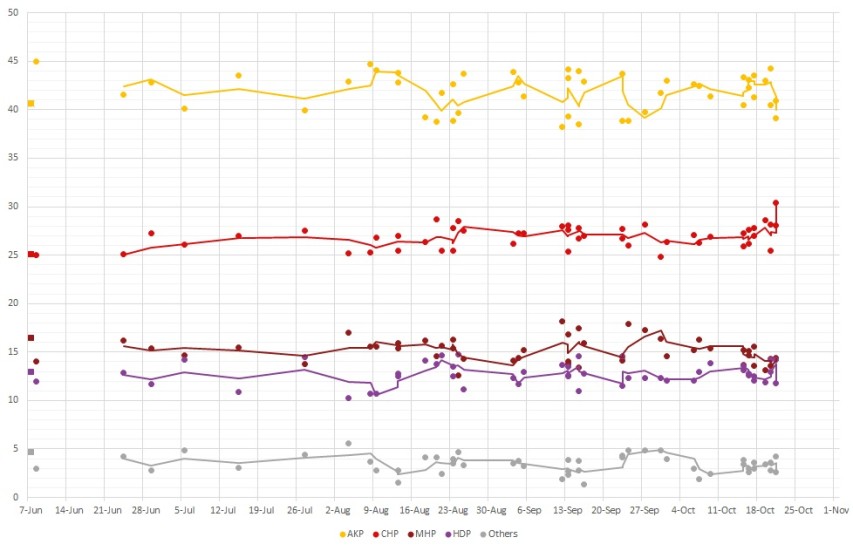
Like other observers of Turkish politics, I was stunned on November 1 when the ruling Justice and Development Party (Adalet ve Kalkınma Partisi, or AKP) was reported to have increased its share of the national vote since the last round of elections in June 2015 by 9 percent and its share of parliamentary seats by 11 percent.
The polls had consistently shown the four major parties winning about the same number of seats as in June. This made intuitive sense; they represent mutually hostile outlooks (Islamist, leftist, Kurdish, nationalist), making substantial movement between them in under five months highly unlikely. That about one in nine voters switched parties defies reason.
Polling results between the June and November 2015 Turkish elections
The AKP’s huge increase gave it back the parliamentary majority it had lost in the June 2015 elections, promising President Recep Tayyip Erdoğan a semi-legal path to the dictatorial powers he aspires to.
But, to me, the results stink of fraud. It defies reason, for example, that the AKP’s war on Kurds would prompt about a quarter of Turkey’s Kurds to abandon the pro-Kurdish party and switch their votes to the AKP.
October 28, 2015
Europe: The First Crusade – Lies – Extra History
Published on 19 Sep 2015
Time to look back on the First Crusade and talk about errors and stories that didn’t make the final cut! The religious nature of the First Crusade meant that many of the primary sources for it (certainly on the Christian side) had a vested interest in reinforcing the idea that the crusaders had the blessing of God. Untangling the truth from their stories reminds us that there is no such thing as “the real story” when it comes to history: our modern perspective cannot help but shape the way we see these events also, and even to the extent that we try to set aside our bias, the conflicting accounts mean we still have to conjecture about what’s most correct. This episode also features answers to questions posed by our supporters on Patreon!
October 27, 2015
QotD: The new censors
Governments began to treat those threatened for their opinions almost as harshly as those attacking them. Dutch legal authorities tried repeatedly, if unsuccessfully, to prosecute Mr. Wilders for “inciting hatred” with his film. He was briefly prohibited from entering Britain. In 2006, Tony Blair’s government passed the Racial and Religious Hatred Act — a kind of “blasphemy lite” law — ostensibly designed to protect all religions against threatening expression but generally understood as intended to limit hostile criticism of Islam. Both the U.S. and the European Union have entered into a dialogue in recent years with the 56 states of the Organization of the Islamic Conference, which is seeking an international law prohibiting blasphemy. In 2011, Secretary of State Hillary Clinton told the OIC that, while the First Amendment prevented the U.S. from prohibiting speech, the administration might still “use some old-fashioned techniques of peer pressure and shaming so that people don’t feel they have the support to do what we abhor.”
Admittedly, it is difficult to draw a clear line between criticism of an Islamic belief and an attack on Muslims who believe it. If you denounce a belief as absurd, you are implicitly criticizing the believers as credulous fools. Christians have to endure explicit denunciations of their faith all the time from such writers as Richard Dawkins and Sam Harris. And so they should. If you can’t stand the heat, don’t listen to hellfire sermons from atheists.
Hearing criticisms of your own convictions and learning the beliefs of others are training for life in a multifaith society. Preventing open debate means that all believers, including atheists, remain in the prison of unconsidered opinion. The right to be offended, which is the other side of free speech, is therefore a genuine right. True belief and honest doubt are both impossible without it.
It isn’t just some Muslims who want the false comfort of censoring disagreeable opinions. Far from it. Gays, Christians, feminists, patriots, foreign despots, ethnic activists — or organizations claiming to speak for them — are among the many groups seeking relief from the criticism of others through the courts, the legislatures and the public square.
John O’Sullivan, “No Offense: The New Threats to Free Speech”, Wall Street Journal, 2014-10-31.
October 22, 2015
Justifying the murder of random Israelis
Brendan O’Neill says that the left has managed to plumb the very bottom of morality:
It’s been clear for years that the left has been losing the moral plot. But I never thought I would see it apologise for, even defend, the stabbing to death of Jews. The silver lining for the left is that it’s impossible for it to sink any lower. This is as low as it gets.
The response in the West to the spate of foul murders by car, knife and meat cleaver in Israel has been almost as shocking as the killings themselves. Many have stayed silent, a global version of “bystander culture”, where people look awkwardly at the ground as someone is battered in front of them. The Western media is currently a shameless shuffling bystander to murders in Israel.
Others have asked, “Well, what do Israelis expect?” The crashing of cars into rabbis waiting for a bus and the hacking at Israeli citizens doing their weekly shop is treated as a normal response by Palestinians to their woes.
When the Guardian glorifies these killings as a “knife intifada”, and radical writers describe them as a natural kickback against Palestinians’ “ongoing humiliation”, they’re really saying Israeli citizens deserve to be murdered.
It’s understandable. It makes sense. These offerers of chin-stroking explanations for why a rabbi just had to be rammed with a car actually dehumanise both Israelis and Palestinians. They treat Israelis as collectively guilty for what their government does, meaning the old woman on a bus is a legitimate target.
And with their handwringing over “Palestinian despair”, with one writer claiming Palestinians are lashing out with knives because it’s “the only option left to them”, they infantilise Palestinians, reducing them to robotic knife-wielders who aren’t responsible for what they do. They heap contempt on both sides, demonising Israeli citizens and pitying Palestinians so much that they end up seeing them as mentally deficient, with no choice but to hack at the nearest Jew.


