
I am not religious but am fascinated by the comparisons at times between religion and environmentalism. Here is the LEED process applied to religion:
- 1 point: Buy indulgence for $25
- 1 point: Say 10 Our Fathers
- 1 point: Light candle in church
- 3 points: Behave well all the time, act charitably, never lie, etc.
It takes 3 points to get to heaven. Which path do you chose?
Warren Meyer, “When Sustainability is not Sustainable”, Coyote Blog, 2013-07-30.
November 4, 2018
QotD: LEED indulgences
Comments Off on QotD: LEED indulgences
October 30, 2018
Pittsburgh’s Jewish community
Jonathan Kay on the importance of Pittsburgh’s Jews in historical terms:
Although the Jewish population of Pittsburgh always has been relatively small, the city has an outsized role in the history of North American Jewry thanks to the “Pittsburgh Platform” of 1885, a landmark in the emergence of Reform Judaism and the broader pattern of Jewish assimilation. Drafted at the city’s Concordia Club (which now serves as a student center for the University of Pittsburgh), the document urged that Jews renounce national aspirations and promote inter-religious bridge-building. While the document has lapsed into obscurity, its signatories’ vision of modern, liberal, assimilated Judaism was prescient:
We consider ourselves no longer a nation, but a religious community, and therefore expect neither a return to Palestine, nor a sacrificial worship under the sons of Aaron, nor the restoration of any of the laws concerning the Jewish state. We recognize in Judaism a progressive religion, ever striving to be in accord with the postulates of reason. We are convinced of the utmost necessity of preserving the historical identity with our great past. Christianity and Islam, being daughter religions of Judaism, we appreciate their providential mission, to aid in the spreading of monotheistic and moral truth. We acknowledge that the spirit of broad humanity of our age is our ally in the fulfillment of our mission, and therefore we extend the hand of fellowship to all who cooperate with us in the establishment of the reign of truth and righteousness among men.
The timing of the Pittsburgh Platform came at a terrible time in Jewish history. The assassination of Czar Alexander II in 1881 had set off waves of pogroms against Jewish communities in Russia and Ukraine. Tens of thousands were slaughtered, and millions of Jewish survivors fled west, swelling Jewish communities across North America and beyond. Between 1880 and 1900, the Jewish population of the United States jumped by a factor of six, from 250,000 to 1.5-million.
Most of the Jews who came to the West didn’t want a new Pale of Settlement, and instead created a new, free kind of Jewish life within majority Christian countries. The vision of co-existence embedded within the Pittsburgh Platform has come to pass — notwithstanding horrific but isolated acts of violence from the likes of Robert Bowers.
The sight of armed state agents swarming a synagogue is hardly a novelty within Jewish history. The difference in Pittsburgh — the aspect of this week’s tragedy that would have shocked many of the 19th century Jews who fled the Cossacks — is that these police officers came to protect besieged Jews, not attack them. There will always be outbreaks of criminal anti-Semitism. The question is what happens when the men in uniform show up.
Eleven Jews were murdered at the Tree of Life. But the casualties also included four wounded (but as yet unnamed) police officers who put their life on the line to defend a Jewish house of worship. That fact is no comfort to the dead and grieving, and the officers themselves no doubt would say they were only doing their jobs. But it’s the one aspect of this whole sad story that, I believe, my own Jewish ancestors would have found uplifting.
Comments Off on Pittsburgh’s Jewish community
October 29, 2018
ESR responds to the synagogue attack
Eric Raymond posted this after hearing the news of the attack on the synagogue in Pittsburgh*.
To my Jewish friends and followers:
I’m grieving with you today. I know the neighborhood where Tree of Life synagogue sits – it’s a quiet, well-off, slightly Bohemian ‘burb with a lot of techies living in it.
I’m not Jewish myself, but I figured out a long time ago that any society which abuses its Jews – or tolerates abuse of them – is in the process of flushing itself down the crapper. The Jews are almost always the first targets of the enemies of civilization, but never the last.
But I’m not posting to reply only with words.
Any Jew who can get close enough to me in realspace for it to be practical and asks can have from me free instruction in basic self-defense with firearms and anti-active-shooter tactics. May no incident like this ever occur again – but if it does, I would be very proud if one of my students took down the evildoer before it reached bloodbath stage.
US official statistics indicate that Jews are still disproportionally the target of hate crimes:
US Hate Crime Data for 2016 (Most Recent Year Available): Blacks vs. Muslims vs. Jews pic.twitter.com/INkyUxCZYS
— Mark J. Perry (@Mark_J_Perry) October 28, 2018
Michael Brown at Townhall.com:
Premeditated, cold-blooded murder is always unspeakably evil. But it is even more evil when the innocent, unsuspecting victims are children in a school or worshipers in their congregational building. How can we even describe monstrous evil like this?
In recent years, we have witnessed horrific school shootings and barbaric church shootings. Now, we have witnessed Jewish blood being shed in a synagogue. And it was not just during a normal Sabbath service. It was during a bris, a special time of celebration when a Jewish baby boy is circumcised on the 8th day.
Families have come together for this special occasion, sometimes spanning three or even four generations. A new Jewish life is welcomed into the world. And at the end of the ceremony, a prayer called shehecheyanu is recited: “Blessed are You, Lord our God, King of the Universe, who has granted us life, sustained us and enabled us to reach this occasion.”
In the midst of this a mass murder took place.
Sadly, different groups will seek to politicize the slaughter. But at times like this, we do well to hold our peace. Already this week, an allegedly unstable Trump-lover was arrested for his role in the attempted pipe bombings. Now, an alleged Nazi Trump-hater was arrested as the synagogue shooter.
So, I appeal to all people of conscience: Let’s focus on the victims rather than on political debate. Let’s hold our tongues out of respect for the dead.
* Rather than give the killer any “glory” by using his name, I’m following the recommendations of the Some Asshole Initiative.
Comments Off on ESR responds to the synagogue attack
October 24, 2018
Kingdom of Majapahit – Lies – Extra History
Extra Credits
Published on 20 Oct 2018Our fantastic writer Rob Rath reviews the mispronunciations we made, the sources we used, and the extra stories we ran out of room to fit into our series on the Kingdom of Majapahit.
Relief efforts: https://secure2.oxfamamerica.org/page… and https://kopernik.info/en/donate/palu-…
Join us on Patreon! http://bit.ly/EHPatreon or http://bit.ly/EMPatreon
Comments Off on Kingdom of Majapahit – Lies – Extra History
October 11, 2018
Prometheus – Origins – Extra Mythology – #1
Extra Credits
Published on 8 Oct 2018Let’s start at the primordial beginning. The first “peoples” on the earth were Cyclops and Titans. Prometheus was one of these titans, and in fact just one of two remaining after an unfortunate conflict with, you guessed it, Zeus…
Join the Patreon community! http://bit.ly/EMPatreon
Comments Off on Prometheus – Origins – Extra Mythology – #1
October 9, 2018
Kingdom of Majapahit – Changing Winds – Extra History – #5
Extra Credits
Published on 6 Oct 2018When Islam arrived in Indonesia, life changed — except within Majapahit, where court drama kept them focused on themselves and unaware of the visits and alliances between Admiral Zheng He and the Sultanate of Malacca — forming new powers in the southern seas.
Support us on Patreon! http://bit.ly/EHPatreon
As we finished this episode, an even more devastating earthquake and tsunami struck the island of Sulawesi. Once again we’ve linked two fundraising efforts—one international aid organization, and another for a local effort. Any help would be deeply appreciated.
https://secure2.oxfamamerica.org/page…
https://kopernik.info/en/donate/palu-…
Comments Off on Kingdom of Majapahit – Changing Winds – Extra History – #5
October 4, 2018
QotD: Gandhi in World War One
We are therefore presented with the seeming anomaly of a Gandhi who, in Britain when war broke out in August 1914, instantly contacted the War Office, swore that he would stand by England in its hour of need, and created the Indian Volunteer Corps, which he might have commanded if he hadn’t fallen ill with pleurisy. In 1915, back in India, he made a memorable speech in Madras in which he proclaimed, “I discovered that the British empire had certain ideals with which I have fallen in love …” In early 1918, as the war in Europe entered its final crisis, he wrote to the Viceroy of India, “I have an idea that if I become your recruiting agent-in-chief, I might rain men upon you,” and he proclaimed in a speech in Kheda that the British “love justice; they have shielded men against oppression.” Again, he wrote to the Viceroy, “I would make India offer all her able-bodied sons as a sacrifice to the empire at this critical moment …” To some of his pacifist friends, who were horrified, Gandhi replied by appealing to the Bhagavad Gita and to the endless wars recounted in the Hindu epics, the Ramayana and the Mahabharata, adding further to the pacifists’ horror by declaring that Indians “have always been warlike, and the finest hymn composed by Tulsidas in praise of Rama gives the first place to his ability to strike down the enemy.”
This was in contradiction to the interpretation of sacred Hindu scriptures Gandhi had offered on earlier occasions (and would offer later), which was that they did not recount military struggles but spiritual struggles; but, unusual for him, he strove to find some kind of synthesis. “I do not say, ‘Let us go and kill the Germans,’” Gandhi explained. “I say, ‘Let us go and die for the sake of India and the empire.’” And yet within two years, the time having come for swaraj (home rule), Gandhi’s inner voice spoke again, and, the leader having found his cause, Gandhi proclaimed resoundingly: “The British empire today represents Satanism, and they who love God can afford to have no love for Satan.”
The idea of swaraj, originated by others, crept into Gandhi’s mind gradually. With a fair amount of winding about, Gandhi, roughly, passed through three phases. First, he was entirely pro-British, and merely wanted for Indians the rights of Englishmen (as he understood them). Second, he was still pro-British, but with the belief that, having proved their loyalty to the empire, Indians would be granted some degree of swaraj. Third, as the home-rule movement gathered momentum, it was the swaraj, the whole swaraj, and nothing but the swaraj, and he turned relentlessly against the crown. The movie to the contrary, he caused the British no end of trouble in their struggles during World War II.
Richard Grenier, “The Gandhi Nobody Knows”, Commentary, 1983-03-01.
Comments Off on QotD: Gandhi in World War One
October 1, 2018
Kingdom of Majapahit – The Golden Reign – Extra History – #4
Extra Credits
Published on 29 Sep 2018The new sixteen-year-old king, Hayam Wuruk, had inherited an empire. Gajah Mada acted on his behalf, reshaping the way that the throne of Majapahit would be run, but he made a big mistake with the Sundanese princess…
Support us on Patreon! http://bit.ly/EHPatreon
Comments Off on Kingdom of Majapahit – The Golden Reign – Extra History – #4
September 27, 2018
“Oops” indeed!
Colby Cosh has a bit of good-natured fun-poking at the great and the good of the Canadian Establishment as an honorary Canadian turns out to be presiding over something that might be described as genocide:
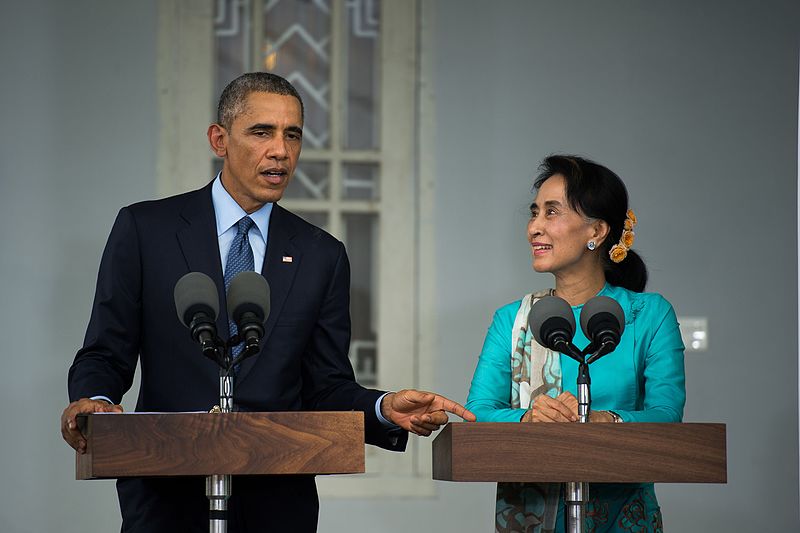
President Barack Obama and Aung San Suu Kyi in 2014
Photo via Wikimedia Commons
Sometimes I am convinced that Canada is a name that will endure through the ages and travel with mankind throughout the galaxy. Sometimes I am convinced that we should be considered exclusively as a subject for absurdist fairy tales, a real-life Ruritania or Grand Fenwick. I guess it goes about 50-50. But I am afraid the emerging controversy over Aung San Suu Kyi’s honorary Canadian citizenship puts us firmly in kooky Zembla territory.
The present State Counsellor of Burma was the fourth person ever to receive this distinction. Now we are talking about withdrawing her honorary citizenship because, as first minister of Burma, she has been heavily implicated in massacres and ethnic cleansing of the Muslim Rohingya people of the country’s Rakhine state.
One in four: not such a great batting average, is it? Our political class devised the highest and most permanent form of honour that could be envisioned for a foreign do-gooder, and literally the fourth person on the entire surface of the planet who was deemed to have met the criteria went and became CEO of a genocide. What does this suggest about the collective judgment of Canada’s elite? You don’t suppose anyone is going to lose a job over this, do you?
[…]
Our prime minister is now spitballing the idea of having Aung San Suu Kyi’s honorary citizenship withdrawn, and one supposes that if this might help save innocent lives, it ought to be considered, even at the price of turning this concocted showpiece institution of “honorary citizenship” into garbage. One of the essential meanings of citizenship is that it cannot be withdrawn, even with due process, even when a citizen has perpetrated unspeakable crimes. “Honorary citizenship” does not confer the legal rights of the real thing, but surely it is at least supposed to resemble the real thing — to represent a commitment of analogous significance and irreversibility as that which we enter into with immigrants taking the oath and joining the club over at the courthouse.
Since honorary citizenship is not conferred by Parliament, it is not clear that it could be revoked by Parliament. Probably an Order-in-Council would do (because, again, no enforceable rights are at stake). If this is done in the case of Aung San Suu Kyi, it seems obvious that we should just put the institution in abeyance for a century or so. Let later generations see if they can manage not to screw up this honorary citizenship thing so thoroughly.
September 23, 2018
30 Years War | 3 Minute History
Jabzy
Published on 28 Oct 2015Thanks to Xios, Alan Haskayne, Lachlan Lindenmayer, William Crabb, Derpvic, Seth Reeves and all my other Patrons. If you want to help out – https://www.patreon.com/Jabzy?ty=h
Comments Off on 30 Years War | 3 Minute History
September 22, 2018
September 18, 2018
Kingdom of Majapahit – Wrath of the Khan – Extra History – #2
Extra Credits
Published on 15 Sep 2018The Mongols came to the island of Java — the King of Singhasari had defied them for too long. But by the time they got there, the king had died, and instead someone claiming to be his stepson, Raden Vijaya, promised to be their vassal. The Mongol forces were in for quite a surprise.
Comments Off on Kingdom of Majapahit – Wrath of the Khan – Extra History – #2
September 16, 2018
Early Arab Conquests | 3 Minute History
Jabzy
Published on 13 Dec 2015Covering the conquests during the Rashidun Caliphate. I will probably do a separate video on the First Fitna.
Thanks for the 15,000 subs. And thanks to Xios, Alan Haskayne, Lachlan Lindenmayer, Derpvic, Seth Reeves and all my other Patrons. If you want to help out – https://www.patreon.com/Jabzy?ty=h
Comments Off on Early Arab Conquests | 3 Minute History
September 13, 2018
QotD: “God is dead”
The life and work of the maverick German philosopher Friedrich Nietzsche (1844-1900) is associated with five interlinking ideas: the death of God; nihilism and the crisis in morality; the Superman; the will to power; and the eternal recurrence.
Nietzsche first announced that ‘God is dead’ in his 1883 work The Joyful Science. As with much that he wrote, this phrase of Nietzsche’s has subsequently been often misunderstood. Taken literally, it is obviously a nonsensical declaration, for either a Christian god is real and eternal, or else he never existed in the first place. What Nietzsche meant by the death of God was that European civilisation had lost its faith in Christianity, but was still living by values and a morality system based on it. For this reason he believed European civilisation was facing a crisis resulting from the approaching collapse in its morality system, and the dawn of the age of nihilism – hence the title of his 1886 work, Beyond Good and Evil, which was not the libertine manifesto it sounds like, but a contention that Christian values of good and evil have become redundant.
In this respect, Nietzsche was not a nihilist, another common misconception. He viewed the coming age of nihilism with much trepidation, fearing (rightly) that the result would be great wars in the 20th century. He believed that it was imperative that humanity create a new morality system for the coming post-Christian age. The solution, he believed, was a new individualistic morality system in which the strongest, bravest men would become their own masters and creators, and in turn would become philosopher kings and oligarchs of the spirit. This new man was to be embodied in his infamous, hypothetical Übermensch, or Superman (as Über means above and beyond in German, Nietzsche’s word used to be also translated as the Beyond-Man or Overman, but today is usually not translated at all. The Übermensch goes above and beyond.)
Patrick West, “Nietzsche and the struggle against nihilism”, Spiked, 2018-08-03.
Comments Off on QotD: “God is dead”
September 9, 2018
Holy Roman Empire Explained
WonderWhy
Published on 9 Aug 2018Looking at the origins and history of the Holy Roman Empire, assessing the claim by Voltaire that it was not holy, nor Roman, nor an empire, and finally looking at the complex hierarchical political structure of the empire.
Have you ever wondered what the world would be like if the Holy Roman Empire existed today? This video is a collaboration was RealLifeLore, who looked at that very question. Link here: https://www.youtube.com/watch?v=SIwNR…
Comments Off on Holy Roman Empire Explained


