
Published on 7 Dec 2015
The Australian and New Zealand Army Corps or ANZAC fought in Gallipoli, on the Western Front and in the Middle East during World War 1. Even though the Gallipoli campaign was an ultimate failure, it was the birth hour of the New Zealand and Australian national consciousness. Find out how the Great War shaped Australia and New Zealand in our special episode.
December 8, 2015
Born On The Shores Of Gallipoli – ANZAC in WW1I THE GREAT WAR Special
December 6, 2015
The American Civil War: Every Day
Published on 31 Oct 2014
See every day of the American Civil War unfold as the Union fights against the Confederacy to reunite the country in a bitter struggle.
Legend:
Maroon = Confederate States of America and territories
Red = Areas occupied by Confederate forces
Pink = Gains for that Day
Dark Blue = United States of America and territories
Blue = Areas occupied by Union forces.
Light blue = Gains for that day
Yellow = Border states / disputed areas.
H/T to BoingBoing for the link.
Comments Off on The American Civil War: Every Day
December 4, 2015
The Serbian Exodus Through Albania I THE GREAT WAR – Week 71
Published on 3 Dec 2015
Serbia’s last stand is over and the remaining forces and civilians have to leave their home country across the inhabitable trails of the Albanian Alps. So, a whole nation is on the run while their enemies celebrate their successful military operation. The German Army is gladly relocating the much needed troops to other fronts while they leave the Austrians and Bulgarians to deal with the new situation on the Balkans.
Comments Off on The Serbian Exodus Through Albania I THE GREAT WAR – Week 71
December 3, 2015
Bombing probably won’t change anything in Syria
Charles Stross looks at the role of Turkey in the fight against ISIS (that is, Turkey’s actions within the theatre of war, not strictly speaking, actions against ISIS):
Turkey was, prior to 1918 and the Sykes-Picot Agreement, the hegemonic imperial power in the middle east, in the form of the Ottoman Empire. Syria was as much a part of Turkey’s “sphere of influence” as the Eastern Ukraine was of Russia’s — incidentally, another zone where the post-1918 settlement is going up in gunsmoke and it’s raining airliners. More to the point, geopolitically Turkey is in a weird position. It was roped into NATO in the wake of the second world war as part of the USA’s policy of encirclement of the USSR—but Turkey’s national aspirations are intrinsically at odds with some of its NATO partners, spiking on occasion to the level of warfare. Let us not forget that Turkey was also the imperial hegemon that ruled Greece and the Balkans. And today Turkey controls a vital regional resource — the tributary rivers that flow into the Euphrates, the main supply of irrigation of water into Syria and northern Iraq. Turkey has been damming the Euphrates and restricting the water flow to Raqqa province, violating international water sharing conventions. Syrian anger over the Güney Doğu Anadolu project was a major reason why the Assad government began providing material support to the PKK insurgency in Turkey. In turn, Turkish control over the Euphrates headwaters is a potent weapon against the Kurdish independence movement.
I’m an outsider and not adequately informed on this area. However, it looks (from here) as if the Turkish centralizing obsession with suppressing the PKK has led to the destabilization of Syria and northern Iraq. Syria’s government encouraging a push towards water-intensive agriculture coincided with the most intense drought on record in Syria, from 2007 to 2010, then ran into the generalized political discord of the Arab Spring: the Ba’ath government badly mishandled the demographic/economic situation during the 00’s and it would be a mistake to lay the blame for the Syrian civil war entirely on Turkey. However, cutting the river water supply to a drought-stricken region in the middle of a period of popular discontent didn’t help.
Today, 4 years after the war began, Syria is a shattered mess. It’s noteworthy that Da’esh controls areas where the water supply has been most badly affected, crippling agriculture, the main support of the poor, mostly conservative Sunni locals. Add in lots of former Iraqi army officers (pushed into fighting by the de-Ba’athication policies imposed by the US occupation and then the anti-Sunni policies of the subsequent Shi’ite government in Baghdad) and a seasoning of Wahhabite fanatics, and you have the recipe for Da’esh to get started, take root, and hold territory.
Comments Off on Bombing probably won’t change anything in Syria
Korea: Admiral Yi – V: Martial Lord of Loyalty – Extra History
Published on 24 Oct 2015
After his success at Myeongnyang, Yi began rebuilding the Korean navy and strengthening his partnership with the Chinese. But then, Toyotomi Hideyoshi died. Japan’s new leaders had no interest in continuing the war, but although they sued for peace, Korea now held the upper hand and was determined to punish the people who had committed so many massacres against their people. Yi and the Chinese fleet bottled up the Japanese at the fort in Suncheon. When the Japanese called for reinforcements, Yi interrupted them in Noryang Strait. Again they were outnumbered, 500 to 150, but the Chinese commander did not yet understand Yi’s long range style of warfare and immediately closed for close combat. Yi ordered his flagship to rescue their allies, and as soon as the Japanese recognized him, they focused fire on him. This allowed the Chinese, suddenly forgotten, to fire freely on them. The Japanese realized their error and tried to flee, but Yi would have none of it. Beating the war drum himself, he urged his ships to chase the Japanese – to punish them for all the slaughter they brought to Korea. It was then that he was struck by a fatal gunshot. Before he died, he ordered his son and nephew to command the battle for him. They dressed in his armor to hide his death from the troops and continued beating the dream. Together, they carried the day – only for Yi’s tragic death to be revealed at the moment of victory. But although Yi did not live to see it, 300 Japanese ships were captured and destroyed that day and the rest of their invading force was rounded up soon after. For his tireless service, his brilliant leadership, and his unwavering devotion to Korea, Yi was given the posthumous title of Chungmugong, the Martial Lord of Loyalty.
Comments Off on Korea: Admiral Yi – V: Martial Lord of Loyalty – Extra History
December 2, 2015
Can the Royal Navy fund a “cheap and cheerful” frigate?
In the most recent British government SDSR plan, the Royal Navy’s hopes to get 13 new Type 26 frigates have been trimmed down to only eight. Save the Royal Navy speculates on developing a cheaper ship design that could perhaps fill the gap:
Is it really possible to produce a fully effective frigate that is significantly cheaper than a T26? Let us call it the ‘Type 31’, It still requires point defence missiles, anti-ship weaponry, a hangar and small flight deck (even if only for a UAV or Lynx size helicopter), plus a command and control system and suite of sensors. Although the hull size could be reduced, a simpler propulsion system used and the anti-submarine capability eliminated or reduced. You might cut the cost by 30%, and get a general purpose ship but there is still the cost of developing a new design. (At least £200M has already been spent on the T26 design as well as various development ‘blind alleys’ along the way.) A second frigate type will also need its own equipment support logistics and training pipelines.
The desire to create an exportable frigate is laudable but will we not be re-inventing the wheel when there are already cheaper foreign designs that could be licensed or adapted. The highly successful German MEKO design and the Danish Stanflex system are good examples.
If your warship is designed to cope in high-intensity conflict then it will need expensive weapons and sensors. Today’s generation of supersonic anti-ship missiles are truly formidable. Modern surface ships face greater and more diverse threats than ever. To counter this requires good sensors, agile missiles and an array of decoys, backed up by last-ditch close in weapon systems (CIWS). Although the general purpose frigate may not be dedicated to hunting submarines, it will still need a decent sonar to give some hope of prosecuting a submarine or detecting and avoiding torpedo attack. Submarines are also getting more and more stealthy with a growing arsenal of weapons. Without quiet propulsion and sophisticated sonars (i.e. towed arrays) that can detect threats at range and helicopters to attack, the Type 31 could ‘just be another target’.
If your escorts are really going to escort anything eg. an aircraft carrier or merchant shipping, then it needs more than just last-ditch self-defence weapons. A Phalanx CIWS may defend the ship it is mounted on, but it is little use protecting another vessel. If the escort ship can only defend itself, it has very limited use or must be permanently on the offensive. The Sea Ceptor being fitted to the Type 23 and Type 26 frigates has the major advantage over the Sea Wolf it replaces by having more than double the range (around 25Km), significantly extending the size of the protection umbrella over ships being escorted. Frigates are traditionally built to hunt submarines, if our Type 31 has no real ASW capability then it is pretty limited in a wartime role.
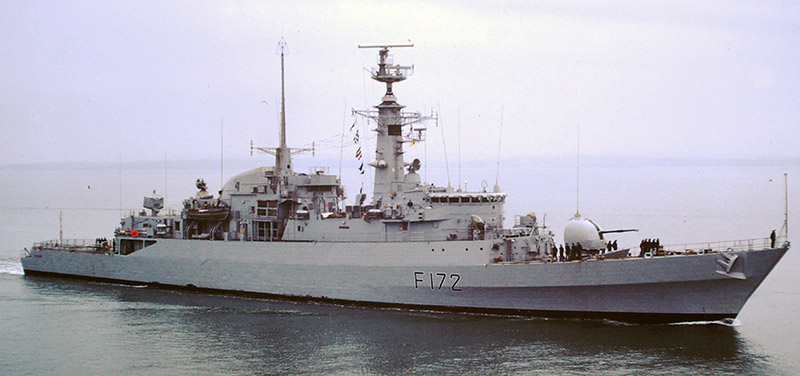
Sleek, fast and loved by their crews, the Type 21 was the poster child for the cheap frigate. There is a very fine line between a successful ‘less capable, cheaper frigate’ and a compromised warship design that becomes a liability. The Type 21 Frigate design of the 1970s was designed by a private company and accepted by the RN as a way to get a modern and affordable frigate to sea. Unfortunately when tested in the heat of the Falklands war their deficiencies became obvious. A top-heavy design on a lightweight hull, they suffered structural problems in the prolonged South Atlantic operations. They were also inadequately armed and suffered accordingly. God help them if they had gone up against Soviet aircraft or missiles. Ironically the surviving Type 21s still soldier on today in the Pakistani navy. Upgraded with a Phalanx system and Chinese SAMs / Harpoon missiles they are now slightly more potent.
Comments Off on Can the Royal Navy fund a “cheap and cheerful” frigate?
December 1, 2015
Hell’s Handmaiden – Canadian Flying Ace Billy Bishop I WHO DID WHAT IN WORLD WAR 1?
Published on 30 Nov 2015
William “Billy” Bishop was not only the top Canadian flying ace but also one of the most successful flying aces of World War 1. With 72 confirmed victories, he soon became the fear of the German Jagdstaffeln who actually put a bounty on his head and called him Hell’s Handmaiden. Surviving one of the bloodiest theatres of war, the sky above the Western Front, Billy Bishop’s skill made him a national hero.
Comments Off on Hell’s Handmaiden – Canadian Flying Ace Billy Bishop I WHO DID WHAT IN WORLD WAR 1?
November 30, 2015
Why Don’t You Use Modern Names For Cities? Who Was A Capable Commander in WW1? I OUT OF THE TRENCHES
Published on 28 Nov 2015
Indy sits in the chair of wisdom again and this time answers two questions that you were asking a lot. He explains his policy for naming places in a historical context and if there were any good commanders actually.
Comments Off on Why Don’t You Use Modern Names For Cities? Who Was A Capable Commander in WW1? I OUT OF THE TRENCHES
November 28, 2015
QotD: Recruiting and training Rome’s legions
In the purer ages of the commonwealth, the use of arms was reserved for those ranks of citizens who had a country to love, a property to defend, and some share in enacting those laws, which it was their interest as well as duty to maintain. But in proportion as the public freedom was lost in extent of conquest, war was gradually improved into an art, and degraded into a trade. The legions themselves, even at the time when they were recruited in the most distant provinces, were supposed to consist of Roman citizens. That distinction was generally considered, either as a legal qualification or as a proper recompense for the soldier; but a more serious regard was paid to the essential merit of age, strength, and military stature. In all levies, a just preference was given to the climates of the North over those of the South: the race of men born to the exercise of arms was sought for in the country rather than in cities; and it was very reasonably presumed, that the hardy occupations of smiths, carpenters, and huntsmen, would supply more vigor and resolution than the sedentary trades which are employed in the service of luxury. After every qualification of property had been laid aside, the armies of the Roman emperors were still commanded, for the most part, by officers of liberal birth and education; but the common soldiers, like the mercenary troops of modern Europe, were drawn from the meanest, and very frequently from the most profligate, of mankind.
That public virtue, which among the ancients was denominated patriotism, is derived from a strong sense of our own interest in the preservation and prosperity of the free government of which we are members. Such a sentiment, which had rendered the legions of the republic almost invincible, could make but a very feeble impression on the mercenary servants of a despotic prince; and it became necessary to supply that defect by other motives, of a different, but not less forcible nature — honor and religion. The peasant, or mechanic, imbibed the useful prejudice that he was advanced to the more dignified profession of arms, in which his rank and reputation would depend on his own valor; and that, although the prowess of a private soldier must often escape the notice of fame, his own behavior might sometimes confer glory or disgrace on the company, the legion, or even the army, to whose honors he was associated. On his first entrance into the service, an oath was administered to him with every circumstance of solemnity. He promised never to desert his standard, to submit his own will to the commands of his leaders, and to sacrifice his life for the safety of the emperor and the empire. The attachment of the Roman troops to their standards was inspired by the united influence of religion and of honor. The golden eagle, which glittered in the front of the legion, was the object of their fondest devotion; nor was it esteemed less impious than it was ignominious, to abandon that sacred ensign in the hour of danger. These motives, which derived their strength from the imagination, were enforced by fears and hopes of a more substantial kind. Regular pay, occasional donatives, and a stated recompense, after the appointed time of service, alleviated the hardships of the military life, whilst, on the other hand, it was impossible for cowardice or disobedience to escape the severest punishment. The centurions were authorized to chastise with blows, the generals had a right to punish with death; and it was an inflexible maxim of Roman discipline, that a good soldier should dread his officers far more than the enemy. From such laudable arts did the valor of the Imperial troops receive a degree of firmness and docility unattainable by the impetuous and irregular passions of barbarians.
And yet so sensible were the Romans of the imperfection of valor without skill and practice, that, in their language, the name of an army was borrowed from the word which signified exercise. Military exercises were the important and unremitted object of their discipline. The recruits and young soldiers were constantly trained, both in the morning and in the evening, nor was age or knowledge allowed to excuse the veterans from the daily repetition of what they had completely learnt. Large sheds were erected in the winter-quarters of the troops, that their useful labours might not receive any interruption from the most tempestuous weather; and it was carefully observed, that the arms destined to this imitation of war, should be of double the weight which was required in real action. It is not the purpose of this work to enter into any minute description of the Roman exercises. We shall only remark, that they comprehended whatever could add strength to the body, activity to the limbs, or grace to the motions. The soldiers were diligently instructed to march, to run, to leap, to swim, to carry heavy burdens, to handle every species of arms that was used either for offence or for defence, either in distant engagement or in a closer onset; to form a variety of evolutions; and to move to the sound of flutes in the Pyrrhic or martial dance. In the midst of peace, the Roman troops familiarized themselves with the practice of war; and it is prettily remarked by an ancient historian who had fought against them, that the effusion of blood was the only circumstance which distinguished a field of battle from a field of exercise. It was the policy of the ablest generals, and even of the emperors themselves, to encourage these military studies by their presence and example; and we are informed that Hadrian, as well as Trajan, frequently condescended to instruct the unexperienced soldiers, to reward the diligent, and sometimes to dispute with them the prize of superior strength or dexterity. Under the reigns of those princes, the science of tactics was cultivated with success; and as long as the empire retained any vigor, their military instructions were respected as the most perfect model of Roman discipline.
Edward Gibbon, “Chapter I: The Extent Of The Empire In The Age Of The Antonines — Part II”, History of the Decline and Fall of the Roman Empire, 1782.
Comments Off on QotD: Recruiting and training Rome’s legions
November 27, 2015
Pride Comes Before The Fall – British Trouble in Mesopotamia I THE GREAT WAR – Week 70
Published on 26 Nov 2015
Far away from the Western Front, the British Indian Army gets intro trouble in Mesopotamia against the Ottoman Empire. In the Alps, the Fourth Battle of the Isonzo is proving just as disastrous to the Italians the other three before. And in Serbia the situation is getting darker and darker as Nis is falling to the Central Powers. All while the flying aces of World War 1 are fighting it out in the skies over the Western Front.
Comments Off on Pride Comes Before The Fall – British Trouble in Mesopotamia I THE GREAT WAR – Week 70
November 26, 2015
Tom Kratman’s “Dear Russia” letter
Tom Kratman looks at what is known about the Turkish military’s attack on a Russian aircraft earlier this week:
Firstly, my condolences on the recent murder of your two pilots. While one might argue that shooting descending parachutists (as opposed to paratroopers) would be permissible in some circumstances, as when there is no reasonable possibility of capture, in this case there was such a possibility. Obviously, you’ll want revenge. I – and I think most Americans, at least such as are not in favor of a large and viciously fundamentalist Islamic state in the Middle East – understand and, generally speaking, approve of things like that, where called for. The situation, however, is more complex than that. Because of that complexity, I strongly encourage you to dispense with emotion, to the utmost of your ability, and reason carefully before acting.
I can’t offer condolences on the initial shoot down of your Sukhoi-24, because I really don’t know what happened. If it drifted into Turkish airspace, and the Turks shot it down, even if they pursued it out of Turkish airspace…well, you’re in an unenviable moral position to complain about any of that, given the conduct your predecessor in interest, the USSR, with regard to KAL 007. If, however, it never violated Turkish airspace, and the Turks crossed over to attack it, you may well have a casus belli against Turkey.
If the Turks are offering war I strongly advise you to decline the invitation. They are very nearly a peer competitor, having similarly sized armed forces, quite possibly better trained, an economy almost as strong as your own, and likely rather stronger when you count out export of raw materials. They’re not as technologically sophisticated as you are, but they have friends who are more so. And you just wouldn’t believe the long-standing love affair between the US Army and the Turkish Army, based on their performance in Korea in the early fifties.
*****
A little aside is in order at this point. I’m not really so concerned about the incident that just took place, with one of your planes shot down by the Turks, and the ejected pilots murdered on the way down. What’s really bugging me is the almost instantaneous assumption of people over here that this was the first set of shots in World War V, World War III having been the Cold War, and World War IV the on-again, off-again, fiasco with the Islamics. On its own, this should not be capable of doing that. Add in paranoia, self-fulfilling prophecy, idiotic foreign policy on many fronts, from many fonts, a fairly inscrutable Turkey…I’m a little concerned that things might spiral out of control.
*****
Earlier in this missive I said I don’t know what happened. Nonetheless, here’s what I think happened. I think that Sukhoi was on a strike mission against the Turkmen Brigades in Syria. I think you’ve been occasionally bombing the crap out of the Turkmen Brigades in Syria for a while now. That would tend to explain the vindictiveness of the folks on the ground who shot at your descending pilots. I think because of that bombing, the Turks, or at least one of the Turks, north of the border decided to help his or their close cousins in Syria. I think it made not a bit of difference whether or not you crossed the border; the Turks wanted to set an example and instill a little fear and friction on you, so would have crossed themselves even if you hadn’t. I suspect the order to do this came from the highest levels in Turkey, probably Erdogan, himself.
No, that doesn’t mean that whipping out the Polonium 210 dispensers would be a good idea.
Comments Off on Tom Kratman’s “Dear Russia” letter
Britain’s latest military and strategic five-year plan
Back in 2010, the British government published the Strategic Defence and Security Review (SDSR), which I joked should properly have been called the “Slashing Damage to Strategic Resources” plan. Back then, the strategic picture was fairly undisturbed with no obvious rising threats, but the economy was still in bad shape. That meant that the RN, RAF, and the army had to cut, cut, cut (and cut some more). The next version of that document has just been published and this time it’s been joined to the National Security Strategy in a single document. Patrick Bury looks at how things have changed from SDSR 2010 to the new NSSSDSR 2015:
On Monday, Prime Minister David Cameron unveiled Britain’s new National Security Strategy and Strategic Defence and Security Review in the House of Commons. It marked the first time the United Kingdom has undertaken a review of its strategy and security within the new five-year schedule. This edition is also notable in that it combines the National Security Strategy (NSS) and Strategic Defence and Security Review (SDSR), which were previously two separate documents. True to its name, the NSS outlines the perceived threats to Britain and its vision for dealing with them, while the SDSR details how the armed forces are configured to execute this vision.
These developments point to a realization in the United Kingdom that it must be more flexible and responsive in terms of setting strategy and defense priorities. After introducing the NSS in 2010 in the wake of criticism that Britain “couldn’t do strategy,” the Conservative government clearly feels it now makes sense to present both policies in a single document. Similarly, the overarching tone of the document is one of internationality. Britain clearly believes it will be working with the United States and France especially closely in the future. But what is inside, and what does it mean?
The NSS related-chapters outline the usual myriad of threats commonly listed in the post-Cold War era. Based on the security services’ National Security Risk Assessment, these threats are then classed into tiers. Tier One risks are the highest priority based on high likelihood and/or high impact. Reflecting the impact of threats and hazards, and the development of risks since 2010, the latest assessment includes a greater number of Tier One risks than in 2012. These are listed in order as terrorism, cyber, international military conflict (rising since 2010), instability overseas (Tier Two in 2010), public health (a new addition), and natural disasters. Interestingly, the general erosion of international order and resulting chaos also makes a more significant appearance.
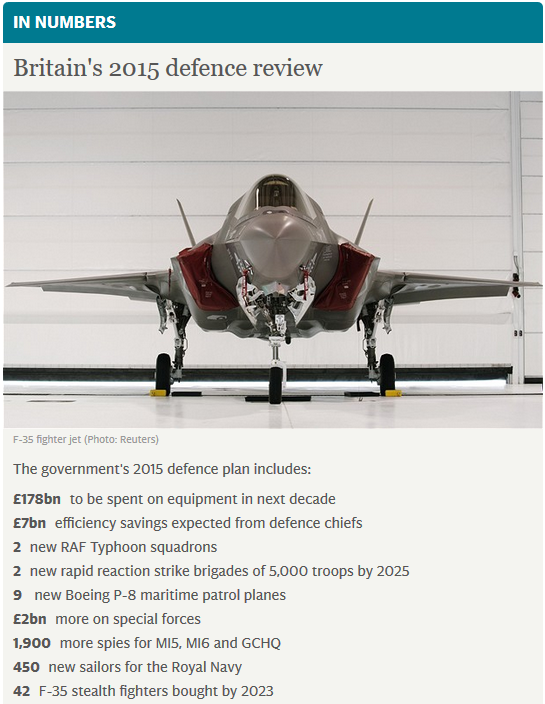
Here’s the quick overview of what is promised this time around:
One area that looks concerning is that the British government appears to be considering replicating the Canadian experiment with merging the military services into a “unified” structure:
Tying all these developments together, this SDSR is notable for its underlying shift towards viewing Britain’s smaller services as a single force, as unveiled in the new Joint Force 2025. Over the next decade, the core of the Joint Force will be based around an expeditionary force of around 50,000 (compared with around 30,000 planned in 2010’s Future Force 2020) and is set to include a new F-35 equipped aircraft carrier, “a land division with three brigades including a new Strike Force; an air group of combat, transport and surveillance aircraft,” and a special forces task group. Of course, the Whole Force concept underpins jointness, but one gets the sense that future SDSRs may well pave the way for the merging of all three services into one force in the name of flexibility and in the search for efficiencies. Another interesting nuance was the primacy of special forces in the document – above that of the Royal Navy which is the senior service – perhaps an indication of why the government is investing an extra £2 billion ($3 billion) in its equipment as well. The number of staff at GCHQ (the signal-intelligence agency), MI5 and MI6 (the domestic and foreign intelligence services) is to also increase by 1,900.
Despite this SDSR unveiling the first major investment, rather than reductions, in the United Kingdom’s security forces for about 25 years, there are a number of noticeable gaps. The first concerns its people. The army remains at its smallest size since the Napoleonic era; recruitment and retention is a problem across British defense; and it remains to be seen if the government’s Spending Review released tomorrow will better the terms and conditions of service. Without the right people in the right place, all the fancy kit in the world is not much use. The message is also clear that rapid-reaction forces are in fashion, and boots on the ground and long-term counter-insurgency operations are out, at least for now. The now bit is important: with a lot of these investments and the Joint Force structure not scheduled for delivery for ten years, there is plenty of scope to adjust or change course entirely between now and then. Which is exactly how the Brits do long-term strategy. Nevertheless, this SDSR is clearly intended to show that Britain wants to remain in the top tier of international powers over the coming decade.
Comments Off on Britain’s latest military and strategic five-year plan
Korea: Admiral Yi – IV: Those Who Seek Death Shall Live – Extra History
Published on 17 Oct 2015
Yi’s success had forced the Japanese to give up offensive naval operations, but their huge fleet remained entrenched in Busan harbor. While Yi pinned them down, reinforcements from the Chinese army had finally arrived and helped the Korean army take back the country on land. Yi petitioned for marines to take Busan back from the Japanese, but his requests were ignored. Instead, he focused on making his base on Hansando self-sufficient: he promised protection to refugees in exchange for them working the island, building his equipment, and even researching military technology. But a truce was called with Japan, one that dragged on for years until Hideyoshi broke it by ordering a second invasion. An informant brought word of secret, unprotected Japanese fleet movements, but Yi recognized it as a trap and refused to go. However, his friend Ryu’s enemies at court seized on this as an opportunity to put Yi on trial for treason. They demoted him again, and gave his fleet to Won Kyon. Won Kyon fell into the trap Yi had refused, and a coordinated surprise attack from the Japanese resulted in the destruction of all but 12 ships. Yi was quickly re-instated, but ordered to disband the navy. He refused, and planned his counterattack carefully: he would fight at Myeongnyang Strait, where he hoped the natural currents would do what his numbers could not. His plan worked: the reversing tide caught the Japanese by surprise and flung their ships against each other right as he pressed the attack. With 13 ships versus 133, he once again drove back Japan with zero losses to his own navy. Word of his success brought other ships out of hiding and convinced the Chinese navy to ally with him at last.
Comments Off on Korea: Admiral Yi – IV: Those Who Seek Death Shall Live – Extra History
November 25, 2015
The delaying tactics of Fabius Cunctatus
James Holmes suggests a few lessons modern tacticians can learn from the great Roman general, Quintus Fabius Maximus:
Quintus Fabius would nod knowingly at seeing the world turned upside down. Celebrated as Fabius Cunctatus (“the Delayer”), the Roman dictator lent his name to strategies whereby commanders deploy strategically defensive yet tactically offensive methods to forestall a decisive battle — all while marshaling manpower, implements of war, and other resources to right the military imbalance.
Skillfully prosecuted, a Fabian strategy proffers an opportunity to defeat a superior foe in a conventional trial of arms. And indeed, Fabius’s feats of arms earned him the nickname “Maximus” among Romans — signifying rock-star status. Historians of classical antiquity ranging from Polybius to Plutarch to Machiavelli considered him an icon of patient, guileful martial statecraft.
Polybius retells Fabius’s tale expertly. After trekking over the Alps, the Carthaginian warlord Hannibal’s army had rampaged throughout Italy, compiling a virtually unbroken record of battlefield victory. In particular, his triumph over the Roman legions at Cannae won enduring fame in Western military circles. Two millennia later General Dwight Eisenhower recalled in his memoir Crusade in Europe, “Every ground commander seeks the battle of annihilation,” maintained Eisenhower; “he tries to duplicate in modern war the classic example of Cannae.”
Granted emergency powers, Fabius assumed personal command of the legions and encamped near the Carthaginian host at Aecae. Upon learning that the Roman army was nearby, Hannibal resolved to “terrify the enemy by promptly attacking.” The Roman riposte? Nothing. No one responded to the Carthaginians’ approach. They trudged back to camp. Having acknowledged his army’s “manifest inferiority,” Fabius “made up his mind to incur no danger and not to risk a battle.”
He was ornery that way. Better to live to fight another day, and on more favorable terms. Why rush in and risk fresh disaster? Rome was fighting on home turf. Its armies were beneficiaries of an “inexhaustible supply of provisions and of men.” Fabius only needed time to tap that potential, transforming latent into kinetic military power.
Comments Off on The delaying tactics of Fabius Cunctatus
November 24, 2015
German Rifles of World War 1 feat. Othais from C&Rsenal I THE GREAT WAR Special
Published on 23 Nov 2015
The next live stream about the Austro-Hungarian rifles and pistols of WW1 will be next Sunday!
Indy and Flo sat down for one of our live streams about historical firearms again. Othais from C&Rsenal explained the various German rifles and pistols of the First World War. Among them of course the famous Gewehr 98 from Mauser and its predecessor, the Gewehr 88. In our next episode we will also have a look at the iconic German pistols such as the Reichsrevolver or the Mauser C96.
Comments Off on German Rifles of World War 1 feat. Othais from C&Rsenal I THE GREAT WAR Special


