
Published on 25 Sep 2014
On October 15, 2013 Al Stewart performed his classic “Year Of The Cat” album in its entirety for the first time ever in London at the Royal Albert Hall, with a band containing many of the musicians who played on the original recording.
Here is Al performing the title song with original band members Peter White (piano, musical director), Tim Renwick (el gtr), Stuart Elliott (drums) and Phil Kenzie (alto sax)- along with Mark Griffiths (bass), Dave Nachmanoff (gtr) and Joe Becket (perc).
January 26, 2015
Al Stewart performs “Year of the Cat” at the Royal Albert Hall
Comments Off on Al Stewart performs “Year of the Cat” at the Royal Albert Hall
January 25, 2015
QotD: TED
Take the curious phenomenon of the TED talk. TED – Technology, Entertainment, Design – is a global lecture circuit propagating “ideas worth spreading”. It is huge. Half a billion people have watched the 1,600 TED talks that are now online. Yet the talks are almost parochially American. Some are good but too many are blatant hard sells and quite a few are just daft. All of them lay claim to the future; this is another futurology land-grab, this time globalised and internet-enabled.
Benjamin Bratton, a professor of visual arts at the University of California, San Diego, has an astrophysicist friend who made a pitch to a potential donor of research funds. The pitch was excellent but he failed to get the money because, as the donor put it, “You know what, I’m gonna pass because I just don’t feel inspired … you should be more like Malcolm Gladwell.” Gladwellism – the hard sell of a big theme supported by dubious, incoherent but dramatically presented evidence – is the primary TED style. Is this, wondered Bratton, the basis on which the future should be planned? To its credit, TED had the good grace to let him give a virulently anti-TED talk to make his case. “I submit,” he told the assembled geeks, “that astrophysics run on the model of American Idol is a recipe for civilisational disaster.”
Bratton is not anti-futurology like me; rather, he is against simple-minded futurology. He thinks the TED style evades awkward complexities and evokes a future in which, somehow, everything will be changed by technology and yet the same. The geeks will still be living their laid-back California lifestyle because that will not be affected by the radical social and political implications of the very technology they plan to impose on societies and states. This is a naive, very local vision of heaven in which everybody drinks beer and plays baseball and the sun always shines.
The reality, as the revelations of the National Security Agency’s near-universal surveillance show, is that technology is just as likely to unleash hell as any other human enterprise. But the primary TED faith is that the future is good simply because it is the future; not being the present or the past is seen as an intrinsic virtue.
Bryan Appleyard, “Why futurologists are always wrong – and why we should be sceptical of techno-utopians: From predicting AI within 20 years to mass-starvation in the 1970s, those who foretell the future often come close to doomsday preachers”, New Statesman, 2014-04-10.
Comments Off on QotD: TED
January 24, 2015
Hey, young’uns? Wanna feel old? It’s over 20 years since Nirvana’s last concert
At risk of alienating some of my younger friends — it’s already more than two decades since Nirvana’s final concert:
Yes, it’s been over 20 years now since Nirvana played their last show, and if you’re old enough to have been there, go ahead and take a moment of silence to mourn your lost youth. Given the relative paucity of raw, authentic-sounding guitar rock these days, it’s tempting to romanticize the nineties as halcyon days, but that kind of nostalgia should be tempered by an honest accounting of the tedious flood of grunge-like also-rans the corporate labels released upon us after Nirvana’s mainstream success. In a certain sense, the demise of that band and death of its leader marks the end of so-called “alternative” rock (whatever that meant) as a genuine alternative. After Nirvana, a deluge of growly, angsty, and not especially listenable bands took over the airwaves and festival circuits. Before them — well, if you don’t know, ask your once-hip aunts and uncles.
Comments Off on Hey, young’uns? Wanna feel old? It’s over 20 years since Nirvana’s last concert
January 22, 2015
Rickspeak, end of season edition
 The Daily Norseman‘s Ted Glover goes into another deep trance to help explain to the masses (that’s us) just what the heck Vikings general manager Rick Spielman was really saying in his end-of-season talk with the local Minneapolis/St. Paul sports media:
Spielman met with the local Vikings beat writers on Wednesday, and covered a wide range of topics, from Adrian Peterson, to everything else. So, what did he say?
Well, you know it’s not what he said … it’s what he meant. And how do we know what he really meant?*
It’s simple.** You just need to know how to read between the lines and interpret accordingly.***
*We have no idea what he really meant
**It’s not simple, because I’m making everything up. And making this up is hard, man. So freaking hard.
***Again, there’s no reading between the lines. If I could read minds, dude, I’d use that power for evil and rule the world. Let’s all be thankful I’m just an idiot with a keyboard instead.
So, thanks to the local beat guys, we bring you Rickspeak, the post season edition. What Rick was actually quoted as saying will be first, and then our ridiculously satiric and completely made up interpretation* will follow.
*Or is it completely made up? (Yes. Yes it is.)
Comments Off on Rickspeak, end of season edition
January 21, 2015
Al Stewart, “Lord Grenville”, Royal Albert Hall October 15th 2013
Published on 25 Oct 2013
Al Stewart, Lord Grenville, Royal Albert Hall October 15th 2013
From the Facebook page:
You simply don’t want to miss Al Stewart with a full band, led by musical director Peter White, at the Royal Albert Hall in London – 16 May & the second night, 22 May 2015. They added the second night due to the high demand for tickets. They’ll perform the albums “Past Present & Future” and “Year of the Cat” in their entirety. Grab those tickets now.
Comments Off on Al Stewart, “Lord Grenville”, Royal Albert Hall October 15th 2013
January 20, 2015
Mark Knopfler on twenty musical milestones
Mark Knopfler talks to Paul Sexton about some significant way markers in his life and career:
2. On how his love of guitars developed as a boy:
“I knew what the Fender catalogue smelt like, what the grain of paper was like, I wanted this thing so badly. I was always in trouble at school. I would be making metallic noises at the back of the class and playing ‘Wipeout’ runs on my desktop”3. On his first guitar, a twin pick-up Höfner V2:
“I managed to get my dad to buy that, bless him. It cost him 50 quid, which was a big stretch for him. I didn’t have the nerve then to ask him for an amplifier, so I used to borrow friends’ acoustic guitars. Looking back, they were pretty bad, pretty often, but I learned to play on them”4. On teaching himself to play:
“I learned to fingerpick on acoustic guitars, and playing with a flat pick on the electric, so I had that sort of dual education. Being self-taught, you can really go off in the wrong direction for years. It’s a guitar teacher’s nightmare”[…]
16. On playing the old Dire Straits hits:
“People will always want you to play songs from the songbook, that’s part of what you’re doing playing live. You’ve got to please yourself, but at the same time it’s a celebration. You’re all there to have a good time together. I enjoyed writing the songs, I enjoyed recording them so I’m going to enjoy playing them. If I get up there and play ‘Romeo & Juliet’ or ‘Brothers In Arms,’ it’s because I want to play them. It’s important to me that it’s important to people, that you’ve created milestones in people’s lives”
Comments Off on Mark Knopfler on twenty musical milestones
QotD: Neuroscientific claims
One last futurological, land-grabbing fad of the moment remains to be dealt with: neuroscience. It is certainly true that scanners, nanoprobes and supercomputers seem to be offering us a way to invade human consciousness, the final frontier of the scientific enterprise. Unfortunately, those leading us across this frontier are dangerously unclear about the meaning of the word “scientific”.
Neuroscientists now routinely make claims that are far beyond their competence, often prefaced by the words “We have found that …” The two most common of these claims are that the conscious self is a illusion and there is no such thing as free will. “As a neuroscientist,” Professor Patrick Haggard of University College London has said, “you’ve got to be a determinist. There are physical laws, which the electrical and chemical events in the brain obey. Under identical circumstances, you couldn’t have done otherwise; there’s no ‘I’ which can say ‘I want to do otherwise’.”
The first of these claims is easily dismissed – if the self is an illusion, who is being deluded? The second has not been established scientifically – all the evidence on which the claim is made is either dubious or misinterpreted – nor could it be established, because none of the scientists seems to be fully aware of the complexities of definition involved. In any case, the self and free will are foundational elements of all our discourse and that includes science. Eliminate them from your life if you like but, by doing so, you place yourself outside human society. You will, if you are serious about this displacement, not be understood. You will, in short, be a zombie.
Bryan Appleyard, “Why futurologists are always wrong – and why we should be sceptical of techno-utopians: From predicting AI within 20 years to mass-starvation in the 1970s, those who foretell the future often come close to doomsday preachers”, New Statesman, 2014-04-10.
Comments Off on QotD: Neuroscientific claims
January 18, 2015
The Origins of Spinal Tap
From Open Culture, the original clip that got the Spinal Tap movie greenlighted:
When This is Spinal Tap came out over 30 years ago, it went over a lot of people’s heads. “Everybody thought it was a real band,” recalled director Rob Reiner. “Everyone said, ‘Why would you make a movie about a band that no one has heard of?’”
It’s hard to believe that lines like “You can’t dust for vomit” failed to come off as anything but a joke. But, to be fair, Hollywood comedies were generally straight-forward affairs in the ‘80s. Think Blues Brothers or Fletch. Fake documentaries weren’t a thing. And This is Spinal Tap looks and feels exactly like a rock documentary – the hagiographic voiceover, the shaky camera, the awkward interviews. The movie was just as unscripted as rock docs like Don’t Look Back, The Song Remains the Same and The Kids Are All Right. The film is not only a parody of the generally overblown silliness of rock and roll, it is also, as Newsweek’s David Ansen notes, “a satire of the documentary form itself, complete with perfectly faded clips from old TV shows of the band in its mod and flower-child incarnations.”
Comments Off on The Origins of Spinal Tap
January 17, 2015
If anything, Blade Runner was too optimistic
Joey DeVilla posted a few images comparing the dystopian future envisioned in Blade Runner with the modern cityscape of Beijing:
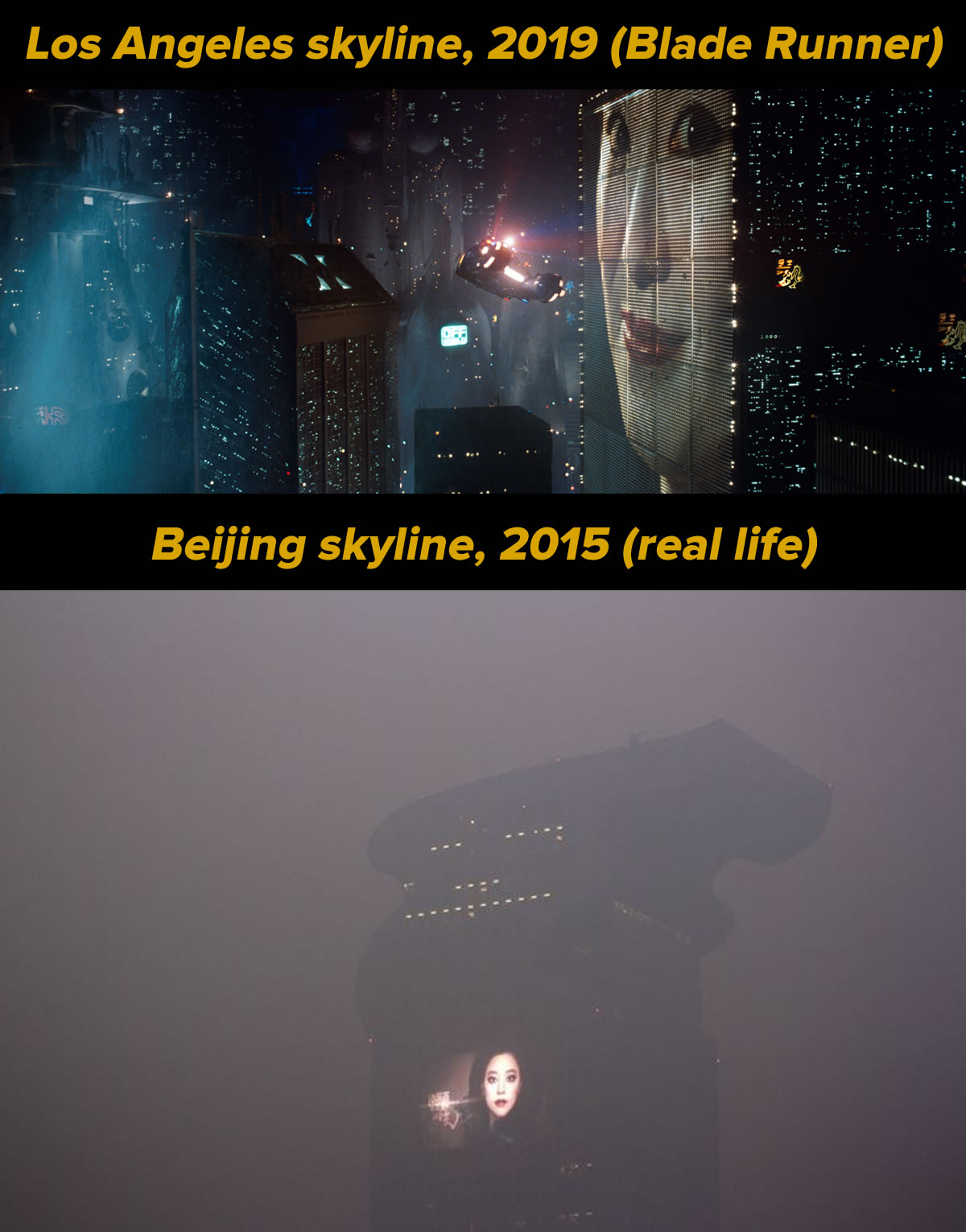
Click to embiggenate
The crowded, dirty Los Angeles of 2019 featured in the 1982 film Blade Runner looks rather pristine compared to the real-life Beijing of 2015.
Comments Off on If anything, Blade Runner was too optimistic
Still nothing to see here, folks, just move along now…
David Warren expresses his surprise at the news of police raids in Europe:
“Two die in Belgian anti-terror raid.” … The headline is from the BBC website, yesterday, but these keywords could be found in breaking-news headlines all across Europe. (I checked.)
Gentle reader must have been wondering, who is it this time? The Buddhists, perhaps? (Mahayana or Theravada?) Jains? Angry rampaging Hindu swamis? Prim Confucians? Taoist anarchists? What about the Zoroastrians, we haven’t heard from them in a while. But it might be the Lutherans, no? Or the Presbyterians? Pentecostals more likely, or Fundamentalist Christians from Allah-bama. Hey wait, Belgium used to be a Catholic country, perhaps they were Latin Mass traditionalists? SSPiXies? Dominican monks? Third Order Franciscans? On the other hand, Secular Humanists would be statistically more likely. Wiccans? Druids? Nudists? Maybe we should bet long-shot on Animists of some sort, from the former Belgian Congo. Or from New Guinea: could be, you never know these days.
Well, the answer caught everyone by surprise. Turned out they were Muslims.
As some wag in Washington recently responded, to another “religion of peace” muttering from on high: “How odd that so many are killing for it.”
A correspondent in Alexandria-by-Egypt reminds of Christians slaughtered and churches trashed in his town not so long ago, after rumours circulated that a Coptic priest had said, “Islam is a violent religion.” Turned out he hadn’t said that. But whatever it was, he won’t be saying it again.
The media have thoughtfully spared us from reports of demonstrations in the Muslim world in support of recent actions in Paris, which involved the “execution” of several French cartoonists who had drawn vile, blasphemous pictures of their Prophet Jesus, and his Mother Mary. Also, of the Prophet Muhammad. The media don’t want to abet prejudice against any particular religious community; and Islam is quite particular.
Comments Off on Still nothing to see here, folks, just move along now…
January 16, 2015
Dressing up as a North Korean general is racist … even if you’re Korean
Margaret Cho gets into hot water with the perpetually offended for dressing up as a North Korean general:
Korean-American comedian Margaret Cho did an impression of a North Korean general at the Golden Globes that many on Liberal Twitter attacked as racist because apparently not even people of Korean descent are allowed to make fun of Kim Jong Un.
In one of many jokes aimed at the recent Sony cyber-hack, Cho wore a Korean general costume and made fun of the lack of spectacle at the event:
“You no have thousand baby playing guitar at the same time. You no have people holding up many card to make one big picture,” she said in a thick accent. “You no have Dennis Rodman.”
Predictably, people went nuts.
The Guardian editor-in-chief Katharine Viner said Cho was “like, totes racist.” Time deputy tech editor Alex Fitzpatrick questioned how anyone could have seen the bit as anything but “broadly racist.” The International Business Times managing editor called the decision to allow it a “bad call.” And that’s just to name a few.
Cho defended herself, tweeting: “I’m of mixed North/South Korean descent — you imprison, starve and brainwash my people you get made fun of by me #hatersgonhate.”
Comments Off on Dressing up as a North Korean general is racist … even if you’re Korean
January 15, 2015
Why the EFF can’t do an iPhone version of their mobile app
Last week, the Electronic Frontier Foundation‘s Corynne McSherry had to break the sad news to Apple iPhone users that due to Apple’s incredibly restrictive developer rules, the EFF cannot produce an iPhone version of their mobile app:
As we have been saying for years now, the [Apple] Developer Agreement is bad for developers and users alike. Here are a few of the terms that we are worried about:
Ban on Public Statements: Section 10.4 prohibits developers from making any “public statements” about the terms of the Agreement. This is particularly strange, since the Agreement itself is not “Apple Confidential Information” as defined in Section 10.1. So the terms are not confidential, but developers are contractually forbidden from speaking “publicly” about them.
Ban on Reverse Engineering: Section 2.6 prohibits any reverse engineering (including the kinds of reverse engineering for interoperability that courts have recognized as a fair use under copyright law), as well as anything that would “enable others” to reverse engineer, the software development kit (SDK) or iPhone OS.
App Store Only: Section 7.3 makes it clear that any applications developed using Apple’s SDK may only be publicly distributed through the App Store, and that Apple can reject an app for any reason, even if it meets all the formal requirements disclosed by Apple. So if you use the SDK and your app is rejected by Apple, you’re prohibited from distributing it through competing app stores like Cydia.
No Tinkering with Any Apple Products: Section 3.2(e) is the “ban on jailbreaking” provision that appears to prohibit developers from tinkering with any Apple software or technology, not just the iPhone, or “enabling others to do so.”
Apple Owns Your Security: Section 6.1 explains that Apple has to approve any bug fixes or security releases. If Apple does not approve such updates very quickly, this requirement could put many people in jeopardy.
Kill Your App Any Time: Section 8 makes it clear that Apple can “revoke the digital certificate of any of Your Applications at any time.” Steve Jobs once confirmed that Apple can remotely disable apps, even after they have been installed by users. This contract provision would appear to allow that.
We have some other concerns as well, but these top the list.
Comments Off on Why the EFF can’t do an iPhone version of their mobile app
January 14, 2015
Dave Grohl’s demo tapes
At Open Culture, Josh Jones talks about Dave Grohl’s early work while he was still a member of Nirvana:
Like ‘em or lump ‘em, you should give ‘em credit — Dave Grohl’s Foo Fighters have kind of redefined the concept album with their latest, Sonic Highways, pushing a tired form in a refreshing direction. Rather than a self-contained narrative, the record opens itself up to tell the stories of rock ‘n’ roll itself or, as Allmusic puts it, “the classic rock that unites the U.S. from coast to coast.” Picking up where his celebratory film Sound City left off, Grohl ties in his newest release with a series of HBO documentaries that visit cities from New York, to Nashville, Austin, New Orleans, L.A., Washington, DC., and Seattle to tell their musical stories.
Of course, the musical history of that last metropolis cannot be narrated without reference to Grohl’s former band, and so, Consequence of Sound informs us, “Nirvana received heavy focus during the [Seattle Sonic Highways] episode as Dave Grohl recounted his time in the Rock and Roll Hall of Fame outfit. Among the biggest revelations was the time Kurt Cobain asked to hear solo recordings Grohl had been working on during Nirvana’s 1992 tour.”
“Kurt heard that, and kissed me on the face, as he was in a bath,” Grohl revealed. “He was so excited. He was like, ‘I heard you recorded some stuff with Barrett [Jones].’ I was like, ‘Yeah.’ He was like, ‘Let me hear it.’ I was too afraid to be in the same room as he listened to it.”
Comments Off on Dave Grohl’s demo tapes


