
Extra Credits
Published on 9 May 2015Support us on Patreon! http://bit.ly/EHPatreon
____________No historian is perfect, so it’s important we acknowledge our mistakes where we find them (with the help of our viewers, no less)! After we clear up some discrepancies that emerged during the South Sea Bubble series, we turn to answering some common questions that came up during this series on economic history. In a period where financial masterminds like John Blunt engaged in trickery meant to confuse other people and hide his real activities, it’s no wonder that many viewers had questions about what insider trading is and how Blunt could endlessly inflate stock prices for his unprofitable company. This is a history show, but we do our best to explain! As a bonus, James also reads Robert Knight’s letter to Parliament on the eve of his illegal flight and tells some cool stories about Robert “It was Me” Walpole.
November 30, 2018
England: South Sea Bubble – Lies – Extra History
November 29, 2018
England: South Sea Bubble – It Was Walpole – Extra History – #5
Extra Credits
Published on 25 Apr 2015Support us on Patreon! http://bit.ly/EHPatreon
____________Robert Walpole’s attempts to use the South Sea Company scandal to enhance his own ambitions are threatened by the appearance of Robert Knight, a former South Sea employee whose records of corporate bribery implicate Walpole and his friends in Parliament. But faced with threats of retribution if he ever shares these records, Knight flees the country rather than face a public inquiry. Although he gets caught and sent to prison in Antwerp, Walpole deftly engineers his release and escape. With Knight finally gone, Walpole teams up with John Blunt to pin the blame for the South Sea stock bubble on his political opponents, conveniently clearing the way for himself to become essentially the first Prime Minister of England. He also makes sure that all of his own supporters get off easy (if not scot free) for their involvement, and even Blunt walks away from the South Sea Bubble with more money than he started with.
QotD: Overprotecting children
While it’s hard to argue against safer playgrounds, it’s also true that by design the transparent playground offers kids no privacy. “As [playgrounds] were childproofed to improve safety, they inadvertently reduced the opportunities for the young to take part in forms of fantasy, sensory, and exploratory play, and construction activities apart from adults,” writes historian Mintz. “Unstructured, unsupervised free play outside the home drastically declined for middle-class children. As more mothers joined the labor force, parents arranged more structured, supervised activities for their children. Unstructured play and outdoor activities for children 3 to 11 declined nearly 40 percent between the early 1980s and the late 1990s. Because of parental fear of criminals and bad drivers, middle-class children rarely got the freedom to investigate and master their home turf in ways that once proved a rehearsal for the real world.”
So much for the roving pack of kids each block boasted during Mintz’s childhood, and my own. “The empty lot has disappeared,” he quips. “And we are so concerned with legal liability that if kids do find one, you’d better be sure you’ll get a call from the police.”
Beth Hawkins, “Safe Child Syndrome: Protecting kids to death”, City Pages, Volume 26 – Issue 1267.
November 28, 2018
England: South Sea Bubble – The Bubble Pops – Extra History – #4
Extra Credits
Published on 11 Apr 2015Support us on Patreon! http://bit.ly/EHPatreon
____________With the South Sea Company’s value dangerously inflated, Blunt drives one more scheme to raise stock prices – and it finally backfires on him. Early investors (including the famous politician Robert Walpole) seize the opportunity to sell their stock while the value is high, and the general public finally realizes that the South Sea Company has no actual worth. Everyone who didn’t sell their stock in the first round finds themselves suddenly bankrupt as the stock value plummets. Even King George, on vacation when disaster strikes, loses a large amount of the royal fortune. Robert Walpole, however, sees this as an opportunity to make himself a hero of the public. Hiding his own involvement in the South Sea Swindle, he cancels all debts owed for the company’s stock to help put its public investors back on their feet. Despite this, the public demands an inquiry and Walpole must walk a thin line between his facade as defender of the people and the reality of his, his party, and the King’s blatant corruption.
November 27, 2018
Cutting back on ethanol makes financial and environmental sense
Craig Eyermann explains why President Trump’s push to expand the use of ethanol in cars is a bad call for many reasons:
For example, because ethanol packs less energy per gallon than gasoline does, vehicle owners can expect to get even lower fuel mileage from the expansion of E15 fuel (a blend of 15% ethanol with 85% gasoline) under the new mandate to include more ethanol in automotive fuels, which would be 4% to 5% less than they would achieve if they only filled their vehicles with 100% gasoline. Today’s vehicle owners already pay a fuel efficiency penalty of 3% to 4% lower gas mileage from the E10 ethanol-gasoline fuel blend mandated under the older ethanol content rules, where the new rules will require even more fill-ups.
Beyond that, to the extent that it diverts corn from food markets to fuel production, corn-based ethanol production also jacks up the price of food—the corn itself, plus everything that eats corn, like beef cattle. One review of multiple studies found that the U.S. government’s corn-based ethanol mandates added 14% to the cost of agricultural commodity prices from 2005 through 2015.
Last summer, the Environmental Protection Agency also found that burning increasing amounts of ethanol has made America’s air dirtier because it generates more ozone pollution, which contributes to smog formation. Worse, growing the additional corn to make more ethanol has also increased agricultural fertilizer runoff pollution in the nation’s rivers and waterways.
That runoff has been linked to the increased incidence of harmful algal blooms, which have been responsible for contaminating drinking water and contributing to red tide events in coastal regions, where fish and other aquatic organisms have been killed off.
There is a solution to these federal government-generated pollution problems: stop forcing corn-based ethanol to be used in the nation’s fuel supplies. There’s even a case study from Brazil, where the city of Sao Paulo found that its air became cleaner after it switched from ethanol-based fuels to gasoline in the years from 2009 to 2011.
England: South Sea Bubble – Buying Out Britain – Extra History – #3
Extra Credits
Published on 28 Mar 2015Support us on Patreon! http://bit.ly/EHPatreon
____________The time has come for Blunt to enact the final act of his scheme: taking on the 31 million pound British debt. When Parliament initially balks at transferring responsibility for that much money to Blunt’s insolvent South Sea Company, he bribes them with special deals on his own stock. Despite a legal clause that should have locked the stock price until the company began paying off the debt, Blunt keeps introducing new plans to inflate the stock price and pocket the money for himself. He does everything from selling stocks on layaway to loaning people money so they could buy more stocks from him, creating an artificial demand for South Sea Company stock that drives the company’s worth up to 300 million pounds: a staggering ten times the initial value of the already stunning debt it had assumed. His success, founded entirely on speculation with no actual revenue from trade, not only starves out other businesses across Britain but exceeds the total amount of money in the country’s entire economy. This bubble can not last.
November 26, 2018
England: South Sea Bubble – Too Big to Fail – Extra History – #2
Extra Credits
Published on 14 Mar 2015Support us on Patreon! http://bit.ly/EHPatreon
____________Frustrated at every turn by the Whig-controlled Bank of England, Harley and Blunt decide to start their own institution: a trading company that will exchange government debt for stock shares. This new South Sea Company will have a monopoly on trade in the rich new lands of South America, but all the ports there are controlled by Spain, with whom Britain is at war. So Blunt pushes the country into a premature and unfavorable peace with Spain, enlisting famous authors to write his propaganda and convincing Queen Anne herself to tip the balance of Parliament in his favor. After the queen dies and the government changes hands, Blunt kicks Harley and his Tory leaders out of the company. He manages to bring King George I himself on board as a ceremonial leader, linking the success of the South Sea Company with the reputation of the monarchy. But while his maneuvering inflates the value of his company’s stock, it’s never produced anything close to the amount of money he’s convinced people to invest in it.
November 25, 2018
QotD: Calvin Coolidge, master of inactivity
When asked to summarize the record of his administration, Coolidge replied, “Perhaps one of the most important accomplishments of my administration has been minding my own business.” The point wasn’t that he was lazy, the point was that it takes work to stop government from doing stupid things. “It is much more important to kill bad bills than to pass good ones,” he once remarked.
When Coolidge said, “When you see ten problems rolling down the road, if you don’t do anything, nine of them will roll into a ditch before they get to you.” Again, the point wasn’t laziness, it was confidence in the ability of society — a.k.a. the people — to figure things out for themselves. For every ten big problems our society faces, nine of them aren’t the government’s problem. Liberals think not only that all ten are the government’s problem, but that ten is an insanely low tally of the big problems the government is supposed to be dealing with. And fewer and fewer conservatives would endorse the Coolidge Ratio.
I’m increasingly convinced we’ll never have another one like him. My point isn’t that we don’t produce people like Coolidge anymore — though that’s more than a little true, too. It’s not that a Coolidge couldn’t get elected today either, though who could argue with that? It’s that even if we somehow produced a Coolidge and got him or her elected, the nature of the state is such that even Coolidge couldn’t really be Coolidge.
Jonah Goldberg, “The Unwisdom of Crowds”, National Review, 2017-01-21.
November 24, 2018
November 23, 2018
“These are deficits of choice, not necessity”
The federal government released its fall economic statement the other day. The contents would not really have been a surprise to anyone who’s been paying attention since the last election, as Andrew Coyne explains:
The 2018 fall economic statement begins with a puzzle. Economic growth, it trumpets, is strong — the strongest in the G7 in, er, 2017. Unemployment is at a 40-year low; capacity utilization is back to pre-recession levels; profits are up; wages are growing faster than they have in eight years.
All this good news has produced a bumper crop of revenues to the federal treasury: an average of roughly $5.5-billion more annually over the next couple of years than was projected in the spring budget. Yet deficits are now projected to be … higher than expected — at $19.6 billion and $18.1 billion, respectively, about 10 per cent over forecast.
What explains this surprising result? Simple: as it has done throughout its tenure, the Trudeau government took the revenue windfall, and spent it — every last dollar and then some.
This is what the government calls “carefully managing deficits over the medium term.” It used to talk about reducing or even eliminating deficits. Now it seems devoted to doing whatever it takes to keep them in the $20 billion range, in perpetuity.
To be sure, the current set of projections, like its predecessors, shows deficits declining majestically in later years. But somehow in the here and now they never do. Once upon a time, this was supposed to be owing to a shortfall in revenues, the fruit of the Harper government’s supposed obsession with austerity.
By now this is not even pretended. The last Harper budget projected revenues for the current fiscal year at $326.9 billion, enough for a small surplus. The latest estimate has them at $328.9 billion — yet the deficit stands at $18.1 billion. Even allowing for a couple of billion dollars in accounting adjustments, it’s clear what is going on. These are deficits of choice, not necessity.
November 22, 2018
This is why tax cuts are always criticized for benefitting the rich
Rebecca Zeines and Jon Miltimore explain why newspaper headlines and TV anchors always seem to decry any tax cut as being disproportionally beneficial to the wealthy:
But crucial facts are often missing in these articles. As a recent Bloomberg piece explained, two key points tend to be overlooked in articles written by media outlets and progressive tax proponents:
- The top 1 percent paid a greater share of individual income taxes (37.3 percent) than the bottom 90 percent combined (30.5 percent).
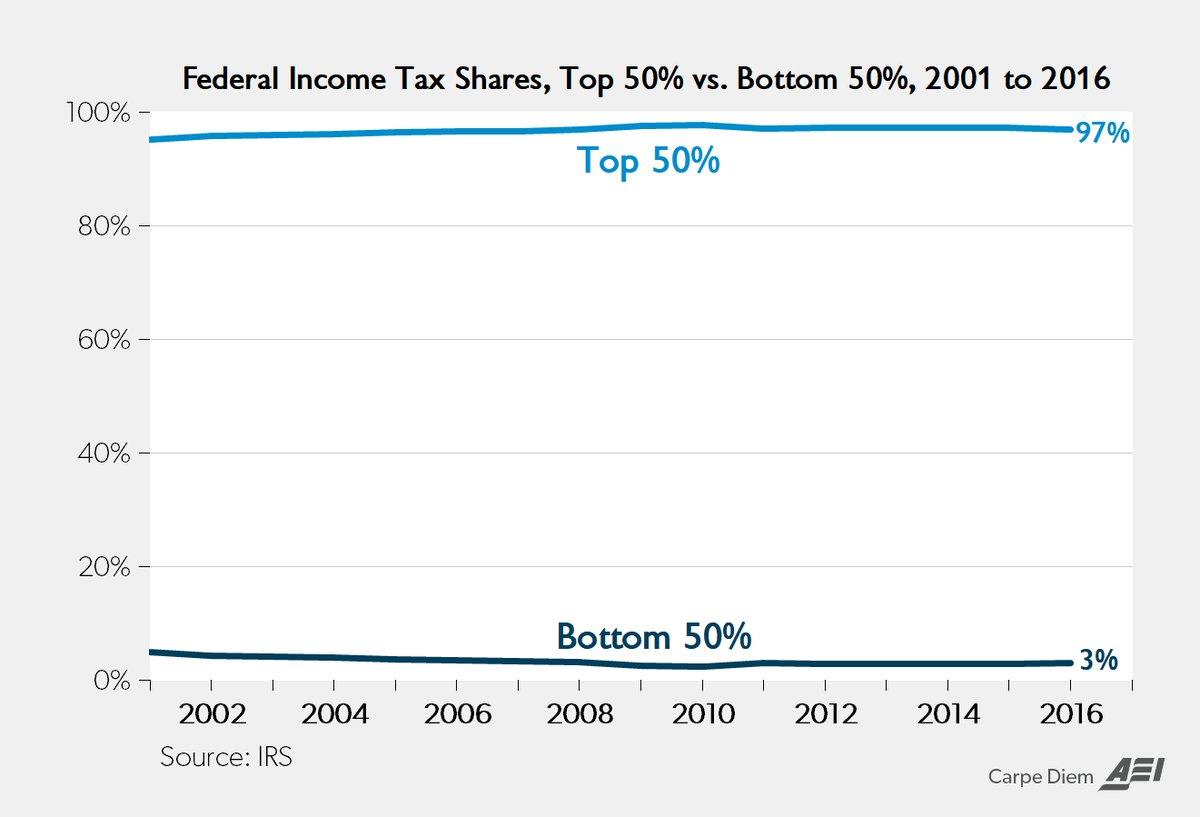
- The top 50 percent of all taxpayers paid 97 percent of total individual income taxes.
These numbers date back to 2016 but remain applicable in 2018.
These data show that the bottom 50 percent of US taxpayers paid just 3 percent of total income taxes in 2016, while the top 50 percent accounted for 97 percent.
Here is a wonderful visual representation of this dynamic, courtesy of Mark Perry of the American Enterprise Institute:
There is a clear correlation between economic freedom and prosperity, and tax climate is a key component of economic freedom.
Economist Dan Mitchell explains it best: Heavy taxation destroys entrepreneurship. The more money is taxed out of the private sector, the less is available for investment, development, and worker compensation (recall that after Trump’s tax bill was enacted, many businesses raised workers’ wages and offered bonuses).
Efforts to improve America’s tax climate are consistently and predictably derided as tax cuts for “the rich.” But, as the above diagram shows, it’s quite impossible to offer people a comparatively huge tax cut when they’re paying a comparatively tiny percentage of income taxes.
November 21, 2018
Statistics Canada’s instrumentalist philosophy
In the Financial Post, Bruce Pardy discusses the motivation behind Statistics Canada’s recently revealed demand for the private financial records of half a million Canadians:
Recently it was revealed that Statistics Canada sought to obtain the private banking information of half a million Canadians without their knowledge or consent. Jennifer Robson, professor of political management at Carleton University, in an interview with the CBC, justified the data sweep on the grounds that governments need this information to make good policy. But don’t be concerned, she said, it is not for ideological purposes, since Statistics Canada is ideologically neutral. That made me laugh. The very idea of policy based on data reflects an instrumentalist belief that governments should solve social problems by political means. That requires an ideological confidence in the administrative state, to which the agency is a handmaiden.
Ideology is not a dirty word. An ideology is merely a worldview, a lens through which to perceive society. Political parties, by definition, each have one (and sometimes extra ones for special occasions). But it is another thing for a public agency to act independently in furtherance of its own ideology while pretending to be neutral.
Statistics Canada’s deep dive into banking records — presently on hold while federal privacy commissioner Daniel Therrien investigates its legality — appears not to have been directed by government officials but was undertaken on its own initiative. The agency’s decision is consistent with a conviction that the more personal data available to government, the better off we will be; that governments are benevolent; that private financial matters call for public policy management; and that a bigger government is a better government. A commitment to social policy, wrote Milton Friedman “involves the acceptance of the socialist view that political mechanisms, not market mechanisms, are the appropriate way to determine the allocation of scare resources to alternative uses.”
November 20, 2018
Remy: The Legend of Stan Lee
ReasonTV
Published on 19 Nov 2018Remy recalls a time when experts were claiming “Hitler was a beginner compared to the comic-book industry,” and how Stan Lee took a stand.
Written and Performed by Remy
Video Produced by Meredith and Austin Bragg
Music tracks and background vocals by Ben Karlstrom
November 16, 2018
The political wrangles ahead over the federal carbon tax
Andrew Coyne — for once not beating the drum for electoral reform — discusses the challenge facing the federal government in the wake of provincial resistance to their carbon tax plans:
But the real test, of course, is yet to come. The provinces cannot stop the tax on their own. The court challenges are likely to fail. Provinces that refuse to implement carbon pricing will simply find the federal “backstop” tax imposed in its place. It is the election that will decide the issue, not duelling governments. Or so Conservatives hope.
Certainly there are abundant grounds to doubt the political wisdom of the Liberal plan. A tax, or anything that resembles it, would be a hard enough sell on its own. But a tax in aid of a vast international plan to save the earth from a scourge that remains imperceptible to most voters, to which Canada has contributed little and against which Canada can have little impact, while countries whose actions would be decisive remain inert? Good luck.
What seems clear is that voters’ support for carbon pricing is shallow and tentative. The Conservative strategist who chortled to the National Post that the Liberals are asking Canadians “to vote with their hearts, not their wallets” — an impossibility, he meant — was correctly cynical. Just because people want to save the planet doesn’t mean they want to pay for it.
The best way to read the public’s mood is in the positions of the political parties, who are in their various ways each trying to assure them that it won’t cost them a dime. The Liberal version of this is to promise to rebate the extra cost of the federal tax to consumers — indeed, they pledge, 70 per cent of households will make a profit on the exchange.
The Conservatives have been less forthcoming, but it would appear their plan is to hide the cost, substituting regulations, whose effects are largely invisible to consumers, for the all-too-visible tax at the pump. Here, too, I suspect they may have a better (i.e. more cynical) read on popular opinion. The public often prefer to have the costs of government hidden from them, even if they know they are paying them — even if they know they are paying more this way, as indeed they are in this case. Do what you want to us, they seem to say, just don’t rub our faces in it.
So I would be skeptical about polls showing majority support for the federal plan: 54 per cent, according to Angus Reid, while Abacus finds 75 per cent would either support or at least accept it (versus 24 per cent opposed). These were taken shortly after the announcement of the federal rebates. Yet it is far from evident the rebates will still register with people a year from now. Indeed, the Conservatives barely paused to acknowledge them as inadequate before going on to pretend they had never been mentioned.
November 15, 2018
Amazon’s HQ$2Bn decision
If you had any doubt that the Amazon HQ2 competition was about anything other than trolling for economic bribes, this should banish the thought:
Amazon is getting some prime real estate.
In exchange for more than $2 billion in economic incentives, the online shopping giant will locate a pair of new corporate headquarters just across the Potomac River from Washington, D.C., and just across the East River from Manhattan. Tuesday’s much-anticipated announcement of the locations for Amazon’s “HQ2” also included details — which had previously been kept from the public — about the economic incentives that successfully lured the Seattle-based firm to the east coast’s political and economic hubs.
Amazon says it will invest $5 billion and create more than 50,000 jobs across the two new locations, with at least 25,000 employees at each of its new corporate campuses, to be located in Virginia’s Crystal City and New York’s Long Island City. Nashville wins a consolation prize: a new supply chain and logistics center that promises 5,000 jobs in exchange for $102 million in economic incentives.
In New York, Amazon will receive $1.2 billion in refundable tax credits through a state-level economic development program and a cash grant of $325 million that’s tied to the construction of new buildings at the Long Island City location over the next 10 years. In Virginia, the state is ponying up $573 million in tax breaks tied to the creation of 25,000 jobs, and the city of Arlington will provide a cash grant of $23 million over 15 years funded by an existing tax on hotel rooms.
Yes, the numbers are staggering — New York state’s pledge of $1.52 billion for 25,000 jobs works out to more than $60,000 in taxpayer support per new job created — but Amazon appears to have selected New York and the D.C. area based on more than just how many zeroes local officials agreed to put on the giant cardboard check.
After all, New Jersey offered Amazon $5 billion (with another $2 billion from Newark), and Maryland offered $8.5 billion. Yet Amazon passed them both over to pick their neighbors.


