
World War Two
Published 29 Apr 2023The fighting at Kohima is up close, personal, and vicious, as it is at Imphal. The Allies consolidate their gains at Hollandia, the Japanese are advancing in Central China, and it seems like the Chinese Nationalist Army has lost the support of the civilian population. This might not surprise you when we take a closer look.
(more…)
April 30, 2023
Germany’s Existential Crisis – WW2 – Week 244 – April 29, 1944
Comments Off on Germany’s Existential Crisis – WW2 – Week 244 – April 29, 1944
QotD: Propaganda, dezinformatsiya, and maskirovka in the Current Year
… I don’t speak Russian, but as an amateur Sovietologist I’m aware of the KGB’s rich lexicon of “information warfare”. Disinformation is, of course, either a loan word or a calque, depending on how you want to look at it — dezinformatsiya. (A loan word comes over directly, like “concerto”; a calque is a literal translation of a foreign term, like “flea market”). And then there’s the maskirovka, a whole class of specifically military deceptions. No nation poured more resources into this stuff than the Soviets. A KGB defector named Golitsyn wrote a study, New Lies for Old, that’s interesting. A general in the Securitate, the Romanian secret police, named Ion Mihail Pacepa wrote another, called Disinformation. Good stuff.
Looking at the “news” these days is a fraternal socialist experience, comrades. Of course, we must be careful to distinguish between disinformation and propaganda. As we know from Theodore Dalrymple, propaganda is designed to humiliate you. All the “Biden won” stories, obviously, are pure propaganda — we know they’re not true, they know they’re not true, but by shoving them down our throats, they emphasize the almost total power differential between them and us. This is obvious, therefore uninteresting.
The dezinformatsiya, though, that’s fun. You know it’s a lie — is it in the Media? then it’s a lie — but the purpose of the lie is often opaque. For instance, this new variant of COVID supposedly making the rounds in England. You don’t have to wear a tinfoil hat to find the timing of that pretty damn suspicious. After all, we’re all supposed to have our “warp speed” mandatory goop shots here in a month, which means no more masks, no more lockdowns, no more of the führer-iffic fun our Glorious Leaders are jonesing for. We can’t be having that, and so hey, whaddaya know, just in time for Christmas, a new pox …
[…]
The problem with any disinfo op, of course, is that you have to pitch it at not just how smart the enemy actually is, but how smart he thinks he is. The KGB used to use two-stage deceptions all the time. There was a clumsy, obvious ploy that was designed to fail. The counterintelligence people would sniff it out, then congratulate themselves for seeing through those goofy commies and their hilarious misunderstandings of the free world. Meanwhile, the second caper sailed right through, because the counterintel boys stopped looking after busting the first one.
Severian, “Stojak”, Rotten Chestnuts, 2020-12-22.
Comments Off on QotD: Propaganda, dezinformatsiya, and maskirovka in the Current Year
April 29, 2023
What Was the Deadliest Day of the First World War?
The Great War
Published 28 Apr 2023What was the deadliest day of any nation in WW1? There are multiple candidates for that, but why should we even care? Well, the answer to this question highlights a challenge with popular memory that is often focused on the biggest battles of the war like the Somme or Verdun.
(more…)
Comments Off on What Was the Deadliest Day of the First World War?
April 24, 2023
Even fighter pilots and gunners have love lives
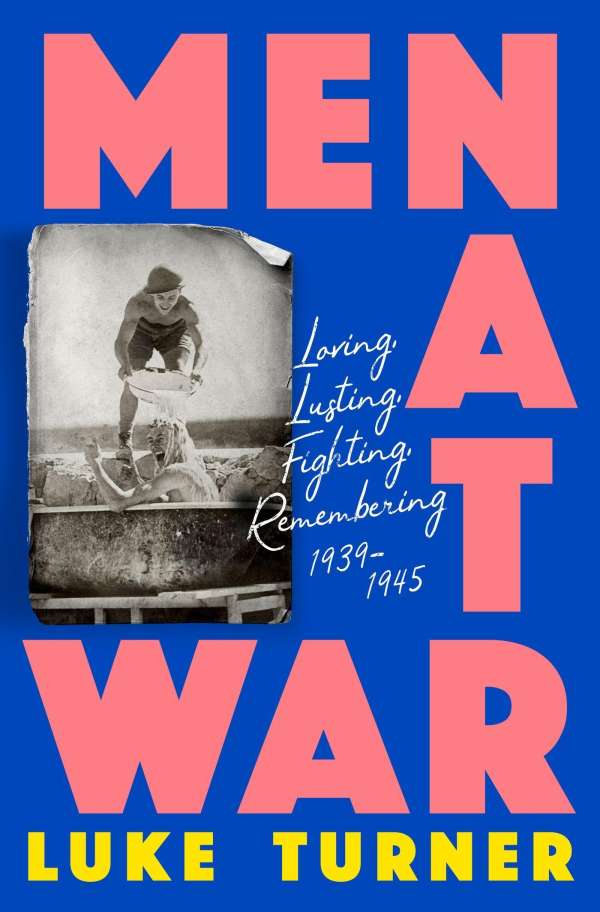
In The Critic, John Sturgis reviews a new book by Luke Turner titled Men at War: Loving, Lusting, Fighting, Remembering 1939-1945, which considers the myths and reality of wartime relationships during the Second World War:
Spitfire pilot Ian Gleed shot down five enemy aircraft in just a week in May 1940 — the fastest time in which this had ever been done, making him an official “ace” who would be quickly promoted to Wing Commander.
Gleed had become a poster boy for “the few”, the hero pilots of the Battle of Britain to whom so many would owe so much. He lived up to the popular image with his talk of “a bloody good show” and shooting down “damned Huns”, after which he’d sink a few warm beers and spend some “wizard” free time recuperating with his girlfriend Pam, whom he “loved now more than ever”.
Gleed’s luck finally ran out over Tunisia in April 1943 when his plane was hit by a German fighter and crashed into dunes. Gleed was killed. He was just 26.
It would only emerge decades later that much of the popular image he had cultivated simply wasn’t true. Gleed was gay. Pam was an imaginary character he had invented as a cover to keep his double life as a sexually active homosexual firmly secret.
Gleed’s story is one of many similar vignettes in this alternative history of the Second World War. Its author Luke Turner’s previous book was a memoir about his own grappling with issues around his identity as a bisexual. Here he takes up the question of how this would have played out for him and other sexual non-conformists in 1939–45.
Turner grew up obsessed with the war — everything from Airfix kits and Dad’s Army to Stalingrad and the Berlin bunker — and here he examines what it was to live through that period as a sexually active person of whatever hue. It proves a particularly rich subject matter as sex seems to have been everywhere in war time: everyone was sleeping with everyone else, apparently. It’s a perennial truth that you or I might be hit by a bus tomorrow — but make that bus a bomb, and suddenly this seems to create a sense of urgency which frequently manifests itself sexually, lending daily life what Turner calls “an aphrodisiac quality”. As Quentin Crisp put it when describing the shenanigans in blacked-out, Blitz London: “As soon as the bombs started to fall, the city became like a paved double bed.”
Whilst war may see an explosion of sex of all kinds, the establishment was not always comfortable with this. A Home Office report on public behaviour in London during the Blitz noted, “In several districts cases of blatant immorality in shelters are reported; this upsets other occupants of the shelters.”
One contemporary account suggests, “In wartime a uniform, whether of the Army, Navy or Air Force, to the average girl ranks as a fetish.” This had consequences in the field: Dear John letters from home could be a real problem in this regard. As an Army report in 1942 put it, morale is often damaged by “the suspicion, very frequently justified, of fickleness on behalf of wives and girls”.
Amongst all this sex was, of course, sex with Americans. Turner cites George Formby who captured this mood in the song “Our Fanny’s Gone All Yankee”: “She don’t wait for the dark when she wants to have a lark/In a bus or train she does her hanky panky.”
Then in a dark reversal of this two-nations-colliding-sexually motif, we get the horror of the Red Army’s organised rape of as many as 1.4 milllion German women during the Russian advance on Berlin, whose residents would later refer to the city’s grandiose monument to Soviet war dead as “the tomb of the unknown rapist”.
Comments Off on Even fighter pilots and gunners have love lives
April 23, 2023
The Biggest Offensive in Japanese History – WW2 – Week 243 – April 22, 1944
World War Two
Published 22 Apr 2023Japan Launches Operation Ichigo in China, their largest offensive of the war … or ever, but over in India things are not going well for the Japanese at Imphal and Kohima. The Allies also launch attacks on the Japanese at Hollandia, while over in the Crimea, the German defenses at Sevastopol are cracking under Soviet pressure.
(more…)
Comments Off on The Biggest Offensive in Japanese History – WW2 – Week 243 – April 22, 1944
April 19, 2023
Time to remove US nuclear weapons from Europe?
CDR Salamander has long advocated getting the final few American “tactical” nuclear weapons off European soil and makes the case for doing it now:
It may seem like a strange thing to propose while there is the largest land war in Europe since 1945 going on, but as it is something I’ve been a supporter of for a few decades I might as well be consistent: we are long overdue to remove American nuclear weapons from Europe.
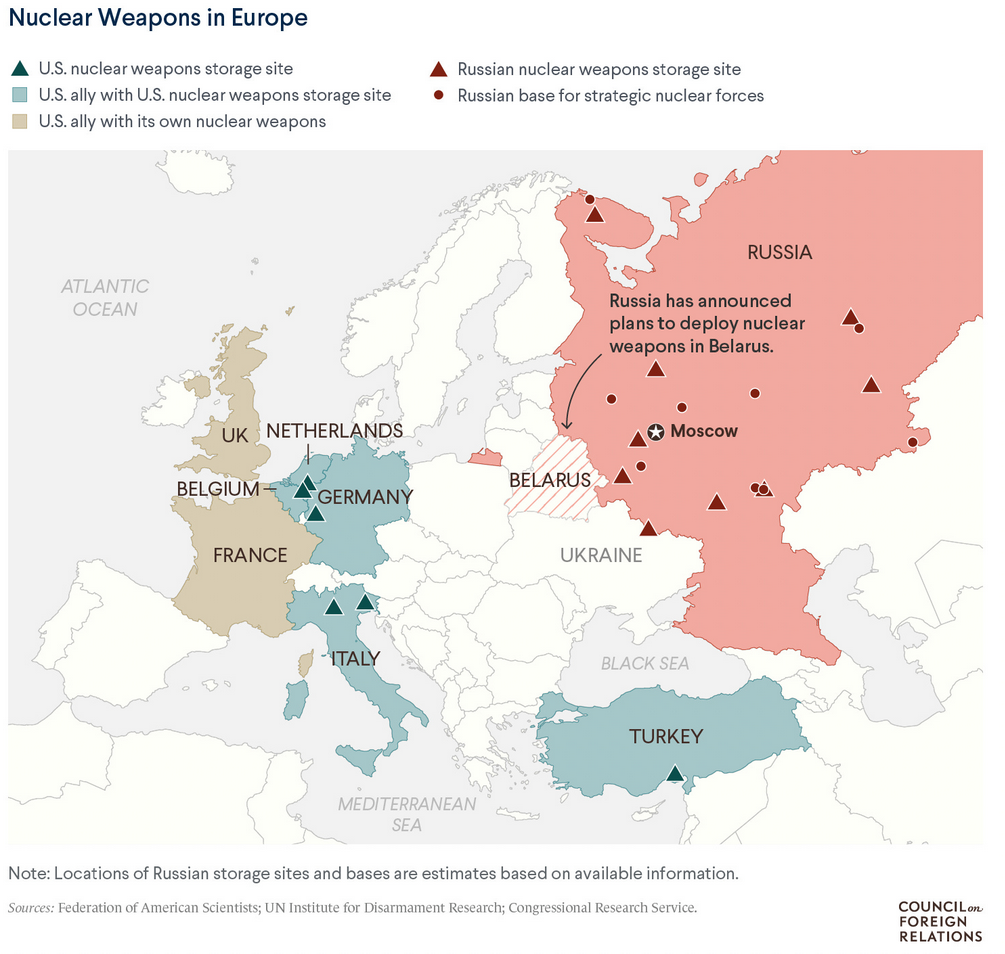
It is 2023. Just look at this map.
[…]
The Soviet Union stopped existing over three decades ago.
Even though we’ve decreased from 7,000 warheads down to 100 … there really is no reason to keep what remains in Europe.
- Gravity bombs on continental Europe – that require tactical aircraft to deliver them – are the least survivable, reliable, or timely way to deliver a nuclear weapon.
- There is no such thing as a tactical nuclear weapon. I don’t care what some theorist proposes to defend their pet theories, you lob one nuke an order of magnitude larger than the Hiroshima bomb and only a foolish nation would let their strategic nuclear forces stay unused and in danger.
- Gravity bombs are not a first strike weapon and are a poor second strike weapon. As such, you have to consider that the the time gap from approval to flash-boom would be so long the war would be over before your F-XX pickled their nuke over their target – even if the aircraft made it off the ground.
- If they are NATO weapons, you not only have to get NATO to approve their use, but host nation to as well … in addition to the USA. Do you really think the Russians would not leverage their influence with the useful idiots in the Euro-Green parties, former communists, and general black-block anti-nuke activists to politically of physically stop the use of the nukes, especially in BEL, NLD, DEU, and ITA? Add that to point 3 above.
- Especially with the weapons in Turkey – the risk of these bombs having a bad day due to human or natural causes is non-zero. In the days of mutually assured destruction, those non-zero odds were manageable, but there is no reasonable person in the third decade of the 21st Century who can with a straight face explain to you why any tactical, operational, or strategic use justify their presence. They deter no enemy, but puts every friend in danger.
- Look again at the map above. Exactly what target set are you going to “service” at that range (non-refueled)?
- If things go nuclear in Europe then the right weapons are either British, French, and if they must be American are sitting in a silo in CONUS, a SSBN in the Atlantic, or a B-2 in Missouri.
Comments Off on Time to remove US nuclear weapons from Europe?
April 16, 2023
4,000 German teens trapped in Tarnopol – WW2 – Week 242 – April 15, 1944
World War Two
Published 15 Apr 2023Thousands of German soldiers, mostly new teenage recruits, are obeying Hitler’s “Fortress Directive” and are surrounded in Tarnopol; it does not go well for them. German forces in Ukraine manage to all pull back across the Dniester, but they are under serious pressure in the Crimea. Meanwhile, in India, the Japanese siege of Kohima continues, and in China they are poised to launch a gigantic offensive.
(more…)
Comments Off on 4,000 German teens trapped in Tarnopol – WW2 – Week 242 – April 15, 1944
April 15, 2023
Type 68 North Korean Tokarev/High Power Hybrid
Forgotten Weapons
Published 18 May 2020The Type 68 is a North Korean hybrid of the Tokarev and the High Power, used as a military service pistol until replaced by the Beak-Du-San copy of the CZ75. The general outline of the gun is a copy of the Tokarev, with a modular removable fire control group, lack of manual safety, and tall thin sights. It is chambered for 7.62x25mm, and uses a magazine identical to the standard Tokarev except for not having a magazine catch cut, as the Type 68 has a heel magazine release.
Internally, the High Power elements include a detent-retained barrel pin, use of a solid barrel cam instead of a 1911/Tokarev swinging link, and a fixed barrel bushing. Two patterns of markings exist, one with a date and North Korean marking, and one (like this example) with only a serial number.
North Korean guns of all types are very rare in the United States. A very small number of Type 68s have come into the US, generally through Central America (probably via Cuba) and South Africa (via Rhodesia/Zimbabwe).
Update: It appears that the original design work for these was done by an independent engineering firm in Yugoslavia. The design (a TT33 with High Power type locking and angled slide serrations) was not completed in time for the trials that would lead to adoption of the Yugoslav M57, and the drawings were transferred to “another country” — probably North Korea.
(more…)
Comments Off on Type 68 North Korean Tokarev/High Power Hybrid
April 10, 2023
The Crimean Naval War at Sea – Battleships, Bombardments and the Black Sea
Drachinifel
Published 5 Apr 2023Today we take a look at most of the naval theaters of the Crimean War on conjunction with the fine people @realtimehistory find their video here: Last Crusade or F…
(more…)
Comments Off on The Crimean Naval War at Sea – Battleships, Bombardments and the Black Sea
April 9, 2023
New Offensive in the Crimea – WW2 – Week 241 – April 8, 1944
World War Two
Published 8 Apr 2023The Soviets are finally going to try and push the Axis out of Sevastopol and the Crimea. They also continue to drive the Axis back in Transnistria. Over in Burma and Northeastern India, the Japanese have the Allies under siege at not one, but two towns, and are also attacking Imphal from several points, but the Japanese have way bigger future plans up their sleeves in China.
(more…)
Comments Off on New Offensive in the Crimea – WW2 – Week 241 – April 8, 1944
April 8, 2023
Russia’s Last Crusade – The Crimean War 1853-1856
Real Time History
Published 7 Apr 2023The Crimean War between the Ottoman Empire and Russia (and later the UK and France) has been called the last crusade and the first modern war at the same time.
(more…)
Comments Off on Russia’s Last Crusade – The Crimean War 1853-1856
April 5, 2023
PTRS 41: The Soviet Semiauto Antitank Rifle (aka an SKS on Steroids)
Forgotten Weapons
Published 14 Dec 2022Prior to World War Two, the Soviet Union had a rather lackluster interest in antitank rifles — a series of guns were developed, but slowly and without all that much success. The Barbarossa invasion gave a very immediate need for just this sort of weapon, however, to give Soviet infantry units an organic anti-armor capability. Two star Soviet designers were tasked with designing AT rifles, Degtyarev and Simonov. The cartridge they were to use was the new 14.5x114mm, a high-velocity monster using a tungsten carbine cored projectile.
After a shockingly fast development period, the guns from both design bureaus were accepted. The Degtyarev became the PTRD-41, a single-shot auto-ejecting design that was extremely cheap and fast to produce. The Simonov design became the PTRS-41, a 5-shot semiauto offering more firepower but also taking longer to produce. The Degtyarev entered service first, with the first substantial deliveries of PTRS rifles arriving in 1942.
Both designs would serve through the war, with hundreds of thousands being made. Many were put into storage in 1945, and they are still seen today in Ukraine periodically. The PTRS would go on to be the basis for Simonov’s 7.62x39mm infantry rifle, adopted as the SKS.
(more…)
Comments Off on PTRS 41: The Soviet Semiauto Antitank Rifle (aka an SKS on Steroids)
April 3, 2023
Goodbye Manstein… Hello Model – WW2 – Week 240 – April 1, 1944
World War Two
Published 1 Apr 2023As the Allies prepare to close in on Germany from all fronts, a shake up of the German military leadership can only achieve so much…
(more…)
Comments Off on Goodbye Manstein… Hello Model – WW2 – Week 240 – April 1, 1944
March 29, 2023
Will Finland Leave the War? – WW2 Special
World War Two
Published 28 Mar 2023The Finns have been fighting the Soviet Union since the Winter War. But now, Marshal Mannerheim and Prime Minister Risto Ryti look like they might pull out of the Eastern Front commitments they agreed upon with their Axis allies. German-Finnish relations seem to be at breaking point, and Red Army troops are threatening the borders. How long will Finland stay in this war?
(more…)
Comments Off on Will Finland Leave the War? – WW2 Special
March 27, 2023
Why Russia Lost the Polish-Soviet War
The Great War
Published 24 Mar 2023
The Polish-Soviet War was one of the most important conflicts in the aftermath of the First World War when Eastern Europe was in flux. Both the Polish and the Bolshevik Army had the advantage numerous times and at the Battle of Warsaw is looked like the Bolsheviks would carry the revolution into Western Europe.
(more…)
Comments Off on Why Russia Lost the Polish-Soviet War


