Quotulatiousness

September 10, 2009

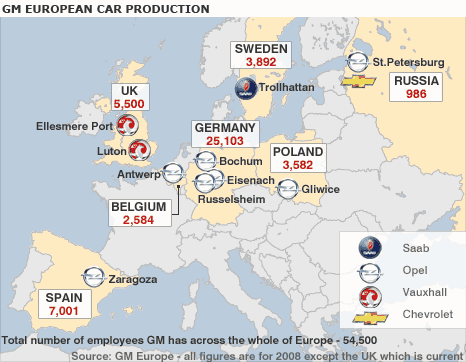
Magna wins the competition for Opel

Filed under: Cancon, Europe, Germany — Tags: — Nicholas @ 09:49

The German government has settled on Canada’s Magna as the winner in the bidding for Opel (GM’s European presence, including Britain’s Vauxhall):

Earlier, there had been rumours that GM could be planning to try to keep control of its European arm.

Magna was the German government’s preferred bidder. The decision must be approved by the Opel Trust, which is due to hold a press conference shortly.

Magna has pledged to keep all German plants open.

“I am very pleased about the decision that’s been made and it is along the lines that the federal government has been advocating,” Chancellor Merkel said.

“But it’s also along the lines that the employers and the employees of Opel wanted.”

GM_Europe

September 8, 2009

What’s in a name?

Filed under: Britain, Bureaucracy, Education — Nicholas @ 09:17

For most people, certain names pick up associations that have to do with the first person you encountered who bore that name. You may view all “Garys” with mild apprehension, while you’re automatically well-disposed to “Michaels”. “Kathy” or “Chelsea” may remind you of an unpleasant classmate from grade school, while “Tina” or “Pauline” may be viewed in advance as good people, all based on your early experiences.

Teachers in Britain have their little list of names, too:

As teachers eye the register on the first day back at school this September, they’ll be nervously keeping a sharp look-out for certain names which “strike fear into the nation’s tutors”.

The list of those likely to make mischief includes young ‘uns dubbed Aliesha, Brooke, Brooklyn, Casey, Chelsea, Connor, Crystal, Demi, Jack, Jake, Jessica, Kyle, and (pay attention at the back there El Reg’s Executive Vice President, Global Sales), Liam.

This roster of foreboding comes courtesy of Bounty.com, which polled 3,000 blackboard botherers to determine just which names spell trouble. Doubtless there are those among you who have a lad called Jake who’s an absolute angel, but that makes no difference to tremulous teachers, because they’ve already got him marked down as a wrong ‘un as soon as they clock his ID.

John Snow and the start of modern epidemiology

Filed under: Britain, Health — Tags: , , — Nicholas @ 08:52

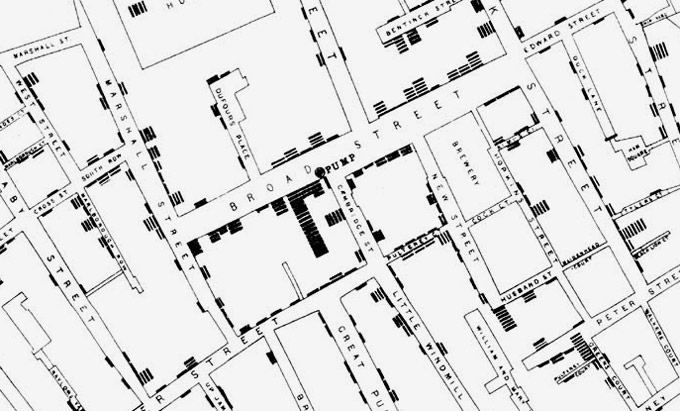
Another “on this date” entry for you: in 1854, John Snow persuaded the local authorities in a London borough to remove the handle from a water pump at the centre of a cholera outbreak. The move was successful, and the death rate dropped immediately. Randy Alfred has the story:

BroadSt_cholera_map

Physician John Snow convinces a London local council to remove the handle from a pump in Soho. A deadly cholera epidemic in the neighborhood comes to an end immediately, though perhaps serendipitously. Snow maps the outbreak to prove his point . . . and launches modern epidemiology.

The Soho neighborhood was not then filled with galleries, clubs, restaurants and other fine urban diversions. Some of it was an unsanitary slum where centuries-old cesspits sat chockablock with the wells that provided drinking water to a crowded populace.

Asiatic cholera had stricken Britain in successive waves since 1831. Snow, an obstetrician who pioneered the use of anesthesia in Britain, published On the Mode of Communication of Cholera in 1849. His hypothesis (and supporting data) held that the scourge was caused by sewage pollution in drinking water and “always commences with disturbances of the functions of the alimentary canal.”

September 4, 2009

Yesterday, the wine. Today, it’s the candy label.

Filed under: Britain, Humour — Tags: , , — Nicholas @ 12:08

After yesterday’s indecent-in-Alabama wine label, today’s outrage is a German candy wrapper that has raised someone’s ire in Britain. Here’s the Telegraph report:

Obscene_candy_wrapper

Simon Simpkins, a father of two, said he was shocked at the “pornographic” poses when he bought the sour candy for his children Benjamin and Ofelia.

Mr Simpkins, of Pontefract, West Yorks, told The Sun: “The lemon and lime are locked in what appears to be a carnal encounter.

“The lime, who I assume to be the gentleman in this coupling, has a particularly lurid expression on his face. I demanded to see the shop manager and, during a heated exchange, my wife became quite distressed and had to sit down in the car park.”

H/T to Christian T. for the link. Roger Henry quickly commented:

I can understand why his wife became distressed and had to sit down in the car-park. Probably overcome with hysterics after watching her husband make an absolute public prat of himself.

Couldn’t have said it better myself.

September 3, 2009

1939: Britain declares war on Germany

Filed under: Cancon, Europe, History, WW2 — Tags: — Nicholas @ 08:54

The German invasion of Poland two days earlier triggered the French and British governments’ guarantee to Poland, so after the expiry of the ultimatum, war was declared. Here’s British PM Neville Chamberlain’s announcement of the state of war (RAM file, not WMV).

Unlike the situation in 1914, where Canada was automatically at war when Britain went to war, in 1939 Canada was able to decide whether and when to go to war. It wasn’t until a week later, on September 10, that Canada was formally at war with Germany.

September 2, 2009

Canadian troops acting badly . . . in WW2

Filed under: Britain, Cancon, History, WW2 — Nicholas @ 13:02

Jon sent me an interesting anecdote from The Telegraph. According to this (as far as I know uncorroborated) story, the Canadian soldiers stationed in Britain during the Second World War were far from being boy scouts:

Apparently the manoeuvres had got completely out of hand and some of the people living in the Forest Hill and Shotover areas of the county and adjoining Wheatley were being terrorised by tanks, driven utterly without care and thought through the area.

They ploughed up gardens, ruined hedges and flattened walls and carefully cultivated vegetable plots. Concrete pavements were smashed and local roads were apparently chewed up like ploughed fields.

One woman out for a walk with her children was terrorised by a madman in a tank and had her pram damaged.

Stories of the causes of this irresponsibility abounded and the memory of that awful Sunday lived on for years.

The Canadians had the dubious distinction of having inflicted more damage and fear on the civilian population that the Germans!

I’d not be surprised to hear that there’d been some incidents, but I hadn’t heard of anything of quite this magnitude. Has anyone else heard about it before?

Speaking of historical revisionism, here’s Pat Buchanan!

Filed under: Europe, Germany, History, WW2 — Tags: , , , — Nicholas @ 12:47

Pat Buchanan recently published a book called Churchill, Hitler and ‘The Unnecessary War. From the title, you can probably pick up the notion that he feels that Hitler was misunderstood and didn’t really want to go to war. If you aren’t busy retching already, try this on for size:

Did Hitler Want War?

Well, from the title alone, we’re off into cloud-cookoo land already. Yes, Hitler did want war. He was pretty emphatic about it too, and not just in 1939. His written-in-prison Mein Kampf was not a particularly pacific and conciliatory little homily.

The German-Polish war had come out of a quarrel over a town the size of Ocean City, Md., in summer. Danzig, 95 percent German, had been severed from Germany at Versailles in violation of Woodrow Wilson’s principle of self-determination. Even British leaders thought Danzig should be returned.

Why did Warsaw not negotiate with Berlin, which was hinting at an offer of compensatory territory in Slovakia? Because the Poles had a war guarantee from Britain that, should Germany attack, Britain and her empire would come to Poland’s rescue.

Danzig was an excuse, not a reason. The plebiscite had shown that the inhabitants wanted to be part of Germany again, which is probably not surprising as the pre-war Polish government was anti-German and were actively trying to suppress the German language and culture in former German areas of Poland. The Polish government was authoritarian, not democratic, and were not the innocents that some later portrayals might try to indicate. Few of the governments of central or eastern Europe would pass muster as democracies in the 1930s.

Poland did not trust the German government to negotiate in good faith, with plenty of reason, so trying to blame them for the outbreak of the war is ludicrous.

But where is the evidence that Adolf Hitler, whose victims as of March 1939 were a fraction of Gen. Pinochet’s, or Fidel Castro’s, was out to conquer the world?

Um. There’s a tiny little bit of evidence. His book. His speeches. The war plans he had his military leaders draw up. The re-armament program, far in excess of what a peaceful nation with nearby enemies might need as a deterrent.

But yeah, aside from that, he didn’t — so far as we know — conduct a secret pinky-swear session with Mussolini and Hirohito at midnight in the Chancellery basement to conquer the world or else. I mean that’d be the smoking gun, wouldn’t it?

But if Hitler was out to conquer the world — Britain, Africa, the Middle East, the United States, Canada, South America, India, Asia, Australia — why did he spend three years building that hugely expensive Siegfried Line to protect Germany from France? Why did he start the war with no surface fleet, no troop transports and only 29 oceangoing submarines? How do you conquer the world with a navy that can’t get out of the Baltic Sea?

Why did he build the Westwall (aka “Siegfried Line“)? Well, perhaps it was because the French had already constructed large sections of the Maginot Line? This — at least as far as generals on both sides thought — provided a dual purpose: to prevent a German attack into France, and to provide a safe starting point for a French attack into Germany. The fact that the line failed to prevent an attack which came from beyond the flank of the line is hindsight. The Westwall was also multi-purpose, in this case it had three goals: prevent the French attacking, provide a base for an attack on France, and (borrowing the modern term) infrastructure. The Nazi party came to power partly because of the unemployment situation in Germany in the early 1930s. A vast construction project like the Westwall offered chances to soak up lots of “excess” labour . . . and to provide money to the “right” kind of private firms (those who supported the Nazis or those which the Nazis needed to curry favour with).

Go read the whole thing if you’re interested, but I’m feeling that there’s little point in going on . . . I’m certainly not going to persuade Mr. Buchanan or his followers of anything.

September 1, 2009

70 years on, Poland remembers

Filed under: Europe, Germany, History, WW2 — Tags: — Nicholas @ 07:46

Seventy years ago today, German troops crossed the Polish frontier, starting the Second World War in Europe. Poland held a memorial to that event this morning:

The first ceremony took place at dawn on Westerplatte peninsula near Gdansk, where a German battleship fired the first shots on a Polish fort in 1939.

Poland’s president and prime minister led a sombre ceremony at the fort.

President Lech Kaczynski added to a row with Russia over responsibility for the war, saying his country had received a “stab in the back”.

Foreign leaders from 20 countries including Germany and Russia are expected in Gdansk during the day as ceremonies continue.

August 31, 2009

More police hijinks in the UK

Filed under: Britain, Law — Tags: , — Nicholas @ 13:16

Natalie Solent looks at two particularly intrusive expansions of British policing. One I’ve already discussed: Police nicking goods from unlocked vehicles, but the other one is new to me:

On the same theme, Longrider has a story about the police in Northamptonshire impounding cars if the same car with foreign plates is seen twice more than six months apart. A Mr West writes:

I live in Spain for about seven months of the year and France for the other five. My Spanish-registered car was impounded in March after two short visits to the UK within nine months of each other.

At the start of 2009, a pilot scheme called Operation Andover started in Northamptonshire, with any foreign vehicle seen just twice, more than six months apart, being impounded without warning.

Once again, Mr West got his car back, eventually. But he had to fight not to pay a fee of several hundred pounds. As he points out, an enormously common reason for a foreign registered car being seen twice in the same place a year apart might be, not the effort to evade paying UK road tax that the police seem (pretend?) to suspect, but regular visitors coming to Britain at about the same time every year.

So the police can not only nick stuff out of your car, if it’s got a non-UK license plate, they can take the whole thing. Fascinating.

August 28, 2009

Richmond upon Thames police expand their services . . .

Filed under: Britain — Tags: , — Nicholas @ 12:27

. . . to include educational theft:

To teach motorists who leave their cars unlocked a lesson, police in Richmond upon Thames, a borough of London, have begun taking their stuff. The victims beneficiaries of these thefts educational efforts return to their cars and find that expensive items such as cameras, laptops, and leather jackets have been replaced by notes instructing them to retrieve their valuables at the police station. Not to worry, though: “If items are needed urgently,” the London Times reports, “police will return the goods immediately.” Which suggests that if you can’t show an urgent need for, say, your computer, they’ll take their own sweet time. The justification offered by Superintendent Jim Davis: “People would be far more upset if their property really was stolen.”

What’s worse than Davis’ assumption that when the police violate your property rights it’s not really a crime? The supine attitude of the British Automobile Association, which allegedly represents the interests of motorists:

The initiative was welcomed by the AA. “It would be quite irritating for motorists to come back to their car and find that items have gone missing. But on reflection they may think it is better that the stuff has been taken by the police rather than local thieves.

August 27, 2009

Kids will be kids

Filed under: Britain, Media, Railways, Randomness — Tags: , , , — Nicholas @ 00:06

Even when they’re adults . . . James May tried to set a record, but the kids just got in the way:

An attempt by Top Gear‘s James May to break the world’s longest model railway record has failed amid claims that vandals and thieves tampered with the track.

The long-haired presenter joined 400 enthusiasts to build the miniature railway stretching 10 miles from Barnstaple to Bideford, in North Devon.

He was recording the attempt yesterday for his new show James May’s Toy Stories.

The team hoped that a train would run successfully along the length of the track, built on the picturesque Tarka Trail.

But their hard work was hampered as parts of the track were taken and coins dropped on the line, blowing the battery. Even the battery was stolen.

H/T to Jeff Shultz.

August 22, 2009

Tweet of the day

Filed under: Liberty, Quotations, Russia — Tags: — Nicholas @ 08:06

Esther Dyson: russian pol Yavlinsky said: “Problem is not freedom of speech. Problem is freedom *after* speech.”

August 12, 2009

Cellaring your wine in restricted spaces

Filed under: Britain, Wine — Nicholas @ 00:04

Liam sent me this link, which may be of interest to wine fans who don’t have a lot of space for a proper cellar:

What is a Spiral Cellar?

It’s the quickest, cheapest and easiest way of building a wine cellar for your house.

A watertight, pre-cast cylindrical system that’s sunk into the ground, it can be located anywhere from kitchen to conservatory, workshop to study. It can be installed into an existing ground floor room, or incorporated into the build of an extension or new property.

If you’re the sort of person who never keeps any wine for more than a week or two then a cellar might not be necessary. But if you always like to have a few dozen bottles around the place and tend to keep bottles for months or years before drinking them, then you need a Spiral Cellar.

Perhaps of less use for apartment and condominium dwellers, however.

August 11, 2009

So much for the right to not self-incriminate

Filed under: Britain, Law, Liberty — Tags: , , — Nicholas @ 12:24

The headline really does tell the story: Two convicted for refusal to decrypt data: Up to five years in jail after landmark prosecutions. You will provide the key, citizen . . . or you’ll do hard time:

Two people have been successfully prosecuted for refusing to provide authorities with their encryption keys, resulting in landmark convictions that may have carried jail sentences of up to five years.

The government said today it does not know their fate.

The power to force people to unscramble their data was granted to authorities in October 2007. Between 1 April, 2008 and 31 March this year the first two convictions were obtained.

The disclosure was made by Sir Christopher Rose, the government’s Chief Surveillance Commissioner, in his recent annual report.

The former High Court judge did not provide details of the crimes being investigated in the case of the individuals &mash; who were not necessarily suspects — nor of the sentences they received.

August 7, 2009

No more manned fighters? This is not a repost from 1957

Filed under: Britain, History, Military — Tags: , , — Nicholas @ 08:01

Back in the depths of the cold war, the British Minister of Defence proclaimed that the end was in sight for manned fighter aircraft, and that automation was rapidly making humans obsolete in the cockpit. A few generations on, another British minister is saying the same thing, with a bit more chance of being proven correct:

In a bizarre repeat of history, a British defence minister has given it as his opinion that we are currently witnessing development of the final generation of manned combat aircraft. The comments made last week by Quentin Davies MP echo those made in a 1957 government white paper by the then Defence minister, Duncan Sandys.

Mr Davies, minister for Defence Equipment and Support, made his new “last of the manned fighters” comments at an Unmanned Air Systems exhibition held on Friday at the London headquarters of the Ministry of Defence (MoD).

“My own working assumption is that although we certainly need the manned combat aircraft, and are investing in some very good ones at the moment… that will take us through to the 2030s, but beyond that I think the name of the game will be UAVs [Unmanned Aerial Vehicles],” he said.

To be fair, the view from 1957 was not as dazed and confused as it might appear to be in hindsight. It was only 13 years after the start of the first widespread and successful cruise missile attacks (Nazi Germany’s V-1 “buzz bombs”), and in the middle of the nuclear arms race. Strategic bombing was still the way wars were expected to be won . . . and with thermonuclear warheads, it was likely to be a final war for all concerned. Flying fighter aircraft was seen to be a relic of the second world war, and an expensive relic at that.

« Newer PostsOlder Posts »

Powered by WordPress