
The School of Life
Published on 28 Nov 2016We’re used to thinking hugely well of democracy. But interestingly, one of the wisest people who ever lived, Socrates, had deep suspicions of it.
December 12, 2018
Why Socrates Hated Democracy
Comments Off on Why Socrates Hated Democracy
December 9, 2018
MYSTERIOUS ‘Sea People’ And Their Unknown Origins
Beyond Science
Published on 28 Aug 2017Who were these mysterious sea people?
Comments Off on MYSTERIOUS ‘Sea People’ And Their Unknown Origins
December 8, 2018
The Iliad – what is it really about?
Lindybeige
Published on 4 Mar 2016The Iliad – Homer’s epic poem of Achilles and the Trojan War. It was the Bible of its day, but what is it really about? Spoilers!
Support me on Patreon: https://www.patreon.com/Lindybeige
Here I summarise the plot of the Iliad, which may surprise and disappoint those who thought that it was the story of the Trojan War, and then describe and illustrate one of its main themes: the glory and tragedy of war; and then go on to point out the crucial scene of the poem, in which Priam begs for the return of the body of his son, and argue that this is actually the scene that gives meaning to the piece.
Lindybeige: a channel of archaeology, ancient and medieval warfare, rants, swing dance, travelogues, evolution, and whatever else occurs to me to make.
▼ Follow me…
Twitter: https://twitter.com/Lindybeige I may have some drivel to contribute to the Twittersphere, plus you get notice of uploads.
website: www.LloydianAspects.co.uk
Comments Off on The Iliad – what is it really about?
November 22, 2018
Perseus – Medusa – Extra Mythology – #2
Extra Credits
Published on 19 Nov 2018Join the Patreon community! http://bit.ly/EMPatreon
Perseus is not intimidated by the grey women and their eyeball, or by Hermes’s complicated directions, or by Medusa, or by a winged horse sprouting out of Medusa’s blood, or by Andromeda’s boyfriend, or by his own dad.
Comments Off on Perseus – Medusa – Extra Mythology – #2
November 8, 2018
Perseus – Plans of Bismarckian Proportion – Extra Mythology – #1
Extra Credits
Published on 5 Nov 2018Join the Patreon community! http://bit.ly/EMPatreon
Perseus was the undesirable grandchild of the king Acrisius, who wanted him dead — but accidentally just left him alive to float to a new beach. THEN he became the undesirable ADOPTED grandchild of the island’s despot, Polydectes, who sent him on a quest to obtain the head of a gorgon…
Comments Off on Perseus – Plans of Bismarckian Proportion – Extra Mythology – #1
October 27, 2018
Last Spartans: the survival of Laconic Greek
NativLang
Published on 27 Jan 2017The story of a Greek town that I’m told still preserves the Spartan tongue. I explore why they don’t speak like the rest of Greece and dig into their connection to ancient Sparta. Will their Tsakonian language survive?
Thanks to Vlogbrothers for their sponsorship of this video.
~ CORRECTIONS & ADDITIONS ~
The man from Leonidio is a “headmaster”, not “schoolmaster”. His story and links to the recordings are in my sources doc below.
“hoplos researched” should read “hoplon researched” / “aspis researched” – my thanks to @Roelkonijn
~ SUMMARY ~
Ancient Greece was home to a variety of dialects. Athens and Sparta both put up a major fight. Long story short, the dialect of one of those cities won out. Guess which? Athens, of course. Attic Greek combined with a hefty dose of Ionic to form the Koiné (Common) Greek, the ancestor of basically all modern Greek dialects.
All but perhaps one. Travel to a small town in the south of Greece, where a headmaster leads his students up the hillsides to record the words of their elders. These aging villagers speak Tsakonian (Τσακώνικα), a special remnant that may soon crumble into another Greek artifact.
I look at pieces of the grammar and pronunciation of the language, and show you what sets it apart from Modern Greek. Search for any ancient holdouts it preserves. Consider its connection to the Doric dialect of Ancient Sparta. Finally, ponder its place in modern Greece and how much longer it will be with us.
Comments Off on Last Spartans: the survival of Laconic Greek
October 25, 2018
Prometheus – The Making of Man – Extra Mythology – #2
Extra Credits
Published on 22 Oct 2018Join the Patreon community! http://bit.ly/EMPatreon
As the age of heroes faded and monsters were cast from the world, Zeus brought a task to the wisest of titans, Prometheus and his brother Epimetheus. They were to create the animals and form man to populate the upcoming age — which also lead to the creation of Pandora (and her box of sorrows).
Comments Off on Prometheus – The Making of Man – Extra Mythology – #2
October 11, 2018
Prometheus – Origins – Extra Mythology – #1
Extra Credits
Published on 8 Oct 2018Let’s start at the primordial beginning. The first “peoples” on the earth were Cyclops and Titans. Prometheus was one of these titans, and in fact just one of two remaining after an unfortunate conflict with, you guessed it, Zeus…
Join the Patreon community! http://bit.ly/EMPatreon
Comments Off on Prometheus – Origins – Extra Mythology – #1
September 28, 2018
The Death of Socrates
Andrew Heaton
Published on 17 Feb 2017A 100% historically accurate, clinical portrayal of the Death of Socrates.
Comments Off on The Death of Socrates
September 25, 2018
Amazons – fierce fighting tribe or just ancient Greek porn?
Lindybeige
Published on 21 Jun 2011You can believe in them if you want, but if you do, you should out of fairness to other mythological characters believe in giants, cyclopes, griffins, and gorgons.
Comments Off on Amazons – fierce fighting tribe or just ancient Greek porn?
September 8, 2018
QotD: Reactions to, and criticisms of, Epicureanism
Hedonism has always been a controversial doctrine, so far as it is opposed to the teachings of the explicitly altruistic philosophies and religious systems. There are difficulties with hedonism when it comes to the exact comparison of pleasures. We do not have any of the more detailed works in which Epicurus might have attempted what Jeremy Bentham later called a “felicific calculus”. But, bearing in mind the difficulties that Bentham and the 19th century utilitarians found when they tried to move from principles to details, there is no reason to suppose he was more successful.
However, it is hard to see anything so scandalous in the pursuit of happiness through moderation and through friendship that should have brought on a flood of often hysterical denunciation and misrepresentation in antiquity that began in his own lifetime and did not end even with the loss of virtually the whole body of Epicurean writings.
The early accusations are very detailed, and are cited by Diogenes Laertius. Among much else, it is alleged:
- That he wrote 50 obscene letters;
- That one of his brothers was a pimp;
- That his understanding of philosophy was small and his understanding of life even smaller;
- That he put forward as his own the doctrines of Democritus about atoms and of Aristippus about pleasure;
- That in his On Nature Epicurus says the same things over and over again and writes largely in sheer opposition to others, especially against his former teacher Nausiphanes;
- That he was not a genuine Athenian;
- That he vomited twice a day from over-indulgence.
Three centuries after his death, Plutarch (46-127 AD) wrote against him in almost hysterical tone. He says:
Epicurus… actually advises a cultivated monarch to put up with recitals of stratagems and with vulgar buffooneries at his drinking parties sooner than with the discussion of problems in music and poetry.
And again:
Colotes himself, for another, while hearing a lecture of Epicurus on natural philosophy, suddenly cast himself down before him and embraced his knees; and this is what Epicurus himself writes about it in a tone of solemn pride: ‘You, as one revering my remarks on that occasion, were seized with a desire, not accounted for by my lecture, to embrace me by clasping my knees and lay hold of me to the whole extent of the contact that is customarily established in revering and supplicating certain personages. You therefore caused me,’ he says, ‘to consecrate you in return and demonstrate my reverence.’ My word! We can pardon those who say that they would pay any price to see a painting of that scene, one kneeling at the feet of the other and embracing his knees while the other returns the supplication and worship. Yet that act of homage, though skillfully contrived by Colotes, bore no proper fruit: he was not proclaimed a Sage. Epicurus merely says: ‘Go about as one immortal in my eyes, and think of me as immortal too.’
Now, all this and more was said against Epicurus when the whole body of his writings was still available, and by men who had access to those writings. It is unlikely, bearing in mind their general ability, that they were incapable of understanding plain Greek. So what could have been their motivation for misrepresenting him in defiance of the evidence, or in repeating personal libels irrelevant to his philosophy?
A possible answer is that they hated his philosophy for other reasons that they were not able or did not wish fully to discuss.
What does make Epicurus and his philosophy so controversial is one further piece of advice on the pursuit of happiness. It is impossible to be happy, he insists, unless we understand the nature of the universe and our own place within the universe.
Sean Gabb, “Epicurus: Father of the Enlightenment”, speaking to the 6/20 Club in London, 2007-09-06.
Comments Off on QotD: Reactions to, and criticisms of, Epicureanism
July 21, 2018
QotD: Epicurus and Plato
Epicurus had reacted against the Platonic concepts of Reason with a capital R, the Good, the Beautiful, Duty, and other absolute concepts existing in themselves in some supernatural world. For Epicurus, what is moral is what brings pleasures to individuals in a context where there is no social strife. The Epicurean wise man will keep the covenant and not harm others not because he wishes to comply with some moral injunction being imposed from above, but simply because that’s the best way to pursue his happiness and keep his tranquility of mind.
Martin Masse, “The Epicurean roots of some classical liberal and Misesian concepts“, speaking at the Austrian Scholars Conference, Auburn Alabama, 2005-03-18.
Comments Off on QotD: Epicurus and Plato
July 15, 2018
Alcibiades, the Athenian Byron
Not for poetry, but for the Byronian swathe he cut through a large portion of Classical Greece:
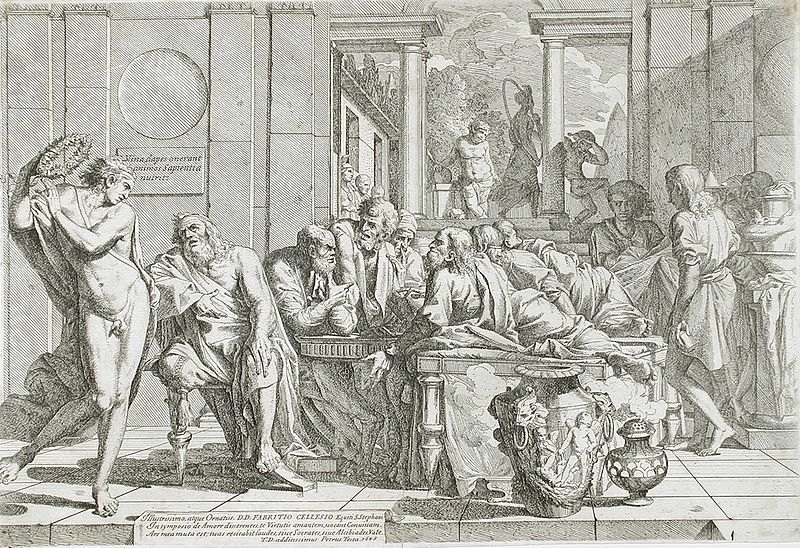
“Drunken Alcibiades interrupting the Symposium”, an engraving from 1648 by Pietro Testa (1611-1650)
Via Wikimedia Commons.
Of all personality traits, charisma is the hardest to appreciate at second hand. We read Cicero’s letters and can instantly tell that he was vain, insecure and ferociously clever; we read scraps of Samuel Johnson’s conversation in Boswell’s biography and know at once that he was magnificent, lovable and desperately unhappy. But as to what it was like to have Lord Byron turn the full force of his attention onto you – well, we have no conceivable way of knowing. We just have to trust his contemporaries that it felt like ‘the opening of the gate of heaven’.
This causes problems for a biographer of Alcibiades. On the face of it, the man was utterly insufferable. Born in around 450 BC into one of the oldest and richest families of ancient Athens, Alcibiades was the only Old Etonian (as it were) to play a leading role in the late-fifth-century radical democracy. The account of his childhood in Plutarch’s Life of Alcibiades suggests a bad case of antisocial personality disorder: biting during wrestling, mutilating dogs, punching his future father-in-law in the face for a dare. His later political career makes Boris Johnson seem like a man of firm and unbending principle. Exiled from Athens in 415 BC over some particularly odious Bullingdon Club antics, Alcibiades promptly sold his services to Sparta (where he seduced the king’s wife) before double-crossing both sides and wheedling his way into the court of a Persian satrap.
But Alcibiades, like Byron, clearly had that indefinable something. One catches a glimpse of it in the unforgettable last scene of Plato’s Symposium, when he crashes into the room, blind drunk, flirting with everything on legs, shouting about his love for Socrates. Thucydides captures it in his report of Alcibiades’s speech whipping up the Athenian assembly to vote for the disastrous Sicilian expedition of 415 BC – an extraordinary stew of egotistic bragging (about how successful his racehorses are), mendacious demagoguery and brilliantly acute strategic thinking. The unwashed Athenian masses, not usually prone to atavistic toff-grovelling, absolutely adored him: when Alcibiades finally returned to Athens in 407 BC after eight years of exile, sailing coolly into Piraeus on a ship with purple sails, they welcomed him back with paroxysms of joy.
Behind the Peloponnese-sized ego, Alcibiades was a general of spectacular genius – when he could be bothered. In 410 BC, shortly after his controversial reinstatement as admiral of the Athenian navy (on the back of a bogus promise of Persian support), he wiped out the entire Spartan fleet at the Battle of Cyzicus; two years later, through sheer chutzpah, he captured the city of Selymbria near Byzantium with only fifty soldiers, and without striking a blow. When things went wrong – as in 406 BC, after a disastrous campaigning season in the eastern Aegean – he showed an infuriating ability to wriggle out of trouble. His final years (406–404 BC) were spent once again in exile from Athens, holed up in a private castle on the Gallipoli peninsula. The circumstances of his death are still shrouded in mystery. One story tells that he died in the remote mountains of central Turkey at the hands of the brothers of a Phrygian noblewoman whom he had decided to seduce. This is, I fear, all too believable.
This is the introduction to a review by Peter Thonemann of a new biography of Alcibiades by David Stuttard in the Literary Review for July, 2018. H/T to Never Yet Melted for the link.
Comments Off on Alcibiades, the Athenian Byron
July 13, 2018
The Gardeners Of Salonica Prepare A New Offensive I THE GREAT WAR Week 207
The Great War
Published on 12 Jul 2018The Macedonian Front has been quite since the recapture of Monastir except for some minor battles like at Skra. But the five nation Army of the Orient wants to change that and is readying a new offensive.
Comments Off on The Gardeners Of Salonica Prepare A New Offensive I THE GREAT WAR Week 207
July 10, 2018
QotD: Epicurean philosophy
Epicurus was born in 341 B.C., only six years after Plato’s death. He was 18 when Alexander the Great died. This event conventionally separates the classical Greece of independent city-states from the Hellenistic period, when Alexander’s generals and their dynasties ruled vast kingdoms in the former Persian Empire. He set up his school in a Garden in the outskirt of Athens. There is very little that survived from his many books. But fortunately, the work of his Roman disciple Lucretius, who lived in the first century B.C., De Rerum Natura, or On the Nature of Things, was rediscovered in the 15th century.
Through this work, Epicureanism had a major influence on the development of science in the following centuries. Epicurus had borrowed and refined the atomic hypothesis of earlier philosophers, and De Rerum Natura was studied and discussed by most scientists and philosophers of the West. The physics of Epicureanism, which explains that worlds spontaneously emerge from the interaction of millions of tiny particles, still looks amazingly modern. It is the only scientific view coming out of the Ancient World that one can still read today and find relevant.
Those influenced by Epicureanism include Hobbes, Mandeville, Hume, Locke, Smith, and many of the British moralists up to the 19th century. They not only discussed the Atomic theory, but Epicurean ethics, his views on the origin of society, on religion, his evolutionary account of life, and other aspects of his philosophy.
To me, Epicureanism is the closest thing to a libertarian philosophy that you can find in Antiquity. Plato, Aristotle, the Stoics, were all statists to various degrees, glorified political involvement, and devised political programs for their audiences of rich and well-connected aristocrats. Epicurus focused on the individual search for happiness, counselled not to get involved in politics because of the personal trouble it brings, and thought that politics was irrelevant. His school included women and slaves. He had no political program to offer and one can find no concept of collective virtues or order or justice in his teachings. On the contrary, the search for happiness implied that individuals should be as free as possible to plan their lives. To him, as one of his sayings goes “natural justice is a pledge guaranteeing mutual advantage, to prevent one from harming others and to keep oneself from being harmed.”
Martin Masse, “The Epicurean roots of some classical liberal and Misesian concepts“, speaking at the Austrian Scholars Conference, Auburn Alabama, 2005-03-18.


