Quotulatiousness

February 19, 2025

A brief nod to the shade of Missouri Representative James Beauchamp “Champ” Clark

Filed under: Cancon, Economics, Government, History, Politics, USA — Tags: , , — Nicholas @ 03:00

I was aware that the greatest Liberal Prime Minister in Canadian history, Sir Wilfred Laurier, had lost an election on the basis of a negotiated free trade deal with the United States, but I was not aware of exactly how that happened. Colby Cosh provides the gory details that got Laurier out of office for good:

Funny thing I noticed: Friday marked the anniversary of the 20th century’s most remarkable explosion in Canadian-American relations, which took place on the floor of the U.S. House of Representatives in 1911. On that day, Feb. 14, Missouri Democratic congressman James Beauchamp “Champ” Clark gave a short speech in defence of a free-trade agreement that had been hammered out between the (Republican) Taft administration and Wilfrid Laurier’s Liberal government.

Clark, a progressive and witty westerner who had already been chosen to become Speaker of the House in April, was widely expected to be the Democratic nominee for president in 1912. He was, in other words, a man who counted. And on the floor of the House, he advocated passage of the free-trade deal on grounds that eventually doomed it: namely, that it was a conscious step toward total American absorption of the Dominion of Canada.

When Clark’s remarks hit the newspapers up north — and no news story hit harder between 1900 and the dawn of the Great War — there was a spasm of anti-American and pro-Empire feeling throughout the country. As any schoolbook will tell you, this helped lead to the defeat of Laurier and the ruin of the trade deal in September 1911’s general election. This gaffe is indeed now what Clark is best remembered for, along with his eventual fumbling away of the 1912 presidential nomination to an unassuming professor named Woodrow Wilson.

When I was an undergraduate, we all had to have it explicitly explained to us that back in Edwardian days, the Liberals were the party of free trade, and the Conservatives the great defenders of tariff protection (although Sir John A. had sometimes sought without success to kick-stark “reciprocity” negotiations with the U.S.). Perhaps the most confusing feature of the 1911 controversy to students of today will be Champ Clark’s idea that the U.S. government would want to lower trade barriers to facilitate eventual annexation of Canada, rather than raising them to mutually punitive levels as a matter of crude antagonism.

Between Confederation and Champ’s time, Americans often just assumed as a matter of course that Canada would fall into their laps without any need for aggression or invasion. We northerners would eventually see that the benefits of American citizenship were more valuable than our romantic imperial attachments, and we would come beat down the door. This was certainly Clark’s own idea, and it created no controversy among Americans themselves when he expressed it.

Of course, in Laurier’s day “liberal” meant something closer to the modern sense of “libertarian” than it does to the current incarnation (or shambling corpse) of that party.

February 18, 2025

Canadian academic life now entails mandatory indoctrination about “settler colonialism”

In Quillette, Jon Kay talks about the pervasive indoctrination of Canadian university students in that invasive intellectual weed from Australia, “settler colonialism”:

Last month, I received a tip from a nursing student at University of Alberta who’d been required to take a course called Indigenous Health in Canada. It’s a “worthwhile subject”, my correspondent (correctly) noted, “but it won’t surprise you to learn [that the course consists of] four months of self-flagellation led by a white woman. One of our assignments, worth 30%, is a land acknowledgement, and instructions include to ‘commit to concrete actions to disrupt settler colonialism’ … This feels like a religious ritual to me.”

Canadian universities are now full of courses like this — which are supposed to teach students about Indigenous issues, but instead consist of little more than ideologically programmed call-and-response sessions. As I wrote on social media, this University of Alberta course offers a particularly appalling specimen of the genre, especially in regard to the instructor’s use of repetitive academic jargon, and the explicit blurring of boundaries between legitimate academic instruction and cultish struggle session.

Students are instructed, for instance, to “commit to concrete actions that disrupt the perpetuation of settler colonialism and articulate pathways that embrace decolonial futures”, and are asked to probe their consciences for actions that “perpetuate settler colonial futurity”. In the land-acknowledgement exercise, students pledge to engage in the act of “reclaiming history” through “nurturing … relationships within the living realities of Indigenous sovereignties”.

My source had no idea what any of this nonsense meant. It seems unlikely the professor knew either. And University of Alberta is not an outlier: For years now, whole legions of Canadian university students across the country have been required to robotically mumble similarly fatuous platitudes as a condition of graduation. It’s effectively become Canada’s national liturgy.

After my tweet went viral, I was contacted by a US-based publication called The College Fix, which covers post-secondary education from a (typically) conservative perspective. Like many observers from outside Canada, reporter Samantha Swenson couldn’t understand why Canadian students were being subjected to this kind of indoctrination session. “I hope you can answer,” she wrote: “Why do schools make mandatory classes like these?”

I sent Swenson a long 13-paragraph answer — which, at the time, felt like a waste of my time: I assumed the reporter would pluck a sentence or two from my lengthy ramble, and the rest of my words would fall down a memory hole.

So when her article did come out — under the title, Mandatory ‘Indigenous Health’ class for U. Alberta nursing students teaches ‘systemic racism’ — I was pleased to see that I’d been quoted at length. I especially appreciated the fact that Swenson had kept in my point that educating Canadians (especially students in the medical field) about Indigenous issues is important work; and that courses such as Indigenous Health in Canada would provide value if they actually served up useful facts and information, instead of self-parodic faculty-lounge gibberish about “decolonized futurities”.

February 17, 2025

A maple-flavoured DOGE? Maxime Bernier proposed this in 2020

Filed under: Bureaucracy, Cancon, Government, Media, Politics — Tags: , , , , , , — Nicholas @ 05:00

It’s both amusing and alarming seeing the kind of things the US government has been pouring money into, as the young auditors of Elon Musk’s DOGE dig into the accounts. Some folks on social media have been asking for a Canadian version of DOGE, but they’re nearly five years behind PPC leader Maxime Bernier:

Did you know that the Canadian government is spending $143,000 to help the African country of Senegal implement a “sectorial gender strategy” in its armed forces?

Or $46,793 to improve healthcare for intersex people in the Chinese province of Shandong?

What about $4.6 million to develop programs promoting a “positive masculinity” in Cuba?

There are hundreds of such crazy programs costing Canadian taxpayers billions of dollars every year to fund the Liberals’ woke ideology in other countries.

Many people on social media just found out that these programs exist last week, after they started looking for them on the website of the Government of Canada.

They were inspired by similar crazy programs that Elon Musk has unearthed with his DOGE team in Washington.

The DOGE – or Department of Government Efficiency – was created by President Trump and has already cut tens of billions of dollars in frivolous spending after only a few weeks.

I’m being asked if I support having the equivalent of a DOGE in Canada.

Not only do I support it, but I didn’t wait for Trump and Musk to do it to propose one. I did years ago!

In 2020, I stated that a PPC government would have a Minister of Government Downsizing to examine every federal program and cut or abolish everything that is inefficient, wasteful or not essential.

And speaking of DOGE, Coyote Blog shares some thoughts about some of the reasons Democrats are critical of the organization’s efforts:

… having thought about this longer, I think this is about more than just money. It is also about class. Just listen to how the cool kids in the media talk about Musk’s group of young weirdly-nicknamed geeks. This is fairly typical:

    He was speaking specifically about a Trump executive order that decrees that the Department for Government Efficiency can force federal agencies into firing four people for every new hire. “Who the hell voted for Mr. Musk?” Begala raged. “Who the hell voted for — excuse the phrase — a guy who calls himself Big Balls? A 19-year-old kid going in there and trying to fire cancer researchers and scientists and teachers and agricultural specialists. It’s, it’s appalling.”

This is moderately hilarious from a) a party who still has not told us which unelected people really were making decisions behind the curtain for a senile Joe Biden; and b) an individual (Begala) who wielded immense power and influence across all departments of the Clinton Administration. The department staffs in DC are 99.99% people who are both unelected and unconfirmed by Congress. The issue is not that they are unelected, the issue is that they are “the wrong sort”. I am reminded of the British aristocracy in the 19th century that would tolerate almost any sort of governmental incompetence or malfeasance as long as the people were “the right sort” — meaning of their class.

The mention of Victorian England reminds me of another way that class is likely involved here. In the English aristocracy the oldest son inherited the title and often all the land and income (which was entailed to the title). This left little for any additional sons, so an income had to be found somewhere for them in a profession that did not require them to sully themselves with “trade” (daughters were handled a different way, through the marriage market). Reading for the law was an acceptable profession for a son with brains, and the army or navy were outlets for many. But most families needed a way for their sons without too much brains or ability and not militarily inclined to make a living. A position in the Church was often the solution.

Modern American blue-blood parents are no different — they need a way to secure a living for their kids who won’t or can’t land a job in the modern elite career choices (law, consulting, investment banking, or a sexy startup). Unlike in Victorian times, the military or the Church are no longer preferred elite options. So what to do with your 22-year-old gender studies major? The parents need her to get an income and they need her to do it in a context that they can proudly report to their friends — Paul Begala does not want to tell his friends that his son’s job is maintaining distributor pricing lists (anyone who does not believe the latter criteria should have been at my Princeton or Harvard Business School 25th reunions).

The solution? Get them a job at a non-profit, the modern American version of going to the Church. As Arnold Kling noted once, non-profits tend to have much higher status than do for-profits. And without competition they don’t have to carry the same performance standards as for-profits. And they are incredibly susceptible to trading a position for your kid in exchange for a nice donation.

The employment rosters of non-profits and NGO’s are stuffed with the children of privilege. So much so that there are many non-profits that seem to do nothing EXCEPT employ and pay the travel expenses of 20-something kids from rich and/or influential families. I have been writing about the non-profit scam for years. As I wrote then:

    From my direct experience, I would go further. There is a tranche (I don’t know how large) of non-profits that are close to outright scams, providing most of their benefits to their managers and employees rather to anyone outside the organization. These benefits include 1) a salary with few performance expectations; 2) expense-paid parties and travel; 3) myriad virtue-signalling opportunities; 4) opportunities to build personal networks. This isn’t just criticizing theoretical institutions — people I know are in such jobs in these organizations.

The spending that DOGE is going after at USAID and other departments likely threatens the income of a number of under-qualified elite kids. So I will update my meme:

The growing problem of “America’s hat”

Filed under: Cancon, China, Government, History, India, USA — Tags: , , , , , — Nicholas @ 03:00

John Carter’s latest post is excellent — but that’s his usual standard — but it’s of particular interest to inhabitants of what used to be the proud Dominion but who now live in a “post-national state” with “no core identity” as our outgoing prime minister so helpfully explained it:

Canada and the US have been frenemies for most of the last two hundred years. With the exception of some spats in the 19th century, they’ve fought on the same side in all major wars, and haven’t taken up arms against one another. At the same time, Canada has from the very beginning fiercely guarded its independence. Through the 1950s, this came from Canada’s self-conception as an outpost of sober, orderly British traditionalism, in stark contrast to the chaotic liberal revolutionaries across the border. Following the Liberal Party’s cultural revolution in the 1960s, Canada increasingly came to see itself as different from the US primarily in that it was more liberal, in the modern sense, than it’s Bible-thumping, gun-toting redneck cousins – which is to say more socialist, leftist, multicultural, gay-friendly, internationalist, feminist, and so forth. In fairness to Canada, the British government, having long-since fallen under the sway of the Labour party, had followed the same ideological trajectory, so Canada was really just taking its cue from Mother England as it always had. In further fairness to Canada, all of this has been aggressively pushed by Blue America, which has been running American culture (and therefore everyone else’s) until about five minutes ago.

Despite these differences, the US could always rely on Canada being a stable, competently run, prosperous, and happy neighbour – perhaps a bit on the prickly side, given the inferiority complex, but much less of a headache than the entropic narcostate to the south that keeps sending its masses of illiterate campesinos flooding over the banks of the Rio Grande. Canada might be annoying sometimes, but it didn’t cause problems. To the contrary, Canada and the US have maintained one the world’s most productive trading relationships for years: America gets Canadian oil, minerals, lumber, and Canada gets US dollars, technology, and culture.

Now, however, Canada has become a problem for America. Not yet, perhaps, the biggest problem – America has a very large number of extremely pressing problems – but a significant one nonetheless, with the potential to become quite acute in the near future.

The problem is that Canada has become a security threat.

[…]

The next security problem is the border, an issue which Trump has repeatedly stressed as a justification for tariffs. The 49th Parallel is famously the longest undefended border on the planet. It is much longer than the Southern border; there are no barbed wire border fences; most of the terrain is easily traversed – forest, lake, or prairie – in contrast to the punishing desert running across the US-Mexico border. Militarizing the US-Mexico border is already a huge, costly undertaking. Doing the same on the Canadian border would be vastly more challenging.

Canada’s extraordinarily lax immigration policy has, in recent years, led to a much higher encounter rate at border crossings with suspects on the terrorism watch list. These people come into Canada legally, part of the millions of immigrants Ottawa has been importing, every year, for the last few years. When you’re bringing in over one percent of your country’s population every single year, it is simply not possible to properly vet them, and it seems that Ottawa barely even bothers to try. Given that not every such person of interest will get stopped at the border, and that not every terrorist is on a watch list, one wonders how many enemies have already slipped across into the US by way of Canadian airports.

RCMP officers with their haul from a fentanyl superlab. Only one person was arrested.

The second border problem is fentanyl. Like the US, Canada has a raging opiod epidemic. We’ve got tent cities, zombies in the streets, needles in the parks, and this is not limited to the big cities – it spills out into the small towns, as well. Like Mexico, Canada has fentanyl laboratories. Precursor chemicals are imported from China by triads, turned into chemical weapons in Canadian labs, and then distributed within Canadian and American markets by predominantly Indian truckers. The occasional busts have turned up vast quantities of the stuff, but have resulted in very few arrests. The proceeds are then laundered through casinos or fake colleges, with the laundered cash then parked in Canadian real estate. There are estimates that the volume of fentanyl money flowing through Canada’s housing markets is significant enough to be a major factor (immigration is certainly the main factor) distorting real estate prices – keeping the housing bubble inflated, propping up Canada’s sagging economy, and pricing young Canadians out of any hope of owning a home or, for that matter, even renting an apartment without a roommate or three.

It’s generally understood, though essentially never acknowledged at official levels, that poisoning North America with opiods is deliberate Chinese policy, both as revenge for the Opium Wars of the 19th century, and as one element in their strategy of unrestricted warfare i.e. the covert but systematic weaponization of every point of contact – economic, industrial, cultural, etc. – between Chinese and Western societies. By allowing the fentanyl trade to continue, the Canadian government is complicit in an act of covert war being waged by a foreign power, one whose casualties include the Canadian government’s own population.

February 16, 2025

Canada – parliamentary democracy or elected dictatorship?

Filed under: Cancon, Government, Law, Liberty, Politics — Tags: , , , — Nicholas @ 05:00

During the entire dramatic confrontation with Donald Trump, Canada’s parliament has been prorogued … effectively meaning that the opposition can’t hold the government to task for how it is handling Trump’s aggression. In any other western country, parliament would have been in session all the way through this, but because Justin Trudeau was aware that his government might be defeated in the house, he chose to ask the Governor General to prorogue until late March.

Not everyone has been meekly accepting Trudeau’s position, and the Justice Centre for Constitutional Freedoms is challenging the prorogation in Federal Court. Dan Knight updates us on the progress of the hearing:

Arms of the Federal Court of Canada

We are now in Day 2 of the Federal Court hearing, where Justin Trudeau’s government is trying to convince a judge that shutting down Parliament to avoid Well, folks, here we are. Day two of the Federal Court showdown, where the Trudeau government is desperately trying to convince Canadians that shutting down Parliament to protect their own hide was a completely reasonable thing to do. They want you to believe that this is all perfectly normal, that it’s routine, that it’s just a quirk of the system. Nothing to see here, folks!

But the problem with lying is that eventually, you get caught. And on Day 2 of this hearing, Justin Trudeau’s legal team got caught. Over and over again.

If you watched what unfolded in court, you saw the Trudeau government’s lawyers flailing like fish on dry land, fumbling through weak excuses as Chief Justice Paul S. Crampton shredded their arguments one by one. At one point, they actually misrepresented a legal precedent in court, only for the Chief Justice to read the case aloud and reveal that it actually contradicted their argument. Humiliating.

And that was just the start.

This case isn’t just about whether Trudeau technically had the ability to prorogue Parliament. It’s about why he did it — and more importantly, whether Canada is now a country where the Prime Minister can shut down democracy whenever it gets inconvenient for him. Because if the courts let this stand, what’s stopping the next Prime Minister from proroguing indefinitely? What’s stopping the government from suspending Parliament every time there’s a corruption scandal, every time they fear a non-confidence vote, every time they need to cover up a mess of their own making?

And that’s exactly what Trudeau did. His government was facing multiple crises all at once — a massive financial scandal, a looming non-confidence vote, and an economic firestorm caused by Trump’s tariff threats. So rather than actually dealing with it, he shut Parliament down. The question is: Did he have the right to do that?

[…]

The Chief Justice has promised to issue a ruling before Parliament resumes on March 24. That means this case will be decided before Trudeau can walk away and pretend none of this ever happened.

If the court rules against the government, it will mean that future Prime Ministers cannot abuse prorogation to avoid scrutiny. It will send a clear message that shutting down Parliament to protect yourself is unconstitutional and illegal.

But if the government wins, it will mean that the Prime Minister can shut down democracy anytime he wants. It will mean that Canada is no longer a functioning parliamentary system but a country where the executive can do whatever it pleases.

And if that happens, ask yourself this: What’s stopping the next Prime Minister from just shutting down Parliament indefinitely?

Trudeau might be stepping down soon, but his legacy of corruption, incompetence, and political cowardice will haunt this country for years. The question now is whether the courts will allow him to rewrite the rules of democracy on his way out the door.

We’ll find out soon.

Update: Fixed broken link.

February 15, 2025

Halifax Donair (Canada) on Sandwiches of History⁣

Filed under: Cancon, Food, History — Tags: , , , — Nicholas @ 02:00

Sandwiches of History
Published 27 Oct 2024

Welcome back to another episode of You’re Doing it Wrong. Lol. Also known as International Sandwich Sunday. I’m joking, kinda. Today, we’re headed northeast to Halifax, Nova Scotia for the Halifax Donair. As I mention in the video, this was created by a Greek immigrant after his traditional lamb and beef gyros just weren’t selling. So it’s less cultural appropriation and more adaptation to the needs of the market. I think if you ask anyone in Halifax, they’d fully acknowledge the original inspiration for this. Also, if you’re tempted to comment on how it’s not a sandwich, just know that, while I understand where you’re coming from, I don’t keep strict purity tests in place for sandwiches as I don’t want to miss out on deliciousness because of them. Join me, won’t you?
(more…)

February 14, 2025

Trump may start paying attention to Canadian cultural protectionist polices next

Michael Geist points out just how many Canadian federal policies and programs will likely come under scrutiny by the Trump administration for their blatant protectionism against US cultural products:

My Globe and Mail op-ed argues the need for change is particularly true for Canadian digital and cultural policy. Parliamentary prorogation ended efforts at privacy, cybersecurity and AI reforms and U.S. pressure has thrown the future of a series of mandated payments – digital service taxes, streaming payments and news media contributions – into doubt. But the Trump tariff escalation, which now extends to steel and aluminum as well as the prospect of reviving the original tariff plan in a matter of weeks, signals something far bigger that may ultimately render current Canadian digital and cultural policy unrecognizable.

Our cultural frameworks are largely based on decades-old policies premised on marketplace protections and mandated support payments. This included foreign ownership restrictions in the cultural sector and requirements that broadcasters contribute a portion of their revenues to support Canadian content production.

As we moved from an analog to digital world, the government simply extended those policies to the digital realm. But with Mr. Trump appearing to call out what he views to be Canadian protectionist policies in sensitive sectors such as banking ownership, the cultural and digital sectors may be next.

If so, there are no shortage of long-standing policies that tilt the playing field in favour of Canadians that could spark some uncomfortable conversations.

Why do U.S. companies face ownership restrictions in the telecom and broadcast sectors? Why are Canadian broadcasters permitted to block U.S. television signals in order to capture increased advertising revenue? Why do Canadian content rules exclude U.S. companies from owning productions featuring predominantly Canadian talent?

The Canadian response that this is how it has always been is unlikely to persuade Mr. Trump.

Canadian policies premised on “making web giants pay” may also be non-starters under Mr. Trump. For the past five years, the Canadian government seemingly welcomed the opportunity to sabre rattle with U.S. internet companies. This led to mandated payments for streaming services to support Canadian film, television and music production; link taxes that targeted Meta and Google to help Canadian news outlets; and the multibillion-dollar retroactive digital services tax that is primarily aimed at U.S. tech giants.

Not only have those policies raised consumer affordability and marketplace competition concerns, they have also emerged as increasingly contentious trade issues. If the trade battles with the U.S. continue, the pressure to scale back the policies will mount.

Beyond rethinking established cultural and digital policies both new and old, the bigger changes may come from re-evaluating the competitive impact of policies that rely heavily on regulation just as the U.S. prioritizes economic growth through deregulation. Proposed Canadian privacy, online harms and AI rules have all relied heavily on increased regulation, looking to Europe as the model.

For example, consider the Canadian approach to AI regulation in the now-defunct Artificial Intelligence and Data Act. It specifically referenced the European Union’s regulatory system, which establishes extensive regulatory requirements for high-risk AI systems and bans some AI systems altogether.

However, the European approach is not the only game in town. Mr. Trump moved swiftly to cancel the former Biden administration’s executive order on AI regulation, signalling that the U.S. will prioritize deregulation in pursuit of global AI leadership. Further, the arrival of DeepSeek, the Chinese answer to ChatGPT, took the world by storm and served notice that U.S. AI dominance is by no means guaranteed.

The competing approaches – U.S.-style lightweight regulation that favours economic growth against a more robust European regulatory model that emphasizes AI guardrails and public protections – will force difficult policy choices that Canada has thus far avoided.

February 13, 2025

Australia’s most toxic export (so far) – “Settler-colonial ideology”

Filed under: Australia, Books, Cancon, Education, History, Media, Politics, USA — Tags: , , , , — Nicholas @ 05:00

Helen Dale explains how a lunatic fringe Australian notion has grown to be a major ideology in most of the Anglosphere and even as far afield as Israel:

Despite a great efflorescence of literature and especially film about the mafia, it’s a truism to say that it isn’t very good for Sicily. It also hasn’t been very good when exported to other countries, either, spreading violence, corruption, and lawlessness. Well, Australia is to settler-colonial ideology as Sicily is to mafia, and our poisonous gift to the world is, like Sicily’s mafia, one of those things about us that really isn’t for export.

“Settler-colonial ideology” seems a mouthful, but if I describe bits of it to you, you’ll recognise it. Heard Australia Day called “Invasion Day”? You’ve encountered settler-colonial ideology. Been called racist for voting NO in the 2023 Voice Referendum? You’ve encountered settler-colonial ideology. Noticed Aboriginal academics get hired with obviously inadequate qualifications? You’ve encountered settler-colonial ideology.

Many Australians — including me — first encountered settler-colonial ideology at university. Back then, it was a theoretical and foreign concern, and largely in languages other than English (mainly French and Arabic). I do remember one of the “post-colonial literatures” (note the s, the s is important) obsessives trying to convince me that Alan Paton’s Cry the Beloved Country wasn’t a “legitimate book” because its author was white, but back then, this was still a niche view.

Like other Australians confronted with daft academic ideas, I blamed the US or France and ignored my own country’s contribution. Australians aren’t noted for their theoretical acumen, which made this easier. Critical race theory and affirmative action are all-American, while US academics have often executed hostile takeovers of French nonsense like postmodernism or queer theory early on in proceedings. It gets easy to blame America and France.

Easy, but unfair.

I realised how mistaken I’d been when, in October last year, I returned to Australia for a stint. While I was there, I read Adam Kirsch’s On Settler Colonialism: Ideology, Violence and Justice. I did so in part because October 2024 was the one-year anniversary of two important events. Both concerned what Kirsch calls “the ideology of settler-colonialism”.

Kirsch documents a process whereby the French- and Arabic-speaking theorists of post WWII decolonial conflicts — particularly Frantz Fanon — had their ideas grafted (very, very awkwardly) onto dissimilar Australian history and conditions by Australian intellectuals. These were then exported throughout the English-speaking world, likely through academic conferences. This explains how cringeworthy Australian nonsense like land acknowledgments managed to spread first to Canada and then the US in a reversal of the usual process whereby America sneezes and so gives its Hat a cold.

Fanon was a Marxist and a Freudian. His writing seethes with angry bloodthirstiness and pseudoscientific psychodrama, but he was responding to a vicious war of independence and incipient civil conflict. Kirsch notices a pattern where Australian scholars borrow bits of Fanon to give a sanguinary rhetorical garnish to their writing. “Fanon’s praise of violence is a large part of his appeal for Western intellectuals,” he notes. “Many of the sentiments expressed in The Wretched of the Earth, coming from a European or American writer, would immediately be identified as fascistic.”

Australia’s intervention changed the ideology, in some ways making it more destructive. Fanon is shorn of most of his Marxism, for example (can’t have that, won’t be able to recruit rich minorities to the boss class otherwise). The key Australian shift coalesces around an oft-quoted aphorism from historian Patrick Wolfe: “invasion is a structure, not an event”. That is, colonisation trauma is constantly renewed because “settler” is a heritable identity. “Every inhabitant of a settler colonial society who is not descended from the original indigenous population,” Kirsch points out, “is, and always will be, a settler”.

“Settler” here includes people transported to both America and Australia in chains — slaves and convicts. Once it became acceptable to construe one group of people conveyed against their will across thousands of miles of ocean in dreadful conditions as providentially lucky (and genocidal) settlers, it became possible to extend the reasoning to other, similar groups. After all, the only difference between a convict and a slave is the presence or absence of a criminal conviction.

Kirsch’s attempt to explain how Australia was analogised with Fanon’s Algeria and then how Israel was analogised with Wolfe’s Australia is heroic, in part because the casuistry he seeks to unpick is so convoluted. Filtering Fanon through Australian academia and its claim that “settler” is a heritable identity did have the effect of making Jewish Israelis look more like non-indigenous Australians or Americans, however, especially when attention was focussed on European Jewish immigrants to Israel.

February 12, 2025

Poilievre’s outlined plan for the Canadian Arctic gets the CDR Salamander seal of approval

Filed under: Cancon, Military, Politics — Tags: , , , — Nicholas @ 05:00

Although most of the attention is on the still ongoing Trump tariff tantrum, there is still the required battle-space preparations going on for the next federal election. Conservative leader Pierre Poilievre discussed his proposals for improving national security in the Arctic, and CDR Salamander is enthusiastic:

Pierre and Ana Poilievre at a Conservative leadership rally, 21 April, 2022.
Photo by Wikipageedittor099 via Wikimedia Commons.

… here are the highlights as I see them.

  • Canada’s Arctic is under threat. 75% of Canada’s coastline is in the far north, and 40% of her landmass. Canada needs to become self-sufficient.
  • In the fall of 2022, the Canadian military found Chinese monitoring buoys in the Arctic.
  • A Royal Canadian Navy frigate shadowed a Chinese research vessel in the Bering Strait off Alaska last year (thank you RCN friends, we don’t have any frigates nor naval bases in Alaska because … our leaders don’t understand much outside Norfolk, San Diego, or the Potomac).
  • Russia is building new bases and infrastructure in the Arctic.
  • Canada will take back control of Canadian waters, sky, and land.
  • The Canadian military today is weakened and her allies no longer respects her.
  • Canada does not have a permanent military presence in the Arctic.
  • When Prime Minister, he will increase Canadian forces by:
  • – Doubling the size of the Canadian Rangers from 2,000 to 4,000 Rangers.

    – Acquire two additional polar heavy icebreakers for the Royal Canadian Navy by 2029 on top of the two current icebreakers being built for the Canadian Coast Guard.

    – Will build Canada’s first permanent Arctic military base since the Cold War. It will be CFB Iqaluit. 100% of the cost of the base will come out of the Canadian foreign aid budget and will be up and running within two years of Poilievre becoming Prime Minister.

    – New submarines.

  • Bringing wasted foreign aid back to Canada.
  • If Canada wants to be a sovereign, self-reliant nation, it must take control of their north, secure its borders, and stand on its own two feet.
  • Canada cannot count on the Americans to do it for them.

Further on in this speech, Poilievre speaks out strongly against some of the statements of President Trump and his administration, and that is fine for me. Were I Canadian, I would say very similar things. This is OK. Friends can have disagreements now and then, but for every one item that causes friction, we will always have nine items that bring us together.

It’s all good.

Electric vehicles and cold Canadian weather

Filed under: Cancon, Technology — Tags: , , — Nicholas @ 03:00

The Canadian government has been a noisy proponent for Canadians replacing their internal combustion vehicles with electric-powered alternatives, but unlike places like California it gets cold in Canada … very cold indeed at times. The CAA conducted some tests on popular EVs to find out how typical cold conditions impact the range of the cars:

Nissan Leaf electric vehicle charging.
Photo by Nissan UK

CAA is out with the results from their first ever road tests of how electric vehicles (EV) charge and perform in a Canadian winter.

They tested out 14 electric vehicles which included seven of the top 10 sellers in Canada. They were driven from Ottawa to Mont Tremblant and the temperatures during the drive ranged from -7 to -15 degrees Celsius.

Each vehicle was driven until the battery completely died to determine the range in winter conditions. The results were compared to the estimated driving range published by Natural Resources Canada. CAA says officially posted EV ranges (below) in Canada are based on overall, year-round numbers.

“CAA is responding to a top concern of Canadians when it comes to EVs,” said Ian Jack, vice-president, public affairs, CAA National. “We measured the effective range of electric vehicles in cold weather and how quickly they charge. These insights are critical for both current EV owners and those considering making the switch.”

The association says a recent poll revealed more than two-thirds of Canadians say the drop in driving range during winter is the top barrier to purchasing an EV. Out of those who own an EV, 65 per cent said they experienced a lower battery range in extreme cold weather.

The rest results showed the vehicles drove 14 to 39 per cent less than their official range.

“The vast difference in results really highlights the importance in truth and advertising when it comes to EV range and making sure that Canadians are comparing numbers when it comes to winter performance,” said Kristine D’Arbelles, Senior Director of Public Affairs for CAA National.

February 8, 2025

Interprovincial trade barriers in Canada

Filed under: Cancon, Economics, Government, History — Tags: , , , — Nicholas @ 03:00

In the National Post, Jamie Sarkonak pours some icy cold water on the fever dream that we can fix what ails us economically with this one neat trick:

Understand what an interprovincial trade barrier is: it isn’t a simple matter of repealing tariffs, because internal tariffs don’t exist — provinces aren’t allowed to impose them. Instead, barriers take the form of red tape that differs in shade by province; if there are 10 provinces that each regulate, say, what shape of toilet seat is required to be used on a construction site, expect 10 different rules on the matter (Ontario requires a gap at the front of the seat; Alberta doesn’t care).

For Canada’s toilet seat manufacturers, that’s another level of complexity that can complicate production and make it costly to expand to new jurisdictions.

Now repeat the mental exercise for every other provincially regulated product: food, alcohol, pesticides, lumber and so on. And again, with all the other provincially regulated things you can buy but not hold: massage therapy, legal services, hair and aesthetic services, provincially regulated securities.

It adds up to a lot, and that’s by design: in 1867, the Constitution explicitly handed authority over most sectors to provincial governments. Provincial regulations, and by extension, interprovincial trade barriers, are central to provincial autonomy.

Theoretically, rule consolidation is a good deal. It would be far easier to do business in Canada if it worked more like one country with one set of rules, rather than a heterogenous group of 10 micro-states packed into one.

On the taxpayer side, there are savings to be had, too: regulatory bodies use public funds and there are (theoretically) savings to be had by centralizing the offices of 10 different sheriffs into one. Estimates vary, but lifting barriers is thought to add a boost of $80 billion (International Monetary Fund) to $200 billion (Canadian Federation of Independent Business) to the economy.

But standing in the way of free-trade utopia are the practical considerations, the big one being protectionism. Making its case in the Journal de Montreal, William Rousseau put it well: “The abolition of these barriers can even be economically harmful, because for each barrier that blocks a company from the rest of the country, there is a Quebec company that benefits from it and whose business model takes this barrier into account.” The exact same can be said for any province.

This is why I thought well of Pierre Poilievre’s recent trial balloon about ways to coax the provinces into reducing interprovincial trade barriers by … let’s be honest … providing a financial bribe from the federal government. By allowing the individual provinces to “capture” some of that “lost” revenue, it may provide enough incentive to start dismantling at least some of the structural barriers to free trade within Confederation.

February 6, 2025

Trump tariff diary, day 5

Filed under: Cancon, Government, Media, Politics, USA — Tags: , , , , — Nicholas @ 03:00

The attention shifted away from the BOM kicking the Little Potato around as BOM floated the idea of annexing the Gaza Strip (as Eastern New Jersey?) on social media. There goes at least 24 hours of media hysteria …

Justin Trudeau’s vision of Canada

As I’ve pointed out a few times, the situation didn’t blow up out of nowhere (we’re back to the Trump tariffs, not the Gaza Strip), as Trump had given ample warning that this was an important issue for him. However, as Roxanne Halverson points out, Trudeau’s government paid it not the slightest bit of attention until Trump forced them:

This means Ontario Premier Doug Ford who threatened to cancel a $100 million dollar Starlink contract with Elon Musk to provide high-speed internet to northern and rural Ontario communities because of Musk’s strong ties to Trump. And perhaps BC Premier David Eby shouldn’t have threatened to take alcohol products from “red states” in the US off the shelves of BC liquor stores. And perhaps Team Trudeau shouldn’t been trying to play the mouse that roared by threatening to slap retaliatory tariffs on American products coming into Canada, given that it means Canadians will pay more for products like fruits and vegetables that we simply can’t get here in the winter. And that goes for all the provincial premiers, with the exception of Alberta Premier Danielle Smith.

And for all Canadians — particularly those who voted for Trudeau — who are so angry at Trump that they are blowing up the internet with memes, threatening never to vacation in the States, and booing the singing of the American anthem at hockey games — grow up and smarten up and rethink who your anger should be directed at.

Everyone needs to recognize the fact that Trump made it pretty clear about the tariffs when he was campaigning for the US presidency, after he won the presidency — but had yet been officially sworn in — and as soon as he entered the Oval Office. And yet everyone seemed so shocked when he did it — including Prime Minister Trudeau.

Trump also made it pretty clear what he was after — fix Canada’s porous border and fix the drug trafficking problem — and the fentanyl problem in particular. And thanks to the dithering of the Trudeau government — vacillating between “negotiating and diplomacy” and talking “tough”, as well as using the issue as a campaign tool, this is what it came to. Because, it would seem, Trump didn’t think his request was being taken seriously so he made it serious. One thing Trump recognizes is weakness, and it is something he is willing to take advantage of it. And in Canada he saw weakness — weak leadership and an weak economy. Another thing Trump is very good at, and that is rattling people and he did that in spades on Saturday — and by Sunday he got results.

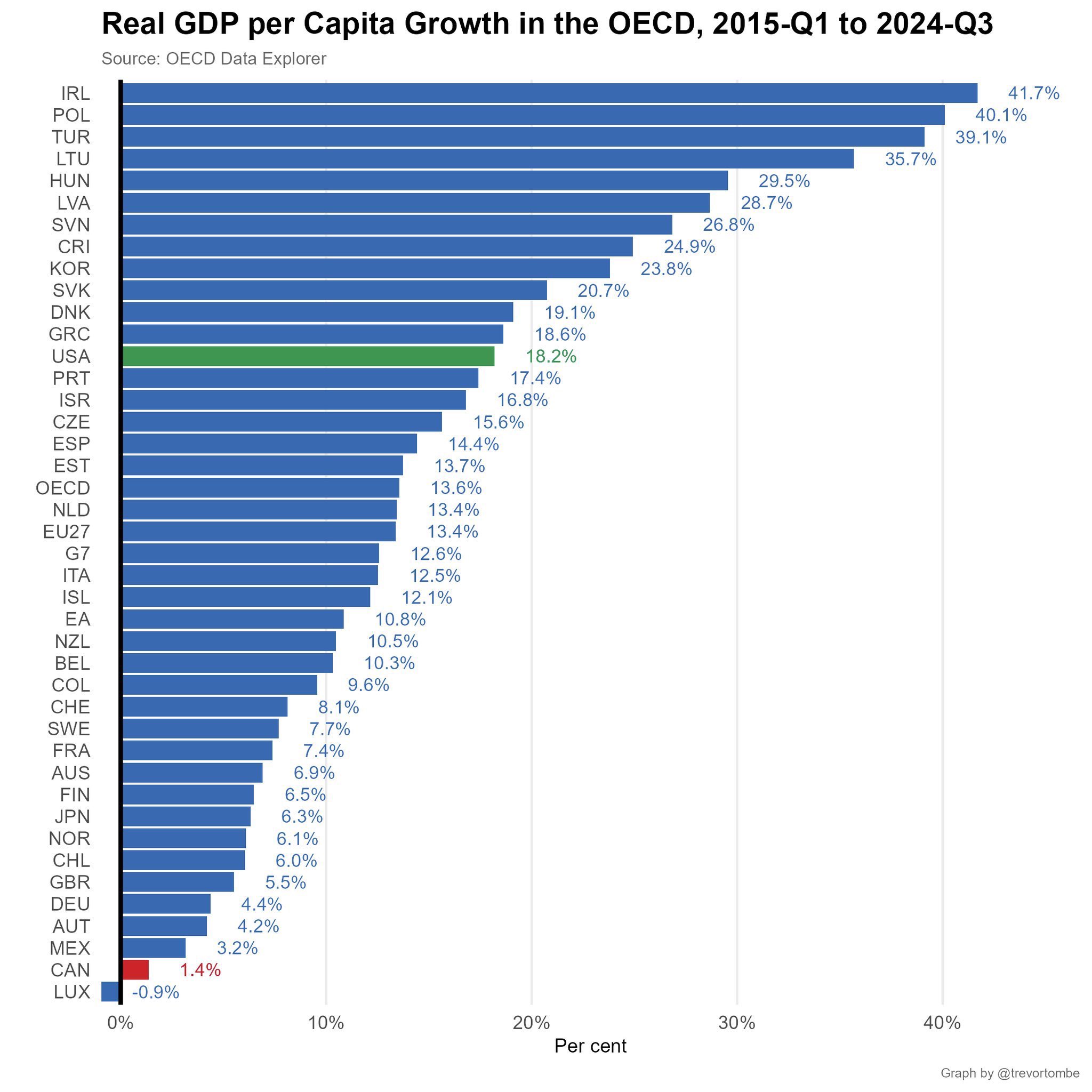
For all the Canadians who are mad at Trump for starting these tariff wars, particularly those who voted for Trudeau. Remember this … if Canada had a strong economy that hadn’t been driven into the ground by ten years of Liberal economic, monetary, social engineering and “green” policies we wouldn’t be so vulnerable to Trump’s tariffs.

Trump didn’t halt the building of pipelines that could have taken our oil products to both eastern and western coasts to be shipped to markets overseas. This would have expanded markets for Canadian oil, meaning we wouldn’t be selling sell the bulk of it to the Americans at bargain prices. It wasn’t Trump who drove billions, if not trillions of dollars in investments out of the country by overtaxing businesses with ever increasing carbon taxes and various other in sundry operating costs, or stifling business growth with endless crippling green energy policies and regulations, or extinguishing any chance of expanding our natural gas production to sell to overseas markets by claiming “no business case” for it.

The business investment picture in Canada shows a clear decline dating almost exactly to the start of Trudeau’s time in office:

The Canadian government’s (and several provincial governments’) hostility to economic development and infrastructure expansion is clearly illustrated, I think.

February 5, 2025

Trump tariff diary, day 4

Filed under: Cancon, Government, Media, Politics, USA — Tags: , , , , , , , — Nicholas @ 03:00

The Big Orange Meanie and the Little Potato had a phone call, after which the BOM announced a 30-day delay to the imposition of tariffs. In Canada, all of “peoplekind” were relieved to hear that they won’t have to give up their American-made binkies quite yet. Some appropriate snark from The Free Press:

It was actually a phone call between the BOM and the Little Potato, but we can imagine this is what it would have looked like in person.

Mexican president Claudia Sheinbaum Speedy Gonzales’d her way to a deal with Trump yesterday, promising to deploy 10,000 Mexican troops to the border to stop the flow of illegal immigrants and drugs. In return, Trump agreed to pause his 25 percent tariff on goods coming from south of the border. Soon after, he struck a seemingly identical deal with Justin Trudeau, who said he’d appoint a “fentanyl czar” and promised to send 10,000 Canadian troops to the northern border. Who knew they even had that many?! Tariffs will still be levied against Chinese goods starting today, but Trump says he plans to talk with President Xi Jinping as soon as this week.

The FP isn’t wrong … the Canadian Army doesn’t have 10,000 spare troops just hanging around their barracks who could be sent to the border, so it’s much more likely to be a combination of Canadian Border Services Agency (CBSA) agents, RCMP officers, provincial police (if the respective provinces are willing), and whatever the army can spare. (Trudeau refers only to “nearly 10,000 frontline personnel”, not “troops” as a lot of US reports state … that seems a lot more achievable.)

You may be wondering how the US President has such disruptive and antagonistic tools at his disposal. It’s yet another hangover from the Carter years, as Congress delegated these powers to the president in 1977:

Donald Trump as Napoleon the 47th.
Image generated by Grok.

The emerging on-off-on-off trade war between Canada and the United States has everyone asking “How should we fight?” — understandably enough — but we should not move too quickly beyond the question “How is this literal nonsense at all possible?” How did the U.S. Congress’s clearly specified constitutional power to regulate the country’s commerce with foreign nations fall into naked and unapologetic decrepitude? Why is every new American president now a Napoleon, and why isn’t this at all a political issue in the U.S.?

The American Constitution, it seems, has no political party apart from a handful of cranky, tireless libertarians like Gene Healy, Clyde W. Crews or Ilya Somin, who has a new article spitballing possible litigation approaches for Americans who lie in the path of the tariffs now being wishcasted into existence by Napoleon the 47th. Somin explains that President Donald Trump is using an openly contrived “national emergency” to invoke powers delegated to the White House by Congress in 1977, powers that are to be invoked only in the face of “unusual and extraordinary threats” to the Republic.

Since the president apparently has plenary power to define an emergency, and to do so without offering anything resembling a rational explanation, this act of Congress now appears to be less of a delegation and more of a surrender — a total abandonment of constitutional principle and the classical separation of powers. I pause to observe that the cheeks every Canadian should redden with slight shame at the spectacle of frivolous recourse to the law of emergencies causing obvious and sickening injury to the rule of law in the U.S. (Oh, no, that could never happen here!)

February 4, 2025

Trump tariff diary, days 2 and 3

Filed under: Cancon, Economics, Government, Media, Politics, USA — Tags: , , , — Nicholas @ 03:00

Posted to social media yesterday:

To celebrate Groundhog Day, Governor Trudeau wore commemorative Groundhog-themed socks. Governor Trudeau’s announced counter-tariffs seem to have made no difference to the Big Orange Meany, so the Great State of Canada proceeds with plans to annex Guam and American Samoa. China has indicated interest in purchasing Vancouver Island or leasing the naval base in Esquimault. The National Post‘s Tristin Hopper suggested “Spend 10 years relentlessly kneecapping the Canadian economy for no reason to show Trump we’re not scared of him”, but we’ve already done that.

Today’s tariff diary entry was going to be:

Reports indicate that the Mexican government is folding to Trumpian pressure. Governor Trudeau insists he won’t budge, regardless of the economic damage to Canadian consumers … what a hero! A few of us may lose our jobs, our businesses, and our economic futures, but he’s willing to take that risk. Update: Trudeau folded like the cheap suit he so resembles. Tariff war on hold for 30 days as Trudeau looks for a way to sign the terms of surrender without any blame attaching to him or his party … he’ll probably blame the provincial governments and the federal NDP (who’ll still support him in Parliament, regardless).

… But the “pause” in tariff enforcement may be enough to let Trudeau and the Liberals — with the active connivance of the bought-and-paid-for Canadian legacy media propagandists — portray this as a great national victory and attempt to turn it into votes for Liberal candidates in the next federal election. I’d love to be proven too cynical here, but the Liberal track record isn’t good.

The FN C1A1 – Workhorse of the Cold War Canadian Army

Filed under: Cancon, History, Military, Weapons — Tags: , , , , — Nicholas @ 02:00

On Target Canada
Published 20 Jan 2020

Time to get a closer look at a rifle I have spent a lot of time with in the past. The FN C1A1, used by the Canadian Army from the mid 1950s to the late 1980s.

Enjoy!
(more…)

« Newer PostsOlder Posts »

Powered by WordPress