Quotulatiousness

October 13, 2012

Sometimes there’s a logical reason to discriminate in pricing

Filed under: Business, Europe — Tags: , , , — Nicholas @ 11:00

Tim Harford on the recent EU ruling that insurers will no longer be allowed to consider gender in setting insurance rates:

He: And not before time. It’s outrageous that I have to pay more for my car insurance than you do. I’m a perfectly safe driver.
She: Of course you are, dear. But you also drive a lot more than I do, which is not unusual for men. Since you drive more miles you are exposing yourself to the risk of more accidents.
He: Am I? Oh.
She: This is one of the reasons that men have more accidents than women. Another, of course, is that some young men are aggressive, overconfident idiots. But in any case you should probably put the money you save into your pension pot because you’re going to need it when you get stuck with the low annuity rates we women have had to put up with.
He: But my life expectancy is shorter. I deserve much higher annuity rates. That’s outrageous.
She: So you’re outraged that discrimination against you hasn’t ended earlier, and equally outraged that discrimination in your favour isn’t going to continue for ever?

[. . .]

She: We might not get too comfortable. Insurers will start looking at other correlates of risk. The obvious one is how far people drive: men tend to drive more than women. Then there are issues such as the choice of a sports car rather than a people carrier. Such distinctions may carry more weight in determining your premium than they do now. As for annuities, if they can’t pay any attention to your sex they might start paying more attention to your cholesterol.
He: I can see that this might get very intrusive.
She: It might. Or it might get very clumsy. Mortgage lenders used to be accused of using geography as a way of discriminating against minorities in the US, since ethnicity and postcode can be closely correlated. There are modern analogies: since women are on average smaller than men, perhaps in the future premiums will be proportionate to height. Stranger things have happened.


October 10, 2012

Is “national security” just another term for “protectionism”

Filed under: Business, Cancon, China, Government, Technology — Tags: , , , — Nicholas @ 10:16

Daniel Ikenson at the Cato@Liberty blog:

Chinese telecommunications companies Huawei and ZTE long have been in the crosshairs of U.S. policymakers. Rumors that the telecoms are or could become conduits for Chinese government-sponsored cyber espionage or cyber attacks on so-called critical infrastructure in the United States have been swirling around Washington for a few years. Concerns about Huawei’s alleged ties to the People’s Liberation Army were plausible enough to cause the U.S. Committee on Foreign Investment in the United States (CFIUS) to recommend that President Bush block a proposed acquisition by Huawei of 3Com in 2008. Subsequent attempts by Huawei to expand in the United States have also failed for similar reasons, and because of Huawei’s ham-fisted, amateurish public relations efforts.

So it’s not at all surprising that yesterday the House Permanent Select Committee on Intelligence, yesterday, following a nearly year-long investigation, issued its “Investigative Report on the U.S. National Security Issues Posed by Chinese Telecommunications Companies Huawei and ZTE,” along with recommendations that U.S. companies avoid doing business with these firms.

But there is no smoking gun in the report, only innuendo sold as something more definitive. The most damning evidence against Huawei and ZTE is that the companies were evasive or incomplete when it came to providing answers to questions that would have revealed strategic information that the companies understandably might not want to share with U.S. policymakers, who may have the interests of their own favored U.S. telecoms in mind.

It’s not just the United States, either: Canada is also getting wary of Huawei.

The Canadian government has said that it will be invoking a “national security exemption” as it hires firms to build a secure network, hinting that Chinese telco Huawei could be excluded.

The exemption allows the government to kick out of the running any companies or nations considered a security risk, which coming in the wake of the US report earlier this week labelling Huawei and ZTE as security threats, strongly indicates they’re out of the bidding.

Prime Minister Stephen Harper’s top media spokesman refused to say for sure whether the government had Huawei in mind when invoking the exemption.

“The government is going to be choosing carefully in the construction of this network and it has invoked the national security exception for the building of this network,” he said, according to the Calgary Herald.

October 9, 2012

Gewirtz: The Windows 8 user interface

Filed under: Business, Technology — Tags: , , , , , — Nicholas @ 09:19

David Gewirtz is unimpressed with the Windows 8 user interface. To understate the case a wee bit:

… And that’s why, in pure analytical terms, one has to wonder what went through the (fill-in-the-blank) (fill-in-the-blank) misguided brains of Microsoft’s managers, analysts, and strategists when they decided to ditch the Start menu.

I finally decided to load the preview edition of Windows 8 and use it. And, despite the operating itself being a marvel of engineering, ease of use, speed, and underlyng functionality — I’m forced to say that it’s unusable for desktops out of the box. Un-frakin’-usable.

[. . .]

Microsoft, on the other hand, has decided that — rather than make some very minor interface nods to the billion or so users it has — it’s going to force everyone to change how they use their machines.

This is not change in a good way. It’d be as if Ford decided to yank out the typical comfortable interior of a car, and replace it with a motorcycle seat, handlebars, and control interface. One day, grandma would get up to go to work, get in her trusty Ford (which she’s been happily driving for decades) — and not know how to do anything!

Worse, since the motorcycle UI isn’t designed for the inside of a car, using it there would suck. People have tried it, and it’s amusing as an exercise, but it doesn’t really work.

Windows 8’s change to the Start menu is not amusing as an exercise. It’s an insult to all the billions of Windows users the world wide.

Here’s the thing. You get into Windows and it’s Metro. You click the desktop tile because you have real work to do — and you’re stuck. How do you launch apps? There’s no launcher or Start menu. If you don’t know to click in the corner of the screen, you ain’t doin’ nothin’. There’s no hint, no cue, no application, no Start menu. There’s nothing there, there.

October 8, 2012

Legal weapons of mass destruction

Filed under: Business, Law, Technology — Tags: , , , , — Nicholas @ 11:19

Software patents: two words that probably should not go together at all.

Mr. Phillips and Vlingo are among the thousands of executives and companies caught in a software patent system that federal judges, economists, policy makers and technology executives say is so flawed that it often stymies innovation.

Alongside the impressive technological advances of the last two decades, they argue, a pall has descended: the marketplace for new ideas has been corrupted by software patents used as destructive weapons.

[. . .]

Patents are vitally important to protecting intellectual property. Plenty of creativity occurs within the technology industry, and without patents, executives say they could never justify spending fortunes on new products. And academics say that some aspects of the patent system, like protections for pharmaceuticals, often function smoothly.

However, many people argue that the nation’s patent rules, intended for a mechanical world, are inadequate in today’s digital marketplace. Unlike patents for new drug formulas, patents on software often effectively grant ownership of concepts, rather than tangible creations. Today, the patent office routinely approves patents that describe vague algorithms or business methods, like a software system for calculating online prices, without patent examiners demanding specifics about how those calculations occur or how the software operates.

As a result, some patents are so broad that they allow patent holders to claim sweeping ownership of seemingly unrelated products built by others. Often, companies are sued for violating patents they never knew existed or never dreamed might apply to their creations, at a cost shouldered by consumers in the form of higher prices and fewer choices.

October 6, 2012

Here’s a potentially viable secondary market for SF hardcovers

Filed under: Books, Business, Media — Tags: , — Nicholas @ 11:14

Charles Stross updates his readers on what’s in the writing and production pipeline, and in the process discovers a niche market that might just be viable:

[…] Because if there’s one thing guaranteed to annoy everyone, it’s embarking on a project that is bound to be at least a year late …

What’s the problem? Well, I only get one slot per 12 months with my main publishers, and they’re nailed down years in advance. And the 2013 slot is currently occupied by Neptune’s Brood, which I finished writing in July this year, about six months later than originally expected. Neptune’s Brood is notionally a space opera, but I prefer to think of it as a parable about the banking liquidity crisis of 2008; the setting is recycled from Saturn’s Children, albeit 5000 years later and without the overt Heinlein homage (and the characters). Unfortunately I’m a slow learner. A chunk of the action takes place on (or rather in) an aquatic super-earth with no land masses: consequently, the early cover art treatments rely on the theory that the book will sell best if, rather than somehow conveying the message that it’s about fractional-reserve banking fraud in a slower than light universe, the cover promises MERMAID BOOBIES!!!1!!

Hmm.

(I wonder if there’s a secondary market for fake dust-jackets for the easily-embarrassed reader, bearing the correct name and title but a different illustration? Signed by the author, even …!)

For example, here is the original cover for Saturn’s Children:

October 4, 2012

The zero-sum trading myth

Filed under: Business, Cancon, China, Economics — Tags: — Nicholas @ 09:44

In Maclean’s, Stephen Gordon decries the undying myth that if one party to a trade is benefitting then the other must be losing:

In The Myth of the Rational Voter, Bryan Caplan argues that the most important obstacles to implementing sound economic policies are not lobby groups or the ability of other special interests to influence politicians, but certain systemic, irrational beliefs of the electorate. This is hardly an encouraging conclusion, but if we needed any more evidence for at least one aspect of his thesis, the CNOOC-Nexen takeover is providing it.

One of the prejudices identified by Caplan is what he calls anti-foreign bias: “a tendency to underestimate the economic benefits of interaction with foreigners.” According to popular (mis)perception, dealing with foreigners is to be mistrusted: if they want something from us, then they must perceive some benefit from the exchange. And if foreigners are gaining, then Canadians must be losing.

October 2, 2012

Why (some) business experience is valuable for politicians

Filed under: Bureaucracy, Business, Education, Government — Tags: , , , — Nicholas @ 09:34

Megan McArdle writes about the worsening problem of government officials who have never spent any time in the business world, but have huge power over the business environment:

Of course, we’ve had many good presidents with no business experience. But Obama’s whole administration tends to be light on people from outside the academia — NGO — government triangle. It’s something that’s increasingly true of Washington in general — and, I think, increasingly problematic.

[. . .]

The increasingly mandarin elite, hygienically removed from the grubby business of scrounging for customers, frequently seems to have no idea at all what goes on in companies. Stop grinning, Republicans; I mean you too. Yes, too many liberals seem to believe that all infelicitous market outcomes can be cured by appointing a commission composed of really top-notch academics — during the debate over health care reform, the words “peer reviewed study” were invoked by supporters with no less touching a faith than an Italian grandmother performing a rosary for the salvation of the godless Communists. On the other hand, here comes the GOP claiming that entrepreneurship can be started or stopped with small changes in marginal tax rates, as if one were turning on and off a light. This is no less of a technocratic fallacy, even if, as with many technocratic fallacies, there is a grain of sound theory buried somewhere under that towering mountain of unwarranted assumptions.

The result is that companies usually get treated as a rather simple variable in a model rather than the complex organizations they are. For example, you see people reasoning from corporate behavior to efficacy: if fast food companies spend a lot of money on advertising, then said advertising must make kids eat more fast food; if hiring managers demand a college degree for positions that didn’t used to require one, there must be a good business reason. “They wouldn’t do it,” says the argument, “if it didn’t work.”

If you’ve actually worked at a company, this is a ludicrous statement. Companies do stuff that doesn’t work all the time, and it can take decades to unwind even the stupidest expenditures and rules. More importantly, when they do have good reasons, they are often not the reasons that outsiders think. The elite projects their own concerns onto the company, instead of asking the company what it’s worried about.

[. . .]

The flip side of this is the people who think that companies don’t do anything at all that couldn’t be done better by government or academia … except sit back and rake the money in. This is particularly prevalent in discussions of health care, but it frequently pops up elsewhere. My favorite in this genre is Jerry Avorn, the professor of pharmacoeconomics who told Ezra Klein that we didn’t really need drug companies because now academics with good drug prospects could simply go straight to the capital markets and raise money to fund their own projects.

This is simply breathtakingly wrong. For one thing, venture capitalists want an exit strategy before they will put money in, and in biotech, exit is often a sale to a big pharmaceutical firm; no Big Pharma, no VC funds. And second, few newly hatched biotech firms have the complementary capacities to bring a drug to market by themselves. Forget the sales force; I’m talking about the expertise to get the thing through the FDA approval process and produce it in massive quantities. How do they acquire those capacities? They partner with Big Pharma, or license to them.

September 29, 2012

CN experiments with natural gas for its locomotives

Filed under: Business, Cancon, Railways, Technology — Tags: , , — Nicholas @ 00:01

Canadian National Railways is running a limited experiment with a pair of retro-fitted diesel locomotives converted to running on natural gas:

Canadian National Railway is exploring whether its feasible to use cheap and relatively clean natural gas to power its trains instead of diesel.

CN has retrofitted two of its existing diesel-fired locomotives to run mainly on natural gas. It’s testing the locomotives along the 480-kilometre stretch between Edmonton, a key energy processing and pipeline hub, and the oilsands epicentre of Fort McMurray, Alta.

Longer term, CN and three other partners are looking at developing an all-new natural gas locomotive engine as well as a specialized tank car to carry the fuel.

September 24, 2012

One thing the Occupy movement was absolutely right about: crony capitalism

Filed under: Business, Government, Politics — Tags: , , , — Nicholas @ 12:29

In the Calgary Herald, Mike Milke says that the Occupy protest movement was spot-on in their criticism of crony capitalism:

With the recent first anniversary of Occupy Wall Street, consider one beef from protesters that was legitimate: crony capitalism.

In general, Occupy Wall Street types could be described as a little too naive about the downside of more government power, and too critical of people who exchange goods and services in markets.

But insofar as any protester was annoyed with politicians who like to subsidize specific businesses — corporate welfare in other words, and which is an accurate example of abused capitalism — hand me a protest sign and give me a tent.

When taxpayer dollars are given or “loaned” (wink, wink, nod, nod) to specific businesses, such taxpayer-financed subsidies are not cheap.

According to the OECD, in 2008, at least $48 billion was proposed for automotive companies alone. Annually, global taxpayer subsidies to the energy industry clock in at more than $100 billion. And in Canada, between 1994 and 2007, governments spent $202 billion on all types of subsidies to multiple corporations in all sorts of industries.

September 23, 2012

Canada is open for (shady) business

Filed under: Business, Cancon, Law — Tags: , , , — Nicholas @ 10:03

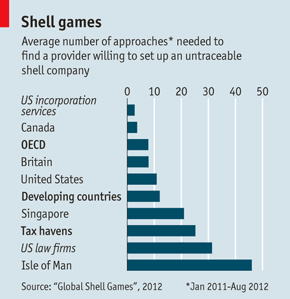
The Economist looks at the relative level of difficulty in setting up a shell corporation in various jurisdictions and how easy it is to create an untraceable shell:

Shell companies — which exist on paper only, with no real employees or offices — have legitimate uses. But the untraceable shell also happens to be the vehicle of choice for money launderers, bribe givers and takers, sanctions busters, tax evaders and financiers of terrorism. The trail has gone cold in many a criminal probe because law enforcers were unable to pierce a shell’s corporate veil.

The international standard governing shells, set by the inter-governmental Financial Action Task Force (FATF), is clear-cut. It says countries should take all necessary measures to prevent their misuse, such as ensuring that accurate information on the real (or “beneficial”) owner is available to “competent authorities”. More than 180 countries have pledged to follow it. A study* scrutinises the level of compliance worldwide. The results are depressing.


Posing as consultants, the authors asked 3,700 incorporation agents in 182 countries to form companies for them. Overall, 48% of the agents who replied failed to ask for proper identification; almost half of these did not want any documents at all. Contrary to conventional wisdom, providers in tax havens, such as Jersey and the Cayman Islands, were much more likely to comply with the standards than those from the OECD, a club of mostly rich countries. Even poor countries had a better compliance rate, suggesting the problem in the rich world is not cost but unwillingness to follow the rules (see chart). Only ten out of 1,722 providers in America required notarised documents in line with the FATF standard.

September 22, 2012

The “joy” of data-capped, throttled internet access

Filed under: Business, Cancon, Technology — Tags: , , , — Nicholas @ 09:13

Welcome to Canada:

Blogger Stephanie Morrow has complained about data caps in Canada for a while now. The details of her situation show just how hard it can be to get faster internet even if you are willing to pay for it:

    My monthly data cap at the moment is 80 gigs. I pay just over $100 CA for 80 gigs a month, and $2 CA per gig over my cap. Understandably, 80 gigs is not that much, especially if you play multiple games or download a lot of games on Steam, watch Netflix, have a PlayStation 3, Xbox, 3DS, iPad or iPhone like we do. Sadly, there are not a lot of other options. We have two major ISP companies in the city that work this way (there’s no such thing as unlimited here in Canada from these two ISPs), and then there are a handful of smaller ISPs that do offer unlimited but at a greatly reduced speed.

    So, I had to make the sacrifice. Did I want an unlimited cap when I’d barely able to download anything because it would take weeks and weeks, or did I want a cap and be able to download at the speed of light? The cap is a harsh mistress, not to mention that everything peer-to-peer gets throttled. That means no free-to-play games for me because they typically download via a peer-to-peer method that gets throttled. I was unable to do my job while using internet from Rogers, one of the major companies here. I had no choice but to switch to a smaller company or give up my job. I wrote to the companies about this situation but didn’t hear anything back.

That’s a pretty amazing story. I remember the speeds I got when I used another cable company, and I remember just how bad it felt to have to set a game to download overnight. Stephanie goes on to update the situation on her Google + blog, noting that the company she is with is one of the worst throttlers in the country. She quotes TechVibes:

    In 2010, Shaw throttled 14% of users and Bell throttled 16% of users. Rogers? The Toronto-based telco throttled a startling 78% of users, and this number has surpassed 90% during some quarters since 2008.

Again, it can be hard for many of us to imagine having such a limited connection, but I hear from players all the time who have such issues. Is internet access a human right, as declared by the United Nations? Do players have a right to the internet, even if they are using the connection mainly for gaming? I’d have to say yes simply because there are so many common advantages that come with internet access, access that provides information not only about one’s social network but local weather problems, health issues… the list goes on and on. The internet is now so much a part of our lives that we forget just how much we need it.

It’s a very rare month that I don’t get a bandwidth warning from Rogers…

September 19, 2012

Just who does join the early queue for a new iPhone?

Filed under: Britain, Business, Technology — Tags: , , — Nicholas @ 08:09

The Register‘s Anna Leach asks the folks in line at the Apple store in London:

The iPhone 5 doesn’t go on sale until 8am on Friday, 21 September – yet lines of fanbois, socio-averse hipsters, campaigners and self-promoting twits awaiting the new mobe are already clogging the pavements outside Apple Stores.

Yesterday on the steps of London’s flagship Regent Street pomaceous-product outlet, punters queueing to seize the slightly updated phone include an unemployed bloke, a very keen Apple enthusiast and his carer and some very recalcitrant bods who insisted that El Reg bring them coffees. No such luck, Popeye.

The fact that four of the first seven queuers were making films about why people queue for iPhones speaks volumes about pre-launch iPhone hype. Given the media circus surrounding those who shun more practical methods of shopping and instead queue in the British September air, it’s not surprising that all of the first six were representing interest groups on the lookout for publicity.

September 18, 2012

New chapter from The Undercover Economist available for free download

Filed under: Books, Business, Economics, Media — Nicholas @ 11:16

If you read the first edition of Tim Harford’s excellent book The Undercover Economist, you might be interested in reading the new chapter he added for the second edition. For those of us who bought the first edition, he’s made the new chapter available for download:

The second edition of The Undercover Economist was published last year in the UK, and recently as an eBook in the US.

The biggest change from the first edition was a new chapter about the financial crisis. Lots of people have written to ask whether they can get this chapter without buying the entire book again. That seems only reasonable, and you can now download it here. Enjoy.

Publishers hit libraries with big ebook price hike

Filed under: Books, Business, Media, Technology — Tags: — Nicholas @ 07:49

Techdirt has the details:

Publishers are at it again, levying what amount to economic sanctions against that infamous freeloader hangout, The Library. In a move that will endear it to exactly no one, Hachette is increasing its back catalog prices 220% for ebooks, sticking it to the cherished public institutions whose shelves (including the digital ones) are lined with nothing but Lost Sales (apparently).

Hachette has been hard at work dragging its reputation through the mud. You may remember it from a few weeks ago, when it greeted Tor’s announcement that it was going DRM-free with “HAHAHA but no, seriously, there will be DRM.” This move seems ill-advised at best, what with some authors banding together to offer their titles to libraries for $dirt cheap, a price that falls more in line with the economic realities of the average library.

Hachette isn’t the only publishing fish in the sea (and not even the only fish to jack up its prices — Random House dialed its prices up 300% in March). Hachette is one of several publishers, many of whom haven’t increased prices (or at least, not as severely). Of course, other publishers have gone other routes, including limiting the number of lends on their ebooks, making their digital offerings the equivalent of poorly manufactured physical books (Falls Apart After 26 Uses!). As a whole, the Big Six treat libraries like an intrusive vagrant.

September 17, 2012

The chilling of free speech: corporate defamation suits

Filed under: Australia, Business, Cancon, Law — Tags: , , , — Nicholas @ 13:07

An interesting article in the Toronto Star looks at the idea of reducing the ability of corporations to launch SLAPP lawsuits against private citizens:

Fed up with suits like this (sometimes called Strategic Lawsuits Against Public Participation, or SLAPPs), Australia changed its laws to prevent most corporations from being able to sue for defamation. Canada’s provinces should do the same.

Canada is no stranger to SLAPPs. For example, when Mark Prince created a website inviting people to describe their customer service experiences with Future Shop, he was threatened with a defamation suit. On the advice of a lawyer, Prince shut the site down. It wasn’t that what he’d done was necessarily defamation, but it would simply have cost too much to defend himself.

Cases like this highlight the fact that defamation is easy to allege and hard to defend. Those who claim to have been defamed need only prove that the defendant published something about them to at least one other person, and that a reasonable person would think less of them as a result. Plaintiffs do not have to prove they suffered any actual loss to their reputation, or that the statement was false. Instead much of the burden falls to defendants to prove a defence, such as that the statement was true.

As a result, most people will retract or apologize, even if a statement is true, rather than spend a small fortune defending their right to say it. This chilling effect doesn’t only affect individuals; the news media’s publishing decisions are also influenced by defamation law.

H/T to Bob Tarantino for the link:

« Newer Posts — Older Posts »

Powered by WordPress