
IT’S HISTORY
Published on 5 Sep 2015After the fall of the Qing dynasty China fell apart and both, forces loyal to Chiang Kai-shek’s National Kuomintang Party and as Mao Zedong’s Communist Party of China, fought to rule the country. This bloody struggle would ultimately result in the Chinese Civil War. It would take more than 22 years but would come to a halt during the 2nd Sino-Japanese War. After Japan’s defeat, Mao’s troops grew strong quickly and soon after they were able to force Chiang Kai-shek and his followers out of China. They sought refuge in Taiwan. Shortly after, Mao Zedong called out the People’s Republic of China. Learn all about the Chinese Civil War in this episode of Battlefields with Indy Neidell.
May 7, 2018
The Chinese Civil War – Blood for Unity l HISTORY OF CHINA
Comments Off on The Chinese Civil War – Blood for Unity l HISTORY OF CHINA
April 13, 2018
India and the “Quad”
At Strategy Page, Austin Bay discusses India’s position, both geographically and militarily with respect to China:
As the Cold War faded, a cool aloofness continued to guide India’s defense and foreign policies. Indian military forces would occasionally exercise with Singaporean and Australian units — they’d been British colonies, too. Indian ultra-nationalists still rail about British colonialism, but the Aussies had fought shoulder to shoulder with Indians in North Africa, Italy, the Pacific and Southeast Asia, and suffered mistreatment by London toffs. Business deals with America and Japan? Sign the contracts. However, in defense agreements, New Delhi distanced itself from Washington and Tokyo.
The Nixon Administration’s decision to support Pakistan in the 1971 Indo-Pakistani War [Wikipedia link] embittered India. Other issues hampered the U.S.-India relationship. Indian left-wing parties insisted their country was a “Third World leader” and America was hegemonic, et cetera.
However, in the last 12 to 15 years, India’s assessments of its security threats have changed demonstrably, and China’s expanding power and demonstrated willingness to use that power to acquire influence and territory are by far the biggest factors affecting India’s shift.
In 2007, The Quad (Quadrilateral Security Dialogue), at the behest of Japan, held its first informal meeting. The Quad’s membership roll sends a diplomatic message: Japan, Australia, America and India. Japan pointed out all four nations regarded China as disruptive actor in the Indo-Pacific; they had common interests. Delhi downplayed the meeting, attempting to avoid the appearance of actively “countering China.”
No more. The Quad nations now conduct naval exercises and sometimes include a quint, Singapore.
The 2016 Hague Arbitration Court decision provided the clearest indication of Chinese strategic belligerence. In 2012, Beijing claimed 85 percent of the South China Sea’s 3.5 million square kilometers. The Philippines went to court. The Hague tribunal, relying on the UN Convention on the Law of the Sea treaty, supported the Filipino position that China had seized sea features and islets and stolen resources. Beijing ignored the verdict and still refuses to explain how its claims meet UNCLOS [Wikipedia link] requirements.
That is the maritime action. India and China also have mountain issues. In 1962, as the Cuban Missile Crisis diverted world attention, the two Asian giants fought the Indo-Chinese War [Wikipedia link] in the Himalayas. China won. The defeat still riles India.
Comments Off on India and the “Quad”
March 30, 2018
Havildar Bhanbhagta Gurung’s Knife Wielding WWII Assault
Today I Found Out
Published on 19 Feb 2018In this video:
In March of 2008, the world lost one of the most fearless soldiers to have served during WWII; a man who single-handedly cleared five heavily fortified positions with nothing more than a knife, a few grenades, a rock, and a complete disregard for the bullets flying around him the whole time. This is the story of Bhanbhagta Gurung.
Comments Off on Havildar Bhanbhagta Gurung’s Knife Wielding WWII Assault
March 27, 2018
History Buffs: Tora! Tora! Tora!
History Buffs
Published on 21 Jun 2017Tora! Tora! Tora! is a 1970 Japanese-American historical war film that dramatizes the Japanese attack on Pearl Harbor in 1941. The film was directed by Richard Fleischer, Toshio Masuda and Kinji Fukasaku and stars an ensemble cast, including Martin Balsam, Joseph Cotten, Sō Yamamura, E. G. Marshall, James Whitmore and Jason Robards. The title is the Japanese codeword used to indicate that complete surprise had been achieved. “Tora” means “tiger” in Japanese.
Cynical Historian: Pearl Harbor review – https://www.youtube.com/watch?v=oUlwDDeAQNE
Comments Off on History Buffs: Tora! Tora! Tora!
March 19, 2018
The Katana
Lindybeige
Published on 4 Jun 2009Revered object of sacred mystery and deadly beauty, or tool for hitting people – you decide. I’ll help.
For examples of pattern forging, see http://www.paul-binns-swords.co.uk/Pattern_welding.htm
Comments Off on The Katana
February 25, 2018
Feature History – Russo-Japanese War
Feature History
Published on 28 May 2017Hello and welcome to Feature History, featuring a Russian and Japanese disagreement, and why you don’t record when sick.
Comments Off on Feature History – Russo-Japanese War
January 14, 2018
POWs in Japan – Great War Remembrance – Marasesti I OUT OF THE TRENCHES
The Great War
Published on 13 Jan 2018Ask your questions here: http://outofthetrenches.thegreatwar.tv
In today’s episode, Indy answers questions about the state of the prisoner of war camps in Japan, the ways in which WW1 is remembered in Germany and the food shortages in the Ottoman Empire, plus he takes a closer look at the Battle of Marasesti.
Comments Off on POWs in Japan – Great War Remembrance – Marasesti I OUT OF THE TRENCHES
December 7, 2017
The battleships of Pearl Harbour
Last month Naval Gazing ran a three-part series on the US Navy battleships at Pearl Harbour on the morning of 7 December, 1941, their post-attack fates, and later careers in World War 2. Part 1 was about the initial Japanese attack:
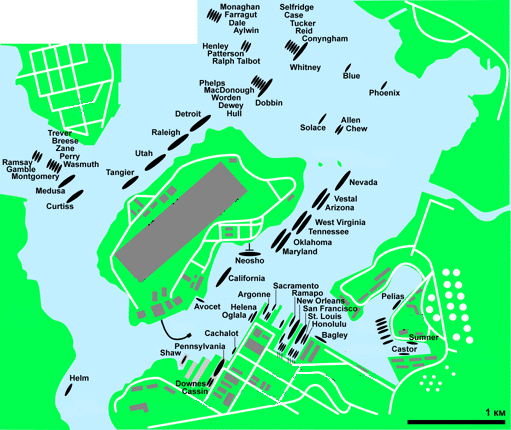
In Pearl Harbor on December 7th were eight battleships: Nevada, Oklahoma, Pennsylvania, Arizona, Tennessee, California, West Virginia and Maryland. All of them were of First World War vintage, representatives of what was known as the Standard Type. These were ships commissioned between 1914 and 1923, all of broadly the same size, and the first ships designed for long-range combat using an all-or-nothing armor scheme. All had four turrets, and all but West Virginia and Maryland mounting 14” guns. (They had 16” guns instead.)
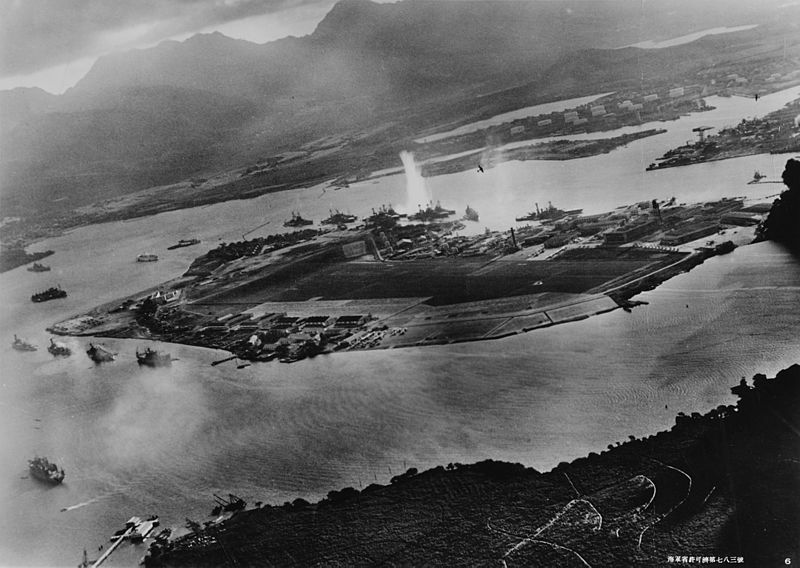
Pearl Harbour at the beginning of the attack, Battleship Row at the top (the waterspout is the first torpedo hit on the USS West Virginia)
All of the ships except Pennsylvania (which was in drydock) were moored along Ford Island in the famous ‘battleship row’. I’m going to focus on the stories of the individual ships during the attack, moving north to south. The attack began at 0748 on Sunday, December 7th, and a total of 353 Japanese aircraft were involved, in two waves.
A map of Pearl Harbour before the attack
The second post in the series covered the salvage of the damaged US Navy battleships:
When we left Pearl Harbor, it was the evening of December 7th, and most of Battle Force was on the bottom of the harbor. But what happened to the ships afterwards? We’ll go through the ships in the order which they returned to service (if they did) and then look more broadly at the use of the survivors during the war.
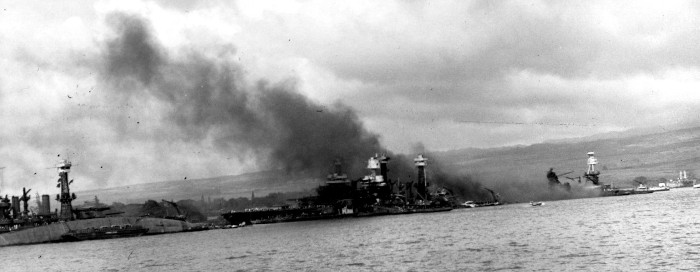
Battleship Row, 8 December 1941. Left-to-right: Maryland, Oklahoma, Tennesee, West Virginia, Arizona.
Maryland was the first ship ready to go to sea again, albeit with some damage. Tennessee was slightly behind her, as she was wedged by the West Virginia. Both ships were sent to Puget Sound at the end of the year, and repairs were completed in February. Pennsylvania was sent to San Francisco at the same time, returning to duty in March. All three ships (along with Colorado, New Mexico, Mississippi, and Idaho) served as part of TF 1, the backup to the carrier fleet until after Midway. Tennessee and Pennsylvania were sent to the states for comprehensive refit, running 8/42-5/43 and 10/42-2/43 respectively. Both received the standard upgrade, a reconstructed superstructure resembling those on the fast battleships (although there was less work done on Pennsylvania than the others), 5”/38 secondary guns in place of the former mixed secondary battery and upgraded fire control. Tennessee was also blistered against torpedoes, restricting her to the Pacific or a long journey around South America. Maryland was never refitted.
Part 3 discussed the Pearl Harbour survivors at the battle of Leyte Gulf:
The invasion began on Leyte Island in October of 1944, and triggered the largest naval battle in history, the battle of Leyte Gulf. The Japanese, who had long planned for the ‘Decisive Battle’ between their battleships and those of the US, planned a counterattack on the US landings in three main groups. Their carriers would come in from the north and draw off the US carriers covering the invasion, while two groups of battleships would sneak up on the invasion fleet from the east, passing through the Philippines and pincering the US transports from the north and south.
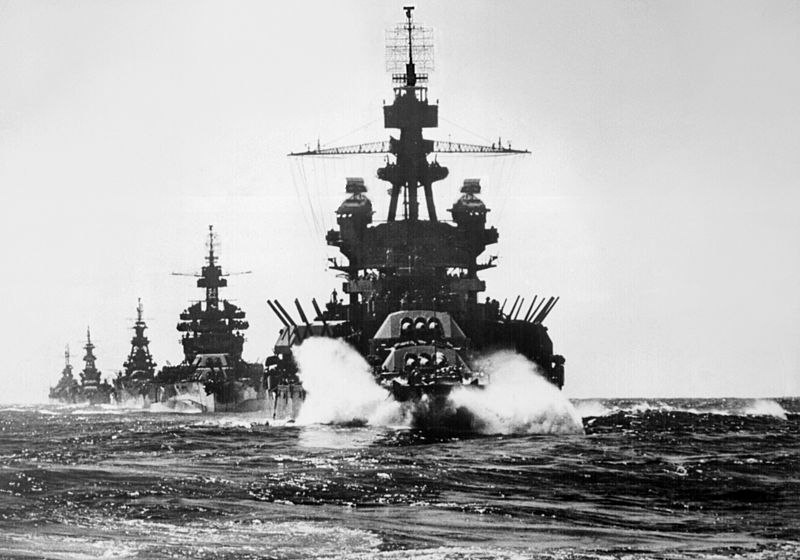
USS Pennsylvania leads a column of battleships into Lingayen Gulf.
The northern group (basically without planes after severe losses in June during the Battle of the Philippine Sea) managed to draw off Admiral Halsey. He’s often criticized for this, but in fairness, he was tasked with destroying the Japanese fleet, and the US didn’t realize how badly the carrier air groups had been hammered. The center group (with the faster battleships) had been detected, and appeared to have turned back after Musashi, Yamato’s sister ship, was sunk. They in fact resumed their course, and their encounter with escort carrier group Taffy 3 is the stuff of legend, but also a matter for another time.
Comments Off on The battleships of Pearl Harbour
October 5, 2017
Four Reasons Financial Intermediaries Fail
Marginal Revolution University
Published on 26 Jul 2016As we’ve discussed in previous videos, financial intermediaries bridge savers and borrowers. When these bridges crumble, the effects can be disastrous. For businesses, credit shortages can lead to bankruptcy, or layoffs. For individuals, they rely on credit to invest in education or a new home or car. These negative effects show you how crucial intermediaries are to our lives.
Still, what exactly causes failed intermediation? Four answers:
First, insecure property rights. Simply speaking, when you save money at a bank, you expect the ability to pull out your funds when needed. But what if your deposits are frozen? Or confiscated altogether? For instance, in 2013 amidst a financial crisis, the government in Cyprus confiscated bank deposits to help pay down the country’s budget shortfall. You can see how insecure property rights can scare away potential savers.
Second, controls on interest rates. Interest rates are the price of borrowing. Thus, controls on interest rates, often called usury laws, are effectively price ceilings—they set the interest rate lower than the market equilibrium interest rate. With this forced lowering of interest rates, borrowers will want to borrow more, but lenders won’t want to lend. The effect? A lending shortage.
Third, politicized lending. Banks profit by assessing risk, and then loaning, based on that assessment. Banks that excel at assessment succeed. Those poor at it die out. Problems arise when the government intervenes to prop up failing banks, resulting in what we call “zombie banks.” In such cases, intervention undercuts normal competition, and intervention tends to favor banks that are politically connected. In fact, it’s been shown that there’s an inverse correlation between government ownership in banks and a country’s GDP per capita and productivity growth.
Fourth, you have runs, panics, and scandals. Remember, trust is vital to the financial system. When trust erodes, depositors may rush to withdraw their money from banks, causing what is known as a “bank run.” This can cause banks to fail, as we saw during the Great Depression. Scandals can also depress market confidence. Enron, WorldCom and Bernie Madoff may come to mind.
So, which of these four factors contributed to the Great Recession of 2008?
We’ll discuss that in our next video.
Comments Off on Four Reasons Financial Intermediaries Fail
June 28, 2017
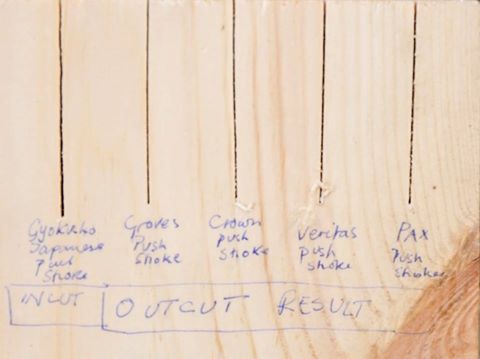
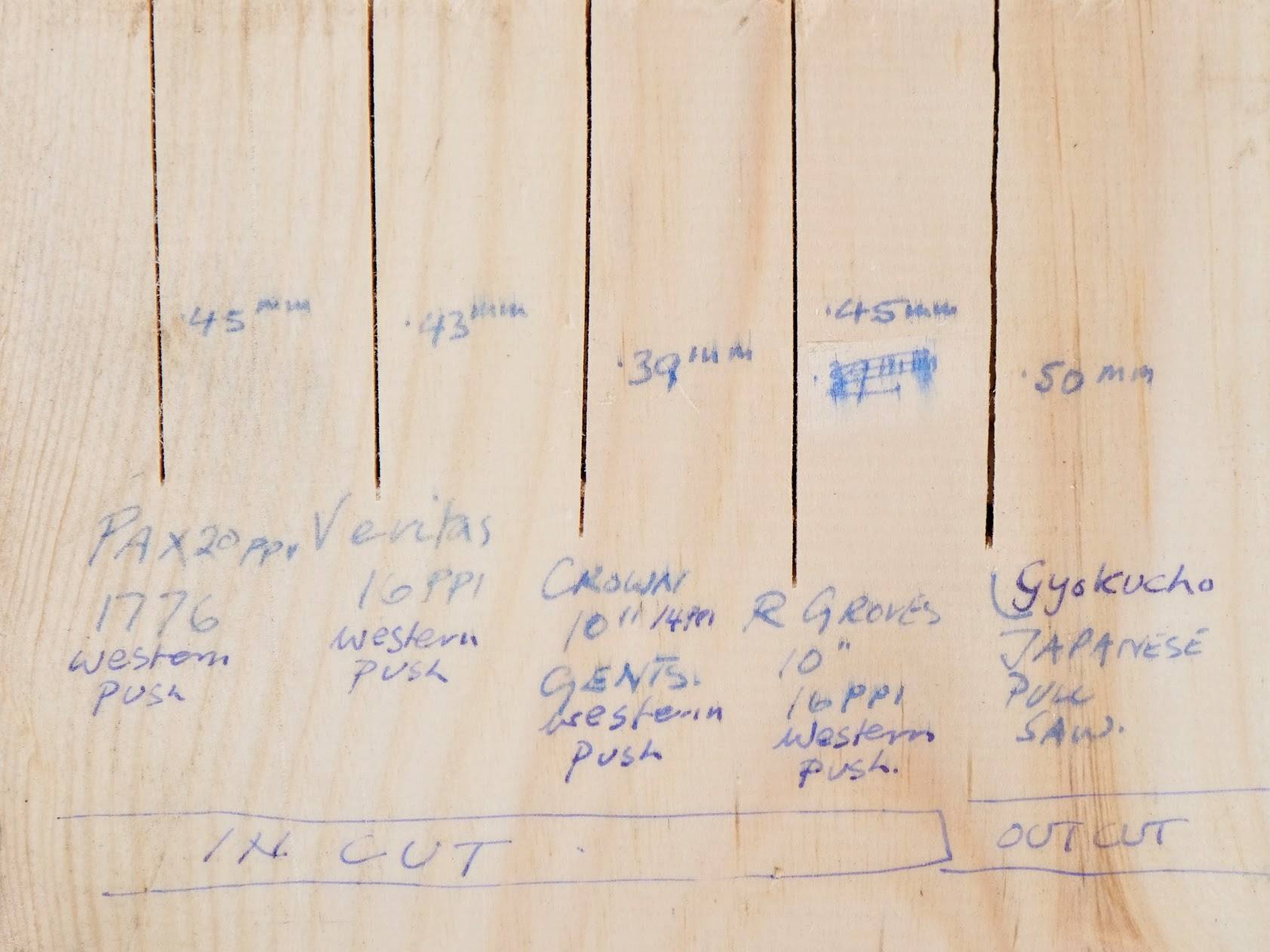
Handsaw comparison – Japanese pull-cut versus Western push-cut
On Facebook, Paul Sellers posted a couple of photos showing the differences between some traditional western hand saws, which cut on the push stroke, and traditional Japanese hand saws, which cut on the pull stroke:
When you hear people say Japanese saws cut better, cut cleaner, cut faster, cut easier, usually it’s not necessarily true. In reality the Japanese saws cut on a pull stroke and the western saw on a push. When sharpened properly both cut very well. The difference for me is that one is a throwaway, the other a keeper for a lifetime. I own saws made in England and the USA that are totally functional and range in age from between the early 1800s 1860s and some up to date that I use daily. You can make any saw any thickness you like and it will work well.
Just saying.The main difference nowadays is you throw away the Japanese saws because you can’t sharpen them whereas a decent western saw can be sharpened, well, for 200 years when you learn how. Most people can master saw sharpening with an hour of practice.
Comments Off on Handsaw comparison – Japanese pull-cut versus Western push-cut
June 25, 2017
Fort Drum – America’s concrete battleship
Published on 15 Sep 2016
After the United States acquired the Philippines from Spain, the U.S. Board of Fortifications recommended that important harbors be fortified. This led to the development of defenses on several islands at the mouth of Manila and Subic Bays. One of these was El Fraile Island which would later become Fort Drum, America’s concrete battleship.
Read more about America’s concrete battleship, Fort Drum, here: http://www.wearethemighty.com/articles/americas-concrete-battleship-defended-manila-bay-until-the-very-end
Comments Off on Fort Drum – America’s concrete battleship
June 4, 2017
The Battle of Midway, 4-7 June 1942
Last month, Victor Davis Hanson recounted the American side of the Battle of Midway, which many historians see as the turning point of the Pacific War:
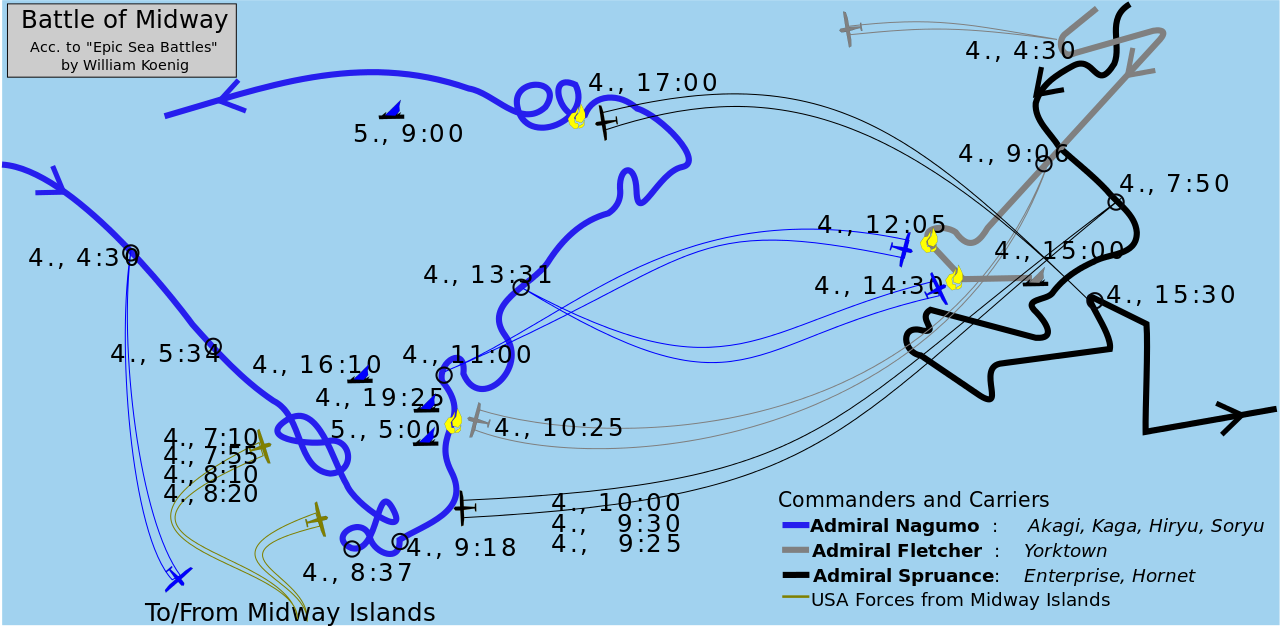
Battle of Midway deployment map, according to Seeschlachten der Weltgeschichte by William Koenig (German version of Epic Sea Battles) via Wikimedia
Seventy-five years ago (June 4-7, 1942), the astonishing American victory at the Battle of Midway changed the course of the Pacific War.
Just six months after the catastrophic Japanese surprise attack on Pearl Harbor, the U.S. crushed the Imperial Japanese Navy off Midway Island (about 1,300 miles northwest of Honolulu), sinking four of its aircraft carriers.
“Midway” referred to the small atoll roughly halfway between North America and Asia. But to Americans, “Midway” became a barometer of military progress. Just half a year after being surprised at Pearl Harbor, the U.S. Navy had already destroyed almost half of Japan’s existing carrier strength (after achieving a standoff at the Battle of the Coral Sea a month earlier).
The odds at the June 1942 battle favored the Japanese. The imperial fleet had four carriers to the Americans’ three, backed up by scores of battleships, cruisers and light carriers as part of the largest armada that had ever steamed from Japan.
No military had ever won more territory in six months than had Japan. Its Pacific Empire ranged from the Indian Ocean to the coast of the Aleutian Islands, and from the Russian-Manchurian border to Wake Island in the Pacific.
Yet the Japanese Navy was roundly defeated by an outnumbered and inexperienced American fleet at Midway. Why and how?
Comments Off on The Battle of Midway, 4-7 June 1942
Intro to the Solow Model of Economic Growth
Published on 28 Mar 2016
Here’s a quick growth conundrum, to get you thinking.
Consider two countries at the close of World War II — Germany and Japan. At that point, they’ve both suffered heavy population losses. Both countries have had their infrastructure devastated. So logically, the losing countries should’ve been in a post-war economic quagmire.
So why wasn’t that the case at all?
Following WWII, Germany and Japan were growing twice, sometimes three times, the rate of the winning countries, such as the United States.
Similarly, think of this quandary: in past videos, we explained to you that one of the keys to economic growth is a country’s institutions. With that in mind, think of China’s growth rate. China’s been growing at a breakneck pace — reported at 7 to 10% per year.
On the other hand, countries like the United States, Canada, and France have been growing at about 2% per year. Aside from their advantages in physical and human capital, there’s no question that the institutions in these countries are better than those in China.
So, just as we said about Germany and Japan — why the growth?
To answer that, we turn to today’s video on the Solow model of economic growth.
The Solow model was named after Robert Solow, the 1987 winner of the Nobel Prize in Economics. Among other things, the Solow model helps us understand the nuances and dynamics of growth. The model also lets us distinguish between two types of growth: catching up growth and cutting edge growth. As you’ll soon see, a country can grow much faster when it’s catching up, as opposed to when it’s already growing at the cutting edge.
That said, this video will allow you to see a simplified version of the model. It’ll describe growth as a function of a few specific variables: labor, education, physical capital, and ideas.
So watch this new installment, get your feet wet with the Solow model, and next time, we’ll drill down into one of its variables: physical capital.
Helpful links:
Puzzle of Growth: http://bit.ly/1T5yq18
Importance of Institutions: http://bit.ly/25kbzne
Rise and Fall of the Chinese Economy: http://bit.ly/1SfRpDL
Comments Off on Intro to the Solow Model of Economic Growth
May 23, 2017
The Ally From The Far East – Japan in World War 1 I THE GREAT WAR Special
Published on 22 May 2017
Japan’s participation in World War 1 is an often overlooked part of their history – even in Japan itself. Their service as one of the members of the Entente marked the climax of a development that started with the Meiji Restoration, a way out of isolation and into the global alliance system. This brought Japan more power and was also very lucrative. And after fighting in the Pacific Theatre of World War 1, the Siege of Tsingtao and contributing the Japanese Navy to the war effort, Japan had a seat at the table of the Versailles peace negotiations.
Comments Off on The Ally From The Far East – Japan in World War 1 I THE GREAT WAR Special
April 24, 2017
Growth Miracles and Growth Disasters
Published on 26 Jan 2016
In previous videos, you learned two things.
First, that there can be large disparities in economic wealth among different countries. And second, you learned that one key factor drives that disparity: growth rate. As we said, it changes everything. But just how transformative is a country’s growth rate?
Take Argentina, for example.
In 1950, the Argentine standard of living was similar to that of many Western European countries. Up until 1965, Argentina’s per capita income was ahead of many of its neighbors.
On the other hand, Japan in 1950 was on the other end of the spectrum. Japan had been ravaged by war and was only just beginning to find its economic footing again. At that time, Japan’s standard of living was roughly the same as that of Mexico.
It was quite poor, compared to the Argentina of the same era.
But look at what’s happened in the past 65 years.
Japan today is one of the world’s most prosperous countries. Since 1950, it has managed to double its living standards about every eight years. Argentina, on the other hand, has stagnated. Once, Argentina had double the standard of living of Japan. But Japan now doubles them today, with a standard of living 10 times higher than the one it had in 1950.
In economic terms, Japan is what we would call a growth miracle. It’s in the same class as other growth success stories, like South Korea and China which have experienced the “hockey stick” of prosperity. (India seems like it may have started on this path as well.)
These countries are proof of one thing: with the right factors, a poor country can not only grow, but it can do so quickly. It can catch up with developed countries at an astonishing rate.
What took the United States two centuries of steady growth can now be achieved by other countries in about one-fifth the time. Catch-up can happen in 40 years — about the span of a generation or two.
That’s the good news.
The bad news is, while growth can skyrocket in some countries, growth isn’t guaranteed at all.
Argentina is an example of this. It grew well for a time, and then it stalled. Even worse than Argentina, are countries like Niger, and Chad, which are the very worst of growth disasters. Not only are these countries in extreme poverty, but they also have little to no growth. More than that, these countries have never experienced substantial growth in the past.
But why does that all matter?
It matters because growth isn’t just about numbers. It’s not just about more goods and services. When a country grows, its citizens often end up with longer, healthier, and happier lives. Conversely, the countries that are growth disasters have citizens in poverty, with shorter and less happier lives.
As bleak as this seems, it’s the plain truth: while growth miracles are possible, growth disasters are, too.
Which leaves us with another question: what causes either state?
What leads to growth, prosperity, health, and happiness? And then, what leads to the opposite situation?
We’re excited to share the answer, but that’s a topic for future videos.
For now, check out this video to get up to speed on growth miracles and growth disasters.
Comments Off on Growth Miracles and Growth Disasters


