
Extra Credits
Published on 5 Aug 2017A humble signal station manned by only twenty one Sikh soldiers of the British Empire finds itself beset by 10,000 attackers. There is no hope for relief, but even knowing it will come at the cost of their lives, the Sikhs refuse to stand down.
Twenty one men in the 36th Sikh Regiment stand against thousands of attackers, prepared to make their final stand.
June 26, 2018
Saragarhi – The Last Stand – Extra History
Comments Off on Saragarhi – The Last Stand – Extra History
June 25, 2018
QotD: Gandhi and the British army
The film, moreover, does not give the slightest hint as to Gandhi’s attitude toward blacks, and the viewers of Gandhi would naturally suppose that, since the future Great Soul opposed South African discrimination against Indians, he would also oppose South African discrimination against black people. But this is not so. While Gandhi, in South Africa, fought furiously to have Indians recognized as loyal subjects of the British empire, and to have them enjoy the full rights of Englishmen, he had no concern for blacks whatever. In fact, during one of the “Kaffir Wars” he volunteered to organize a brigade of Indians to put down a Zulu rising, and was decorated himself for valor under fire.
For, yes, Gandhi (Sergeant-Major Gandhi) was awarded Victoria’s coveted War Medal. Throughout most of his life Gandhi had the most inordinate admiration for British soldiers, their sense of duty, their discipline and stoicism in defeat (a trait he emulated himself). He marveled that they retreated with heads high, like victors. There was even a time in his life when Gandhi, hardly to be distinguished from Kipling’s Gunga Din, wanted nothing so much as to be a Soldier of the Queen. Since this is not in keeping with the “spirit” of Gandhi, as decided by Pandit Nehru and Indira Gandhi, it is naturally omitted from the movie.
Richard Grenier, “The Gandhi Nobody Knows”, Commentary, 1983-03-01.
Comments Off on QotD: Gandhi and the British army
June 11, 2018
QotD: Gandhi as filmic hagiography
Gandhi, therefore, the film, this paid political advertisement for the government of India, is organized around three axes: (1) Anti-racism — all men are equal regardless of race, color, creed, etc.; (2) anti-colonialism, which in present terms translates as support for the Third World, including, most eminently, India; (3) nonviolence, presented as an absolutist pacifism. There are other, secondary precepts and subheadings. Gandhi is portrayed as the quintessence of tolerance (“I am a Hindu and a Muslim and a Christian and a Jew”), of basic friendliness to Britain (“The British have been with us for a long time and when they leave we want them to leave as friends”), of devotion to his wife and family. His vow of chastity is represented as something selfless and holy, rather like the celibacy of the Catholic clergy. But, above all, Gandhi’s life and teachings are presented as having great import for us today. We must learn from Gandhi.
I propose to demonstrate that the film grotesquely distorts both Gandhi’s life and character to the point that it is nothing more than a pious fraud, and a fraud of the most egregious kind. Hackneyed Indian falsehoods such as that “the British keep trying to break India up” (as if Britain didn’t give India a unity it had never enjoyed in history), or that the British created Indian poverty (a poverty which had not only existed since time immemorial but had been considered holy), almost pass unnoticed in the tide of adulation for our fictional saint. Gandhi, admittedly, being a devout Hindu, was far more self-contradictory than most public men. Sanskrit scholars tell me that flat self-contradiction is even considered an element of “Sanskrit rhetoric.” Perhaps it is thought to show profundity.
Richard Grenier, “The Gandhi Nobody Knows”, Commentary, 1983-03-01.
Comments Off on QotD: Gandhi as filmic hagiography
May 29, 2018
QotD: Gandhi on the Holocaust
I am aware that for many not privileged to have visited the former British Raj, the names Gujarat, Rajasthan, and Deccan are simply words. But other names, such as Germany, Poland, Czechoslovakia, somehow have a harder profile. The term “Jew,” also, has a reasonably hard profile, and I feel all Jews sitting emotionally at the movie Gandhi should be apprised of the advice that the Mahatma offered their coreligionists when faced with the Nazi peril: they should commit collective suicide. If only the Jews of Germany had the good sense to offer their throats willingly to the Nazi butchers’ knives and throw themselves into the sea from cliffs they would arouse world public opinion, Gandhi was convinced, and their moral triumph would be remembered for “ages to come.” If they would only pray for Hitler (as their throats were cut, presumably), they would leave a “rich heritage to mankind.” Although Gandhi had known Jews from his earliest days in South Africa — where his three staunchest white supporters were Jews, every one — he disapproved of how rarely they loved their enemies. And he never repented of his recommendation of collective suicide. Even after the war, when the full extent of the Holocaust was revealed, Gandhi told Louis Fischer, one of his biographers, that the Jews died anyway, didn’t they? They might as well have died significantly.
Richard Grenier, “The Gandhi Nobody Knows”, Commentary, 1983-03-01.
Comments Off on QotD: Gandhi on the Holocaust
May 22, 2018
Feature History – Opium Wars
Feature History
Published on 19 Oct 2016Welcome to Feature History, featuring the Opium Wars, western imperialism, and this fancy new intro and vignette.
The super sexy stuff like animation, voice, and script are all by the super sexy me.
The music is Anamalie and Clash Defiant, both by Kevin MacLeod
Twitter: https://twitter.com/Feature_History
Comments Off on Feature History – Opium Wars
May 15, 2018
QotD: The making of Gandhi
As it happens, the government of India openly admits to having provided one-third of the financing of Gandhi out of state funds, straight out of the national treasury — and after close study of the finished product I would not be a bit surprised to hear that it was 100 percent. If Pandit Nehru is portrayed flatteringly in the film, one must remember that Nehru himself took part in the initial story conferences (he originally wanted Gandhi to be played by Alec Guinness) and that his daughter Indira Gandhi is, after all, Prime Minister of India (though no relation to Mohandas Gandhi). The screenplay was checked and rechecked by Indian officials at every stage, often by the Prime Minister herself, with close consultations on plot and even casting. If the movie contains a particularly poisonous portrait of Mohammed Ali Jinnah, the founder of Pakistan, the Indian reply, I suppose, would be that if the Pakistanis want an attractive portrayal of Jinnah let them pay for their own movie. A friend of mine, highly sophisticated in political matters but innocent about film-making, declared that Gandhi should be preceded by the legend: The following film is a paid political advertisement by the government of India.
Gandhi, then, is a large, pious, historical morality tale centered on a saintly, sanitized Mahatma Gandhi cleansed of anything too embarrassingly Hindu (the word “caste” is not mentioned from one end of the film to the other) and, indeed, of most of the rest of Gandhi’s life, much of which would drastically diminish his saintliness in Western eyes. There is little to indicate that the India of today has followed Gandhi’s precepts in almost nothing. There is little, in fact, to indicate that India is even India. The spectator realizes the scene is the Indian subcontinent because there are thousands of extras dressed in dhotis and saris. The characters go about talking in these quaint Peter Sellers accents. We have occasional shots of India’s holy poverty, holy hovels, some landscapes, many of them photographed quite beautifully, for those who like travelogues. We have a character called Lord Mountbatten (India’s last Viceroy); a composite American journalist (assembled from Vincent Sheehan, William L. Shirer, Louis Fischer, and straight fiction); a character called simply “Viceroy” (presumably another composite); an assemblage of Gandhi’s Indian followers under the name of one of them (Patel); and of course Nehru.
I sorely missed the fabulous Annie Besant, that English clergyman’s wife, turned atheist, turned Theo-sophist, turned Indian nationalist, who actually became president of the Indian National Congress and had a terrific falling out with Gandhi, becoming his fierce opponent. And if the producers felt they had to work in a cameo role for an American star to add to the film’s appeal in the United States, it is positively embarrassing that they should have brought in the photographer Margaret Bourke-White, a person of no importance whatever in Gandhi’s life and a role Candice Bergen plays with a repellant unctuousness. If the film-makers had been interested in drama and not hagiography, it is hard to see how they could have resisted the awesome confrontation between Gandhi and, yes, Margaret Sanger. For the two did meet. Now there was a meeting of East and West, and may the better person win! (She did. Margaret Sanger argued her views on birth control with such vigor that Gandhi had a nervous breakdown.)
I cannot honestly say I had any reasonable expectation that the film would show scenes of Gandhi’s pretty teenage girl followers fighting “hysterically” (the word was used) for the honor of sleeping naked with the Mahatma and cuddling the nude septuagenarian in their arms. (Gandhi was “testing” his vow of chastity in order to gain moral strength for his mighty struggle with Jinnah.) When told there was a man named Freud who said that, despite his declared intention, Gandhi might actually be enjoying the caresses of the naked girls, Gandhi continued, unperturbed. Nor, frankly, did I expect to see Gandhi giving daily enemas to all the young girls in his ashrams (his daily greeting was, “Have you had a good bowel movement this morning, sisters?”), nor see the girls giving him his daily enema. Although Gandhi seems to have written less about home rule for India than he did about enemas, and excrement, and latrine cleaning (“The bathroom is a temple. It should be so clean and inviting that anyone would enjoy eating there”), I confess such scenes might pose problems for a Western director.
Richard Grenier, “The Gandhi Nobody Knows”, Commentary, 1983-03-01.
Comments Off on QotD: The making of Gandhi
May 1, 2018
Sikh separatists (and even terrorists) are being protected by the federal government
There’s no reason that Canadian Sikhs can’t agitate for their fellow Sikhs in India to create a separate country in the Punjab, but that freedom must not include active support for terrorists. The Canadian government is looking particularly bad on this front, and it isn’t just because of Justin Trudeau’s farcical adventures on his recent trip to India. None of the major federal parties want to appear to be anti-Sikh, as Sikh voters cluster in several key swing ridings around the country, and any criticism of the terrorists is spun as an attack on all Sikhs. At Quillette Terry Milewski details the government’s unwillingness to deal with the problem:
The Sikh faith, created in what is now northern India by the 15th-century Guru Nanak, remains obscure to many in the West. Turbaned Sikh men are sometimes confused with Muslims, and some have been assaulted by confused thugs following Islamist terrorist attacks. Like the United States, Britain and other Western countries, Canada has been home to emigrant Sikhs for generations—the vast majority of them living peaceably in their adopted homeland.
In the 1980s, however, a powerful spasm of separatist militancy shook India and spread to the Sikh diaspora. In June, 1984, two months before the Madison Square Garden convention, Prime Minister Gandhi and her government set out to end a killing spree by Sikh militants who had turned the Sikhs’ holiest site — the Golden Temple at Amritsar — into an armed camp. The Indian army wrecked the temple complex and took many lives. Revenge came on October 31, 1984, when Gandhi was gunned down in her garden by two of her Sikh bodyguards. Hindu mobs immediately took revenge for the revenge, slaughtering thousands of Sikhs in hellish reprisals that were aggravated by official complicity. The police looked the other way. The horrors of 1984 won’t be forgotten by either side.
Soon, Canada and its Sikh community were dragged into the thick of the struggle. In June of 1985, Parmar’s Babbar Khalsa placed suitcase bombs on two planes leaving Vancouver. One brought down Flight 182, a massacre that remained, until 9/11, the deadliest terrorist attack in the history of aviation. The second bomb, intended to destroy another Air India plane simultaneously, exploded on the ground at Narita Airport in Japan, killing two baggage handlers. The reverberations from the attack were so profound in Canada that even today, 33 years later, a striking emblem of the Khalistani dream survives: a large “martyr” poster honouring Talwinder Parmar, sword in hand, permanently fixed to the exterior of an important Sikh gurdwara in Surrey, British Columbia. Tens of thousands gather beneath it each spring for an annual Sikh parade. In American terms, the poster is equivalent to a public veneration of Osama Bin Laden.
[…]
Today, the parents who lost their children [on Air India Flight 182] are old, the orphaned children have their own children and the Sikh struggle for independence is moribund in India. Last year, in fact, Sikh voters overwhelmingly supported a united India and were key to the election of the Congress Party — the party of Indira Gandhi — to govern the Sikh homeland of Punjab. Support for Congress was especially strong in majority-Sikh districts. And Punjab’s Chief Minister is a strongly pro-unity Sikh, Amarinder Singh, who has alleged separatist influence in the Canadian government.
Harjit Sajjan, a Sikh who is Canada’s Minister of National Defence, firmly denied the claim. And on Justin Trudeau’s visit to India this year, Singh agreed to a photo-op including Sajjan. But the Chief Minister let it be known that he’d handed over a list of Canadians he suspects of fundraising for Punjab’s few remaining separatist Sikh militants.
The listed suspects amount to a tiny subculture among Canada’s 450,000 Sikhs, the vast bulk of whom seek no return to the bloody 1980s and 1990s, when the battle for Khalistan took some 20,000 lives in India, most of them Sikh. But the hardliners are a well-organized political force, still raising the cry of “Khalistan Zindabad!” — long live Khalistan — in some Canadian gurdwaras where “martyred” Sikh assassins are memorialized as models for the young. These include the two bodyguards who machine-gunned Indira Gandhi. Khalistani fervour is alive on social media and a 2018 tweet from “George” (@PCPO_Brampton) declared: “Indira’s assassins are HEROES. Sikhs should glorify them.”
The endurance of such attitudes in Canada reflects the weak record of its justice system in deterring violence. For years, it seemed, Canadian courts were where terrorism cases went to die.
Comments Off on Sikh separatists (and even terrorists) are being protected by the federal government
April 30, 2018
QotD: Gandhi versus Gandhi
I had the singular honor of attending an early private screening of Gandhi with an audience of invited guests from the National Council of Churches. At the end of the three-hour movie there was hardly, as they say, a dry eye in the house. When the lights came up I fell into conversation with a young woman who observed, reverently, that Gandhi’s last words were “Oh, God,” causing me to remark regretfully that the real Gandhi had not spoken in English, but had cried, Hai Rama! (“Oh, Rama”). Well, Rama was just Indian for God, she replied, at which I felt compelled to explain that, alas, Rama, collectively with his three half-brothers, represented the seventh reincarnation of Vishnu. The young woman, who seemed to have been under the impression that Hinduism was Christianity under another name, sensed somehow that she had fallen on an uncongenial spirit, and the conversation ended.
At a dinner party shortly afterward, a friend of mine, who had visited India many times and even gone to the trouble of learning Hindi, objected strenuously that the picture of Gandhi that emerges in the movie is grossly inaccurate, omitting, as one of many examples, that when Gandhi’s wife lay dying of pneumonia and British doctors insisted that a shot of penicillin would save her, Gandhi refused to have this alien medicine injected in her body and simply let her die. (It must be noted that when Gandhi contracted malaria shortly afterward he accepted for himself the alien medicine quinine, and that when he had appendicitis he allowed British doctors to perform on him the alien outrage of an appendectomy.) All of this produced a wistful mooing from an editor of a major newspaper and a recalcitrant, “But still …” I would prefer to explicate things more substantial than a wistful mooing, but there is little doubt it meant the editor in question felt that even if the real Mohandas K. Gandhi had been different from the Gandhi of the movie it would have been nice if he had been like the movie-Gandhi, and that presenting him in this admittedly false manner was beautiful, stirring, and perhaps socially beneficial.
Richard Grenier, “The Gandhi Nobody Knows”, Commentary, 1983-03-01.
Comments Off on QotD: Gandhi versus Gandhi
April 13, 2018
India and the “Quad”
At Strategy Page, Austin Bay discusses India’s position, both geographically and militarily with respect to China:
As the Cold War faded, a cool aloofness continued to guide India’s defense and foreign policies. Indian military forces would occasionally exercise with Singaporean and Australian units — they’d been British colonies, too. Indian ultra-nationalists still rail about British colonialism, but the Aussies had fought shoulder to shoulder with Indians in North Africa, Italy, the Pacific and Southeast Asia, and suffered mistreatment by London toffs. Business deals with America and Japan? Sign the contracts. However, in defense agreements, New Delhi distanced itself from Washington and Tokyo.
The Nixon Administration’s decision to support Pakistan in the 1971 Indo-Pakistani War [Wikipedia link] embittered India. Other issues hampered the U.S.-India relationship. Indian left-wing parties insisted their country was a “Third World leader” and America was hegemonic, et cetera.
However, in the last 12 to 15 years, India’s assessments of its security threats have changed demonstrably, and China’s expanding power and demonstrated willingness to use that power to acquire influence and territory are by far the biggest factors affecting India’s shift.
In 2007, The Quad (Quadrilateral Security Dialogue), at the behest of Japan, held its first informal meeting. The Quad’s membership roll sends a diplomatic message: Japan, Australia, America and India. Japan pointed out all four nations regarded China as disruptive actor in the Indo-Pacific; they had common interests. Delhi downplayed the meeting, attempting to avoid the appearance of actively “countering China.”
No more. The Quad nations now conduct naval exercises and sometimes include a quint, Singapore.
The 2016 Hague Arbitration Court decision provided the clearest indication of Chinese strategic belligerence. In 2012, Beijing claimed 85 percent of the South China Sea’s 3.5 million square kilometers. The Philippines went to court. The Hague tribunal, relying on the UN Convention on the Law of the Sea treaty, supported the Filipino position that China had seized sea features and islets and stolen resources. Beijing ignored the verdict and still refuses to explain how its claims meet UNCLOS [Wikipedia link] requirements.
That is the maritime action. India and China also have mountain issues. In 1962, as the Cuban Missile Crisis diverted world attention, the two Asian giants fought the Indo-Chinese War [Wikipedia link] in the Himalayas. China won. The defeat still riles India.
Comments Off on India and the “Quad”
April 11, 2018
Mumbai’s high court demonstrates lack of economic knowledge in theatre ruling
Movie theatres and multiplexes generally charge more for the concessions than sometimes adjacent businesses in the same area, and also usually forbid patrons from bringing in their own food to consume on the premises. A recent case before the Bombay High Court argued that this was unfair to moviegoers and the court agreed:
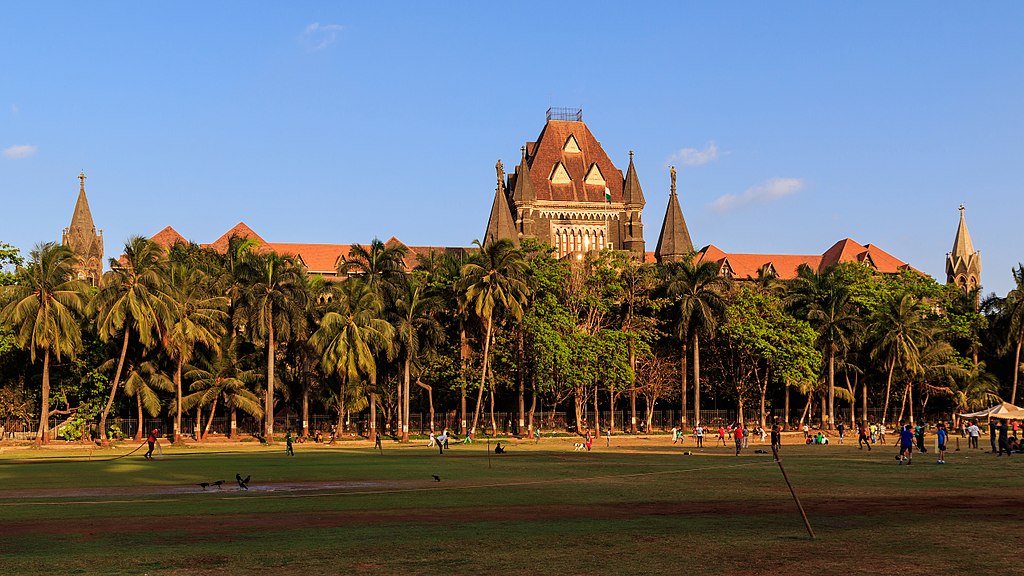
Bombay High Court in Mumbai
© A.Savin, Wikimedia Commons
This is an interesting little test of the judicial system – you know, those told that the Beatles were a popular beat combo – on the subject of property rights. The Bombay High Court has just failed this test too. The question is, multiplex cinemas, why is the food so expensive in them? The correct answer is because the owners of multiplex cinemas make a profit in that manner. According to the court this doesn’t wash. In fact, they seem not to have even considered the argument in that manner:
The Bombay High Court has ruled that food items and bottled water be sold at regular prices inside multiplexes. The directive was issued by a division bench of Justices S.M. Kemkar and M.S. Karnik last week in response to a Public Interest Litigation (PIL) filed by Mumbai resident Jainendra Baxi. He had challenged the prohibition on carrying outside food in movie theatres and multiplexes across Maharashtra.
The economics here is simple enough. The people who order food inside the cinema, at those higher prices, subsidise the others who only buy the ticket to see the movie. Sure, that’s not the first round outcome, but it is the competitive equilibrium. Cinema owners being able to profit from food makes the basic ticket cheaper.
The rights based part is also simple enough. I’m running a business, I can and should be able to decide how people access that business. If I’m running a restaurant I’m entirely at liberty to insist that you only get to consume things at my table that you’ve bought from me. Even if I show a film at the same time.
Another way to put this is that the judges have just failed Chesterton’s Fence. They’ve not grasped why the limitation is in place to start with, therefore they see nothing wrong in ridding everyone of the limitation. And the net effect of this is going to be higher multiplex cinema ticket prices for everyone in Maharashtra.
Comments Off on Mumbai’s high court demonstrates lack of economic knowledge in theatre ruling
March 11, 2018
Polls begin to reflect public disillusionment with Trudeau after gaffe-filled India trip
After all the PR blunders, it’s amazing that the Liberals are still riding as high in public opinion polls as they are:
By now it is clear the federal Liberals are in some difficulty with the public. Much excitement attended that Ipsos poll earlier this week showing them trailing the Conservatives for the first time, and by a not inconsequential margin: 38 to 33. But it’s not just Ipsos.
Forum Research, which gives the Tories a 12-point lead, may be an outlier, but Nanos’s latest four-week rolling poll shows the Liberal lead has shrunk to less than four points from eight points in December; Abacus Data, similarly, now has them just three points ahead, the narrowest margin they have found since the election.
Overall, the CBC’s Poll Tracker website now puts the two parties more or less level, based on a weighted average of the polls, at 36 per cent. Contrast that with the Liberals’ first year in office, when they maintained a lead of as much as 20 points, or even their second, when they led by eight to 10. Something is clearly up.
The reason is not hard to find, nor is it unusual: the prime minister’s personal approval rating has declined markedly. To be sure, he remains the Liberals’ chief asset: Nanos still shows 40 per cent of Canadians put Justin Trudeau as their preferred prime minister. Sixty per cent say he “has the qualities of a good political leader.”
[…]
The immediate explanation for the prime minister’s cratering appeal is the recent official visit to India, conceded on all sides to have been a disaster. There’s no doubt this has taken its toll — Ipsos finds more than twice as many Canadians of the view that the visit was “negative for Canada-India relations” than the contrary.
But if the India visit accelerated the decline, it is also true that the prime minister’s appeal has been fading for some time. The India trip may have crystallized certain perceptions of him, but the ingredients have been evident for a while. People do not form impressions of a leader’s character and abilities instantaneously, but only as the result of an accumulation of incidents and impressions.
The Tories’ pre-election attempts to discredit Trudeau as “just not ready” failed in the light of a long campaign in which he persuaded increasing numbers of Canadians that he was. I don’t imagine many would have said he was much of a deep thinker — his worst moments are almost always when he tries to pretend he is — but people gave him credit for sincerity, personal decency, idealism, and a native political ability that seemed to grow throughout the campaign.
But now? Asked to name the first quality that came to mind, I suspect increasing numbers might be more inclined to mention his cynicism.
Comments Off on Polls begin to reflect public disillusionment with Trudeau after gaffe-filled India trip
March 3, 2018
China’s growing presence in the Indian Ocean
At Strategy Page, a useful primer on recent Chinese moves to set up another facility in India’s sphere of influence, this time in the Maldives:

The Maldive Islands in relation to southern India and Sri Lanka
Image from Google Maps.
China and India are threatening each other over who should do what in Maldive Islands just south of India. This conflict heated up at the end of 2017 when China and the Maldives signed an agreement that allowed China to build and operate a “Joint Ocean Observation Station”. This monitoring station would be built on an atoll that is the closest part of the Maldives to India. Opposition politicians in the Maldives claim China has already taken possession of sixteen small islands and that China has been investing heavily in the Maldives economy and influential politicians.
This agreement was apparently obtained by Chinese bribes and assurances that there would be more Chinese investments. Meanwhile the Maldives government is in chaos over elected officials and the Supreme Court judges disagreeing about who should actually be in charge. The tiny (248 square kilometers spread over 1,192 coral atolls spread over 90,000 square kilometers of water off the southern coast of India) nation has a mostly Moslem (98 percent) population of 430,000 plus 100,000 foreign workers (a third of them illegals). Most of the population is concentrated on about 15 percent of the islands. The per capita income is about $10,000 and most of it is based on tourism followed by fishing. Many young men have been attracted to Islamic terrorism but there is not much religious violence in the Maldives. While a democracy the religious parties and military have kept the government in turmoil by asserting decidedly non-democratic powers.
Over the last decade India has become alarmed at growing Chinese investment in neighboring countries (like Sri Lanka, Maldives and Bangladesh). Chinese firms are more experienced and effective at arranging these foreign investments and India’s smaller neighbors feel more comfortable with investment from distant China rather than neighbor (and sometimes big bully) India. The Chinese economic investments often have military implications, like China building satellite ground stations in Sri Lanka, a major port in Pakistan and now an “Ocean Observation Station” in the Maldives.
China had earlier persuaded the Maldives to join its OBOR (One Belt, One Road) project. The Maldives would be part of the “maritime road” going from Chia, through the newly annexed South China Sea and into the Indian Ocean and sea routes to the Persian Gulf the Suez Canal and East Africa and beyond. The Maldives government has always been unstable and Islamic radicalism is still an issue there. Islamic terrorists were never able to establish themselves in the Maldives, although they tried. In 2007 three men were sentenced to 15 years in prison for carrying out a terror bombing attack three months earlier that wounded a dozen tourists. The Islamic radicals were intent on destroying the tourist industry, which is the main source of income in the Maldives, because they saw it as un-Islamic. Most people on the Maldives did not agree with that, and justice was swift. However, ten Islamic radicals responsible for planning the bombings fled the country the day before the attack and are being sought in Pakistan.
Comments Off on China’s growing presence in the Indian Ocean
March 2, 2018
Canada’s foreign policies, in the wake of recent Prime Ministerial mis-steps
Ted Campbell suggests that our current foreign policy goals have been seriously undermined by the — shall we say “disappointing” — outcomes of Prime Minister Trudeau’s Chinese and Indian trips:
[Former senior Canadian diplomat David] Mulroney begins by saying that: “The best that can be said about Prime Minister Justin Trudeau’s visit to India is that it may prompt a review, if not a complete rethinking of a Canadian foreign policy that appears to be seriously off the rails. We have some hard lessons to learn … [and] … At the very least, the Prime Minister’s debacle in India should encourage smart people in Ottawa to zero in on what isn’t working.” That’s good thinking. At the end of every major campaign, an especially after campaigns in which things go awry, good military commanders convene a board of senior officers to consider “lessons learned,” in the hope that they will not make the same mistakes next time. sadly, especially today, the lessons learned are all too quickly forgotten even if the analysis was rigorous enough in the first place.
“Most worrying,” David Mulroney says, “is a fundamental and puzzling failure at the level of policy implementation, something that appears to be compounded by the Prime Minister’s own impetuosity. Flying to India before the big meeting with Prime Minister Narendra Modi was in the bag, much like heading off to Beijing on a free-trade themed visit without any reasonable expectation that a deal was doable, exposes Mr. Trudeau to a degree of prolonged public skepticism that comes to define the visit itself.” In other words: Justin Trudeau goes off “half cocked” as we soldier say … not ready for action. That is, I suspect, in part because his team in the Prime Minister’s Office (PMO), was brilliant on the campaign trail in 2015 but is really unqualified to advice the leader of the government of the G7 nation; that poor quality of policy advice matters because Justin Trudeau was, and still is, to be sure, “just not ready” for the job he was handed. But his
officecampaign team wants to get and keep him in the public eye because that’s part of the 2019 campaign strategy … this time it failed because they really didn’t understand the business at hand.[…]
But India is not just any country, as Mr Mulroney explains: “India isn’t our friend. It is a rising regional power beset with a range of domestic problems, including serious human rights issues. It takes a prickly approach to global issues that is often at odds with traditional Canadian policies in areas ranging from trade policy to nuclear disarmament … [and, he says] … The Indian diplomats I worked with could be wonderfully pleasant after the official day was done. But, for the most part, they brought a formidably ruthless precision to their pursuit of India’s interests in the world. While they might ultimately agree to grant Canada a concession, this was always a product of hard and often heated negotiations. They never conceded a point because they liked us or because we are home to a large Indo-Canadian community.” Further, he adds that “My experience with Chinese diplomats was entirely similar.” Although never at the same level as Mr Mulroney, I worked in the international arena as a senior officer, especially in one sector (global radio-communications which included arranging for the expansion of mobile communications in the 1990s. My Chinese and Indian colleagues were, indeed, fine men and women but they, just like me, were there ~ Geneva, a lot, but everywhere from Washington, London, Canberra and Tokyo to Beijing ~ defending their interests. “friendship,” even long standing alliances didn’t count for anything. Billions of dollars were at stake, profits and losses would hinge on how we ~ engineers and lawyers and businessmen and soldiers from dozens of countries ~ managed to slice up the radio spectrum to allow these new services to thrive. The Chinese and Indian delegates were just as professional, just as technically qualified, just as hard nosed as the Americans, Brits and Canadians.
“Long before the election of U.S. President Donald Trump,” David Mulroney says, “it should have been clear to us that the world is changing in ways that do not align with traditional Canadian views, interests and values. If we’re smart, the rise of countries like China and India can certainly contribute to our prosperity, and with hard work, we should be able to find common cause on important issues such as global warming … [but, he adds] … the rise of these assertive and ambitious Asian powers will almost certainly challenge global and regional security. Both will also continue to reject traditional Canadian notions about global governance and human rights, and neither will be particularly squeamish about interfering in Canadian affairs.” Sunny ways, feminism and being green don’t count for much; they are very certainly not a sound foundation upon which to build a foreign policy. We have to start thinking about our vital interests in the world ~ about what they are and about how we can and will protect and promote them: that’s the basis of a grand strategy. It was also the kind of thinking that Stephen Harper hated: he wanted to deal with issues incrementally, linking them together, sometimes, into a coherent web but never allowing them to become too important in and of themselves. That was bad enough but I’m persuaded that Justin Trudeau doesn’t think about those “big ideas” at all … because, I fear, they are, simply, quite beyond his comprehension.
Comments Off on Canada’s foreign policies, in the wake of recent Prime Ministerial mis-steps
February 26, 2018
India’s largest newspaper on Justin Trudeau’s “disaster visit”
Paul Wells linked to this story in the world’s largest circulation English language newspaper, The Times of India:
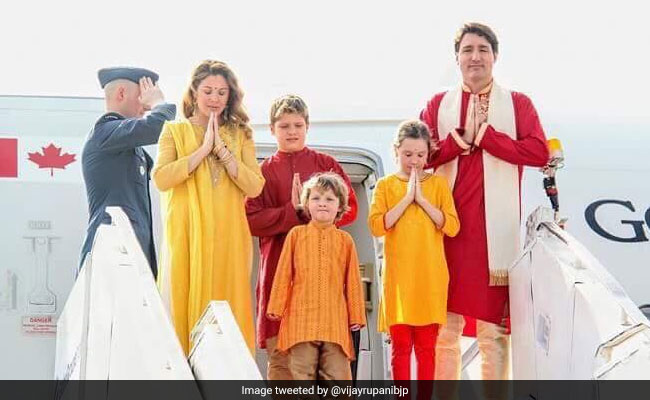
Justin Trudeau and family during India visit
Image via NDTV, originally tweeted by @vijayrupanibjp
Canadian prime minister Justin Trudeau’s visit was a disaster that has little parallel in India’s recent diplomatic history. But as the Canadian prime minister returned home on Saturday after almost a week of recurrent diplomatic missteps, ironically, it may have provided the opportunity to reset relations between Canada and India.
On Saturday, Indian government officials were angry at suggestions by Canadian officials that India was responsible for Khalistani terrorist Jaspal Atwal getting a visa to India and used his presence to embarrass Trudeau.
Trudeau, in his meeting with prime minister Narendra Modi, also complained that his visit had been shadowed by a single issue. Atwal got a visa because he was taken off the blacklist some years ago. But he was part of a number of Trudeau’s own events that did not involve the Indian government at all.
A prime ministerial visit to a foreign country for a week with a thin official component is always fraught with danger. In addition, moving the official meetings to the very end of the trip indicated that the government meetings were an after-thought. Most foreign leaders who throw in other events almost always front-load the official meetings, and then go on to business or tourism events.
Here, it was clear from the start that Trudeau came to India to score with his Sikh constituency back home — four out of the six cabinet ministers who travelled with him were Sikh, as were an overwhelming number of MPs who also travelled with him. Until the media barrage in India forced the Canadian side to change tack, Trudeau was not even ready to meet Amarinder Singh, chief minister of Punjab. Even the Canadian high commissioner’s official reception was a celebration of Punjab with the prime minister himself waltzing in on bhangra beats.
Comments Off on India’s largest newspaper on Justin Trudeau’s “disaster visit”
February 23, 2018
“…the Trudeaus playing ‘Mr Dressup and Family’ in exotic locations on the taxpayers’ dime isn’t the problem”
The press is having a hard time presenting Justin Trudeau’s India trip in a positive light, which clearly pains the teeny-bopper Trudeau fan club that composes a large part of the Canadian media. Ted Campbell sees the trip as a series of wasted opportunities to begin healing the breach between India and Canada:
I’ve taken my time in commenting on the prime minister’s trip to India. To say that I’m very disappointed is to put it mildly … I’m disappointed and a little embarrassed to be a Canadian. But the Trudeaus playing “Mr Dressup and Family” in exotic locations on the taxpayers’ dime isn’t the problem. We have, in fact, a serious problem as far as India is concerned and we, Canada, one of India’s oldest and firmest friends is in danger of being seen as an adversary. That’s a problem and it is, in my mind, a HUGE problem for Canada.
As Vishnu Prakash, former Indian envoy to Canada, told Indian news site The Print on Monday, ““Over the years, the Canadian political establishment, across the spectrum (whether it is the NDP, Conservatives or Liberals) has been mollycoddling Khalistani elements. Under the Trudeau government, this has increased. He had himself appeared on a Khalistani platform in Toronto in April last year.” It, the “mollycoddling Khalistani elements,” has been going on since at least the 1980s, back when Indira Ghandi’s government cracked down (1984) and nearly provoked a civil war and even in 1985 when Air India flight 182 was bombed, almost certainly an attack organized by Canadians, in Canada, as retaliation. Then the governments of the day spent 20 years and over $100 million on an investigation that retired Supreme Court Justice John Major described as a “cascading series of errors” by the government, writ large, including, especially, the RCMP and CSIS. India was not impressed.
India was less impressed when Canadian political parties began to actively court the Canadian the entire Indo-Canadian community but failed to condemn Sikh separatism. Canadians, including Brian Mulroney, Jean Chrétien, Stephen Harper and Justin Trudeau have “explained,” correctly, that people are allowed to support unpopular causes here in Canada, so long as they don’t break our laws, but India, not unreasonably, given Canada’s own history of separatist violence, would like something more. But the Sikh vote is active and “efficient” and all parties want it and that seems, to India, anyway, to mean turning a blind eye to the (disputed)
factassertion that the Khalistan independence movement is centred in and funded from Canada … Prime Minister Trudeau made thing worse, according to The Hindu, when “On April 30, [2017] Mr. Trudeau addressed a parade for ‘Khalsa Day’, which included floats glorifying Sikh militant leaders Jarnail Singh Bhindranwale, Amreek Singh and former General Shahbeg Singh who were killed in the siege of the Golden Temple and Operation Bluestar in June 1984.” That act appears to have crossed a line, leading to what the whole world is now interpreting as a major diplomatic snub […]The big issue is not the rather gentlemanly snub of Justin Trudeau by India’s highest officials; our prime minister appears more interested in having an all expenses paid vacation with his family than in doing the nation’s business in any event; the real issue is the Canadian political actions that made it politically necessary for Prime Minister Modi to administer that snub at all.
What Canada needs to do now is repair relations with India, and that may require Prime Minister Trudeau to look very, very closely at any ties any of his ministers may have with the Khalistan independence movement, he says there are none, and either making them sever all ties with separatists or severing them from the Liberal cabinet, caucus and even the Party. Andrew Scheer needs to do the same with the Conservatives and Jagmeet Singh needs to speak out for national unity ~ if it’s good for Canada then it’s good for India, too. On this issue, at least, politics should indeed, stop at the water’s edge.
Of course, when you allow things like this to happen, diplomacy becomes a much trickier profession than normal:
Sweet Mother of God. No family fashion photoshoot in Hello! magazine is going to fix this one. https://t.co/rLvI7ip8Vh
— Terry Glavin (@TerryGlavin) February 21, 2018
In Britain, the Daily Mail published the comments from a lot of Indians who have been offended by Trudeau’s choices of clothing on the visit so far:
Justin Trudeau has been ridiculed on social media by Indians for his ‘tacky’ and over the top outfit choices while on his first visit to their nation as Prime Minister.
While many praised his clothing during the first two days of his trip, patience was wearing thin by the time he attended a Bollywood gala on Tuesday night, before the tide turned against him on Wednesday.
Ministers, authors, journalists and ordinary Indians lined up to mock him on Wednesday, saying his wardrobe was ‘fake and annoying’.
Perhaps taking note of the criticism, the Canadian leader donned a suit on Thursday as he visited Jama Masjid, one of India’s largest mosques.
Leading the criticism was Omar Abdullah, former chief minister of Jammu and Kashmir, who tweeted on Wednesday saying Trudeau’s preening was ‘all just a bit much.’
‘We Indians do not dress like this every day sir, not even in Bollywood.’
Bhaavna Arora, a bestselling Indian author, also chimed in, accusing Trudeau of wearing ‘fancy dress’ and saying she found it ‘fake and annoying’.
Shekhar Gupta, founder of Indian newspaper The Print also mocked the Canadian Prime Minister, accusing him of ‘running a week-long “election campaign” in India in fancy dress.’
Comments Off on “…the Trudeaus playing ‘Mr Dressup and Family’ in exotic locations on the taxpayers’ dime isn’t the problem”


