Quotulatiousness

September 3, 2013

The market for civilian armoured vehicles

Filed under: Americas — Tags: , , , , — Nicholas @ 08:33

Strategy Page on the growing demand in some areas of the world for protected civilian vehicles:

Since September 11, 2001 there has been a sharp increase in the use of such bullet proof automobiles. The wealthy are buying most of them, but government has become a major customer as well, accounting for about a third of sales. The biggest markets are those suffering from lots of kidnapping and seemingly random violence. Mexico, Colombia and many Middle Eastern countries are the main markets for these expensive vehicles.

[…]

Because of the cartel wars in Mexico, over 2,500 armored sedans, SUVs and light trucks are now produced each year in Mexico alone. The violence down there has been horrendous. The government believes about a thousand people a month are dying from drug cartel related violence. This puts Mexico ahead of the recently increased terrorist violence in Iraq and where Syria was earlier this year. Some 70,000 have died in the Mexican cartel war since 2007, compared to over 100,000 in two years of Syrian violence and 120,000 Iraqi dead in a decade of religious violence. Since the 1970s there have been similar internal conflicts in Algeria, Egypt, Lebanon and Turkey. Mexico is a bit of Middle East style civil violence in North America. This is not the first time the Americas have suffered this. Leftist and drug gang violence in Colombia have left over 220,000 dead in the last 60 years. That’s for a country with only about 40 percent as many people as Mexico. This war in Colombia in finally winding down, but is shows you how long and bloody such conflicts can be. Some 20,800 people have disappeared in Mexico since 2006, including 1,200 children under the age of 11. Another estimate holds that that 24,000 people were missing since 2000, and that around 16,000 bodies have been discovered but not identified.

The armored vehicles must, at a minimum, be protected against pistol bullets. But most now are resistant to sniper and assault rifles. Some manufacturers will also build vehicles that provide some protection from roadside bombs. Turning a civilian sedan or SUV into an armored vehicle is a labor-intensive job. First, you have to strip the vehicle down to the bare frame. Then you install Kevlar and steel plate armor and bullet-proof glass. The standard tires are replaced with run-flat models. The additional weight (up to a ton or more) requires the installation of enhanced shocks and a more powerful engine. It takes a few hundred pounds of armor to provide protection from pistol bullets. Protection from rifle bullets requires half a ton. For protection against heavy machine-gun (12.7mm) and bombs, you need a ton or more. The first armor kits for military vehicles, like the hummer, weighed a ton. Soon that was up to two tons. The additional load on high-end vehicles 1.5 tons, which is enough armor to stop heavy machine-gun bullets.

August 28, 2013

Hurricane and cyclone paths since 1842

Filed under: Americas, Environment, Pacific, Science — Tags: , , — Nicholas @ 08:59

Wired‘s MapLab has a lovely visualization of both hurricane and cyclone tracks starting with the earliest records in 1842:

Historical Hurricane and Cyclone paths since 1842

This map shows the paths of every hurricane and cyclone detected since 1842. Nearly 12,000 tropical cyclones have been tracked and recorded, and the National Oceanic and Atmospheric Administration keeps them all in a single database. Long-term datasets can be really interesting and scientifically valuable, and this one is undoubtedly both.

In the image above, you can clearly see that more storm tracks have overlapped in the western Pacific ocean and northern Indian ocean. This is largely because of the length of the typhoon season, which basically never stops in the warmer waters there.

The tracks of the earliest storms are based on mariner’s logs and storm records, collected from various countries, agencies and other sources. Reconciling data from these different entities was tough. Most international agencies had their own set of codes for cyclone intensity, and only recorded this information once per day. India was even using different wind thresholds to designate cyclone stages.

August 15, 2013

Argentinian primary results may signal the end of Cristina Kirchner’s presidency

Filed under: Americas, Politics — Tags: , — Nicholas @ 09:26

In The Beacon, Alvaro Vargas Llosa explains why the odd primary system in Argentina may have created an impossible situation for President Cristina Kirchner:

Argentina held open primaries last Sunday whose ostensible purpose was to pick the candidates that will compete in October’s midterm elections. But Argentineans saw them as a major test of Cristina Kirchner’s increasingly corrupt, authoritarian presidency — and she was badly humiliated.

The rules make these primary elections a foretaste of the real race, which means that the president will be roundly defeated in October. More importantly, this spells the end of Cristina’s attempt to change the constitution so she can run for a third consecutive term. (Since she succeeded her own husband, who was president between 2003 and 2007, it would actually amount to a fourth Kirchner term.)

The beauty of Argentina’s political underdevelopment, if one can put it that way, is that, unlike what happens in Venezuela, where the competing factions of the dictatorship have been able to keep their differences from bringing the government down, Peronismo has a kind of built-in system of checks and balances that ensures no autocrat can rule forever. As soon as one Peronista smells electoral blood, he goes after the governing Peronista with gusto, with the result that the president is eventually brought down in large part due to internecine fighting.

This is what happened in Sunday’s primary election. A former Chief of the Cabinet of Ministers who used to be a loyal Kirchner underling, Sergio Massa, turned on her at the last moment and ran against her chosen candidate in the province of Buenos Aires, which accounts for a bit less than 40 percent of the national vote. Not to speak of several Peronista dissidents who have been in opposition for a while and also ran against her candidates in several other districts. Over all, seventy percent of the country voted for anti-Kirchner candidates, while only twenty-six percent voted for the government. Kirchner, who was reelected with 54 percent of the ballots just two years ago, has lost half of her supporters.

July 4, 2013

“Buenos Aires […] is the headquarters for the central planning bad idea bus”

Filed under: Americas, Economics, Government — Tags: , , , , , — Nicholas @ 08:32

At the Sovereign Man blog, Simon Black discusses Argentina’s sad history of central planning failures:

The more interesting part about Buenos Aires, though, is that this place is the headquarters for the central planning bad idea bus.

Argentina’s President, Cristina Fernandez, continues to tighten her stranglehold over the nation’s economy and society.

This country is so abundant with natural resources, it should be immensely wealthy. And it was. At the turn of the 20th century, Argentina was one of the richest countries in the world.

Yet rather than adopting the market-oriented approaches taken by, say, Colombia and Chile, Argentina is following the model of Venezuela.

Cristina rules by decree here; there is very little legislative power. She may as well start wearing a crown.

Just in the last few years, she’s imposed capital controls. Media controls. Price controls. Export controls.

She’s seized pension funds. She fired a central banker who didn’t bend to her ‘print more money’ directives. She even filed criminal charges against economists who publish credible inflation figures, as opposed to the lies that her government releases.

Inflation here is completely out of control. The government figures say 10%, but the street level is several times that.

[. . .]

Being here in this laboratory of central planning makes a few things abundantly clear:

1) Printing money does not create wealth. If it did, Argentina would be one of the richest places in the world again.

2) All of these policies that are ‘for the benefit of the people’ almost universally and up screwing the people they claim to help.

Printing money creates nasty inflation. If you’re wealthy, it leads to asset bubbles, which can make you even wealthier. If you’re poor, you just get crushed by rising prices. Or worse – shortages (remember the recent Venezuelan toilet paper crisis?)

3) Desperation leads to even more desperation. The worse things get, the tighter government controls become… which makes things even worse. It’s a classic negative feedback loop.

Both the United States and pan-European governments are varying degrees of this model, with only a flimsy layer of international credibility separating them from the regime of Cristina.

So Argentina is really a perfect case study in things to come.

June 28, 2013

Ecuador responds to US diplomatic pressure by abandoning trade agreement

Filed under: Americas, Politics, USA — Tags: , , , — Nicholas @ 08:17

This is either political grandstanding for foreign audiences or a shrewd attempt to gain some positive domestic points:

One of the points that many people have made concerning most countries in the world is that they’re loathe to challenge the US on many things, even when they’re in the right, because they’re so reliant on the US for trade. The US regularly lords this fact over countries in seeking to get its way. In fact, US officials had been very strongly suggesting to Ecuador that if it decides to take in Ed Snowden and grant him asylum, that there could be consequences for trade under the Andean Trade Preference Act that both countries are signed to, but which needs to be renewed next month. Specifically, US politicians suggested that they might not allow the renewal if Ecuador granted asylum.

In response, Ecuador has taken a stand: saying that it’s breaking the trade agreement upfront as it doesn’t appreciate the attempt by the US to blackmail it in this matter.

[. . .]

As the article notes, some of this is surely political. It is a bit of a populist move by the government, and many suspected that the trade agreement was unlikely to be renewed anyway by the US, so in some ways this is an attempt to get out in front of that story and pull something of a “you can’t fire me, I quit!” move. Still, it highlights, once again, the way the US bullies smaller countries, and how that can backfire.

June 23, 2013

Ecuador press law to mandate coverage of government propaganda items

Filed under: Americas, Law, Liberty, Media — Tags: , , , , , — Nicholas @ 10:28

Ecuador has a new law on the books that may force the media to carry government propaganda or risk prosecution:

Under Ecuador’s new Communications Law, however, journalists may have to pay far more attention to ribbon-cutting ceremonies and other government PR events. Article 18 of the law forbids the “deliberate omission of … topics of public interest.” But this wording is so vague that nearly any action by local, state, or national government official could be considered of public interest.

“Newspapers don’t have enough journalists or space to cover all these events. Radio programs don’t have enough air time,” Paúl Mena, president of the Ecuadoran Journalists’ Forum, told CPJ. “If the government starts demanding coverage, there are going to be problems.”

More conflict between the media and the Correa government seems inevitable under the Communications Law, which was approved by the National Assembly on June 14 and will go into effect next month. Not only does the law create a state watchdog entity to regulate media content, but it is filled with ambiguous language demanding that journalists provide accurate and balanced information or face civil or criminal penalties. “This is completely crazy,” Monica Almeida, an editor at the Guayaquil daily El Universo, told CPJ. “The law is designed to regulate everything we do.”

[. . .]

The 44-page law contains 119 articles. In interviews with CPJ, Ecuadoran journalists were at a loss to pick out the worst provisions since they view nearly all of them as serious violations of press freedom.

For example, under the law reporters are now required to earn a journalism degree. Rather than serving as a neutral referee, the Superintendence of Information and Communication — the government’s new watchdog agency — could be used by Correa to simply bash the press. And reporters are especially incensed by Article 26 that prohibits “media lynching.” This is defined as “the dissemination of concerted and reiterative information … with the purpose of undermining the prestige” of a person or legal entity. Media outlets found violating this provision could be ordered to issue public apologies and would be subject to criminal and civil sanctions that are not specified in the legislation.

One magazine editor in Quito, who asked to remain anonymous, said the article seems designed to thwart investigations. That’s because such in-depth reporting often requires publishing a series of stories over several days or weeks that could be construed as harassment.

Brazilian protests were triggered by bus fare hike, but sustained by many more grievances

Filed under: Americas, Government, Soccer — Tags: , , , , , — Nicholas @ 10:09

In the Independent, James Young reports from Rio de Janeiro:

The most recent wave of protests began at the beginning of the month in Sao Paulo over what may seem an insignificant 20 centavo (7p) bus-fare hike. But the level of the increase was less important than what it represented. Once again, Brazilians felt they were being asked to pay an onerous price for a shoddy service. Buses in big cities are overcrowded, infrequent and journeys can take hours.

Now the leaderless, non-politically affiliated protest movement has a variety of goals. Better public healthcare is one. “I recently spent eight hours in a hospital waiting room with dengue,” says Lee, a bank worker protesting on Friday. “People were sleeping on the floor.” Another is an improved education system. “We work hard and pay high taxes. And we get nothing in return,” he continues.

Frustration over the country’s institutionalised corruption has attracted many to the protests. Influence-peddling scandals such as 2005’s Mensalao (“big monthly allowance”) affair and, more recently, the saga of Carlinhos Cachoeira, accused of running a political bribery network, have left many desperate for change.

Some protesters have focused on the £8bn spent on stadium and infrastructure work for next year’s World Cup, seen as indefensible in a country with so many more pressing needs. The brutal tactics employed by the police have added to the indignation. Rubber bullets and tear gas have been used, often indiscriminately and at close range.

June 21, 2013

Brazilian protests trigger emergency presidential meeting

Filed under: Americas, Politics, Soccer — Tags: , , , , — Nicholas @ 09:09

In the Guardian, Jordan Watts reports on the continuing disturbances in Brazil:

Brazil’s president, Dilma Rousseff, and key ministers are to hold an emergency meeting on Friday following a night of protests that saw Rio de Janeiro and dozens of other cities echo with percussion grenades and swirl with teargas as riot police scattered the biggest demonstrations in more than two decades.

The protests were sparked last week by opposition to rising bus fares, but they have spread rapidly to encompass a range of grievances, as was evident from the placards. “Stop corruption. Change Brazil”; “Halt evictions”; “Come to the street. It’s the only place we don’t pay taxes”; “Government failure to understand education will lead to revolution”.

Rousseff’s office said she had cancelled a trip to Japan next week.

A former student radical herself, Rousseff has tried to mollify the protesters by praising their peaceful and democratic spirit. Partly at her prompting, Rio, São Paulo and other cities have reversed the increase in public transport fares, but this has failed to quell the unrest.

A vast crowd — estimated by the authorities at 300,000 and more than a million by participants — filled Rio’s streets, one of a wave of huge nationwide marches against corruption, police brutality, poor public services and excessive spending on the World Cup.

June 19, 2013

V for Vinegar

Filed under: Americas, Media, Soccer — Tags: , , , , , — Nicholas @ 08:29

The Economist reports on the rising tide of protest in Brazil:

All that changed on June 13th when the state’s unaccountable, ill-trained and brutal military police turned a mostly peaceful demonstration into a terrifying rout. Dozens of videos, some from journalists, others from participants and bystanders, show officers with their name tags removed firing stun grenades and rubber bullets indiscriminately at fleeing protesters and bystanders and hunting stragglers through the streets. Motorists trapped in the mayhem ended up breathing pepper spray and tear gas. Demonstrators found with vinegar (which can be used to lessen the effect of tear gas) were arrested. Several journalists were injured, two shot in the face with rubber bullets at close range. One has been told he is likely to lose his sight in one eye. The following day’s editorials took a markedly different tone.

By June 17th what has become dubbed the “V for Vinegar” movement or “Salad Revolution” had spread to a dozen state capitals as well as the federal capital, Brasília. The aims had also grown more diffuse, with marchers demanding less corruption, better public services and control of inflation. Many banners protested against the disgraceful cost of the stadiums being built for next year’s football World Cup. Brazil has already spent 7 billion reais, three times South Africa’s total four years earlier, and only half the stadiums are finished. “First-world stadiums; third-world schools and hospitals”, ran one placard.

[. . .]

So, why now? One reason is surely a recent spike in inflation, which is starting to eat into the buying power of the great majority of Brazilians who are still getting by on modest incomes, just as a big ramp-up in consumer credit in recent years has left them painfully overstretched. Bus fares have not risen for 30 months (mayors routinely freeze fares in municipal-election years, such as 2012, and in January this year the mayors of Rio and São Paulo agreed to wait until June before hiking in order to help the federal government massage the inflation figures). In fact, the rise in São Paulo’s and Rio’s bus fares comes nowhere close to matching inflation over that 30-month period. But bus fares are under government control, unlike other fast-rising costs such as those for housing and food. Perhaps they were simply chosen as a scapegoat.

More broadly, the very middle class that Brazil has created in the past decade — 40m people have escaped from absolute poverty, but are still only one paycheck from falling back into it, and 2009 was the first year in which more than half the population could be considered middle class — is developing an entirely new relationship with the government. They see further improvements in their living standards as their right and will fight tooth and nail not to fall back into poverty. And rather than being grateful for the occasional crumb thrown from rich Brazilians’ tables, they are waking up to the fact that they pay taxes and deserve something in return. Perhaps their government’s triumphalism over those shiny new stadiums was the final straw.

May 7, 2013

Escaped Colombian convict gets sex change to avoid recapture

Filed under: Americas, Law — Tags: , , , , — Nicholas @ 08:57

You have to admire the dedication of Colombian prison inmate Giovanni Rebolledo who apparently went through a partial sex-change in an attempt to stay off the police radar:

Colombian transgender criminal

After escaping from prison where he had been sentenced to serve 60 years, Giovanni Rebolledo reportedly decided to get breast implants to help him avoid capture.

Despite his rather impressive new rack, Police were able to identify and capture Rebolledo during a routine stop and search in the Viejo Prado district of the northern coastal city of Barranquilla.

Following his extreme make-over, the suspect reportedly was involved to some degree in prostitution in the area.

Depending on where the Colombian justice system decides Rebolledo has to serve the remaining years of the original sentence, “Rosalinda” may be a very popular inmate after this.

April 15, 2013

When will the US embargo of Cuba achieve its purpose?

Filed under: Americas, Economics, History, Politics, USA — Tags: , , , — Nicholas @ 10:28

In Reason, Steve Chapman wonders if the US embargo has actually propped up the very regime it was intended to topple:

The U.S. embargo of Cuba has been in effect since 1962, with no end in sight. Fidel Castro’s government has somehow managed to outlast the Soviet Union, Montgomery Ward, rotary-dial telephones and 10 American presidents.

The boycott adheres to the stubborn logic of governmental action. It was created to solve a problem: the existence of a communist government 90 miles off our shores. It failed to solve that problem. But its failure is taken as proof of its everlasting necessity.

If there is any lesson to be drawn from this dismal experience, though, it’s that the economic quarantine has been either 1) grossly ineffectual or 2) positively helpful to the regime.

The first would not be surprising, if only because economic sanctions almost never work. Iraq under Saddam Hussein? Nope. Iran? Still waiting. North Korea? Don’t make me laugh.

What makes this embargo even less promising is that we have so little help in trying to apply the squeeze. Nearly 200 countries allow trade with Cuba. Tourists from Canada and Europe flock there in search of beaches, nightlife and Havana cigars, bringing hard currency with them. So even if starving the country into submission could work, Cuba hasn’t starved and won’t anytime soon.

Nor is it implausible to suspect that the boycott has been the best thing that ever happened to the Castro brothers, providing them a scapegoat for the nation’s many economic ills. The implacable hostility of the Yankee imperialists also serves to align Cuban nationalism with Cuban communism. Even Cubans who don’t like Castro may not relish being told what to do by the superpower next door.

April 2, 2013

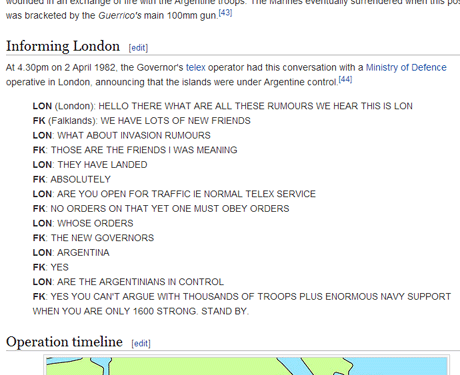
Reporting on “Maggie’s War”

Filed under: Americas, Britain, History, Military — Tags: , , , — Nicholas @ 09:02

In History Today, Patrick Bishop recounts his experiences as a war correspondent during the Falklands War, 31 years ago:

For me, a young reporter attached to 3 Commando Brigade aboard the requisitioned cruise ship Canberra, covering ‘Maggie’s war’ was a process of constant revelation. The soldiers, the sea and landscapes, the actuality of combat — everything was surprising and collided with expectations.

I arrived in the war, like Britain itself, bemused at the suddenness of events. One minute I was a home news hack on the Observer, the next I was an official war correspondent, with a red cloth-covered Second World War-issue booklet of regulations and the rank of honorary captain.

We left from Southampton on a drizzly Good Friday evening. Two or three hundred wives, girlfriends and children had gathered on the quayside to say goodbye and good luck to their menfolk, while onboard a band played ‘A Life On The Ocean Wave’ and ‘Land Of Hope And Glory’. The crowd was cheerfully patriotic. Some waved union flags. Two buxom girls, soon the object of close attention by the TV cameras, were wearing T-shirts with the legend ‘Give The Argies Some Bargie’.

Who were these people? To my metropolitan eyes they appeared somewhat alien. Indeed they were. The era of Callaghan’s Labour government, which was replaced by Margaret Thatcher’s Conservative administration in 1979, had forced patriotism underground. Mrs T. was untried and not yet confident enough to encourage its resurrection.

March 21, 2013

“Henrich had thought he would be adding a small branch to an established tree of knowledge. It turned out he was sawing at the very trunk.”

Filed under: Americas, Economics, Science — Tags: , , , , — Nicholas @ 10:02

By way of Five Feet of Fury, an interesting story about challenging some very basic assumptions about psychology:

While the setting was fairly typical for an anthropologist, Henrich’s research was not. Rather than practice traditional ethnography, he decided to run a behavioral experiment that had been developed by economists. Henrich used a “game” — along the lines of the famous prisoner’s dilemma — to see whether isolated cultures shared with the West the same basic instinct for fairness. In doing so, Henrich expected to confirm one of the foundational assumptions underlying such experiments, and indeed underpinning the entire fields of economics and psychology: that humans all share the same cognitive machinery — the same evolved rational and psychological hardwiring.

[. . .]

When he began to run the game it became immediately clear that Machiguengan behavior was dramatically different from that of the average North American. To begin with, the offers from the first player were much lower. In addition, when on the receiving end of the game, the Machiguenga rarely refused even the lowest possible amount. “It just seemed ridiculous to the Machiguenga that you would reject an offer of free money,” says Henrich. “They just didn’t understand why anyone would sacrifice money to punish someone who had the good luck of getting to play the other role in the game.”

The potential implications of the unexpected results were quickly apparent to Henrich. He knew that a vast amount of scholarly literature in the social sciences — particularly in economics and psychology — relied on the ultimatum game and similar experiments. At the heart of most of that research was the implicit assumption that the results revealed evolved psychological traits common to all humans, never mind that the test subjects were nearly always from the industrialized West. Henrich realized that if the Machiguenga results stood up, and if similar differences could be measured across other populations, this assumption of universality would have to be challenged.

Henrich had thought he would be adding a small branch to an established tree of knowledge. It turned out he was sawing at the very trunk. He began to wonder: What other certainties about “human nature” in social science research would need to be reconsidered when tested across diverse populations?

A notion that’s popped up several times in the last couple of months is that the easy access to willing test subjects (university students) introduces a strong bias to a lot of the tests, yet until recently the majority of studies disregarded the possibility that their test results were unrepresentative of the general population.

March 13, 2013

Argentinian president derides Falkland Islanders as “squatters”

Filed under: Americas, Britain — Tags: , , — Nicholas @ 08:24

I figured the Argentine government would brush off the overwhelming result of the Falkland Islands referendum once it became clear that the result would not flatter Argentinian egos:

In her first public comment on the referendum, the outspoken president dismissed the vote as a “parody” and thanked Argentinians for their “monolithic opposition”.

She said the referendum, where residents voted in favour of remaining a British overseas territory, was “as if a group of squatters had voted on whether to continue to occupy a building”.

Speaking at an event at the Presidential Palace in Buenos Aires, she added: “We reaffirm our commitment to dialogue in accordance with the UN.

“To achieve a solution that also included the interests of those who live on our Malvinas islands.”

She quoted British Foreign Office minister Hugo Swire as saying that the referendum result didn’t change the situation “from a legal point of view”.

The vote wasn’t even close, with only three votes for the “No” option out of 1,517 total votes cast.

February 26, 2013

UN mistake costs 8,000 Haitian lives, UN refuses to compensate or even apologize

Filed under: Americas, Asia — Tags: , , , , , — Nicholas @ 00:01

A mind-numbing case of bureaucratic error, death, and ass-covering in Haiti:

International affairs can be complicated, but sometimes a case comes along that’s so simple it’s almost absurd. In 2010, the United Nations made a horrendous mistake that, so far, has claimed more than 8,000 lives. Its officials tried to cover it up. When the evidence came out anyway, lawyers for victims’ families petitioned the U.N. to end the crisis, pay damages, and apologize. For a year and a half, the world’s leading humanitarian organization said nothing. Then, last week, it threw out the case, saying, “The claims are not receivable.”

The background should be well-known by now. But despite the fact that American taxpayers have footed the lion’s share of the bill for the U.N. peacekeepers responsible for this disaster — to the tune of roughly $1.5 billion since 2004 — the story remains largely unknown in the United States.

The place was Haiti. The mistake: a killer combination of cholera and gross negligence. The peacekeeping mission, known by its French initials, MINUSTAH, had been in country since 2004, when it was authorized to protect an interim government installed after a coup. Six years later — thanks to a healthy dose of mission creep — the peacekeepers were still there. While rotating troops into what was now post-quake Haiti, the U.N. neglected to adequately screen a contingent of soldiers coming from an active cholera outbreak in Nepal. Upon arrival, the soldiers were sent to a rural U.N. base, outside the quake zone and long known for leaking sewage into a major river system that millions of Haitians used to drink, bathe, wash, and farm. Within days of their arrival, people downstream began to die. The epidemic then exploded, sickening more than 647,000 people, and killing in its first year more than twice the number of people who died on 9/11.

« Newer PostsOlder Posts »

Powered by WordPress