
In Reason, Jacob Sullum outlines Justice Gorsuch’s proposed new test for limiting government abilities to surveil and monitor private actions:
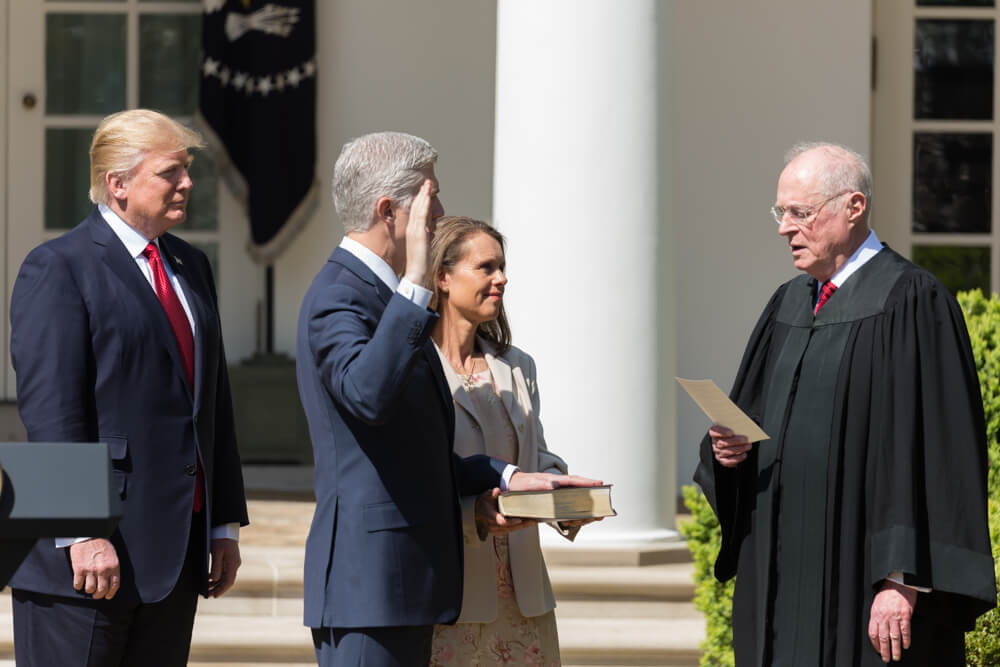
Supreme Court Justice Anthony M. Kennedy swears in Justice Neil M. Gorsuch on Monday, April 10, 2017, in the Rose Garden of the White House in Washington, D.C.
White House photo via Wikimedia Commons.
The Court’s 1967 decision in Katz v. United States, which held that the Constitution’s prohibition of “unreasonable searches and seizures” applies when people have a “reasonable expectation of privacy”, continues to shape Fourth Amendment rulings six decades later. That was clear on June 29, when the Court decided Chatrie v. United States, holding that a government-ordered analysis of cellphone location data qualifies as a “search” under the Fourth Amendment.
“An individual has a reasonable expectation of privacy in records about his cell phone’s location, and police intrude on that constitutionally protected interest when they demand the information”, Justice Elena Kagan wrote in an opinion joined by four of her colleagues. Justice Neil Gorsuch agreed with the result but not the rationale. The Katz test, he complained, “has no basis in the Constitution’s text or history”. He added that it has proven unworkable in practice because it has never been clear how courts should determine whether an expectation of privacy is “reasonable”.
Gorsuch is surely right that the Katz test has produced inconsistent and puzzling results. In cases addressing intrusions such as trash searches, demands for bank and telephone records, surveillance by low-flying aircraft, and police trespassing on private property, the Supreme Court has perceived no expectations of privacy it was prepared to recognize as reasonable. Applying the same test, it has repeatedly ruled that the Fourth Amendment does not apply to information that people voluntarily share with third parties. Yet the Court has repeatedly rebelled at the disturbing implications of that principle without explicitly renouncing it.
That is what happened in Chatrie, which involved a Virginia bank robbery investigation. Police used a “geofence” warrant to identify the perpetrator by requiring Google to search customer data collected by its Location History feature, which tracks the whereabouts of cellphone users. For reasons that are not entirely clear, the Court declined to apply the third-party doctrine, instead reverting to the original, unmodified Katz test.
A better approach, Gorsuch argued, would be to treat Location History records as “effects” covered by the Fourth Amendment — as a form of personal property, in other words. While it is not clear exactly how that property-rights approach would work in other contexts, it does seem less malleable than the Katz test, which gives courts wide discretion in discerning expectations and deciding whether they are reasonable. Gorsuch aptly likened the Court’s understanding of that test to its definition of obscenity in the 1960s: “We know a ‘reasonable expectation of privacy’ (and an exception to the third party doctrine) when we see it”.



In related news, the State of Ohio just outlawed the Fourth Amendment. Appealing this flaming barrel of shit is going to be funny.
https://www.legislature.ohio.gov/legislation/136/hb492
Comment by Clayton Barnett — July 9, 2026 @ 11:41
While I can’t load that URL at the moment, I’m a bit puzzled … didn’t you guys fight a whole civil war that settled the question about whether individual states can override the federal government? Our feds stick their noses into provincial matters by giving big chunks of money as “grants”, and the provinces put up with it to get the funds, and I believe the US government does similar things (the 55mph speed limit is the one that immediately comes to mind).
Comment by Nicholas — July 9, 2026 @ 11:49