
The Line
Published 3 February, 2025Today on On The Line, Matt Gurney is joined by Vice-Admiral Angus Topshee, commander of the Royal Canadian Navy, for an extended, wide-ranging conversation recorded in the library of the Royal Canadian Military Institute in downtown Toronto. The discussion ranges across geopolitics, the state of the world, the state of Canada’s navy, what’s going right for the fleet, and what still needs to improve.
First, a correction from your host. During the conversation, Matt incorrectly stated at several points that Canada intends to procure 15 new submarines. Admiral Topshee was too kind to interrupt him during the recording, but the correct number is 12. That mistake was entirely Matt’s, and he regrets the error.
With that out of the way, the conversation spans the globe. Admiral Topshee discusses what’s happening in Europe with Russia and Ukraine, and in the Pacific, where growing Chinese power and influence is challenging long-held assumptions about global security. There’s also extensive discussion of the Arctic, why it matters, and what is changing there. Procurement comes up as well — shipyards, new ships for the fleet, and what it will actually cost to deliver on plans that now enjoy broad political support.
They also spend time on what Canada itself needs to sustain a much larger navy and armed forces. Do we have enough bases? Enough reservists? Are people being enrolled into the navy quickly enough? And how, realistically, could Canada expand its forces rapidly in a time of war?
It’s a long, free-ranging conversation about geopolitics, the evolution of warfare, and the future of the Royal Canadian Navy. Check it out today on On The Line. And special thanks to the Royal Canadian Military Institute for hosting this recording of the podcast. For more like this, visit ReadTheLine.ca, and as always, like and subscribe.
0:00 Intro
0:26 Vice-Admiral Angus Topshee
54:16 Outro#OnTheLine #RoyalCanadianNavy #AngusTopshee #CanadianForces #Geopolitics #ArcticSecurity #NavalPower #CanadaDefence #MattGurney
February 5, 2026
On The Line with Vice-Admiral Angus Topshee, commander of the Royal Canadian Navy
“It was not fear of the crime that silenced authorities, but fear of a word: racist“
On Substack, Celina101 outlines the long and sordid history of official deliberate blindness to a widespread and horrific crime wave in Britain, all for fear that if they paid proper attention they’d be labelled as “racists”:
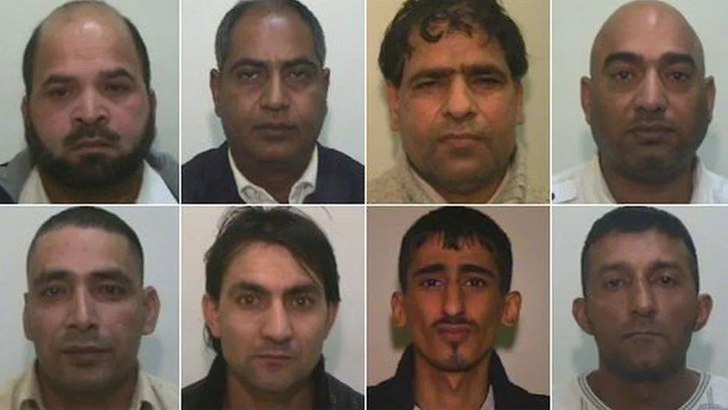
There are crimes so extreme that the mind instinctively rejects them, not because they are implausible, but because accepting them would require acknowledging a collapse of morality too large to comprehend. Child sexual abuse is one such crime.
Child sexual abuse does not arrive in a single form. It ranges from isolated abductions, to organised pornography networks, to violence carried out by parents or those entrusted with care. Every one of these crimes is horrific, and none should ever be minimised or ignored.
But there is one form of abuse that stands apart, not because it is worse in kind, but because it was allowed to flourish unchecked. The organised targeting of schoolgirls by groups of men who lingered outside schools, fast-food outlets, and transport hubs, grooming children into addiction, sexual exploitation, and prostitution, constituted a distinct and recognisable pattern of abuse.
This pattern was not hidden. It was not unknowable. And yet for longer than a quarter of a century, British authorities chose not to act. Despite the issue being raised at a national level as early as 2003, and despite its presence being well understood in certain towns since at least the late 1980s, it was deliberately sidelined, minimised, and left to metastasise.1
For decades, these gangs were allowed to congregate openly around school gates without consequence. What shielded them was not ignorance or lack of evidence, but an institutional terror of confronting anything that carried racial implications; the shade of their skin protected them.
By 2011, the long-standing silence surrounding the issue began to break. Once the initial barrier was breached, the extent of the abuse became increasingly difficult to suppress.2 Over the following years, British media outlets published a succession of detailed investigations that brought the scale of the crimes into public view.
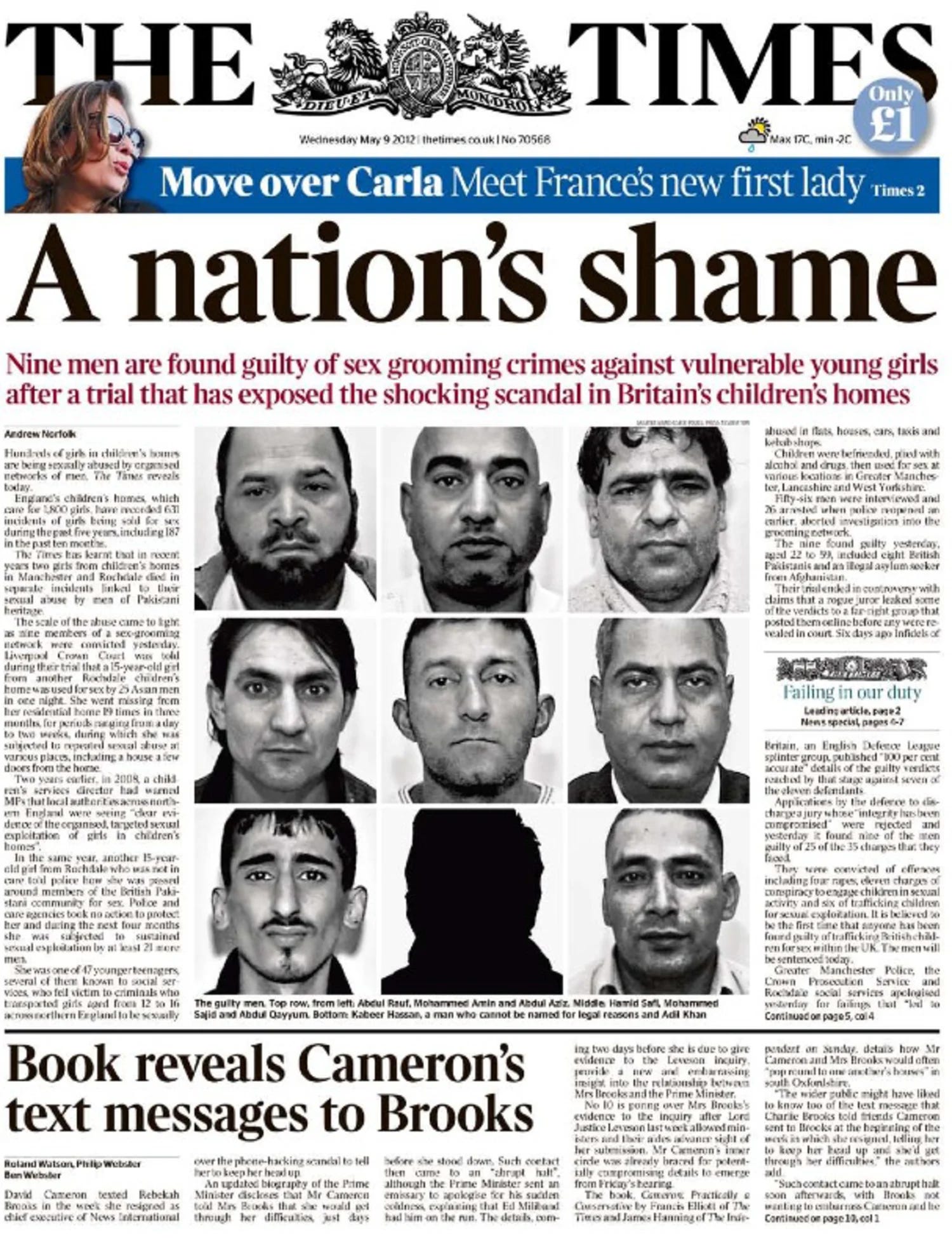
In September 2012, The Times published an extensive overview of the phenomenon.3 The paper reported that for more than a decade, organised groups of men had been able to groom, exploit, and traffic girls across multiple towns and cities in Britain, often operating with minimal interference from authorities.
Yet, event The Times underestimated the scale of this. By early 2015, senior police figures were publicly acknowledging the scale of the crisis. One officer spoke of “tens of thousands” of current victims of grooming gangs. A Member of Parliament, representing a constituency widely associated with the problem, went further, suggesting that the total number of victims nationwide, past and present, could reach as high as one million.4
These figures are almost impossible to comprehend. They refer to school-aged girls systematically identified, isolated, and exploited over many years. And yet, despite the magnitude of the harm, perpetrators were able to operate with remarkable impunity.
By the end of 2014, the Association of Chief Police Officers confirmed that the number of victims each year ran into the tens of thousands.5 Even on the most conservative interpretation, this would place the number of victims over a twenty-year period well into six figures. Against this backdrop, the number of successful convictions, under 200, stands as a staggering indictment of the system meant to protect the vulnerable and enforce the law.
There is no comparable serious crime in modern Britain where the disparity between victims and convictions is so extreme.
- https://web.archive.org/web/20100620042427/http://www.channel4.com/news/articles/society/law_order/Asian%2Brape%2Ballegations/256893
- https://assets.publishing.service.gov.uk/government/uploads/system/uploads/attachment_data/file/944206/Group-based_CSE_Paper.pdf
- Andrew Norfolk, “Police Files Reveal Vast Child Protection Scandal”, The Times, 24 Sep 2012.
- https://www.thetimes.com/uk/society/article/grooming-gangs-ethnicities-how-many-statistics-data-dpx2bfrts#:~:text=The%20%E2%80%9Cone%20million%E2%80%9D%20figure%20comes,over%20a%2070%2Dyear%20period.
- https://www.thetimes.com/uk/crime/article/police-files-reveal-vast-child-protection-scandal-ffrpdr09vrv
The Mote in God’s Eye: A No-Win Scenario
Feral Historian
Published 26 Sept 2025For whatever reason books by [Larry] Niven and [Jerry] Pournelle always end up being a lot harder to cover than I expect. It’s not that the core ideas are buried in dense convoluted storytelling or unusually compelling characters (often quite the opposite) but rather I think that the core ideas are always a little uncomfortable to face head-on. And Mote is great example.
Niven and Pournelle create a scenario not only of the cyclical rise and fall of a civilization, but one that through a combination of biological and cultural factors points to the impossibility of long-term coexistence between Humanity and the Moties.
00:00 Intro
01:26 Aristocracy and Contact
04:11 The Moties
08:48 Crazy Eddie
10:18 The Middle Path?
12:53 The Gripping Hand
(more…)
QotD: The medicalization of unhappiness
I have noticed the disappearance of the word “unhappy” from common usage, and its replacement by the word “depressed”. While unhappiness is a state of mind that is clearly the result of the circumstances of one’s life, whether self-inflicted or inflicted by circumstances beyond one’s control, or a mixture of both, depression is an illness that is the doctor’s responsibility to cure. This is so, however one happens to be leading one’s life. And the doctor, enjoined to pass no judgement that could be interpreted as moral on his patients, has no option but to play along with this deception. The result is the gross over-prescription of medication, without any reduction in unhappiness.
Theodore Dalrymple, interviewed by James Glazov in “Our Culture, What’s Left Of It”, FrontPage, 2005-08-31.


