Quotulatiousness

January 22, 2026

Carney in Davos … “the mismatch between message and messenger is … very special”

I make it a point not to listen to politicans’ speeches, as I need to keep my blood pressure within safe ranges for health reasons. A lot of Canadian commentators have been gushing with praise for Prime Minister Mark Carney’s bloviations at the WEF gabathon in Davos, because of course they have. Brave Mr. Carney standing up to the Bad Orange Man and getting ovations from the kind of people he’s most comfortable dealing with. How very nice for him. But as Chris Bray explains, it didn’t play quite as well with the rest of the non-Davos-attending world:

Mark Carney gave a speech in Davos, that fortress of democratic pluralism where hotel rooms inside the security zone cost thousands of dollars a night and no one with an expense account has to be lonely because the massive security forces don’t try to interfere with all the sex trafficking, which is very democratic. Anyway, the speech was stunning and brave, and everybody clapped a lot.

Someone put the word “flexes” next to the word “Canada”, apparently not intending to cause laughter, but yes: Mark Carney flexed and warned and puffed himself up like a man who’d just eaten the wrong part of the fugu.

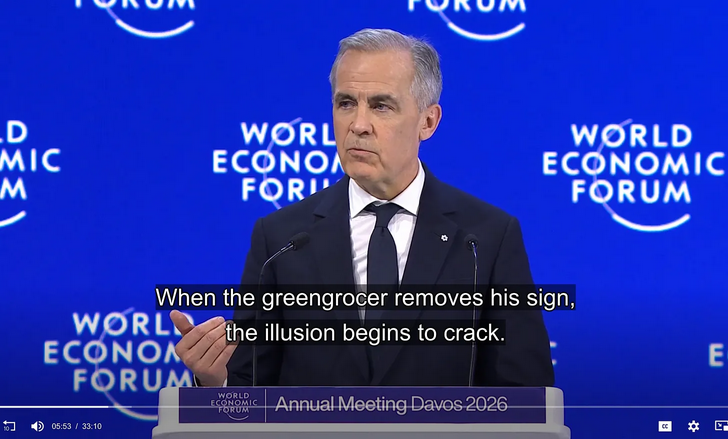
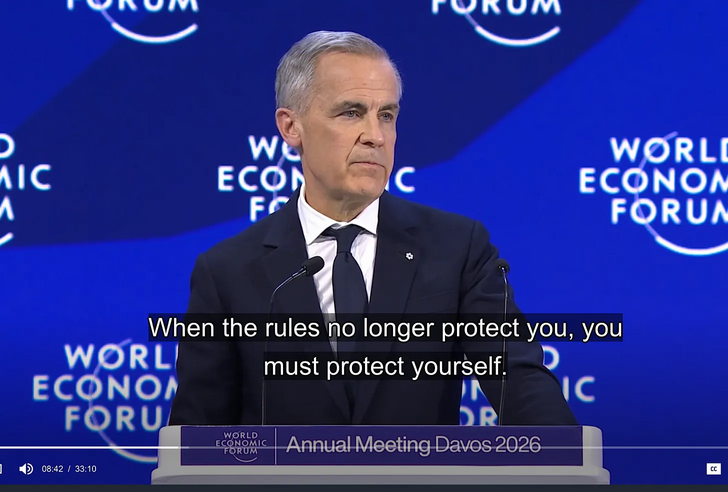
You should watch it. Don’t try to eat or drink during the speech, because you’ll choke, and push any breakable household goods away from the reach of what will soon be your flailing arms, but you should watch him perform this extraordinary set of stranded symbols. The mismatch between message and messenger is … very special.

I was physically paralyzed as an effect of hearing this sentence from this face for a full ten seconds, and then I spasmed. It’s like watching Erich Honecker stand up to the East German regime. “We cannot tolerate misogyny, warns Jack the Ripper.”

Carney hinted broadly that the rules are breaking down in international relationships …

… which for the first time in a long time are being reshaped by mere power, a rare thing on the global stage, because there’s meanness and bullying and a rejection of friendly norms and restraint from … someone very bad, not that he was naming names, and so Canada is turning to new partners, extending the hand of friendship to nations and leaders that still care about rules and values and democracy.

The central banker who was selected as his country’s head of government before he’d ever stood for election to any office anywhere ever, the prime minister of a country where the government had just been rebuked by its courts for faking a national security emergency so it could suspend the rule of law and crush dissent, gave a real tubthumper about democracy and the rule of law.

The total absence of connection between “things being said” and “things being done” sets a record, here.

Dresden Part 1 – Targets, Tangents & Genocide

HardThrasher
Published 20 Jan 2026

Was Dresden a war crime or a late-war military decision made in cold blood? The firebombing of Dresden (13–14 Feb 1945) remains one of the most infamous episodes of the WW2 history: a firestorm, a shattered city, and a death toll that still sparks argument today.

But most of what “everyone knows” about Dresden is wrong. In Part 1 of this two-part series, you and I will dig into the real reasons Dresden became a target. We also ask the uncomfortable questions: Was Dresden an “innocent” city? How Nazi was it? And what does Dresden reveal about the logic — and limits — of strategic bombing? And because this is my video and I’ll do as I damn well please, we’ll also do a quick overview of nearly 1,000 years of history, because why not. Thus in this you will also get the Northern Crusades, a discussion of pottery, a smattering of Central European history and long discussion of how the Nazis subverted power and used it to abuse people whilst being wildly incompetent at the basics

00:00 – Start
04:39 – Part 1 – A Brief History of Everything in Central Europe
17:36 – Rise of the Nazis and the Nuremberg Laws
30:25 – Military and Industrial Dresden
34:03 – Failure to Prepare for War
40:37 – How did it become a target?
52:37 – Survivor’s Club
(more…)

California considering a new way to kill the golden goose

Filed under: Economics, Government, Politics, USA — Tags: , , , , — Nicholas @ 03:00

When I first heard about California’s proposed “Billionaire Tax” I thought it was a joke — nobody could be that economically illiterate. But I was wrong and the state really does seem to want to make their state economy a new case study in economics courses of the future. J.D. Tuccille explains why the tax, if implemented, is likely to impact a lot more folks who don’t rank as plutocrats:

California’s potential adoption of a one-time 5 percent “billionaire tax” on the net worth of high-value individuals is already sending wealthy residents fleeing for the exits. By one estimate, at least a trillion dollars has moved beyond the reach of state officials. But a new analysis says the tax may be even more onerous than advertised. Californians may need to get used to the sight of moving vans leaving the state.

Give Us 5 Percent of Everything You Own

Sponsored by a chapter of the Service Employees International Union, the proposed billionaire tax is set to appear as an initiative on the California ballot in November. According to the summary approved by state Attorney General Rob Bonta, the measure “imposes one-time tax of up to 5% on taxpayers and trusts with covered assets valued over $1 billion; covered assets include businesses, securities, art, collectibles, and intellectual property, but exclude real property and some pensions and retirement accounts”. If passed, the tax would apply to people resident in California as of January 1, 2026 — a retroactive element bound to be challenged in court.

[…]

Five Percent Understates the Pain

“The 2026 Billionaire Tax Act, a California ballot initiative, would ostensibly impose a one-time tax of 5 percent on the net worth of the state’s billionaires,” notes Jared Walczak for the Tax Foundation. “Due, however, to aggressive design choices and possible drafting errors, the actual rate on taxpayers’ net worth could be dramatically higher. One particularly momentous policy choice has the potential to strip the founders of some of the world’s largest companies of their controlling interests and force them to sell off a significant portion of their shares.”

According to Walczak, there are many ways in which the initiative creates situations under which “tax liability would be vastly more than 5 percent of net worth”. He focuses on six of them: valuations based on voting interests; assessment rules that can overvalue privately held businesses; excessive underpayment penalties that encourage overvaluing privately held businesses; anti-avoidance rules that tax more than the amount of transfers; provisions on spousal assets and debt to relatives that would tax nonresidents’ assets; and deferrals that would tax wealth that no longer exists.

As an example, Walczak points to the initiative’s means for valuing voting shares that aren’t publicly traded. DoorDash founder Tony Xu owns 2.6 percent of the company but controls 57.6 percent of voting rights. The initiative specifies, “the percentage of the business entity owned by the taxpayer shall be presumed to be not less than the taxpayer’s percentage of the overall voting or other direct control rights.”

That means Xu could be taxed on his voting rights rather than his economic stake in the company. That turns a $2.41 billion ownership interest into a $4.17 billion tax liability. It could force the conversion of voting shares to common stock for sale (subject to capital gains tax), and loss of control of the company.

The other provisions examined by Walczak also impose potential tax liabilities far beyond the 5 percent claimed by the initiative’s sponsors.

Charles Fain Lehman explains that the proposed tax will end up making everyone in California worse off:

… If you pick up all of Google’s employees and put them in Texas — where some of California’s billionaires might look to relocate — then one might assume they would be just as productive.

That would be a reason for non-Californians to be relatively sanguine about the wealth tax’s effects. Yes, it will be bad for California fiscally. But the titans of technology and entertainment can just set up shop in a red state and continue their work unabated.

But what if cities themselves have some additive effect? What if there’s something special about Los Angeles or San Francisco per se? What if the specific concentration of human capital in a specific place yields more than the output you’d expect if you put that same capital in a different place?
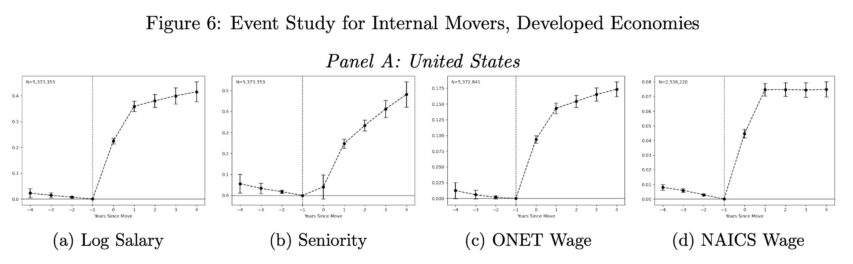
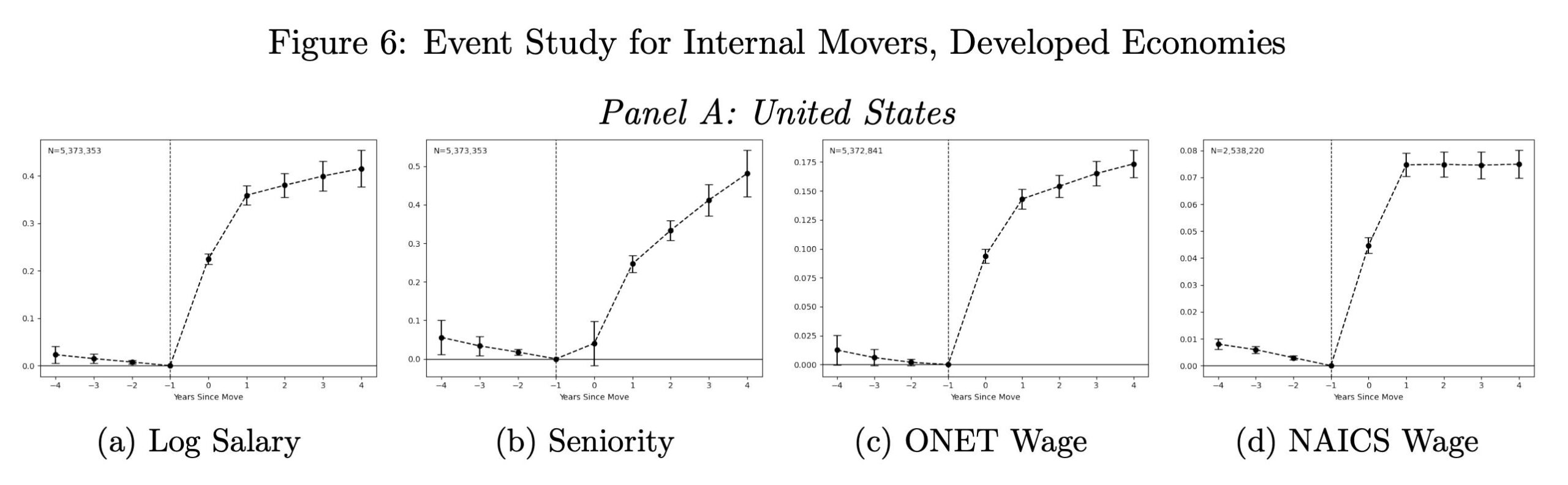
Source: Bhalothia et al, fig. 6.

As it turns out, that’s exactly what happens. Take recent research from economists at UC San Diego and Northwestern University. They use data on over 500 million LinkedIn users across 220,000 cities worldwide to ask how moving from one city to another affects an employee’s wages (a measure of their productivity). Because they observe the same people moving multiple times, they can disentangle the effects on wages of moving to a given city from the qualities of the people moving between cities.

The results are remarkable. The authors estimate that 93 percent of global wage variation is attributable to city effects, rather than to the qualities of workers themselves. That effect shrinks when you’re talking about movement within the developed world — someone moving from Bangalore to San Francisco gets a bigger wage bump than someone moving from Omaha to San Francisco, for example. But even looking at movers within their own developed country, cities explain something like 30 to 50 percent of the variance in wages.

In other words: it’s not just that people with better skills move to otherwise more desirable cities. Cities themselves make people worth more — meaning that they also increase total productivity and output, and therefore make the economy stronger.

How can it be that where you work is so important for how much you produce? The basic answer is what economists call agglomeration effects, the gains that come when firms cluster together. Agglomeration effects come, in general, from lowered barriers to exchange — of material goods, but also of ideas. Lots of start-up founders move to San Francisco because that’s where they can meet other start-up founders, and be on “the cutting edge” of what’s happening in their field. That’s only possible in a specific physical place.

Even if you put all the start-up founders in the same new part of Texas, moreover, they would still be worse off. Agglomeration economies come also from local culture and supportive industry infrastructure. Los Angeles as a city is built to support entertainers; San Francisco is built to support programmers. If you move those industries to Miami or Austin, neither city will be able to offer the same amenities — which is why both have struggled in their efforts to replace their Californian counterparts.

In other words: if California’s major industries leave California, they can’t be rebuilt somewhere else. Dismantle Silicon Valley, and you can’t just put it back together in Miami. We’ll still have technology companies, sure. But all else equal, they will be less productive than they would have been if they had stayed put. And we’ll all pay the price.

D’Joan, C’Mell, and the Rediscovery of Man

Filed under: Books — Tags: , , , — Nicholas @ 02:00

Feral Historian
Published 29 Aug 2025

Cordwainer Smith, through short stories and novellas, tells a sprawling history spanning thousands of years and an entire galaxy. In this one, I’m looking at a single narrative thread of that world, the gulf between man and animal and the partnerships that make humanity whole again after a long span of cultural stagnation and loss of vitality.

00:00 Intro
02:19 Partners and Divisions
05:15 Heading Down to Clown Town
15:53 Mans’ Other Friend
19:22 Norstrilia

The first month’s ad revenue from this video will be donated to 2 animal rescues. https://pauseforpawsaz.com/ and https://sites.google.com/site/catalli…
(more…)

QotD: Higher education

Back in the 1980s, I took an interest in Latin American guerrilla movements, especially in Central America. The general consensus among those who took an interest in such matters was that they were caused by the intolerable conditions of the poor, oppressed peasantry who rose up spontaneously against them. This was complete nonsense, of course. This is not to say that the peasantry was not poor and oppressed, but poor and oppressed peasants are rarely capable of more than a jacquerie, a kind of rural riot that exhausts itself and results in the oppressors coming back stronger than ever.

No; I came to the conclusion that the cause of the revolutionary guerrilla movements was the expansion of tertiary education in countries where it had not long before been the province only of the elite, largely, though never entirely, hereditary. (For the poor, gifted, and ambitious, the army was the route to social ascension.)

Tertiary education, however, was expanded with comparative suddenness. Before it was expanded, those who had it, being few, were more or less guaranteed important roles in the economy and government. They had already drawn a winning ticket in the lottery of life. Not surprisingly, a false syllogism insinuated itself into the minds of the newly educated: If the rich were educated and important, then being educated would make you rich and important. Again not surprisingly, this turned out not to be the case. If you turn out thousands of lawyers, for example, the remuneration of their work, if they find any, will be reduced and they will be disappointed in their hopes and expectations. They become angry, bitter, and disaffected, believing themselves not to be valued at their inestimable worth. They and their ilk became the middle ranks of the guerrillas (the very uppermost reaches being filled mainly by the narcissistic, spoiled sprigs of the upper classes). Only revolution would acquire for them the positions of influence and importance to which they felt that their education entitled them, and which such education had always entitled people to in the past.

Is it possible that Latin America was not so much in the rear as in the forefront of this modern social development (the case of Sendero Luminoso, the Shining Path of Peru, was a pure culture of this phenomenon)? Is it not possible that we in our societies have duped tens of millions of young people into believing that the prolongation of their formal education would lead them inexorably into the sunny uplands of power, importance, wealth, and influence, when in fact many a PhD finds himself obliged to do work that he could have done when he was 16? No one likes to think that he has been duped, however (it takes two for fraud to be committed, after all), so he looks around for some other cause of his bitter disappointment. It isn’t ignoramuses who are pulling down the statues, but ignoramuses who think that they have been educated.

Theodore Dalrymple, “Bees With Degrees”, Taki’s Magazine, 2020-07-02.

Update, 24 January: Welcome, Instapundit readers! Have a look around at some of my other posts you may find of interest. I send out a daily summary of posts here through my Substackhttps://substack.com/@nicholasrusson that you can subscribe to if you’d like to be informed of new posts in the future.

Powered by WordPress