
CrowsEyeProductions
Published 5 Dec 2018A Victorian maidservant dresses ready for a day of work, then ventures out into a cold evening …
(more…)
December 21, 2025
Getting Dressed – Victorian Maid, Christmas 1853
Comments Off on Getting Dressed – Victorian Maid, Christmas 1853
QotD: Renfaires
They had spent the day at the Renaissance Festival, and my wife was still shuddering over the event. I did a story on the event almost ten years ago, and while it had its annoying aspects, it was a rather benign and gentle thing. Apparently it’s changed, and now it’s full of louts and Goths and lewdenesse; half-naked Creative Anachronism types happy to unfurl their great white guts for all to see, fleshy snaggle-toothed watermelon-jugged exhibitionists in costumes more appropriate for a bar called The Teatery, theatrical bits full of cheap single-entendres, grim meat-shops that swapped a fiver for a jot of pale stringy meat and an indifferent shrug. All this and ankle-deep mud in the parking lot. At least it’s authentic.
James Lileks, The Bleat, 2005-09-05.
Comments Off on QotD: Renfaires
December 20, 2025
Ours is a culture that actively conspires against and sabotages its own children
Following up on yesterdays post (here) on the viral essay about the Millennial “lost generation”, John Carter enumerates the extent of damage done to Millennials in general and Millennial men in particular:
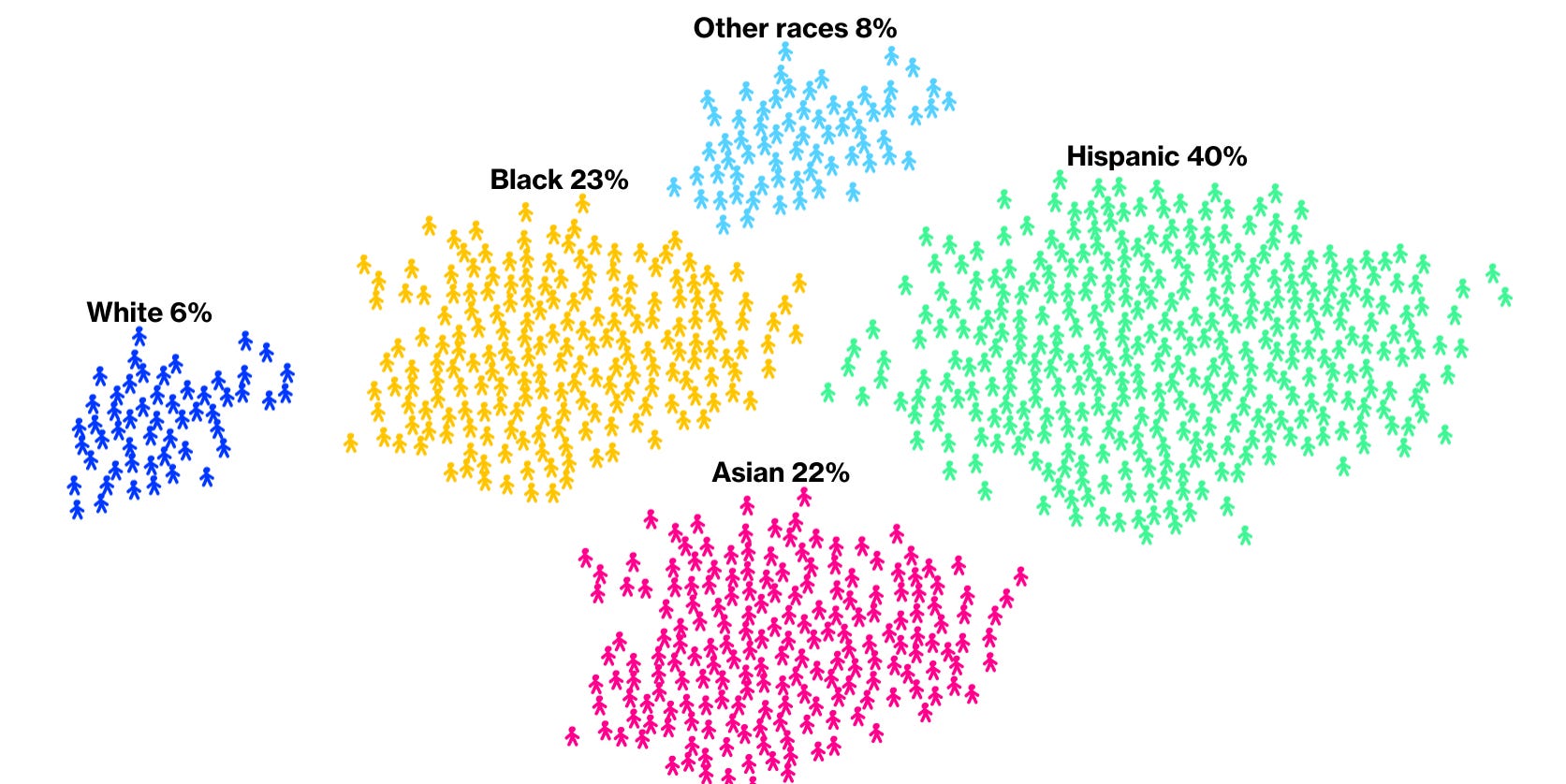
A Bloomberg report from 2023 tracked reported hiring by 88 Standard & Poor’s 100 companies and of 323,094 reported hires from 2018-2021, only 6% were white.
The response to the essay has been an outpouring of suppressed rage that has been simmering for years in an emotional pressure cooker of silenced frustration. The author, Jacob Savage, provides a ground-level view of the DEI revolution’s human cost, beginning with his personal experiences as an aspiring screenwriter, and then widening the reader’s perspective via interviews with would-be journalists and academics. Every subject described a similar pattern of frustrated ambitions in which, starting around the middle of the 2010s, their careers stalled out for no other reason than their melanin-deficiency and y-chromosome superfluity. Young white men were systematically excluded from every institutional avenue of prestige and prosperity. Doors were closed in academia, in journalism, in entertainment, in the performing arts, in publishing, in tech, in the civil service, in the corporate world. It didn’t matter if you wanted to be a journalist, a novelist, a scientist, an engineer, a software developer, a musician, a comedian, a lawyer, a doctor, an investment banker, or an actor. In every direction, Diversity Is Our Strength and The Future Is Female; every job posting particularly encourages applications from traditionally underrepresented and equity-seeking groups including women, Black and Indigenous People Of Colour, LGBTQ+, and the disabled … a litany of identities in which “white men” was always conspicuous by its absence.
The Lost Generation does not rely only on the pathos of anecdote. Savage includes endless reams of data, demonstrating how white men virtually disappeared from Hollywood writing rooms, editorial staff, university admissions, tenure-track positions, new media journalism, legacy media, and internships. He shows how, after the 2020s, they even stopped bothering to apply, because what was the point? The comprehensive push to exclude young white men from employment wasn’t limited to prestigious creative industries, of course. The corporate sector has also adopted a practice of hiring anyone but white men, as revealed two years ago by a Bloomberg article which gloated that well over 90% of new hires at America’s largest corporations weren’t white.
The Bloomberg article was criticized for methodological flaws, but judging by the outpouring of stories it elicited (just see the several hundred comments my own essay got, the best of which I summarized here) it was certainly directionally accurate.
The real strength of Savage’s article isn’t the cold statistics, though, but the heartrending poignancy with which it highlights the emotional wreckage left in the wake of this cultural revolution.
Hiring processes are opaque. If an employer doesn’t extend an offer, they rarely explain why; at best one receives a formulaic “thank you for your interest in the position, but we have decided to move forward with another applicant. We wish you the best of luck in your endeavours.” They certainly never come out and say that you didn’t get hired because you’re a white man, which is generally technically illegal, for whatever that is worth in an atmosphere in which the unspoken de facto trumps the written de jure. Candidates are not privy to the internal deliberations of hiring committees, which will always publicly claim that they hired the best candidate. Officially a facade of meritocracy was maintained, even as meritocracy was systematically dismantled from within.
The power suit-clad feminists who body-checked their padded shoulder into C-suites and academic departments in the 1970s flattered themselves that they were subduing sexist male chauvinism by outdoing the boys at their own game and forcing the patriarchy to acknowledge their natural female excellence. Growing up I would often hear professional women say things like “as a woman, to get half as far as a man, you have to be twice as good and work twice as hard”. [NR: usually with a smug “fortunately, that’s not difficult” tacked on] The implication of this was that women were just overall better than men, because the old boy’s club held the fairer sex to a higher standard than it did the good old boys. Of course this was almost never true, these women were overwhelmingly the beneficiaries of affirmative action programs motivated by anti-discrimination legislation that opened up any corporation that didn’t put a sufficient number females on the payroll to ruinous lawsuits. Moreover, a fair fraction of them were really being recruited as decorative additions to the secretarial harems of upper management. Nevertheless it helped lay the foundation for the Future Is Female boosterism that stole the future from a generation of young men.
There was a time, not so long ago, where I naively assumed that my own situation was simply the inverse of the one women had faced in the 70s and 80s. I was aware that I was being rather openly discriminated against, but imagined that this simply meant that I had to perform to a higher standard, that if I was good enough, the excellence of my work would shatter the institutional barriers and force someone to employ me. It took me several long and agonizing years to realize that this just wasn’t true. The crotchety patriarchs of the declining West may have been principled men capable of putting stereotypes aside to recognize merit; in fact, the historical evidence suggests that they overwhelmingly prized merit above any other consideration (just as the evidence suggests that their stereotypes were overwhelmingly correct). The priestesses of the present gynocracy hold themselves to no such standard. They don’t care about your promise or your performance, at all. If anything, performing well is a strike against you, because it threatens them. Nothing makes them seethe more than being outperformed by men. They champion mediocrity as much to punish as to promote.
Young white men had been raised to expect meritocracy. They’d also been raised to be racial and sexual egalitarians. People in the past, they believed, had been bigoted, believing superstitious stereotypes about differences of ability and temperament between the sexes and races that had no foundation in reality, pernicious falsehoods that were developed and propagated as intersectional systems of oppression with the purpose of justifying slavery, colonialism, imperialism, and genocide. Naturally they were appalled to have such charges laid at their feet, and so they they agreed that we were all going to try and correct this injustice, and we’d do it by carefully eliminating every potential source of racial or sexual bias, eliminating all the unfair barriers to advancement within society, in particular although not certainly not exclusively via university admissions and institutional hiring. That was the original official line on DEI: that it wasn’t about excluding white men, heaven forbid, no, it was simply about including everyone else, widening the talent pool so that we could ensure both the fairest possible system of advancement, and that the best possible candidates were given access to opportunity. In practice, we were told, this wouldn’t be a quota system: everything would still be meritocratic, but if it came down to a coin flip between two equally qualified candidates, one of whom was a white man and the other of whom was not, the not would win. Fair enough, the young white men thought at first: we’ll all compete on a level playing field, in fact we’ll even accept a bit of a handicap in the interests of correcting historical injustices, and may the best human win.
But the DEI commissars had absolutely no interest in a level playing field. That the playing field wasn’t already as level as it could be was, in fact, one of their most infamous lies. The arena has always been level: physics plays no favourites in the eternal struggle for survival and mastery. If some always end up on top – certain individuals, certain families, certain nations, certain races – this is invariably due to their own innate advantages over their competitors. An interesting example of this was provided by the Russian revolution. The Bolsheviks cast down the old Czarist aristocracy, stripping them of land, wealth, and status, and then discriminated against them in every way possible; a century later, their descendants had clawed their way back to power and prominence. The only possible conclusion from this is that the Russian aristocrats were, at least to some degree, aristos – the best, the noblest – in some sense that went beyond inherited estates.
The young white men did not think of themselves as aristocrats with a blood right to a certain position in life, but as contestants in a fair competition, who would rise or fall on their own merits and by their own efforts. They then abruptly found themselves competing in a system in which it was simply impossible for them to rise, but which also lied to them about the impassable barrier that had been placed in their way. If you noticed the unfairness, you were told that this was ridiculous, that as a white man you were automatically and massively privileged, that it was impossible to discriminate against you because of this, and that in addition to being a bigoted racist you were also quite clearly mediocre, a bitter little man filled with envy for the winners in life, the brilliant beautiful black women who had obviously outcompeted you because they were just so much smarter, so much more dedicated, and so much better because after all they had succeeded in spite of the deck being stacked against them whereas you had failed despite having been born with every unearned advantage in the world.
An entire generation had their future ripped from their hands, and were then told that it was their fault, their inadequacy. They were gaslit that there was no systemic discrimination against them, that their failure to launch was purely due to their individual failings … while at the same time being told that those who were so clearly the beneficiaries of a heavy thumb on the scale were the victims of discrimination, that the oppressors were the oppressed, and that to cry “oppression” yourself was therefore itself a form of oppression.
Do you see how cruel that is? How sadistic? It is more psychologically vicious by far than anything the Bolsheviks did to the Russian aristocracy. At least the Bolsheviks were honest. Although, it must be said, the psychological sadism of the gay race commissars is part of a tradition, communists have often been noted for their demonic cruelty.

The “pursuit” of the Brown University shooter as a parable of incompetence
Mark Steyn is supremely unimpressed with the quality of police work demonstrated by the “forty-seven genius law-enforcement agencies” apparently involved in investigating the murders at Brown University and the murder of an MIT nuclear fusion expert:
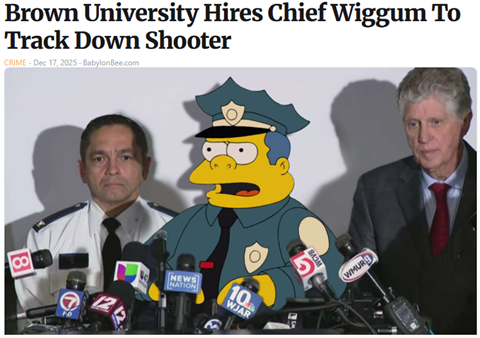
The Brown University shooter has been found dead by his own hand in a storage locker in southern New Hampshire. The entire officialdom of Providence, Rhode Island celebrated by throwing “the most worthless, uninformative, cover-your-ass press conference I have ever seen in my entire life“.
You’ll be glad to hear that the DEI Mayor of Providence has declared “we believe that you remain safe in our community“. He said this at 11pm last Sunday, but his statement was technically true because at that point the shooter was driving out of “our community” up to someone else’s community to kill an MIT professor, who would assuredly be alive today had not everybody in Providence bungled everything that could be bungled. The storage-locker guy and the Boston guy are both Portuguese nationals of the same age who are believed by the FBI to have attended the same university in Lisbon at the end of the last century. What that means, who knows? A random mass-shooting as prelude to something more personal and targeted? As is now traditional, I doubt we shall ever know, […] However, we do know how the forty-seven genius law-enforcement agencies “cracked the case”. An Internet user saw this post on Reddit, and brought it to the attention of one of the forty-seven agencies, who shortly thereafter swung into what passes for action. Here’s what the Redditor wrote:
I’m being dead serious. The police need to look into a grey Nissan with Florida plates, possibly a rental. That was the car he was driving. It was parked in front of the little shack behind the Rhode Island Historical Society on the Cooke St side. I know because he used his key fob to open the car, approached it and then something prompted him to back away. When he backed away he relocked the car. I found that odd so when he circled the block I approached the car and that is when I saw the Florida plates. He was parked in the section between the gate of the RIHS and the corner of Cooke and George St.
That’s it. That’s the entire “investigation”. “He blew this case right open. He blew it open,” cooed the Rhode Island Attorney-General, Peter Neronha. “That person led us to the car, which led us to the name, which led us to the photographs of that individual renting the car, which matched the clothing of our shooter here in Providence, that matched the satchel which we see here in Providence.”
Great. His name is “John”, and he had multiple interactions with the killer on the day of the shooting — both in the bathroom of the building two hours beforehand and by the car to which the killer kept circling back to see if “John” had ended his apparent stakeout of the vehicle. He spoke to the man long enough to determine that he had an “Hispanic” accent. In fact, Portuguese. But close enough. Or closer than the forty-seven kick-ass agencies.
But here’s the thing: “John” only wrote his post on Reddit because nobody on the scene was interested in what he’d seen that day. “John” is apparently a homeless man who lives in the basement below the scene of the shooting.
Come again? Brown University lets the homeless live in its faculty buildings? You might want to bear that in mind if you’re thinking of taking on six-figure debt to be gunned down at the Ivy League.
Oh, wait, no, relax: “John” is not any old homeless man but a graduate of Brown. They’re not all working as baristas. So it’s some grandfathered-in alumni legacy racket.
Which brings us to the other thing: He was generally known to be living there. So, on Saturday or at the very latest Sunday, why did no-one from the forty-seven kick-ass agencies seek to interview him? His would surely have been a unique perspective: neither teacher nor pupil, but someone who knows the building after-hours and observes the comings and goings. One expects the three-mil-a-year DEI president’s “campus security” to totally suck, but how can you call in the FBI and then the elite best-of-the-best G-men not be aware that there’s a guy living in the basement under the scene of the crime who had multiple interactions with the perp?
As I have had cause to remark a thousand times, nothing works anymore. When I observe that of the UK, English readers get mildly peeved. When I observe it of the Fifth Republic, French readers start gabbling and waving their Gauloise-stained hands around so animatedly their strings of onions fall from their shoulders. And, when I observe it of the United States, American readers get particularly chippy. But I’m an equal-opportunity civilisational doom-monger: we’re all going over the falls, and arguing that the canoe of the Euro-pussies or the tight-assed Brits is a foot-and-a-half ahead isn’t really much consolation. Police-wise, the Aussie constabulary bollocksed Bondi Beach and the forty-seven Yank agencies bollocksed Brown and MIT.
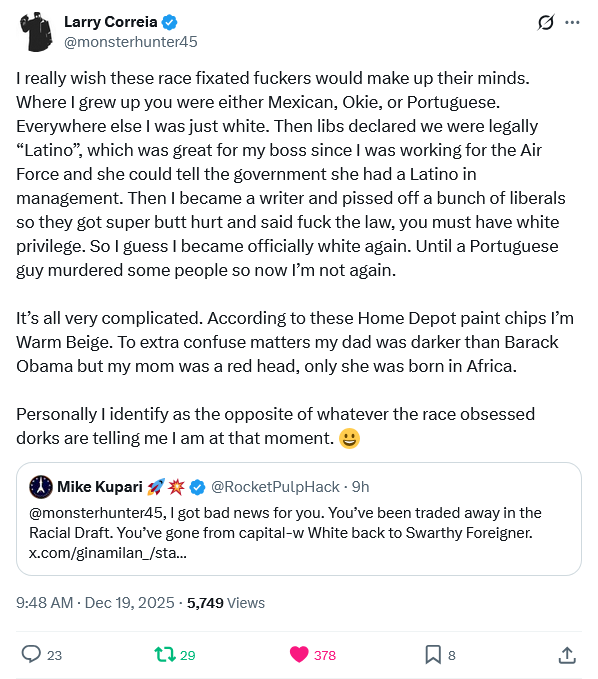
Of course, with the revelation that the shooter may have been Portuguese, the race hustlers are busy re-sorting the hierarchies of victimhood:
“We don’t want to change Canada; we want the Canada we grew up in back”
On the social media site formerly known as Twitter, Gun Owners of Canada refute claims that they want to change the nation and explain that the nation has been radically changed to the agenda of a small, urban pressure group by compliant politicians and civil servants:

For those of us who grew up in or lived through the 1980s and 1990s, the change is impossible to miss.
We remember a Canada where firearms ownership was ordinary, regulated, and largely uncontroversial. Target shooting, hunting, and collecting were part of everyday life. Gun clubs existed quietly on the edge of town. Weekend trap shoots, small-bore leagues, cadets, and hunting camps weren’t political statements, they were just normal parts of growing up.
That Canada had rules. Before the mid-1990s, ownership was governed through the Firearms Acquisition Certificate (FAC) system. You were screened, approved, and expected to act responsibly. Misuse was punished severely. But lawful owners weren’t treated as provisional citizens, waiting to see if the rules would change again next year.
Context matters. In the Canada of the 1980s, firearms that are now politically charged were treated very differently. The AR-15, for example, existed openly within the shooting sports community and was classified as non-restricted at the time. It was regulated, owned by vetted individuals, and largely absent from public controversy.
That isn’t shocking to people who lived through it. It simply illustrates how much the framework has shifted.
Firearms ownership in that era wasn’t limited to a single purpose. Most people participated through sport, hunting, or collecting. Some also possessed firearms with personal security in mind, particularly in rural areas, remote communities, or professions where police response was distant. This wasn’t sensationalized, and it wasn’t politicized. It was understood as part of lawful ownership, governed by responsibility and accountability.
In the Canada many of us grew up in, following the law meant something. If you complied with the rules as they existed, you could reasonably expect stability.
That’s what’s been lost.
Beginning in the mid-1990s, Canada transitioned to the modern licensing system and expanded registration, classification, and regulation. The shooting sports community adapted, again, to our own fault. We trained, we licensed, we registered, and we complied in good faith.
What we didn’t grow up with was the idea that entire classes of legally owned firearms could be redefined by regulation overnight. Or that decades of compliance could still end in confiscation, not because of misuse, but because of shifting political definitions and political theatre.
When firearm owners push back against this, we’re told we want to “change Canada.”
From our perspective, we’re responding to the change, not demanding it.
Other democracies have recognized the risk in allowing lawful ownership to exist solely at the discretion of the government of the day. Some have taken steps to ensure that civilian firearms ownership, particularly for sport, hunting, and lawful personal security, is anchored in a way that prevents arbitrary reclassification, while still allowing strong regulation and oversight.
That idea isn’t radical. It’s about predictability, due process, and trust between citizens and governance.
Firearm owners aren’t asking for chaos. We’re asking for the same social contract we grew up with: follow the rules, be accountable and don’t have the ground shift beneath your feet without warning.
So, no. We don’t want to change Canada.
We want the Canada we knew, back:
One where responsibility mattered, laws were stable, and lawful communities weren’t erased by regulation.Bring that Canada back. This one doesn’t resemble it, at all.
Comments Off on “We don’t want to change Canada; we want the Canada we grew up in back”
Christmas During the Great Depression
Tasting History with Max Miller
Published 17 Dec 2024Gelatinous Christmas pudding with chocolate, nuts, dried fruit, and whipped cream
City/Region: United States of America
Time Period: 1931During the Great Depression, making Christmas festive was more important than ever. Homemade gifts, cards, and decorations defined the season when money was tight for everyone. Many people who lived through the Great Depression recalled that no matter what, Christmas dinner was special.
This recipe from 1931 comes from a radio program hosted by the fictional character Aunt Sammy, who was supposedly the wife of Uncle Sam. I’m not quite sure how this Christmas pudding was much less expensive than a traditional boiled pudding, but it’s an interesting change nonetheless. I like the flavors of the chocolate and fruit coming through, though I do wish the texture was a little smoother.
There are twelve ingredients. Quite a lot to write down but I’ll go slowly.
2 tablespoons of granulated gelatin
1 cup of cold water
1 pint of milk
1 cup of sugar
1 and 1/2 squares of chocolate
1 cup of seeded raisins
3/4 of a cup of dates
1/2 cup of nuts
1/2 cup of currants, and
3 egg whitesThat’s a long list. I’ll go over it again while you check. (Repeat)
To make this pudding, first soften the gelatin in the cold water for ten minutes. While the gelatin is soaking, melt the chocolate with part of the sugar. When it is melted, add a little of the milk, just enough to make a smooth paste. Put the rest of the milk in the upper part of the double boiler. When the milk is hot, add to it the melted chocolate. Then the sugar and salt. And, finally, the soaked gelatin. Stir the mixture. Then remove it from the fire. Set it away to grow cold. When it begins to thicken, add the vanilla, the fruit, and the chopped nut meats. Then fold in the beaten egg whites.
Now turn the mixture into a wet pudding mold decorated with whole nut meats and raisins. Set the mold in the refrigerator or other cold place, to chill. When the pudding is cold and firm, and it is time for serving at dinner, turn it out on a pudding plate or platter. Garnish it with sprigs of holly. A wreath of holly springs around the edge and one stuck in the top makes it look like a real Christmas pudding.
Serve the pudding with whipped cream, sweetened and flavored with vanilla, or with a currant jelly sauce.
— Aunt Sammy, December 1931
Comments Off on Christmas During the Great Depression
QotD: Women’s Rugby
Now, however, the sport is professional and played by men who seem to be eight feet wide and run straight into one another, very fast and often headfirst. Not surprisingly, a significant proportion of them suffer from traumatic dementia very early in their lives, and some, understandably though I do not think justifiably, try in the early stages of their sad condition to obtain financial compensation. The sport has become so violent that even people who are not unduly sensitive to violence shrink from observing it close-up.
Freud might have taken these women’s desire to participate in a sport that is so radically unsuited to them as an instance of what, in one of his absurd speculations about the psychology of women, he called penis envy. I think, rather, it is a sign of the masculinization of at least some women, who are responding to the overvaluation in our culture of the exercise of power as the supreme end in life. The exercise of all power is fleeting, sporting prowess being among its most fleeting forms; but the illusion dies hard.
Theodore Dalrymple, “All in a Day’s Irk”, New English Review, 2025-08-29.
Comments Off on QotD: Women’s Rugby
December 19, 2025
“2014 was the hinge, the year DEI became institutionalized across American life”
In Compact, Jacob Savage talks about the “Lost Generation” … not a reference to the group before the “Greatest Generation” who fought and died in their millions in the trenches of World War One … but a much more recent group who are still becoming living casualties of a war fought without weapons and uniforms, but just as bitter and unnecessary:
In retrospect, 2014 was the hinge, the year DEI became institutionalized across American life.
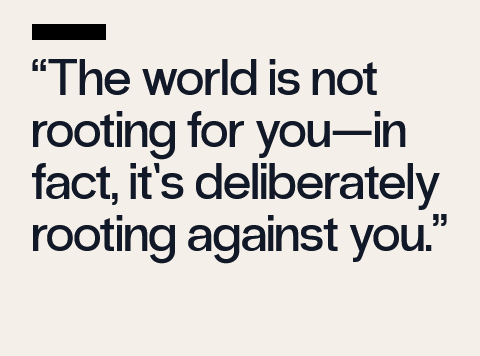
In industry after industry, gatekeepers promised extra consideration to anyone who wasn’t a white man — and then provided just that. “With every announcement of promotions, there was a desire to put extra emphasis on gender [or race],” a former management consultant recalled. “And when you don’t fall into those groups, that message gets louder and louder, and gains more and more emphasis. On the one hand, you want to celebrate people who have been at a disadvantage. On the other hand, you look and you say, wow, the world is not rooting for you — in fact, it’s deliberately rooting against you.”
As the Trump Administration takes a chainsaw to the diversity, equity, and inclusion apparatus, there’s a tendency to portray DEI as a series of well-meaning but ineffectual HR modules. “Undoubtedly, there has been ham-fisted DEI programming that is intrusive or even alienating,” explained Keeanga-Yamahtta Taylor in The New Yorker. “But, for the most part, it is a relatively benign practice meant to increase diversity, while also sending a message that workplaces should be fair and open to everyone.”
This may be how Boomer and Gen-X white men experienced DEI. But for white male millennials, DEI wasn’t a gentle rebalancing — it was a profound shift in how power and prestige were distributed. Yet practically none of the thousands of articles and think-pieces about diversity have considered the issue by cohort.
This isn’t a story about all white men. It’s a story about white male millennials in professional America, about those who stayed, and who (mostly) stayed quiet. The same identity, a decade apart, meant entirely different professional fates. If you were forty in 2014 — born in 1974, beginning your career in the late-90s — you were already established. If you were thirty in 2014, you hit the wall.
Because the mandates to diversify didn’t fall on older white men, who in many cases still wield enormous power: They landed on us.
[…]
Institutions pursuing diversity decided that there would be no backsliding. If a position was vacated by a woman or person of color, the expectation was it would be filled by another woman or person of color. “The hope was always that you were going to hire a diverse candidate,” a senior hiring editor at a major outlet told me. “If there was a black woman at the beginning of her career you wanted to hire, you could find someone … but if she was any good you knew she would get accelerated to The New York Times or The Washington Post in short order.”
The truth is, after years of concerted effort, most news outlets had already reached and quietly surpassed gender parity. By 2019, the newsrooms of ProPublica, The Washington Post, and The New York Times were majority female, as were New Media upstarts Vice, Vox, Buzzfeed, and The Huffington Post.
And then 2020 happened, and the wheels came off.
[…]
There are many stories we tell ourselves about race and gender, especially in academia. But the one thing everyone I spoke to seemed to agree on is it’s best not to talk about it, at least not in public, at least not with your name attached. “The humanities are so small,” a millennial professor nervously explained. “There’s a difference between thinking something and making common knowledge that you think it,” said another.
So it came as a bit of a shock when David Austin Walsh, a Yale postdoc and left-wing Twitter personality, decided to detonate any chance he had at a career with a single tweet.
“I’m 35 years old, I’m 4+ years post-Ph.D, and — quite frankly — I’m also a white dude,” he wrote on X. “Combine those factors together and I’m for all intents and purposes unemployable as a 20th-century American historian.”
The pile-on was swift and vicious. “You are all just laughable,” wrote The New York Times‘ Nikole Hannah-Jones. “Have you seen the data on professorships?” “White males are 30 percent of the US population but nearly 40 percent of faculty,” tweeted a tenured professor at GWU. “Hard to make the case for systemic discrimination.”
It didn’t matter that as far back as 2012 women were more likely to be tenure-track across the humanities than men, or that a 2015 peer-reviewed study suggested that STEM hiring favored women, or even that CUPAHR, an association of academic DEI professionals, found that “assistant professors of color (35 percent) and female assistant professors (52 percent) are overrepresented in comparison to US doctoral degree recipients (32 percent and 44 percent respectively).”
As in other industries, what mattered were the optics. When people looked at academia, they still saw old white men. Lots of them.
“A big part of why it’s hard to diversify is the turnover is really slow,” a tenured millennial professor explained. “And that’s become worse now, because Boomers live a long time.” Many elite universities once had mandatory retirement at 70. But in 1994, Congress sunsetted the academic exemption for age discrimination, locking in the demographics of the largely white male professoriate for a generation.
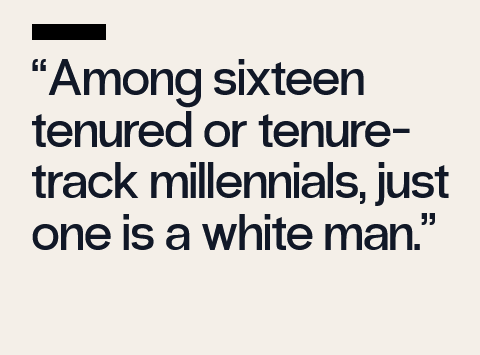
White men may still be 55 percent of Harvard’s Arts & Sciences faculty (down from 63 percent a decade ago), but this is a legacy of Boomer and Gen-X employment patterns. For tenure-track positions — the pipeline for future faculty — white men have gone from 49 percent in 2014 to 27 percent in 2024 (in the humanities, they’ve gone from 39 percent to 21 percent).
The strange rebirth of English patriotism
In The Conservative Woman, Niall McCrae discusses what he calls “a new crusade” as the downtrodden English rediscover — or in many cases, discover for the first time — patriotic feelings for their nation, and earn the scorn and contempt of the ruling class and their media fart-catchers:

“Union Jacks and crosses of St George” by Ben Sutherland is licensed under CC BY 2.0 
 .
.
A wave of patriotism swept across England last summer. Flags were tied to lampposts up and down the country, but while these displays had wide public support, the intelligentsia were troubled, particularly as the colours were often flown in areas of cultural diversity or on roads passing hotels accommodating illegal immigrants. This suggested provocation, rather than the use of national flags to celebrate sporting success.
Politicians and Guardian commentators were careful not to appear too negative, but they emphasised unity and inclusion over nationalistic fervour. The Union Jack was preferable to the St George’s Cross, because they associated the latter more with the far right (this is not accurate, as groups such as the National Front and BNP rallied under the Union Jack).
The Union Jack (properly termed “flag” as a jack is hoisted at sea), comprises the crosses of St George, St Andrew and St Patrick. It is perhaps the most impressive flag in the world, a classic design of great cultural impact. How globalists, the EU and Islamists would like to banish it!
The “Unite the Kingdom” march led by Tommy Robinson in September, which brought a million people to the streets of London, was a marvellous spectacle of patriotism. For the counter-Jihad movement, conflict in the Middle East is regarded as an existential struggle against militant Islam. Israeli flags are often waved towards pro-Palestine marchers, and the London rally gave several Zionists a platform at Whitehall. However, the vast majority of marchers were there for one country only – their own. This was truly a British event, with a roughly equal mix of Union and St George flags, alongside some Welsh dragons and Scottish saltires, and Irish tricolours too.
Significantly, there was another symbol prominently at the London march: the Christian cross. A poignant moment was at the ramparts of Westminster Bridge, where a fearless young man mounted the head of the stone lion and from that precarious pedestal raised in one hand the flag of St George, and in the other a wooden cross. (https://www.instagram.com/reel/DOpagGvkQk9/)
I first observed the resurgence of Christian faith at the huge protests against the Covid-19 regime. Several marchers bore crosses, or placards asserting the power of God over earthly evil. The Book of Revelation was quoted, and when the “vaccine” was launched it was cast as the “Mark of the Beast”.
Socially unacceptable they may have been, but now St George and Christian crosses are regularly appearing together in gatherings for patriotic or traditional causes. In his book Worth Dying For: The Power and Politics of Flags (2017), Tim Marshall observed that “with the rise of Islam in Europe, these symbols are likely to be increasingly used by the far right to try to define the continent as what they think it is, and in opposition to what they think it is not”. You can’t get a book released by a mainstream publisher without expressing such approved outlook, but Marshall is making the mistake of blaming patriots for the devaluing of their national flag; it is surely the subversive ideology of the progressive left that has taught generations that national pride is regressive and bigoted. Meanwhile “woke” warriors are not shy of waving the Pride rainbow, transgender stripes and the flag of Palestine. And the likes of Hope Not Hate had no complaint about huge fascist-style marches awash in the blue and yellow stars of the EU.
Brendan O’Neill on the Islamophobia racket
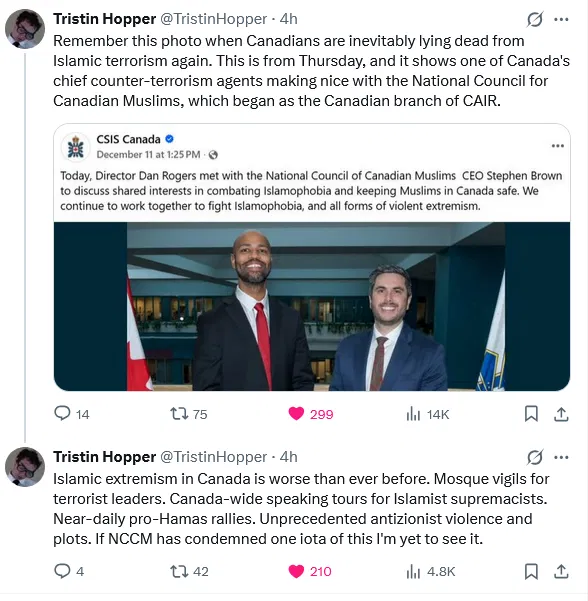
In the National Post, Brendan O’Neill criticizes Australian Prime Minister Anthony Albanese in particular, but he’s just the most recent exemplar of western politicians trying to blame society in general and “right wing extremists” in particular for the terrorist attacks by Islamic extremists:
Australian Prime Minister Anthony Albanese spoke a total of 5,022 words in the day after the slaughter of Jews at Bondi Beach. And not one of those words was “Islam”. Or “Muslim”. Or even “Islamic extremism”.
He did talk about the “far right” though. Twice. We need to tackle “the rise of right-wing extremist groups”, he said.
What an odd thing to focus on the day after a father-and-son Islamofascist outfit had mown down 15 innocents, all while proudly displaying the black flag of ISIS.
To fret about the far right hours after suspected Islamic militants had carried out the worst slaughter of Jews in Australian history is cognitive dissonance of epic proportions.
It would be like turning up to the bloody aftermath of a KKK massacre and flat-out refusing to say the words “Klansmen”, “racist” or “white supremacist”. Well, we wouldn’t want to offend the pointed-hood community.
Some Australians were dumbfounded by the PM’s bullish refusal to name the ideology that fuelled this act of antisemitic savagery.
After all, at the time he was holding forth on the various threats to the Aussie way of life, officialdom had found the killers’ ISIS flag and other paraphernalia suggesting they had taken the knee to the death cult of radical Islam.
“What happened at Bondi was an act of radical Islamic terrorism”, thundered Sean Bell of the populist party One Nation. If the PM “cannot be honest” about the “radical Islamic ideology”, he said, “then he has no place leading the country”.
It’s hard to disagree. The first duty of a leader following the barbarous slaying of citizens is to tell the truth. If Albanese can’t even bring himself to mouth the words “Islamic extremism”, how’s he going to fight it?
The PM’s yellow-bellied dodging of the i-word was shocking but not surprising. Other Western leaders have behaved similarly in the wake of Islamist outrages. They have furiously thumbed their thesauruses for spins on the word “extremist” — fanatic, militant, evil — all so that they can avoid committing that most gauche faux pas in polite society: talking about the problems in Islam.
This is the dire handiwork of the Islamophobia industry. For years now, Islam has been ruthlessly ringfenced from free, frank discussion.
Mock Muhammad and you’ll be damned as “phobic”. Crack a joke about the Koran and you can expect a mob of fundamentalists at your front door. Say Islam has an extremism problem and the self-elected guardians of correct-think will drag you off for re-education.
We’ve witnessed the rehabilitation of medieval strictures against “blasphemy”. The end result is that even as women and children writhe in agony from the wounds inflicted on them by Islamist militants, still our leaders won’t say that i-word. It clogs in their throats. They dread cancellation more than they cherish truth.
[…]
After every attack, the same platitudes are trotted out. “Nothing to do with Islam”. “Islam is a religion of peace”. We’re gagged from naming the threat we face, from correctly identifying the men who are killing our fellow citizens.
Believe them when they show you what they are, Oz edition:
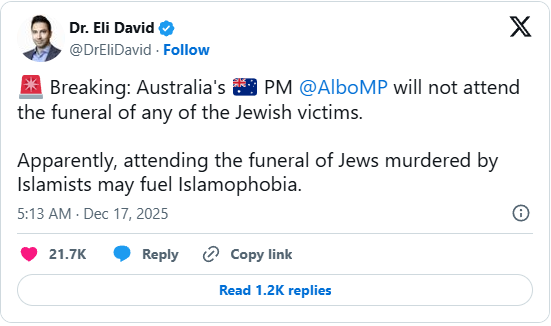
In The Line, Ariella Kimmel thinks there are signs that at least some political figures are getting the right lessons out of the events of the last few years:
In the wake of the terrorist attack in Bondi Beach, it seems as if leaders are finally starting to realize the risk of allowing antisemitic extremism to run unchecked for years.
Calgary’s new mayor offered a powerful example of what this means in practice.
At Calgary City Hall’s Chanukah celebration, Mayor Jeromy Farkas delivered remarks that stood out not only for their eloquence, but for their accountability. He spoke plainly about antisemitism and acknowledged the very real fear that Jewish communities are living with. Most importantly, he made clear that civic leadership means showing up publicly, consistently, and without excuses.
In a room of just over a thousand, he declared “let me be absolutely crystal clear. There is no place for antisemitism in Calgary. Not on our streets, not in our schools or campuses, not at protests, not online, not hidden behind slogans, not excused as politics, because Jewish lives are not expendable. Jewish safety is not expendable.”
That moment was especially symbolic given Calgary’s recent past. Two years ago, then-Mayor Jyoti Gondek refused to attend a Chanukah event amid pressure and controversy. Farkas’ presence this week marked a break from that pattern. It signalled that someone, finally, was willing to take responsibility.
That is what leadership looks like.
The Bondi Beach attack should force a reckoning in Canada. If we want to avoid becoming the next headline, this country must do more than mourn; we must decide, clearly and concretely, that extremism has consequences and that antisemitism will not be indulged.
In Canada, politicians were quick to offer condolences. Statements flowed with the standard lines – “my thoughts are with the community”, “our government condemns all forms of hate”, “no one should be targeted for practicing their religion”. The words are familiar, and quite frankly hollow, because for the past two years, many of the same leaders issuing their thoughts and prayers have either ignored, excused, or actively engaged with movements that normalize hostility toward Jews.
Since October 7, Jewish Canadians have watched as public spaces became hostile territory. Synagogues require police protection, while Jewish schools are shot at and community centres are defaced. Rallies openly glorify terrorist groups, call for the destruction of Israel, and chant slogans that any reasonable person understands as genocidal, such as calls to “globalize the intifada”, “from the river to the sea Palestine will be free”, “there is only one solution, intifada revolution”, and “resistance is justified”.
What makes the current moment particularly dangerous is the gap between rhetoric and reality among leaders. Politicians speak of fighting hate while refusing to enforce existing laws against intimidation, mischief, and hate-motivated harassment. They speak of unity while legitimizing groups and movements that openly reject the safety of Jewish communities, even giving funding through government programs meant to combat antisemitism, to organizations that perpetrate it. They issue statements condemning violence abroad while tolerating the ideological conditions that make violence inevitable at home.
Pick One: G1 (FAL) vs G3 (H&K) w/ John Keene
Forgotten Weapons
Published 2 Aug 2025If you had to pick one, would you take a G1 (FAL) or a G3 (H&K)? Both are 7.62mm NATO rifles adopted by Germany. The G1 has more features and capabilities, like the carry handle, bipod, multiple muzzle devices, and adjustable gas system. The G3, on the other hand, is simpler, without things to change for better or worse. So which would you take?
(more…)
QotD: “1998 was the official start of the Girlboss Era”
Paltrow seemed to arrive on the scene having everything and wanting for nothing.
Funny, that’s also the most accurate description of an AWFL ever penned. Who the hell are they, and where did they come from? How do they have the free time and endless disposable cash to do literally every single thing they do?
In 2001, she promoted Shallow Hal — in which she played Rosemary, an obese woman whose “inner beauty” is only visible to Hal (Jack Black) — by talking about doing practice runs in her character’s fat suit. “I got a real sense of what it would be like to be that overweight, and every pretty girl should be forced to do that.”
Wait, this is supposed to be a hit piece? Because that might be the most sensible thing I have ever heard a woman say. Yes, definitely they should be forced to do that, if not the full Norah Vincent. If you’re halfway presentable, ladies — hell, if you’re not grossly deformed — you’re playing life on “God mode”. Look at all the simps in your social media feeds, and tell me I’m wrong. Being forced to go around in a fat suit for a week or two is a necessary corrective.
Paltrow’s first big trip on the Hollywood hater-go-round was 1998, the year she won the Best Actress Oscar for Shakespeare in Love and gave a memorably messy, genuinely emotional acceptance speech. (Days after her win, Salon was among many outlets eviscerating her.) What viewers didn’t see, Odell notes, is the amount of effort by Miramax head Harvey Weinstein to make Shakespeare a winner, raise the profile of his still-independent studio, and solidify his belief that Paltrow belonged to him.
I’m going to stop here, because there’s really no point. I just wanted everyone to remember Shakespeare in Love. You do remember Shakespeare in Love, don’t you?
Of course you don’t; it was silly and forgettable at the time, and now is remembered, if at all, as a bizarre footnote — it’s the movie that won Best Picture over Saving Private Ryan. From the perspective of 2025, then, it sure looks like 1998 was the official start of the Girlboss Era.
Severian, “Kvetching Up With Karen: DC Edition”, Founding Questions, 2025-08-14.
Comments Off on QotD: “1998 was the official start of the Girlboss Era”
December 18, 2025
A 2025 Update from the Canadian Tank Museum
The Chieftain
Published 13 Dec 2025When up at the Canadian Tank Museum a whiles back, I caught up with Sam to find out what’s been going on up there and what’s coming soon.
Comments Off on A 2025 Update from the Canadian Tank Museum
“You can still hunt”
The Canadian federal government is working diligently (well, “diligently” by civil service standards) to disarm Canadians, and have been doing so for decades now. Rather than cracking down on criminal use of firearms, which would be difficult, they concentrate their efforts on literally the most law-abiding group of Canadian citizens — legal gun owners … because it’s easy, safe, and gets them lots and lots of friendly media coverage from the equally anti-gun Canadian media (few of whom even know any gun owners personally).
One of the constant replies when legal gun owners protest against yet another gun grab or tightened legal restriction is along the lines of “this doesn’t affect you: you can still hunt” … but hunting is only a part of Canadian gun ownership, and not the largest part. On the social media site formerly known as Twitter, Gun Owners of Canada explains why “you can still hunt” is neither helpful nor constructive in the larger conversation:
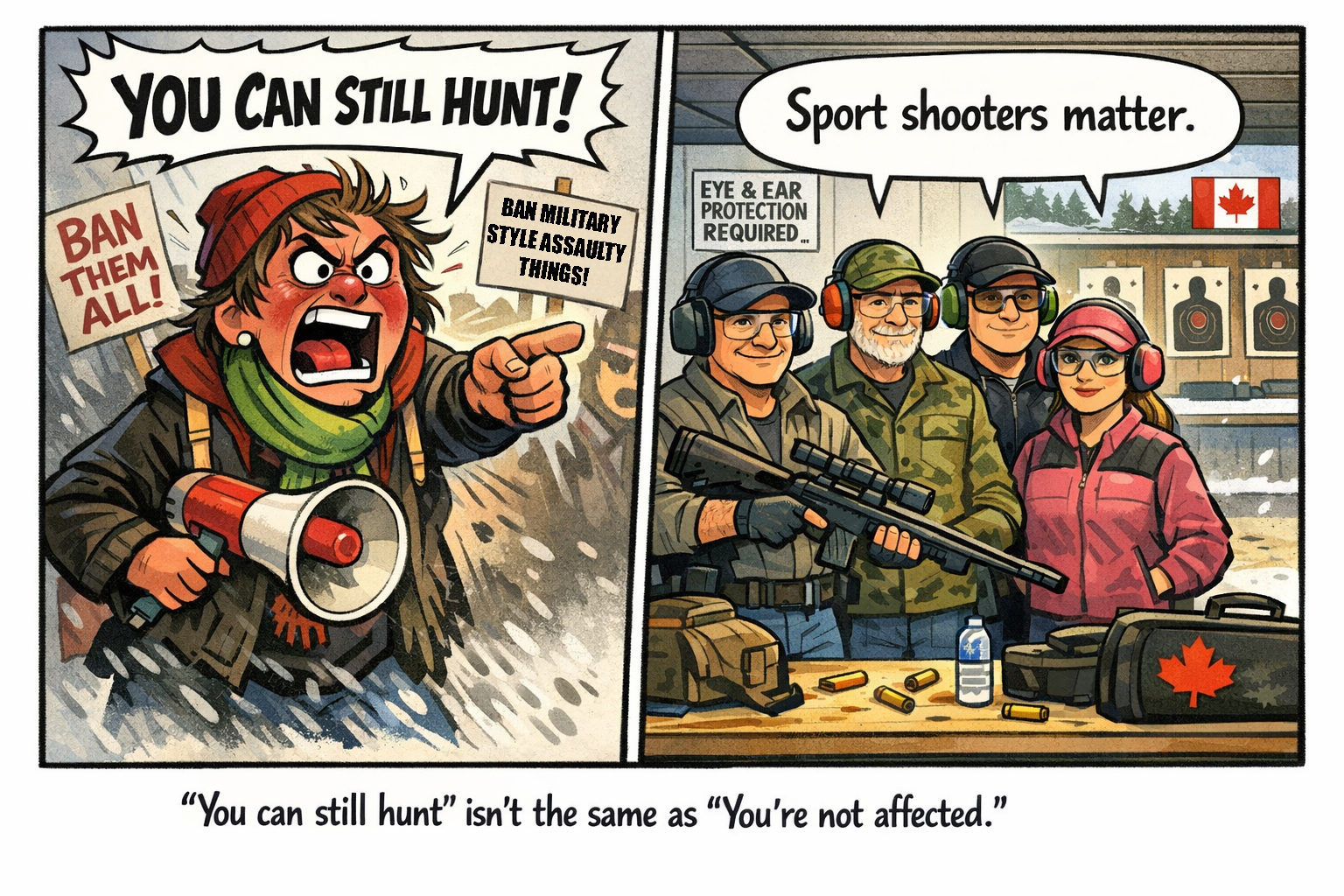
We keep hearing the same tired line:
“You can still hunt.”
But that’s not what this is about.
That phrase exists because it’s simple, relatable, and politically convenient for people who don’t understand Canada’s firearm laws or their history. If you do understand them, you’re in the minority.
For most Canadian firearm owners, shooting has never been just about hunting. Yes, we hunt — but the bulk of our time is spent at the range, participating in recreational and competitive target shooting. That’s where families gather, skills are learned, friendships are built, and the next generation is introduced to safe, responsible firearm ownership.
Sport shooters are the backbone of the firearms community and the industry that supports it. We shoot year-round, we buy ammunition regularly, and we keep ranges and retailers alive. Many hunters will bring the same box of ammo to camp year after year. Both matter — but they are not the same.
Over the past six years, lawful firearms have been prohibited, replaced, and then prohibited again. Models that once brought families together at the range can no longer be used. That experience — one many of us grew up with — is increasingly out of reach for our kids.
This admin grew up at the range with parents and grandparents deeply involved in Canadian shooting sports. That’s where lifelong relationships were formed. Many of those people don’t hunt at all — but they are responsible, licensed, community-minded Canadians.
So when restrictions strip away lawful, safe activities while violent criminals face little consequence, don’t expect silence — or gratitude.
This isn’t about hunting.
It’s about what’s been taken, who it’s been taken from, and who’s expected to quietly accept it.
Don’t accept it. Get involved. It’s not like there aren’t enough advocacy groups to join and political avenues to get involved in.
For my own part, I no longer have the resources to do any shooting, but I was always interested in target shooting, not hunting. It was fun, and isn’t that what your hobbies should be for? Back when I sometimes travelled on business, I used to envy my American co-workers who had legal access to a plethora of shooting ranges and a much-less restrictive licensing regime. Every chance I got to go out to the range and try new-to-me rifles and pistols was like an adult version of a trip to the candy store. The one time I was nearly shot, ironically, was on a military target range when I was in the army reserves … an idiot (who out-ranked me) had a misfire with his submachine gun and turned away from the target towards me as the round fired. Fortunately, the bullet went in a safe-ish direction and nobody was hurt.
Update, 19 December: Welcome, Instapundit readers! Please do have a look around at some of my other posts you may find of interest. I send out a daily summary of posts here through my Substack – https://substack.com/@nicholasrusson that you can subscribe to if you’d like to be informed of new posts in the future.
How to Carve a Star | Paul Sellers
Paul Sellers
Published 25 Jul 2025I have been asked to create this video for some time but couldn’t get to it. Here it is.
All you need is a good sharp chisel. This chisel is an Aldi, £2.50 version, so nothing special. The steps I show guarantee a positive outcome, but please be prepared to put in some practice on a scrap of wood. Avoid softwoods because they have hard and soft aspects surrounding the growth rings which are sometimes difficult to work with. I’m using cherry, but there are many choices that have consistent grain, such as poplar, oak, and walnut.
Carving this star took me a little over half an hour to do. With practice, you will get to understand the grain of the wood, direction and the chiselling techniques I used. I hope you enjoy creating your star!
(more…)
Comments Off on How to Carve a Star | Paul Sellers


