Quotulatiousness

October 31, 2025

The “internet of shit” is somehow managing to get even shittier

Filed under: Business, Media, Technology — Tags: , , — Nicholas @ 05:00

At The Honest Broker, Ted Gioia enumerates just a few of the ways that advertisers have abandoned attempts to persuade you and instead now run online extortion rackets to get you to pay to avoid having to see their ads:
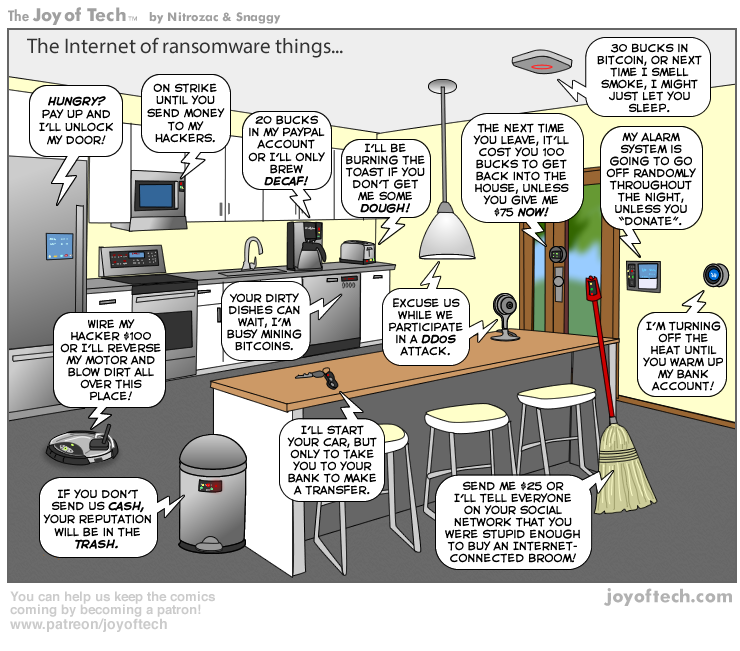
Advertising is no longer about creativity and storytelling. Ads are now a matter of annoyance, plain and simple (as I recently described in this article).

It’s a simple concept. Web platforms force people to pay money to avoid the ads — so the more annoying they are, the more money they make.

They used to call it extortion — pay now to avoid pain later. And it always works like a charm. Needless to say you don’t need an English major to run an extortion business. (However, they do make good victims.)

This business strategy started out in media — where it made some sense. People are familiar with the idea of advertising during screen entertainment.

And here is how it played out:

  • YouTube started this with the launch of an ad-free tier in 2014.
  • Paramount announced an ad-supported subscription plan in June 2021.
  • Disney + launched a low-price subscription option with advertising in March 2024.
  • Netflix introduced a similar program in October 2022.
  • Amazon Prime did the same thing in early 2024.
    But in the last few months, it’s gone crazy. The ads are spreading beyond movies and videos — and into almost anything with a digital interface. So we’ve seen the following in recent days:
  • Jeep drivers started complaining about ads on their vehicle touchscreen in early 2025. An ad for an extended warranty allegedly appears every time they stop their car (at a red light, etc.).
  • Meta announced an ad-free subscription option for Facebook and Instagram in September 2025. (initially in the UK).
  • Microsoft announced an ad-supported subscription plan for Xbox cloud gaming in October 2025.
  • A rumor about Apple inserting ads into its map app started spreading in October 2025. This will allegedly launch in 2026.

This is more than annoying — it’s also abusive. A new Jeep can cost $50,000 or more. When you hand over that much cash, you should get an exemption from spam ads on your screen.

But the most annoying move of all is coming from Samsung. They are putting ads on $3,499 smart fridges. They’re rolling out this “software upgrade” right now.

According to Samsung, your smart (or maybe smart-ass) refrigerator will soon share “useful day-to-day information such as news, calendar and weather forecasts, along with curated advertisements”. The display will change every ten seconds.

I definitely rely on my fridge for some things — milk, eggs, orange juice, and an occasional cold beer. But you don’t see curated advertisements on that list.

Ads will never be on the list.

“NFL media is dominated by the nerds” and their “never-ending performance of Well, Actually football contrarianism”

Filed under: Football, Media, USA — Tags: , , , , — Nicholas @ 04:00

Freddie deBoer discusses the way NFL media coverage has changed from the retired jocks of old to today’s emphasis on data nerd analysis and clickbait contrarianism:

Being a sports media professional means forcing yourself to have this kind of a reaction every time you’re on camera.
Screencap from Freddie deBoer

Consider how smart football journalism was supposed to be by now. Long the domain of ex-jocks ladling out evidence-free bromides about how you have to pound the ball and causation-flipping claims that time of possession is the ultimate metric, today NFL media is dominated by the nerds, analysts who proudly announce that they’ve never played the game and let their teenage resentments power their never-ending performance of Well, Actually football contrarianism. Experience is out! Numbers are in! Empiricism reigns! The bible was right: someday, the meek will inherit the earth, and it’s happening every Sunday on NFL Twitter, where it’s always time to re-prosecute high school.

And yet … The analytics revolution promised to graft rationality and context onto our game-day commentary, but when it comes to the most common and pernicious trend in NFL analysis — overreacting to small samples and short runs of good or bad performance — nothing has really changed. That’s because NFL new media conditions dictate that even the most temperamentally sober and judicious talking heads operate as 24/7 hype machines. This is not, to put it mildly, a new problem. In 2007, ESPN’s Kevin Jackson wrote that NFL media was “Overreaction Nation – a land where no sample size is too small for drawing conclusions, where the most common movement is the knee-jerk”. That description still fits the NFL media perfectly. Week after week, cable TV and podcasters spin wild narratives, proclaiming teams hopeless or superhuman after one game, seemingly embracing the idea that “no sample size is too small”. That this all comes from people who will tell you that they’re the keepers of the flame of Rational Football Analysis only makes it all more annoying.

Modern front offices have jumped on modern statistical analysis, with every team employing analytics departments and with more and more coaches regularly expressing disdain for yesterday’s conventional wisdom. This isn’t a secret; the Ringer, which has always employed its fair share of football nerds who heap contempt on the old ways, proclaimed back in 2018 that “football’s analytics moment has arrived”, pointing out the rise of modern tracking data and explaining how it gives teams an edge. But if we’re honest, even the Ringer was clear that football will never be baseball in statistical clarity: “Football will likely never be baseball, where statistics can basically explain anything,” Kevin Clark (now of ESPN) wrote – “there are too few games and too many variables”. In other words, the sport I love the most is inherently a beast of variance, full of noise. You’d think that message would temper the beat writers.

Instead, it seems the analytics evangelists and talking heads don’t trust their own analytic philosophy. They invoke “small sample size” as a scolding cliché if you dare overreact, but shamelessly turn right around and do it themselves. With every Monday morning comes a fresh rush of oversimplified hot takes. And time has proven that the ostensibly-objective analytics peddlers are no better when it comes to hype than their old school former player competition.

The Minnesota Vikings drafted J.J. McCarthy last year as their “quarterback of the future” only to lose him for his rookie season with a knee injury in the preseason. He started two games so far this season and got injured in his first loss and will only return to play this coming weekend. Bust? A lot of online fans certainly seem to think so, on the basis of a two-game sample, one of which included one quarter of amazing work earning him NFC Offensive Player of the Week. Fans are fickle at the best of times, but the NFL media hype juices that into a kind of sports schizophrenia.

Could Drake Maye be the next big thing? Sure. He certainly has the physical ability. Or he could be Daunte Culpepper. Could CJ Stroud and Jayden Daniels justify all of the hype from their rookie years? Of course! The point is that I don’t know, you don’t know, and neither do the NFL pundits. Neither does Ben Solak. And what bothers me in particular about this species of condescending NFL pundit is that they will endorse concepts like “small sample size theater” when it conforms to their narratives and then gleefully discard those concepts when they don’t. It’s quite frustrating.

Here are tropes to watch out for when it comes to the NFL hype train:

  • One Game = Season’s Fate A single loss becomes proof a coach’s job is on the line, a single win means the team is a contender.
  • Player of the Year (or Bust) in 48 Hours A QB throws two picks and the media declares him washed up; the next week he goes 25-of-30 and he’s an MVP candidate. NFL pundits alternate between funeral dirges and coronation ceremonies every Monday.
  • Outsized Weighting of One Stat Analysts cherry-pick a percentage or grade and assign it cosmic meaning, AKA “going the full PFF.” (This is, not coincidentally, a big part of why so many ex-players despise PFF.)
  • Vox Populi Misguided NFL analysis has a habit of looking an awful lot like chatter on Reddit; go look for a team’s subreddit and note the way that supposedly adult-in-the-room analysts ape the exact same hype and intensity of the Reddit squad. A lot of new media-style entities even straight-up quote random tweets as if they’re serious analysis. When you’re looking to backstop deeply irresponsible predictions, any evidence will do.

“Devon Eriksen: Professional Racist”

Filed under: Business, Humour, Media, Politics, USA — Tags: , , — Nicholas @ 03:00

On the social media site formerly known as Twitter, Devon Eriksen floats a new business model to take advantage of an unsatisfied market demand. It’s pretty radical:

Years ago, when Jussie Smollet was assaulted by two deep-southern KKK members who happened to be wandering around Chicago in a blizzard with some rope and bleach — you know, just in case — I had an idea.

I speculated that the supply of racism couldn’t keep up with demand, and the price of racism would rise steeply, leading to a surge in black-market counterfeit racism to fill the market gap.

At least until more genuine racism could be manufactured.

Now, the moment has arrived, and lefties, desperate for a new source of racism, have started advertising their willingness to purchase it.

Well, never let it be said that Devon Eriksen doesn’t give the people want they want.

For $1000, I will call you a racial slur on twitter.

For $2000, I will call you a racial slur in person, in front of an audience. (You must pay for all travel arrangements and sign a waiver assuming civil and criminal liability for any violent consequences.)

For $10,000, I will design a custom racist rant wherein I abuse you in public with all sorts of controversial and racially charged language.

I also offer special deals on sexism, and can provide bigotry against homosexuals, Muslims, trannies, Jews, and people who voluntarily live in Luxembourg. I can also do immigration status and intelligence level.

I also offer fat jokes, which I outsource to a team of bodybuilders, fitness models, and personal trainers. Former Olympians also available at a premium.

I don’t anti-Christian. Can’t touch it. Market’s flooded. Maybe in a few years when they start trying to outlaw oral sex or something.

To be honest, this is a bit of side hustle right now, I still pay the bills with writing fiction… and occasionally satire.

But I look forward to the day when I can go full time and proudly hang a shingle over my office door:

Devon Eriksen: Professional Racist.

Update, 3 November: Welcome, Instapundit readers! Please do have a look around at some of my other posts you may find of interest. I send out a daily summary of posts here through my Substackhttps://substack.com/@nicholasrusson that you can subscribe to if you’d like to be informed of new posts in the future.

Halloween Special: Doctor Jekyll and Mister Hyde

Filed under: Books, Britain, Humour, Media, Science — Tags: , , , — Nicholas @ 02:00

Overly Sarcastic Productions
Published 31 Oct 2019

Some monsters are undead creatures of the night. Some monsters are cosmic horror nightmare gods. Some monsters are existential personifications of dread and decay. But perhaps the greatest monster of all… is man.

Have a very spooky Halloween! And don’t forget the explicit moral of Jekyll and Hyde — that the greatest danger you’ll ever face comes from wealthy middle-aged white men who get away with their crimes because society refuses to believe they would ever do such horrible things. … Hm. Are we SURE this was written in 1886 …?

(Topic originally requested by patron Kyakan!)

MERCH LINKS: https://www.redbubble.com/people/OSPY…

OUR WEBSITE: https://www.OverlySarcasticProduction…

QotD: The Zoomers as human Giant Pandas

Filed under: China, Humour, Media, Quotations, Technology, USA — Tags: , , , — Nicholas @ 01:00

When was the moment you first realized you’re a cold-hearted sumbitch? For me, it was sometime in my late childhood — early high school, thereabouts — when for whatever reason I became aware of the Giant Panda. I forget the occasion — I think one of the few captive pairs was going to have cubs — but we were treated to a massive media blitz about these gentle giants. And look: they’re cute and all, but the upshot of so many of those stories was that these things are critically endangered, not least because it takes tremendous effort to get them to breed.

Not just “breed in captivity”, mind you. Breed in general. Apparently panda lovin’ is like nerds on date night — the conditions must be perfect, it’s incredibly awkward, it takes massive effort, and even the tiniest misstep can throw the whole thing off forever. Your average MGTOW gets more poony than your average panda … all of which prompted in me the very uncharitable thought: Are you sure God doesn’t want it to be dead?

Which — black pill incoming — is pretty much what I feel about the human race right now.

Take a gander at this. The “aki no kure” guy has a lot of issues, no doubt, but when he’s on he’s a very useful read. If for no other reason than that he keeps up with the Kids These Days, and I just can’t, y’all, I just can’t. And here’s why:

    Well, if Zoomers never leave the home (something they all make self-deprecating jokes about), then you *are* watching their daily lives as they sit in a chair in front of a computer set-up. Their whole lives are online and virtual, not IRL. Their daily activities are not going to the store and running into neighbors who they share funny stories with, it’s scrolling their timeline and engaging with its content. So you are watching them go through all sorts of daily activities — checking their subreddit, uploading pictures to Instagram, clapping back to haters on Twitter, reacting to other streamers’ video clips, sending text messages, and so on and so forth. And the other characters in their online lives are also entirely online — other accounts who they interact with, although every once in awhile they make an IRL guest appearance.

That right there is my definition of hell. Seriously, if that’s “life” in the Worker’s Paradise, I’m punching out. But: That’s what so many people, not just “Zoomers”, seem to want. See “Every single thing about the Holocough, 2020-present”. If that’s what Western Civ has come to, then let me complete my transformation into the goofiest hippie on campus circa 1992: “Hey hey, ho ho, Western Civ has got to go.”

Severian, “Giant Pandas”, Founding Questions, 2022-03-28.

October 30, 2025

Javier Milei’s party does well in mid-term elections

J.D. Tuccille on the results of Argentina’s recent elections which returned significantly more of Javier Milei’s allies than pre-election polls predicted:

And things were going so well before 2am …

Argentina’s libertarian President Javier Milei won an important election victory on Sunday when his coalition, La Libertad Avanza (LLA), received a plurality of votes in the country’s legislative elections. With about half of the seats in the lower house up for grabs and a third of the Senate, LLA didn’t gain a majority, but it dramatically increased its share enough to block repeals of presidential decrees by lawmakers from other parties and to support presidential vetoes.

As Reason‘s César Báez commented, the results give Milei and his allies crucial time to continue needed free-market reforms and, hopefully, restore the fortunes of a country once held up as a model of prosperity, but which has been driven into poverty by decades of statist misrule.

In what it calls “a shocking electoral victory”, La Nacion reports that LLA pulled 40.66 percent of the vote. That’s well ahead of the opposition Peronists, who have long dominated the country and drew 31.7 percent of votes. Importantly, LLA won the populous province of Buenos Aires (home to 40 percent of voters), a Peronist stronghold where Milei’s allies were recently trounced in local elections.

From Wealth to Poverty Under Government Economic Meddling

This is good news for anybody who hopes for the advance of freedom, of course. But it’s especially encouraging for Argentines who, over the course of generations, have seen their country reduced from one of the wealthiest in the world to an impoverished basket case.

“At the end of the 19th century, economists agreed: Argentina, the ‘land of silver’, had a golden future ahead of it,” Deutsche Welle noted in 2020. “‘Rich like an Argentine’ was a common phrase at the time.”

The German broadcaster added, “in an unprecedented fall, Argentina went from ranking among the world’s top economies to one at the very bottom of the list. Today, economists simply roll their eyes at the fate of Argentina, which is now a developing country.”

The reason is simple enough: Argentines handed their political fates to a man named Juan Peron. In the 1930s, Peron served as a military observer in Europe, traveling to countries including Germany, Italy, and the Soviet Union. He was deeply impressed by some of the worst ideas to ever motivate a government and blended them into his own “justicialist” ideology. Through decades of political dominance, first Peron and then successor justicialists demonstrated that, in practice, there’s no real difference between fascism and socialism and that statist economics by any name are destructive.

To illustrate just how destructive Peron’s legacy has been, it’s worth pointing out that after Sunday’s election, The Wall Street Journal reported that Milei’s free-market, smaller-government policies “have restored some credibility to Latin America’s third-largest economy, but about one in three people still live in poverty”. One-third of the population living in poverty is horrifying, but what’s remarkable is that this is an improvement over what went before. At the end of the preceding Kirchner presidency, poverty stood at 41.7 percent and then briefly rose to 52.9 percent before falling to its current level.

In Spiked, Hugo Timms points out that the success of La Libertad Avanza is almost diametrically opposed to what most mainstream media reports were saying in the days leading up to the elections:

Argentine president Javier Milei has won a significant victory in Argentina’s midterm elections, held on Sunday. His libertarian party, La Libertad Avanza (Liberty Advances), claimed more than 40 per cent of the vote, effectively doubling its share of seats in the senate and lower house to 37 (out of 72) and 64 (out of 257) respectively.

The result came as a bitter shock to much of the mainstream Western press. Milei’s assault on established economic orthodoxies since his election in December 2023 led many “experts” to take it for granted that Milei’s party was in for a hiding.

In a primer for the election published last weekend, the Observer had already begun salivating over the prospect of Milei’s defeat. “Argentina is counting the cost of its turn to Javier Milei”, wrote economics editor Heather Stewart. Glum portraits of Nigel Farage and Donald Trump behind Milei loomed above the article. “Politicians around the world are closely watching what happens when populist economic prescriptions collide with reality”.

This was a comparatively soft take compared with what the Guardian published earlier in October. “Farage, Trump, Musk: your boy Javier Milei just took one hell of a beating. Why so quiet?”, blared the headline when Milei’s party was defeated in a provincial election in the capital Buenos Aires. The Guardian said Milei’s “hard right” administration was “melting away”, along with his “once-packed international throng of cheerleaders and wolf-whistlers”.

Unsurprisingly, the BBC struggled to get to grips with Milei’s victory on Sunday, even though its only job was to convey the results impartially. Apparently, the president made gains despite Argentina “hurtling towards an economic collapse”, it editorialised. It said the voter turnout of 68 per cent reflected “widespread apathy”. This might be lower than past midterm elections in Argentina, but it was still higher than turnouts at last year’s US presidential election (65 per cent) and the most recent UK General Election (60 per cent).

None of this should come as a shock. Since Milei’s rise to power in 2023, most of the commentariat has been eager to see him fail. His promises to radically cut public spending and deregulate key industries were seen in the eyes of many economic experts to only mean one thing: the dreaded return of Thatcherite “neoliberalism”, from which, they claim, Britain and America have never truly recovered.

The antipathy is mutual. In a speech to the World Economic Forum in January 2024, Milei famously referred to the world’s political classes as “parasites who live off the state”. That his speech was shared approvingly by Elon Musk on X confirmed, in the eyes of the Western establishment, Milei’s status as a dangerous insurrectionist.

Cowardice & Courage – Fear, Flying & Combat Stress

Filed under: Britain, Health, History, Military, USA, WW2 — Tags: , , , — Nicholas @ 04:00

HardThrasher
Published 24 Oct 2025

Just getting into a bomber took guts. To do it twice required balls of steel. What happened when men wouldn’t or couldn’t continue to fly? We’ll look at the dangers they faced, what the RAF and the USAAF did to tackle the problem and talk about the infamous “LMF” cases in the RAF

00:00 – Come with Me
03:51 – Intro
04:16 – Shell Shock
06:00 – Inter War vs Early War
09:17 – Night Terrors
10:31 – Death in the Daylight
11:00 – Common Fears
13:22 – Raw Numbers
14:55 – The Mew Who Flew
16:35 – In The Hands of the CO
18:53 – LMF
21:01 – Combat Stress in the USAAF
22:03 – Attempts at treatment
24:47 – Wrap up and Closing Message
(more…)

Unlabelled cloned meat – coming soon to Canadian grocery stores

Filed under: Bureaucracy, Cancon, Food, Government — Tags: , — Nicholas @ 03:00

Dr. Sylvain Charlebois on a recent Health Canada decision to allow cloned meat to be sold in Canada with no label to differentiate it from ordinary meat:

Sometimes the most significant food-policy changes happen not with a bang, but with a bureaucratic whisper.

According to Health Canada’s own consultation documents, Ottawa intends to remove foods derived from cloned cattle and swine from its “novel foods” list — the very process that requires a pre-market safety review and triggers public disclosure. Once this policy takes effect, cloned-animal products could enter the Canadian food supply without announcement, notice, or label.

From a regulatory standpoint, this looks like an efficiency measure. From a consumer-trust standpoint, it’s a miscalculation.

Health Canada’s rationale is familiar: cloned animals and their offspring are, by composition, indistinguishable from conventional ones. Therefore, the logic goes, they should be treated the same. The problem isn’t the science — it’s the silence.

Canadians are not being told that the rules governing a deeply controversial technology are about to change. No press release, no public statement, just a quiet update on a government website most citizens will never read.

Cloning, after all, is not about making food cheaper or more nutritious. It’s a genetic management tool for breeders and biotech firms — a way to reproduce elite animals with prized traits. The clones themselves rarely end up on the dinner plate; their offspring do. The benefits, if any, are indirect: perhaps steadier production, fewer losses from disease, or marginally more uniform quality.

But the consumer sees no gain at checkout. Cloning is costly and yields no visible improvement in taste, nutrition, or price. The average shopper might one day unknowingly buy steak from the offspring of a cloned cow — and pay the same, if not more, for it.

And without labels, any potential efficiencies or cost savings stay hidden upstream. When products born from new technologies are mixed with conventional ones, consumers lose their ability to differentiate, reward innovation, or make an informed choice. In the end, industry keeps the savings, while shoppers see none.

Arab-Israeli War, 1973 (Yom Kippur War)

Filed under: History, Middle East, Military — Tags: , , , , — Nicholas @ 02:00

Real Time History
Published 6 Jun 2025

On October 6, 1973, Israelis celebrating the holiday of Yom Kippur are shocked by news of a mass two front attack in the Sinai and Golan Heights. Egypt and Syria, two nations still reeling from their humiliating defeat by Israel in 1967, smash through Israeli defenses.
(more…)

QotD: When species’ mating rituals are disturbed, they don’t mate … and Humans are a species

Filed under: Health, Media, Quotations — Tags: , , — Nicholas @ 01:00

    Rob Henderson @robkhenderson

    The actual truth is a lot of guys are naturally timid and are secretly grateful that approaching women was stigmatized because it gave them a righteous-sounding excuse for their own cowardice.

Is thirty seconds’ thought before posting too much to ask?

If cold approaching strange women was part of the natural human reproductive cycle, no men would [be] afraid to do it, because those who were would not have had descendants.

Every species has mating rituals. If those rituals are not disrupted, they will mate. If they are disrupted, they will not mate.

This is why a cattery run by a middle aged housewife in her own home can breed Occicats, Russian Blues, or Bengals, but the best zoos in the world can’t make two pandas into three pandas.

The basic mating ritual of human beings does not begin with a man cold approaching a strange woman.

It begins with a woman covertly signalling a willingness to be approached, either to a specific man, or in general. Only then is the man supposed to respond with an overt approach.

Women raised under the heel of feminism not only don’t know how to signal, they don’t even know that they should.

Men raised under the heel of feminism not only don’t know how to spot a signal, they don’t know they should be looking for one. And even if they did, it wouldn’t do them any good, because the women are not signalling.

This is why women’s twitter histories are an endless litany of “don’t approach me at the park, don’t approach me in the dark, don’t approach me here or there, don’t approach me anywhere”, alternating with “why don’t I get any attention? *sob*”.

They instinctively know that an approach from a man they do not favor is an affront, so they are affronted, and demand not be approached, when it happens.

Then everyone stops approaching, and they cry.

They want only men they like to approach them, but they have no idea that it’s their responsibility to make this happen.

If you attempt to make them understand this, most of them think you are telling them to overtly cold approach men, and they hate this idea, because it’s not natural to them, either.

Blank slatists, who don’t think humans have mating rituals, or at least don’t want them to, will insist that men “man up” and do all the work of solving this problem by cold approaching a steady stream of women until something clicks.

Or they will try to get women to do the approaching by building a dating website where only women can make first contact.

Doesn’t work.

Because mating rituals aren’t just “things you’re afraid to stop doing”, they are “things that make you feel attracted at all”.

When I was in my 20s, I would certainly cold approach women. But only for sex. If a woman didn’t make some sort of “come-hither” signal to me, sex was all I was in it for, and sex was the highest level of commitment she could expect from me.

Because it was firmly fixed in my mind, on an instinctive level, that she wasn’t actually that enthusiastic about me. And if she wasn’t enthusiastic about me, how could I be about her?

No thanks. I wanted to be appreciated, and so do most men.

Walking around with your breasts on display may attract the male gaze, but it’s not a substitute for contributing some energy and enthusiasm to the process.

This is what men really mean when they say “you told us not to approach you”.

It doesn’t mean “I am afraid of being called a creepy pervert or even arrested”.

It means “I can’t drum up much enthusiasm if you don’t show any”.

It means “You told everyone not to approach you, and you never shot me that eye contact and smile to say ‘I didn’t mean you'”.

It means “You project an air of defensiveness, and I’m not interested in rowing upstream. I want to be appreciated.”

No one wants to dance with a mannequin.

Devon Eriksen The social media site formerly known as Twitter, 2025-07-26.

October 29, 2025

Smartphones don’t belong in the classroom

Filed under: Education, Media, Technology — Tags: , — Nicholas @ 05:00

City Journal, whose articles I’ve been linking to for over 20 years, recently started a Substack to highlight articles including this recent post by Robert VerBruggen arguing against letting schoolchildren use smartphones in class:

Today’s kids are getting cell phones — with constant access to viral videos, gaming, social-media bullying, and potentially contact with strangers — as early as elementary school. My ten-year-old reliably informs me that everyone else has one.

Along with parents like me, schools have been struggling to navigate this issue. Phones have become a major source of classroom distraction. There’s a lot of interest in policy action: Earlier this year, my Manhattan Institute colleagues John Ketcham and Jesse Arm proposed strong restrictions on phones in schools. Some places, including Florida, have led the way in pursuing such policies.

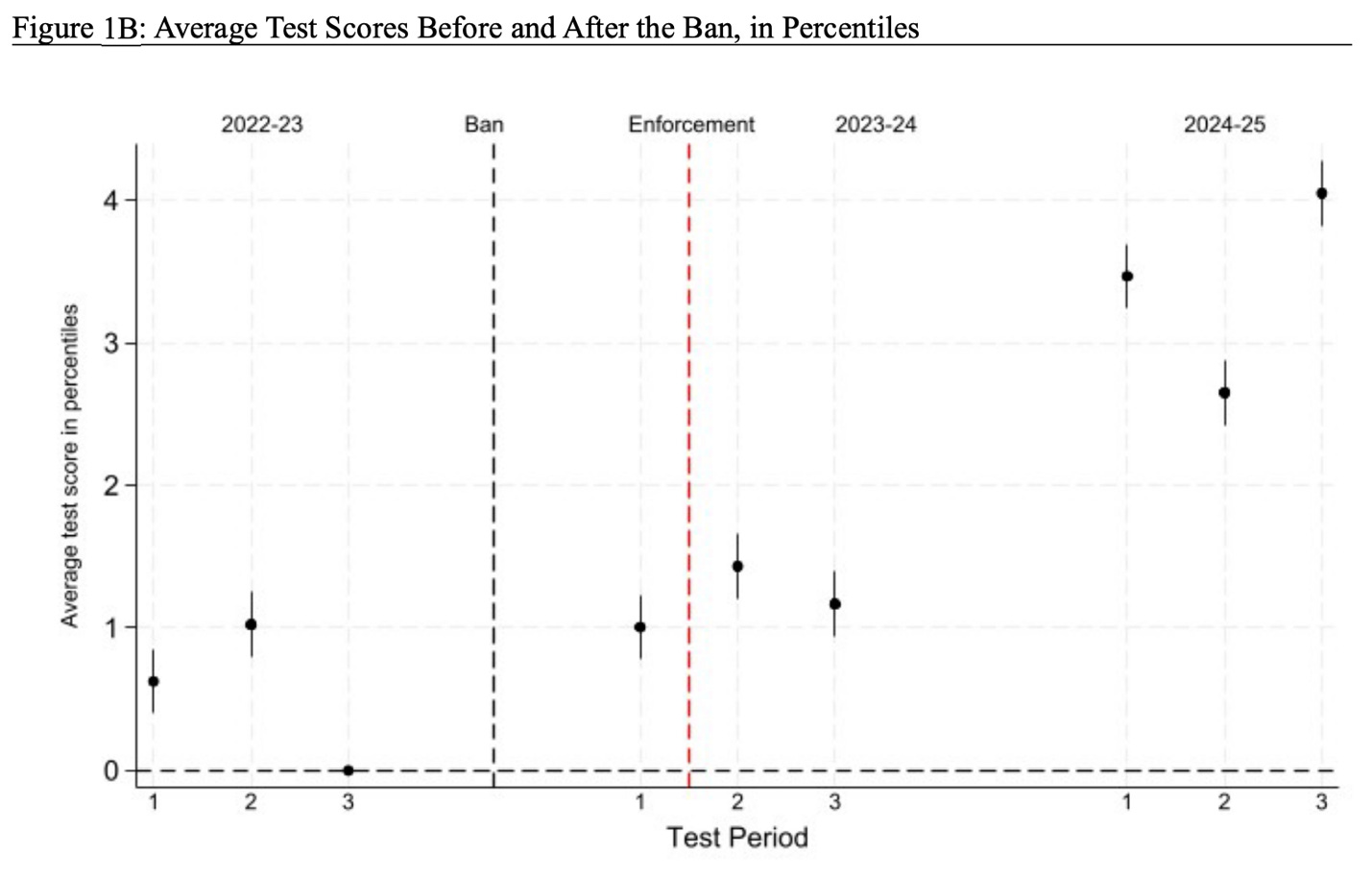
A new study, released as a working paper through the National Bureau of Economic Research, evaluates Florida’s experiment. In the authors’ analysis, the rule drastically reduced student phone use, led to a temporary increase in disciplinary incidents, and improved test scores.

Let’s dig in a little.

The study focuses on an unnamed “large urban county-level school district” in Florida. While the state law restricted phone use only during instructional time, this district went further, requiring phones to be silenced and put away for the entire school day. The policy went into effect in May of 2023 and was enforced with disciplinary measures starting in September of that year.

The change reduced student phone use, measured via phone location data captured from 9 a.m. to 1 p.m. on school days, by about two-thirds. This is a striking victory if you find it self-evident that kids shouldn’t have cell phones on in school.

The transition was a little rough, with disciplinary incidents increasing over the first year—by around 20 monthly incidents per 10,000 students—especially in schools with higher levels of pre-ban phone use. Male and black students were disproportionately affected, though it’s unclear to what extent that stems from behavior vs. enforcement disparities. At any rate, discipline mostly returned to normal in the second year.

That’s also when the test-score benefits manifested. Scores rose a couple of percentiles, on average: a student at the 48th percentile nationally, for example, would tend to end up around the median. The change was largest in schools with higher pre-ban phone use. Student absences also declined and fewer kids switched schools, which may help explain the improvement.

All in all, this looks like a successful policy: Less distracting phone use in schools, better attendance, higher test scores. More effort is warranted, though, to confirm these results elsewhere — and to figure out the best way of implementing and enforcing cell-phone bans.

The Korean War Week 71: The Panmunjom Peace Talks! – October 28, 1951

Filed under: China, History, Military, USA — Tags: , , , , — Nicholas @ 04:00

The Korean War by Indy Neidell
Published 28 Oct 2025

Big news! The peace talks resume after over two months hiatus, now in a village called Panmunjom. Also, UN Commander Matt Ridgway also gives a rare press conference, and he implies that for all his talk about punishment and prevention, those pilots who violated neutral zone air space and killed civilians receive at best a slap on the wrist. Speaking of civilians, a Marine operation is launched to deprive the enemy of civilian dwellings during the coming winter — Operation Houseburner.

Chapters
00:00 Intro
00:41 Recap
01:00 Panmunjom
03:27 Peace Talks Begin
08:35 The Neutral Zone
10:03 Ridgway’s Press Conference
11:42 Houseburner
12:22 Summary
12:30 Conclusion
(more…)

Clankers on the bench

Filed under: Australia, Law, Technology, USA — Tags: , , — Nicholas @ 03:00

The cynic in me wonders if having AI judges would make the justice system any worse, given the ever-increasing pro-criminal bias on display in courtrooms across North America and Europe:

Grok generated this in response to my request for “Robbie the Robot as a judge”

It’s the question rattling through chambers and law schools. Are we in danger of a world where the solemn business of justice, liberty, livelihood, and who really owns the back fence is entrusted not to a human in robes but to a chirpy algorithm with a software bug and a 4,000-word disclaimer? Are we handing over judgment itself to machines, or simply giving them the photocopying and hoping they don’t start offering opinions?

Because, depending on whom you ask, AI in law is either (a) the long-delayed democratization of justice for ordinary people or (b) the first act of a constitutional farce in which courts drown beneath PDFs full of nonsense and fake footnotes.

The Machinery Arrives

Beneath the wood paneling and the reassuring thump of legal pomposity, something mildly heretical is afoot. Judges, clerks, and barristers — those high priests of precedent — are quietly feeding their briefs to generative AI, which now whirs away in the background, summarizing, drafting, and rummaging through case law while its human overlords wrestle with the biscuit tin and their consciences.

According to the Judicial Commission of New South Wales (NSW), the robots are already in the building. Their latest handbook cheerfully notes that AI is used for legal analytics, mass document review, “natural language” searching, and predictive modeling — all of which sound terribly sophisticated until you realize they’re essentially Excel spreadsheets with delusions of grandeur. A UNESCO survey adds the clincher: nearly half the world’s judges, prosecutors, and court staff have used generative AI for work, and only 9 percent have had what’s politely called safe-usage training. This is training where someone explains that you shouldn’t upload confidential evidence to a chatbot that lives in the cloud or take legal advice from a program that thinks Brown v. Board of Education was a musical.

The Law Society of NSW, in a rare fit of clairvoyance back in 2016, created something called the Future Committee — the sort of name that already sounds like a sci-fi tribunal convened to ban fun. Their brief was to consider what might happen when clients demanded more for less, junior lawyers were burnt to a crisp, and artificial intelligence started politely asking, “Shall I draft that for you?” The conclusion was simple: adapt or be eaten.

Meanwhile, in London, the Law Society of England and Wales skipped the warm-up act and went straight to the apocalypse. Its 2021 report, Images of the Future Worlds Facing the Legal Profession 2020–2030, envisioned a legal world in which routine advice would be swallowed whole by AI portals, full-time lawyers would be reduced to an endangered species, and the survivors would work alongside AI and be mandated to take “performance-enhancing medication in order to optimise their own productivity and effectiveness.” The whole thing reads like 1984 rewritten by a management consultant — right down to the faint violin of self-pity playing somewhere in the distance.

Oh, but those were in Australia and the UK, it’s not that bad in North America, surely? Uh, well …

Across the Atlantic, the award for Legal Farce of the Century goes to Mata v. Avianca, Inc. (S.D.N.Y. 2023). In this modern masterpiece of professional self-immolation, a team of lawyers filed court papers quoting three magnificent precedents: Varghese v. China Southern Airlines, Martinez v. Delta, and Zicherman v. Korean Air Lines. Unfortunately, none of them existed — not in Westlaw, not in Lexis, not even in the fever dreams of law students. When the judge asked, quite reasonably, to see the cases, counsel could only offer the look of people discovering gravity for the first time. Sanctions followed under Rule 11 for what the court delicately called “subjective bad faith”, which is American for “you made this up”. The ruling is now shown at continuing-education sessions under the optimistic title Let’s Not Do That Again.

The sequel writes itself:

  • Massachusetts: A lawyer submitted memoranda stuffed with phantom cases, blamed “the office AI”, and was fined. The judge, channeling divine exasperation, warned that blind acceptance of AI-generated content is not a defense — it’s a lifestyle choice.
  • Alabama: Attorneys for the state prison system filed citations to imaginary authorities and were sentenced to the most humiliating punishment known to the bar: writing apology letters to their law school deans and delivering public lectures on ethics.
  • California: One overzealous litigator managed to produce a brief in which twenty-one of twenty-three authorities were pure fiction. The court fined him, the press dined out on it, and AI-compliance seminars across America gained a new slide.

Thus, the first commandment of the digital age is: the robot may write it, but the Submit button still belongs to a human — and the human still gets to explain it to the judge.

The Making Of Modern London – The Heyday of London Transport 1914 – 1939

Filed under: Britain, History, Railways — Tags: , , , , — Nicholas @ 02:00

Classic Vehicle Channel
Published 15 May 2020

A lovely documentary telling the story of the development of the London transport system from 1914 to 1939 — The heyday of London Transport. This film features awesome archive footage of buses, trams and London street scenes from the time. It’s one of a number of episodes this one featuring London’s transport system.

I’ve cut out the LWT adverts but I have left two in that I think you’ll love!

This film was broadcast by London Weekend Television in 1984 and later by CH4.

Written, Directed & Narrated by Gavin Weightman

QotD: Having kids

Filed under: Economics, Health, Quotations, USA — Tags: , , , — Nicholas @ 01:00

So, we have a bunch of kids. And sometimes, usually when something pleasantly mundane is happening — the little kids are building something and the big kids are reading their books and the baby is gurgling away and I’m making dinner, perhaps, or when we’re all bustling around packing lunches and practicing spelling words and chitchatting — I look around and think to myself, “Wow, this is so great. I’m so lucky to have all these awesome people in my house. Why don’t more people do this?”

There are, of course, downsides: I am typing this very slowly because one of my arms is full of a baby who doesn’t like to nap unless I’m holding him. You have to label the leftover lasagna you’re taking for lunch tomorrow or else someone will have it for a snack. I am staring down the barrel of at least another decade of the exact same Mother’s Day musical program at the kids’ school, and it would probably be rude if I started singing along. And there are days when we’re waiting around like Kurt Russell at the end of The Thing to see where the stomach bug will strike next. But come on, nobody doesn’t have kids because of the existence of norovirus.

So … why don’t more people do this? (Either having a bunch of kids or, increasingly, just having kids period.) I’ve heard a lot of theories: just recently and off the top of my head, I’ve been told that kids cost too much money, that kids don’t actually have to cost a lot of money but we have very high standards for our parenting, that there are too many fun things you can’t do anymore when you have kids, that having a lot of kids is low status, and that being a housewife (an increasingly sensible choice the more kids you have) is low status. And, of course, car seat mandates. There’s something to most of those theories, but they all boil down to one fundamental claim: we’ve built a world where having kids, and especially having a lot of kids, just … kind of sucks.

It’s never going to be easy — there will always be sleepless nights and bickering siblings and twelve different people who all need incompatible things from you all at once — but anything worth doing is hard sometimes. It’s also often wonderful, and it doesn’t need to be this hard.

Tim Carney agrees with me, providing a guided tour of the cultural and structural factors that combine to make American parenting so overwhelming that many couples are stopping after one or two children — or opting out altogether. We think our children require our constant close attention. We worry about them incessantly. We think anything that’s not absolute top-tier achievement is failure. We build neighborhoods that mean they need to be driven everywhere, and then between car trips we all stare at our glowing rectangles. We, and they, are sad and lonely, and then no one around us has kids and we all get sadder and lonelier.

Jane Psmith, “JOINT REVIEW: Family Unfriendly, by Timothy P. Carney”, Mr. and Mrs. Psmith’s Bookshelf, 2024-10-14.

Older Posts »

Powered by WordPress