Quotulatiousness

September 20, 2025

Feds move to neuter the “notwithstanding clause” to frustrate Alberta

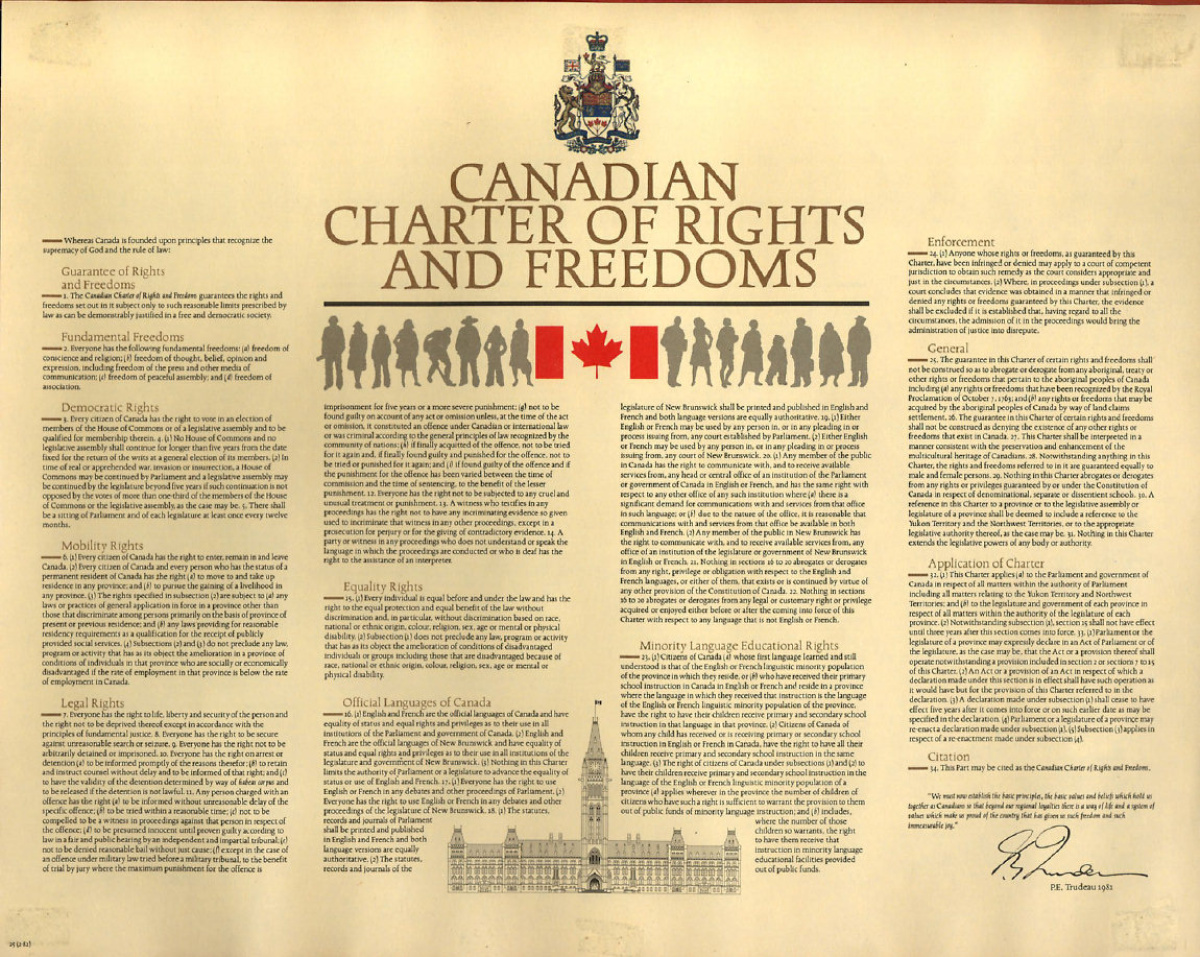
To be honest, I wasn’t a fan of the Charter of Rights and Freedoms when it was forced down our throats in 1982, on the basis that if Pierre Trudeau thought it was a good idea then it must be the opposite. All these years later, although I’m still not a huge fan, I support the provinces who now need to combat Mark Carney’s minority Liberal government’s attempt to use the Supreme Court to limit or eliminate the provinces’ use of the notwithstanding clause:
You might be hearing a lot about the notwithstanding clause these days and wondering what is going on. The fact is, the Carney government is trying to change the constitution via a Supreme Court case on Bill 21 – a heinous bill in my opinion – but not an excuse to scrap or weaken the notwithstanding clause.

We’ve been here before with this debate before and I’m still of the same position, leave the clause alone.

It was in 2018 that Ontario Premier Doug Ford was looking to use the notwithstanding clause to shrink the size of Toronto city council. He should never have had to do this, but a lower court ruled that Ford’s actions were unconstitutional.

Which is really weird because the constitution is clear, municipalities are creations of the province. A provincial government can merge municipal governments, they can even abolish them if they wish.

Eventually, a higher court overturned the very politically driven decision against Ford, but for a time, he seemed to need the notwithstanding clause, otherwise known as section 33 of the Charter of Rights and Freedoms.

I’ll never understand why some claim the notwithstanding clause is against the Charter when it is part of the Charter.

On the social media site formerly known as Twitter, Sean Speer notes the Liberals seem to be taken by surprise at the negative reactions to their plans:

I suspect that non-conservatives are a bit surprised by the magnitude of the reaction to the Carney government’s factum on the notwithstanding clause. That’s mainly because I think liberals and progressives don’t quite understand how much the past decade or two of judicial activism has come to animate Canadian conservatism. Even as a somewhat moderate conservatism, I admit to being radicalized on these issues.

The Carter decision on MAID was a key moment in this evolution. Not necessarily because of the issue per se — though a lot of us oppose it. But mainly because it was such a naked example of judicial lawmaking. The clearest case that it’s just power and politics all the way down.

After having ruled that there was no right to physician-assisted death in the Charter, just over twenty years later the Supreme Court unanimously decided there was indeed such a right.

There had been no constitutional amendment in the meantime. Parliament had considered the issue and carefully and consistently voted against it. And yet nine judges decided that the right should exist and so they created one.

If the judiciary isn’t merely protecting constitutionally-prescribed rights but manufacturing them based on the political preferences of judges themselves—if it’s in effect just politics from the bench — then we might as well have the politicians who we’ve duly elected to be making these decisions for us.

Before Carter I would have said that I was broadly supportive of S.33 as part of our constitutional order but today it’s much bigger part of my core political identity as the only check we have on judicial politicking.

The Carney government’s factum then isn’t just objectionable because it threatens to constrain the notwithstanding clause but precisely because it invites the Supreme Court to once again alter the constitution in its own image.

Brian Peckford, the last surviving signatory to the patriation of the Constitution in 1982:

Tragically, it is not surprising that we see this further emasculation of our 1982 Constitution.

It has been ongoing almost since its inception. Witness the 1985 Court Opinion twisting the meaning of the opening words: “the Supremacy of God”.

And the constant distortions ever since, accelerated during the false covid crisis.

This is The Tyranny of The Judiciary —The Destruction Of Parliamentary Democracy!

How important is Section 32 — the notwithstanding clause?

There would be no Constitution Act 1982 — no Charter of Rights and Freedoms without Section 32.

When PM Trudeau Sr. tried to unilaterally Patriate the Constitution and failed miserably because of the Provinces’ opposition before the Courts, he validated the suspicion most Premiers had about the Federal Government and its intentions during that time. The ability of the Provinces to continue democratically to initiate specific exemptions was crucial to solidify the federal nature of this country.

The Supreme Court was right in Sept 1981 in denying the Federal Government such sweeping powers.

None of the 10 First Ministers who signed the Patriation Agreement intended for this Section to be amended in any other way except by the Amending Formula that was achieved for the first time in our history in that Agreement.

The Federal Justice Minister’s action to ask the court is wrong — totally against the intent of those who authored the Patriation Agreement and defies and denigrates one of major accomplishments of 1982, The Amending Formula, a crucial part of the earlier 1981 Agreement, the foundation document, “The Patriation Agreement”.

The Canadian Press carries this:

    OTTAWA — The federal government’s request to Canada’s top court for limits on the notwithstanding clause isn’t only about Quebec’s secularism law, Justice Minister Sean Fraser said on Thursday.

    In a media statement, Fraser said he hopes the Supreme Court’s eventual decision “will shape how both federal and provincial governments may use the notwithstanding clause for years to come”.

Excuse me, Mr Fraser, this is the job, the solemn responsibility, for Canada’s Elected First Ministers and Their elected Parliaments not the Judiciary. Making law is the job of the elected, interpreting law the role of the Judiciary.

This brazen action of the Federal Government would enlarge the Judiciary power to make law — it deciding the powers of The Governments of this Nation.

Ironic in the extreme it is to ponder that Canada sought for decades to find an amending formula — self criticizing itself for not having a legitimate avenue for Constitutional Change.

Now that it has such an avenue instead of using it, it cowardly asks The Court?

Should not a majority of the Provinces have to agree — that’s what the Supreme Court said in 1981?

Hence, the Supreme Court, consistent with it predecessor views of 1981 should refrain from hearing the matter, and inform the Governments that it is they who have the power through the legitimate constitutional process present in the Constitution to make such significant change ie the powers of the Governments, adhering to Section 38, the Amending Formula.

“[V]iolent crime [in Canada] had increased by 30% over the last decade”

Filed under: Cancon, Government, Law — Tags: , , , , — Nicholas @ 04:00

A lot of Canadians are noticing how much social peace has deteriorated in and near major cities, but police and local media increasingly are not sharing full information about suspects — often to avoid accusations of racism. It’s gotten bad but as James Pew points out … it’s just getting worse and worse:

Some of the 18 people charged with violent home invasions and carjackings in the Peel Region, July 2025.

Almost every day we hear new stories of violent crime in Canada. Many of us are shocked into speechlessness. Violent youth offences, home invasions, arsons and assaults are on the rise. The rate of car jackings in the York Region increased by 523% between the years 2019 and 2024. Home invasions in Canada are now a regular occurrence. Last year, Kiernan Green did some number crunching for The Hub. He found that violent crime had increased by 30% over the last decade. And Livio Di Matteo, of the Fraser Institute found that “while Canadian homicide rates remain lower than in the U.S., the Canadian rate has increased at a higher rate since 2014”. In the blink of an eye Canada went from a safe high trust society to a dangerous low trust society. Everything is upside down.

The swarming attack and murder of 59-year old homeless man Kenneth Lee of Toronto in December of 2022 was a somewhat early indication that something was dreadfully off. Eight girls, ranging in age from 13 to 16 attacked Lee, stabbing him with knives and small scissors multiple times. He later died in hospital. Initially charged with second degree murder, ultimately all eight girls had their charges reduced and were sentenced to probation only. The Mayor at the time, John Tory, referred to the judgment as “deeply disturbing.”

So far this year there have been thirteen cases in which youth offenders were charged with homicide in the Greater Toronto Area. The most recent involves a 12-year old who has been charged with murdering a 62-year old homeless man. He had been on a release order at the time of the murder. He was also accompanied by a 20-year-old man named Isaiah Byers. The two went on a spree of unprovoked violent attacks in downtown Toronto, targeting vulnerable individuals. Five in total were attacked with a hammer.

Frustrated with the city’s catch-and-release protocol, the Toronto Police Association recently took to X and asked, “Where are the judges who make these decisions?” And further, in a written statement the TPS pointed out, “Our members are held accountable for the decisions they make and the actions they take. Why isn’t anyone else?”

The Youth Criminal Justice Act (YCJA) is currently protecting the identities of youth offenders involved in shocking levels of violence across the GTA. On July 17th, a 14-year old boy, described as a black youth, was charged with fatally stabbing a 71-year-old woman, Shahnaz Pestonji, while attempting to rob her in a grocery store parking lot. The youth admitted later on a social media livestream that he “didn’t mean to kill the old lady” and was just trying to steal her car.

On August 16th, 8-year old Jahvai Roy was shot and killed by a stray bullet while at home sleeping in his mothers bed. Many bullets were shot that night by thugs outside the Roy home in North York, but tragically one of them passed through a window of Holly Roy’s bedroom and struck Jahvai. She wrote on Facebook, “My baby was preparing for one of his best friend’s birthday celebration. He was so excited he couldn’t sleep!” A 16-year old boy has been arrested, and two others are still being sought by police on Canada-wide warrants: 17-year old Ibrahim Ibrahim of Toronto, and 18-year old Amarii Lindner of Toronto.

On August 23rd a 16-year-old girl was charged with aggravated assault and assault with a weapon after stabbing a woman in her 80s in Scarborough, Ontario. Due to the YCJA, the name of the woman, who is suffering in hospital with life-threatening injuries, was not disclosed by the media. It was reported that the teen and the victim lived in the same residence. The story seems to have vanished. After August 23rd, there are no more media reports.

BC Ferries, federal financing and Chinese shipyards

Filed under: Cancon, China, Government — Tags: , , , , , , — Nicholas @ 03:00

As you may have heard, at the same time that Canadian politicians of all parties were thumping the tub about buying Canadian, British Columbia’s provincially owned ferry corporation decided to buy new ships from China … and the federal government not only gave the deal their blessing, they added in a billion dollar underwriting guarantee to boot:

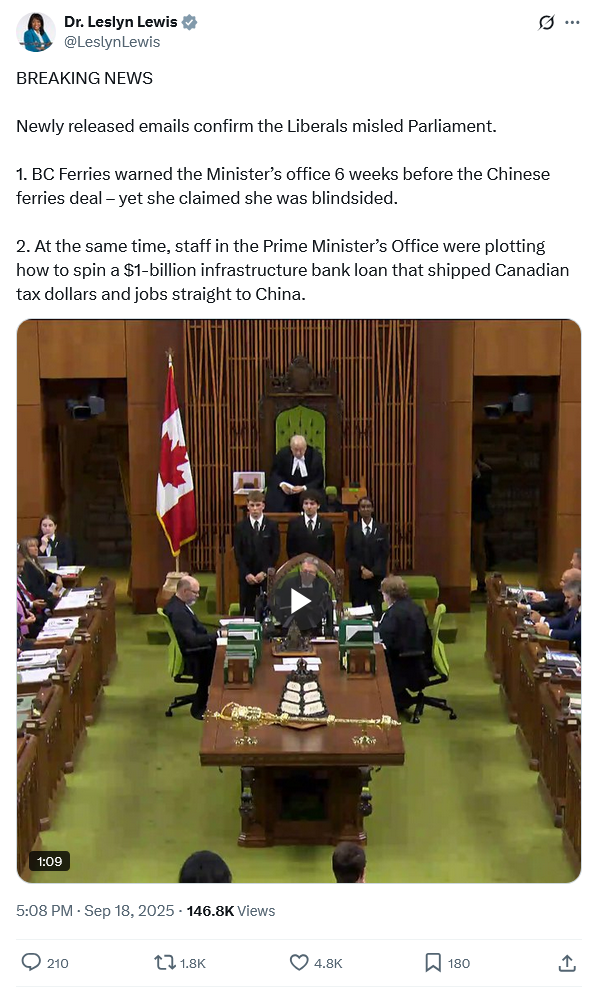
In Ottawa they call it “arm’s-length”. Out in the real world, people call it duck-and-cover. At Meeting No. 6 of the House of Commons transport committee, MPs confronted a simple, damning timeline: Transport Canada’s top non-partisan official was warned six weeks before the public announcement that BC Ferries would award a four-ship contract to a Chinese state-owned yard. Yet the former transport minister, Chrystia Freeland, told Parliament she was “shocked”. Those two facts do not coexist in nature. One is true, or the other is.

There’s an even bigger betrayal hiding in plain sight. In the last election, this Liberal government campaigned on a Canada-first message — jobs here, supply chains here, steel here. And then, when it actually mattered, they watched a billion-dollar ferry order sail to a PRC state yard with no Canadian-content requirement attached to the federal financing. So much for “Canada first”. Turns out it was “Canada … eventually”, after the press release.

Conservatives put the revelation on the record and asked the only question that matters in a democracy: what did the minister know and when did she know it? The documents they cite don’t suggest confusion; they suggest choreography — ministerial staff emailing the Prime Minister’s Office on how to manage the announcement rather than stop the deal that offshored Canadian work to a Chinese state firm.

Follow the money and it gets worse. A federal Crown lender — the Canada Infrastructure Bank — underwrote $1 billion for BC Ferries and attached no Canadian-content requirement to the financing. In plain English: taxpayers took the risk, Beijing got the jobs. The paper trail presented to MPs is smothered in black ink — hundreds of pages of redactions — with one stray breadcrumb: a partially visible BC Hydro analysis suggesting roughly half a billion dollars in B.C. terminal upgrades to make the “green” ferry plan work. You’re not supposed to see that. You almost didn’t.

How did the government side respond? With a jurisdictional shrug. We’re told, over and over, that BC Ferries is a provincial, arm’s-length corporation; the feds didn’t pick the yard, don’t run the procurement, and therefore shouldn’t be blamed. That line is convenient, and in a technical sense it’s tidy. But it wilts under heat. The federal lender is still federal. The money is still public. If “arm’s-length” means “no accountability”, it’s not a governance model — it’s a get-out-of-jail-free card.

The fallback argument is economic fatalism: no Canadian shipyards bid, we’re told; building here would have taken longer and cost “billions” more. Maybe that’s true, maybe it isn’t — but it’s the sort of claim that demands evidence, not condescension. Because the last time Canadians heard this script, the same political class promised that global supply chains were efficient, cheap and safe. Then reality happened. If domestic capacity is too weak to compete, that’s not an argument for outsourcing permanently; it’s an indictment of the people who let that capacity atrophy. And if you swear “Canada first” on the campaign trail, you don’t bankroll “China first” from the Treasury bench.

Dr. Leslyn Lewis on X:

Dutch Navy Luger: From World War One to the End of Neutrality

Filed under: Europe, Germany, History, Military, Weapons, WW1, WW2 — Tags: , , , , — Nicholas @ 02:00

Forgotten Weapons
Published 12 May 2025

The Dutch Navy first acquired Luger pistols in 1918 specifically for its aviators. They had 12 German P04 Lugers taken from a German submarine stranded in the (neutral) Netherlands, and 28 more were purchased from DWM in 1918 to round out the 40 guns needed to equip the Naval Air Service. The pistol was formally adopted as Automatische Pistool Nr.1. In 1928, the Dutch Army adopted the 1906 New Model Luger for its own service, and the Navy decided to update its revolvers at the same time. The Navy opted not to get grip safeties, and so took a copy of the German P08 model instead of what the Army had. The first order was placed in 1928 through BKIW in Germany, and deliveries would run until 1939 with a total of 2654 delivered before German invaded in May 1940.

Dutch Army Luger trials:
Politicians Ruin Everything: Dutch Lu…

Dutch East Indies Lugers:
Lugers for the Dutch East Indies Army
(more…)

QotD: Why modern dishwashers suck

    The current standards for dishwashers took effect in 2013. The standards, which were based on a consensus agreement between manufacturers and efficiency advocates, specify minimum energy and water efficiency levels. The standards require that standard-size dishwashers use no more than 307 kWh per year and 5.0 gallons of water per cycle.

    In 2024, DOE finalized amended standards for dishwashers based on a joint recommendation from manufacturers and efficiency advocates. The new standards for dishwashers will cost-effectively reduce energy consumption by 15% relative to the current standards while also cutting water waste. Dishwashers

It is a general problem, but what started me thinking about it was being told by my dishwasher that it would take three and a half hours to wash the dishes. That seems, judging by a quick search online, to be longer than average but still within the normal range. I have not been able to find figures online for how long dishwashers took twenty or thirty years ago but, by what I remember, it was substantially less — and the dishes ended up dry, which ours don’t.

The explanation is in the final word of the quote above, “waste”. The owners of dishwashers pay for water and power, so if making them more efficient in those dimensions was costless, did not require giving up something else, there would be no need for the Department of Energy to make the manufacturers do it. I conclude that it was not costless, that it either made dishwashers cost more or do their job less well — take longer, not dry the dishes as well, not clean them as well. Using more power or water to do a better job is not waste.

David Friedman, “Optimizing On A Single Variable”, David Friedman’s Substack, 2025-06-02.

Powered by WordPress