Quotulatiousness

August 28, 2025

A civil society can’t allow young Scottish hellions to brandish weapons at immigrants harassing them

Filed under: Britain, Law, Liberty — Tags: , , , , — Nicholas @ 05:00

At least, the headline expresses how the sky people probably frame the situation where a young girl felt she needed to scare off a threat to herself and her friend. This is from an X post which claims to be describing what actually happened rather than what the media has been reporting:

One of many, many images posted to X on this incident.

I spoke with the mom of one of the girls (Mayah) and got the entire story that the media is covering up and lying about.

So first of all, the reporting got the names of the girls mixed up. There were 3 girls who were there who were accosted and attacked by the migrants.

Lola – Lola is the hero from the video. She’s the one with the axe defending her sister from the migrant attackers

Ruby – Lola’s older sister who was attacked and hospitalized

Mayah – Ruby’s best friend who was with them and went to call the police after Ruby was attacked by the migrants

Here’s the summary of what happened from Mayah’s mother:

“Yes. So what happened was the girls where out just walking and the man in the picture made comments to lola(the younger girl) calling her sexy and other sexual remarks then the girls started to tell this man to leave them alone and stop following them and making sexual remarks to them. After that the man’s sister (also in the picture) came around the corner and physically attacked ruby(the older sister) she grabbed her hair dragged her to the floor started to punch her then both the man and woman where kicking her in head while she was on the floor. At this point my daughter (mayah) called the police so my daughters account after that is all abit blurry. But that is when lola had the weapons she pulled them out to protect ruby. After that the man came back at lola recording her making sure she showed the weapons to the camera and antagonising her. Ruby was hospitalised after the attack with a severe concussion a tennis ball sized lump to the back of her head aswell as lots of bruises.”

John Carter reacts to the original image, also on X:

This should be a turning point, but god knows how many such the British elites have ignored so far. Another graphic from X expresses what may happen if this is also ignored:

Even the Brits can be pushed too far and we can’t be very far from that point now. And the way the British media is handling this and pretty much every other confrontation is not helping:

You can’t have missed her, if you’re on social media at all, the dual-wielding 14-year-old Scottish lass raising two blades in defiance of the “migrant” seemingly intent on assaulting her and her 12-year-old friend.

The name of this hero won’t be released due to her age, and police were right on the scene to arrest the violent attacker.

That’s right: the little girl is in jail, charged with possession of a bladed weapon. Two weapons, actually — what appear to be a large santoku-style blade and a small hatchet.

In the widely-circulated clip, her would-be attacker (with the non-British accent) can be heard taunting her to show the blades on camera. Why? The answer is obvious: he’s well aware that self-defense is illegal in Britain, and he also knows she’ll be the one the cops take away.

And he was correct on both counts.

[…]

Culturally, things are so crazy that the BBC didn’t just blur out our heroine’s face, they even blurred out her blades. And now you understand the screencap at the top of this column. Mustn’t ruffle any feathers, you see.

How about pepper spray and the like? Sorry, mate, but pepper spray was banned as a “prohibited weapon” (!!!) in 1968.

In Britain, the only legal defense against rape is a whistle — which is to say, no defense at all.

That 14-year-old girl found it necessary to possibly defend herself and her friend against two possible assailants: would-be rapists and the British criminal justice system. The day came, and she proved herself a hero.

She warded off the former, but God only knows what indignities she’ll suffer at the hands of the latter.

What’s the next little British girl’s defense against that?

Prices are critical economic signals that we ignore at our peril

Filed under: Economics — Tags: , , — Nicholas @ 04:00

At the Foundation for Economic Education, Tim Worstall explains the importance of prices in a free market economy:

Prices matter. Now, I’m a free market, capitalistic type, so of course I’m going to insist that everyone be tied down to mere gilt and pelf in how they live their lives. Yet it is still true that prices really, really matter.

Let’s walk through why that’s true, regardless of your political tribe. Any one thing — any economic resource, fresh water, human labour, cash, capital itself and so on — can be used for a multitude of different things. At any one time, the market price for that thing is the balance between the supply of it and the value in using it to do — in aggregate — all those multitudinous things. Yes, we can even mutter that perhaps the information doesn’t flow here instantaneously and perfectly efficiently. Nevertheless, in its simplest terms, what something costs reflects the value of whatever uses we can put it to.

If we decide that we want to do something new, we need a measure of whether we should or not. In a world where resources are finite, the resources we’ll consume doing this new thing already have prices, thanks to their use in all the other things we’re already doing. So, this new thing we desire to do must add value. We must make a profit doing it. No, this doesn’t mean something that tophatted capitalists get to squirrel away in their subvolcanic secret lair. Rather, it means that the value of the output must be higher than the costs of the inputs. If that’s not true, then we are subtracting value from those resources. Other people could have used them to do their thing and generated value instead.

If something makes us all poorer, we shouldn’t do it. But that’s exactly what happens whenever we use valuable resources to do something which is of less value than the price we pay to do it. Say, for example, recycling disposable vapes:

“CBD Living Vape – Disposable” by weedporndaily is licensed under CC BY 2.0 .

    Vape sellers will have to pay for the disposal of the devices under plans announced by the government.

    Ministers said they would “end the UK’s throwaway culture” as they revealed measures to fund the recycling of electrical waste.

Recycling these vapes’ electronic waste uses more resources than not recycling it. This is why we’ve got to find someone to pay for it — because the value of the resources required to do the thing is greater than the value of having the thing done.

Now I am not against recycling per se — I cannot be, having dealt in scrap metal. I once shipped lorryloads of Soviet nuclear scrap off to be made into fancy car wheels for boy racers’ Escort XR3is. My only whine about that was not also gaining the furry dice concession. Even so, I made a house-sized chunk of money doing it. That’s because I’d added value by working out what the scrap could be used for and getting it to where it could be used to do just that.

But if we mandate a recycling system that makes no profit, adds no value and in fact requires an outside input of money into financing it, then we’re throwing away value and making ourselves poorer. The prices are telling us we should not be doing this thing. That’s why we ignore prices at our peril.

No surprise at all – Liberals completely overshoot temporary foreign worker targets

Filed under: Business, Cancon, Government — Tags: , — Nicholas @ 03:00

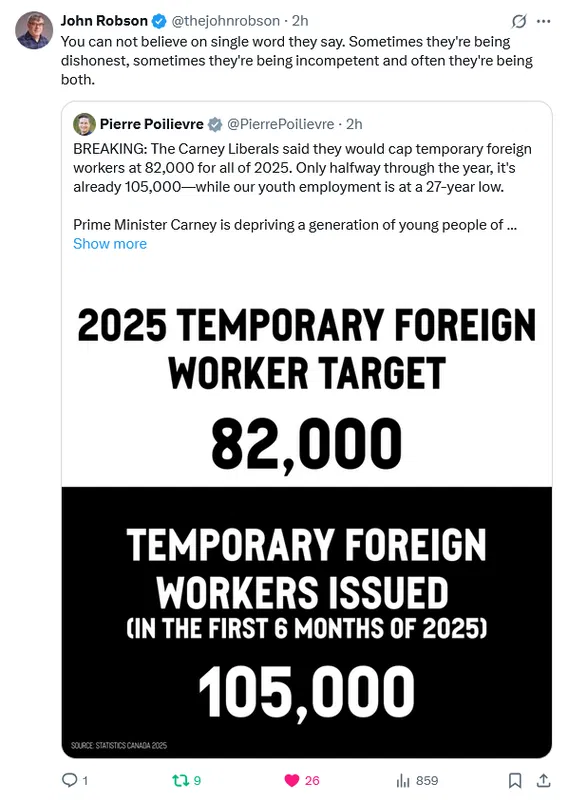
In the National Post, Tristin Hopper confirms that the Mark Carney government, having promised to cap temporary foreign worker visas at 82,000 for the year, have already brought in over 100,000 TFWs in the first six months:

Despite promises from the Liberal government that they would be curbing the sky-high immigration rates of the Trudeau era, new data from Immigration, Refugees and Citizenship Canada shows that Canada is already on track to exceed its 2025 targets.

In the first seven months of 2025, Canada accepted 246,300 new permanent residents, according to data released last week by IRCC.

If this level of intake keeps up for the rest of the year, Canada is on track to bring in approximately 422,000 new permanent residents by year’s end.

[…]

And the missed targets are even more stark when it comes to categories of temporary migrants.

For the entirety of 2025, Canada was only supposed to approve 82,000 entries under the Temporary Foreign Worker Program.

Nevertheless, Government of Canada data shows that 105,195 Temporary Foreign Worker permits were awarded in just the first six months of 2025.

Temporary migration has been disproportionately responsible for the record-breaking population growth witnessed in Canada over the last four years. Since 2021, Canada’s population has grown from 38 million to 41.7 million. This represents an average annual increase of 900,000, which puts Canada well beyond the population growth rates of any other G7 country.

In late 2024, Statistics Canada estimated that the country was home to an unprecedented three million “non-permanent residents,” be they international students or temporary foreign workers.

Temporary migration is also the category on which Ottawa has promised to crack down hardest. Late in 2024, when then prime minister Justin Trudeau announced plans to “turn off the taps” on immigration, temporary migrants represented seven per cent of the overall Canadian population.

History of Britain VII: Fall of Roman Britain

Filed under: Britain, History, Military — Tags: , , , , , — Nicholas @ 02:00

Thersites the Historian
Published 23 Feb 2025

After its efflorescence during the 2nd Century, Roman Britain entered steep decline during the 3rd Century and the benefits of Roman civilization had all but vanished by the time that the Romans withdrew their forces and support.

QotD: The rise and fall of the chariot in combat

Filed under: Books, History, Military, Quotations — Tags: , , , , — Nicholas @ 01:00

Horses had been domesticated long before the Scythians. Horses, along with dogs and reindeer, are the only animals domesticated by foragers, rather than farmers. The first significant use of horses in battle was to draw chariots. Chariot archers could shoot, and javelins could be thrown, further from a chariot than a horse.

The classic chariot was driver and archer or spearmen. A friend describes them as being like a pilot and a navigator (or bomb-aimer) on a bombing run. The pilot/charioteer concentrates on getting the pair of you where you need to be (or not to be). The archer/spearmen/navigator/bomb-aimer concentrates on killing the enemy.

The most famous driver/warrior pairing in myth and literature is Krishna and Prince Arjuna in the Mahabharata and, specifically, the Bhagavad Gita. (Normally, the driver serves the warrior, but if your driver is an incarnation of Vishnu, things work differently.) The warriors of the Iliad are also chariot-driving warriors — hence scenes such as Achilles dragging Hector‘s dead body behind his chariot. Chariots were a major element in Chinese warfare up to the Warring States period. New Kingdom Egypt was very much a chariot empire, as were their great rivals, the Hittites.

Once recurve bows able to match chariot archery from horseback arrived, chariots largely disappeared from combat in the major Eurasian civilisations. This began to occur around the time of the Assyrians — who were a transitional case using both chariots and cavalry — about a thousand years before the invention of the stirrup and even longer before the stirrup’s arrival in the Mediterranean world. Lancers — the heavily armoured version of which was the cataphract — then developed as a way of dealing with horse archers.

Lorenzo Warby, “Stirrups, a rant”, Lorenzo from Oz, 2025-02-28.

August 27, 2025

In praise of the book

Filed under: Books, Media, Technology — Tags: , , , — Nicholas @ 05:00

Ted Gioia contemplates the glorious future of the book:

A decades-old bookmark from a Toronto Book City location (probably the store on the Danforth near Chester).

Can you imagine data storage that never needs an upgrade. Even better, there’s no subscription fee. And the system never crashes — there hasn’t been a single minute of down time in recorded history.

And there’s still more:

  • There are no terms of service.
  • No hidden fees.
  • No customer service bots to deal with.
  • No annoying follow-up spam emails and texts.
  • No privacy intrusions or surveillance of any sort.
  • No data incompatibility issues now or in the future.
  • No advertising or solicitations of any sort.

The list continues — no cookies, no credit cards, no come-ons, no conditions. None of that.

What a miracle!

I’m talking about my favorite handheld device, and I don’t need a cloud to hold its contents. Just a shelf.

You guessed it — I’m referring to books. They’re the greatest hard storage concept in human history, and nothing else comes close.

The book is the ultimate killer app.

People have been predicting the death of the book for decades. The Internet was going to make them obsolete. But somehow they survived.

The launch of the Kindle in 2007 posed a bigger threat. Even I was convinced — at least for a while. I bought a Kindle and tried it out, plunging with enthusiasm into the world of eBooks and digital storage.

But a month later, I’d returned to physical books. It was a better experience in every way.

It didn’t help when Amazon started deleting books from Kindles. Much to the customers’ surprise, they learned that they didn’t own the book they had bought — they were merely “purchasing a license to the content“.

Access can be terminated. And Amazon is the ultimate terminator.

That’s never happened to any physical book on my shelf. I own thousands of them, and nobody has ever revoked my access. I can also sell or give them to others, and they will retain rights in perpetuity.

You can’t do that with a Kindle. You’re not allowed to sell an eBook. You can’t even donate it to a library. Your license is restricted and non-transferable.

But transferability is how books and literary culture survive. Books are supposed to move without friction across generations and borders and boundaries. Some books have had dozens of owners over hundreds of years — creating a legacy unknown in the world of digital technologies.

Even more insidious, Amazon will update books on your Kindle — changing the text without the reader or author’s permission. That’s happened, for example, to books by Roald Dahl, R.L. Stine, Ian Fleming, and Agatha Christie. If somebody in a position of power decides that an author’s work is problematic, your e-book gets cleansed.

The Korean War Week 62: Chinese Break Off Peace Talks! But Whose Fault Is It? – August 26, 1951

Filed under: China, History, Military, USA — Tags: , , , , — Nicholas @ 04:00

The Korean War by Indy Neidell
Published 26 Aug 2025

The Chinese claim that American bombers have attacked the Kaesong conference area and break off the peace talks. The UN delegation smells a set up. Meanwhile, the Battle of Bloody Ridge is in full swing and earning its name, as the casualties mount on both sides.

Chapters
00:41 Recap
01:11 A ROK Success
01:47 Bloody Ridge
06:17 Soviet Reinforcements
07:08 Operation Strangle
11:06 Summary
11:45 Conclusion
13:37 Call to Action
(more…)

Operation Raise the Colours

Filed under: Britain, Liberty, Media, Politics — Tags: , , , , — Nicholas @ 03:00

Gawain Towler on the groundswell of quiet patriotic display in England, against the active attempts by local governments to suppress any and all flag-waving or even flag-flying by the plebs:

It was a seemingly innocuous tweet during the 2014 Rochester and Strood by-election that exposed a deep cultural rift. Emily Thornberry, then Labour’s shadow attorney general, a paragon of establishment elite thought, posted a photo of a terraced house in Strood adorned with multiple St George’s Cross flags, a white van parked outside.

No caption, just “Image from #Rochester”. To Thornberry, the image spoke for itself: a symbol of backward, flag-waving patriotism, the domain of the “white van man” she and her metropolitan peers presumably viewed with quiet derision. She expected her audience to share the contempt, to chuckle at the vulgarity of overt Englishness. But the backlash was ferocious. The public saw snobbery, a sneering dismissal of ordinary lives. Thornberry resigned from the shadow cabinet that day, rebuked by Ed Miliband for disrespecting hardworking families. I played a modest role in that storm, forwarding the tweet to Guido Fawkes and The Sun, which amplified the outrage and forced the reckoning.

That episode, now over a decade old, feels eerily prescient as I contemplate the “raising the flag” phenomenon sweeping Britain in recent weeks. What began as scattered acts of defiance has blossomed into a nationwide movement: St George’s Crosses and Union Jacks hoisted on lampposts, motorway bridges, and public spaces from Birmingham’s Shard End to Tower Hamlets in east London, Southampton to Brighton, and even Cannock. Roundabouts painted red and white, zebra crossings marked with the cross, symbols of England asserting themselves in the urban landscape. Last night I cycled through London’s Labour stronghold of Lambeth, and road markings have been transformed with the St George’s Cross, a quiet but bold reclamation in one of London’s most diverse boroughs. Dubbed “Operation Raise the Colours” by organisers (though it is hard to describe the phenomenon as organised), it has seen thousands of flags raised, with fundraising efforts like Birmingham’s £16,000 drive sustaining the effort. I support this gentle uprising, for it breathes life into symbols long marginalised. Yet I acknowledge the disquiet it stirs: in a polarised society, such displays can evoke unease, linked in some minds to far-right agitation or the riots of summer 2024, that and deeper darker memories of NF marches in the 1970s.

Why is this happening now? The timing aligns with the anniversary of last year’s Southport tragedy and ensuing unrest, where misinformation, both from the state and other bad actors, fuelled anti-immigration protests that spiralled into violence. Many participants frame it as a response to “two-tier policing”, swift crackdowns on native demonstrations while pro-Palestinian marches proceed with apparent leniency. It’s a broader reclamation of national pride amid economic stagnation, unchecked migration, and a sense of cultural dilution. For the overlooked, those Thornberry’s tweet mocked, this is a way to say, “We belong here”. and stronger yet, but uncontroversial in any other land than our own, “This is our land”.

It’s contemplative defiance: not riots, but ribbons of red and white asserting identity in a nation where Englishness often feels like an afterthought.

M1922 BAR Cavalry Light Machine Gun

Filed under: History, Military, USA, Weapons — Tags: , , , , — Nicholas @ 02:00

Forgotten Weapons
Published 21 Apr 2025

After World War One, there was a lot of tinkering with the BAR by the US military. It was recognized as being a very good platform, but the original M1918 configuration left a lot to be desired. It was deemed too heavy to use effectively from the shoulder, but also not really well suited to sustained fire. In an effort to optimize it for use as a dynamic support weapon by a small squad, the Infantry & Cavalry Board requested a model with a heavier barrel and lightweight bipod in 1920. Six experimental examples were made form existing BARs, and the design was formalized two years later as the Model 1922.

This pattern of BAR has a heavy finned barrel to give it more sustained fire capacity and a folding bipod and rear monopod for more accurate use prone. The Board also experimented with larger magazines, and ended up recommending a 30-round size — although this was never put into production. In total, 500 of the Model 1922 guns were made, all converted from existing BARs. Experimentation continued slowly, and eventually in 1937 a lighter pattern was adopted as the M1918A1. The Model 1922 was formally declared obsolete in April 1941, and virtually all of them were rebuilt to the new M1918A2 pattern for use in World War Two. Surviving examples like this one are extremely rare — this is the only known example in private hands.
(more…)

QotD: A critical bureaucratic talent

Filed under: Bureaucracy, Humour, Quotations — Tags: , , — Nicholas @ 01:00

“Gentlemen! Gentlemen!” The Patrician raised his hands in a conciliatory fashion. “It seems to me,” he went on, taking advantage of the brief pause, “that what we have here is a strictly magical phenomenon. I would like to hear from our learned friend on this point. Hmm?”

Someone nudged the Archchancellor of Unseen University, who had nodded off.

“Eh? What?” said the wizard, startled into wakefulness.

“We were wondering,” said the Patrician loudly, “what you were intending to do about this dragon of yours?”

The Archchancellor was old, but a lifetime of survival in the world of competitive wizardry and the byzantine politics of Unseen University meant that he could whip up a defensive argument in a split second. You didn’t remain Archchancellor for long if you let that sort of ingenuous remark whizz past your ear.

“My dragon?” he said.

“It’s well known that the great dragons are extinct,” said the Patrician brusquely. “And, besides, their natural habitat was definitely rural. So it seems to me that this one must be mag—”

“With respect, Lord Vetinari,” said the Archchancellor, “it has often been claimed that dragons are extinct, but the current evidence, if I may make so bold, tends to cast a certain doubt on the theory. As to habitat, what we are seeing here is simply a change of behavior pattern, occasioned by the spread of urban areas into the countryside which has led many hitherto rural creatures to adopt, nay in many cases to positively embrace, a more municipal mode of existence, and many of them thrive on the new opportunities thereby opened to them. For example, foxes are always knocking over my dustbins.”

He beamed. He’d managed to get all the way through it without actually needing to engage his brain.

Terry Pratchett, Guards! Guards!, 1989.

August 26, 2025

Plunder does not explain western prosperity

Filed under: Africa, Europe, History — Tags: , , , , — Nicholas @ 05:00

Lorenzo Warby digs deep into the “mountain range of bullshit” over the issue of plunder, as in the claims that the First World got that way by stealing everything they could from what became identified as the Third World:

I am using mainly European examples because it is the genetically (and archaeologically) best mapped continent. But these grim patterns are normal in the history of Homo sapiens. Consider, for example, the Bantu expansion across Africa that mirrors the march of Anatolian farmers across Europe.

The development of farming and animal herding led to the y-chromosome Neolithic bottleneck: a massive harrowing of male lineages that only about 1-in-17 male lineages survived. The development of farming and pastoralism created much higher populations plus plunderable assets. Folk developed much more coherent kin-groups. Teams of male warriors wiped each other out, taking the land, animals and women of the defeated as their spoils.

Plunder was thus endemic in farming and herding societies. The harrowing of male lineages came to an end via the development of chiefdoms and states. That is, the technology of exploitation — keep defeated males alive so they could breed more payers of tribute and taxes — overtook the technology of aggression (kin-groups).

States were both ordering and predatory. This process worked less well among pastoralists, as the need to defend the mobile assets of animal herds generated highly effective warriors who were harder to control or extract surplus from. Pastoralist states tended to be super-chiefdoms rather than full states and the harrowing of pastoralist male lineages continued, just at a lower level.

Africa was the continent of slavery because, being where Homo sapiens evolved, it was full of pathogens, parasites, predators and mega-herbivores that co-evolved with Homo sapiens, so could cope with them.1 This kept population density down. This meant that labour was more valuable than land. There was more potential wealth in grabbing able-bodied people than in grabbing land.

This made slavery endemic in Sub-Saharan Africa long before the Islamic, then the Atlantic, slave trades developed. Sub-Saharan African states were overwhelmingly slave states. Even those that were trade states traded in slaves.

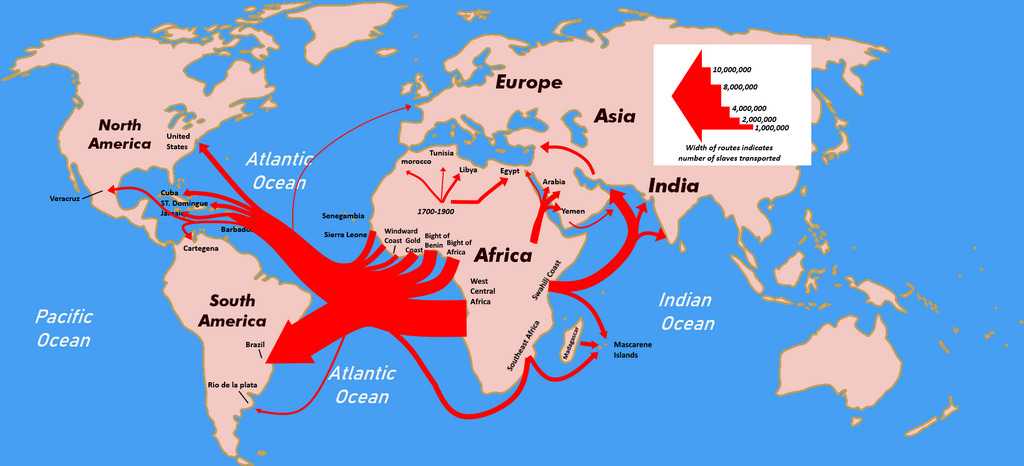
The Atlantic slave trade looks like the most extreme pattern of Europeans plundering others — in this case, Sub-Saharan Africans. It was certainly true that the Atlantic slave trade was horrific and had multiple adverse effects on African society. But those adverse effects were to intensify patterns that already existed. Moreover, the original plundering of people by turning them into slaves was done by … Africans.

The life expectancy of a European who left the African coast was about a year: it was not practical for Europeans to do the original enslaving. They bought the slaves from Africans. This enabled the slave trade carried on by Catholics to conform to the Papal Bull Sublimis Dei (1537) which banned Catholics from enslaving the indigenous inhabitants of the Americas (and, by implication, elsewhere), but did not ban trading in, or owning, slaves.

Wikimedia Commons

Plunder was endemic across human societies: including turning fellow humans into plunder — aka slavery. It was sadly ordinary. It was not a European pattern, it was a Homo sapien pattern. The Islamic slave trade was on the same scale—given it operated for centuries longer — as the Atlantic slave trade, the Saharan passage was every bit as horrific as the Atlantic passage, and the Islamic slave trade had the extra horror of the castration of male slaves. Hence, there is not an ex-slave diaspora in Islam as there is in the Americas.

Just as plunder was endemic, so was poverty. Mass poverty was the norm across farming societies. While there were economic efflorescences across human history, and evidence of periods of sustained growth, the dramatic shifts to mass prosperity since the 1820s — since the application of steam power to railways and steamships — is utterly without precedent. Moreover, it started in precisely one society — Great Britain. None of the other Atlantic littoral societies of Europe showed any sign of such a take-off.


  1. The megafauna outside Africa — which did not co-evolve with Homo sapiens — almost all died out when Homo sapiens turned up.

“One of the top tips for having a decent country is never, ever, allow the fuckwits to gain power”

If you need to drop someone off at London’s Gatwick Airport, you’ll find yourself facing a £7 charge for the privilege, no matter what day of the week or time of day you choose. Tim Worstall explains why:

“Gatwick Airport, North Terminal” by Martin Roell from Berlin, Germany is licensed under CC BY-SA 2.0 .

It’s sod all to do with congestion and everything to do with the tractor production statistics the fuckwits have imposed upon the airport.

    The conditions attached by the transport secretary included national landscape provisions as per the Levelling Up and Regeneration Act 2023, more consideration for sustainability in buildings design and additional pollution-related mitigation measures.

    The government said in its formal response to the Planning Inspectorate’s recommendations on the Gatwick DCO that it wanted more detail on how it would achieve its commitment of 54% of passengers arriving at the airport via rail within the first year of dual runway operations, which could be by the end of this decade.

The government has a target. That 54% of the arrivals at an airport — yes, an airport, where people get on jet planes — must be by public transport. Therefore the airport is charging for car drop offs in order to decrease the number of car drop offs. There is no more reason than that. Or, as up at the top, the reason there’s a £7 drop off charge at Gatwick Airport is because we are ruled by the fuckwits who have a target for public transport to an airport where people then get on jet planes.

    London Gatwick has also accepted a requirement to have 54% of passengers using public transport prior to bringing the Northern Runway into operation and has reiterated the need for third parties, including the Department for Transport, to support delivery of the necessary conditions and improvements required to meet this target. This would include, for example, reinstating the full Gatwick Express train service.

    Given the reliance on other parties to achieve this 54% target, should it not be achieved then London Gatwick has also proposed an alternative cars-on-the-road limit to be met before first use of the Northern Runway to address concerns about possible road congestion. Furthermore, if neither the 54% transport mode share or the cars-on-the-road limit are met, then use of the Northern Runway would be delayed until £350m of road improvements have been completed. This would make sure any additional road traffic flows can be accommodated and any congestion avoided.

It’s all fuckwit targets set by fuckwits.

Of course, there are those who think that fuckwit targets set by fuckwits are a good idea. For one of the problems of life is that there are always fuckwits:

    When we talk about airport expansion, we often focus on runways, terminals, and the physical infrastructure. But what about how people actually get to the airport?

    The journey begins long before passengers step foot in a terminal, and their choices about transport can have a significant impact on congestion, carbon emissions, and overall passenger experience.

    One of the conditions set for Gatwick’s expansion is a legally binding guarantee that 54% of passengers will travel by public transport, up from today’s 44%. On the surface, it sounds like a simple shift. But transport isn’t just about availability — it’s about behaviour, convenience, and incentives.

One of the top tips for having a decent country is never, ever, allow the fuckwits to gain power. But we have done so therefore there is this £7 charge for a drop off at Gatwick Airport. That’s it, there is no other reason. There are fuckwits buried in the belly of the British state and they’re making the rules now.

Table saws, technological patents, and rent-seeking

Tom Knighton, who I’ve “met” on my favourite woodworking forum, celebrates a small victory in the never-ending battle against the rent-seekers of the corporate world:

“SawStop” by Comfr is licensed under CC BY-SA 4.0 .

What does this have to do with rent-seeking?

Well, there’s a company called SawStop. They make really great table saws with a unique safety feature. They’re equipped with a brake and sensor that, when it detects moisture such as one might find in a human finger, it locks the saw and drops the blade down into the saw’s body.

It’s a really great bit of technology, and the saws happen to be really good saws, too, so the company has done well for itself.

However, it started out as a company seeking to license the technology, only no one wanted it at the time.

SawStop decided to try and press the United States government to mandate their technology on all new table saws, and the government was going to.

Was.

This video has a good rundown of the whole thing. (I’d embed it, but the channel doesn’t allow it for some reason.)

The short of it is that the rule that was being considered has now been tossed because it would specifically give SawStop a monopoly on table saw sales in the United States, legally. Yes, they were going to offer up a patent for the public domain, but it wouldn’t be enough to replicate the technology in and of itself.

Plus, at a time when woodworking isn’t the biggest hobby in the world, even if it had been enough, driving up the cost for a central piece of tooling that most consider essential for woodworkers ain’t the way to change that.

For example, Skil makes a jobsite saw that typically runs under $300. SawStop’s equivalent is around three times that much, and that’s a lot of money to spend on something you’re not sure you’ll even enjoy.

Especially since just being careful can prevent the need for the brake in the first place, to say nothing of the fact that if you cut wet wood, it’ll trigger the brake, which is a pain for a lot of people, especially building contractors whose lumber isn’t super dry to begin with.

Seeing the rug pulled out from under SawStop is great, but the real issue here is that it doesn’t happen often enough. Rent-seeking is all too common and all too often works.

When Jagdpanther Fought Churchill

Filed under: Britain, Germany, History, Military, Weapons, WW2 — Tags: , , , — Nicholas @ 02:00

The Tank Museum
Published 18 Apr 2025

Jagdpanther vs Churchill. Tank destroyer vs tank. New technology vs proven veteran. Who will emerge victorious?

It’s 6pm on 30th July 1944. Outnumbered 6 to 1, a platoon of 3 German Jagdpanthers is about to go into action for the first time. Facing them will be a squadron of 18 British Churchill tanks. Within 5 minutes, 11 tanks will be knocked out.

The Jagdpanther is the latest German armoured vehicle to arrive in Normandy. With a devastating gun, and a heavily armoured superstructure, this tank hunter is quick, reliable and deadly.

The Churchill has been fighting with Allied armies in North Africa, Italy and on the Eastern Front. The early marks struggled with a range of issues, but by 1944 it is an essential part of the British and Canadian tank force.

It’s during Operation Bluecoat where these two machines would come face-to-face for the very first time. The Churchills of S Squadron, 3rd Battalion, Scots Guards, have captured Hill 226 – a strategically important area to the south of Caumont. They are preparing for a German counterattack, but their infantry is yet to arrive – leaving their left flank dangerously exposed. And a platoon of Jagdpanthers is ready to take full advantage of their vulnerable state …

00:00 | Introduction
00:35 | The Jagdpanther
02:38 | The Churchill
05:43 | Operation Bluecoat
07:46 | A Turkey Shoot?
12:25 | Aftermath
17:40 | Roll of Honour
(more…)

QotD: Problem-solving in large organizations

Filed under: Bureaucracy, Business, Quotations — Tags: , , — Nicholas @ 01:00

… but it’s the nature of bureaucracy itself that’s most to blame. Everyone who has ever worked for even a midsize company has had this kind of experience: You’re in Customer Service, and some hotshot from Sales calls you up. He’s promised a big new potential client the earth and stars, and now he needs you to deliver. Alas, you tell him, you can’t do it. Not won’t, can’t — you’re not set up for that kind of thing. So you call your Department Supervisor over, and he comes up with what looks like a workaround …

… except no, now Accounting chimes in, that looks like it might be a violation of some codicil to some sub-paragraph of an addendum to a regulation, better check with Compliance. But before you can do that, the Division Managers get into it, because hotshot has called his Department Supervisor over and said look, Dave, I brought in seventy gorillion dollars last fiscal year, you owe me this one …

… and so forth. Everybody with me? No one is corrupt in this scenario. Nobody’s trying to pull a fast one on anybody else. Indeed, everybody’s on the same page, and everybody has every incentive to find a solution, because all our Christmas bonuses are going to look a little nicer if the firm lands this fat client. All we’re trying to do is add one task to the existing Customer Service workflow, but it’s going to take at least a Division Manager-level meeting, if not the direct input of the Big Boss himself, to get it hammered out. It’s an exponential increase in energy expenditure.

And of course it ramifies, and of course that’s true no matter what solution you come up with. Make an exception to the workflow for this one client, and pretty soon you’re going to be making exceptions for every client — every wannabe-hotshot up in Sales is going to demand the works for every little podunk potential client. Same deal if you designate one guy from Customer Service as the dedicated exception-handler. Same deal if you create a whole new sub-unit inside Customer Service (but a lot faster). And so forth.

I’m sure everyone has had that experience, too: Watching your company lose out on a potential big client because the various Departments couldn’t get on the same page for whatever reason.

And that’s just around the office! Meaning: yeah, it’d be nice if we could land that big client, maybe see an extra hundred bucks on our Christmas bonus, but nobody’s losing any sleep over it. Well, ok, Hotshot up in Sales probably is, but even the best salesman loses far more often than he wins. He’ll get over it in a day or two, or he won’t be a salesman much longer.

But the same thing happens when it comes to stuff that matters, which is why complex societies collapse.

Severian, “Collapse II”, Founding Questions, 2021-12-09.

« Newer PostsOlder Posts »

Powered by WordPress