Quotulatiousness

April 26, 2025

A proposal for cutting the Channel crossing phenomenon

Filed under: Britain, France, Government — Tags: , , , — Nicholas @ 05:00

In The Conservative Woman, David Wright suggests a concrete plan to stem the tide of “refugees” arriving in the south of England from Calais and other French Channel ports:
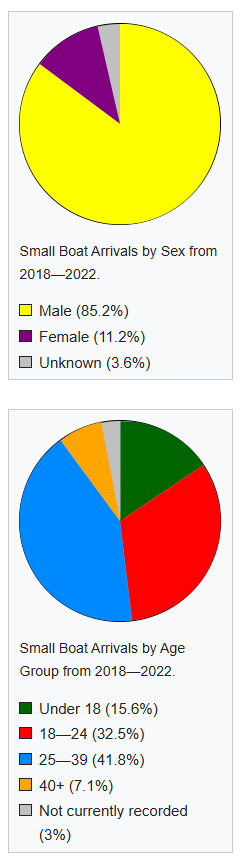
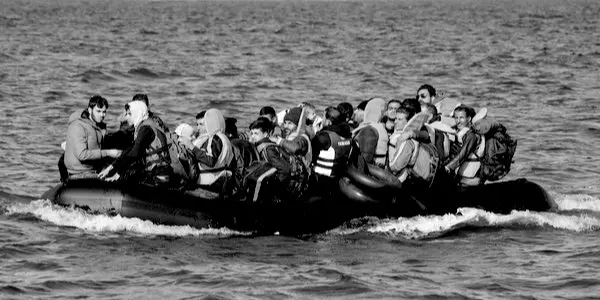
Illegal Channel crossings by rubber dinghies overloaded predominantly with young men have been an increasingly worrying trend for many years yet successive governments have made no serious or workable attempts to do anything about it.

Migrant crossings are up by more than 40 per cent on last year and a record for daily arrivals has been set. A total of 705 migrants in 12 boats crossed the Channel on Tuesday April 15, days after the previous record of 656 was set the previous Saturday. The total number of arrivals in 2025, at 8,888, is 42 per cent higher than at the same point last year and 81 per cent higher than at this stage in 2023. More arrivals were recorded in January to April than in the equivalent four-month period in any year since data on Channel crossings began in 2018.

The French authorities are providing lifejackets to ensure migrants can cross the Channel safely. The jackets are returned to the French once the migrants have been escorted to the mid-point of the Channel and are rescued by the British authorities, so that they can be re-used for future crossings.

We have seen French police on the beach at Calais standing idly by while migrants board dinghies to Dover.

[…]

The boats should be painted grey, a small gun mounted on the foredeck, and manned with recently retired RN personnel. (There would be no shortage of volunteers.) A small support base should be built in Folkestone harbour, initially using Portakabins for rapid start-up, with fuelling facilities, a small workshop, an accommodation block and a canteen. This could be achieved relatively quickly and at a modest cost to the defence budget. These boats would be tasked with patrolling the Dover Strait every day from dawn to dusk, three or four at a time. Drones could also be used to detect dinghies and direct the patrolling boats to them. They would not need to be at sea in weather too rough for small smuggler-boat crossings.

They should be tasked to intercept the smugglers wherever they are in the Channel, approaching our shores, over the mid-way line or just leaving French beaches, and turned back and escorted. On approach to the smugglers’ beach the Border Force vessel should stand off and launch a RIB (rigid inflatable boat) manned by four staff who would escort them until they grounded on the beach. With two of them standing guard with weapons the others, using box cutters, would slash long holes in the rubber dinghies and remove the outboard motors and drop them into the water to render them unserviceable. On completion the RIB should return to its vessel and the vessel withdraw to resume patrol. Input from serving senior naval officers would be needed to provide detailed operating procedures. Once deployed this division would be under the command of a senior serving officer.

Of course, French President Emmanuel Macron would immediately be protesting. But he hasn’t got a leg to stand on. France is a signatory to the Schengen Agreement which requires migrants/asylum seekers to be processed in the first safe country they enter. Not only that but Britain has paid France almost half a billion pounds to stop the migrants arriving at the beaches and boarding dinghies to Dover.

France has not only done nothing but trouser this cash while its navy continues to escort the dinghies into UK waters and hand them off to our Border Force or the RNLI.

The week-before-the-vote Bullshit Bulletin

Filed under: Cancon, Media, Politics — Tags: , , , — Nicholas @ 04:00

The Line‘s invaluable bullshit tracker includes some steaming bullshit from Mark Carney, the Conservative campaign, and, perhaps the most acrid bullshit from the NDP’s Jagmeet Singh:

Jagmeet Singh, the empty turban. He is the current (and possibly last) leader of the federal New Democratic Party, and it’s his conscious actions that may have doomed his party to parliamentary oblivion.

This article, about a recent meeting between Singh and the Toronto Star editorial board, is just absolutely bonkers. Jagmeet. Our dude. We like you. We do. But this is some epic bullshit.

This passage, in particular:

    The NDP leader stood by his decision not to plunge the country into an early election last fall while support for Justin Trudeau’s Liberals plummeted, telling the Star‘s editorial board he “couldn’t stomach” the idea of causing Pierre Poilievre’s seizure of power, and that he made the choice to put Canada’s interests ahead of those of the New Democratic Party.

    “While we could have won lots of seats, it would have meant a Pierre Poilievre majority Conservative government, and I could not stomach that,” Singh said, making the argument that an election would have jeopardized progress on pharmacare deals and dental care expansion. “I love my party. I care deeply about it. I want us to win. I want us to up our seats. I know we’re good for people. But in that moment, I made a decision for the interest of the country ahead of my party. And that was a decision I made wide-eyed, and I stand by that decision.”

Hmmm. Okay. So. Let’s take that at face value. If only for the sake of argument.

Singh realizes what the logical endpoint of that argument is, right? … right?! The story of this election, to the extent there is a single one, is that the NDP collapse made it impossible for the Conservatives to win. We have lots of criticisms of the CPC campaign; we’ve made some already and we’ll have more to say when it’s over. But we recognize the truth that without a strong NDP, even a perfect and flawless Conservative campaign was always going to be an uphill battle. It’s just a really difficult situation for the Conservatives to overcome.

And you know what Singh could do to make that a permanent state of affairs? Give up! Tank the NDP completely. Do a national tour asking everyone to vote Liberal. Defect and become a Liberal. Spend his post-politics career, which seems set to start sometime early next week, campaigning for a two-party system, under which the Liberals defeat the Conservatives over and over.

End the vote splitting by ending the NDP. That’s a case that many Liberals have made before. And fair enough. But it’s some kind of bullshit to see Singh himself making it, and we can’t imagine his NDP colleagues are particularly pleased to see their leader taking a position that the Liberals took years ago: that the best way for left-leaning voters to stop the Conservatives is to put the country first, and vote for them.

Lies, damned lies and government statistics

Filed under: Cancon, Economics, Food, Government, Media, Politics — Tags: , — Nicholas @ 03:00

Francisco at Small Dead Animals linked to this interesting examination of the difference between the official inflation rate and the actual inflation ordinary Canadians are coping with:

    Great news! We’ve brought inflation back under control and stuff is now only costing you 2.4 percent more than it did last year!

That’s more or less the message we’ve been hearing from governments over the past couple of years. And in fact, the official Statistics Canada consumer price index (CPI) numbers do show us that the “all-items” index in 2024 was only 2.4 percent higher than in 2023. Fantastic.

So why doesn’t it feel fantastic?

Well statistics are funny that way. When you’ve got lots of numbers, there are all kinds of ways to dress ‘em up before presenting them as an index (or chart). And there really is no one combination of adjustments and corrections that’s definitively “right”. So I’m sure Statistics Canada isn’t trying to misrepresent things.

But I’m also curious to test whether the CPI is truly representative of Canadians’ real financial experiences. My first attempt to create my own alternative “consumer price index”, involved Statistics Canada’s “Detailed household final consumption expenditure“. That table contains actual dollar figures for nation-wide spending on a wide range of consumer items. To represent the costs Canadian’s face when shopping for basics, I selected these nine categories:

  • Food and non-alcoholic beverages
  • Clothing and footwear
  • Housing, water, electricity, gas and other fuels
  • Major household appliances
  • Pharmaceutical products and other medical products (except cannabis)
  • Transport
  • Communications
  • University education
  • Property insurance

I then took the fourth quarter (Q4) numbers for each of those categories for all the years between 2013 and 2024 and divided them by the total population of the country for each year. That gave me an accurate picture of per capita spending on core cost-of-living items.

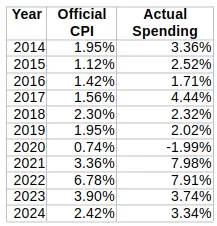
Overall, living and breathing through Q4 2013 would have cost the average Canadian $4,356.38 (or $17,425.52 for a full year). Spending for those same categories in Q4 2024, however, cost us $6,266.48 – a 43.85 percent increase.

By contrast, the official CPI over those years rose only 31.03 percent. That’s quite the difference. Here’s how the year-over-year changes in CPI inflation vs actual spending inflation compare:

As you can see, with the exception of 2020 (when COVID left us with nothing to buy), the official inflation number was consistently and significantly lower than actual spending. And, in the case of 2021, it was more than double.

Since 2013, the items with the largest price growth were university education (57.46 percent), major household appliances (52.67 percent), and housing, water, electricity, gas, and other fuels (50.79).

The Fairey Battle – Light Bomber, Heavy Losses

Filed under: Britain, History, Military, Weapons, WW2 — Tags: , , , , , — Nicholas @ 02:00

Rex’s Hangar
Published 17 Nov 2021

Originally conceived in the early 1930s, by the time the first prototype of the Fairey Battle flew in 1936 it was already becoming obsolete. However, the RAF desperately needed combat aircraft, and so the Battle was put into production. It would go on to fight in the Battle of France, where it would take exceptionally heavy losses due to its slow speed and poor defensive armament. After being retired from front-line duty, the Fairey Battle would go on to becoming a successful training aircraft for the RAF and Commonwealth forces, serving the needs of combat flight schools in Canada, South Africa, Australia and New Zealand.

****

Producing these videos is a hobby of mine. I have a passion for history, and personally own a large collection of books, journals and other texts, and endeavor to do as much research as possible. However if there are any mistakes, please don’t hesitate to reach out and correct anything 🙂

QotD: “Woke”

… over the past few years the term has been appropriated and sloganised by the cult of social justice. “Woke” is no longer simply a matter of standing up to racism, but is irrevocably connected to the authoritarian mindset of the identitarian left. Rather than confront bad ideas through discussion, debate, ridicule and protest, those who self-identify as “woke” would sooner intimidate their detractors into silence through what has become known as “cancel culture”. More insidiously, they have sought to empower the state and strengthen hate-speech laws, which curb individual freedom. They do all this in the belief that theirs is a righteous cause, but their illiberal actions ultimately bolster the very ideas they purport to despise.

Moreover, this monomaniacal need to expose an ever-expanding set of “phobias” in society means that they end up detecting prejudice even where it does not exist. In the absence of evidence of racism the woke have a habit of simply concocting it; hence the continual emphasis on “unconscious bias”, “white privilege” and “institutional power structures”. Such ideas have germinated over many years in academia – particularly in the postmodern branches of critical theory – and have since seeped into the mainstream.

This is why the public is routinely confronted with absurd articles in the media grounded in an extreme form of intersectionality. One, for instance, claims that white women are “evil”, another that white DNA is an “abomination”. Barely a day goes by without some frenzied denunciation of a movie or a television series for its lack of diversity and positive representation, as though the function of the arts is to send a message that accords with identitarian values.

Few members of the public are entirely familiar with the jargon (“cisgender”, “mansplaining”, “toxic masculinity”), but are assured nonetheless that the premises are indisputable. There’s a very good reason why the Catholic Church resisted translating the Bible into the vernacular for so long. Those in power are always threatened when the plebeians start thinking for themselves and asking difficult questions.

Some commentators have recently raised concerns that “woke” has been weaponised by the far right as a slur against anti-racist campaigners. Afua Hirsch, for instance, has claimed in the Guardian that anyone using the word is “likely to be a right-wing culture warrior angry at a phenomenon that lives mainly in their imagination”. This strikes me as particularly odd, given the Guardian‘s own frequent use of the word, including in headlines such as “Can a woke makeover win Barbie and Monopoly new fans?” and “My search for Mr Woke: a dating diary”. Perhaps Hirsch’s colleagues are further to the right than is generally supposed.

Andrew Doyle, “Why I’m anti-woke”, Spiked, 2020-02-04.

Powered by WordPress