
History Hit
Published 2 Oct 2024Was the Trojan War real? Did the Greeks dig ditches? Why did the Greeks fight the Persians?
Ancient Greek historian Roel Konijnendijk Answers Google’s Most Popular Questions About Ancient Greek Warfare.
00:00 Intro
00:46 Who did the Greeks fight?
01:47 How did the Greeks fight?
02:59 What weapons did the Greeks fight with?
04:25 Did the Greeks fight on chariots?
05:08 Did the Greeks have cavalries?
06:51 Did the Greeks have navies?
08:24 Did the Greeks do sieges?
09:46 Did the Greeks dig ditches?
10:47 Who was the best Greek warrior?
12:05 Was the Trojan War real?
14:04 Who started the trojan war?
15:34 Who was Helen of troy?
16:15 Did the gods fight in the trojan war?
17:02 Which heroes fought in the trojan war?
18:21 What was the trojan horse?
19:16 Who won the trojan war?
20:20 Why was the Trojan war important?
21:28 Why did the Greeks fight the Persians?
23:09 Where was the Persian war?
24:59 Who won the Persian war?
26:50 Why was the Persian war important?
28:26 Did the Spartans fight the Athenians?
28:58 Why was it called the Peloponnesian war?
29:50 Who won the Peloponnesian war?
31:51 What happened after the Peloponnesian war?
(more…)
February 6, 2025
Historian Answers Google’s Most Popular Questions About Ancient Greek Warfare
QotD: Wokeness as substitute religion
[In Tom Holland’s Dominion, he] makes that point that in the absence of Christianity, there’s something instinctive about finding these belief systems. And it does have the same hallmarks: it has the aspect of original sin, the Augustinian concept of original sin which now comes in through whiteness, or being heterosexual — having these immutable characteristics that make you a sinner. And then you’ve got the heresy concept, the idea that anyone who doesn’t think the right things is a heretic who needs to be cancelled, and then you get the metaphor of cancel culture, which is a lot like witch hunting, and burning people at the stake as the Inquisition might have done.
And of course so much of the theorizing behind woke ideas is based on entirely unsubstantiated, faith-based positions. They believe in unconscious bias, and institutional power structures — things that you can’t quantify or put your finger on that just sort of exist in the ether like spirits. And to ask them to prove any of these positions is to simply get the response that well, they do exist because we know they do. Which is what a religious zealot would say.
So I think that certainly the best way to understand the social justice movement is to see it as a cult. Because then it all makes sense, and it also makes sense why they’re able to behave so barbarically toward those who don’t subscribe to their belief system. Because the hallmark of many religions is tolerance to a degree. And then where things start going wrong, where witches start getting burned at the stake and heretics start getting executed is where that tolerance runs out. And I think that’s what happened here: the social justice movement is a fundamentally intolerant movement. And fundamentally illiberal. There’s nothing liberal about it.
Andrew Doyle, talking to Spencer Klavan, “Titania McGrath and the Politics of Wokeness: An Interview with Andrew Doyle”, The American Mind, 2020-01-30.
February 5, 2025
The Korean War 033 – A Deadly Game: China & US Both Attack! – February 4, 1951
The Korean War by Indy Neidell
Published 4 Feb 2025The fate of the Korean Peninsula stands on a knife edge as Peng Dehuai’s mighty armies gear up to make their move. The US 8th Army continues to push towards Seoul, now backed up by Edward Almond’s 10th Corps to the east. Violent clashes towards the end of the week confirm what both sides already suspect: a great battle is coming, and in this deadly game of thrust and riposte, there can be but one victor.
Chapters
00:00 Intro
00:47 Recap
01:02 Thunderbolt Continued
06:47 All’s Well That Ends Well
11:38 The Twin Tunnels
15:49 Conclusion
(more…)
Trump tariff diary, day 4
The Big Orange Meanie and the Little Potato had a phone call, after which the BOM announced a 30-day delay to the imposition of tariffs. In Canada, all of “peoplekind” were relieved to hear that they won’t have to give up their American-made binkies quite yet. Some appropriate snark from The Free Press:

It was actually a phone call between the BOM and the Little Potato, but we can imagine this is what it would have looked like in person.
Mexican president Claudia Sheinbaum Speedy Gonzales’d her way to a deal with Trump yesterday, promising to deploy 10,000 Mexican troops to the border to stop the flow of illegal immigrants and drugs. In return, Trump agreed to pause his 25 percent tariff on goods coming from south of the border. Soon after, he struck a seemingly identical deal with Justin Trudeau, who said he’d appoint a “fentanyl czar” and promised to send 10,000 Canadian troops to the northern border. Who knew they even had that many?! Tariffs will still be levied against Chinese goods starting today, but Trump says he plans to talk with President Xi Jinping as soon as this week.
The FP isn’t wrong … the Canadian Army doesn’t have 10,000 spare troops just hanging around their barracks who could be sent to the border, so it’s much more likely to be a combination of Canadian Border Services Agency (CBSA) agents, RCMP officers, provincial police (if the respective provinces are willing), and whatever the army can spare. (Trudeau refers only to “nearly 10,000 frontline personnel”, not “troops” as a lot of US reports state … that seems a lot more achievable.)
You may be wondering how the US President has such disruptive and antagonistic tools at his disposal. It’s yet another hangover from the Carter years, as Congress delegated these powers to the president in 1977:

Donald Trump as Napoleon the 47th.
Image generated by Grok.
The emerging on-off-on-off trade war between Canada and the United States has everyone asking “How should we fight?” — understandably enough — but we should not move too quickly beyond the question “How is this literal nonsense at all possible?” How did the U.S. Congress’s clearly specified constitutional power to regulate the country’s commerce with foreign nations fall into naked and unapologetic decrepitude? Why is every new American president now a Napoleon, and why isn’t this at all a political issue in the U.S.?
The American Constitution, it seems, has no political party apart from a handful of cranky, tireless libertarians like Gene Healy, Clyde W. Crews or Ilya Somin, who has a new article spitballing possible litigation approaches for Americans who lie in the path of the tariffs now being wishcasted into existence by Napoleon the 47th. Somin explains that President Donald Trump is using an openly contrived “national emergency” to invoke powers delegated to the White House by Congress in 1977, powers that are to be invoked only in the face of “unusual and extraordinary threats” to the Republic.
Since the president apparently has plenary power to define an emergency, and to do so without offering anything resembling a rational explanation, this act of Congress now appears to be less of a delegation and more of a surrender — a total abandonment of constitutional principle and the classical separation of powers. I pause to observe that the cheeks every Canadian should redden with slight shame at the spectacle of frivolous recourse to the law of emergencies causing obvious and sickening injury to the rule of law in the U.S. (Oh, no, that could never happen here!)
Beef Tea from a Victorian Hospital
Tasting History with Max Miller
Published 27 Sept 2024Beef tea made with beef, onions, and clove
City/Region: England
Time Period: 1851Beef tea, largely unfamiliar to us now, was all the rage in 19th century hospitals. Believed to contain all of the nutrients of solid beef (not true), it was given to convalescents of all afflictions and social statuses. You can even find it in cocktail books, though you’d be hard pressed to find a bar that serves it today.
This beef tea is surprisingly nice. It’s not really like a beef bouillon or beef stock, and is much lighter in flavor and color. There’s a hint of beef flavor, but I noticed more of a delicious savoriness and unctuousness. While I don’t think it could replace a cocktail, I could see this being lovely on a cold evening.
Soyer’s new way of making Beef Tea
Cut a pound of solid beef into very small dice, which put into a stewpan, with a small pat of butter, a clove, two butter onions, and a salt-spoonful of salt, stir the meat round over the fire for a few minutes, until it produces a thin gravy, then add a quart of water, and let it simmer at the corner of the fire for half an hour, skimming off every particle of fat, when done pass through a sieve. I have always had a great objection to passing broth through a cloth, as it frequently quite spoils its flavor.
— The Modern Housewife or, Ménagère by Alexis Soyer, 1851
QotD: Economies and disasters
One would never hear my colleagues in George Mason University’s economics department spouting such insanities. Just ask yourself whether the Japanese economy would have faced even greater opportunities for economic growth had the earthquake also struck Tokyo, Hiroshima, Yokohama and other major cities? Would the 9/11 terrorists have made a greater contribution to our economy had they also destroyed lives and buildings in Chicago, St. Louis, Los Angeles and Atlanta? The belief that a society benefits from destruction is sheer lunacy.
French economist Frederic Bastiat (1801-1850) explained it in his pamphlet “What is Seen and What is Not Seen”. He said, “There is only one difference between a bad economist and a good one: the bad economist confines himself to the visible effect; the good economist takes into account both the effect that can be seen and those effects that must be foreseen”. That’s why my George Mason University colleagues are good economists.
Walter E. Williams, “Economics Reality”, Townhall.com, 2020-02-04.
February 4, 2025
Trump tariff diary, days 2 and 3
Posted to social media yesterday:

To celebrate Groundhog Day, Governor Trudeau wore commemorative Groundhog-themed socks. Governor Trudeau’s announced counter-tariffs seem to have made no difference to the Big Orange Meany, so the Great State of Canada proceeds with plans to annex Guam and American Samoa. China has indicated interest in purchasing Vancouver Island or leasing the naval base in Esquimault. The National Post‘s Tristin Hopper suggested “Spend 10 years relentlessly kneecapping the Canadian economy for no reason to show Trump we’re not scared of him”, but we’ve already done that.
Today’s tariff diary entry was going to be:
Reports indicate that the Mexican government is folding to Trumpian pressure. Governor Trudeau insists he won’t budge, regardless of the economic damage to Canadian consumers … what a hero! A few of us may lose our jobs, our businesses, and our economic futures, but he’s willing to take that risk. Update: Trudeau folded like the cheap suit he so resembles. Tariff war on hold for 30 days as Trudeau looks for a way to sign the terms of surrender without any blame attaching to him or his party … he’ll probably blame the provincial governments and the federal NDP (who’ll still support him in Parliament, regardless).
… But the “pause” in tariff enforcement may be enough to let Trudeau and the Liberals — with the active connivance of the bought-and-paid-for Canadian legacy media propagandists — portray this as a great national victory and attempt to turn it into votes for Liberal candidates in the next federal election. I’d love to be proven too cynical here, but the Liberal track record isn’t good.
The FN C1A1 – Workhorse of the Cold War Canadian Army
On Target Canada
Published 20 Jan 2020Time to get a closer look at a rifle I have spent a lot of time with in the past. The FN C1A1, used by the Canadian Army from the mid 1950s to the late 1980s.
Enjoy!
(more…)
QotD: The American political spectrum
Then on the right you have (4) Right-liberals (“Classical liberals”), who share liberalism with groups (2) and (3) but reject (or at least substantially challenge) the idea that society can be “engineered” with positive results. This group largely left the Republican party between 2016 and the present (though some were already libertarians). Notably, (3) and (4) in the United States tend to share hawkish anti-authoritarian, anti-communist foreign policy views; this is where the foreign policy “blob” lives. To their right are (5) Traditionalist Conservatives. Because the United States was founded as a liberal country, they tend to still hold some liberal views (and respond well to liberal, “freedom-centered” framing) but their main ideological commitment is generally conservative in its literal meaning of being traditionalist, desiring things to not change or to recover that which has changed and there is a willingness to compromise on liberalism in the pursuit of that. This, I’d argue, is where the core of the Republican Party currently exists. Finally, you have (6) Right-Authoritarians, who come in various forms based on the authority they believe ought to structure society, e.g. populist authoritarians are fascists, whereas Catholic religious authoritarians are integralists and so on. But the core idea here is that there exists an authority, be it the “national will” (invariably channeled by an individual charismatic leader and often herrenvolk in nature) or tradition or the church or whatever else, which has a right to structure society which supersedes individual liberties. For our purposes, they key is they generally despise liberalism because it places limits on that authority. They tend to insist that liberalism makes societies weak even as liberal societies pound their favorite dictators into dust over and over again.
To put the spectrum another way, we might think in terms of publications: Jacobin (1) <-> Vox (2) <-> The Atlantic (3) <-> The Bulwark/Dispatch (4) <-> National Review (5); few major publications openly identify as being in (6) in the United States, but you can see editors at The Federalist or First Things platform political visions that [derive] from it. To the degree to which “horse-shoe theory” works it is because the thing that The Left and the Right-Authoritarians have in common is that they believe in an effectively unlimited claim on the individual by the community, whereas the core of liberal ideology is that the social claim on the individual is and must be limited.
Bret Devereaux, In a footnote to “Collections: The Philosophy of Liberty – On Liberalism”, A Collection of Unmitigated Pedantry, 2024-07-05.
February 3, 2025
A New World Order – War 2 War 01 – Q4 1945
TimeGhost History
Published 1 Feb 2025World War Two is over. The anti-Axis alliance has promised that their victory shall usher in a time of peace, stability, and freedom. They have pledged to uphold new values of humanity, tolerance, solidarity, and the right to self determination. Have they spoken the truth or has it been a string of lies all along?
(more…)
Rational response to Trumpish provocations? Don’t be silly, we must run in circles with our hair on fire!
My first entry in the “Trump tariff diary” on social media perhaps takes the situation too flippantly:
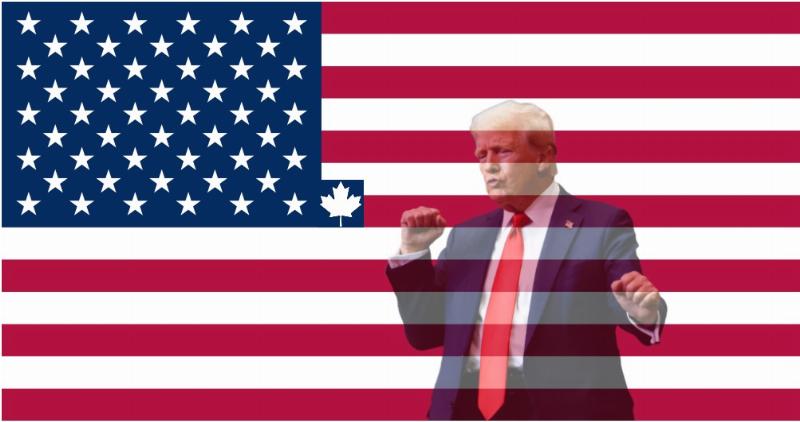
President Trump trolled Justin Trudeau about Canada becoming the 51st state.
Trump tariff diary, day 1: Governor Justin Trudeau of the Great State of Canada struck back at the Big Orange Meany by wearing particularly fashionable socks to his press conference. Ontario will remove all bottles of Jack Daniels from the government liquor monopoly distribution system. The American national anthem will be formally booed at all NHL games played in Canada from now on.
At the National Post, Tristin Hopper offers much more substantive and serious suggestions:
Order Ryan Reynolds to defame American directors until free trade is restored.
Spend 10 years relentlessly kneecapping the Canadian economy for no reason to show Trump we’re not scared of him.
Politely suggest that the U.S. may have confused us with China. Say that although both countries start with the letter C, China is the one seeking to destroy American hegemony via economic means, and we’re just an obsequious neighbour who sells them raw materials.
As a gesture of fealty to American continental supremacy, immediately adopt the U.S. Constitution as Canadian law. Uphold it about as loosely as our existing constitution so there’s no material change.
Volunteer an honour guard of Mounties to serve alongside the Secret Service. Force them to wear red serge if Trump asks.
Offer to pillory a Trudeau at Mar-a-Lago if the tariff threats stop, but don’t specify which one.
Put sugar in the crude oil so all the U.S. refineries seize up.
Instead of shutting off Canadian electricity exports, export too much electricity so that their toast burns and the coffee is too hot.
Send Trump a bentwood box filled with smoked salmon as a gesture of goodwill. When he opens it, it’s just filled with bees.
On a rather more serious note, PPC leader Maxime Bernier posted this on the social media platform formerly known as Twitter:
It’s important to understand that the 25% tariffs announced by President Trump today are NOT imposed on Canada — they will be paid by American consumers and businesses who buy goods imported from Canada. Tariffs are a tax, and Americans who will have to pay more or go without our products will be the first to suffer.
Of course, Canadian exporters of these goods will as a consequence lose clients, contracts and sales, and will be forced to cut down on production and lay off workers. Or they will lower their prices to keep market shares and will see their profits diminish.
Because 75% of our exports go south of the border, our economy will for sure be very negatively impacted by this.
The stupidest thing our government can do however to deal with this crisis is to impose the same kind of tariffs “dollar for dollar” against US imports.
The US economy is ten times bigger than ours, much less reliant on trade than ours, and much less dependent on our market than we are on theirs.
Not only would retaliatory tariffs have much less impact on American exporters, they would immediately impoverish Canadian consumers forced to pay more for imported goods, as well as destabilize Canadian businesses that need inputs from the US in their production processes. It would more than double the harm of the US tariffs to our economy.
Trade wars are bad for everyone, but they are much worse for a small country with fewer options. We simply cannot win a trade war with the US. It’s very unlikely that Trump will back down. All we will do is provoke a massive economic crisis in Canada, until we are forced to capitulate.
Another self-destructive thing to do would be to set up giant “pandemic-level” bailout plans to support everyone affected by this trade war. This will simply bankrupt our governments even more than they already are and make us even weaker.
So what should we do?
1. Double down on efforts to control our border, crack down on fentanyl dealers, deport all illegals, and impose a complete moratorium on immigration, to answer Trump’s immediate concerns about Canada.
2. Tell the US administration that we are ready to renegotiate North American free trade and put dairy supply management and other contentious issues on the table.
3. Wait and see to what extent Trump is willing to keep tariffs in place despite the harm it does to the US economy. Despite his pretenses that Americans don’t need our stuff, the reality is that on the contrary they have few other options for crucial resources like oil, lumber, uranium and other minerals, etc. He will stop acting like a bully when he sees that he can get more results by sitting down and negotiating.
3. To reduce our dependence on the US market, immediately implement an ambitious plan to tear down interprovincial trade barriers and help our impacted exporting industries find alternative markets in other countries.
4. Immediately implement a series of bold reforms to make our economy more productive, including: reduce corporate and personal taxes, abolish the capital gains tax, abolish all corporate subsidies, get rid of excessive regulation, remove impediments to the exploitation and export of natural resources, drastically cut government spending, mandate the Bank of Canada to stop printing money and start accumulating a gold reserve to prepare for the global monetary reset (which is likely part of Trump’s plan).
In short, instead of adopting a suicidal strategy to confront Trump, we must do what we should have done a long time ago to strengthen our economy and our bargaining position. The transition will be rough, but not as much as complete bankruptcy and disintegration.
My strong suspicion is that Trump’s extended tantrum directed at Canada is actually a way to provide pressure against other future tantrum targets … “if he’d do that to friendly neighbour Canada, what won’t he do to us?” An updated version of Voltaire’s quip that Britain needed to shoot an admiral every now and again pour encourager les autres.
Coyote Blog facepalms over Trump’s self-sabotage of the US economy:
Trump’s first few weeks have been a mix of good and bad for this libertarian, all against a backdrop of horror at how Imperial the presidency has become. […] Because we are all tired of those fentanyl-toting Canadians crossing the border illegally. I mean, we all saw the Proposal and know how all those Canadians are trying to cheat US immigration law.
Seriously, this is beyond awful — and not just because of the threat of retaliation, though that is real. Even if all the affected countries roll over and accept these modified tariffs without response, this is still a terrible step for the US. No matter how Trump and his very very small group of protectionist economist friends sell this, this is a tax on 300 million US consumers to benefit a small group of producers. I don’t have time right now to give an updated lesson on free trade — that will have to wait for when I am not on vacation. But I will offer a few ironies:
- After campaigning hard on inflation, Trump is slapping a 10-25% consumption tax on foreign goods. That is a straight up consumer price increase for a variety of key products including much of the lumber we use to build homes, a lot of our oil and gas, a lot of our grain and beef, and many of our cars and appliances.
- Much of this inflation is going to disproportionately hurt Trump’s base. No one is going to care much if a Hollywood actor has the fair trade coffee they buy at Whole Foods go up in price, but Trump voters are going to see a direct effect of this on prices at Wal-Mart.
- Republicans have spent 4 years (rightly) condemning Federal and State governments for the economic disruptions of COVID lockdowns and restrictions. While some of the inflation of the last 4 years was due to ridiculously high government deficits, another major cause was the COVID supply chain disruptions. And now Trump is voluntarily recreating them.
The only small hope I have is that Trump is steeped from his business career in a certain style of brinksmanship bargaining that consists of taking an entirely destructive and irrational position in hopes that they folks on the other side of the table will back down and give him more than he should. My son won poker tournaments like this because he would do so much crazy stuff that no one at the table wanted to challenge him. I have always said that I don’t think Trump is a particularly good business person — he has run business after business that has failed. But he is a good negotiator, and has exited numerous bankruptcies with his creditors giving him far more than one would think was necessary.
Roman Senior Army Officers and their careers
Adrian Goldsworthy. Historian and Novelist
Published 1 Oct 2024Today’s question is about the career paths for senatorial and equestrian officers in the Roman army. This is a big theme, so take this as an introduction. We will return to this topic in the future.
QotD: Illiteracy then and illiteracy now
In the not too distant past, people who were illiterate could neither read nor write. These days they can, with disastrous results for the culture.
He quoted his own old friend Stephen Vizinczey:
No amount of learning can cure stupidity, and formal education positively fortifies it.
David Warren, “On paper logic”, Essays in Idleness, 2020-02-22.
February 2, 2025
HMS Hood – Death in 17 Mins – The Bismarck Part 2
World War Two
Published 1 Feb 2025On May 24, 1941, the Kriegsmarine‘s mighty battleship Bismarck goes head to head with the Royal Navy’s HMS Hood. Seventeen minutes later, just one of the steel titans is left afloat and 1,400 men are dead.
Special thanks goes to the HMS Hood Association, to learn more about HMS hood visit hmshood.org.uk
(more…)
Captain Trumpmerica versus the Post-national Maple Protectionists
Donald Trump has made picking fights with the corrupt oligarchs of Mexico and Canada a key part of his appeal to American voters. Canada used to be a proud nation, but after years of deliberate mismanagement and stubborn opposition to innovation and growth, we’ve become — as Justin Trudeau so smugly put it — the first “post-national state” that has “no core identity [and] no mainstream”, because we’re a plaything for the WEF and other transnational organizations. Elizabeth Nickson calls us a “failed state” and that swapping in globalist WEF’er Mark Carney for globalist WEF’er Justin Trudeau will make no positive difference:
25% tariffs will ruin us. The tariffs mean one million small businesses — all which sell to the U.S. — will contract and many will close their doors. And then Trump, as he promised the unions, will pull “our” auto industry. Then we’re done.
Who is to blame for this?
The following is going to be crude because Canada is so boring (that’s deliberate) that no one cares. There are a thousand ultra-complex rationales on why Canada is failing and all they do is obfuscate. I’m not pulling punches, softening rhetoric — it is bad. It is urgent. This is the death of something that 75 years ago was shining, sunlit, exciting. That country? That country was killed by the Laurentian elite, weak, cosplaying Marxism to stay in power, themselves outwitted by investment bankers who plan to steal everything not nailed down. In so doing new elements were forcibly injected into the population: envy, resentment of the successful, sloth, the refusal to grow up, be strong and independent. We effectively sit on top of the U.S., seething with envy, in wet diapers.
We are a broken country. Everyone who understands the world knows this. The only people who don’t are deluded Canadian socialists, which is to say our entire elite and all our “knowledge class”. Dissent is ignored. Or jailed.
Central banker Mark Carney, WEFer paramount, is being parachuted into the Liberal party in order to sell us off to the investment banks who will harvest us for our resources. Our people? Future serfs in Special Enterprise Zones. We already have the regulation in place. No taxes, no worker rights, no enviro controls, no self-determination, no agency, no freedom. Time frame? Ten years, twenty at the outside. The inevitable end of hard-core socialism.
That is what Carney did to Canada in the ‘08 crisis, a crisis entirely created by larcenous government and investment bankers: he loaded us up with so much debt that the moment the economy turned, the working class — and Canada is now 75% working class — paid for it through interest rates so high they crippled and broke every middle class family with a mortgage. Then, he moved to England and did it to the English. His name there? Mark Carnage. During the ’08 crisis, he in Canada and the UK and Obama in the US transferred trillions in public wealth to the investment banks to keep them going after the worst crisis since ’29. A crisis they caused. That was the people’s money, not theirs.


However, as Peter Menzies points out, our Laurentian Elite are still 100% protecting us from the baleful influence of American culture … well, the commercial bits anyway:
Next Sunday, the federal agency responsible for the flourishing of national culture and identity will be swamped with complaints. The grumbling will emanate from Canadians enraged they can’t get more American culture. Yes, America may be in the process of humiliating Canada as its lamest of lame duck leaders, Prime Minister Justin Trudeau, waddles into the sunset. And, for sure, most of us are mortified that U.S. President Donald Trump has chosen to make an example of us as he launches his mission to bring the globe to heel and Make America Great Again.
But the bitching directed in the days to come at the Canadian Radio-television and Telecommunications (CRTC) headquarters in Gatineau will originate from Canadians angry they can’t watch American Super Bowl TV ads along with the game. A perennial contender to be the most watched TV event in Canada, the Super Bowl also has traditionally been the most controversial event on the CRTC’s calendar.
The USA can slap us silly with tariffs. It can send hundreds of thousands of us into unemployment and despair. It can mock our disinterest in maintaining the essentials of nationhood and drive us into unsustainable debt. Trump can brutalize our national esteem and taunt us for our cavalier attitudes towards the defence of our sovereignty. And he can lick his big beautiful lips while pondering our potential as the 51st state.
But what will really light us up Feb. 9 will be being unable to watch Meg Ryan and Billy Crystal reinvent their famous restaurant scene from When Harry Met Sally or Michelob Ultra’s production starring Willem Dafoe and Catherine O’Hara as a couple of pickleball hustlers. Or Matthew McConaughey channeling legendary Chicago Bears coach Mike Ditka for Uber Eats. And the Clydesdales. Everyone loves those Budweiser Clydesdales, particularly the cute little foal making a debut.
It doesn’t matter that the ads cost $7 million U.S. (which will convert into heaven only knows how many bazillion loonies in the months ahead) for a 30-second spot. Or that for more than a decade many of the commercials have been available on YouTube. Canadians don’t want to watch a Super Bowl adorned with Government of Ontario and Maple Leaf Foods ads. They want to watch the game like real Americans and relish the full, unfettered American experience.
At the National Post, a sad recounting of just how badly we’ve been let down by our politicians — and not just recently … this is a decades-long list of conscious self-harm for short-term domestic political advantage:
Bold counter-attacks against the U.S. can’t work, because all the ideas Canada could have put into action to make such a response viable are collecting dust on the cellar shelf. Drop interprovincial trade barriers that amount to a $200-billion penalty on the national economy every year? That only became a serious conversation in the last month. It should have been a serious conversation 10 years ago, if not more.
End supply management? Out of the question — think of the Quebec votes such a move would cost. The Big Milk lobby is a strong one.
How about resource development? Because Canada is ultimately a resource-exporting economy? No; we’ve been cancelling energy projects at the slightest objection and building more legislation to stand in their way. Industries like mining and fishing, already mired in growth-choking regulations, are increasingly refashioned by governments into welfare and “reconciliation” initiatives, repelling private investment that would have brought prosperity to the country as a whole.
Diversify away from the Americans? We’ve only done the opposite: since 2017, Canadian trade has become more focused on the U.S.
Canada should be a prosperous, growth-oriented economy, but instead, its government — and the people who continuously vote for economy-stagnating policy — settle for subsistence and redistribution of a shrinking pie of wealth. Their choices for the past decade have left us without enough fat to get through a cold trade winter.
Prompt retaliatory counter-tariffs are hence unwise. Such a move would put Canadians in the path of two separate blows, one from the front, the other from the back. And while immediate counter-tariffs could affect Americans whose support the president depends on — as was the case in the 1930s, when Canadian counter-tariffs prolonged the American Great Depression (while inflicting domestic pain) — those Americans have much bigger economic fat stores. In a trade war of attrition, expect Canada to lose.
That leaves us, unfortunately, with the less-glamourous immediate option: play this by the book. The United States-Canada-Mexico free trade agreement, which will be violated by any across-the-board tariff Trump applies, needs to be challenged with the mechanisms agreed upon by party states. During the process, Canada must remind Trump that it’s just following the agreement that he made.


