
I’ve been planning to write about Elon Musk’s Bowie-blasting space car ever since the video footage was transmitted back to Earth in the middle of this week. But I did not even notice until I sat down to the job that I have also been rereading Robert A. Heinlein’s “Future History” short-story cycle. This is not exactly a coincidence: I go back to the Future History every few years. This time I had one of those “Surprise! You’re old!” moments upon realizing that my cheap trade paperback of The Past Through Tomorrow, a collection of the Future History stories, must be 30 years old if it’s a day.
Written between 1939 and 1950 for quickie publication in pulp magazines, the Future History is a series of snapshots of what is now an alternate human future — one that features atomic energy, solar system imperialism, and the first steps to deep space, all within a Spenglerian choreography of social progress and occasional resurgent barbarity. It stands with Isaac Asimov’s Foundation trilogy as a monument of golden-age science fiction.
In some respects the Future History has not aged any better than one might expect. Like other young nerds who created the science-fiction canon, Heinlein was interested in rocketry before it was thought to have any practical use. And Heinlein was really, really good at acquiring or faking expert knowledge of those topics in which he happened to get interested. The man knew his Tsiolkovsky.
The result, in the key story of the Future History, is an uncannily accurate description of the design and launch of a Saturn V rocket. (Written before 1950, remember.) But because Heinlein happened not to be interested in electronic computers, all the spacefaring in his books is done with the aid of slide rules or Marchant-style mechanical calculators (which, in non-Heinlein history, had to become obsolete before humans could go to Luna at all). Heinlein sends people to colonize the moon, but nobody there has internet, or is conscious of its absence.
Colby Cosh, “Heinlein’s monster? The literary key to Elon Musk’s sales technique”, National Post, 2018-02-12.
January 9, 2021
QotD: Heinlein’s “Future History”
January 8, 2021
Renault’s Backwards Car
Big Car
Published 12 Oct 2020Renault’s Project 900 is certainly an odd-looking car, but it’s also a car designed to break new ground. It used innovative new materials and gave class-leading visibility to try to leapfrog the competition. It also seems they were trying to beat their competition in the “weird” category as well, which given they were up against Citroën was no mean feat! So, what happened to Renault’s backwards car, and what echoes of this strange but innovative design are there in today’s cars?
To get early ad-free access to new videos, or your name at the end of my videos, please consider supporting me from just $1 or 80p a month at https://www.patreon.com/bigcar
Link to my second channel – Little Car: https://www.youtube.com/littlecar
Get Big Car t-shirts, mugs or a tote bag at teespring.com/stores/bigcartv
#bigcar

QotD: Culinary appropriation
Some of the resulting dishes are deplorable. I could live happily in a world without chop suey, chilli con carne, or coronation chicken. I’m not going to try a recipe described in Eater magazine as “huevos Kathmandu that paired green chutney and spiced chickpeas with fried eggs”.
Tex-mex cuisine is Montezuma’s most effective revenge. Rijstafel conquered the Netherlands more thoroughly than the Dutch ever subjected the East, and now rivals the drearier Hutspot as Holland’s national dish. Yet Dutch food still lags behind grandes cuisines.
Vindaloo is the epitome of culinary appropriation: a Bengali dish with ingredients from the Americas — potatoes and chillies — and a corruption of a Portuguese name: vinho d’alho, or garlic wine. It has become so British that “Vindaloo nah-nah” was the chorus of a chant popular among English football fans at a World Cup tournament (perhaps they confused it with Waterloo). I still dislike it.
Usually, however, culturally exchanged foods produce admirable dishes. Chocolate, tomato and avocado are among the few English words derived from Nahuatl. The Aztecs never used the items they designate in pain au chocolat, or tricolore, or avocado toast. But the responsible cultural appropriators deserve praise, not blame.
Satay would be unthinkable if Malays hadn’t incorporated peanuts that Portuguese pinched from Brazil. The basics of cajun cuisine reached Louisiana with “Acadian” migrants from French Canada — but cultural appropriation made it what it is today. Black chefs in the same region would be at a loss without African-born yams.
Curries would be historical curiosities if Indians hadn’t appropriated chillies from Mexico. Is Sichuanese cuisine imaginable without American peppers or sweet potatoes. Tempura would be unavailable if Japanese chefs hadn’t annexed and improved Portuguese techniques of frying. Culinary historians bicker over whether Jewish or Italian immigrants developed fish and chips. But almost everyone agrees that the British could never have done it on their own.
Felipe Fernández-Armesto, “Bad taste of PC foodies”, The Critic, 2020-09-19.
January 7, 2021
Banzai Tank Charge – Saipan 1944
Mark Felton Productions
Published 6 Jan 2020The story of the largest tank battle of the Pacific Campaign on the island of Saipan.
Dr. Mark Felton is a well-known British historian, the author of 22 non-fiction books, including bestsellers Zero Night and Castle of the Eagles, both currently being developed into movies in Hollywood. In addition to writing, Mark also appears regularly in television documentaries around the world, including on The History Channel, Netflix, National Geographic, Quest, American Heroes Channel and RMC Decouverte. His books have formed the background to several TV and radio documentaries. More information about Mark can be found at: https://en.wikipedia.org/wiki/Mark_Fe…
Visit my audio book channel “War Stories with Mark Felton”: https://youtu.be/xszsAzbHcPE
Help support my channel:
https://www.paypal.me/markfeltonprodu…
https://www.patreon.com/markfeltonpro…Disclaimer: All opinions and comments expressed in the ‘Comments’ section do not reflect the opinions of Mark Felton Productions. All opinions and comments should contribute to the dialogue. Mark Felton Productions does not condone written attacks, insults, racism, sexism, extremism, violence or otherwise questionable comments or material in the ‘Comments’ section, and reserves the right to delete any comment violating this rule or to block any poster from the channel.

Fallen Flag — the New York Central System
 This month’s Classic Trains fallen flag feature is the first part of the history of the New York Central System by George Drury. The New York Central was one of the biggest and most economically powerful American railways for over a century before the postwar boom turned into the economic disaster of the 1960s and 70s, as passengers switched from rail to road and plane and the decline of northeastern heavy industry and mining hit the established eastern railroads very hard:
The New York Central was a large railroad, and it had several subsidiaries whose identity remained strong, not so much in cars and locomotives carrying the old name but in local loyalties: If you lived in Detroit, you rode to Chicago on the Michigan Central, not the New York Central; through the Conrail era and even now, the line across Massachusetts is still known as “the Boston & Albany.”
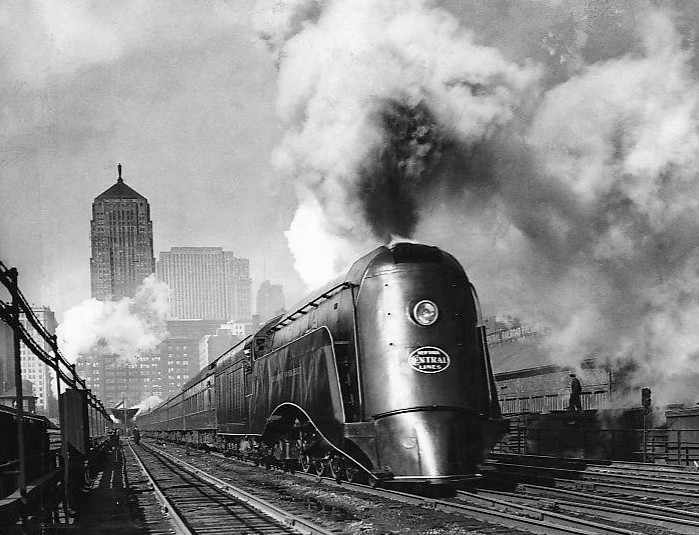
The streamlined steam locomotive New York Central Hudson No.5344 “Commodore Vanderbilt”, leaving Chicago’s LaSalle Street station pulling the NYC’s premier passenger traing, the 20th Century Limited, 22 February 1935.
Photo originally copyrighted International News Photos (copyright not renewed) via Wikimedia CommonsThe system’s history is easier to digest in small pieces: first New York Central followed by its two major leased lines, Boston & Albany and Toledo & Ohio Central; then Michigan Central and Big Four (Cleveland, Cincinnati, Chicago & St. Louis). By the mid-1960s NYC owned 99.8 percent of the stock of Michigan Central and more than 97 percent of the stock of the Big Four. NYC leased both on Feb. 1, 1930, but they remained separate companies to avoid the complexities of merger.
In broad geographic terms, the NYC proper was everything east of Buffalo plus a line from Buffalo through Cleveland and Toledo to Chicago (the former Lake Shore & Michigan Southern). NYC included the Ohio Central Lines (Toledo through Columbus to and beyond Charleston, W.Va.) and the Boston & Albany (neatly defined by its name). The Michigan Central was a Buffalo–Detroit–Chicago line and everything in Michigan north of that. The Big Four was everything south of NYC’s Cleveland–Toledo–Chicago line other than the Ohio Central.
The New York Central System included several controlled railroads that did not accompany NYC into the Penn Central merger. The most important of these were (with the proportion of NYC ownership in the mid-1960s):
- Pittsburgh & Lake Erie (80 percent)
- Indiana Harbor Belt (NYC, 30 percent; Michigan Central, 30 percent; Chicago & North Western, 20 percent; and Milwaukee Road, 20 percent)
- Toronto, Hamilton & Buffalo (NYC, 37 percent; MC, 22 percent; Canada Southern, 14 percent; and Canadian Pacific, 27 percent).
[…]
The New York & Harlem Railroad was incorporated in 1831 to build a line in Manhattan from 23rd Street north to 129th Street between Third and Eighth avenues (the railroad chose to follow Fourth Avenue). At first the railroad was primarily a horsecar system, but in 1840 the road’s charter was amended to allow it to build north toward Albany. In 1844 the rails reached White Plains and in January 1852 the New York & Harlem made connection with the Western Railroad (later Boston & Albany) at Chatham, N.Y., creating a New York–Albany rail route.
The towns along the Hudson River felt no need of a railroad, except during the winter when ice prevented navigation. Poughkeepsie interests organized the Hudson River Railroad in 1847. The railroad opened from a terminal on Manhattan’s west side all the way to East Albany. By then the road had leased the Troy & Greenbush, gaining access to a bridge over the Hudson at Troy. (A bridge at Albany was completed in 1866.)
By 1863 Cornelius Vanderbilt controlled the New York & Harlem and had a substantial interest in the Hudson River Railroad. In 1867 he obtained control of the New York Central, consolidating it with the Hudson River in 1869 to form the New York Central & Hudson River Railroad.
Vanderbilt wanted to build a magnificent terminal for the NYC&HR in New York. He chose as its site the corner of 42nd Street and Fourth Avenue on the New York & Harlem, the southerly limit of steam locomotive operation in Manhattan. Construction of Grand Central Depot began in 1869. The new depot was actually three separate stations serving the NYC&HR, the New York & Harlem, and the New Haven. Trains of the Hudson River line reached the New York & Harlem by means of a connecting track completed in 1871 along Spuyten Duyvil Creek and the Harlem River (they have since become a single waterway). That was the first of three Grand Centrals.
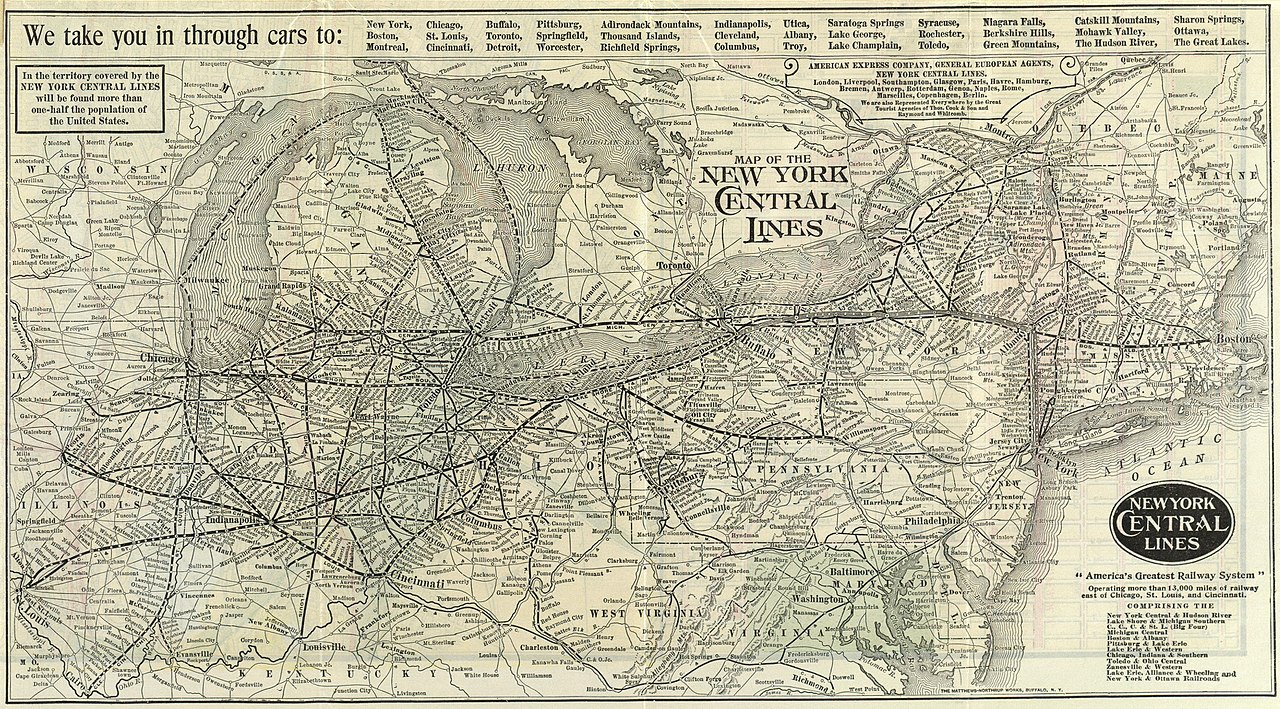
The Wikipedia page on the New York Central includes a good overview of the decline of the railway:
The New York Central, like many U.S. railroads, declined after the Second World War. Problems resurfaced that had plagued the railroad industry before the war, such as over-regulation by the Interstate Commerce Commission (ICC), which severely regulated the rates charged by the railroad, along with continuing competition from automobiles. These problems were coupled with even more formidable forms of competition, such as airline service in the 1950s that began to deprive NYC of its long-distance passenger trade. The Interstate Highway Act of 1956 helped create a network of efficient roads for motor vehicle travel through the country, enticing more people to travel by car, as well as haul freight by truck. The 1959 opening of the Saint Lawrence Seaway adversely affected NYC freight business. Container shipments could now be directly shipped to ports along the Great Lakes, eliminating the railroads’ freight hauls between the east and the Midwest.
The NYC also carried a substantial tax burden from governments that saw rail infrastructure as a source of property tax revenues – taxes that were not imposed upon interstate highways. To make matters worse, most railroads, including the NYC, were saddled with a World War II-era tax of 15% on passenger fares, which remained until 1962, 17 years after the end of the war.
Robert R. Young: 1954–1958
In June 1954, management of the New York Central System lost a proxy fight in 1954 to Robert Ralph Young and the Alleghany Corporation he led.Alleghany Corporation was a real estate and railroad empire built by the Van Sweringen brothers of Cleveland in the 1920s that had controlled the Chesapeake and Ohio Railway (C&O) and the Nickel Plate Road. It fell under the control of Young and financier Allan Price Kirby during the Great Depression.
R.R. Young was considered a railroad visionary, but found the New York Central in worse shape than he had imagined. Unable to keep his promises, Young was forced to suspend dividend payments in January 1958. He committed suicide later that month.
Alfred E. Perlman: 1958–1968
After Young’s suicide, his role in NYC management was assumed by Alfred E. Perlman, who had been working with the NYC under Young since 1954. Despite the dismal financial condition of the railroad, Perlman was able to streamline operations and save the company money. Starting in 1959, Perlman was able to reduce operating deficits by $7.7 million, which nominally raised NYC stock to $1.29 per share, producing dividends of an amount not seen since the end of the war. By 1964 he was able to reduce the NYC long-term debt by nearly $100 million, while reducing passenger deficits from $42 to $24.6 million.Perlman also enacted several modernization projects throughout the railroad. Notable was the use of Centralized Traffic Control (CTC) systems on many of the NYC lines, which reduced the four-track mainline to two tracks. He oversaw construction and/or modernization of many hump or classification yards, notably the $20-million Selkirk Yard which opened outside of Albany in 1966. Perlman also experimented with jet trains, creating a Budd RDC car (the M-497 Black Beetle) powered by two J47 jet engines stripped from a B-36 Peacemaker bomber as a solution to increasing car and airplane competition. The project did not leave the prototype stage.
Perlman’s cuts resulted in the curtailing of many of the railroad’s services; commuter lines around New York were particularly affected. In 1958–1959, service was suspended on the NYC’s Putnam Division in Westchester and Putnam counties, and the NYC abandoned its ferry service across the Hudson to Weehawken Terminal. This negatively impacted the railroad’s West Shore Line, which ran along the west bank of the Hudson River from Jersey City to Albany, which saw long-distance service to Albany discontinued in 1958 and commuter service between Jersey City and West Haverstraw, New York terminated in 1959. Ridding itself of most of its commuter service proved impossible due to the heavy use of these lines around metro New York, which government mandated the railroad still operate.
Many long-distance and regional-haul passenger trains were either discontinued or downgraded in service, with coaches replacing Pullman, parlor, and sleeping cars on routes in Michigan, Illinois, Indiana, and Ohio. The Empire Corridor between Albany and Buffalo saw service greatly reduced with service beyond Buffalo to Niagara Falls discontinued in 1961. On December 3, 1967, most of the great long-distance trains ended, including the famed Twentieth Century Limited. The railroad’s branch line service off the Empire Corridor in upstate New York was also gradually discontinued, the last being its Utica Branch between Utica and Lake Placid, in 1965. Many of the railroad’s great train stations in Rochester, Schenectady, and Albany were demolished or abandoned. Despite the savings these cuts created, it was apparent that if the railroad was to become solvent again, a more permanent solution was needed.
Arsenal AF2011: A Double Barreled 1911 Monster Pistol
Forgotten Weapons
Published 4 Sep 2017The Arsenal 2011 began as a manufacturing proof of concept, to showcase the technical ability of the company making it (their prior experience was largely in exquisite miniature firearms). It was introduced to the public at SHOT Show a few years ago, and garnered more purchases than had been anticipated.
The gun itself is basically two 1911 frames and slides mated together into a single gun. It has two barrels, two magazines, and two hammers attached to make a single unit. The triggers are also connected together, and pulling either one will cause both barrels to fire simultaneously.
While this sort of firearm is fun to consider (and fantastic for use by movie villains), it is rather difficult to imagine a practical use for it. Most oversized handguns are made for hunting and target competition, but the two-shots-per-trigger-pull nature of the 2011 make it rather unsuited to these uses. It is impossible to shoot a truly small group, as the bullets will always be about an inch apart and they cannot be regulated by the shooter to group together. Not that this stops people from wanting this sort of over-the-top handgun, of course.
http://www.patreon.com/ForgottenWeapons
Cool Forgotten Weapons merch! http://shop.bbtv.com/collections/forg…
If you enjoy Forgotten Weapons, check out its sister channel, InRangeTV! http://www.youtube.com/InRangeTVShow

QotD: Sneering at “the throwaway society”
These are not new truths, even if it took the Covid-19 pandemic to reveal them again. The throwaway age began because of public-health campaigns a century ago to control the spread of pathogens. Disposable products were celebrated for decades for promoting hygiene and saving everyone time and money. It wasn’t until the 1970s that they became symbols of decadent excess, and then only because of economic and ecological fallacies repeated so often that they became conventional wisdom.
In a strange turn of events, the most affluent society in history suddenly turned into a mass of neurotic hoarders. Sifting through garbage for valuables, an activity formerly associated with the most destitute inhabitants of Third World shantytowns, became a moral duty in American suburbs. Greens campaigned for “zero waste” and a “circular economy” in which disposable products would be outlawed. They confidently predicted that the throwaway society was doomed, but if they’d known anything about its history, they would have realized that it was created for very good reasons — and that it will endure long after their lamentations are forgotten.
John Tierney, “Let’s Hold On to the Throwaway Society”, City Journal, 2020-09-13.
January 6, 2021
The Use and Abuse of the US Postal System (feat. Mr. Beat)
The Cynical Historian
Published 10 Oct 2020Thanks to Private Internet Access for sponsoring this video. Click here to get 77% off and 3-months free: http://www.privateinternetaccess.com/…
We’ve been seeing a lot of coverage about the post office here in the United States. A lot of folks talk about the history of it, but generally in a piecemeal fashion. The fact most of this commentary lacks is that the post office has always been a political tool, from its beginnings even before the US Constitution. Interestingly enough, what it has been used for over the years has changed substantially, but it is always a harbinger of the up and coming dominant ideology. The post office is a cornerstone of our democracy. The postal system in the United States is uniquely important.
Check out Mr. Beat’s video: https://www.youtube.com/watch?v=favVdKa6cRQ
————————————————————
Connected videos:
3:30 – 1776 | Based on a True Story: https://youtu.be/xY4Te8Qm07A
9:15 – What caused the Mexican-American thing? https://youtu.be/HTmSN4Exci0
9:15 – What Caused the Texas Revolution? https://youtu.be/lDWH-DC74Pk
9:25 – California Gold Rush: https://youtu.be/W1dmyx6LBKA
9:30 – History of California: https://www.youtube.com/playlist?list…
11:30 – The Sectional Crisis: https://youtu.be/Ff2AKILyi0o
14:05 – History of Voting by Mail: https://www.youtube.com/watch?v=favVd…
18:25 – Trains and Oil in California: https://youtu.be/0Ef0Ir-hbFc
18:30 – The History of Early Flight: https://youtu.be/sPgxuD0uYYE
20:35 – US Veterans History: https://youtu.be/ANUqaNykuRs
————————————————————
references:
The United States Postal Service: An American History (Washington, DC: United States Postal Service, 2020). https://about.usps.com/publications/p… [PDF]USPS’s website has a trove of information on their history: https://about.usps.com/who-we-are/pos…
The national postal museum is run by the Smithsonian and includes numerous research articles available to anyone on their website: https://postalmuseum.si.edu/research-…https://www.nationalgeographic.com/hi…
————————————————————
Support the channel through PATREON:
https://www.patreon.com/CynicalHistorian
or by purchasing MERCH: teespring.com/stores/the-cynical-hist…
LET’S CONNECT:
Discord: https://discord.gg/Ukthk4U
Twitter: https://twitter.com/Cynical_History
Subreddit: https://www.reddit.com/r/CynicalHistory/————————————————————
Wiki: The United States Postal Service (USPS; also known as the Post Office, U.S. Mail, or Postal Service) is an independent agency of the executive branch of the United States federal government responsible for providing postal service in the United States, including its insular areas and associated states. It is one of the few government agencies explicitly authorized by the United States Constitution.
The USPS traces its roots to 1775 during the Second Continental Congress, when Benjamin Franklin was appointed the first postmaster general. The Post Office Department was created in 1792 with the passage of the Postal Service Act. It was elevated to a cabinet-level department in 1872, and was transformed by the Postal Reorganization Act of 1970 into the United States Postal Service as an independent agency. Since the early 1980s, many direct tax subsidies to the USPS (with the exception of subsidies for costs associated with disabled and overseas voters) have been reduced or eliminated.
————————————————————
Hashtags: #history #USPS #USMail

QotD: George Bernard Shaw’s views on eugenics
The Irishman’s opinions are, however, coming back to mangle and even smash his reputation. A group of students at RADA have called for Shaw’s name to be removed from the drama school’s theatre as part of an anti-racism action plan. This matters, because Shaw provided for the school in his will, and last year the royalties from his work contributed more than £78,000 to RADA. Yet the accusation that the renowned theatre college “celebrates historical figures who embraced racist ideologies” does have a certain merit. Problem is, as has been debated myriad times: do, can, and should we separate an artist’s work from their period, character and ideas? If the ghosts of anachronism and historical assumptions are never to be exorcised, there are an awful lot of people who will fail and fall to the wide-awake litmus test.
Shaw did indeed write, that, “The only fundamental and possible socialism is the socialisation of the selective breeding of man” and, chillingly, “A part of eugenic politics would finally land us in an extensive use of the lethal chamber. A great many people would have to be put out of existence simply because it wastes other people’s time to look after them.” He lectured for the Eugenic Education Society, praised Stalin (naturally) the early Mussolini, and even Hitler as late as 1935. He abandoned most of all this in his old age but never made any formal apology.
He was also an incisive critic of imperialism, mercilessly exposed establishment hypocrisy, opposed war and oppression throughout his career, and cared passionately about actors and writers – the very people at RADA trying to expunge his name from their place of learning. And here’s another challenge and even embarrassment for those who would remove the social engineers from the litany of the great and the good: many of their harshest opponents were not others on the left but, in Edwardian Britain and in the 20s and 30s, conservative Roman Catholic writers led by G.K. Chesterton and Hilaire Belloc.
Michael Coren, “Eugenics and the intellectual left”, The Critic, 2020-09-16.
January 5, 2021
Lockdowns are inducing a kind of cultural autism (but especially among our self-imagined “betters”)
Last month, Douglas Murray looked at how the various shades and degrees of lockdown in most western nations have disrupted normal socialization patterns and created odd and unusual social feedback to various stimuli:

A building burning in Minneapolis following the death of George Floyd.
Photo by Hungryogrephotos via Wikipedia.
This year has seen a series of extraordinary events. First and foremost are the unprecedented lockdowns, which have removed from almost all our societies not just our ability to congregate, but also almost all of our social antennae. It is not just actors, comedians or public speakers who have lost that mechanism: we all have to some extent.
“Will this statement/opinion/joke go down well or badly?” is a fine judgement call. In public and relative private we all try things out and experiment all of the time. Take away all audiences beyond your immediate household and we must all subject ourselves to some other way of testing which way the wind is blowing. The only such device left is the online world, which — as should be obvious to all by now — has its own problems.
And so, during the middle of the oddest mass psychological experiment in history, came the death of George Floyd in May and the rapid escalation of the Black Lives Matter movement. A movement that attempted to push, inveigle and eventually intimidate itself into almost every walk of life inside America and beyond.
In Britain, institutions as far away from the scene of the crime as the British Library and Cambridge University seemed to think that the death of an unarmed black man at the hands of a Minnesota police officer (currently awaiting trial on a charge of murder) demanded some kind of response, lest they be accused of being insufficiently devout.
In ordinary times, people might have been able to get a sense of where other people stood on such a matter. Did users of the British Library really feel any culpability for events in Minnesota? Were things so bad in the state of race relations in America and across the western world (only the western world, naturally) that a stance was required — indeed demanded — of everyone? For a time, it seemed so. Almost every major British institution, including all its universities, issued statements about the death of a man in police custody on another continent, in a jurisdiction over which we have precisely zero control, and similar levels of influence.
“Taking the knee” became one of the emblems of obedience, or subservience, to the cause. Soon, even questioning the reverence of that hallowed, brand new tradition was cause to be pummelled online. And when all gatherings of more than six were banned by law, what other world mattered?
Tank Chats #89 | Universal Carrier | The Tank Museum
The Tank Museum
Published 22 Nov 2019David Fletcher takes a look at the Second World War Universal Carrier, a light tracked armoured vehicle and the most produced armoured fighting vehicle of WW2.
Support the work of The Tank Museum on Patreon: ► https://www.patreon.com/tankmuseum
Visit The Tank Museum SHOP: ►tankmuseumshop.org
Twitter: ► https://twitter.com/TankMuseum
Instagram: ► https://www.instagram.com/tankmuseum/
Tiger Tank Blog: ► http://blog.tiger-tank.com/
Tank 100 First World War Centenary Blog: ► http://tank100.com/
#tankmuseum #tanks

QotD: Tax “loopholes”
Nope. They’re just laws. These “loopholes” exist because at some point in time congress (both democrat and republican both!) decided that they wanted to promote some type of behavior or discourage some other behavior. So they basically put a reward into the law saying if you do this thing we like, you’ll pay less taxes! Or the opposite, congress wanted to discourage some behavior, so if you do that thing we don’t want, it will cost you more.
Both sides have done this forever, state and federal. We want you to drive electric cars so if you buy an electric car you get a tax break this year. YAY! Uh oh, we want you to stimulate the economy by buying this kind of machinery faster, so you have to depreciate your assets this other way or you’ll pay more! BOO! You get a discount for paying your employees health insurance, YAY! Oh, wait … Not that kind of health insurance. BOO!
So on and so forth, up and down, these perks come and go, all based upon whatever behavior congress is trying to promote at that time (or what favors they are doing for their friends). Why was mortgage interest deductible? Because at one point congress said “we really want people to own houses!” Even regular people have things that are considered “loopholes” to somebody.
So when the blue check mark journalism major (who probably dropped out of PoliSci because “there’s too much math”) declares that it is immoral that some rich dude didn’t pay his fair share because he used loopholes, those are basically a bunch of meaningless buzz words strung together to prey on the feelings of the gullible.
Larry Correia, “No, You Idiots. That’s Not How Taxes Work – An Accountant’s Guide To Why You Are A Gullible Moron”, Monster Hunter Nation, 2020-09-28.
January 4, 2021
Getting started reading the works of P.G. Wodehouse
I only started reading any of P.G. Wodehouse’s wonderful body of work a few years ago — I can’t imagine why I waited that long — but because there are so many books and short stories to choose from, it may be hard to decide where to begin. If you find yourself in that situation, the P.G. Wodehouse reading guide from Plumtopia may be of interest:
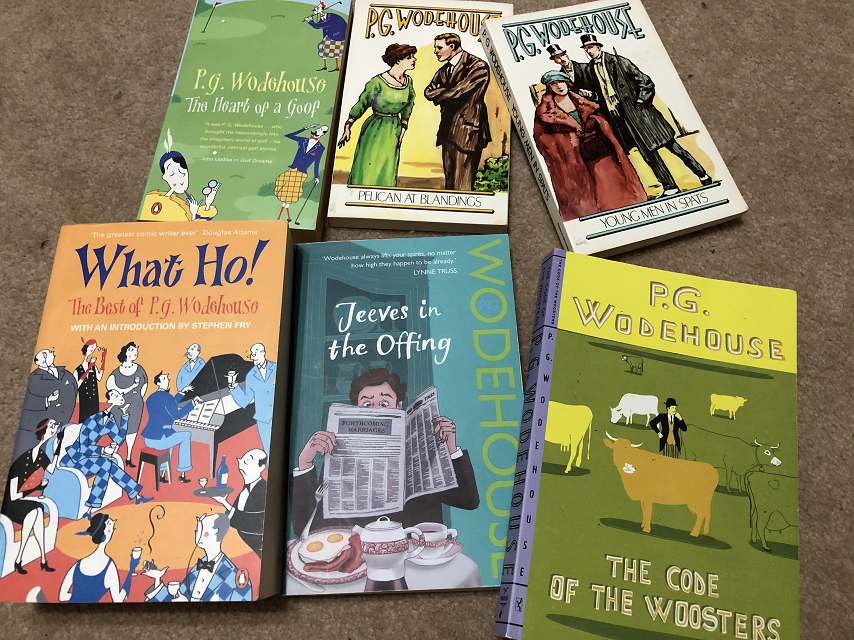
So you’d like to give P.G. Wodehouse a try, but don’t know where to start? Or perhaps you’ve read the Jeeves stories and want to discover the wider world of Wodehouse.
You’ve come to the right place.
There is no correct approach to reading Wodehouse. If you ask a dozen Wodehouse fans, you’ll get at least a dozen different suggestions — and picking up the first book you come across can be as good a starting point as any. But if you want more practical advice, this guide will help you discover the joys of Wodehouse — from Jeeves and Wooster to Blandings, and the hidden gems beyond.
Bertie Wooster & Jeeves
Bertie Wooster and his manservant Jeeves are P.G. Wodehouse’s most celebrated characters. They appear in a series of short stories and novels, all masterfully crafted for optimum joy. Bertie Wooster’s narrative voice is one of the greatest delights in all literature.[…]
Blandings
Evelyn Waugh put it best when he said: “the gardens of Blandings Castle are the original gardens of Eden from which we are all exiled.”Lord Emsworth wants only to be left alone to enjoy his garden and tend to his prize winning pig, the Empress of Blandings, without interference from his relations, neighbours, guests and imposters. So many imposters.
[…]
Psmith
Psmith (the “p” is silent as in pshrimp) made his first appearance in an early Wodehouse school story. Wodehouse knew when he was onto a good thing, and Psmith made the transition to adult novels along with his author. Adoration for Psmith among Wodehouse fans borders on the cultish, and for good reason (he certainly makes me swoon).[…]
Ukridge
The character Wodehouse readers love to hate, Ukridge is a blighter and a scoundrel, but his adventures are comedy gold. If you’ve ever had a friend or relation who pinches items from your wardrobe without asking, and is perpetually “borrowing” money, this series is for you.
Honest Trailers | Firefly
Screen Junkies
Published 29 Sep 2020►►This video is presented by Fistful of Bourbon. It ain’t just a bourbon. It’s a damn fistful.
►►https://www.fistfulofbourbon.com
►►https://www.instagram.com/fistfulofbourbon►►Watch the Honest Trailers Commentary LIVE with the Writers!► https://youtu.be/Mq6egGnAENU
Honest Trailers | Firefly
Voice Narration: Jon Bailey aka Epic Voice Guy
Title Design: Robert Holtby
Written by: Spencer Gilbert, Joe Starr, Danielle Radford, & Lon Harris
Produced by: Spencer Gilbert & Joe Starr
Edited by: Kevin Williamsen
Post-Production Supervisor: Emin Bassavand
Supervising Producer: Max Dionne
Associate Producer: Ryan O’Toole
Executive Producer: Roth Cornet#HonestTrailers
This is a sponsored video
QotD: Repressing the facts in genetic research
In fact, given the state of our present knowledge, I judge all three of these outcomes are near certain. I have previously written about some of the evidence in Racism and Group Differences. The truth is out there; well known to psychometricians, population geneticists and anyone who cares to look, but surrounded by layers of denial. The cant has become thick enough to, for example, create an entire secondary mythology about IQ (e.g., that it’s a meaningless number or the tests for it are racially/culturally biased). It also damages our politics; many people, for example, avert their eyes from the danger posed by Islamism because they fear being tagged as racists. All this repression has been firmly held in place by the justified fear of truly hideous evils – from the color bar through compulsory sterilization of the “inferior” clear up to the smoking chimneys at Treblinka and Dachau. But … if the repressed is about to inevitably return on us, how do we cope?
It’s not going to be easy. I saw this coming in the mid-1990s, and I’m expecting the readjustment to be among the most traumatic issues in 21st-century politics. The problem with repression, on both individual and cultural levels, is that when it breaks down it tends to produce explosions of poorly-controlled emotional energy; the release products are frequently ugly. It takes little imagination to visualize a future 15 or 20 years hence in which the results of behavioral genetics are seized on as effective propaganda by neo-Nazis and other racist demagogues, with the authority of science being bent towards truly appalling consequences.
Eric S. Raymond, “A Specter is Haunting Genetics”, Armed and Dangerous, 2010-06-19.


