Quotulatiousness

May 5, 2020

Early Lever-Action Rifles: Volcanic, Henry, Winchester

Filed under: History, USA, Weapons — Tags: , , , — Nicholas @ 02:00

Forgotten Weapons
Published 6 Feb 2016

Hammer prices:
Volcanic – $19,550
1860 Henry – $15,960
1866 Winchester – $8,625

We’ve all seen lever action rifles galore in movies about the old west, and most of us have handled and shot a bunch of them as well. But do you know where they came from?

Today we will take a look at the first American lever-action rifle put into successful (more or less) production, the Volcanic. We will then continue to examine the 1860 Henry and the 1866 Winchester to get a foundational understanding of the development of these guns, and the interesting group of people involved with them.

http://www.patreon.com/ForgottenWeapons

QotD: Social media encourages autistic behaviour

Nothing like that happens today, as far as I can tell, and I spent a lot of time in a wide variety of ivy-covered halls. Part of it, of course, is the general, catastrophic decline in reading comprehension among today’s student body — Lenin was a wonderfully effective polemicist in his day, but for the modern kid it might as well still be in Russian — but a lot of it isn’t. A much bigger part of it is that modern kids can’t overcome the genetic fallacy, and a large part of that, I argue, is the autism spectrum-like effect of social media.

The genetic fallacy, you’ll recall, is the inability to separate the idea from the speaker. Or, if you’re under age 40, it’s simply “communication,” as our public discourse nowadays proceeds in very little other than genetic fallacies. Try it for yourself. We all know what kind of reaction you’ll get in respectable circles if you say “You know, Donald Trump has a point about …”, but you can do it on “our side” of the fence, too. Watch: Obama was right about Race to the Top. No, really: Compared to W’s No Child Left Behind bullshit, pretty much anything short of letting kids be raised by wolves would’ve been better (and hey, even being raised by wolves worked out ok for Romulus and Remus). Even with the qualifier attached, almost everyone on “our side” instinctively bristles — we’ve been so conditioned by the words “Obama” and “race,” especially in close proximity, that we can’t help ourselves. Even I do it.

It’s especially bad for the younger generations who, as I keep arguing, have been effectively autismized (it’s a word) by social media. Twitter, especially, is so constructed that “replies” can come in hours, days, months, years later. Blogs too for that matter — one of the reasons we close the comments here after a few weeks is to prevent drive-by commenters clogging things up trying to re-litigate something from years ago. Modern “communication” must take place in discrete, contextless utterances. That being the case, understanding a statement in context is impossible — I repeat, impossible. So Lenin (or Hitler, or Mao, or William F. Buckley, or the Stay-Puft Marshmallow Man) didn’t have a point about ___; because that requires understanding how his point fit into the larger context of his thought, his times, his culture, his world. None of that shit fits into a tweet, so we’re trained to respond to the name — Lenin (etc.) is either a good guy or a bad guy, full stop, so anything he says about anything must be good or bad, automatically.

I hardly need to elaborate on the effect this has on our public culture. If Our Thing really wants to get serious, the first thing any “organization,” no matter how loose, must do is: Ban social media.

Severian, “Education, the Genetic Fallacy, and the Spectrum”, Rotten Chestnuts, 2020-01-27.

May 4, 2020

The No 4, Mk I* Lee-Enfield: Introduction

Filed under: Britain, Cancon, History, Military, Weapons, WW2 — Tags: , , — Nicholas @ 06:00

britishmuzzleloaders
Published 21 Aug 2018

If you would like to support the Channel you can do so through our Patreon Page.
https://www.patreon.com/britishmuzzle…

Errata –
The labelling of the “wrongly stamped” Mk III sight should be better described as “confusingly stamped” … the designation refers to the leaf …

It should be clarified that the rifle has at some point spent time in India with resultant modifications and maintenance…

Also, as of the 1937 Manual, the safety catch should be applied with the forefinger of the right hand.

For your Martini and Snider needs email Martyn at xringservices@yahoo.com

And for further reading on all British Victorian (and earlier) arms stop by the British Militaria Forum and say hello. http://britishmilitariaforums.yuku.com

Government “problem solving” is an oxymoron

Antony Davies and James R. Harrigan explain why you should back away quickly when you hear a variant of “We’re from the government and we’re here to help”:

A central theme of our recent book, Cooperation & Coercion, is that all governments are hamstrung when they attempt to fix problems. Policymakers suffer from the knowledge problem: they don’t know enough to foresee every eventuality that will follow from what they do. Politicians see a problem, speak in sweeping statements, then declare what will happen, assuming their edicts will settle matters. But that is always just the beginning. More often than not, all manner of unintended consequences emerge, often making things worse than they were before their policies went into effect.

Consider the United States’ three high-profile wars against common nouns over the past half-century. Lyndon Johnson declared a War on Poverty in the 1960s, Richard Nixon a War on Drugs in the 1970s, and George W. Bush declared a War on Terror in the early 2000s.

How are those wars working out? Because a back-of-the-envelope calculation indicates that we have spent somewhere in the neighborhood of $23 trillion in our attempt to eradicate poverty, drugs, and terror. Not only have we not won any of these wars, it is unclear that any of them can be won. These three so-called wars have managed to saddle future generations of taxpayers with unprecedented debt. And, as is the case with all coercive endeavors, policymakers ask us to imagine how bad things would have been had we not spent the trillions we did spend. And then they ask for even more money. So now we have unwinnable wars along with institutionalized boondoggles to support them.

We see the same sort of thing happening now in the face of the COVID-19 threat that has induced the largest panic attack in world history. In the name of safety, policymakers have shut down myriad productive endeavors. And there will be a raft of unintended consequences to follow. We are already seeing them manifest, and they portend potential disaster as supply chains fail.

The first cracks in US supply chains appeared in the meat industry. Smithfield Foods, reacting to a number of workers contracting the virus, shut down its Sioux Fall plant. Kenneth M. Sullivan, President and CEO, explained in a press release that, “the closure of this facility, combined with a growing list of other protein plants that have shuttered across our industry, is pushing our country perilously close to the edge in terms of our meat supply.” But it’s not just the meat plant that’s implicated. It’s everyone from the cattle farmer to the person who cooks dinner, and there are a number of people who have a place in that process who might first escape attention. The people who make packing materials needed to ship food, the maintenance workers who service machines up and down the supply chain, the truck drivers who move product from one place to another, the grocers who sell the product, the daycare workers who care for the grocers’ children so the grocers can work, and many, many more are all at risk.

[…]

In declaring some jobs “necessary” and others not, in focusing on one supply chain versus another, policymakers show how little they know about the nation’s economy. In their view, they can simply declare things they want to happen, and then those things will happen. But that is not how economies work. An economy is the sum total of everyone’s activities, and when the government declares that something must happen, all kinds of other things happen too.

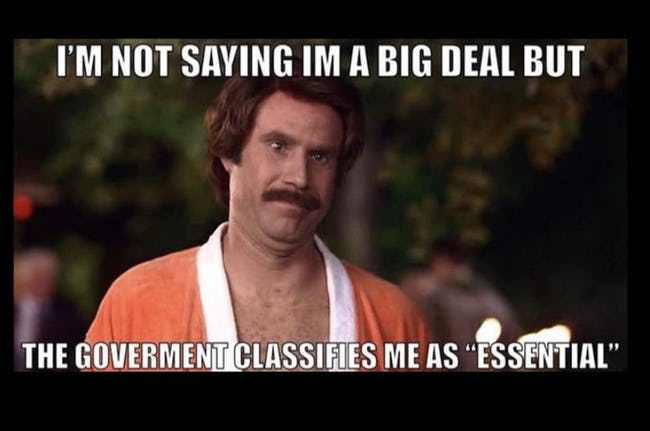
Consider how all the “non-essential workers” have been sent home for the past two months. Who gets to declare which workers are non-essential to the economy, and by what standard? Most assumed that politicians had the correct answers to these questions. But, as we are discovering, there is no such thing as “non-essential” workers. All workers are essential. How do we know? Because their jobs existed. Profit-driven businesses do not create non-essential jobs. Those people’s jobs were essential to their employers. Further, those people’s jobs were incredibly essential to the people themselves. They need their wages to pay the rent, buy their food, make their car payments, and for everything else that makes their lives livable.

But policymakers simply declared them non-essential, as if there would be no fallout from that decision.

History Summarized: The Maya, Aztec, and Inca

Overly Sarcastic Productions
Published 29 Jul 2017

Human sacrifice, smallpox, and the Spanish empire … that’s the whole story, right? Haha, eheh, hehe, HA, not even close! The civilizations of Mesoamerica are fascinating in their own right, and very distinct from each other too! Step on in and I’ll learn you a thing or two.

Also no spoilers, but next time, I’m covering the Iroquois Confederation! Ok, maybe that was exactly a spoiler. [Reposted here.]

This video was produced with assistance from the Boston University Undergraduate Research Opportunities Program.

PATREON: www.patreon.com/user?u=4664797

MERCH LINKS:
Shirts – https://overlysarcasticproducts.threa…
All the other stuff – http://www.cafepress.com/OverlySarcas…

Find us on Twitter @OSPYouTube!

A very different reading of Tolkien’s Tom Bombadil

Filed under: Books — Tags: , , , — Nicholas @ 03:00

Colby Cosh retweeted this link that is certainly an interesting look at one of the more obscure characters in J.R.R. Tolkien’s Middle Earth:

Consider: By his own account (and by Elrond’s surprisingly sketchy knowledge) Bombadil has lived in the Old Forest since before the hobbits came to the Shire. Since before Elrond was born. Since the earliest days of the First Age.

And yet no hobbit has ever heard of him.

The guise in which Bombadil appears to Frodo and his companions is much like a hobbit writ large. He loves food and songs and nonsense rhymes and drink and company. Any hobbit who saw such a person would tell tales of him. Any hobbit who was rescued by Tom would sing songs about him and tell everyone else. Yet Merry – who knows all the history of Buckland and has ventured into the Old Forest many times – has never heard of Tom Bombadil. Frodo and Sam – avid readers of old Bilbo’s lore – have no idea that any such being exists, until he appears to them. All the hobbits of the Shire think of the Old Forest as a place of horror – not as the abode of a jolly fat man who is surprisingly generous with his food.

If Bombadil has indeed lived in the Old Forest all this time – in a house less than twenty miles from Buckland – then it stands to reason that he has never appeared to a single hobbit traveller before, and has certainly never rescued one from death. In the 1400 years since the Shire was settled.

What do we know about Tom Bombadil? He is not what he seems.

Elrond, the greatest lore-master of the Third Age, has never heard of Tom Bombadil. Elrond is only vaguely aware that there was once someone called Iarwain Ben-Adar (“Oldest and Fatherless”) who might be the same as Bombadil. And yet, the main road between Rivendell and the Grey Havens passes not 20 miles from Bombadil’s house, which stands beside the most ancient forest in Middle Earth. Has no elf ever wandered in the Old Forest or encountered Bombadil in all these thousands of years? Apparently not.

Gandalf seems to know more, but he keeps his knowledge to himself. At the Council of Elrond, when people suggest sending the Ring to Bombadil, Gandalf comes up with a surprisingly varied list of reasons why that should not be done. It is not clear that any of the reasons that he gives are the true one.

Now, in his conversation with Frodo, Bombadil implies (but avoids directly stating) that he had heard of their coming from Farmer Maggot and from Gildor’s elves (both of whom Frodo had recently described). But that also makes no sense. Maggot lives west of the Brandywine, remained there when Frodo left, and never even knew that Frodo would be leaving the Shire. And if Elrond knows nothing of Bombadil, how can he be a friend of Gildor’s?

What do we know about Tom Bombadil? He lies.

A question: what is the most dangerous place in Middle Earth? First place goes to the Mines of Moria, home of the Balrog, but what is the second most dangerous place? Tom Bombadil’s country.

By comparison, Mordor is a safe and well-run land, where two lightly-armed hobbits can wander for days without meeting anything more dangerous than themselves. Yet the Old Forest and the Barrow Downs, all part of Tom’s country, are filled with perils that would tax anyone in the Fellowship except perhaps Gandalf.

Now, it is canonical in Tolkein that powerful magical beings imprint their nature on their homes. Lorien under Galadriel is a place of peace and light. Moria, after the Balrog awoke, was a place of terror to which lesser evil creatures were drawn. Likewise, when Sauron lived in Mirkwood, it became blighted with evil and a home to monsters.

And then, there’s Tom Bombadil’s Country.

The hobbits can sense the hatred within all the trees in the Old Forest. Every tree in that place is a malevolent huorn, hating humankind. Every single tree. And the barrows of the ancient kings that lie nearby are defiled and inhabited by Barrow-Wights. Bombadil has the power to control or banish all these creatures, but he does not do so. Instead, he provides a refuge for them against men and other powers. Evil things – and only evil things – flourish in his domain. “Tom Bombadil is the master” Goldberry says. And his subjects are black huorns and barrow wights.

What do we know about Tom Bombadil? He is not the benevolent figure that he pretends to be.

Fourth Crusade | 3 Minute History

Filed under: Europe, History, Middle East, Military, Religion — Tags: , , , — Nicholas @ 02:00

Jabzy
Published 24 Sep 2016

https://www.patreon.com/Jabzy
Thanks to Xios, Alan Haskayne, Lachlan Lindenmayer, Victor Yau, William Crabb, Derpvic, Seth Reeves and all my other Patrons.

https://twitter.com/JabzyJoe

QotD: The eternal “now” of Progressive stasis

Filed under: History, Politics, Quotations, USA — Tags: , , , , — Nicholas @ 01:00

The best practical definition of conservatism I’ve heard is “planting trees you won’t live to sit under.” I’ll die, and though nothing of me will remain, my home, my community, my nation, my civilization, my people will remain … and I did my part, however small, to ensure it, by living my life well. My honor is my loyalty, as someone or other once said.

None of that matters to the cultural marxist, though. How could it? As I wrote yesterday, to the fanatic, the past is one long catalog of freely chosen error. Nor is there any meaningful future to a fanatic. That seems wrong, I realize, but consider that time passes through contrast. People will be born and die in the Communist Utopia, but since everyone will always have everything, human activity will be exquisitely pointless …

Ignore what Leftists say. Watch what they do, and it’ll soon be obvious that what they long for above all things is stasis. They want everyone and everything to be one way, and one way only, forever. Homosexuals are the most flamboyant example. Imagine that — having your entire life defined by your sexual attraction. I like blondes, but you know, if the right brunette came along I’d go for her. Heck, I’d even go for a ginger (I know, I know, I’m a monster). But according to the Left, that’s not allowed. I like blondes, and therefore I’m only allowed to like blondes. Oh, and I can only vote for Bernie Sanders, because he’s the attracted-to-blondes candidate, and I must support abortion, and use the word “cisgendered,” and …

Thus, to the Leftist there’s no past, and no future either. There’s only now, and the only thing that matters now is power. How could it be otherwise?

Severian, “The Endless Now”, Rotten Chestnuts, 2020-01-23.

May 3, 2020

How To… Drink Tea in a Tank | The Tank Museum

Filed under: Britain, Food, History, Military, Weapons, WW1, WW2 — Tags: , , — Nicholas @ 06:00

The Tank Museum
Published 30 Apr 2020

In the 1st episode of The Tank Museum’s brand new “How To” series, Wargaming’s Richard Cutland and historian James Holland explore how British tank crews managed to drink tea, while in a tank!

Download World of Tanks for free and claim your exclusive £15 starter kit: https://tanks.ly/2SiJPje
You can also share the invite code 1TANKIE with your friends.
Starter kit: Matilda Black Prince Tier V tank, 7 days of World of Tanks premium account & T-34-85M rental. Valid for new players only.

Using a WW1, WW2 and modern tank from The Tank Museum’s collection, the duo will discover how tea was made while soldiers were at war.

Support the work of The Tank Museum on Patreon: ► https://www.patreon.com/tankmuseum
Visit The Tank Museum SHOP & become a Friend: ► https://tankmuseumshop.org/

Twitter: ► https://twitter.com/TankMuseum
Instagram: ► https://www.instagram.com/tankmuseum/
Tiger Tank Blog: ► http://blog.tiger-tank.com/
Tank 100 First World War Centenary Blog: ► http://tank100.com/

Slaying Gladiator

Filed under: Europe, History, Humour, Media — Tags: , , , , — Nicholas @ 05:00

Over at Steyn Online, Kathy Shaidle tag-teamed someone else on staff (it probably rhymes with Dark Time) to put the caligulae to Ridley Scott’s Gladiator with Russell Crowe in the leading role:

Germania, 180 AD. Rome is at war with the, er, Germaniacs, who stand around in the Black Forest grunting like Brits on the piss who’ve nutted themselves in one pub fight too many. You need a cool head to take on the Roman Army, and the only one the barbarians have belongs to Caesar’s emissary, whom they thoughtfully decapitated before sending back. They wave the old noggin around like a treasured footie ball, grunting, “Ug Eugh Blug” or, translated from the original gibberish, “Over ‘ere, mate.” It’s a scene that rings oddly contemporary in the age of Isis, although when I first saw it, a year before 9/11, it gave me the giggles. But then barbarians always seem funny from a distance, don’t they? Here they scratch their pelts and grunt some more, seemingly unconcerned by the fact that the Roman legions are lighting up their blazing arrows and fireballs, the smart bombs of the day. The ensuing battle, whose outcome would seem never to be in doubt, is apparently the final bloody act in a twelve-year war.

Despite having had twelve years to get there, the Emperor’s son nevertheless shows up late. “Did I miss it?” he simpers. “Did I miss the battle?” The son’s name is Commodus. No, not Commodus, but Commodus, which sounds like he dates back to a Mel Brooks sketch circa 1962 but in fact goes all the way back to the real Roman Empire. Commodus is that old stand-by of the dynastic drama, the disappointing son. His father, Marcus Aurelius, is a noble philosopher-king, but Commodus is no chip off the old block. We can tell that from the moment we first glimpse Commodus, sprawled in his commodious caravan, but just in case we miss the point Joaquin Phoenix lays on the mincing like a trowel, and the make-up, too. He’s weak, vain, decadent, and has the hots for his sister Lucilla (Connie Nielsen). Even the Bushes would think twice before running this guy for emperor.

Having spent 25 years waging war for the glory of Rome, Marcus Aurelius (Richard Harris) senses there’s not much point leaving it in the hands of an emperor who’d be queen for a day. So he tells Commodus he will not succeed him. Instead, he is going to make his brave general Maximus a “trustee” until Rome is ready to become a republic again. Maximus (Russell Crowe) is a Colin Powell type of general: a nice fellow everyone respects who supposedly has no public ambitions. Commodus, though, has other ideas, and suffocates his father. As the old showbiz saying has it, dying is easy, Commodus is hard. The effete decadent mincer becomes emperor, and promptly orders the death of Maximus and the crucifixion of the general’s wife and child back in Spain.

But Maximus escapes, and what follows in Gladiator is the story of how he takes his revenge and becomes the eponymous Gladiator lui-même. It’s payback time, and, under Ridley Scott’s lean direction, that means there’s no room for sub-plots. Somewhere in pre-production, the archers lobbed their flaming shafts at the script and laid it as bare as those Germanic forests. Not only are there no sub-plots, there’s barely any plot for any sub-plot to be sub-. Once the wife and kid are dead, there’s nothing very emotional at stake. There’s no romantic interest, unless you count Commodus trying to get it on with sis. There’s a hint of backstory at the Senate, where the massed ranks of British Equity have gathered for a vast toga party (the Toga Party having a majority in the Senate at that time). But there’s no dialogue worth speaking of, except statements of the obvious. When the mob is being fickle, as mobs are wont to be, the Emperor is told: “The mob is fickle, sire.” All the lines have been pre-tested in earlier toga romps, and the only one that seems to have been specially written for this picture is Oliver Reed’s complaint that some crook dealer has sold him a pair of homosexual giraffes.

But none of that matters because Ridley Scott photographs the film so brilliantly and mesmerically that they could all be speaking Germaniac and it wouldn’t impair the storytelling. It helps that almost everyone in the movie is a pre-designated great actor, so you tend to assume there’s a lot of great acting going on, even though most of it’s just thoughtful reaction shots. The mob bays for blood. Cut to Derek Jacobi looking thoughtful. They bay some more. Cut to Connie Nielsen looking pensive from atop her fabulous neck. They stop baying. Cut to Russell Crowe looking thoughtful. What are they thinking so pensively? “Hmm. I wish I’d got the gay giraffe line”?

Balkans in Nazi Hands – A Greek Tragedy – WW2 – 088 – May 02, 1941

World War Two
Published 2 May 2020

Greece falls as Axis troops push through the last Allied defences. New plans are made for a German invasion of Crete, and a new war breaks out between Great Britain and Iraq.

Join us on Patreon: https://www.patreon.com/TimeGhostHistory
Or join The TimeGhost Army directly at: https://timeghost.tv

Follow WW2 day by day on Instagram @World_war_two_realtime https://www.instagram.com/world_war_t…
Between 2 Wars: https://www.youtube.com/playlist?list…
Source list: http://bit.ly/WW2sources

Written and Hosted by: Indy Neidell
Director: Astrid Deinhard
Producers: Astrid Deinhard and Spartacus Olsson
Executive Producers: Astrid Deinhard, Indy Neidell, Spartacus Olsson, Bodo Rittenauer
Creative Producer: Joram Appel
Post-Production Director: Wieke Kapteijns
Edited by: Iryna Dulka
Sound design: Marek Kamiński
Map animations: Eastory (https://www.youtube.com/c/eastory)

Colorizations by:
– Olga Shirnina, a.k.a. Klimbim – https://klimbim2014.wordpress.com/
– Julius Jääskeläinen – https://www.facebook.com/JJcolorization/
– Dememorabilia – https://www.instagram.com/dememorabilia/
– Carlos Ortega Pereira, BlauColorizations, https://www.instagram.com/blaucoloriz…

Sources:
– Bundesarchiv, CC-BY-SA 3.0, Bild_146-1977-163-05A, Bild 146-1977-122-16, Bild_141-0816, Bild 101I-757-0023-32
– National Portrait Gallery
– Imperial War Museum: Q 69840, HU 52264

Archive by Screenocean/Reuters https://www.screenocean.com.

A TimeGhost chronological documentary produced by OnLion Entertainment GmbH.

From the comments:

World War Two
2 days ago (edited)
Now, we have decided to leave out any Call to Action (the bit where Indy tells you to subscribe and support us on Patreon) to give room to the dramatic speech on Radio Athens. So allow me to write it right here: If you want to learn more about how Kurt Student’s Fallschirmjäger were developed and used earlier in the war, you can check out our Special Episode about that right here: https://youtu.be/RNr3E3Hr0bo. I don’t want to deny anyone the chance to get a random name shoutout in the video by writing it here, but it is thanks our supporters that we can continue to make content like this. You can join the TimeGhost Army on www.patreon.com/timeghosthistory or https://timeghost.tv. Don’t forget to subscribe, ring the notification bell and see you next time!
Cheers, Joram

The Great Exhibition of 1851

In the latest Age of Invention newsletter, Anton Howes looks at one of the biggest popular events of Queen Victoria’s reign, the Great Exhibition:

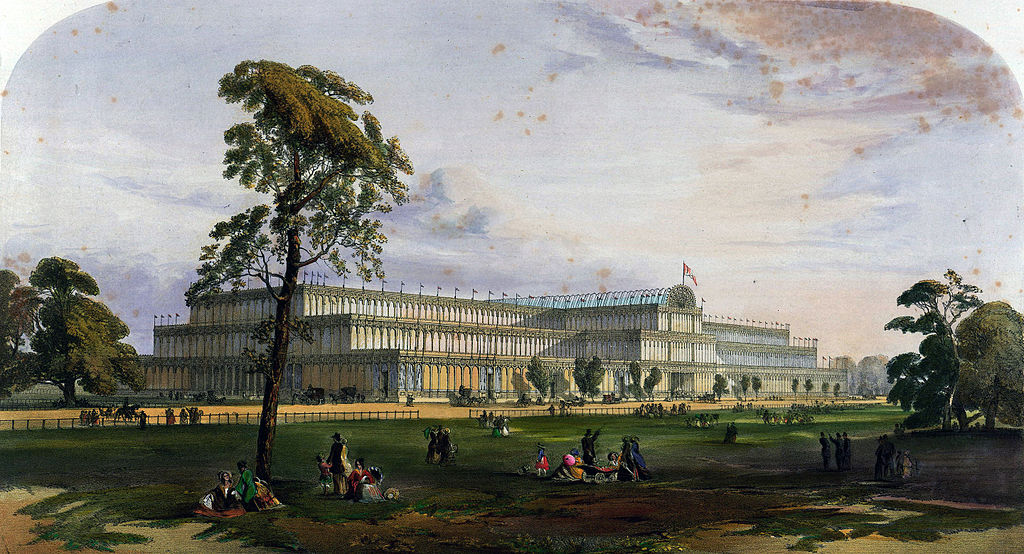
The Crystal Palace from the northeast during the Great Exhibition of 1851, image from the 1852 book Dickinsons’ comprehensive pictures of the Great Exhibition of 1851
Wikimedia Commons.

On this day, in 1851, Londoners were finally allowed to enter one of the most spectacular edifices to grace their city. Over the previous months they had watched it spring up in Hyde Park — the largest enclosed structure that had ever been built, and made with three hundred thousand of the largest panes of glass ever produced. Set against the blackened, soot-stained buildings of London, the massive glass edifice gleamed. It soon became known as the Crystal Palace.

Although it no longer exists — it was rebuilt in Sydenham, but the new version burnt down in the 1930s — the fame of the Crystal Palace endures. The same goes for the event that it was originally built for, the Great Exhibition of 1851. But, despite that name-recognition, I’ve found that most people don’t really know what the Great Exhibition was for. Yes, it attracted six million visitors in the space of just a few months — an estimated two million people, almost a tenth of the entire population of Great Britain, most of them returning again and again. But why? I must admit, despite having mentioned the event before in some of my work, I’d never really considered it properly before I started researching the history of the Society of Arts.

The idea of such an exhibition in Britain originated with the Society’s secretary in the 1840s, the civil engineer Francis Whishaw. He had seen the use of industrial exhibitions in France, as a means of catching up with Britain in terms of technology. Every few years since 1798, the French government had held an exhibition of its national industries in Paris. The state paid for everything — a grand temporary building, as well as the expenses of the exhibitors — and the head of state himself awarded medals and cash prizes for the bet works on display. Some of the very best exhibitors were even admitted to the Légion d’honneur, France’s highest order of merit. The benefits to exhibitors were so high that essentially every manufacturer wished to take part. In the days before GDP statistics, the exhibitions were thus an effective means of getting a detailed snapshot of the nation’s manufacturing capabilities. An exhibition served as the nation’s industrial audit.

[…]

Although there had been a few local exhibitions of industry in Britain in the late 1830s and early 1840s, there had been nothing on a national scale to rival the French ones. So Francis Whishaw began the work of getting the Society to organise such an event — a national exhibition of industry for Britain. His initial plan came to nothing, partly as he left the Society to take another job, but in the late 1840s the project was resurrected by a new member of the Society, a civil servant named Henry Cole. In fact, Cole almost entirely took over the Society in the late 1840s, turning it into an exhibition-holding organisation. It held exhibitions devoted to particular living artists, on ancient and medieval art, on inventions, and especially on industrial design — what Cole liked to call “art-manufactures”. And, at the 1849 national exhibition in Paris, he adopted an idea that had already been floated for some years by French officials: an international exhibition, to show the industry of all nations.

This was the crucial step. The idea of an international exhibition of industry appealed to the free trade movement in Britain, which had achieved success in the 1840s with the abolition of the Corn Laws. By displaying the products of other nations, the argument went, British consumers would demand that they be able to buy them more cheaply. And free trade would hopefully bring an end to war, too. Free trade campaigners argued that the productive classes of rival nations competed peacefully, simply by trying to outdo one another in the quality and quantity of what they produced. It was the landed aristocracy, they argued, who let the competition become violent, feeding their pride by causing destruction. Thus, a grand exhibition of the products of all nations — the Great Exhibition — would be a physical manifestation of free trade and international harmony: a “competition of arts, and not of arms”.

The Great Exhibition thus had many roles. It was partly born of national paranoia, about French industrial catch-up, as well as about Britain being the first to hold such an event. It was also about exciting competitive emulation between manufacturers, showing consumers what they did not know they wanted, and achieving world peace and free trade. It certainly spurred on dozens of examples of international cooperation. In fact, just the other day I discovered that the first international chess tournament was held in London to coincide with the exhibition. And it served as an audit of the world’s industries, allowing people to judge who was ahead and who was behind. It thereby gave domestic reformers the ammunition to push for changes in areas where Britain seemed to be falling behind, in areas like education, intellectual property, and design. But more on those another time.

Scottish army ration (MRE) with radioactive heater

Filed under: Britain, Food, Humour, Military — Tags: , , — Nicholas @ 02:00

bigclivedotcom
Published 17 Jan 2020

A review of a VERY rare Scottish army ration. Carbohydrate-rich to match the Scottish diet and protect against the harsh cold environment of war and Scotland in general.

It appears to be made of all the key Scottish, Irish and Canadian food groups with the bonus of a slightly dangerous ration heater based on radioactive components also used by the Russian army.

It almost seems to be engineered to encourage fighting.

If you enjoy these videos you can help support the channel with a dollar for coffee, cookies and random gadgets for disassembly at:-
http://www.bigclive.com/coffee.htm
This also keeps the channel independent of YouTube’s advertising algorithms allowing it to be a bit more dangerous and naughty.

QotD: Tragic cultural misunderstandings

Filed under: Africa, History, Middle East, Quotations — Tags: , , , , — Nicholas @ 01:00

… the problem is how cultures “read” things and people can be completely different/opposite. Part of our issue with Islamic culture is just that: cultural. They’d never get in the pissing contest they are pushing, if they could read us accurately. And arguably our liberals would never be pushing for peace and appeasement if they could read THEM accurately.

It’s one of those cultural traps which I have read about and which are tragic.

I think I’ve spoken before of the tragic encounter between Zulu and Boers in South Africa. Zulus were doing what they did that had won them Africa (they came from central Africa shortly before the whites arrived): Commit incredibly scary atrocities so the enemy runs/avoids combat/submits. The whites were in their head just another tribe. They could not understand the idea of a “tribe” that was starting to span the globe and which would self-identify as “tribe” in the face of a savage. So their savagery made the Europeans MORE determined to wipe them out.

We’re seeing something like that, again. Islamic CULTURES are big on bragging, exaggeration of force and intimidation of the enemy. This is functional in a desert where there’s always a lot of low-level “war.” Some atrocities, scare “the enemy” and you keep your patch, and you go on. They have a fine tuned ear for this. When the other tribe isn’t committing atrocities against YOU and particularly when they’re being appeasing/accommodating, you have them over a barrel. If you strike with showy force you can take their stuff and enslave them. NOTE most of the attacks are designed to be showy.

TWO things they don’t get: Our elites are appeasing because the elites think they’re SO powerful they can’t be touched and are oikophobes who hate their own people. AND our PEOPLE is pissed, really pissed.

You know the old joke? There are no Muslims in Star Trek because it’s set in the future.

This is unfortunately the likely outcome of the cultures meeting. At some point (already happening) the elites will have to fight or be replaced. And when we go to war, our power is incalculable compared to them. They think we exaggerate our strength, while, culturally, we underplay it. They don’t understand we’re holding back.

The result will be a horrific destruction of guilty and innocent alike and even people like me who look Arab/Mediterranean in a bad light will be at risk.

And they will be the victims of genocide.

Sarah Hoyt, “Cross-Culture”, According to Hoyt, 2017-03-23.

May 2, 2020

Saigon memories

Filed under: Asia, History, Media, Military — Tags: , , — Nicholas @ 06:00

I had no idea that David Warren had some brief journalism experience in Vietnam before the US pulled out their military forces:

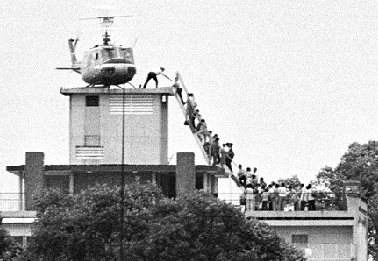
A member of the CIA helps evacuees up a ladder onto an Air America helicopter on the roof of 22 Gia Long Street on April 29, 1975, shortly before Saigon fell to advancing North Vietnamese troops.
Hubert van Es photo via Wikimedia Commons.

An article in the New York Post (here) brings one historical event back into view, with a bitterness I haven’t yet overcome. It is only an aside on an old photo-caption, which like so many others from the Vietnam War was, shall we say, inaccurate. Taken for a symbol, it has passed into our electronic folk memory, as one of innumerable lies it contains. I wasn’t there, of course, but I had visited that country, and once, too briefly, lived in Saigon. The (very consequential) deceit, dishonesty, and faithlessness of “the mainstream media” was among the lessons I took from my apprenticeship. My ludicrous ambition, to “correct it” some day, will never be fulfilled. But to the link: my praise to one writer who did his homework. Let me be grand and say, the truth has set him free.

It will soon be fifty years since I first attended the “Five O’Clock Follies” at “MAC-V,” where the best hamburgers in South-east Asia could be obtained for the price of a chocolate bar. This press conference format — bluster and counter-bluster — has not changed in all this time. Everything in that vast sprawling compound of military administration was sprayed, swept, and polished; I always entered with wide eyes. There, and in bars along Tu-Do Street (the old rue Catinat, once an exquisite ribbon from the Cathedral down lines of fragrant tamarinds), was where I first fell in with “real professional journalists,” practising their trade.

Those I met were, by and large, pathological liars, and extremely vain. They were also coarsely disrespectful, much like our journalists today: rudely cynical and sarcastic. The only serious exceptions I came to know were a couple of religious weirdos — one a Lutheran ex-pastor from West Germany, the other a reject from a Catholic seminary in southern France. They, like me, had strayed into the field, from a misplaced sense of adventure.

At all levels, and on all sides, I was witnessing a freak show — there and wherever I wandered outside the Unreal City. I owned a reliable Nikkormat camera, that would sometimes earn me much-needed cash, but was quite unsuccessful as a print journalist. My earnest despatches, sent to newspapers on spec, were routinely “spiked” — not, I think, because I was so young (they didn’t know that), but because I kept, often unknowingly, writing things that contradicted what the New York Times and CBS were reporting.

Not only was I learning that the “mainstream” was all lies, but too, that it invariably followed an agenda. The self-appointed purpose of the press was to sabotage the American war effort. (That of the life-or-death desperate Viets was, at best, ignored.)

But then, I was deceitful, too. I was pretending to be over 18 when I was still only 17, in order to get a press pass.

« Newer PostsOlder Posts »

Powered by WordPress