
Forgotten Weapons
Published on 11 Sep 2018http://www.patreon.com/ForgottenWeapons
Cool Forgotten Weapons merch! http://shop.bbtv.com/collections/forg…The German army captured Blanc Mont Ridge in the early months of World War One and occupied it throughout the years of fighting, fending off repeated French assaults throughout 1915 and 1916. While the ridge looks far from imposing, it is a piece of high ground which overlooks a large part of the front in the Champagne region of France, and was a very valuable outlook for artillery observation. Its continuous occupation allowed it to be heavily fortified by the Germans as a major strong point in their defensive lines.
In October of 1918, the task would fall to the American Expeditionary Force to take the ridge as part of the ongoing offensive that was finally pushing the Germans back all along the front lines. Years of war had gradually sapped the strength of the German forces, and the last gasp spring offensive earlier in the year had destroyed the last remaining units of elite German troops. And yet, they still had their fortifications here, armed with more than 350 machine guns on this ridge alone.
On the morning of October 3rd, 1918, a combined force of US Army and Marines (the 2nd and 36th Infantry Divisions) set off on an attack up the gradual slope towards the ridge. The attack was preceded by only a few minutes of artillery fire and then a creeping barrage behind which the men advanced. A thick layer of ground fog was perhaps their best ally, as they began the assault of the German position. A fierce fight left the positions on the front of the ridge in American hands by the end of the day, although the fighting would be tenacious for several days, as the Americans advanced well beyond the supporting French units on their flanks, and were left exposed on the reverse slope of the ridge.
By October 7th, the ridge position was consolidated, and the French and American forces continued their advance towards the next objective, the town of Saint-Étienne-à-Arnes. American casualties in the assault would come to approximately 7,800 men – this was not a position relinquished easily by the Germans. The battle was considered a major accomplishment at the time, although it has been largely forgotten in the century since.
Today, the summit of the ridge is the site of a major American war memorial:
https://www.abmc.gov/cemeteries-memor…
Thanks to Military History Tours for making this video possible! https://www.miltours.com
If you enjoy Forgotten Weapons, check out its sister channel, InRangeTV! http://www.youtube.com/InRangeTVShow
September 12, 2018
Forgotten History: The Americans Take Blanc Mont Ridge, October 1918
The wisdom of Zim Tzu, post-49ers edition
 The head coach of the Minnesota Vikings traditionally holds a press conference for local (and sometimes national) media after each game. Although Mike Zimmer has a reputation for plain speaking, he still manages to conceal behind the ordinary-seeming words deep koans of wisdom. Fortunately, the Daily Norseman‘s Ted Glover has spent untold years studying and meditating and decyphering ancient scrolls in order to provide Vikings fans with a clear and piercing analysis of the true meanings behind the words of Zim Tzu:
How Do Light Bulbs Work? | Earth Lab
BBC Earth Lab
Published on 1 Nov 2013James May explains one of the most important inventions to modern life: the lightbulb.
“Subscribe to Earth Lab for more fascinating science videos – http://bit.ly/SubscribeToEarthLab
All the best Earth Lab videos http://bit.ly/EarthLabOriginals
Best of BBC Earth videos http://bit.ly/TheBestOfBBCEarthVideosHere at BBC Earth Lab we answer all your curious questions about science in the world around you. If there’s a question you have that we haven’t yet answered or an experiment you’d like us to try let us know in the comments on any of our videos and it could be answered by one of our Earth Lab experts.
QotD: Origins of India’s caste system
In India, the notion of Hindu culture as a giant conspiracy by Aryan invaders to enshrine their descendants at the top of the social order for the rest of eternity perhaps struck a little too close to home.
But Reich’s laboratory has found that the old Robert E. Howard version is actually pretty much what happened. Conan the Barbarian-like warriors with their horse-drawn wagons came charging off the Eurasian steppe and overran much of Europe and India. Reich laments:
The genetic data have provided what might seem like uncomfortable support for some of these ideas — suggesting that a single, genetically coherent group was responsible for spreading many Indo-European languages.
Much more acceptable to Indian intellectuals than the idea that ancient conquerors from the Russian or Kazakhstani steppe took over the upper reaches of Indian culture has been the theory of Nicholas B. Dirks, the Franz Boas Professor of History and Anthropology at Columbia, that the British malignantly transformed diverse local Indian customs into the suffocating system of caste that we know today.
Now, though, Reich’s genetic evidence shows that caste has controlled who married whom in India for thousands of years:
Rather than inventions of colonialism as Dirks suggested, long-term endogamy as embodied in India today in the institution of caste has been overwhelmingly important for millennia.
This is in harmony with economic historian Gregory Clark’s recent discovery in his book of surname analysis, The Son Also Rises (Clark loves Hemingway puns), that economic mobility across the generations is not only lower than expected in most of the world, but it is virtually nonexistent in India.
Steve Sailer, “Reich’s Laboratory”, Taki’s Magazine, 2018-03-28.
September 11, 2018
Is this what true love used to be?
Megan McArdle recounts a story of a couple who lived through the depression (well, the Great Depression … in culinary terms, they may never have emerged from the ordinary depression of lunchbag letdown):
Fear the Internet-of-Things
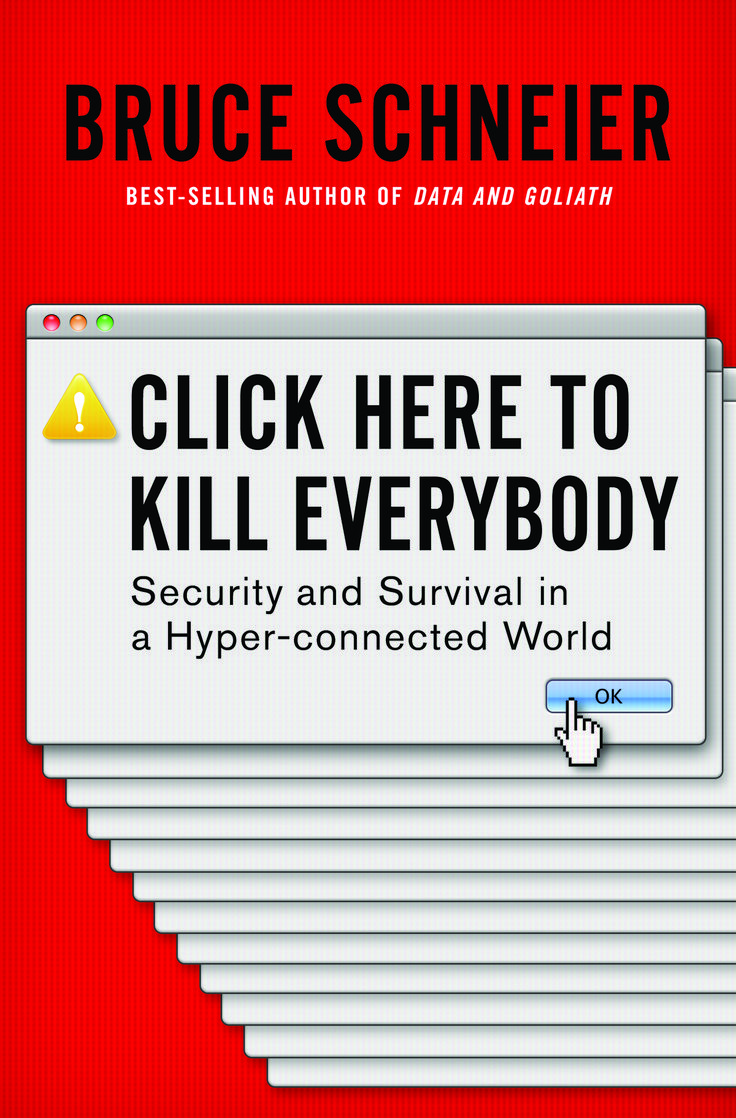
Martin Giles talks to Bruce Schneier about his new book, Click Here to Kill Everybody:
The title of your book seems deliberately alarmist. Is that just an attempt to juice sales?
It may sound like publishing clickbait, but I’m trying to make the point that the internet now affects the world in a direct physical manner, and that changes everything. It’s no longer about risks to data, but about risks to life and property. And the title really points out that there’s physical danger here, and that things are different than they were just five years ago.
How’s this shift changing our notion of cybersecurity?Our cars, our medical devices, our household appliances are all now computers with things attached to them. Your refrigerator is a computer that keeps things cold, and a microwave oven is a computer that makes things hot. And your car is a computer with four wheels and an engine. Computers are no longer just a screen we turn on and look at, and that’s the big change. What was computer security, its own separate realm, is now everything security.
You’ve come up with a new term, “Internet+,” to encapsulate this shift. But we already have the phrase “internet of things” to describe it, don’t we?
I hated having to create another buzzword, because there are already too many of them. But the internet of things is too narrow. It refers to the connected appliances, thermostats, and other gadgets. That’s just a part of what we’re talking about here. It’s really the internet of things plus the computers plus the services plus the large databases being built plus the internet companies plus us. I just shortened all this to “Internet+.”
Let’s focus on the “us” part of that equation. You say in the book that we’re becoming “virtual cyborgs.” What do you mean by that?
We’re already intimately tied to devices like our phones, which we look at many times a day, and search engines, which are kind of like our online brains. Our power system, our transportation network, our communications systems, are all on the internet. If it goes down, to a very real extent society grinds to a halt, because we’re so dependent on it at every level. Computers aren’t yet widely embedded in our bodies, but they’re deeply embedded in our lives.
Can’t we just unplug ourselves somewhat to limit the risks?
That’s getting harder and harder to do. I tried to buy a car that wasn’t connected to the internet, and I failed. It’s not that there were no cars available like this, but the ones in the range I wanted all came with an internet connection. Even if it could be turned off, there was no guarantee hackers couldn’t turn it back on remotely.
Hackers can also exploit security vulnerabilities in one kind of device to attack others, right?
There are lots of examples of this. The Mirai botnet exploited vulnerabilities in home devices like DVRs and webcams. These things were taken over by hackers and used to launch an attack on a domain-name server, which then knocked a bunch of popular websites offline. The hackers who attacked Target got into the retailer’s payment network through a vulnerability in the IT systems of a contractor working on some of its stores.
Unleashing The Tank’s Full Potential – 1918/1919 Tank Tactics I THE GREAT WAR On The Road
The Great War
Published on 10 Sep 2018Support The Tank Museum: https://www.patreon.com/tankmuseum
Indy and David Willy from the Tank Museum sit inside a Mark V tank to talk about the evolution of tank tactics and how the Allies started to properly use tanks during and after the battle of Amiens.
How the Media and Literati Class Determines the Politics of a Nation
rubatirabbit
Published on 15 Oct 2016From Yes Prime Minister S02E05 Power To The People
The prime minister intends to introduce a professor’s scheme for enacting bottom-up government. The civil service and reformists reacts to this scheme.
QotD: Debunking the “company store” story
First, company stores flourished in many parts of the USA, especially in the coal regions and other places with many isolated work sites, long before any legal minimum wages were put into effect. Second, Alchian is right that the workers understood perfectly how these stores worked (how could they not have when the stores were so common?): they provided basic consumption goods — flour, bacon, beans, kerosene, matches, cotton cloth — at the work-and-living site on credit, as advances against the workers’ future pay. Yes, the prices were higher than in, say, the closest towns. But the closest towns were often much too far away to allow the workers or their wives to go there easily, frequently, or cheaply. So, what the stores actually did was to reduce transaction costs for the workers, who otherwise would have been unlikely to accept employment in remote, isolated places far from stores.
Robert Higgs, letter to Don Boudreaux, 2016-11-06.
September 10, 2018
San Francisco 49ers fall short against the Minnesota Vikings, 24-16
The season opener for the Vikings saw the San Francisco 49ers under Jimmy Garappolo visit Minneapolis to face the revamped Vikings offence under $84 million quarterback Kirk Cousins. This was also supposed to be a return visit for former Vikings running back Jerick “Jet” McKinnon, but he suffered a season-ending ACL injury during one of San Francisco’s final practices and had to be put on injured reserve.
The first half certainly looked like Minnesota was going to just walk away with the game, as Kirk Cousins put up great numbers in his first Viking start and the Vikings defence looked like they hadn’t missed a beat since last season. During the second half, however, San Francisco managed to stay close and even threatened to even up the score late in the game. At one point in the second half, the Minnesota offence only managed three consecutive three-and-outs, which meant the defence was spending too much time on the field. Rookie cornerback Mike Hughes saw his first NFL action, including his first interception which he ran back for his first touchdown. Hughes got more snaps than the coaches originally may have intended after starter Trae Waynes had to leave the game with a knee injury (nickel corner Mackenzie Alexander was ruled out before the game started). The defensive star of the game was safety Harrison Smith, with eight tackles (including two for loss), a sack, a fumble recovery and the game-sealing interception.
At the Daily Norseman, Ted Glover provides his regular Stock Market Report on the game, including his buy/sell recommendations:
Buy: Going for points at the end of the first half. I really liked the aggressiveness to get some points at the end of the half. After the fumble recovery, Minnesota had the ball on their 2, with 2:12 left. It would have been easy to maybe play for a first down, run out the clock, and go to the locker room with a 10-3 lead. But the Vikings got aggressive and pushed the ball upfield, and lo and behold, with 42 second left they were near midfield with a timeout left, and a real opportunity to get in to field goal range, at a minimum.
Sell: The last three plays of the drive to end the first half. Then I don’t know what happened. Well, I do, but it was like watching a train wreck in slow motion. Or a Tarvaris Jackson sequence, your call. The Vikings threw a pass to Dalvin Cook that lost six yards thanks to Cook taking nothing and making it worse. Then instead of calling a timeout, Minnesota chose to run a play…which was a downfield heave of two yards to Laquon Treadwell. After a timeout, the offense, wanting to REALLY out do themselves, said ‘hold my beer’ and Cousins took a sack to end the half. WHAAAAAAAAAAAAT……
Buy: Dalvin Cook, pass catcher. The Vikings fed Dalvin Cook early and often, and when he got the ball in the flat it looked like he had never been injured. He was fast, fluid, and made some great plays on the edge, catching six passes for 55 yards. In the game, only Adam Thielen was targeted more in the passing game, and it was a nice debut for him coming off his ACL injury.
Sell: Dalvin Cook, runner. As good as he looked catching the ball, he didn’t have a good day running. He averaged less than three yards a carry, and on his longest run of the day, a 15 yard duck, stop, and then go, he fumbled and Dicky Sherman recovered. His offensive line didn’t help him a whole lot, though, so hopefully this aspect will improve as the season goes along.
Buy: The goal line stand and fumble. That was a thing of beauty, and straight out of the Purple People Eaters era. They stuffed the 49ers running game four times, and on the last attempt they forced a fumble and recovered the ball, dodging a major bullet and leaving the 49ers going ‘we went 14 plays for this’? YES YOU DID…YES YOU DID BRETT!
Sell: The 13 plays preceding that fumble. But that drive that got San Francisco on the doorstep was a bit troublesome. They converted three first downs, and the Vikings committed a defensive holding penalty on second down that nullified a big sack by Danielle Hunter. They gave up plays of 14, 14, and 11 yards, and it felt like the 49ers had figured out what the Vikings were doing.
American Handguns of World War 1 I THE GREAT WAR Special feat. C&Rsenal
The Great War
Published on 8 Sep 2018Check out Othais’ channel: youtube.com/candrsenal
Indy and Othais take a look at the US service pistols of World War 1.
Speculation on an early federal election
Ted Campbell on the recent musings in the official party organ Toronto Star on the pros and cons of the Prime Minister going to the polls this fall rather than next year:

The Star, a pretty Liberal friendly journal, says, in an article by Robin Sears, a former NDP insider (in fact he was national director of the NDP for seven years), that “Liberal hawks, like those of a generation earlier, are heatedly debating a snap election call. Not entirely surprising, since [we] have not seen a decade since the ’50s when a government has not been forced by events, or decided to seize a strategic advantage, and called an early election … [and] … The Liberal hawks’ arguments are getting stronger. Neither of their opponents is ready, and each will likely be stronger a year from now. The Federal Court and Donald Trump have both just stuck a finger in the Prime Minister’s eye. This is an opportunity to return the favour with a much harder counterpunch, a strong new political mandate.“
[…]
I agree with Robin Sears … going [to] the polls sooner, in the fall of 2017, and running against Donald Trump (and the ghost of Stephen Harper) makes good political sense because it seems, to me, highly unlikely that Justin Trudeau and his gang that cannot shoot straight are going to get any better in the next year or so. In fact the Trudeau regime’s record, to date, suggests that a year from now the country might be in ruins.
Right now the NDP appears to be in shambles; Jagmeet Singh’s leadership is being questioned at pretty high levels, and the Conservatives are still reeling from Maxime’s Bernier’s defection. Waiting until October 2018 risks giving both the Conservatives and the NDP time to reorganize and present new, attractive programmes and, perhaps even new, more attractive leaders, too.
Will he go to the polls in 2017? Who knows? Parliament is due to reconvene, after the long summer recess, in a week ~ on 17 September. Many people were expecting a new Throne Speech outlining a pre-election platform filled with promises that will, most likely, never be kept, but Robin Sears makes a good case for Prime Minister Trudeau to go to the Governor General, next week, and to tell her that the situation is such that Canada’s government needs a new mandate.
HMS Victorious Receives New Strike Force (1966)
British Pathé
Published on 13 Apr 2014Full title reads: “Moray Firth. ‘Victorious’ Receives New Strike Force”.
Moray Firth, Scotland.
Air view Royal Navy warship, the aircraft carrier HMS Victorious at sea refuelling from tanker. Air view ditto. Angle shot as Buccaneer fighter jets flies overhead. LV Interior of bridge. SV The Captain DL Davenport talking to Senior Officer. CU The Captain.
LV As Buccaneer comes in and lands on Victorious. LV As wings fold up. GV As it moves to side of ship. Air view as another plane comes in and lands. LV As it misses the arrester wire and overshoots. SV Men watching. Air view as the plane comes in again. CU As it hooks the arrester wire. LV As the plane comes to a halt. CU The arrester wire comes back for next plane. LV Next plane coming in. CU As it hooks wire. LV As it comes to halt.
LV The FDO (Flight Deck Officer) signalling for catapult mechanism to be fixed to aircraft. LV The aircraft preparing for take off. SV As the plane is hooked up. LV Firemen standing ready. Steam is rising from catapult mechanism. CU Firemen. CU FDO signals for take off. LV As the aircraft takes off. SV Buccaneer with wings folded on deck. GV The deck packed with Buccaneers.
(Original Neg.)
FILM ID:1795.16A VIDEO FROM BRITISH PATHÉ. EXPLORE OUR ONLINE CHANNEL, BRITISH PATHÉ TV. IT’S FULL OF GREAT DOCUMENTARIES, FASCINATING INTERVIEWS, AND CLASSIC MOVIES. http://www.britishpathe.tv/
QotD: Perversion of the law
The law perverted! The law — and, in its wake, all the collective forces of the nation — the law, I say, not only diverted from its proper direction, but made to pursue one entirely contrary! The law become the tool of every kind of avarice, instead of being its check! The law guilty of that very iniquity which it was its mission to punish! Truly, this is a serious fact, if it exists, and one to which I feel bound to call the attention of my fellow citizens.
Frédéric Bastiat, The Law, 1850.


