Quotulatiousness

May 17, 2014

Even the Times thinks the latest climate scandal is damaging to the cause

Filed under: Britain, Environment, Science — Tags: , , — Nicholas @ 09:22

The Times article titled “Scientists in Cover Up of ‘Damaging’ Climate View” is behind the usual paywall, but Steven Hayward has a longer excerpt that gets the key element across:

Research which heaped doubt on the rate of global warming was deliberately suppressed by scientists because it was “less than helpful” to their cause, it was claimed last night.

In an echo of the infamous “Climategate” scandal at the University of East Anglia, one of the world’s top academic journals rejected the work of five experts after a reviewer privately denounced it as “harmful”.

Lennart Bengtsson, a research fellow at the University of Reading and one of the authors of the study, said he suspected that intolerance of dissenting views on climate science was preventing his paper from being published. “The problem we now have in the climate community is that some scientists are mixing up their scientific role with that of a climate activist,” he added.

Professor Bengtsson’s paper challenged the finding of the UN’s Intergovernmental Panel on Climate Change (IPCC) that the global average temperature would rise by up to 4.5C if greenhouse gases in the atmosphere were allowed to double. It suggested that the climate might be much less sensitive to greenhouse gases than had been claimed by the IPCC in its report last September, and recommended that more work be carried out “to reduce the underlying uncertainty”.

[…]

Professor Bengtsson, the former director of the Max Planck Institute for Meteorology in Hamburg, said he accepted that emissions would increase the global average temperature but the key question was how quickly.

He added that it was “utterly unacceptable” to advise against publishing a paper on the ground that the findings might be used by climate sceptics to advance their arguments. “It is an indication of how science is gradually being influenced by political views. The reality hasn’t been keeping up with the [computer] models. Therefore, if people are proposing to do major changes to the world’s economic system we must have much more solid information.”

The genesis of George MacDonald Fraser’s Flashman

Filed under: Books, Britain, History, Media — Tags: — Nicholas @ 08:59

In the Telegraph, Harry Mount has the story of how George MacDonald Fraser came to create his most memorable fictional character, Harry Flashman:

“I had written what might be called an introductory chapter about this boozy old veteran pouring out his soul on Mafeking Night to some anonymous listener; I think, but I’m not sure, that I called the veteran Flashman, having in mind Thomas Hughes’s character. Anyway, I discarded the introduction, which wasn’t good, and it has probably been destroyed, unless it’s in a trunk somewhere,” MacDonald Fraser wrote in the unpublished account.

“‘How did you get the idea?’ is a question I have been asked ad nauseam, and the answer is that I don’t know. I read Tom Brown’s Schooldays as a child, and possibly on later occasions; I found Flashman the most striking character in the book, and suspect that Hughes did, too — and probably wrote Flashman out of the story because he realised that, if he didn’t, the deplorable lout would take over the book.”

“Possibly it was simply boyhood recollection that prompted it. I certainly don’t remember thinking, ‘Flashman – eureka!’ Anyway, somewhere around April ’66, when I was 41 years old, I sat down to write Flashman, working in the kitchen after I came home from work in the small hours.”

“I began where Hughes had left off, in the style of a memoir; since I knew from internal evidence in Tom Brown the date of Flashman’s expulsion from Rugby, and, since I had determined that he was the kind of rotter whose career was bound to lie in the army, various plot points suggested themselves at once — Lord Cardigan, the First Afghan War, etc. But I had no idea, when I started, of any coherent storyline: Flashman would be a cad and a coward, but I would just plunge ahead and see where my imagination took me.”

Fraser’s Flashman and the following books will tell you more about British history in the Victorian era than you’d learn in a proper history undergrad program, but no university course could be as entertaining as Flashman’s recounting of episodes in his own career. One of the books (and in my opinion the weakest) was turned into a movie, but it didn’t do well enough at the box office, so no more were made. I doubt that a modern movie could be made, as Flashman has all the vices of “his” era, most of which are now so politically incorrect that no studio would dare touch them.

QotD: Modern echoes of 1914

Filed under: Europe, History, WW1 — Tags: , , , , — Nicholas @ 00:01

Though the debate on this subject is now nearly a century old, there is no reason to believe that it has run its course.

But if the debate is old, the subject is still fresh — in fact it is fresher and more relevant now than it was twenty or thirty years ago. The changes in our own world have altered our perspective on the events of 1914. In the 1960s-80s, a kind of period charm accumulated in popular awareness around the events of 1914. It was easy to imagine the disaster of Europe’s ‘last summer’ as an Edwardian costume drama. The effete rituals and gaudy uniforms, the ‘ornamentalism’ of a world still largely organized around hereditary monarchy had a distancing effect on present-day recollection. They seemed to signal that the protagonists were people from another, vanished world. The presumption stealthily asserted itself that if the actors’ hats had gaudy green ostrich feathers on them, then their thoughts and motivations probably did too.

And yet what must strike any twenty-first-century reader who follows the course of the summer crisis of 1914 is its raw modernity. It began with a squad of suicide bombers and a cavalcade of automobiles. Behind the outrage at Sarajevo was an avowedly terrorist organization with a cult of sacrifice, death and revenge; but this organization was extra-territorial, without a clear geographical or political location; it was scattered in cells across political borders, it was unaccountable, its links to any sovereign government were oblique, hidden and certainly very difficult to discern from outside the organization. Indeed, one could even say that July 1914 is less remove from us — less illegible — now than it was in the 1980s. Since the end of the Cold War, a system of global bipolar stability has made way for a more complex and unpredictable array of forces, including declining empires and rising powers — a state of affairs that invites comparison with the Europe of 1914. These shifts in perspective prompt us to rethink the story of how war came to Europe. Accepting this challenge does not mean embracing a vulgar presentism that remakes the past to meet the needs of the present but rather acknowledging those features of the past of which our changed vantage point can afford us a clearer view.

Among these is the Balkan context of the war’s inception. Serbia is one of the blind spots in the historiography of the July Crisis. The assassination at Sarajevo is treated in many accounts as a mere pretext, an event with little bearing on the real forces whose interaction brought about the conflict. In an excellent recent account of the outbreak of war in 1914, the authors declare that ‘the killings [at Sarajevo] by themselves caused nothing. It was the use made of this event that brought the nations to war.’ The marginalization of the Serbian and thereby of the larger Balkan dimension of the story began during the July Crisis itself, which opened as a response to the murders at Sarajevo, but later changed gear, entering a geopolitical phase in which Serbia and its actions occupied a subordinate place.

Our moral compass has shifted, too. The fact that Serbian-dominated Yugoslavia emerged as one of the victor states of the war seemed implicitly to vindicate the act of the man who pulled the trigger on 28 June — certainly that was the view of the Yugoslav authorities, who marked the spot where he did so with bronze footprints and a plaque celebrating the assassin’s ‘first steps into Yugoslav freedom’. In an era when the national idea was still full of promise, there was an intuitive sympathy with South Slav nationalism and little affection for the ponderous multinational commonwealth of the Habsburg Empire. The Yugoslav wars of the 1990s have reminded us of the lethality of Balkan nationalism. Since Srebrenica and the siege of Sarajevo, it has become harder to think of Serbia as the mere object or victim of great power politics and easier to conceive of Serbian nationalism as an historical force in its own right. From the perspective of today’s European Union we are inclined to look more sympathetically — or at least less contemptuously — than we used to on the vanished imperial patchwork of Habsburg Austria-Hungary.

Christopher Clark, The Sleepwalkers: How Europe Went To War In 1914, 2012.

May 16, 2014

The built-in confusion about net neutrality

While I’ve been following the net neutrality debate, I was still unconvinced that either side had the answers. In a post from 2008, ESR helps to explain why I was confused:

Let it be clear from the outset that the telcos are putting their case for being allowed to do these things with breathtaking hypocrisy. They honk about how awful it is that regulation keeps them from setting their own terms, blithely ignoring the fact that their last-mile monopoly is entirely a creature of regulation. In effect, Theodore Vail and the old Bell System bribed the Feds to steal the last mile out from under the public’s nose between 1878 and 1920; the wireline telcos have been squatting on that unnatural monopoly ever since as if they actually had some legitimate property right to it.

But the telcos’ crimes aren’t merely historical. They have repeatedly bargained for the right to exclude competitors from their networks on the grounds that if the regulators would let them do that, they’d be able to generate enough capital to deploy broadband everywhere. That promise has been repeatedly, egregiously broken. Instead, they’ve creamed off that monopoly rent as profit or used it to cross-subsidize competition in businesses with higher rates of return. (Oh, and of course, to bribe legislators and buy regulators.)

Mistake #1 for libertarians to avoid is falling for the telcos’ “we’re pro-free market” bullshit. They’re anything but; what they really want is a politically sheltered monopoly in which they have captured the regulators and created business conditions that fetter everyone but them.

OK, so if the telcos are such villainous scum, the pro-network-neutrality activists must be the heroes of this story, right?

Unfortunately, no.

Your typical network-neutrality activist is a good-government left-liberal who is instinctively hostile to market-based approaches. These people think, rather, that if they can somehow come up with the right regulatory formula, they can jawbone the government into making the telcos play nice. They’re ideologically incapable of questioning the assumption that bandwidth is a scarce “public good” that has to be regulated. They don’t get it that complicated regulations favor the incumbent who can afford to darken the sky with lawyers, and they really don’t get it about outright regulatory capture, a game at which the telcos are past masters.

[…]

In short, the “network neutrality” crowd is mainly composed of well-meaning fools blinded by their own statism, and consequently serving mainly as useful idiots for the telcos’ program of ever-more labyrinthine and manipulable regulation. If I were a telco executive, I’d be on my knees every night thanking my god(s) for this “opposition”. Mistake #2 for any libertarian to avoid is backing these clowns.

In the comments, he summarizes “the history of the Bell System’s theft of the last mile”.

This week in Guild Wars 2

Filed under: Gaming — Tags: , — Nicholas @ 10:36

My weekly Guild Wars 2 community round-up at GuildMag is now online. ArenaNet has finally broken their uncharacteristic radio silence since the release of the April Feature Pack, and announced the “Festival of the Four Winds” to celebrate this week’s full release of the Chinese version of Guild Wars 2. In addition, there’s the usual assortment of blog posts, videos, podcasts, and fan fiction from around the GW2 community.

GuildMag logo

Nobody expected the university inquisition

Filed under: Politics, USA — Tags: , , — Nicholas @ 08:19

The old Monty Python skit may now need to be amended, replacing “an almost fanatical devotion to the Pope” with “an almost fanatical devotion to political correctness”. Dan Henninger calls it the “Bonfire of the Humanities”:

It’s been a long time coming, but America’s colleges and universities have finally descended into lunacy.

Last month, Brandeis University banned Somali-born feminist Ayaan Hirsi Ali as its commencement speaker, purporting that “Ms. Hirsi Ali’s record of anti-Islam statements” violates Brandeis’s “core values.”

This week higher education’s ritualistic burning of college-commencement heretics spread to Smith College and Haverford College.

On Monday, Smith announced the withdrawal of Christine Lagarde, the French head of the International Monetary Fund. And what might the problem be with Madame Lagarde, considered one of the world’s most accomplished women? An online petition signed by some 480 offended Smithies said the IMF is associated with “imperialistic and patriarchal systems that oppress and abuse women worldwide.” With unmistakable French irony, Ms. Lagarde withdrew “to preserve the celebratory spirit” of Smith’s commencement.

On Tuesday, Haverford College’s graduating intellectuals forced commencement speaker Robert J. Birgeneau to withdraw. Get this: Mr. Birgeneau is the former chancellor of UC Berkeley, the big bang of political correctness. It gets better.

Berkeley’s Mr. Birgeneau is famous as an ardent defender of minority students, the LGBT community and undocumented illegal immigrants. What could possibly be wrong with this guy speaking at Haverford??? Haverfordians were upset that in 2011 the Berkeley police used “force” against Occupy protesters in Sproul Plaza. They said Mr. Birgeneau could speak at Haverford if he agreed to nine conditions, including his support for reparations for the victims of Berkeley’s violence.

[…]

Years ago, when the academic left began to ostracize professors identified as “conservative,” university administrators stood aside or were complicit. The academic left adopted a notion espoused back then by a “New Left” German philosopher — who taught at Brandeis, not coincidentally — that many conservative ideas were immoral and deserved to be suppressed. And so they were.

This shunning and isolation of “conservative” teachers by their left-wing colleagues (with many liberals silent in acquiescence) weakened the foundational ideas of American universities — freedom of inquiry and the speech rights in the First Amendment.

No matter. University presidents, deans, department heads and boards of trustees watched or approved the erosion of their original intellectual framework. The ability of aggrieved professors and their students to concoct behavior, ideas and words that violated political correctness got so loopy that the phrase itself became satirical — though not so funny to profs denied tenure on suspicion of incorrectness. Offensive books were banned and history texts rewritten to conform.

Narendra Modi wins in a landslide

Filed under: India, Politics — Tags: , — Nicholas @ 08:08

The Economist reports on the first election in India to produce a single-party majority since 1984:

“INDIA has won” tweeted Narendra Modi, on May 16th, his first public comment after official counting from India’s general election made it clear that he, and his Bharatiya Janata Party, had delivered a landslide victory beyond the expectations of almost everyone. The scale of the BJP win was remarkable. It swept entire states, including Rajasthan, Delhi, Gujarat, Himachal Pradesh, Uttarakhand. More importantly it made enormous strides in two crucial, and massive, northern states, Uttar Pradesh and Bihar. There not only did Congress do disastrously, regional parties were also badly walloped. As of lunch time, it appeared that the BJP and its closest allies (known as the NDA) would have 324 seats of the 543 parliament, with the BJP alone getting 275. BJP spokesmen called that, rightly, a “tectonic shift in the polity of India”. It is the first time since 1984 that a single party has enough seats to rule alone.

Much is made is the importance of Mr Modi as a leader, who inspired great enthusiasm among the voters, especially youngsters. Clearly, too, there is demand for a stronger economy and more development. So strong is his victory, it might be no other party has enough seats to serve automatically as the opposition, since to lead it in parliament you need at least 10% of the seats, and Congress’s total haul might include even fewer than that. The array of ministers and prominent figures in Congress who have lost their seats is impressive. Mr Modi will give speeches and enjoy victory parades, first in Gujarat (where he has already visited his mother to get her blessings), then on May 17th in Varanasi. He may be sworn in as prime minister on May 21st, though obviously he hardly need wait to start forming a government and picking his ministers.

So lopsided is the outcome that enormous expectations will now rest on the BJP and Mr Modi to start delivering changes quickly. The vote share claimed by the BJP, some 35% nationally, is enormous by Indian standards. Combined with an historically high turnout, at 64%, it gives Mr Modi a huge mandate for his rule. Nor does it seem that any other party can offer any serious opposition to him. Congress is in tatters and its leaders must think seriously about its future role in politics. Rahul Gandhi, despite early signs that he was behind in his own constituency, at least appeared able to hold on there. But his margin of victory appeared to be hugely reduced. The Aam Aadmi Party, born of an anti-corruption movement, has at least claimed one MP (and perhaps several) in Punjab.

Update: Dave Weigel reminds us about Rahul Gandhi’s “total implosion in the worst interview ever”.

The debut of John Oliver’s Last Week Tonight, an exciting moment for the Slate demo, spent a good while shaming American media for ignoring India’s election. This was just, and right, and true — lots of things are more interesting than Hillary Clinton’s set speeches at charity events, not least the fate of the world’s largest democracy. And Oliver got the gist of the election, which was that the charismatic Narendra Modi would lead a right-wing coalition into power over the ruling Congress Party. That happened.

My only quibble with Oliver was how he described Rahul Gandhi, the man who led Congress to defeat. To be fair, the party was doomed by corruption and slowing economic growth, and Gandhi was given… I was about to write “a poisoned chalice,” but that seems like a gauche analogy for a man whose father and grandmother were assassinated in office. But Oliver quickly described Rahul as an “Indian Han Solo” and a man with the “total political package.”

This was not the whole story. Gandhi was sort of a disaster, a groomed yet unprepared candidate who never recovered from a nightmare interview with TV host Arnab Goswami. The whole gruesome thing is online, and the transcript is here. Both offer their own flavors of cringe comedy, from the start, when Gandhi struggles to explain why he’s doing his first-ever TV interview after 10 years in office.

Improving “privilege awareness” at Harvard

Filed under: Education, Randomness, USA — Tags: , , — Nicholas @ 08:02

Conor Friedersdorf talks about a new privilege awareness exercise for new grad students at Harvard’s John F. Kennedy School of Government:

Such exercises are not without insight or merit (though I find it hard to believe that first-year graduate students at Harvard haven’t encountered this sort of thing before). It surprises me not at all that Harvard insiders would craft the exercise to highlight where they ostensibly stand relative to their fellow Harvard classmates.

As a Harvard outsider who will one day live under a governing elite populated by today’s KSG first-years, I’d only ask for one addition to the “step forward, step back” exercise. Prior to the day it is conducted, KSG should take out some ads in local media: $50 dollars available for the first 500 non-Harvard students to show up at the campus football field at an appointed time. Let them gather, black, white and brown; men and women; straight and gay. The hoi poloi and the KSG freshmen should all mass together behind one end zone. Then the stadium announcer should say, “If you’re not a Harvard student, stay where you are. And if you are a Harvard student, take 95 steps forward, until you’re at the 5 yard line by the far end zone.”

Once all the KSG freshmen are lined up straight at that 5 yard line, everyone can do the “step-forward, step-back” exercise as before. I submit that my augmented approach will afford a more accurate understanding of privilege as it operates at Harvard.

May 15, 2014

The “typical American voter [is] a moderate national socialist who strongly supports state intervention in many areas”

Filed under: Economics, Media, Politics, USA — Tags: , , — Nicholas @ 11:42

Kevin Williamson responds to Michael Lind’s recent hit piece on Bryan Caplan:

Mr. Lind’s piece contains no analysis. Like a great deal of what currently passes for commentary, it is mostly a half-organized swarm of insults out of which emerges the occasional tendentious misstatement of Professor Caplan’s views and those of the libertarian thinkers with whom he is sometimes associated. Mr. Lind begins by bemoaning our alleged national descent into plutocracy and writes: “Some on the libertarian right have responded to this research by welcoming our new plutocratic overlords. Among these is Bryan Caplan.” Professor Caplan, author of The Myth of the Rational Voter, is a trenchant critic of electoral decision-making. Voters, he argues, suffer from specific, predictable biases — anti-market bias, anti-foreign bias, make-work bias, and pessimistic bias — that causes them to hold, and act on, untrue beliefs about the way the world works. Being an economist, Professor Caplan focuses on what voters believe about economics vs. what professional economists believe. He characterizes the typical American voter as a moderate national socialist who strongly supports state intervention in many areas, and remarks, “Given public opinion, the policies of First World democracies are surprisingly libertarian.”

There is a great deal of agreement among the poor, the middle class, and the rich on most political issues, but the rich are significantly more libertarian than are the poor. As Professor Caplan notes, the wealthy and the poor both support raising the minimum wage, but the poor much more strongly so. You might think that that is a question of narrow self-interest, but self-interest, counterintuitively, has little effect on public opinion. And the rich are more libertarian than the poor not only on economic issues but also on social issues. The poor are “much more anti-gay,” Professor Caplan writes. “They’re much less opposed to restricting free speech to fight terrorism.” On the relatively few issues on which there is strong disagreement between the poor and the rich, the preferences of the rich have tended to prevail, and that pleases Professor Caplan, because that means that more libertarian policies are put into place than public opinion would suggest. “To avoid misinterpretation,” he writes, “this does not mean that American democracy has a strong tendency to supply the policies that most materially benefit the rich. It doesn’t.” But there is no avoiding misinterpretation when the opposite side is committed to misinterpreting you. Professor Caplan celebrates the advance of gay rights, pushback against the surveillance state, and, regrettably (especially for the author of Selfish Reasons to Have More Kids), abortion rights, among other items on the progressive social agenda. Mr. Lind sees only a champion of plutocracy — because that is all he is inclined to see.

Mr. Lind, who shares with fellow former conservative David Brock the convert’s zeal, is something of a fanatic on the subject of libertarianism, and the bulk of his piece is dedicated to abominating every libertarian thinker he’s ever heard of, making the case that the abominable Professor Caplan should fit right in. He starts with the predictable home-run swing (“you might be tempted to dismiss Bryan Caplan as just another Koch-funded libertarian hack …” and follows up with “Koch-subsidized intelligentsia of the libertarian right,” “almost all of them are paid, directly or indirectly, by a handful of angry, arrogant rich guys,” “third-rate minds like Peter Thiel”), goes right into the shallow insults (“that near-oxymoron, libertarian thought”), and then proceeds to the greatest hits: “Ludwig von Mises praised Mussolini,” “Friedrich von Hayek” [NB: The Hayek family ceased being the “von Hayek” family in 1919, when Hayek was twelve, and he did not use the honorific himself, but that “von” sounds kind of Nazi-ish, so, there you have it] admired the military dictator Augusto Pinochet,” and closes out with moral preening: “Our squalid age of plutocratic democracy has found a thinker worthy of it.”

Craft brewers face potential hop shortages

Filed under: Business, USA — Tags: , — Nicholas @ 07:55

BBC News has terrible news for craft beer fans:

Hops are hot. Their price in the US has doubled in 10 years. Some even predict the equivalent of Armageddon for beer lovers — a hops shortage.

The reason is craft beer, which has come from nowhere to claim 8% of the US beer market.

Far more hops go into craft beer than the equivalent produced by large corporate brewers — roughly six times more. The brewing revolution has triggered a shift away from bland, high-yield alpha hops to the “aroma” varieties responsible for the striking citrus notes in craft beer. It is a “double whammy” — more hops needed but they are of the varieties that are less productive.

By next year, acreage will be planted 60/40 in favour of aroma varieties, says Ann George, director of Hop Growers of America. It used to be 70/30 the other way. The hop plants take a couple of years to be productive. It’s going to be touch and go. “Craft breweries are opening faster than farmers can grow hops,” reported US online magazine Vox.

Clearly this calls for a blue-ribbon panel to recommend government solutions to the impending doom of higher prices! Let’s set up a bureaucracy to allocate the market so that all current brewers get a fair share … and of course, we must protect the companies already in the market from upstart competitors! We should have the first report in by 2016, which will allow the new organization to be set up by 2018 or so, and by 2020 the market will be fully regulated and operating smoothly under the benevolent guidance of government officials.

Or, y’know, let the market decide. Which it appears to be doing nicely — demand for more aromatic hops is up, so prices have risen to the market-clearing level. Higher prices for hops are signalling to hop producers that they need to produce more, to take advantage of the higher prices. Higher prices are also telling brewers that they need to economize in the short term or raise retail prices for the hoppiest brews to reflect the higher input costs. Knowing that a shortage is possible — signalled by higher prices now — means that brewers will adapt quickly (or, for a few less-well-managed firms, go out of business).

The NSA’s self-described mission – “Collect it all. Know it all. Exploit it all.”

Filed under: Government, Liberty, Media, Technology — Tags: , , , , — Nicholas @ 07:31

In The Atlantic, Conor Friedersdorf reviews Glenn Greenwald’s new book, No Place to Hide:

NSA - New Collection Posture

Collect it all. Know it all. Exploit it all.

That totalitarian approach came straight from the top. Outgoing NSA chief Keith Alexander began using “collect it all” in Iraq at the height of the counterinsurgency. Eventually, he aimed similar tools at hundreds of millions of innocent people living in liberal democracies at peace, not war zones under occupation.

The strongest passages in No Place to Hide convey the awesome spying powers amassed by the U.S. government and its surveillance partners; the clear and present danger they pose to privacy; and the ideology of the national-security state. The NSA really is intent on subverting every method a human could use to communicate without the state being able to monitor the conversation.

U.S. officials regard the unprecedented concentration of power that would entail to be less dangerous than the alternative. They can’t conceive of serious abuses perpetrated by the federal government, though recent U.S. history offers many examples.

[…]

But it is a mistake (albeit a common one) to survey the NSA-surveillance controversy and to conclude that Greenwald represents the radical position. His writing can be acerbic, mordant, biting, trenchant, scathing, scornful, and caustic. He is stubbornly uncompromising in his principles, as dramatized by how close he came to quitting The Guardian when it wasn’t moving as fast as he wanted to publish the first story sourced to Edward Snowden. Unlike many famous journalists, he is not deferential to U.S. leaders.

Yet tone and zeal should never be mistaken for radicalism on the core question before us: What should America’s approach to state surveillance be? “Defenders of suspicionless mass surveillance often insist … that some spying is always necessary. But this is a straw man … nobody disagrees with that,” Greenwald explains. “The alternative to mass surveillance is not the complete elimination of surveillance. It is, instead, targeted surveillance, aimed only at those for whom there is substantial evidence to believe they are engaged in real wrongdoing.”

That’s as traditionally American as the Fourth Amendment.

Targeted surveillance “is consistent with American constitutional values and basic precepts of Western justice,” Greenwald continues. Notice that the authority he most often cites to justify his position is the Constitution. That’s not the mark of a radical. In fact, so many aspects of Greenwald’s book and the positions that he takes on surveillance are deeply, unmistakably conservative.

Fanatical groups and their reaction to negative stimuli

ESR linked to an older blog post by Eliezer Yudkowsky which seems to explain how fanatical cults survive the impact of events that on the surface should cause them to give up their faith:

Early studiers of cults were surprised to discover than when cults receive a major shock — a prophecy fails to come true, a moral flaw of the founder is revealed — they often come back stronger than before, with increased belief and fanaticism. The Jehovah’s Witnesses placed Armageddon in 1975, based on Biblical calculations; 1975 has come and passed. The Unarian cult, still going strong today, survived the nonappearance of an intergalactic spacefleet on September 27, 1975. (The Wikipedia article on Unarianism mentions a failed prophecy in 2001, but makes no mention of the earlier failure in 1975, interestingly enough.)

Why would a group belief become stronger after encountering crushing counterevidence?

The conventional interpretation of this phenomenon is based on cognitive dissonance. When people have taken “irrevocable” actions in the service of a belief — given away all their property in anticipation of the saucers landing — they cannot possibly admit they were mistaken. The challenge to their belief presents an immense cognitive dissonance; they must find reinforcing thoughts to counter the shock, and so become more fanatical. In this interpretation, the increased group fanaticism is the result of increased individual fanaticism.

I was looking at a Java applet which demonstrates the use of evaporative cooling to form a Bose-Einstein condensate, when it occurred to me that another force entirely might operate to increase fanaticism. Evaporative cooling sets up a potential energy barrier around a collection of hot atoms. Thermal energy is essentially statistical in nature — not all atoms are moving at the exact same speed. The kinetic energy of any given atom varies as the atoms collide with each other. If you set up a potential energy barrier that’s just a little higher than the average thermal energy, the workings of chance will give an occasional atom a kinetic energy high enough to escape the trap. When an unusually fast atom escapes, it takes with an unusually large amount of kinetic energy, and the average energy decreases. The group becomes substantially cooler than the potential energy barrier around it. Playing with the Java applet may make this clearer.

In Festinger’s classic “When Prophecy Fails”, one of the cult members walked out the door immediately after the flying saucer failed to land. Who gets fed up and leaves first? An average cult member? Or a relatively more skeptical member, who previously might have been acting as a voice of moderation, a brake on the more fanatic members?

After the members with the highest kinetic energy escape, the remaining discussions will be between the extreme fanatics on one end and the slightly less extreme fanatics on the other end, with the group consensus somewhere in the “middle”.

[…]

When Ayn Rand’s long-running affair with Nathaniel Branden was revealed to the Objectivist membership, a substantial fraction of the Objectivist membership broke off and followed Branden into espousing an “open system” of Objectivism not bound so tightly to Ayn Rand. Who stayed with Ayn Rand even after the scandal broke? The ones who really, really believed in her — and perhaps some of the undecideds, who, after the voices of moderation left, heard arguments from only one side. This may account for how the Ayn Rand Institute is (reportedly) more fanatic after the breakup, than the original core group of Objectivists under Branden and Rand.

ESR thinks the Anthropogenic Global Warming (AGW) groups are starting to suffer this same phenomenon.

Here’s a major sign of evaporative cooling: the American Physical Society has since appointed a committee of working scientists (one of whom is Curry herself) to reexamine and possibly reverse its public commitment to AGW alarmism. As well it should; the alarmists’ predictions have failed so massively that they no longer have a scientific case – they’re going to have to rebuild one with a set of models that at least retrodicts the actual data.

Whatever findings the APS committee issues, the very fact that it has been convened at all is a sign that (in Yudkowsky’s analogy) the higher-energy molecules have become excited by the counterevidence and are exiting the cold trap. Or, in the metaphor of an earlier day, the rats are looking for a way off the sinking ship…

This is happening at the same time that the IPCC’s AR5 (Fifth Assessment Report) asserts its highest ever level of confidence that the (nonexistent for 15+ years) global warming is human-cased. What Yudkowsky tells us is that AR5′s apparently crazed assertion is a natural result of the mounting counterevidence. The voices of sanity and moderation, such as they are in the AGW crowd, are evaporating out; increasingly, even more than in the past, their game will be run by the fanatics and the evidence-blind.

The real Havana, outside “Cuba’s Elysium”

Filed under: Americas, History — Tags: , , , — Nicholas @ 00:01

Michael Totten lied to Cuban immigration officials to get into Cuba. Then he went outside the area of Havana that the foreign tourists see. The movie Elysium is supposed to be about a dystopian LA in the future, where the plutocrats live in vast luxury aboard a satellite, looking down on the squalor of those left behind. Totten says this is a pretty accurate description of Cuba today:

Outside its small tourist sector, the rest of [Havana] looks as though it suffered a catastrophe on the scale of Hurricane Katrina or the Indonesian tsunami. Roofs have collapsed. Walls are splitting apart. Window glass is missing. Paint has long vanished. It’s eerily dark at night, almost entirely free of automobile traffic. I walked for miles through an enormous swath of destruction without seeing a single tourist. Most foreigners don’t know that this other Havana exists, though it makes up most of the city — tourist buses avoid it, as do taxis arriving from the airport. It is filled with people struggling to eke out a life in the ruins.

Marxists have ruled Cuba for more than a half-century now. Fidel Castro, Argentine guerrilla Che Guevara, and their 26th of July Movement forced Fulgencio Batista from power in 1959 and replaced his standard-issue authoritarian regime with a Communist one. The revolutionaries promised liberal democracy, but Castro secured absolute power and flattened the country with a Marxist-Leninist battering ram. The objectives were total equality and the abolition of money; the methods were total surveillance and political prisons. The state slogan, then and now, is “socialism or death.”

Cuba was one of the world’s richest countries before Castro destroyed it — and the wealth wasn’t just in the hands of a tiny elite. “Contrary to the myth spread by the revolution,” wrote Alfred Cuzan, a professor of political science at the University of West Florida, “Cuba’s wealth before 1959 was not the purview of a privileged few … Cuban society was as much of a middle-class society as Argentina and Chile.” In 1958, Cuba had a higher per-capita income than much of Europe. “More Americans lived in Cuba prior to Castro than Cubans lived in the United States,” Cuban exile Humberto Fontova, author of a series of books about Castro and Guevara, tells me. “This was at a time when Cubans were perfectly free to leave the country with all their property. In the 1940s and 1950s, my parents could get a visa for the United States just by asking. They visited the United States and voluntarily returned to Cuba. More Cubans vacationed in the U.S. in 1955 than Americans vacationed in Cuba. Americans considered Cuba a tourist playground, but even more Cubans considered the U.S. a tourist playground.” Havana was home to a lot of that prosperity, as is evident in the extraordinary classical European architecture that still fills the city. Poor nations do not — cannot — build such grand or elegant cities.

[…]

Cubans in the hotel industry see how foreigners live. The government can’t hide it without shutting the hotels down entirely, and it can’t do that because it needs the money. I changed a few hundred American dollars into convertible pesos at the front desk. The woman at the counter didn’t blink when I handed over my cash — she does this all day — but when she first got the job, it must have been shattering to make such an exchange. That’s why the regime wants to keep foreigners and locals apart.

Tourists tip waiters, taxi drivers, tour guides, and chambermaids in hard currency, and to stave off a revolt from these people, the government lets them keep the additional money, so they’re “rich” compared with everyone else. In fact, they’re an elite class enjoying privileges — enough income to afford a cell phone, go out to restaurants and bars, log on to the Internet once in a while — that ordinary Cubans can’t even dream of. I asked a few people how much chambermaids earn in tips, partly so that I would know how much to leave on my dresser and also to get an idea of just how crazy Cuban economics are. Supposedly, the maids get about $1 per day for each room. If they clean an average of 30 rooms a day and work five days a week, they’ll bring in $600 a month — 30 times what everyone else gets. “All animals are equal,” George Orwell wrote in Animal Farm, his allegory of Stalinism, “but some animals are more equal than others.” Only in the funhouse of a Communist country is the cleaning lady rich compared with the lawyer. Yet elite Cubans are impoverished compared with the middle class and even the poor outside Cuba.

May 14, 2014

Not fewer entrepreneurs – fewer resources for entrepreneurs

Filed under: Bureaucracy, Business, USA — Tags: , , , — Nicholas @ 13:51

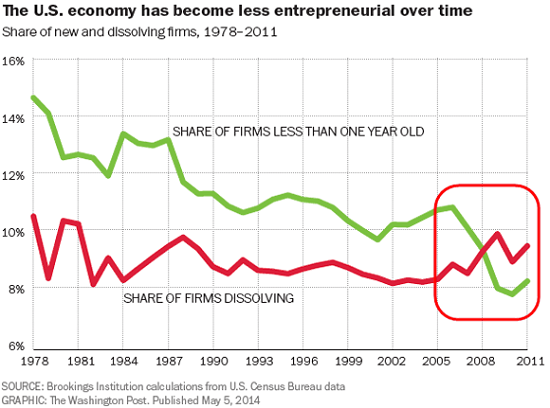
This image showed up in a post at Coyote Blog a couple of days ago, and it’s an indication of the decline in new business formation in the United States:

US becoming less entrepreneurial 1978-2011

Increasing bureaucracy — especially at the state level — undoubtedly contributes to that depressing chart, but it’s far from the whole story:

Home equity has historically been an important source of capital for small business formation. My first large investment in my company was funded with a loan that was secured by the equity in my home. What outsiders may not realize about small business banking nowadays is that it is nothing like how banking is taught in high school civics. In that model, the small business person goes to her local banker and presents a business plan, which the banker may fund if they think it is a good risk.

In the real world, trying to get such an unsecured loan from a bank as a small business will at best result in laughter. My company is no longer what many would call “small” — we will do millions in revenue this year. But there is no way in the world that my banker of over 10 years will lend to my business unsecured — they will demand some asset they can put a lien on. So we can get financing of equipment purchases (as a capital lease on the equipment) and on factored receivables and inventory. But without any of that stuff, a new business that just needs cash for startup cash flow is out of luck — unless the owner has a personal asset, typically a house, on which the banker can place a lien.

So, without home equity, one of the two top sources of capital for small business formation disappears (the other top source is loans from friends and family, which one might also expect to dry up in a tough economy).

Russia, the United States, and the ISS – an opening for SpaceX

Filed under: Europe, Russia, Space, USA — Tags: , , — Nicholas @ 11:48

Motherboard‘s Jason Koebler says that Russia’s threat to ban companies from shipping rocket engines to the US represents a great chance for SpaceX to cash in:

Russia just announced plans to shut down the International Space Station in 2020, and prohibited companies in the country from selling engines to Lockheed Martin and Boeing for military launch purposes. If this is more than just posturing, there’s at least one takeaway: SpaceX is about to get paid.

It was just a month ago that NASA Administrator Charles Bolden said that Russia would never ban the United States from the ISS, and that his “contingency plan” for getting astronauts to and from the ISS was to continue working with Russia as normal until an American company is ready to fly manned flights to the ISS in roughly three years.

[…]

And that brings us to SpaceX. The company stands to gain greatly from both bits of news Rogozin announced today.

The company recently won (and then subsequently lost) an injunction to force the United States Air Force to compete for military satellite launch contracts. If Boeing and Lockheed Martin are blocked from buying Russian engines for their Atlas V and Delta IV from the other side (it’s worth noting that both countries have threatened to ban the companies from buying Russian engines), the Air Force once again has incentive to look at SpaceX as a legitimate option to launch military satellites.

The Air Force’s contract with the Boeing-Lockheed cooperative United Launch Alliance is worth roughly $70 billion through 2030 — SpaceX could potentially swoop in and take some of that amid the uncertainty.

« Newer PostsOlder Posts »

Powered by WordPress