Quotulatiousness

May 14, 2014

Another area for freedom of choice – the “right to try”

Filed under: Bureaucracy, Health, Science, USA — Tags: , , , — Nicholas @ 11:32

Amity Shlaes talks about a movement to allow more freedom of choice, but in an unusual and tightly regulated sector:

For decades now the Food and Drug Administration has maintained an onerous and slow approval process that delays the debut of new drugs for fatal diseases, sometimes for years longer than the life span of the patients desperate to try them. Attorneys and scholars at the Goldwater Institute of Arizona have crafted legislation for the states that would allow terminally ill patients to try experimental drugs for cancer or degenerative neurological diseases earlier. These “Right to Try” bills are so scripted that they overcome the usual objection to delivery of such experimental drugs: safety. Under “Right to Try,” only drugs that have passed the crucial Phase 1 of FDA testing could be prescribed, thereby reducing the possibility of Thalidomide repeat. Second, only patients determined to have terminal cases would be eligible to purchase the drugs, making it harder to maintain that the drug will jeopardize their lives.

Representatives in Colorado, Louisiana, and Missouri approved the “Right to Try” measure unanimously. Citizens of Arizona will vote on the effort to circumvent the FDA process this fall.

Why the popularity? The phrase “Right to Try” appeals especially in a nation that senses all too well the reductions in freedom that come as the Affordable Care Act is implemented. The recent success of The Dallas Buyers’ Club, a film about a man who procured experimental drugs for AIDS patients, also fuels the “Right to Try” impulse. Some of the popularity comes from our culture of choice. In Colorado, where citizens have choice about abortion, and now the choice to use marijuana, they may also get what seems an elemental choice, that to try to save their own lives.

But of course “Right to Try” also sails because of the frustration of tragedy. Years ago a man named Frank Burroughs founded the Abigail Alliance after conventional options failed to cure his 21-year-old daughter’s cancer. Abigail’s oncologist tried to get Abigail newer drugs, Erbitux or Iressa from AstraZeneca, the company with which Pfizer hopes to merge. But the drugs were not available in time to save the girl. The Abigail Alliance is attempting on the federal level what Goldwater is trying for states: The federal bill’s name is the Compassionate Care Act. “Those waiting for FDA decisions, mainly dying patients and those who care for them, view the agency as a barrier,” co-founder Steve Walker explained simply. And who can disagree? Many of the supporters of “Right to Try” or the Abigail Alliance are businesspeople or scientists who are motivated to honor ones they have lost to illness; others are racing to save sick family who are still living. Yet others labor for patients in particular or science in general.
The rich boozehound’s guide to globetrotting

Filed under: Britain, Business, Randomness — Tags: , , , , — Nicholas @ 11:07

Got lots of money burning a hole in your bank account? Want to show off just how filthy stinking rich you are? Like spending your however-earned-or-inherited loot on fancy booze? Then there’s a million-dollar booze vacation you’ll probably like:

UK-based travel company Holidaysplease is offering a luxury world drinking tour in which you can learn and demonstrate the art of conspicuous consumption.

Starting and ending in London — although pickups are possible elsewhere — the ultimate hedonistic, money-no-object vacation takes in the world’s best hotels, swankiest restaurants and most exclusive bars in 10 upmarket destinations.

En route, drinkers take in the universe’s most ludicrously expensive niche beverages.

In Monaco, members of the bottomless budget brigade will mingle with other surreally high net individuals at the high end Hotel Hermitage Monte-Carlo and party at Flavio Briatore’s Billionaire Sunset Lounge in the hotel Fairmont Monte Carlo, quaffing selections from the $565,000 “in-house Armand de Brignac Dynastie” champagne collection.

It all comes complete with fawning waiters and diamond-filled ice buckets.

“We spend the first three nights in London in the five-star Corinthia Hotel and hang out in the Playboy Club, Park Lane, Mayfair,” says Byron Warmington of Holidaysplease.

Hef once said: “Life needs to be lived with a sense of style.”

As a taste of things to come, surrounded by grinning Bunnies, guests will sample the glam high life and swallow what’s reported to be the second most expensive drink in the history of mixology.

The Legacy cocktail includes 1788 Clos de Griffier Vieux Cognac, which comes in at $21,000 for a 40 ml shot.

It also includes ancient Kummel liqueur, vintage orange Curacao and four dashes of circa 1900 Angostura bitters.

Turning pixel weapons into bronze and steel

Filed under: Gaming, Technology, Weapons — Tags: , — Nicholas @ 07:41

I thought this Geek & Sundry project might be interesting. It’s called Arcade Arms and the idea is they take a weapon from an online game and try to create a real-world version, then use that to see what kind of damage you can do with it. The first episode is about a massively oversize mace from the game Elder Scrolls Online:

Published on 13 May 2014

Jake Powning shows Nika Harper how to forge the Mace of Molag Bal, featured in The Elder Scrolls series. Then Andre Sinou shows her how much damage a mace can really do!

Get Elder Scrolls Online for yourself: http://www.elderscrollsonline.com

In Arcade Arms Nika brings gaming into real life by taking the most potent digital weapons, from Final Fantasy XIV‘s Gae Bolg to Elder Scrolls Online‘s Mace of Molag Bal, and smashing things with their real life counterparts.

Real world downer note: most single-handed weapons were significantly lighter than this fantasy mace: it clocks in at 35 pounds, which is a lot more weight than you’d be able to swing in a real fight (their combat demonstrator also points this out … and note how much smaller the examples he shows are compared to the “Mace of Molag Bal”).

I’d hoped there would be more “how we made this” footage, but I understand the majority of the audience only really want to see how much damage the weapon can do…

May 13, 2014

The NFL’s first openly gay player

Filed under: Football, Media — Tags: , , , , , — Nicholas @ 09:03

Michael Sam was drafted this weekend by the St. Louis Rams. He’s the first openly gay player to be drafted by an NFL team. Back in February, I wrote:

In addition to the questions about whether Sam’s collegiate talents will be enough to allow him to flourish in the NFL, and whether a given team would welcome an openly gay team-mate in the locker room, there’s also the “Tim Tebow” problem … the team that drafts Sam will be in the unrelenting focus of the media’s publicity floodlights. Just drafting Sam would only be the start of the media’s attention. Everything to do with Sam will draw TV cameras, paparazzi, and the team’s beat writers for local media outlets.

Perhaps I misjudged the degree of ongoing interest by media outlets, as after the initial flurry of coverage, I heard very little about Michael Sam until he was actually drafted, as a photo of him kissing his boyfriend hit Twitter (and the knuckle-dragging idiots came out in droves). In February, I didn’t think Sam would be drafted, but I was wrong. However, as David Boaz points out, he was drafted far later than he would likely have been if he wasn’t “out”:

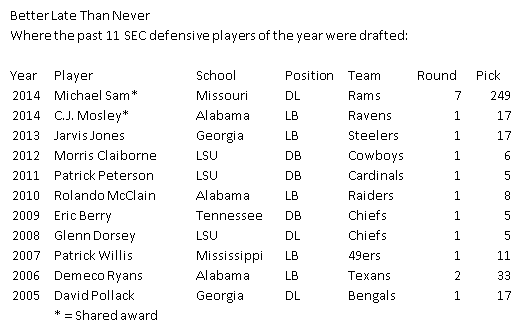
… this past weekend has reminded us that we haven’t quite achieved “opportunity to the talented.” Michael Sam was the Co-Defensive Player of the Year in the country’s strongest football conference, yet many people wondered if any NFL team would draft the league’s first openly gay player. Turns out they were right to wonder. Here’s a revealing chart published in yesterday’s Washington Post (based on data from pro-football-reference.com and published alongside this article in the print edition but apparently not online).

2014 NFL draft and Michael Sam

Every other SEC Defensive Player of the Year in the past decade, including the athlete who shared the award this year with Michael Sam, was among the top 33 picks in the draft, and only one was below number 17. Does that mean that being gay cost Michael Sam 232 places in the draft, compared to his Co-Defensive Player of the Year? Maybe not. There are doubts about Sam’s abilities at the professional level. But there are doubts about many of the players who were drafted ahead of him, in the first 248 picks this year. Looking at this chart, I think it’s hard to escape the conclusion that Sam paid a price for being openly gay. That’s why classical liberals – which in this broad sense should encompass most American libertarians, liberals, and conservatives – should continue to press for a society in which the careers are truly open to the talents. That doesn’t mean we need laws, regulations, or mandates. It means that we want to live in a society that is open to talent wherever it appears. As Scott Shackford writes at Reason, Sam’s drafting is “a significant cultural development toward a country that actually doesn’t care about individual sexual orientation. The apathetic should celebrate this development, as it is a harbinger of a future where such revelations become less and less of a big deal.” Let’s continue to look forward to a society in which it’s not news that a Jewish, Catholic, African-American, Mormon, redneck, or gay person achieves a personal goal.

Update: Draw Play Dave gets it exactly right.

H.R. Giger, RIP

Filed under: Media — Tags: , — Nicholas @ 08:18

Another unexpected obituary notice today for artist H.R. Giger:

Artist H.R. Geiger sits for an April 1994 portrait in New York City, New York. (Photo by Bob Berg/Getty Images)

In Scientific American, Glendon Mellow talks about Giger’s impact in art:

Hans Ruedi Giger gave us machines moving like flesh. His airbrush compositions are strongly considered to be descendants of Dalí though I have always felt the unease, the dark mirror of the 1890 Symbolists behind his work. If you cracked open the biomechanoid shell, I always assumed the devastating mythologies of Khnopff, Böcklin and Delville would come pouring out. His paintings were the work of sperm, bullet casings, grotty stone and soft cheekbones. It was not made to be beautiful, it was made to unsettle.

ELP - Brain Salad Surgery cover by HR Giger

Giger’s work unsettled me as a painter and drove me like it did so many others. Are you another painter who paints, in some small way, because of Giger? Share your stories and links to your art in the comments below. Perhaps we will follow-up with a post of art inspired by Giger here on Symbiartic.

Giger is dead. His shadow remains cast over our future. The shadow moves.

I’ve always thought his name was spelled “Geiger”, yet most of the obituaries spell it as “Giger” … but the 1994 image at Getty has it as “Geiger”. I’ve edited this post to use the more common spelling.

Climate change policies – “a massive conservative blind spot … matched by liberals’ tunnel vision”

Filed under: Environment, Politics, USA — Tags: , , , — Nicholas @ 07:35

Shikha Dalmia on the real reason the right fights against massive government action to fight climate change:

The decibel level in our national debate about global temperature went up several notches this week. The White House noisily released a report full of dire claims about the havoc manmade global warming is causing in America — and Republicans, equally noisily, denounced this as “liberal gloom and doom.”

The left has a deep ideological need to hype this issue, and the right to minimize it. And despite the deafening political noise on what ought to be a scientific matter, Americans must not be tempted to reach for their earplugs in disgust. After all, these ideological wars are how democracies sort out their differences.

[…]

The right’s chief commitment (which I share) is to free enterprise, property rights, and limited government that it sees as core to human progress. So when the market or other activities of individuals harm third parties or the environment, they look for solutions in these principles.

If overgrazing threatens a pasture, to use a classic example, the right’s answer is not top-down government diktats to ban or ration use. Rather, it is to divvy up the pasture, giving ownership to farmers — or privatizing the commons. The idea is that what individuals own, they protect; what they don’t, they abuse.

But there is no pure free market or property rights solution to global warming. There is no practical way to privatize the Earth’s atmosphere or divvy up pollution rights among the world’s seven billion inhabitants in 193 countries. This creates a planet-sized opening for the expansion of the regulatory state. Hence, right-wingers have an inherent need to resist the gloomy global warming narrative.

This is a massive conservative blind spot. But it is, in many ways, matched by liberals’ tunnel vision.

It is no secret that liberal commitment is less to promoting individual liberty and more to curbing capitalistic greed, which the left views as the great enemy of social justice and equality. At first blush, environmentalism and egalitarianism appear in conflict given that the environment is something of a luxury good that rich folks generally care about more than the poor.

Indeed, this conflict is why the 1960s New Left, driven primarily by humanistic concerns such as eradicating poverty and eliminating racism, shunned the emerging environmental movement for over a decade, according to University of Wisconsin’s Keith M. Woodhouse. Many in the New Left condemned the first Earth Day in 1970 as “the white liberal’s cop out” and believed that a preoccupation with overpopulation, for example, was “racist hysteria.”

The global 1% includes almost all North Americans

Filed under: Economics, USA — Tags: , — Nicholas @ 07:14

Peter Jaworski explains that as with so many other issues, where you sit on the issue of economic inequality determines what you see:

When people talk about the “1%”, I think they think that they are talking about a specific group of individuals, who have been and remain in that category over time.

When they say “We are the 99%” I think they think that that’s a static category, designating a group of people who persist as members over their lifetime.

Would people be so upset if it turned out that the individuals who made up the 1% were different people over time? That those who are in the 1% spend most of their lives in the 99%, and will go back to being 99%ers after a few years of being 1%ers?

I’m not sure. I am sure that if those categories represented a permanent group of specific individuals, we would be justified in lamenting the state of the economy.

But at any rate, if you’re someone who worries a great deal about the 1 and 99 %ers, would you be as worried if the following were true?:

Suppose just over one-in-ten (or 12%) would be in the 1% for at least a year of their lives.
Suppose further, to expand our view a bit, that just over one-in-three (or 39%) would hit top 5%, just over one-in-two (or 56%) would hit top 10%, and two-in-three (or 73%) would hit top 20%, each for at least a year of their lives.

And now suppose that less than one-in-150 (or a mere 0.6%) remained in the top 1% for 10 consecutive years.

If all of that were true — if the income distribution were that fluid — would you still be so upset?

All of that isn’t a hypothetical: “it’s a description of the income distribution over time in the U.S.” (and Canadians are probably similarly distributed).

For people in India, I bet they think the heated discussion about top 1%ers and 99%ers in Canada and the U.S. is a great big joke. The very same kind of joke that we would laugh about if the Tremblays in the Westmount area of Montreal were to bitterly complain about the Jones’ living in the Bridal Path area of Toronto. Sure, the Tremblays with their average $8 million net worth have half what the Jones’ and their $16 million net worth have, but it would take a comic to suggest we should lament and despair about the Tremblays’ attempts to keep up with the Jones’.

But it’s not a joke. Or, maybe, the people who occupied Bay Street and Wall Street didn’t get it.

Us Canadian 99%ers are not just rich, which we are. By global standards, we’re filthy, stinking rich. It takes roughly an annual net income of $41,600 to be in the global 1%.

If that’s you, then take a deep breath, find a mirror, and repeat these words, “I am the 1%.”

Coravin – a new technique for sampling wine in the bottle

Filed under: Business, Wine — Tags: — Nicholas @ 06:59

Brendan linked to this article about an innovative wine sampling device:

Five years later and news of another device with even more exciting ramifications for the wine trade began to ripple across from the US. Nuclear engineer and, crucially, wine lover Greg Lambrecht turned his mind to exploring whether it might be possible to sample the contents of a cellar without having to pull the cork.

Fourteen years and 23 prototypes later, Coravin was born. The portable apparatus allows a needle to be inserted through the foil capsule and cork; it then extracts the wine, fills in the gap with inert argon and withdraws, leaving the flexible cork to reseal itself.

Having initially launched in the US, Coravin is now available to be shipped to 22 countries and made its first UK appearance last October, priced at £300.

Although vice-president for marketing Howard Leyda says “the primary target market for Coravin is wine enthusiasts first for personal use”, it is the UK restaurant scene that has been generating the biggest buzz around what many believe is a real game changer.

[…]

Until Coravin becomes more easily available, a number of restaurants that have managed to get their hands on one can be seen drumming up excitement among their clientele by promoting this gadget’s most obvious application: the chance to taste some serious old wines.

At one early adopter, D&D London restaurant Avenue, the French- and American-focused wine list now reaches its apogee in the form of vertical flights of Mouton Rothschild and the first growth’s Californian sister venture Opus One.

Other options include Cheval Blanc 1999 at £91 for a 125ml glass or, for those looking to treat themselves on a tighter budget, a 75ml sample of Clerc Milon 2004 for £13.

“It’s really interesting for us to be able to offer these wine flights,” enthuses Avenue restaurant manager Robert Kihlstrom.

Nash the Slash, RIP

Filed under: Cancon, Media — Tags: , , — Nicholas @ 06:51

CBC News reports that Nash the Slash has died:

Nash the SlashHe started the independent record label Cut-Throat Records, which he used to release his own music. Among his albums was Decomposing, which he claimed could be listened to at any speed, and Bedside Companion, which he said was the first record out of Toronto to use a drum machine.

His biggest hit was Dead Man’s Curve, a cover of a Jan and Dean song.

More recently, he played at Toronto’s Pride Festival and toured up until 2012. In 1997 Cut-Throat released a CD compilation of Nash the Slash’s first two recordings entitled Blind Windows. In 1999 he released Thrash. In April 2001, Nash released his score to the silent film classic Nosferatu.

Plewman retired in 2012, bemoaning file-sharing online and encouraging artists to be more independent. “It’s time to roll up the bandages,” he wrote.

In the last few years, Plewman also became a vocal supporter of Toronto Mayor Rob Ford.

He will be remembered for his experimental ethos as well as his unusual stage presence.

“I refused to be slick and artificial,” Plewman wrote of his own career.

There has not been word on how the musician died.

H/T to Victor for the link.

Update: Kathy Shaidle has more.

May 12, 2014

Reason.tv – Trigger Warnings, Campus Speech, and the Right to Not Be Offended

Filed under: Media, Politics, USA — Tags: , , , , , , — Nicholas @ 16:55

Published on 8 May 2014

“It’s really not anyone else’s business to tell someone when they are mentally and emotionally ready to deal with things,” says Bailey Loverin, a University of Santa Barbara (UCSB) junior who authored a resolution to mandate that professors issue “trigger warnings” before presenting material that might trigger memories of past traumas in students.

Feminist and social justice blogs popularized the concept of the trigger warning, with writers encouraging each other to label posts that might trigger flashbacks to sexual assault or domestic abuse. As the popularity, and scope, of the trigger warning idea grew, some bloggers began listing potential triggers, ranging from rape and violence and suicide to snakes and needles and even “small holes.”

Thumbnail sketch of Russian history

Filed under: Europe, History, Humour, Russia — Tags: , — Nicholas @ 14:10

P.J. O’Rourke says we need to take the long view in regard to Vladimir Putin, and provides a rough history of Russia to back up his contention:

In the sixth century A.D. Russia was the middle of nowhere in the great Eurasian flat spot bounded by fuck-all on the north and east, barbarian hordes and the remains of the Byzantine Empire on the south, and the Dark Ages on the west.

Wandering around in here, up and down the watershed of the Dnieper River from Novgorod (which hadn’t been built yet) to Kiev (ditto) were disorganized tribes of Slavic pastoral herdsmen herding whatever was available, pastorally. They were harried by Goths, Huns, Khazars, and other people who had the name and nature of outlaw motorcycle gangs long before the motorcycle was invented.

The original Russian state, “Old Russia,” was established at Novgorod in A.D. 862 by marauding Vikings. They’d set off to discover Iceland, Greenland, and America, took a wrong turn, and wound up with their dragon boat stuck on a mud bar in the Dnieper. (Historians have their own theories, involving trade and colonization, but this sounds more likely.)

The first ruler of Old Russia was the Viking Prince Ryurik. Imagine being so disorganized that you need marauding Vikings to found your nation — them with their battle axes, crazed pillaging, riotous Meade Hall feasts, and horns on their helmets. (Actually, Vikings didn’t wear horns on their helmets — but they would have if they’d thought of it, just like they would have worn meade helmets if they’d thought of it.) Some government it must have been.

Viking Prince Ryurik: “Yah, let’s build Novgorod!”

Viking Chieftain Sven: “Yah, so we can burn it down and loot!”

New Zealand 4K timelapse

Filed under: Environment, Pacific — Tags: , — Nicholas @ 07:58

Published on 26 Apr 2014

Part I/IV of a timelapse series through the always changing landscapes of New Zealand. Shot over 4 month, travelling through amazing landscapes, sleeping under the stars, hiking on mountains and exploring remote roads. Locations in this video where at Fjordland NP, Mount Cook NP and Arthurs Pass NP, Mavora Lakes and Lake Ohau.

H/T to Roger Henry who said “A nice bit of promo work for NZ. […] A little bit Arthur Clarkish in a couple of spots.”

Evaluating NFL team drafts

Filed under: Football — Tags: , , — Nicholas @ 07:25

It’s said that you can’t evaluate a draft class until three years later, because you need at least that long to see which players have established careers and which ones are no longer in the league, rather than who won the popularity contest before the draft. Despite that, many talking heads on TV have been eagerly assigning grades to the just-concluded NFL draft, and the fans of each team eagerly follow the narrative. Even Arif Hasan has fallen victim to this temptation, although he’s at least trying to follow a methodology to determine the overall strength or weakness of each team’s 2014 draft class.

One of the interesting things about gathering Big Boards across the country and finding the different ways that evaluators grade the players is that it gives us an ability to take a look at the draft from their perspective. There’s a big stigma against “grading the draft,” that I don’t think makes a lot of sense because we’re so willing to share our opinions on the players and teams who drafted them in every other way.

It seems we can give opinions about individual players and their teams without criticism. but as soon as we summarize it in a letter grade, we’re doing something wrong and have to wait. Instead, it may be better to wait three years to judge it.

But that’s no fun, and we want feedback. We just have to acknowledge we have a high band of uncertainty and give our impressions of the draft.

But how about instead of inserting post-hoc opinions about our favorite team, we take a look at a metric we’ve already laid the groundwork for? Let’s compare a team’s draft capital to what the Big Boards accumulated said.

It’s not perfect, especially in a deep draft, but by assigning players in their rankings an amount of points equal to the trade charts’ equivalent pick value, we can find out what players are considered to be worth. Using the NFL Trade Value Chart (put together by Jimmy Johnson way back when), we can compare the amount of draft capital a team entered the draft with to the “value” of players selected. This is perhaps the most appropriate way to gauge the number of “steals” and “reaches” a team makes and quantifying.

Spoiler:

Arif's 2014 draft grades-partial

Amazon gets a patent for a decades-old photographic technique

Filed under: Bureaucracy, Business, Government, Technology — Tags: , , — Nicholas @ 06:42

Stephen Shankland provides another exhibit in the patent-system-is-broken case:

Amazon - Studio Arrangement patent

Photographers are hooting derisively at a patent Amazon won in 2014 for a photography lighting technique that’s been in use for decades, a patent that’s helped undermine the credibility of the patent system.

Amazon’s patent 8,676,045, granted in March and titled “Studio Arrangement,” describes a particular configuration of the photography subject in the foreground and a brightly lit white screen behind, an approach that “blows out” the background to cleanly isolate the subject.

It’s a fine idea, but not a novel invention, argued David Hobby, a professional photographer since 1988 who runs the Strobist site that for years has been a popular source of advice on flash photography. He used the approach himself as a staff photographer on his first job decades ago for a business publication.

May 11, 2014

The NSA worked very hard to set themselves up for the Snowden leaks

Filed under: Government, Liberty, Technology — Tags: , , , , , — Nicholas @ 10:30

A few days back, Charles Stross pointed out one of the most ironic points of interest in the NSA scandal … they did it to themselves, over the course of several years effort:

I don’t need to tell you about the global surveillance disclosures of 2013 to the present — it’s no exaggeration to call them the biggest secret intelligence leak in history, a monumental gaffe (from the perspective of the espionage-industrial complex) and a security officer’s worst nightmare.

But it occurs to me that it’s worth pointing out that the NSA set themselves up for it by preventing the early internet specifications from including transport layer encryption.

At every step in the development of the public internet the NSA systematically lobbied for weaker security, to enhance their own information-gathering capabilities. The trouble is, the success of the internet protocols created a networking monoculture that the NSA themselves came to rely on for their internal infrastructure. The same security holes that the NSA relied on to gain access to your (or Osama bin Laden’s) email allowed gangsters to steal passwords and login credentials and credit card numbers. And ultimately these same baked-in security holes allowed Edward Snowden — who, let us remember, is merely one guy: a talented system administrator and programmer, but no Clark Kent — to rampage through their internal information systems.

The moral of the story is clear: be very cautious about poisoning the banquet you serve your guests, lest you end up accidentally ingesting it yourself.

« Newer PostsOlder Posts »

Powered by WordPress