Quotulatiousness

May 11, 2014

Market disruption and innovation

Filed under: Bureaucracy, Business, Government — Tags: , , , , — Nicholas @ 10:19

Innovation often leads to challenges to established markets. Existing players in those established markets have three choices when faced with a disruptive new competitor or technological change: they can innovate themselves, they can retrench and avoid direct competition, or they can do what most incumbents do — get the government regulators to fight their battles for them.

Market incumbents do not like disruption. Uber, the ride-sharing service that has loosened the stranglehold of the taxi cartels, has been the object of government attacks and vigilante attacks both. Various regulatory agencies have tried with varying degrees of success to shut it down, London’s taxi drivers are even as we speak promising “chaos” in response to the firm’s success, French vigilantes have attacked its drivers, and in Seattle — blessed Seattle! — self-styled anarchists are targeting its cars and drivers. “Anarchists” for state-enforced cartel economics to increase private profit — somebody is unclear on the concept, it seems.

A great deal of the program of the old Left — from its full-on Marxist wing to its Proudhonian anarchist wing — is in the process of being accomplished by 21st-century capitalism. The means of production have been radically democratized, with multi-billion-dollar firms springing up out of garages and dorm rooms. The privileged position of dominant old-line financiers is being undermined rapidly by innovations such as Kickstarter, which blurs the line between the altruistic and the consumerist. The life expectancy of large corporations has collapsed, from about 75 years in the 1960s to 15 years and declining today. When Pierre-Joseph Proudhon called for “a war of labor against capital; a war of liberty against authority; a war of the producer against the non-producer; a war of equality against privilege,” he certainly did not have in mind Uber or Outbox; his most famous motto was, after all, “Property is theft.” (I think there is rather more to his idea of property than that simplistic formulation communicates, but this is not the place for that particular essay.) But the characteristics of those firms — relatively modest capital requirements, subverting various kinds of political authority in the form of licensure and regulation enacted in the interests of market incumbents, empowering efficient producers to compete with rent-seeking non-producers, and, above all, undermining the privileged place of state-sanctioned monopolies and cartels — looks a lot more like what the 19th-century revolutionaries had in mind than the USPS does. If what you mean by “capitalism” is the East India Company, then capitalism is not very attractive; if what you mean by “capitalism” is Kickstarter, then it is.

Not that a man transported from the 19th century to our own time would recognize that. If we could transport M. Proudhon or any of his contemporaries to the here and now, their eyes would not register any economic system with which they were familiar at the sight of the daily wonders we take for granted. They wouldn’t see capitalism; they’d see magic. But the DMV, the USPS, the housing project, and the prison would all be familiar to their 19th-century eyes. Our choice is not really between neat ideological verities with their roots in Adam Smith or Karl Marx, but between the DMV and the Apple store. Each model has its downsides, to be sure, but it does not seem like a terribly difficult choice to me.

Ontario politics: “Insular, petty and involves a cast of characters you wouldn’t want to meet wandering down a dark alley”

Filed under: Cancon, Politics — Tags: , , , , — Nicholas @ 10:02

It’s election season once again in Ontario, and Richard Anderson looks at the current state of play:

I know most of you can’t stand Ontario politics.

Especially those of us who live here…

It’s insular, petty and involves a cast of characters you wouldn’t want to meet wandering down a dark alley. Still it’s the largest province in Confederation so attention must be paid, however grudgingly.

The last decade of provincial politics has revolved around the astonishing acrobatics of the McGuinty-Wynne Liberals. They have lied, overspent and borrowed to an extent without precedent in English speaking Canada. Those of us who remember the Bob Rae years had assumed that they had seen the worst. Apparently it wasn’t. After a brief house cleaning under Harris-Eves we were returned to spendthrift form. The provincial debt has doubled in ten years. Nothing else in Ontario has grown anywhere near as fast.

A political party that was this incompetent, this obviously corrupt, would you think be headed for certain defeat at the polls. Transforming the engine of the Canadian economy into its busted leg took some doing. A treasure trove of natural resources, close proximity to the largest American markets and a highly skilled workforce. Ontario has, what seemed until recently, to be nearly indestructible advantages. A pack of Gibbonese monkeys could be running the show at Queen’s Park and the economy, somehow, would still keep moving along.

But no one saw Dalton McGuinty coming. How could they? With the personality of a mediocre non-entity and the political cunning of a dishonest child, he won two majority governments and narrowly missed a third. How has been something of a mystery. The Dalt had certain inborn advantages. His sheer nebbishness made him seem unthreatening. Yet here we stand at the bottom of a deep hole he himself dug. There were, of course, his weak and bungling rivals. Ernie Eves looked and sounded like an unenthusiatic version of Gordon Gekko. John Tory’s ability to self-destruct is near legend. Tim Hudak isn’t a real boy at all.

Yet the greatest advantage that Dalton McGuinty had, and which Kathleen Wynne retains, is the electorate. There is no greater advantage to a scheming and incompetent politician than a disengaged and misinformed electorate. That describes the voters of Ontario almost perfectly. This might seem a tad puzzling to some. Generations of Canadian voters have been been able to hold their governments to rough account. Semi-literate frontier farmers were able to follow the twists and turns of the Pacific Scandal and send John A, temporarily, packing. Today the ordinary voter sees greater crimes and follies with nary a batted eye.

Vikings day 3 draft picks

Filed under: Football — Tags: , , , , — Nicholas @ 09:05

“Trader” Rick Spielman was in full wheel-and-deal mode on Saturday, as the Vikings traded back a few times to stockpile extra picks. Despite some moaning on the part of the fan base, this is something he’s been remarkably consistent about — he likes to have about ten picks in a given draft. He’ll move up to get a particular player (like Harrison Smith in 2012, Cordarrelle Patterson in 2013, and Teddy Bridgewater this year), but in general he prefers to trade down to get more opportunities to draft players for the long term. There was a particularly persuasive article about this at Vox.com a few days back, arguing that teams should always try to maximize the number of players they draft, to increase their chance of getting players who will be around for a long time in the league:
Draft picks can be traded, and the success of any one player picked is highly uncertain. Because of that, their data says that in the current trade market, teams are always better off trading down — that is, trading one high pick for multiple lower ones — but many teams become overconfident in their evaluation of one particular player and do the exact opposite: package several low picks for the right to take one player very early.

“There are one or two teams out there that philosophically follow this idea,” says Massey, who serves as a draft consultant with several NFL teams that he can’t disclose. “But in my experience, teams always say they’re on board with it in January. Then when April rolls around, and they’ve been preparing for the draft for a long time, they fall in love with players, get more and more confident in their analysis, and fall back into the same patterns.”

My only disagreement with this argument is that due to the current Collective Bargaining Agreement, there’s a discontinuity in the data at the bottom of the first round: teams get an optional fifth year on contracts with first round players. For this reason, I think Minnesota was right to trade up to get Bridgewater at the bottom of the first round, to get that option instead of waiting until they were next on the clock (which would have been eight picks later in the second round).

At the Daily Norseman, KJ Segall looks at the draft philosophy being employed by Rick Spielman and Mike Zimmer:

As we agonized through the pre-draft build up, I contemplated the basic two directions the Vikings could go — solving the offense with relatively few moves, or focusing on a defense that had holes everywhere. On one hand, we needed three things to have an offense worthy of contending in the NFC North: a good quarterback, a good offensive guard, and a reliable backup running back. (Not bad when one of the things you need is a backup position.) If we fixed that, then our solid WR corps, strong Oline, and superstar RB would be giving opposing DCs nightmares… but, that would also mean that our defense would have missed out on some upgrades, and many a team might simply outscore us no matter what we could do with the ball. On the other hand, letting the offense be with the adequate Matt Cassel, Charlie Johnson, and (fill-in-the-blank backup running back), all while attempting to plug as many holes on the leaky longship that was our defense could create a relatively well-balanced team that might not scare a lot of people but could still sneak out some surprises.

So it came down to this — be mediocre across the board, or be great at one thing and weak at another. Ultimately, through FA and what has been a shockingly good draft (shockingly because when you get the hands-down best QB available at freakin’ pick 32… well, the mind, it gets blown), they basically have gone with the latter. Yes, we solved our quarterback situation beyond our wildest expectations, and our offense will in fact be much, much better this year (and it wasn’t even all that terrible last year, either). And yes, by drafting Daddy David Yankey and Jerick McKinnon, we did technically solve those other two holes- although McKinnon is most definitely a project at first, and Yankey’s ability to unseat Charlie Johnson yet remains to be seen. (Although he should hopefully do so at some point in the season.) In reality, we focused pretty heavily on defense throughout the draft, starting off with the selection of Anthony Barr. The Bridgewater awesomeness aside, it would appear that the Vikings were determined to work on the defensive upgrades made in free agency as their primary focus.

On to the actual day three picks below the fold.

(more…)

QotD: Longevity

Filed under: Health, Humour, Quotations — Tags: , — Nicholas @ 00:01

It is not, naturally and generally, the happy who are most anxious either for prolongation of the present life or for a life hereafter; it is those who never have been happy. Those who have had their happiness can bear to part with existence, but it is hard to die without ever having lived.

John Stuart Mill, Three Essays on Religion, 1874

May 10, 2014

QotD: Ideal government

Filed under: Government, Liberty, Quotations — Tags: , — Nicholas @ 14:03

The ideal government of all reflective men, from Aristotle to Herbert Spencer, is one which lets the individual alone — one which barely escapes being no government at all. This ideal, I believe, will be realized in the world twenty or thirty centuries after I have passed from these scenes and taken up my home in Hell.

H.L. Mencken, “Le Contrat Social”, Prejudices, Third Series, 1922

Former head of the LCBO at the Ontario Wine Awards

Filed under: Business, Cancon, Humour, Wine — Tags: , — Nicholas @ 13:17

Michael Pinkus attended last night’s award ceremony and found the star of the proceedings was the master of ceremonies, former LCBO head Andy Brandt:

The 20th Annual Ontario Wine Awards were held Friday night at the Queen’s Landing Inn in Niagara-on-the-Lake hosted by former head of the LCBO Andy Brandt; who had to be one of the unintentionally funny MC I’ve ever experienced. Between the butchering of words (Pinot “Griss”, Cabernet “Frank”, “Sara” for Syrah, “Ca-lom-us” for Calamus and “Toss-e” for Tawse) and the total omission of names he did not want to pronounce like Musque and Viognier during the presentation — he seemed uncomfortable giving out the awards, but was good at puns and for a few stories. All-in-all Brandt was a train-wreck, but at least you knew the room was listening for his next faux-pas and he was the talk of the room over beers and desserts at the after-party (the most talked about host I can remember). One person commented to me, “He’s my favourite MC at [The Ontario Wine Awards] ever, I just never knew what was going to come out of his mouth from one moment to the next. Obviously pronunciation has gone out the window tonight, it’s a free-for-all.” Others could not believe that the once head of the LCBO could not pronounce grape varieties correctly.

What did King Solomon and David Lee Roth have in common?

Filed under: Business, Economics, History, Media — Tags: , , — Nicholas @ 12:59

Actually, more than a few things, as the Freakonomics team of Dubner and Levitt explain:

King Solomon built the First Temple in Jerusalem and was known throughout the land for his wisdom.

David Lee Roth fronted the rock band Van Halen and was known throughout the land for his prima-donna excess.

What could these two men possibly have had in common? Well, both were Jewish; both got a lot of girls; and both wrote the lyrics to a No. 1 pop song (“Jump” in Mr. Roth’s case and, in Solomon’s, several verses from Ecclesiastes that appeared in the Byrds’ 1965 hit “Turn! Turn! Turn”). But most improbably, they both dabbled in game theory, as seen in classic stories about their clever strategic thinking.

[…]

And so it was that David Lee Roth and King Solomon both engaged in a fruitful bit of game theory — which, narrowly defined, is the art of beating your opponent by anticipating his next move.

Both men faced a similar problem: How to sift the guilty from the innocent when no one is stepping forward to profess their guilt? A person who is lying or cheating will often respond to an incentive differently than an honest person. Wouldn’t it be nice if this fact could be exploited to ferret out the bad guys?

We believe it can — by tricking the guilty parties into unwittingly revealing their guilt through their own behavior. What should this trick be called? In honor of King Solomon, we’ll name it as if it is a lost proverb: Teach Your Garden to Weed Itself.

Vikings second day draft picks

Filed under: Football — Tags: , , — Nicholas @ 10:47

Having traded away their original second round pick to Seattle to move back up to the bottom of the first round to get Teddy Bridgewater, the Vikings started the evening with only two third round picks. There was some speculation about Rick Spielman trading back up into the second round, but nobody had solid ideas about which player the team might have wanted urgently enough to give up any more later round picks. Spielman later said that they’d tried to “make some movement” but that they couldn’t come up with “a deal we felt comfortable with”.

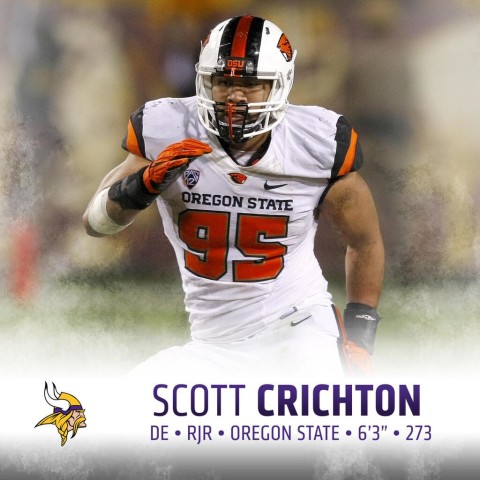
Scott ChrichtonThe Vikings selected Oregon State defensive end Scott Crichton with the first of their third round picks. The Daily Norseman‘s Eric Thompson says this was a good selection:
With many fans expecting the team to go after a corner with the 72nd overall pick in the 2014 NFL Draft, the Vikings got another talented pass rusher in Oregon State defensive end Scott Crichton. It was definitely a “value” pick — Crichton had a second round grade on most draft boards and was widely considered one of the best five or six edge rushers available in the draft. Mere moments after being chosen by the Vikings, Crichton jumped on a conference call to talk with Twin Cities beat writers.

[…]

Crichton played a little linebacker his freshman year at Oregon State, but make no mistake about it–he’ll be on the field to get after the quarterback. The Beavers ran a 4-3 defense and Crichton’s bread and butter was his pass rush. “That’s my thing. I love to get after the quarterback.” He played on both sides of the line with the Beavers along with some plays. Like most draft pundits Crichton expected to be drafted in the third round but nonchalantly claimed that the “third round’s fine”. “I’m just grateful for this opportunity. I’m ready to show what I can do and prove people wrong for not picking me earlier.”

At the press conference after the selection, Rick Spielman said “He’s not very nice on the field, which you like to see.”

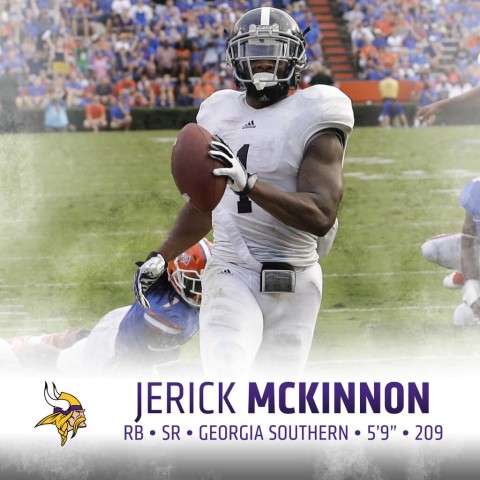
Jerick McKinnonWith their last pick of the evening, the Vikings selected running back Jerick McKinnon from Georgia Southern. Arif Hasan said that McKinnon had been a stand-out performer at the combine, but that he’ll be a bit of a project (despite “insane measureables”). He’s certainly not a carbon copy of Toby Gerhart, being 5’9″ tall, weighing 209 lbs, and boasting a 4.4 time at the combine. His college football career was an odd one: started out as a cornerback, then eventually becoming a quarterback and running back (Ben Goessling refers to his role as having been “triple-option”, which is a new one on me). His role isn’t as clear-cut as you’d think, despite being drafted as a running back, during the NFL Network draft coverage, Mike Mayock said he could even start at safety in the NFL. On the official Vikings overview, his weaknesses make you think the team has other plans for him: “On the short side. Runs a bit upright and hesitant. Average burst to the perimeter. Not a creative, make-you-miss runner. Very limited career receiving production (10 career catches). Not stout in pass protection.” Those last two items are not what you’d expect if the team was planning to use McKinnon to spell Adrian Peterson on third down. Ideally, your third round running back would be an experienced receiver with good blocking skills.

With both Chrichton and McKinnon, the Vikings clearly valued their athletic potential or “upside” over more polished players with lower theoretical potential. That’s a strong indication of confidence that they can teach technique on both sides of the ball. And given the strength of the new coaching staff, that’s a sensible approach. Neither of these players is likely to start as rookies, but they both have versatility in the roles they could fill and given a year of seasoning, they could become useful parts of the puzzle down the road.

The Vikings have four picks remaining in today’s final four rounds of the draft: 145th (5th), 148th (5th), 184th (6th) and 223rd (7th) … before we account for Trader Rick’s taste for wheeling and dealing, anyway.

Update: Arif Hasan profiles Scott Chrichton and Jerick McKinnon. Arif’s always good at analysis.

Ten years of Quotulatiousness

Filed under: Administrivia, Media — Tags: — Nicholas @ 00:01

Today is the tenth anniversary of my very first blog post. It wasn’t really a barn burner: El Neil on the Iraqi Prisoners. With only two posts on the first day, it wasn’t clear that the blog would last even to the end of May. Eleven posts on the second day were a more hopeful sign. I’d been reading and commenting on blogs for a few years at that point, so the transition to being a blogger was relatively easy. Managing some kind of consistency — that was more of a challenge.

Becoming a long-term blogger just sort of happened: my friend Jon installed MovableType and invited me to start a blog of my own on his site. Jon eventually decided that blogging wasn’t for him so he shut down his blog, but allowed me to keep my blog hosted at his site for over five years as a primary and my first five years of posts are still available there. Jon’s short experiment in blogging was called Blogulatiousness, and I named my own blog as a back-handed reference to his … which is why I still have the least easily pronounced blog name in the Anglosphere. Initially, I expected the blog to be primarily quotations, although even from the start, I didn’t post a QotD entry all that regularly.

Advice for anyone wanting to start a blog? (Especially if you’re involved in the gaming-oriented Newbie Blogger Initiative this year.) Blog every day. Even if you don’t have much to say, make sure you post something. It’s dual purpose: you need to get yourself into the habit of posting regularly, and you need to have something new every time a reader loads your page, or they’ll stop coming back. I have a stockpile of QotD posts ready to go for those days when I’m too busy or too pre-occupied to come up with regular posts. I recommend you do something similar, although it should be something that ties in with your general theme (if you have one): original artwork, YouTube videos, quotations, short poems or drabbles if you write fiction, historical photos, a list of assorted links, etc. But do remember that a blog isn’t Instagram or Tumblr or Facebook: don’t post photos of your lunch. Please. You’re trying to build your own audience, and it’s unlikely you’ll do better than those services, as they’re optimized for their particular niches.

Whatever you choose to do, remember to link back to your sources every time. It’s courteous and it’s common sense: you want your work to be appreciated, and so do the other writers/artists/musicians you link to.

Earlier anniversary postings:

Update, 13 May: I just discovered that May 10 in 2004 was the same day that ArenaNet announced the development of their first MMO, Guild Wars (now known as Guild Wars Prophecies. I didn’t play the game until a year or so later, but I’m amused and pleased that we share an anniversary date.

May 9, 2014

Shakespeare: Original pronunciation

Filed under: Britain, History, Media — Tags: , , , — Nicholas @ 13:04

Jon, my former virtual landlord sent along an interesting link:

An introduction by David and Ben Crystal to the ‘Original Pronunciation’ production of Shakespeare and what they reveal about the history of the English language.

This week in Guild Wars 2

Filed under: Gaming — Tags: , — Nicholas @ 11:23

My weekly Guild Wars 2 community round-up at GuildMag is now online. ArenaNet has continued to be unusually quiet since the release of the April Feature Pack, but last week’s release of the Chinese version of Guild Wars 2 is undoubtedly keeping them very busy indeed. In addition, there’s the usual assortment of blog posts, videos, podcasts, and fan fiction from around the GW2 community.

GuildMag logo

QotD: Real history and economic modelling

Filed under: Economics, History, Media, Quotations — Tags: , , — Nicholas @ 08:23

I am not an economist. I am an economic historian. The economist seeks to simplify the world into mathematical models — in Krugman’s case models erected upon the intellectual foundations laid by John Maynard Keynes. But to the historian, who is trained to study the world “as it actually is”, the economist’s model, with its smooth curves on two axes, looks like an oversimplification. The historian’s world is a complex system, full of non-linear relationships, feedback loops and tipping points. There is more chaos than simple causation. There is more uncertainty than calculable risk. For that reason, there is simply no way that anyone — even Paul Krugman — can consistently make accurate predictions about the future. There is, indeed, no such thing as the future, just plausible futures, to which we can only attach rough probabilities. This is a caveat I would like ideally to attach to all forward-looking conjectural statements that I make. It is the reason I do not expect always to be right. Indeed, I expect often to be wrong. Success is about having the judgment and luck to be right more often than you are wrong.

Niall Ferguson, “Why Paul Krugman should never be taken seriously again”, The Spectator, 2013-10-13

Vikings make two moves in first round of the draft

Filed under: Football — Tags: , , , — Nicholas @ 07:51

The Vikings were busy in the NFL draft once again, as “Trader” Rick Spielman swapped first round picks with Cleveland to select linebacker Anthony Barr (gaining an extra pick in the process), then traded two later round picks for Seattle’s number 32 (the last pick in the round) to select quarterback Teddy Bridgewater. The Barr pick surprised me, as I thought middle linebacker would be a much higher priority, but you could make the case that Barr was the best athlete if not the best overall player available at that spot.

Linebacker Anthony Barr #11 of the UCLA Bruins sacks quarterback Jared Goff #16 of the California Golden Bears at the Rose Bowl on October 12, 2013 in Pasadena, California. Photo by Stephen Dunn, Getty Images.

Barr was one of the top linebacker prospects, despite only having played two years at that position. It’s expected that he’ll take Chad Greenway’s position on the strong side, while Greenway moves to one of the other linebacking spots.

Teddy Bridgewater of the Louisville Cardinals poses with NFL Commissioner Roger Goodell after he was picked #32 overall by the Minnesota Vikings during the first round of the 2014 NFL draft. Photo by Elsa, Getty Images.

For quite a long time in the run-up to the draft, Teddy Bridgewater was seen as not only the top quarterback prospect, but even as the top overall pick until he had a bad outing at his Pro Day, and then his stock began to drop. Each of the three top quarterbacks were linked to the Vikings in many mock drafts, but Bortles was off the board before the Vikings were on the clock, and Manziel was drafted (by Cleveland) in the second half of the round. I had thought the Vikings were more interested in Bridgewater, but many reported that the Vikings had attempted to get back into the first round to get Manziel, but that Cleveland’s extra first round pick meant they couldn’t top that offer without giving away too much. Personally, I doubt that as Manziel would have been the worst fit of the top three in Norv Turner’s offensive scheme — the skills Manziel offered were not the ones that Turner values the most in a quarterback.

One of the most impressive stats on Bridgewater is his performance against the blitz: a 70.1 percent completion rate averaging 11 yards per attempt, for 15 touchdowns and only 1 interception. That’s head-and-shoulders above the other “top two” quarterbacks. However, Rick Spielman said that there’s no expectation that he’ll start right away, and that he’ll be given time to develop behind Matt Cassel. The coaching staff will determine when he’s ready to step up.

(more…)

The 1964 trial of Jack Ruby

Filed under: History, Law, USA — Tags: , , , , — Nicholas @ 00:01

The Toronto Sun shares a portion of Peter Worthington’s Looking for Trouble (now available as an e-book) dealing with the trial of Jack Ruby. Worthington had been in the room when Ruby gunned down Lee Harvey Oswald.

The Ruby trial was pure showbiz. While the witnesses and characters who surfaced during the trial were Damon Runyon, the judge and lawyers seemed straight out of Al Capp and Dogpatch. Judge Joe B. Brown’s legal education before he was elected to the bench consisted of three years of night school 35 years earlier. In Dallas he was known as Necessity – “because Necessity knows no law.”

[…]

One day as a stripper who worked at Ruby’s nightclub called Little Lynn (who was over nine months pregnant at the time), was waiting to testify, seven prisoners in the connecting county jail grabbed a woman hostage and fled. They had fashioned a pistol of soap, pencils and shoe polish, persuaded guards that it was real, and made their break, witnessed by some 100 million viewers.

Little Lynn fainted and Belli prepared to play midwife. A BBC reporter on the phone to his office was describing the action and repeatedly swore to his editors that he was neither kidding, nor had he been drinking. “Listen, you bloody fools, this is America, this is Texas … any bloody insane thing is possible here!”

The next day, the New York Daily News ran an eloquent black headline: “Oh, Dallas!”

The jury returned in 140 minutes with a guilty verdict. In Texas, where the juries set the penalty, they opted for the electric chair.

Belli returned to San Francisco in disgust. “I shall never return here; it’s an evil, bigoted, rotten, stinking town.”

As it happened, Ruby died three years later and won a form of immortality and a place in criminal and political legend.

And as for conspiracy theories, the flaw is that Oswald was an ideologue, a semi-literate left-wing extremist, while Ruby wouldn’t know what an ideologue was unless he did a strip-tease for him.

To choose two such perfect foils on which to base a presidential murder plot challenges credulity. There has been so much official deceit, perjury, rationalization and cover-up that the deeds seem […] more sinister than they actually have been.

We will probably never know the truth.

May 8, 2014

Reason‘s Video Game Nation page

Filed under: Business, Gaming, Liberty, Media — Tags: , , , — Nicholas @ 09:02

Reason's Video Game Nation page

« Newer PostsOlder Posts »

Powered by WordPress