
Quotulatiousness

July 6, 2012

US Navy re-thinks their Pacific strategy options

Filed under: China, Military, Pacific, USA — Tags: , , , — Nicholas @ 08:07

Strategy Page discusses the historical uses of the submarine in the Pacific and why things would not be the same in the case of a Chinese war:

The U.S. Navy is rethinking how it will use its submarines in a future Pacific War. The problem is that a campaign against Chinese shipping is unlikely, in part because of what actually happened during the last great anti-shipping campaign, which occurred during World War II (1939-45). After the war, the U.S. analyzed its operations against Japanese shipping and found that submarines were important, but not the only weapon effective against shipping. Some 8.9 million tons of Japanese shipping was sunk or so seriously damaged (disabled) at the end of the war. Submarines accounted for 54.7 percent of this. But 16.3 percent was attributable to carrier-based aircraft, 14.5 percent to land- based planes and 9.3 percent to mines (most dropped by B-29s). Less than one percent was due to surface gunfire, and the balance of 4 percent was caused by accidents.

[. . .]

Meanwhile, the U.S. has adopted a new approach to any potential war with China. The U.S. Department of Defense has been told that, for the foreseeable future, there will be no more large-scale land campaigns. The air force, navy, and marines responded with a plan (AirSea Battle) that has been in the work for years. The new strategy is designed to cope with the rising power of China in the Pacific. AirSea Battle involves tighter planning and coordination of navy, marine, and navy forces, plus the development of some new weapons and tactics and cooperation with allies.

[. . .]

AirSea battle concentrates on military operations. But these will be heavily influenced by economic factors. For example, during World War II the United States was a largely self-sufficient “continental power.” We exported much (more than any other nation on the planet), but did not have to import much. That has changed. Now the U.S. has to import a lot of its oil, special raw materials (like “rare earths” from China) and a lot of manufactured goods. The U.S. is now like much of the rest of the world, China included. If there were a maritime blockade of China, the U.S. and many other Chinese trading partners would suffer severe economic disruptions. There would be massive unemployment for all concerned and that would happen despite energetic efforts by everyone to find alternative sources to goods no longer available because of the disruption of the China trade.

[. . .]

Meanwhile, the nuclear submarine community has done the math and found that their greatest contribution these days is not attacking enemy warships, but land bombardment with cruise missiles and intelligence collecting. Since the first nuclear subs showed up in the 1950s, only one, a British boat, has used a torpedo to sink a hostile warship. But hundreds of cruise missiles have been launched at land targets and uncounted (because they are highly classified) intelligence missions have been, and continue to be, carried out. All that is the recent past for subs, and is likely to be the future as well. World War II in the Pacific is not likely to be rerun. The U.S. Navy still expects its subs to go after enemy warships, and its surface and air forces to battle enemy subs. But a major war on shipping is much less likely.

Maybe Obama has scaled back the War on Drugs

Filed under: Government, Law, Military, USA — Tags: , , , , , — Nicholas @ 07:45

At least, that’s the highly charitable conclusion reached by some supportive media folks. Jacob Sullum explains how they came up with this revelation:

One-upping GQ‘s Marc Ambinder, who recently predicted that Barack Obama “will pivot to the drug war” in his second term if he is re-elected, The Daily Beast‘s James Higdon claims the president already has scaled back the crusade to stop Americans from altering their consciousness in politically disfavored ways. Higdon’s evidence: less money in the administration’s fiscal year 2013 budget for marijuana-spotting helicopters. Seriously:

    Until now, the DEA and state law enforcement could count on the National Guard to fly hundreds of helicopter hours over national forests and other public land, where growers became active following the passage of property-seizure laws in the Reagan years—but the FY13 budget changes that.

    The 50-percent cut is not being apportioned evenly across the states — it’s a two-thirds cut in Oregon and a 70-percent cut in Kentucky, while the Southern border states are receiving less severe reductions in funding. It’s essentially a diversion of Defense Department assets away from the interior American marijuana fields to where the national-security risk is greatest: along our Southern border.

Higdon sees this budgetary rejiggering, which by his own admission will have no impact on the amount of marijuana supplied to or consumed by Americans, as a landmark on “the road map to pot decriminalization.”

I guess you need to pretend there’s a pony somewhere when you’re digging through that much horse shit.

QotD: Criticism is not bullying

Filed under: Law, Liberty, Quotations — Tags: , , , — Nicholas @ 00:04

Portraying criticism — even wrong-headed or unfair criticism — as “bullying” and “totalitarian” — is a whine that is not worthy of our respect. It encourages ignorance about the fundamental nature of free speech and the marketplace of ideas. There is no generalized right to be free of offense. But there’s also no right to be free of the words “that’s offensive.” Please. Even if you don’t respect the people you disagree with, have some self-respect.

Ken White, “All This Talk of Harassment Is Harassing Me!”, Popehat, 2012-07-05

July 5, 2012

Between loopholes and exemptions, Bloomberg’s soda rules fail to address real problem

Filed under: Food, Government, Health, USA — Tags: , , , — Nicholas @ 10:35

Jacob Sullum has a modest proposal to fix NYC Mayor Michael Bloomberg’s ineffectual soda rule:

At a Board of Health meeting last month, several members zeroed in on the most obvious problem with Mayor Bloomberg’s plan to shrink New Yorkers’ waistlines by shrinking their soft drink servings: It does not go far enough.

One member questioned the exception for milk-based beverages such as shakes, which “have monstrous amounts of calories.” Another noted that the carveout for convenience stores, supermarkets and vending machines (which are not regulated by the city’s Health Department) means 7-Eleven’s Big Gulp — the epitome of effervescent excess — will remain available. There also was murmuring about the continued legality of free refills, which will let people drink as much soda as they want, provided they do it 16 ounces at a time.

But one glaring gap in Bloomberg’s big beverage ban went unprobed: Why limit the limit to soft drinks? What about the hard stuff?

[. . .]

With all that in mind, think about eggnog, which is doubly exempt from Bloomberg’s drink order, since it is milk-based and alcoholic. This drink is a horror measured by calories alone, clocking in at 50 or so an ounce, more than four times the count for sugar-sweetened soda. Yet this lurking threat to thinness and sobriety is untouched by Bloomberg’s pitiful pint-size pop prescription.

Beer, also exempt from Bloomberg’s serving ceiling, can contain as many as 28 calories an ounce — more than twice as many as soda. Why do you think they call it stout?

Some sensible regulation in this area could head off many incipient beer bellies and lots of loutish behavior at Yankee games. Instead of the mayor’s arbitrary 16-ounce limit, why not simply decree that all beer orders from now on will be light beer orders? Taste is a small sacrifice to make for public health.

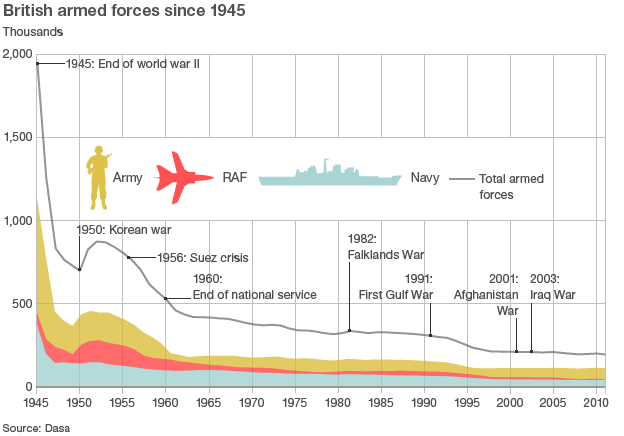
British army reduces and consolidates 17 units

Filed under: Britain, Military — Tags: , , , — Nicholas @ 09:47

As reported earlier, the British army will be losing several battalions of infantry in the consolidation effort to reduce the army’s total manpower by 20,000:

The four infantry battalions to disappear are the 2nd Battalion the Royal Regiment of Fusiliers, the 2nd Battalion the Yorkshire Regiment (Green Howards), the 3rd Battalion the Mercian Regiment and the 2nd Battalion the Royal Welsh.

A fifth infantry battalion, the 5th Battalion the Royal Regiment of Scotland (Argyll and Sutherland Highlanders), will become a single company to carry out public duties in Scotland.

The Armoured Corps will be reduced by two units with the mergers of the Queen’s Royal Lancers and the 9th/12th Royal Lancers and the 1st and 2nd Tank Regiments.

The Royal Artillery, the Royal Engineers, the Army Air Corps, the Royal Logistic Corps, the Royal Electrical and Mechanical Engineers and the Royal Military Police will also be affected.

[. . .]

Details of the other changes are:

  • The Royal Artillery will be reduced from 13 to 12 units with the withdrawal of the 39th Regiment Royal Artillery
  • The Royal Engineers will be reduced from 14 to 11 units with the withdrawal of 24 and 28 Engineer Regiments and 67 Works Group
  • The Army Air Corps will reduce from five to four units as 1 Regiment AAC merges with 9 Regiment AAC
  • The Royal Logistic Corps will be reduced from 15 to 12 units with 1 and 2 Logistic Support Regiments withdrawn from the Order of Battle and 23 Pioneer Regiment disbanded
  • The Royal Electrical and Mechanical Engineers will be reduced to seven units with the withdrawal of 101 Force Support Battalion
  • 5 Regiment Royal Military Police will be removed

Update: As you’d expect, the changes are not being welcomed by current or former soldiers.

The reforms have caused anger and frustration within senior ranks. Earlier this week, a leaked letter to General Wall from one senior officer in the Royal Fusiliers showed the anger brewing over the scale of the proposed cuts.

Brigadier David Paterson, the honorary Colonel of the Regiment of Fusiliers, said the decision to axe one of its battalions would not “best serve” the armed forces and “cannot be presented as the best or most sensible military option”.

He added: “I, as Colonel, have the duty to tell my men why it is their battalion, which at the time of the announcement will be the best manned battalion in the army, with recruits waiting in the wings, was chosen by CGS. I will then also have to explain to my Fusiliers in a fully manned battalion why they are likely to be posted to battalions that cannot recruit. This will not be an easy sell.”

What do software developers and predatory bankers have in common?

Filed under: Business, Technology — Tags: , , , , , — Nicholas @ 09:02

In his regular column at The Register, Matt Asay points out that using another company’s API can be a quick and easy way to get going, but it carries significant risks:

In tech today, it has become a truism that “if you’re not paying for it, you’re the product”. Somehow we have applied this wisdom to consumers without recognising that the same principle applies to enterprises and their developers. Recently, however, Netflix and LinkedIn have reminded us just how precarious it is to build on someone else’s platform — or API.

Paul Graham, one of the founders of Y Combinator, has described APIs as “self-serve [business development]”. It’s a great story: open and document your API and watch a thousand businesses bloom, bringing you cash and legitimacy. All of which may be true, if done correctly.

But the other side of Graham’s “business development” is the difficulty of predicting the business planning on the other side of the API. Twitter was pretty free with API access in its early days when it was seeking adoption rather than income. Now that the company has grown up and continues to tighten its grip on how and where users interact with tweets, Twitter terminated its tweet syndication partnership with LinkedIn and has promised to clamp down even more tightly on how developers use its API. Twitter is doing this because it can, as professor Joel West points out, but also because it must: its advertising business depends upon it.

So where’s the banking similarity come in?

There’s one other thing to consider, as venture capitalist Bill Davidow opines in The Atlantic, and that is the very real possibility that this API mercantilism is a sign of how the technology world is changing, and not for the better:

    At both Hewlett-Packard and Intel, where I next worked, money was important — but it wasn’t the top priority. The goal was to do the right thing and do it well. If you did that, over time, rewards followed and shareholders supported your efforts…

    Many other things have changed in the valley over the past five decades. I’ve become increasingly concerned about one thing that is seldom discussed: the valley is no longer as concerned about serving the customer, and even sees great opportunity in exploitation. We are beginning to act like the bankers who sold subprime mortgages to naïve consumers…

Or sold developers subprime APIs?

The failed state league table

Filed under: Africa, Government — Tags: , , , , , , — Nicholas @ 08:51

This is a list you never want your country (or your neighbours) to appear on: the “top ten” failed states.

For the fifth year in a row, Somalia is ranked as the most failed failed state on the planet. This ranking was made by The Fund for Peace and Foreign Policy Magazine. Over the last decade, it’s become popular for think tanks, risk management firms and intelligence agencies to compile lists of “failed states.” This is what unstable countries, prone to rebellion and civil disorder, are called these days. What they all have in common is a lack of “civil society” (rule of, and respect for, law), and lots of corruption. The two sort of go together. Somalia consistently comes in first on most of these failed state lists. This year the top ten list of failed states (from worst to less worse) was Somalia, Congo Democratic Republic, Sudan, Chad, Zimbabwe, Afghanistan, Pakistan, Guinea, Cote d’Ivoire and the Central African Republic.

Not surprisingly, the best example of a failed state has long been Somalia, and that’s largely because the concept of the “nation of Somalia” is a very recent development (the 1960s). It never caught on, which is a common feature of failed states. Same could be said for the Palestinians. Sudan is accused of being a failed state, but it isn’t in the same league with Somalia. Sudan has had central government of sorts, on and off, for thousands of years. Not so Somalia.

Another common problem in failed states is a large number of ethnic groups. This is a common curse throughout Africa, which why the majority of the worst failed states are there. Europe, and much of Asia, have managed to get past this tribalism, although that has not always resulted in a civil society. It usually takes the establishment of a functioning democracy to make that happen. This tribalism has kept most African nations from making a lot of economic or political progress. The top five failed states are all African. Somalia is also unique in that it is one of those rare African nations that is not ethnically diverse. Instead, Somalia suffers from tribal animosities and severe warlordism (basically successful gangsters who establish temporary control over an area).

Cisco “updates” consumer routers to allow tracking of internet usage, automatic bricking for terms & conditions violations

If you have a modern Cisco or LinkSys router on your home network, you may have just given up a significant amount in the last “update” the company distributed. ESR has the details:

For those of you who have missed the news, last a few days Cisco pushed a firmware update to several of its most popular routers that bricked the device unless you signed up for Cisco’s “cloud” service. To sign up, you had to agree to the following restrictions:

    When you use the Service, we may keep track of certain information related to your use of the Service, including but not limited to the status and health of your network and networked products; which apps relating to the Service you are using; which features you are using within the Service infrastructure; network traffic (e.g., megabytes per hour); internet history; how frequently you encounter errors on the Service system and other related information (“Other Information”).

So in order to continue using the hardware you bought and paid for and own, you have to agree to let Cisco snoop your browser history and monitor your traffic — a clickstream they would of course instantly turn around and sell to advertising agencies and other snoops. Those terms are so loose (“including but not limited to”) that they could legally read your email and sell that data too.

Disgusted enough yet? Wait, it gets better. The cloud terms of service also includes this gem:

    You agree not to use or permit the use of the Service: (i) to invade another’s privacy; (ii) for obscene, pornographic, or offensive purposes; (iii) to infringe another’s rights, including but not limited to any intellectual property rights; (iv) to upload, email or otherwise transmit or make available any unsolicited or unauthorized advertising, promotional materials, spam, junk mail or any other form of solicitation; (v) to transmit or otherwise make available any code or virus, or perform any activity, that could harm or interfere with any device, software, network or service (including this Service); or (vi) to violate, or encourage any conduct that would violate any applicable law or regulation or give rise to civil or criminal liability.

Translated out of lawyerese, this gives Cisco the right to brick your router if you use it to view anything Cisco considers pornography, or do anything that it might consider IP theft — like, say, bit-torrenting a movie. Or even if you send anything it considers unsolicited advertising — which doesn’t have to mean bulk spam, see “any other form of solicitation”?

The sum of these paragraphs is: “We control your digital life. We can spy on you, we can filter your traffic, we can cut off your net access unilaterally if you do anything we don’t like, and you have no recourse.”

The idea of replacing your router with one that can load and run an open source rather than proprietary system just became a lot more enticing (such things do already exist, although not for all routers).

July 4, 2012

Canada’s new Cyclone helicopters — already 4 years late — may not arrive for another 5 years

Filed under: Cancon, Military, Technology — Tags: , , , — Nicholas @ 10:32

Greg Weston reports for CBC News:

Canada’s long-promised fleet of new Sikorsky naval helicopters, already four years late and $300 million over budget, likely won’t be delivered and ready for combat for up to another five years, informed industry sources tell CBC News.

Last month, Connecticut-based Sikorsky missed its latest contract deadline to finish delivering 28 sleek, state-of-the-art Cyclone maritime helicopters to replace Canada’s aged fleet of increasingly unreliable Sea Kings, now nearing 50 years old.

In fact, delivery of the new choppers hasn’t even started.

[. . .]

As of last month, Sikorsky had only provided a couple of prototypes that have no military mission systems, and aren’t certified to fly over water or at night.

The two helicopters apparently spend most of their time on the tarmac at Shearwater Heliport at CFB Halifax as “training aids” for ground mechanics.

The machines are so incomplete the Canadian government refuses to accept them as an official delivery of anything in the contract.

What is it about helicopters in particular that makes it so difficult and so expensive for the Canadian government to acquire? Here’s the sad chronology:

  • In 1963, the CH-124 Sea King helicopter (a variant of the US Navy S-61 model) entered service with the Royal Canadian Navy.
  • In 1983, the Trudeau government started a process to replace the Sea Kings. That process never got far enough for a replacement helicopter to be ordered.
  • In 1985, the Mulroney government started a new process to find a replacement for the Sea Kings.
  • In 1992, the Mulroney government placed an order for 50 EH-101 Cormorant helicopters (for both naval and search-and-rescue operations).
  • In 1993, the Campbell government reduced the order from 50 to 43, theoretically saving $1.4B.
  • In 1993, the new Chrétien government cancelled the “Cadillac” helicopters as being far too expensive and started a new process to identify the right helicopters to buy. The government had to pay nearly $500 million in cancellation penalties.
  • In 1998, having split the plan into separate orders for naval and SAR helicopters, the government ended up buying 15 Cormorant SAR helicopters anyway — and the per-unit prices had risen in the intervening time.
  • In 2004, the Martin government placed an order with Sikorsky for 28 CH-148 Cyclone helicopters to be delivered starting in 2008 (after very carefully arranging the specifications to exclude the Cormorant from the competition).
  • Now, in 2012, we may still have another five years to wait for the delivery of the Cyclones.

Update: In the National Post, Kelly McParland tries to draw some useful conclusions from the longest-running Canadian comedy act:

If there is a solution to this farce it’s not easily identified. Canada desperately needs the helicopters and it is far too late to return once again to the drawing board. The blame is so widespread that politicians barely bother to bestir themselves to try: if Jean Chretien’s government hadn’t maliciously cancelled Brian Mulroney’s original 1992 purchase, a full decade might have been cut from the script, but there is no guarantee other mishaps wouldn’t have occurred. Ottawa’s only option now is to hound Connecticut-based Sikorsky relentlessly and mercilessly, recover every cent possible for its repeated failure to live up to its promises, and accept nothing less than full compliance with its contracted responsibilities.

The greater lesson lies in the nether world that surrounds military procurement. It’s a world where no promise can be accepted as reliable, no cost guarantee assumed to be binding, no contract treated as worth the paper it’s written on. The federal Conservatives should think long and hard on the Sea King saga as they push ever deeper into their own purchase of new fighter jets, whether the F-35 or otherwise. Prime Minister Stephen Harper would be well-advised to abandon his usual aggressive approach and tread warily. The uncertain costs, the shifting due dates, the obdurate insistence of the military mandarins on having their way, the determined stonewalling of the politicians : it has all the identifying markings of a Sea King re-make.

Update the second: On Facebook, Damian Brooks suggests that Kelly McParland is only able to see the humour because he hasn’t been close enough to the situation: “I’d be curious to know if McParland’s ever flown in one of our Sea Kings, with tranny fluid dripping down the fuselage, practicing autorotations ad nauseum (literally). I suspect not. If he had, I have a feeling he’d find the situation much more disgraceful and much less funny.” He also posted a link to this:

ACTA rejected decisively by European Parliament

Filed under: Europe, Law, Media — Tags: , , , , — Nicholas @ 09:37

Apparently even the insulated, protected European Parliament can be moved if enough people are actively against something — in this case it was the Anti-Counterfeiting Trade Agreement (ACTA). Michael Geist explains:

When ACTA was formally signed by most participants in October 2011 in Tokyo, few would have anticipated that less than a year later, the treaty would face massive public protests and abandonment by leading countries. But with tens of thousands taking to the streets in Europe earlier this year, ACTA became the poster child for secretive, one-sided IP agreements that do not reflect the views and hopes of the broader public. This morning, the European Parliament voted overwhelmingly against the agreement, effectively killing ACTA within the EU. The vote was 478 against, 39 in favour, with 165 abstentions. This is a remarkable development that was virtually unthinkable even a year ago. Much credit goes to the thousands of Europeans who spoke out against ACTA and to the Members of the European Parliament who withstood enormous political pressure to vote against the deal.

The European developments have had a ripple effect, with the recent Australian parliamentary committee recommendation to delay ACTA ratification and the mounting opposition around the world. ACTA is not yet dead — it may still eke out the necessary six ratifications in a year or two for it to take effect — but it is badly damaged and will seemingly never achieve the goals of its supporters as a model for other countries to adopt and to emerge as a new global standard for IP enforcement. That said, ACTA supporters will not take today’s decision as the final verdict. In the coming weeks and months, we can expect new efforts to revive the agreement within Europe and to find alternative means to implement its provisions. That suggests the fight will continue, but for today, it is worth celebrating how the seemingly impossible — stopping a one-sided, secretly negotiated global IP agreement — became possible.

This has been referred to as the biggest parliamentary defeat ever for a European Commission initiative. In theory, the ACTA treaty cannot be enacted into EU law without being approved by the European Parliament (although, as we’ve seen before, the EU is adept at getting around minor inconveniences like referenda and recalcitrant national governments).

British banks are “a cossetted, subsidised industry with captive consumers”

Filed under: Britain, Economics, Government — Tags: , , , — Nicholas @ 08:46

If any industry has more than its fair share of “too big to fail” wards of the state, it’s the banking sector. Allister Heath in the Telegraph:

There is a horrendous problem, certainly, and urgent reform is required. But the ailment has been fundamentally misdiagnosed: banking has become a ward of the state, a cossetted, subsidised industry with captive consumers, and it is that which has crippled it. We have been there before, in other sectors, and the medicine is always the same. This may come as a shock, but we need more capitalism in banking, not less.

Banks need to be allowed to go bust, like every other private company. It was a disgrace that taxpayers were called upon to bail out some of the City’s grandest names. This must never happen again. The reason capitalism works so well, whenever it is tried properly, is that the principle at its heart — profit and loss — is the toughest of disciplines and the best of motivators. It is more ruthless than anything regulators, however clever, could ever dream up. It allows two conflicting emotions, greed and fear, to balance one another out. Shareholders, creditors and bosses want to make money — but they know that a step too far might entail ruin.

That, at least, is how it works for much of UK Plc — but no longer in banking, where profits have been privatised and losses nationalised. It is an obscene perversion of capitalism. Forget the nonsense about “light touch” regulation: the problem is that the fear of failure ceased to exist. Market discipline was replaced by extreme laxity.

There was no longer much need for prudence, proper capital buffers or strict internal controls: the taxpayer was ready to pick up the bill if anything went wrong, while incompetent regulators signed everything off. The Labour government which introduced this mad system wasn’t deliberately seeking to subsidise risk: it merely made a terrible mistake, though with the politically useful side effect of reducing the cost of credit and increasing its availability. The real blunder was that the Financial Services Authority had no plan to cope with a bank going bust. It simply assumed failure would never happen. After all, how could it? Gordon Brown had abolished booms and busts.

US military pay has more than kept up with civilian payscales

Filed under: Economics, Government, Military — Tags: — Nicholas @ 00:07

Mike Riggs has the details:

In other words, it’s not *just* teachers, cops, firefighters, and the bulk of civil federal employees who are riding high on the hog. Tom Philpott at Military.com reports:

    As private sector salaries flattened over the last decade, military pay climbed steadily, enough so that by 2009 pay and allowances for enlisted members exceeded the pay of 90 percent of private sector workers of similar age and education level.

    That’s one of the more significant findings of the 11th Quadrennial Review of Military Compensation report released last week, given its potential to impact compensation decisions by the Department of Defense and Congress as they struggle to control military personnel costs.

Unlike previous generations, for whom military pay was almost a joke compared to civilian payroll, modern western military pay has been catching up to (or even exceeding) equivalent civilian jobs. When I joined the reserves in the mid-1970’s, the pay was actually quite good: better than minimum wage — the drawback was that the Canadian Forces’ budget was so tight that we were strictly limited to the number of paid training days. While that was a drawback for enlisted troops, it was worse for our senior NCOs and officers: they were working without pay for months at a time.

July 3, 2012

Ontario government considering “streamlining” universities, reducing from four-year to three-year degree programs

Filed under: Cancon, Education, Government — Tags: , , — Nicholas @ 12:09

I rarely find anything interesting in Heather Mallick’s Toronto Star writings, but her Sunday article on possible Ontario government changes to the university system raises some valid concerns:

The Ontario government has run a hasty educational reform plan up a flagpole and is hoping you’ll salute it. Don’t.

The discussion paper, titled “Strengthening Ontario’s Centres of Creativity, Innovation and Knowledge,” is as mystifying as the gentlewomen’s pompous, verbose porn novel Fifty Shades of Grey, which reads to me as if it were written by a small weird girl-child, or perhaps Conrad Black.

Without Star education reporter Kristin Rushowy to translate the jargon — which curses the education sector more than any other — I would not have known that basically the McGuinty government wants to cut four-year university degrees to three and “support flexible degree structures that provide new learning options made possible by advancements in technology,” which means online degrees.

[. . .]

This report heralds bad things for Ontario students.

I opposed ending Grade 13 and was proved right, universities frantically offering catch-up courses for students who couldn’t spell or add. I opposed the “30% Off Ontario Tuition Grant for students from middle-income families” that the report boasts of, because the $160,000 cut-off is far too high. I opposed turning colleges into universities because a diploma is just as valuable as a degree, but they are not interchangeable.

And I oppose cutting degrees to three years, not just because other provinces and countries won’t accept this, but because fourth year is when you come into your own intellectually. The report refers repeatedly to the unfortunately titled Bologna Declaration aimed at harmonizing EU higher education — trans. “Yurp does it so we can too” — although I note that there has been talk in Britain of “accelerated” two-year degrees, at which point I despair.

H/T to the Phantom Observer for the link, who twittered:

https://twitter.com/PhantomObserver/statuses/220178327166648321

Details of British army cuts leaked

Filed under: Britain, Military — Tags: , — Nicholas @ 09:19

The Guardian has some details on the upcoming cuts to the British army, which will include the elimination of several battalions of infantry and the merging of some armoured regiments:

The acrimony and chaos surrounding plans to cut 20,000 troops from the army have been laid bare after details of the battalions to be scrapped were leaked before a ministerial statement on Thursday.

The proposals, whose publication has been delayed by Downing Street because of their sensitivity, show historic units to be axed include the third battalion of the Yorkshire regiment and the Argyll and Sutherland Highlanders, the fifth battalion of the Royal Regiment of Scotland. One battalion will be lost from the Royal Welsh, the Mercians and the Royal Fusiliers.

[. . .]

Official letters to army commanders were sent out on Tuesday, ready for the announcement in parliament by the defence secretary, Philip Hammond. The hope had been that soldiers would hear about the cuts from senior officers, but this has been dashed by the leak in Tuesday’s Sun.

[. . .]

The army is losing a fifth of its overall strength because of budget cuts and restructuring set out in the much criticised 2010 Strategic Defence and Security Review.

A subsequent MoD re-evaluation — last year’s so-called “three-month exercise” — more than doubled the number of troops to be lost to 20,000.

[. . .]

The battalions to be saved include the Royal Scots Dragoon Guards, the Queen’s Dragoon Guards and the Royal Dragoon Guards. The Parachute Regiment’s three battalions will be spared.

Under the proposals, the Queen’s Royal Lancers will be merged with the 9th/12th Lancers, and the 1st Royal Tank Regiment with the 2nd Royal Tank Regiment.

US Army’s UCP camouflage pattern “makes soldiers more visible, not less”

Filed under: Military, Technology, USA — Tags: , , , — Nicholas @ 09:06

As I mentioned briefly last week, the US Army is abandoning their most recent camouflage patterned combat uniforms:

The United States military is abandoning its recently-adopted pixelated camouflage uniforms, according to articles this week in The Daily as well as Stars and Stripes.

The drab grey digital pattern, known as the Universal Camouflage Pattern (UCP), will be discarded after only eight years following mounting evidence that the colour scheme makes soldiers more visible, not less.

The articles pull few punches in their appraisal of the move to adopt the pattern in 2004.

“Army brass interfered in the selection process, choosing looks and politics over science,” reports Stars and Stripes, the official newspaper of the United States armed forces.

And while the Pentagon spent $5 Billion on the much-heralded uniforms, some of the earliest attempts to conceal soldiers on the battlefield were considerably less expensive.

The This is War blog has a discussion of the development of camouflage over the last century and a half.

« Newer PostsOlder Posts »

Powered by WordPress


