
Quotulatiousness

July 9, 2012

Bush vs Obama: degrees of imperialism

Filed under: Government, USA — Tags: , , , , , — Nicholas @ 09:07

Jacob Sullum responds to a Wall Street Journal editorial on whether Obama’s presidency has been more “imperial” than that of George W. Bush:

The first bogus distinction has to do with drug policy. Strassel claims “Obama disagrees with federal law, which criminalizes the use of medical marijuana.” If so, why has the Obama administration steadfastly refused to reclassify marijuana so it can legally be used as a medicine, a power it has under the Controlled Substances Act? Instead it absurdly insists that marijuana has no medical applications, cannot be used safely, and poses a bigger abuse risk than cocaine, morphine, and methamphetamine. Notwithstanding the fact that Obama opposes loosening the federal ban on marijuana, Strassel says Congress’ refusal to do so has led the president to “instruct…his Justice Department not to prosecute transgressors.” This will come as news to the hundreds of medical marijuana suppliers shut down by federal raids or threats of prosecution and forfeiture since Obama took office. By some measures (frequency of raids, for example), Obama’s crackdown on medical marijuana has been more aggressive than Bush’s, and both administrations have in practice taken essentially the same approach, going after growers and sellers rather than individual patients. That policy does not reflect tolerance or compassion so much as the feds’ customary allocation of resources: The DEA, which accounts for less than 1 percent of marijuana arrests, has never shown much interest in minor possession cases.

The second bogus distinction between Obama and Bush has to do with “auto bailouts,” one of the examples Strassel (correctly) cites to illustrate Obama’s power grabs. She seems to have forgotten that it was Bush who initiated the illegal use of money from the Troubled Asset Relief Program to rescue American car manufacturers from their own mistakes (a policy that Obama welcomed as a senator and expanded as president). That episode followed precisely the pattern that Strassel is decrying: The Bush administration unsuccessfully sought congressional approval for bailing out car companies, then did it anyway. This example also undermines Strassel’s mitigation of Bush’s abuses: She incorrectly states that “his aggressive reading of executive authority was limited to the area where presidents are at their core power — the commander-in-chief function.”
Adrian Peterson on his arrest, sort of

Filed under: Football, Law, Liberty, Quotations, USA — Tags: , , , , , — Nicholas @ 08:06

The first word directly from Adrian Peterson after his arrest in Houston this weekend:

H/T to Christopher Gates at the Daily Norseman.

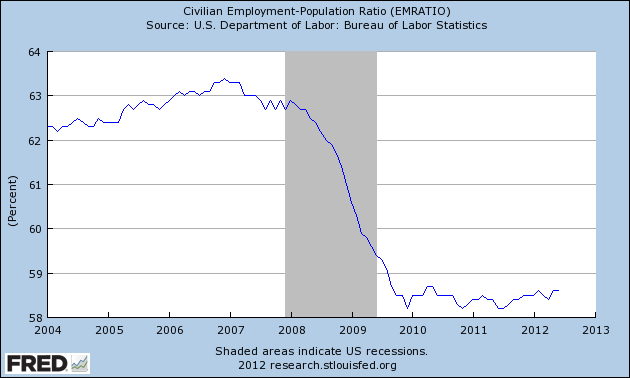
US recovery from the recession still more theory than reality

Filed under: Economics, USA — Tags: , — Nicholas @ 07:54

Greg Mankiw has a graphical refutation of any claim that the United States has actually seen any recovery from the Great Recession of 2008:

At best, you’d have to call that a “stabilization”, but not a “recovery”.

July 8, 2012

Canada beats US at football. Really. Not a joke.

Filed under: Cancon, Football, USA — Tags: — Nicholas @ 10:59

Okay, it was Under-19 football, but Canada did win:

… the U.S. team at the IFAF U-19 World Championship fell to Canada, 23-17, in the gold medal game. The American team was the defending champion in the event, and had won its first two games in the 2012 event by a combined 97-13 score.

An American team losing in a sport that theoretically only America is any good at? And to Canada? Never mind that gridiron football — the umbrella term for football played in the U.S. and Canada that encompasses both American football and the Canadian football that actually existed a few years before it — is about as much Canadian as American; do you expect most American fans to know that?

A bit of triumphalism is surely allowed, right?

https://twitter.com/DaveLozo/status/221816030463393793

Economic land mines laid by Blair and Brown’s governments exploding now

Filed under: Britain, Economics, Government — Tags: , , , , , — Nicholas @ 10:34

At The Commentator, John Phelan wonders if it’s now time for “an economic Nuremburg” for the 1997-2010 British governments of Tony Blair and Gordon Brown:

Like an iceberg, the extent of the damage wrought by the last Labour government is still becoming apparent.

One of the wheezes Labour used to camouflage its vast spending spree was the Private Finance Initiative. These had been brought in by John Major’s Conservatives (to criticism from the then Labour opposition) and involved a private sector entity building something and then selling it or leasing back to the government over a number of years, usually decades.

Upon winning the election in 1997 however, Labour performed a volte face and embraced PFIs. They appealed to Gordon Brown because the liabilities taken on under PFIs would not show up on the government’s balance sheet. In other words, they wouldn’t be included in the national debt figure.

Labour signed up to an estimated £229 billion of PFI projects. That’s almost two and a half times the entire projected budget deficit for 2012 – 2013, or 16 percent of GDP.

[. . .]

Indeed, like the cat who leaves little ‘presents’ around the house for you to discover when you return from holiday, the Labour government of 1997 to 2010 is the gift that keeps on crapping on your carpet. We will be discovering fiscal turds left by Labour for literally decades to come.

If you were being charitable you would ascribe the fiscal incontinence of the Blair/Brown governments to some sort of Keynesian economic theory, though that fails to explain why they applied fiscal ‘stimulus’ for seven years to an already growing economy.

If you were being slightly less charitable you might ascribe it to incompetence of a quite staggering degree. The last Labour government, after all, were probably the biggest set of mediocre idiots ever to govern this country.

And, if you were being even less charitable, you might ascribe it to something more sinister – Brown poisoning the wells when he heard opposition tanks at the end of his strasse.

Argentina to force domestic banks to loan money at a loss

Filed under: Americas, Economics — Tags: , — Nicholas @ 10:21

As the financial situation in Argentina gets more dire, the government is stepping in to make things even worse:

[President Cristina] Fernandez, a center-leftist, is embracing increasingly unorthodox economic policies as she seeks to sustain activity, which analysts say is vulnerable to insufficient credit.

“We’re going to tell the 20 principal banks… they have the obligation to lend for production and for investment,” Fernandez said in a televised speech.

“The central bank’s going to establish the conditions,” she said, adding that state-run banks should not have to shoulder the entire responsibility for business loans.

She said the loans would carry a maximum interest rate of the Badlar reference rate, which was 11.9pc per year for private banks in June, plus 400 basis points. The minimum loan period would be three years.

Officially, inflation in Argentina is running around 25%, so forcing banks to loan money out at half the rate of inflation seems like asking them to dig their own economic graves.

H/T to Tim Worstall for the link.

Apparently in Texas you can be arrested merely for “resisting arrest”

Filed under: Football, Law, Liberty, USA — Tags: , , , , , — Nicholas @ 09:09

In what must be the worst kind of news for Minnesota Vikings fans, star running back Adrian Peterson was arrested early Saturday morning for … resisting arrest. ProFootballTalk has the report:

A source with knowledge of the situation tells PFT that the incident culminating in Peterson’s arrest was captured by one or more surveillance cameras. Multiple persons also witnessed the event.

According to the source, Peterson, his girlfriend, and some family members were at a nightclub in Houston. At closing time, a group of police officers entered the club, and they began instructing the remaining patrons to leave.

Peterson wanted to get some water before he left, but an officer told Peterson that he needed to leave. Some words apparently were exchanged, but Peterson eventually walked to the exit with one of the club’s bouncers.

It’s believed that one of the officers then jumped on Peterson’s back from behind and tried to take him down. (Key word: “tried.”) Other officers then joined the fray and completed the arrest.

Peterson was charged with resisting arrest, which implies he was being arrested for something else. He is charged for now with no other crime.

I was under the vague impression that to be charged with “resisting arrest” you’d have to already be wanted by the police for doing something that warranted arrest. Based on the initial reports, it doesn’t sound like Peterson did anything before he was arrested to justify arresting him … unless it’s a case of a police officer deciding that he’d been disrespected. We’ll have to wait until more of the information becomes available.

Update: Contrasting with the initial report, Dan Zinski of The Viking Age says Peterson was “heavily intoxicated” at the time:

More on Adrian’s incident, and this isn’t flattering. The general manager of the club where Adrian Peterson was arrested after allegedly pushing an off-duty cop has told website TMZ that the running back was “heavily intoxicated” at the time of the incident. A police report says Peterson became belligerent after he and his companions were told the leave the bar, and ended up being subdued by three officers.

Live at Bayou Place general manager Daniel Maher says Peterson tried to order one last drink after being told to leave, and after being denied, tried to intimidate the bartender into giving him the drink anyway. It was at this point that Maher himself intervened, but Peterson refused to listen to him. The off-duty cop then broke in and was shoved by Peterson, leading to the Viking being hauled in for a misdemeanor A count of resisting arrest.

Update the second: At Viking Update, John Holler provides a bit of background (which may or may not be relevant to this particular case, but is interesting anyway):

The interesting aspect of the Peterson incident is that the only charge he was hit with was resisting arrest. He wasn’t charged with assaulting an officer. Had he actually shoved a policeman to the point that he “stumbled,” it would seem logical that charges of assaulting of an officer would also have been leveled. Therein lies the need to hear both sides of the story.

I come from a different perspective than most on this type of subject. I have been involved with “bouncer dust-ups” on the wrong side. Yet, three of my best friends are or were cops. I could accurately be accused of being “cop-friendly.” Of the numbers saved in my phone, a half-dozen of them are cops. When they’re “moonlighting,” it’s a night off for them. The odds of them getting shot as the result of a meth-addled domestic abuse call are out of the question. In those situations, they are truly “in charge.” And they like it that way.

When a bouncer (cop or otherwise) is working “his turf,” he can be aggressive. Very aggressive. As tenuous as life is in the NFL, the reality is that “hired muscle” at a nightclub can’t lose if he gets in a dust-up with a drunken patron. Whether an off-duty policeman, a local college football player or just a big guy who casts an imposing shadow, “security” at a big-time nightclub is expected to quell all problems — exceptions not allowed.

In order to do so, off-duty cops (trust me when I tell you that they’re never truly off-duty) aren’t going to take any guff from anyone. They have the experience. They have the sobriety advantage.

If the Peterson matter actually goes to court — the smart money would say that only a hard-core prosecutor would push the case — it will be destroyed by competent legal representation on Peterson’s behalf.

Britain’s “two-tier” army after the recently announced cuts

Filed under: Britain, Military — Tags: , — Nicholas @ 00:49

At the Thin Pinstriped Line, Sir Humphrey looks at some of the potential problems the reconfigured British army may face:

In summary, the Army will comprise two very distinct elements, the so-called ‘Reaction Force’ and the ‘Adaptable Force’. The Reaction Force will comprise what appears to be a slimmed down Armoured Division, built around three brigades, and augmented by 16 Air Assault Brigade (and effectively 3 Commando Brigade) plus supporting units to provide the short notice rapid response capability. The Adaptable Force is built around those units which are held at longer readiness to move, and which will provide the routine garrison, training and roulement duties. Within this structure some units will be held at different levels of readiness depending on how the security situation looks. Essential to this plan is the use of some 30,000 trained Army Reserve personnel to augment both forces, through a bolstered set of employment rules.

[. . .]

That said, there are real challenges that will need to be overcome in order to make this a success. From the outset real leadership is going to be needed to avoid the accusation and emergence of a ‘two-tier army’. It seems clear from looking at the wiring diagrams that large swathes of the Infantry and supporting units is going to be working under what was previously seen as the Regional Forces. Assuming that the Arms Plot has not been reintroduced, and that battalions will remain locked into their roles, it is going to take a lot of effort to convince people to join a unit which is posted to the ‘Adaptable Forces’. Who is going to want to join the part of the Army that is unlikely to deploy anywhere exciting, or where deployment is likely to be peace keeping, and not high intensity warfare? It will be a real blow to the morale of many soldiers if they perceive that their soldiering careers are in future going to be spent on Salisbury plain practising feeding Orphans or watching fake militias simulate slaughtering innocent civilians whilst they have to stand and watch in accordance with their UN ROE. Meanwhile their peers in the Reaction Forces will be charging around playing with the best equipment, newest kit, and better deployment prospects.

The Army manning cell at Glasgow is going to have to come up with a very good way of ensuring that those who join for a career regularly cross between the two forces. There already exists a sense of ‘them and us’ between the Regional Forces and the rest of the Army. One feels that this will only get worse over time, particularly if deployments go to units such as the Paras or Guards, which enjoy better publicity in the eye of politicians.

The danger is that the best posts get earmarked for the high flyers, and that over time the Officer Corps will emerge with the best and brightest occupying all the promotion jobs, while everyone else is left to stay in the Adaptable Forces. This could lead to a real challenge as good officers walk early, not leaving sufficient leadership across the Army as a whole.

July 7, 2012

Tim Worstall: the software patent system is FUBAR’ed

Filed under: Business, Law, Technology — Tags: , , , , , , — Nicholas @ 11:05

In Forbes, Tim Worstall explains the odd situation of Amazon trying to obtain patents to use defensively when (not if) they get sued for entering the smartphone market:

… Amazon isn’t searching out patents which would allow it to build phones to, say, the GSM or CDMA standards. For those patents, by virtue of being included in those standards, must be made available to all comers on reasonable and non-discriminatory terms (RAND, or Europeans add “Fair” to the beginning to give FRAND). So any patent that is actually necessary to make a phone that interacts with the network is already available to them on exactly the same terms that Samsung, Apple, Nokia or anyone else pays for them.

No, what Amazon is looking for is just some bundle of patents, somewhere, that have something to do with mobile telephony. So that when (and sadly, it really is when, not if) they get sued by someone or other for breaching a patent then they’ve got some great big bundle of documents that they can wave back at them. Such patents can range from the possibly valid (slide to unlock perhaps) through to two that really irk me: Apple claiming a patent on a wedge shaped notebook and, unbelievably to me, on the layout of icons on the Galaxy Tablet in Europe.

I take this to be evidence that the technology patent system has simply got out of hand: that the system is entirely Fubar in fact. We need to recall what a patent is supposed to do: it is not that intellectual property is some God given right. Rather, we realise that given that ideas and technologies are public goods it is very difficult to make money out of having invented them. Thus we artificially create intellectual property in the form of patents and trademarks. But we are always walking a narrow line between encouraging invention by awarding such rights and discouraging derivative inventions by awarding rights that are too strong.

Genuine iconoclasm in Mali

Filed under: Africa, Religion — Tags: , , , — Nicholas @ 10:57

Robert Fulford on the religious strife in Mali:

In the modern West, an iconoclast is someone who criticizes cherished beliefs. The people we call iconoclasts deal in nothing more dangerous than opinion. But in regions dominated by Islamists that term becomes painfully literal.

It means breaking icons — destroying sculpture and desecrating tombs for the purpose of religious purity. It means gangs of thugs with axes and dynamite and the need to impose their beliefs on others.

This week the world learned that iconoclasm has found a new home in the wretched African state of Mali. A landlocked, geographically misshapen nation of 14.5 million, Mali has borders with seven other countries. At the moment, Malian refugees are crossing three of those borders (Mauritania’s, Niger’s and Burkina Faso’s) to escape the results of the Islamist rebellion that overturned their national government in March.

The dominant rebels belong to Ansar Dine, which means “Defenders of the Faith.” They are Sunnis allied with al-Qaeda. They now control northern Mali and they have put the destruction of graves and monuments at the top of their agenda.

In the last week or so they have destroyed six graves of ancient Sufi saints. At a 15th-century mosque in Timbuktu they took their axes to an entrance considered sacred. According to local belief, it was expected the door would remain closed till the world ended.

This is a Muslim vs. Muslim conflict. A spokesman for Ansar Dine summarized the party line on venerating Sufi shrines: It’s un-Islamic. “What doesn’t correspond to Islam, we are going to correct.” It’s what must be done to defend the faith.

Deregulating a “natural monopoly”

Filed under: Economics, USA — Tags: , , — Nicholas @ 09:44

Arnold Kling is a Pepco customer. Pepco is one of the regulated electricity providers in Washington DC and surrounding area. He suggests that there may be a better way to deliver electricity to customers:

A recent storm in the Washington, D.C. area left many households without power for days. Customers served by one company, Pepco, appeared to suffer the worst. Pepco had the slowest rate of power restoration of all the area’s electricity suppliers.

As an economist and a Pepco customer, I am concerned by two factors that insulate Pepco from facing market discipline concerning reliability. The first is that Pepco is a regulated monopoly. The second is that there is no price indicating the benefits of reliability.

The fact that Pepco is a monopoly means that its incentive to improve its operations is limited. Regulators may cajole and threaten, but ultimately Pepco is like an employee with tenure — no matter how badly it performs, it can never be fired.

The fact that there is no market price for reliability makes matters even worse. The amount that Pepco invests in ensuring reliable provision of electricity does not have to bear any relationship whatsoever to the value that consumers place on reliability.

Update: Oops, forgot the hat-tip:

Andrew Coyne on the high school relationship that is Canada and the USA

Filed under: Cancon, USA — Tags: , , — Nicholas @ 00:05

I have to admit that I never saw the diplomatic and trade relationship between the two countries in quite this way before:

As veteran diplomats and foreign policy specialists trade blows over who is to blame for the crisis in Canada-U.S. relations — How Obama Lost Canada; How Obama Won Canada; Obama Didn’t Lose Canada; Maybe Canada Lost Obama, Ever Think of That? — thoughtful observers on both sides of the border are concerned that important nuances in the debate are being overlooked.

While managing a bilateral relationship is never easy, especially one as complex and multi-faceted as that between Canada and the U.S., sources close to the Canadian government stress that America totally did not break up with Canada, Canada broke up with it first. They point to the Obama administration’s politically motivated decision to block approval of the Keystone XL pipeline extension as an important irritant in the relationship, adding that America has been avoiding Canada in the halls for weeks.

On the other hand, long-time State Department watchers suggest Canada may have erred in focusing its diplomatic efforts too intently on the administration, in a capital in which power is increasingly dispersed, and besides Canada didn’t even look at America in the library even though they were like studying at the same table.

Seeking to downplay tensions, they note that today’s disputes pale in comparison to the controversies that have sometimes roiled relations between the two countries in the past, such as over Vietnam or that thing at the party last year after grad.

Nonetheless, it is clear that on a number of issues there is a gathering sense of grievance on the Canadian side, a feeling that Canada’s concerns are not taken seriously in official Washington. Sources in the department of Foreign Affairs, who did not want to be named because they had English Lit with America right after lunch, cited a long list of perceived slights, from the Buy America provisions in the stimulus bill to the failure to support Canada’s bid for a seat on the Security Council to the lack of recognition of Canada’s contribution to the Afghanistan mission. Would it have killed America, these sources ask, just to call?

In response, Canada has moved to more aggressively assert its interests, for example warning it might cultivate China and other export markets for its crude oil, scaling back its commitment to Afghanistan and changing its Facebook status to “it’s complicated.”

He’s talked some sense into me: no longer will I deny that the bilateral relationship between Canada and the United States should be described in terms of “a sexual chemistry you could cut with a knife”.

July 6, 2012

This week in Guild Wars 2

Filed under: Gaming — Tags: , — Nicholas @ 13:02

My weekly community round-up column at GuildMag is now online. I spent a bit of time talking about the GW2 guild system as we’ve seen it in the beta events and offering some criticism based on the current system. With my luck, about an hour after the column goes live, ArenaNet will announce a raft of changes that will make my commentary obsolete. After my bit of spleen-venting, there’s the usual assortment of blog posts, podcasts, and videos from the Guild Wars 2 fan community.

This might be damage that even the Internet can’t route around

Filed under: Law, Liberty, Media, Technology, USA — Tags: , , , — Nicholas @ 12:50

Tim Worstall on the worst-case interpretation of a recent legal decision in the US courts:

… we now have a ruling that websites are a place of public accommodation under the Americans with Disabilities Act. If this ruling holds then this really will break the internet and web as we have come to know it.

The case is discussed here.

    The case involves a Cyberlaw perennial: are websites obligated to comply with the Americans with Disabilities Act (the ADA)? In this case, the desired accommodation is close-captioning for Netflix-streamed video. If websites must comply with the ADA, all hell will break loose. Could YouTube be obligated to close-caption videos on the site? (This case seems to leave that door open.) Could every website using Flash have to redesign their sites for browsers that read the screen? I’m not creative enough to think of all the implications, but I can assure you that ADA plaintiffs’ lawyers will have a long checklist of items worth suing over. Big companies may be able to afford the compliance and litigation costs, but the entry costs for new market participants could easily reach prohibitive levels.

[. . .]

The place of publication is where the reader is, where the browser through which the site is being viewed. Thus would mean that any foreign website which an American might want to read (say, my personal blog) would become subject to the rules and restrictions of the ADA. And believe me, the 6.7 billion people who are not Americans are not going to put up with that. We might all ignore the law, or we might try and ban access from the US (or more alarmingly, ISPs might be told to do so). Or possibly be subject to the tender ministrations of an ambulance chasing lawyer.

If it’s being “rebuilt” to a different design, with different materials, it’s not the same Bluenose

Filed under: Cancon, History, Technology, Woodworking — Tags: , , — Nicholas @ 10:43

Wooden sailing ships are subject to far more wear and tear than modern vessels: they’re like the old tale of the farmer’s axe (even though everything’s been replaced over time, it’s still the same axe). This means that heritage sailing ships need lots of careful maintenance throughout their lives, and major re-builds at long intervals. In the case of Nova Scotia’s iconic Bluenose II, however, it’s sometimes more than a “rebuild”:

She is a celebrity, immortalized on the back of our dime and presently parked beneath a big white tent in the Lunenburg Shipyard, awaiting finishing touches and the order to set sail.

Built in 1963, Bluenose II was effectively scrapped in the fall of 2010. A small percentage of the old boat, including the sails and masts and some of the mahogany and walnut from the hull, were saved for use in the rebuild. The bow-to-stern reconstruction had the legend at points looking more like a whale skeleton beached on the Lunenburg wharf, with her ribs exposed for all to see.

Some purists, including Ms. Roué, a great-granddaughter of William J. Roué — the naval architect responsible for designing the original Bluenose, which launched in 1921 and achieved lasting fame by hauling in massive catches on the Grand Banks and beating American schooners in ocean races — view the “restoration” tag as a semantic stretch.

They see it as a sham concealing the fact the boat being built and expected to launch this summer under the Bluenose II banner was not built according to Mr. Roué’s original designs. It is not the Bluenose II but a new boat altogether.

You could make the case that this is merely a look-alike, rather than a replica. In fact you’d pretty much have to say that:

The original Bluenose was made from Nova Scotia oak, while its second incarnation blended local and South American oaks.

The latest edition consists of laminated angelique, a bulletproof teak from South America. Meanwhile the engine bed, stern frame, floors and fasteners holding the whole shebang together are steel, where once they were wood.

Any boat, especially a boat named Bluenose, is more than the materials it is made of or the sum of its designs. It is a piece of living history and its identity derives from the stories attached to it and in the recollections of those that sailed aboard her, some accounted for, others lost at sea.

So, just to sum up: she’s being built to a different design (even though outward appearance is much the same), using different materials. In what way can you call her the same ship? The point made in the article, that the masts and sails were some of the “originals” being re-used is odd: those are among the parts that need replacing more often. And the mahogany and walnut saved from the last boat are almost certainly decorative elements, not structural ones.

« Newer PostsOlder Posts »

Powered by WordPress


