To celebrate the cult-favorite sci-fi drama’s 10th anniversary, Science Channel is shooting a new one-hour special chronicling the Firefly cast reunion at Comic-Con this week.
The special — titled Browncoats Unite — will include footage from Friday’s reunion panel, featuring several members of the original team including star Nathan Fillion and creator Joss Whedon. Plus, the cast is shooting an in-depth behind-the-scenes roundtable interview that will dive deeper into burning fan questions about the beloved series. Both the panel and the roundtable will be moderated by Entertainment Weekly‘s own Jeff Jensen.
Comments Off on Firefly 10th anniversary TV special to air in November
Is it true that college students today are unprepared and unmotivated? That generalization does injustice to the numerous bright exceptions I saw in my 25 years of teaching composition to university freshmen. But in other cases the characterization is all too accurate.
One big problem is that so few students are readers. As an unfortunate result, they have erroneous, and sometimes hilarious, notions of how the written language represents what they hear. What emerged in their papers and emails was a sort of literary subgenre that I’ve come to think of as stream of unconsciousness.
Some of their most creative thinking was devoted to fashioning excuses for tardiness, skipping class entirely, and failure to complete assignments. One guy admitted that he had trouble getting into “the proper frame of mime” for an 8 a.m. class.
Then there were the two young men who missed class for having gotten on the wrong side of the law. They both emailed me, one to say that he had been charged with a “mister meaner,” the other with a “misdeminor.”
Comments Off on The newest literary subgenre: the stream of unconsciousness
Jacob Sullum on the recent election result as a sign of repudiation for American drug policy:
Early last year, when the death toll from Mexican President Felipe Calderon’s crackdown on the cartels stood at 35,000 or so, Michele Leonhart, head of the U.S. Drug Enforcement Administration, told reporters in Cancun “the unfortunate level of violence is a sign of success in the fight against drugs.” The results of last week’s presidential election, in which the candidate of Calderon’s National Action Party (PAN) finished a distant third, suggest Mexican voters are no longer buying that counterintuitive argument, if they ever did.
Even if “the fight against drugs” were winnable, it would be an outrageous imposition. Why should Mexicans tolerate murder and mayhem on an appalling scale (more than 50,000 deaths since Calderon launched his assault in December 2006), not to mention the rampant corruption associated with prohibition, all in the name of stopping Americans from obtaining psychoactive substances that their government has arbitrarily decreed they should not consume? That sort of arrogant expectation is becoming increasingly untenable.
Mexico’s incoming president, Enrique Pena Nieto of the Institutional Revolutionary Party (PRI), has promised continued cooperation with U.S. drug warriors. But during the campaign, he and the other two leading candidates all said controlling violence, as opposed to seizing drugs or arresting traffickers, would be their top law enforcement priority. Pena Nieto has reiterated that commitment since the election, saying his success should be measured by the homicide rate.
Comments Off on Mexicans not willing to suffer increasing death toll to support American war on drugs
So much for a honeymoon period in office for French President Francois Hollande:
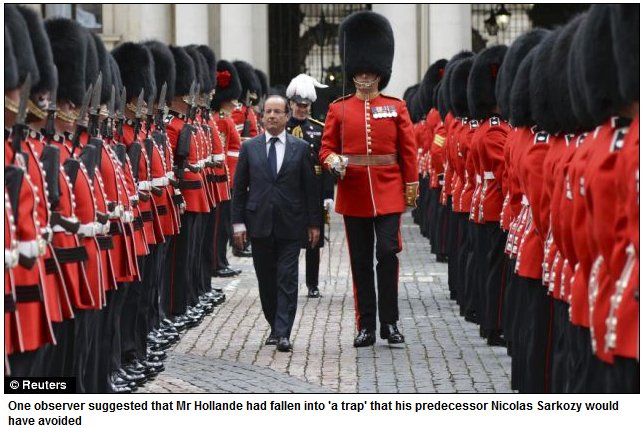
Francois Hollande was ridiculed today after allowing himself to look like a ‘dwarf’ alongside a British regiment which won battle honours at Waterloo and then occupied Paris.
During an official visit to London on Tuesday, the French President inspected a guard of honour from the 1st Battalion of the Coldstream Guards at the Foreign Office.
He then appeared in hugely embarrassing photographs alongside Major James Coleby, who looked around two feet taller than the Gallic head of state.
Comments alongside the image on a website of pictures taken by AFP, France’s national news agency, suggested Hollande had fallen into a ‘trap’ made to make him look ridiculous.
‘Poor France,’ wrote Jean-Marc Rameau, from Paris, while Dmitri Kovaley mocked Mr Hollande, who is 5ft 7ins, with the words ‘Dwarfs rule the world’.
Obama is not proposing that families making up to $250,000 a year keep their tax cuts while families making more than that don’t. He’s proposing that every family keep their tax cuts on their first $250,000 of taxable income (which is not the same as “income” or “earnings,” by the way).
That includes families with taxable income of $260,000, $1 million, $5 billion, $3 trillion, or whatever Jay-Z and Beyonce make in a year. Everyone would continue to pay a lower tax rate on their first $250,000 of taxable income under Obama’s plan. To report that Obama only wants to maintain tax cuts for families making less than $250,000 is simply false.
[. . .]
Normally, a president would want to publicize that he’s trying to cut taxes for everyone in the country. But Obama actually has an incentive this time to downplay the number of Americans who would benefit from his tax plan. His proposal is, at its heart, a political maneuver meant to force Mitt Romney to defend tax cuts for the wealthy. It’s more effective, then, for it to be seen as a cut solely for the middle class. The reality is that Obama’s proposal would also keep Warren Buffett’s taxes lower, if only a little bit.
Despite the ideological miles that separate them, activists in the Tea Party and Occupy Wall Street movements agree on one thing: both condemn the recent bailouts of wealthy and well-connected banks. To the Tea Partiers, these bailouts were an unwarranted federal intrusion into the free market; to the Occupiers, they were a taxpayer-financed gift to the wealthy executives whose malfeasance brought on the financial crisis.[1] To both, the bailouts smacked of cronyism.
The financial bailouts of 2008 were but one example in a long list of privileges that governments occasionally bestow upon particular firms or particular industries. At various times and places, these privileges have included (among other things) monopoly status, favorable regulations, subsidies, bailouts, loan guarantees, targeted tax breaks, protection from foreign competition, and noncompetitive contracts. Whatever its guise, government-granted privilege is an extraordinarily destructive force. It misdirects resources, impedes genuine economic progress, breeds corruption, and undermines the legitimacy of both the government and the private sector.
[. . .]
… regulations can be especially useful to firms if they give the appearance of being anti-business or somehow pro-consumer. Regulations are often supported by strange bedfellows. Bruce Yandle of Clemson University has studied the phenomenon extensively:
The pages of history are full of episodes best explained by a theory of regulation I call “bootleggers and Baptists.” Bootleggers … support Sunday closing laws that shut down all the local bars and liquor stores. Baptists support the same laws and lobby vigorously for them. Both parties gain, while the regulators are content because the law is easy to administer.[25]
The moralizing arguments are often front and center in regulatory policy debates, while the narrow interests that stand to benefit from certain regulations are much less conspicuous.
Comments Off on Crony Capitalism: the issue that unites the Tea Party and the Occupy movement
In History Today, Roger Moorhouse talks to Antony Beevor on his latest booK:
I asked what novelties of approach or new material he employed for the book? Did he, for instance, set out to try to draw the two traditionally distinct narratives of the war in the Pacific and the war in Europe into a single integral whole? Though he does make a nod in that direction, Beevor believes that such an approach is not really feasible, adding that the war in the Pacific was ‘almost like a war on another planet’, such was its separation from events in Europe. ‘I was fascinated,’ he went on, ‘by the reaction of the US Marines on Okinawa when they heard about the surrender of Germany. It was “Who cares?” For them it was impossible to imagine, just as it was impossible for the people fighting in the snows of Russia to imagine war in the Pacific Islands.’
If the approach is largely conventional, the book does not lack new information. Russian sources are still yielding fascinating material, he notes, despite political retrenchment, while German scholarship is throwing up new approaches and new resources, such as the archive of Feldpostbriefe (soldiers ‘field post’ letters) in Stuttgart. Beevor’s most interesting revelation, however, is the horrific contention that the Japanese army practised organised cannibalism. As he explains: ‘Allied prisoners, especially Indian army prisoners, were kept as sort of human cattle and slaughtered one by one for their meat.’ News of such crimes was largely suppressed after the war, as it was considered ‘too awful even to be mentioned in the war crimes trials’, but has since been brought to light by Japanese historians.
[. . .]
Of course the heart of Beevor’s appeal is precisely that straightforward narrative approach, coupled with his lively, engaging style and his use of memorable, almost cinematic, set-pieces. I put it to him that, in tackling a book of this scope, perhaps he had been obliged to rein in some of those literary flourishes. ‘You are right,’ he conceded. ‘There is so much more to tell and there is much less room for the vignette, but it is still terribly important, serving to root the reader in the reality of the moment.’ He is swift to acknowledge a debt to John Keegan in this regard, under whom he studied at Sandhurst and whose The Face of Battle (1976) was hugely influential. ‘It is absolutely vital to give the reader a frequent reminder of what it was actually like, the view from below, otherwise it’s just history from above, which never really works.’
Mark Steyn on the unique American perspective on taxes:
Elsewhere in the world, there are two generally accepted bases for taxation: residency and source of income. Most countries tax you if you live within their borders, some tax you if you live elsewhere but earn money within their jurisdiction, but only America claims the right to tax you simply for being American — even if you, say, live in Belgium but drive over the border to work in Luxembourg every day. This is unique to the United States: Spain taxes you if you’re a resident of Spain; Slovenia taxes you if you’re a resident of Slovenia; but America taxes you if you’re an American who’s working as a teacher in Gabon. You’re at permanent risk of double taxation, and the fines for minor and accidental infraction are arbitrary and confiscatory.
As I say, no other developed country does this — although Eritrea does.
On January 1st 2013, all this gets worse. The FATCAT act (technically, it’s FATCA, but we all get the acronymic message) makes it not worth a foreign bank’s while to do business with Americans. I don’t just mean Mitt Romney’s chums in the Cayman Islands, but an American of modest means on a two-year secondment to Hong Kong requiring a small checking account with which to pay local utility bills — or a small businessman attempting to expand his distribution in Canada.
Maybe you don’t care about these people: Why can’t the business guy expand his business in Michigan or Idaho like true-blue Americans would do, etc? But at a time when America is ever more mortgaged to foreigners, making it more difficult for Americans to go out and earn money from the rest of the planet doesn’t seem a smart move. Unless you’re planning on making U.S. citizenship a combination food-stamp card. American exceptionalism and American isolationism are not the same thing.
More to the point, the 2008 “exit tax”, the existing foreign bank-account disclosure paperwork, the new FATCAT act, and even the recent habit of publishing the names of those who renounce citizenship are simply inappropriate in a free society.
Comments Off on American exceptionalism, especially in taxation
Kathy Shaidle may have found the only known exception to Rule 34:
Since women (and not a few men) obviously love a man in uniform, where is all the porn featuring the Royal Canadian Mounted Police?
Dirty cops are an X-rated staple, and “the UPS guy” has almost driven the once-ubiquitous “mailman” out of the porn business.
Even Nazis get to go where Mounties fear to tread. Those sleek black (Hugo Boss-designed) SS getups can get under even the most surprising skins: During the Eichmann trial in Israel, “Stalag” porn became Über-popular sexual samizdat.
So this slightly put-out Canuck wonders: What’s wrong with the RCMP, eh? Their uniforms are pretty sharp, too. And Due South fandom was rabid.
Yet there’s a distinct Mountie-porn void, one that violates a law of the Internet — “Rule 34” to be exact, which declares, “If it exists, there is porn of it.”
Comments Off on Does “Rule 34” have an exception after all?
What followed Echo 1 was a space race within a space race, this one determining whether government or industry would send up the first active non-military communications satellite. In 1961, NASA awarded a contract for such a satellite to the company RCA, but Pierce and Bell Labs were undeterred. According to Calvin Tomkins, Bell Labs spent US$50-million (at early-1960s rates) for research and development and devoted about 700 of its personnel to the project.
The baby that was born of it all was a sphere weighing 170 pounds (77 kilograms), called Telstar 1. Going by specifications collected by Bill Yenne, an authority on U.S. spacecraft, Telstar 1 received signals at 6,390 megacycles, re-transmitted them at 4,170, and boasted of 600 voice channels and one channel for television.
Perched atop a Thor-Delta booster — paid for by Bell Labs but launched by NASA — Telstar 1 ascended on July 10, 1962. It did not go far, parking itself in an elliptical orbit less than 2,000 miles (3,220 kilometers) away. Within hours, Bell Labs arranged what was previously impossible — transatlantic television. As described by T.A. Heppenheimer, the ensuing video exchange humorously followed national stereotypes. The United States sent France and the U.K. taped material heavy on patriotic themes, the French responded with footage of actor Yves Montand and other cultural figures, and the British muddled about for a few days before getting things straight.
Humour aside, the achievement left the world stunned. In just the month of the launching of Telstar 1, the New York Times ran almost 100 articles related to the satellite. Joe Meek’s Telstar composition stormed the pop charts later in the year, and that 1963 New Yorker profile of Pierce ran for 29 pages. Telstar 1 did not outlast some of this acclaim, as it ceased transmission in early 1963, but it had blazed a path. Today, anyone using satellite TV or radio is honouring that decades-old triumph of engineering.
Arthur C Clarke is often credited with inventing the idea of satellite communications, though in fact his contribution was to point out that three birds in geostationary orbit could provide global coverage. Geostationary orbit is more than 35,000km up, beyond the reach of radios in 1962, so Telstar’s orbit peaked at less than 6,000km up and dipped down to less than 1,000km during its two-and-a-half-hour circumnavigation.
That dip is also what caused Telstar’s downfall. Its repeated drops into the Van Allen radiation belt did allow the satellite to gather information about the belt (which was part of the plan) but the information it gathered was largely the havoc such radiation plays with electronic circuits. If Wikipedia is to be believed then US nuclear tests at the time had left the Van Allen particularly charged, but either way the satellite failed intermittently for a few months and finally stopped relaying signals entirely in February 1963. However, it remains in orbit to this day, faithfully tracked by the US government as required by international treaties.
Telstar was solar powered, with 3,600 solar cells feeding 19 nickel-cadmium batteries which received a 6GHz signal and retransmitted it with 2.25w of power at 4GHz. The electrics necessary were all suspended by shock-absorbent nylon cords in the middle of the spherical body, which had to spin at 180 rpm for stabilisation (gyroscopes perform the same function on modern satellites, but weren’t reliable enough back then).
Iceland managed to create three massive global banks. The economy itself is tiny: Iceland has the same population as Coventry, although arguably the scenery is better. That’s really not big enough to support a lot of globally competitive export industries. Iceland had three: fish, aluminium smelting and tourism. Four if you count Björk. Can you blame them if they fancied dabbling in something a bit sexier, such as investment banking?
Investment banking is sexier than Björk?
I don’t think investment banking even manages to be sexier than aluminium smelting these days, but eight or nine years ago it must have seemed like a great gig. So these Icelandic banks borrowed loads of cash and used it to buy pretty much anything they wanted. In particular, they bought from each other at rather ebullient levels, which made for substantial profits on paper. The whole thing was a classic bubble.
And when the flow of loans dried up?
The banks crashed and there was clearly nothing the government could do to save them – they were far too big. And the party came to a grinding halt.
It doesn’t make a lot of sense.
No. It’s hard to understand why anyone wanted to lend them the money, and just as hard to understand why they thought they could instantly learn the craft of global investment banking.
Comments Off on Tim Harford on Iceland’s economic recovery
Lewis Page explains why being too thin is a bad idea health-wise:
Yet another study has shown that the so-called “obesity” epidemic sweeping the wealthy nations of the world has been massively over-hyped, as new results show that is is far more dangerous to be assessed as “underweight” than it is to be assessed even as “severely obese” — let alone merely “obese” or “overweight”.
“There is currently a widespread belief that any degree of overweight or obesity increases the risk of death, however our findings suggest this may not be the case,” says health prof Anthony Jerant, lead author of the study. “In the six-year timeframe of our evaluation, we found that only severe obesity was associated with an increased risk of death.”
Most statistics in this field are still based on the now widely discredited Body Mass Index (BMI) system, under which people are assessed as “underweight”, “normal”, “overweight”, “obese” or “severely obese”. BMI, devised in the early 19th century by an obscure Belgian sociologist without medical qualifications, copes poorly with increases in height as it assumes the human body will scale up in mass in proportion to the square of height — which doesn’t allow for the fact that bodies are three dimensional — and further fails to allow for the greater cross-sectional area needed in supporting structures to carry increasing weights.
A lot of people look at these modern marvels and see automated soulless flying death-dealers that spy on all our private lives. You can trust me when I say, those people are communists.
Winslow Wheeler on the near-doubling of the F-35 price (so far):
On June 14 — Flag Day, of all days — the Government Accountability Office released a new oversight report on the F-35: Joint Strike Fighter: DOD Actions Needed to Further Enhance Restructuring and Address Affordability Risks. As usual, it contained some important information on growing costs and other problems. Also as usual, the press covered the new report, albeit a bit sparsely.
Fresh bad news on the F-35 has apparently become so routine that the fundamental problems in the program are plowed right over. One gets the impression, especially from GAO’s own title to its report, that we should expect the bad news, make some minor adjustments, and then move on. But a deeper dive into the report offers more profound, and disturbing, bottom line.
Notorious for burying its more important findings in the body of a report — I know; I worked there for nearly a decade — GAO understates its own results on acquisition cost growth in its one-page summary, which — sadly — is probably what most read to get what they think is the bottom line.
[. . .]
Set in 2001, the total acquisition cost of the F-35 was to be $233.0 billion. Compare that to the current estimate of $395.7 billion: cost growth has been $162.7 billion, or 70%: a lot more than what GAO stated in its summary.
However, the original $233 billion was supposed to buy 2,866 aircraft, not the 2,457 currently planned: making it $162 billion, or 70%, more for 409, or 14%, fewer aircraft. Adjusting for the shrinkage in the fleet, I calculate the cost growth for a fleet of 2,457 aircraft to be $190.8 billion, or 93%.
The cost of the program has almost doubled over the original baseline; it is not an increase of 42%.
Tim Harford’s weekend column on the state of Britain’s housing market and a possible solution to the disconnect between supply and demand:
The chief obstacle to house building in the UK is the planning system, which, 65 years ago, did away with the idea that if you owned land, you could build on it, and replaced it with a system where planning permission was required. Permission to build houses is severely rationed, and such rationing can be seen clearly in the gap between the value of agricultural land without planning permission (a few thousand pounds a hectare) and the value of such land once permission has been granted (a few million).
The difficulty is that local authorities have the ability to grant planning permission but have little incentive to do so, because it tends to be unpopular with existing voters. The huge windfall from winning planning permission falls to whoever has managed to speculate on land and navigate the tangle of planning rules. These serve as nice barriers to entry for existing developers, while driving up the price of building land and so driving down the size of new homes.
Tim Leunig, chief economist at CentreForum, a think-tank, has proposed a two-part system of land auctions to get around this problem. Local authorities would buy land at auction, grant planning permission on it and then sell the land on to developers — with some strings attached, if they so choose. The profits would be enormous, and enjoyed by existing residents in the form of lower taxes or better public services. This isn’t the only way to liberalise planning, but it retains local control and democratic accountability — while dramatically increasing the incentive to develop.
Restoring a free market right to build on property you own would also be a fast solution to the diminished housing supply, but when have governments at any level willingly given up power?
Comments Off on The constipated British housing market