
Quotulatiousness

July 3, 2012

“The longer the euro area’s debt crisis drags on, the more it resembles an instrument of economic torture”

Filed under: Economics, Europe — Tags: , , , , , — Nicholas @ 08:47

The Economist on the long-drawn-out European financial mess:

THE longer the euro area’s debt crisis drags on, the more it resembles an instrument of economic torture. Like the medieval rack, every turn of the crisis tears Europe further apart. This week Cyprus announced it would seek a bail-out. Spain formally asked for money to recapitalise its banks. The Greek limb is close to being ripped off. How long can the Italian one hold?

Monetary union was meant to be a blessing. The euro’s founders dreamed that it would end chronic and divisive currency crises, promote growth and multiply Europe’s economic power. After the creation of the single market, the euro was the next step toward political union.

[. . .]

Now, after first blaming speculators, then profligate states, then, more broadly Europe’s lack of competitiveness, the cardinals of monetary union have belatedly come to understand that the main problem is the euro itself. A new report by a group of prominent economists — sponsored by Jacques Delors, the former president of the European Commission, and Helmut Schmidt, the former German chancellor — describes in telling detail how the euro is destroying itself.

Start with the European Central Bank’s “one size fits all” interest rate, which the report’s leading author, Henrik Enderlein of the Hertie School of Governance in Berlin, relabels a “one size fits none” rate. Differences in inflation are magnified: in countries with higher-than-average inflation (eg, Italy), the real interest is too low, fuelling more inflation; the opposite is true in countries where inflation is low (eg, Germany). Another problem is that the single market is far from complete, so that competition does not even out price differences across the EU. The market in services, which represents the biggest share of economic output, is still fragmented. Moreover, European workers are less likely to move in search of jobs than, say, American ones. A further curse is that countries of the euro zone do not independently control their own money. Because each lacks its own central bank to act as a lender of last resort, troubled countries can more easily be pushed into default as markets panic. Lastly, cross-border financial integration has spread far enough to channel contagion from one country to another, but not so far as to break the cycle of weak banks and weak sovereigns bringing each other down.

Bad news (for panicmongers, anyway)

Filed under: Economics, Environment — Tags: , , , , — Nicholas @ 08:32

In the Guardian, George Monbiot (known to his detractors as “The Great Moonbat”) admits the terrible truth. He was wrong, again:

The facts have changed, now we must change too. For the past 10 years an unlikely coalition of geologists, oil drillers, bankers, military strategists and environmentalists has been warning that peak oil — the decline of global supplies — is just around the corner. We had some strong reasons for doing so: production had slowed, the price had risen sharply, depletion was widespread and appeared to be escalating. The first of the great resource crunches seemed about to strike.

Among environmentalists it was never clear, even to ourselves, whether or not we wanted it to happen. It had the potential both to shock the world into economic transformation, averting future catastrophes, and to generate catastrophes of its own, including a shift into even more damaging technologies, such as biofuels and petrol made from coal. Even so, peak oil was a powerful lever. Governments, businesses and voters who seemed impervious to the moral case for cutting the use of fossil fuels might, we hoped, respond to the economic case.

[. . .]

Peak oil hasn’t happened, and it’s unlikely to happen for a very long time.

A report by the oil executive Leonardo Maugeri, published by Harvard University, provides compelling evidence that a new oil boom has begun. The constraints on oil supply over the past 10 years appear to have had more to do with money than geology. The low prices before 2003 had discouraged investors from developing difficult fields. The high prices of the past few years have changed that.

July 2, 2012

Alex Tabarrok on the slow rail and infrastructure bottleneck

Writing at Marginal Revolution, Alex Tabarrok wonders “Why haven’t the $500 bills been picked up?”:

High speed rail, especially California’s project, looks to me to be monorail economics, a costly boondoggle whose appeal lies not in rational calculation […] but in the desire of some politicians (and voters) to feel visionary and sexy. In theory, CA HSR might work but the inevitable reviews, delays, lawsuits and special interest payoffs make the prospects of a beneficial project look dim, demosclerosis kills.

Slow speed rail, however, i.e. freight transport, isn’t sexy but Warren Buffett is investing in rail and maybe we should as well. In particular, there are basic infrastructure projects with potentially high payoffs. Congestion in Chicago, for example, is so bad that freight passing through Chicago often slows down to less than the pace of an electric wheel chair. Improvements are sometimes as simple as replacing 19th century technology with 20th century (not even 21st century!) technology. Even today, for example:

    …engineers at some points have to get out of their cabins, walk the length of the train back to the switch — a mile or more — operate the switch, and then trudge back to their place at the head of the train before setting out again.

In a useful article Phillip Longman points out that there are choke points on the Eastern Seaboard which severely reduce the potential for rail:

    …railroads can capture only 2 percent of the container traffic traveling up and down the eastern seaboard because of obscure choke points, such as the Howard Street Tunnel in downtown Baltimore. The tunnel is too small to allow double-stack container trains through, and so antiquated it’s been listed on the National Register of Historic Places since 1973. When it shut down in 2001 due to a fire, trains had to divert as far as Cincinnati to get around it. Owner CSX has big plans for capturing more truck traffic from I-95, and for creating room for more passenger trains as well, but can’t do any of this until it finds the financing to fix or bypass this tunnel and make other infrastructure improvements down the line.

Hoist a craft-brewed beer to thank Jimmy Carter for saving America’s brewing tradition

Filed under: Business, Government, History, USA — Tags: , , , , — Nicholas @ 10:35

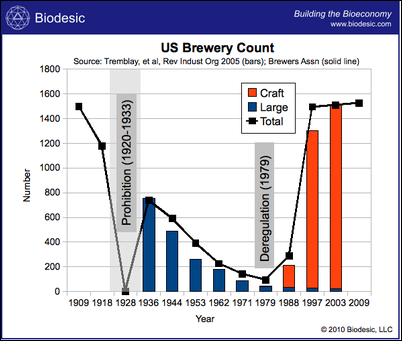
Jimmy Carter will have to go a long time before his reputation recovers from his four years in office, but along with beginning to deregulate the air travel, freight railroad, and trucking industries, he also deserves credit for triggering the revival of the American craft brewing tradition. This is from an article in The New Republic, published in 2010:

If you’re a fan of craft beer and microbreweries as opposed to say Bud Light or Coors, you should say a little thank you to Jimmy Carter. Carter could very well be the hero of International Beer Day.

To make a long story short, prohibition led to the dismantling of many small breweries around the nation. When prohibition was lifted, government tightly regulated the market, and small scale producers were essentially shut out of the beer market altogether. Regulations imposed at the time greatly benefited the large beer makers. In 1979, Carter deregulated the beer industry, opening back up to craft brewers. As the chart below illustrates, this had a really amazing effect on the beer industry:

H/T to The Whited Sepulchre for the link.

What value do speculators offer?

Filed under: Economics, Food, Liberty, Media — Tags: , , , — Nicholas @ 10:17

In most newspapers, you don’t need to wait long to read some journalist beating up on evil speculators for the “damage” they do and the claimed “uselessness” of their activities. Tim Worstall points out that speculators are actually essential to smooth operation of free markets:

What is it that the speculator in food manages to achieve? They move prices through time. At the moment, there’s a drought, and so we think there will be less corn available for consumption next year, so its price goes up.

What would we like to happen? Should prices stay stable? We would all carry on using the amount of corn that we originally thought we’d get. And we’d run out — there may even be a famine. People tend to die in famines.

So what we’d actually like to happen is for people to prepare by consuming a bit less corn this year.

Some of this should come from substitution: farmers will feed wheat to animals not corn. Consumers might move from grits to weetabix for breakfast. Perhaps the fools putting corn into cars will move over to sugar cane to make ethanol from.

We would also like a supply effect: those who are currently growing corn might add a bit more fertiliser, take more care in harvesting, make sure less gets spoiled or lost in transport.

Rising prices causes both of those pretty neatly. Put up the price and people will use less, while suppliers will make more. And what is it that the speculators on the futures markets have done in response to this report of drought? They have raised prices.

Here’s what to expect to pay in Obamacare penalty tax

Filed under: Government, Health, USA — Tags: , , , — Nicholas @ 10:10

There are no easy answers in figuring out in advance exactly what taxes will apply to any given person, but Henry Blodget at Business Insider outlines what to expect in general terms:

  • The penalty/tax will be phased in from 2014 to 2016.
  • The minimum penalty/tax in 2016 will be $695 per person and up to 3-times that per family. After 2016, these amounts will increase at the rate of inflation.
  • The minimum penalty/tax per person will start at $95 in 2014 (and then increase through 2016)
  • No family will ever pay more than 3X the per-person penalty, regardless of how many people are in the family.
  • The $695 per-person penalty is only for those who make between $9,500 and ~$37,000 per year. If you make less than ~$9.500, you’re exempt. If you make more than ~$37,000, your penalty is calculated by the following formula…
  • The penalty is 2.5% of any household income above the level at which you are required to file a tax return. That level is currently $9,500 per person and $19,000 per couple. The penalty on any income above that is 2.5%. So the penalty can get expensive quickly if you make a lot of money.
  • However, the penalty can never be more than the cost of a “Bronze” heath insurance plan purchased through one of the state “exchanges” that will be created as part of Obamacare. The CBO estimates that these policies will cost $4,500-$5,000 per person and $12,000-$12,500 per family in 2016, with the costs rising thereafter.

Update: In spite of all the agonized wailing from the Republicans (especially the Tea Party folks), Steve Chapman is determined to find the limited government silver lining in the Obamacare decision:

While it was upholding the mandate, the court was striking down an equally important part of the law: the requirement that states greatly expand Medicaid coverage, at a cost of about $1 trillion between 2014 and 2022. The administration sought to force states to go along by threatening to take away all their Medicaid funds — not just those provided for the expansion. But Roberts and Co. said no.

Does it matter? You bet. It’s the first time the court has ever said Washington went too far in the conditions it places on money sent to state governments. The ruling will give states more latitude to make their own decisions in all sorts of areas.

The case also registered a victory for the notion that judges should apply the Constitution in an impartial way rather than simply impose their policy preferences. George Washington University law professor Orin Kerr, writing on the conservative-libertarian blog The Volokh Conspiracy, said the overall decision was “a largely conservative opinion that just happens to get to a liberal result.”

Equally significant is that it took a worse health care option off the table. The irony of the challenge is that if Obamacare had been struck down, supporters of universal health coverage would have been left with no good option but a “single-payer” system, also known as “Medicare for all” — which is undoubtedly constitutional.

Whatever the flaws of Obamacare, it at least builds on the existing system of private insurance. Vermont’s self-proclaimed socialist senator, Bernie Sanders, used the court’s decision to renew his call for a single-payer system. But for him, the verdict was the worst thing that could have happened.

For anyone even slightly open to evidence, letting Obamacare take effect will provide an illuminating experiment in how to afford the miracles of the American medical system to more people, including many in dire need. It may be a failure, or it may be a success. But it will not be uninformative.

Meet the new boss … of Mexico

Filed under: Americas, Government, Politics — Tags: , — Nicholas @ 09:47

After more than a decade in opposition, Mexico’s equivalent of the Natural Governing Party* has returned to power:

Mexico’s old rulers claimed victory in a presidential election on Sunday, ending 12 years in opposition after a campaign dominated by a sputtering economy and rampant drug violence.

After pledging to restore order and ramp up economic growth, Enrique Pena Nieto of the Institutional Revolutionary Party (PRI) had a clear lead over his rivals in exit polls and a “quick count” conducted by electoral authorities.

Although his main rival said it was too early to concede defeat, the 45-year-old Pena Nieto delivered a late-night victory speech to cheering supporters, and a senior electoral official said the PRI candidate’s lead was “irreversible”.

“Mexicans have given our party another chance. We are going to honor it with results,” a visibly moved Pena Nieto told followers packed inside the PRI headquarters in Mexico City.

* For non-Canadians, the joke about the “Natural Governing Party” is that the Liberal Party of Canada had been effectively the permanent government in Canada for most of the 20th century, with only a few isolated interruptions by the Progressive Conservatives (aka the Forward-Backward party).

Update: The Economist has more:

The return of the PRI is not welcomed by everyone. The party ran Mexico for seven uninterrupted decades until it was ousted from the presidency in 2000. Back then few expected that the “perfect dictatorship”, as the PRI regime was dubbed by the Peruvian novelist Mario Vargas Llosa, would return to power just 12 years later. But the television-friendly Mr Peña ran a professional campaign and faced weak opposition from the fiery Mr López Obrador and from Ms Vázquez, whose poor result is in part a verdict on Mr Calderón’s disappointing six-year term in office.

Many have predicted that a close result would lead to a challenge by Mr López Obrador, who lost the 2006 election by less than 1% and mounted a months-long blockade of Mexico City’s main thoroughfare to protest that result, which he claimed (with thin evidence) was fraudulent. This year’s race looks to be nothing like as close as that of 2006. But if Monday’s final results show a narrower gap, Mr López Obrador’s committed followers could yet take to the streets again.

Election day provided some ammunition for a challenge, with evidence of cheating by some parties and cock-ups by the electoral authorities—though the scale of both was unclear. There were reports of voters in poor areas being offered upwards of 500 pesos ($38) to hand over their voting cards, which prevented them from casting their votes and perhaps enabled someone else to cast them instead. The PRI featured most often in such reports. A ban on political advertising after the end of the campaign on Wednesday was flouted by the Green Party, a formal ally of the PRI. The Greens illegally sent text-messages and recorded phone calls to many people (including your correspondent) on the day of the election, urging them to vote for their candidates.

July 1, 2012

“Canada was born in debt”

Filed under: Cancon, Economics, Government, History, Railways — Tags: , , — Nicholas @ 11:08

At the Worthwhile Canadian Initiative blog, Livio Di Matteo explains one of the less mentioned but urgent reasons behind confederation in 1867:

The trials and tribulations of the European Union, its debt crisis and the Euro and the suggestion that part of the solution lies in a stronger fiscal union reminds me of the forces behind the drive for Canadian confederation in the mid-nineteenth century. Canadians are usually taught in school that major forces driving Confederation were the potential threat of territorial aggrandizement by the United States in the wake of the Civil War or the need for a larger market given Britain’s move to free trade and the end of Reciprocity with the Americans or the desire to generate the economic resources to build a railway to the west so that it could serve as an investment frontier.

One factor that receives very little mention is the fact that the prior to 1867 the colonies of British North America were heavily in debt and faced a fiscal crisis of their own. The solution to the colonial debt crisis that Confederation allowed was the creation of the federal government that was given strong revenue raising powers and assumed provincial debts and thereby stabilized the public credit. Public debt charges in 1867 already accounted for 29 percent of federal budgetary expenditure and by 1880 had only been whittled down to about 24 percent. Canada was born in debt.

Canada was created with a large debt as the provincial and local levels of government had invested heavily in transportation infrastructure — canals and railways in particular. In 1850, there were only about 66 miles of track in operation but by 1860 about 2000 miles of track had been built in eastern Canada. The total cost of building these railways in British North America up to 1867 was 145.8 million dollars the bulk of which was for the Province of Canada — Ontario and Quebec. By way of comparison, Canada’s GDP in 1870 has been estimated at about 383 million dollars.

[. . .]

Confederation was designed to fix a massive debt problem. Creation of a new political entity — the dominion government — would allow for the current debt burden to be serviced and for more credit to be obtained on foreign markets to fund the railway projects of the late 19th century — the CPR, Canadian Northern, etc… Confederation was a solution to the debt crisis but required a form of government that reduced sovereignty for the member units in order to stabilize the public credit. In the Canadian case, as acrimonious as the discussions were, the process was facilitated by the fact that the member units were all British colonies with similar institutions.

Reason.tv: 3 Big Takeaways From Obamacare Decision

Filed under: Government, Health, Law, USA — Tags: , , , , — Nicholas @ 10:59

Here are the three most important things you need to know in the wake of the Supeme Court’s decision on The Affordable Care Act, a.k.a. Obamacare:

1. Government is still unlimited.
2. Mitt Romney is still lame.
3. Health care costs will still soar.

For more details, go to http://reason.com/blog/2012/06/29/3-essential-takeaways-from-the-obamacare

H.L. Mencken’s New Dictionary turns 70

Filed under: Books, History, Humour, Media, Quotations, USA — Tags: , , , , — Nicholas @ 10:52

Terry Teachout celebrates the 70th anniversary of the original publication of H.L. Mencken’s New Dictionary of Quotations on Historical Principles From Ancient and Modern Sources:

The “New Dictionary” was a byproduct of its prolific editor’s fanatically industrious journalistic career. For years Mencken maintained a card file of quotations “that, for one reason or another, interested me and seemed worth remembering, but that, also for one reason or another, were not in the existing quotation-books.” In 1932 he decided to turn it into a book. When the “New Dictionary” finally saw print a decade later, Time praised it as “one of the rare books that deserve the well-worn phrase ‘Here at last.'”

Painstakingly organized and cross-referenced by subject, with each entry arranged in chronological order by date of original publication, the “New Dictionary” is formidably wide-ranging. Indeed, the only major writer missing from its index is Mencken himself. (“I thought it would be unseemly to quote myself,” he told a curious reporter. “I leave that to the intelligence of posterity.”) Its 1,347 pages abound with such innocent-sounding rubrics as “Civilization,” “Flag, American,” “Hell,” “Hypocrisy,” “Old and New” and “Science and Religion.” At first glance you might mistake it for a cornucopia of the world’s wisdom—but don’t let appearances fool you. The fathomlessly cynical Mencken wisely warned his readers in the preface that the “New Dictionary” was aimed at “readers whose general tastes and ideas approximate my own…. The Congressman hunting for platitudes to embellish his eulogy upon a fallen colleague will find relatively little to his purpose.”

He wasn’t kidding. Look up “Evolution,” for example, and you’ll find this 1925 statement by the Bible-thumping evangelist Billy Sunday: “If a minister believes and teaches evolution, he is a stinking skunk, a hypocrite, and a liar.” Look up “Critic” and you’ll be confronted with a rich catalog of ripe insults, among them this passage from Samuel Coleridge’s “Modern Critics”: “All enmity, all envy, they disclaim, / Disinterested thieves of our good name: / Cool, sober murderers of their neighbor’s fame.” Or check out “Irish,” under which can be found no less than a page of invidious comments, including a sideswipe from, of all people, Gerard Manley Hopkins: “The ambition of the Irish is to say a thing as everybody says it, only louder.”

Teachout is the author of a brilliant biography of Mencken: The Sceptic: A Life of H.L. Mencken, which I happen to be re-reading at the moment. For more on Mencken himself, the wikipedia entry is here.

“… except in Canada”

The National Post editorial board celebrates Canada Day by making a case for Canadian exceptionalism:

The acronym “EIC” can refer to a newspaper’s editor-in-chief, the various forms of the storied East India Company, the Engineering Institute of Canada, and, in scientific circles, Electromagnetically-induced chirality. But in these odd times, they might also be deployed, for verbal economy, to denote “except in Canada.”

As in: Banks all over the Western world have suffered a series of shocks since the 2008 financial crisis – EIC. Economies have slowed — EIC. Real estate bubbles have popped — EIC. Deficits have ballooned to crisis proportions — EIC.

OK: Perhaps national pride leads us to exaggeration. A more truthful acronym might be EICAG — to include Canada “and Germany.” Various smaller European nations, as well as countries in Asia and Latin America, also have fared well. Yet it is hard to remember a time (if ever there was one) when Canada’s fortunes, taken as a whole, were so rosy compared to those of all other Western nations. This good fortune is something worth celebrating as we prepare to celebrate Canada’s 145th birthday this weekend.

They even have some praise to lavish on two former prime ministers who don’t normally get a kind word from the right:

Canada’s relative lack of red ink also is no accident. Two decades ago, Canada was what Greece was today: a bloated welfare state running up massive bills that it couldn’t pay. The unpopular job of fixing the balance sheet feel primarily to Jean Chrétien and Paul Martin — and they accomplished the task without any of the political chaos that has been gripping Athens and other southern European capitals in the last year. The prosperity and stability we enjoy today is in large part due to what those two men did with the fiscal mess bequeathed to them by Brian Mulroney and Pierre Trudeau.

Of course, not everything is going wonderfully well in the Dominion: we still have not emulated one of the notable successes of our European friends:

One of the few institutional factors holding Canada back is its healthcare system. As Shaun Francis writes elsewhere on these pages, our refusal to explicitly permit full-blown private alternatives to the current government-payer health monopoly is bad policy that is out of keeping with that of leading European jurisdictions.

Fortunately, this is a shortfall that can be cured easily. As the furor over Obamacare in the United States shows, building a universal public health system is difficult. But Canada has already done this heavy lifting over the last 50 years: All we lack now is a parallel private track — and that is something that will spring into being without any governmental action at all, save the legislative stroke of a pen needed to modify the Canada Health Act accordingly.

The Royal Navy’s successful privatization effort

Filed under: Britain, Business, Economics, Military — Tags: , , — Nicholas @ 00:04

Even the most dogmatic libertarian would be hard-pressed to defend the notion of privatizing the fighting navy, but the rest of the navy (training, support, maintenance, etc.) can in some instances be privatized not only without impacting military efficiency, but actually boosting it:

The Royal Maritime Auxiliary Service (RMAS) was privatised and taken over by Serco back in the 1990s and run for profit. To this day, Serco Denholm are responsible for the provision of all manner of auxiliary services, ranging from tugs and tender transfers, through to torpedo recovery craft, exercise minelayers and range target vessels.

All in all, there are easily over 100 vessels which can be found primarily in naval bases, but also in other establishments such as the Kyle of Lochalsh, around the UK. This fleet of vessels is an important reason to be positive for two reasons. Firstly, many navies rely on their own personnel to man and operate these vessels. When they need replacing, these costs are funded from naval budgets, and not from a wider contract fund. Similarly, the manpower needed to operate them comes from the Navy, and not from the private sector, meaning more sailors are needed to do this sort of job, and not go to sea on a ‘proper’ military vessel. By contracting out the service, the RN is able to focus its resources and manpower on proper military vessels, and not have to worry about finding funds to replace elderly tugs, at a time when it wants to bring frigates into service. It is not remotely glamorous, but it is an essential part of operating a Navy, and one that is often forgotten.

Also forgotten is just how new this fleet is — there has been a huge amount of investment in the port services fleet in recent years, with literally dozens of craft (Humphrey read something saying over 80 new vessels were being ordered) being built and entering service. The RN has managed to acquire the services of one of the most modern and effective port support vessels fleets in the world. This would not have happened if the RN were still looking after the RMAS — instead, by privatising it, the funding instead has brought new ships and better capabilities into service, at a reduced cost to the taxpayer. This matters because without it, the RN would be reliant on ever older ships, or finding scarce equipment programme funds to pay for them. (For those interested in the ships in service now, try this link — http://www.rfanostalgia.org/gallery3/index.php/RMAS)

« Newer Posts

Powered by WordPress

