
After the Canadian government started subsidizing most of the TV and radio stations along with the newspapers and magazines, it helped me to understand how the concentration of messaging had been key to maintaining and reinforcing Hitler’s grip on power in Germany in the 1930s. Before that time, there were still independent and opposed viewpoints available to ordinary Germans, but after Hitler became Chancellor, most of them were shut down or taken over by the Nazis. The message delivered to Germans from that point on was closely directed by the propaganda ministry under Goebbels, and it was very effective in harnessing German public opinion. Modern communication channels that we enjoy today would not be as easily controlled as the printing presses and radio towers of Hitler’s day … but we’ll see in real time how much various governments are willing to try to extend their control to the internet.
On Substack, Katja Hoyer looks at how the carefully curated images of the Nazi propaganda machine still worked to shape opinions long after the Reich was defeated, as western media kept re-using Nazi images to illustrate stories about that regime:
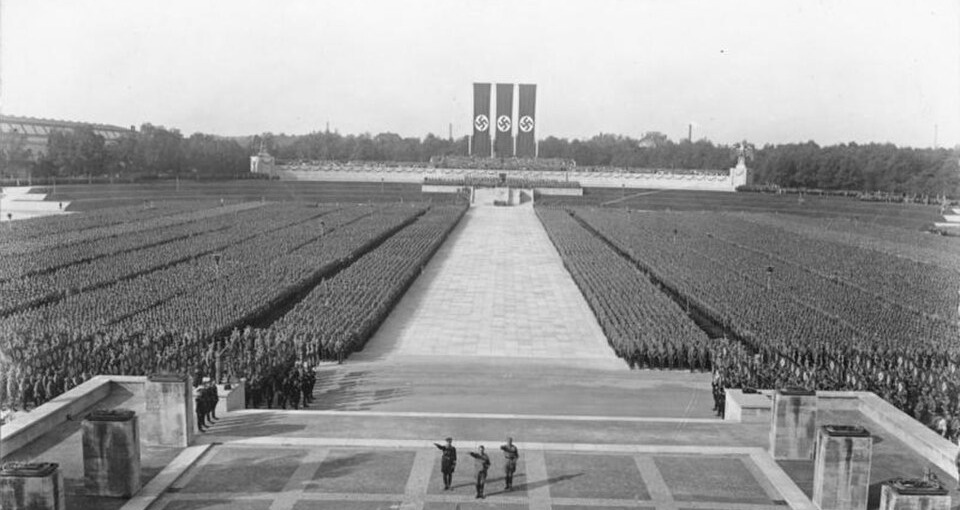
Image taken at the 1934 Nuremberg Rally. Img: Bundesarchiv, Bild 102-16196 / CC-BY-SA 3.0
The result was that many of us grew up with an image of the Nazi era not a million miles away from the one the regime itself had wanted to project. Long columns of soldiers marching in rigid formation. Perfect young boys and girls in uniforms, ecstatically following their Führer into his future. Order. Discipline. Design.
The reality of the Nazi regime was of course very different. So by looking at the Nazi regime through its own lens, are we perpetuating its propaganda?
That’s the question the American art historian Madeleine Johnson asks in her book At Hitler’s Picnic: Discovering the 1934 Nuremberg Rally. She has kindly agreed to give us here at ZEITGEIST a taster of her work and some of the very different images she has found.
Have you ever noticed how you can almost bet which photos will accompany any book or video about Nazi Germany? You can almost guarantee there will be sepia images of armed SA men on trucks, footage from Leni Riefenstahl’s Triumph of the Will, clips from Eva Braun’s home movies or newsreels of the Wehrmacht in combat.
I had never really thought about this until 112 old glass slides turned up when we cleared out my childhood home. As I eventually learned, my uncle, a U.S. G.I., had found them scattered on the floor of a local Nazi headquarters in March 1945 and sent them home as a souvenir.
When I first saw them, it took a moment to recognise that these slides of portly men and their families snacking in the stands, children in mini Nazi uniforms and litter in the famous Luitpold Arena were taken at the 1934 Nuremberg rally. They were completely unlike the perfectly aligned ranks of the SS and SA and glowing Hitler youth familiar from Heinrich Hoffmann’s photos and Riefenstahl’s film.
Image from Madeleine Johnson’s collection
The contrast between these amateur snapshots and the images we “know” got me thinking about how and why such a predictable, and limited, group of images still dominate the narrative of Nazi Germany today.
Some of the reasons we keep seeing the same photographs are structural. It may have been the country of Leitz and Zeiss, but cameras were expensive and not widely owned in 1930s Germany. The regime limited photography too. Only three official photographers were permitted to take photos at rally venues. Those combat films would have required propaganda ministry permission. Heinrich Hoffmann had the exclusive on Hitler photos, and he and Eva Braun were the only ones with access to Hitler’s private life.
There is the survival factor. Personal photos that weren’t destroyed by war may not have survived de-Nazification or family shame. Another reason for the constant employment of the same images is that they are familiar. They are a kind of shorthand that does not need explaining. They offend no one, and their authenticity is not in doubt (except for that famous one of Hitler in the 1914 crowd, probably made by Hoffmann’s studio).
Image from Madeleine Johnson’s collection

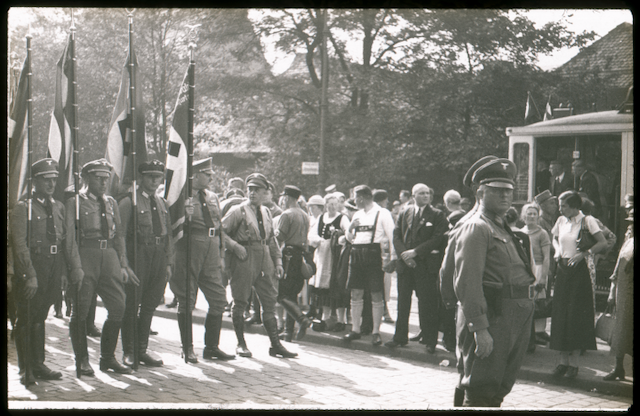
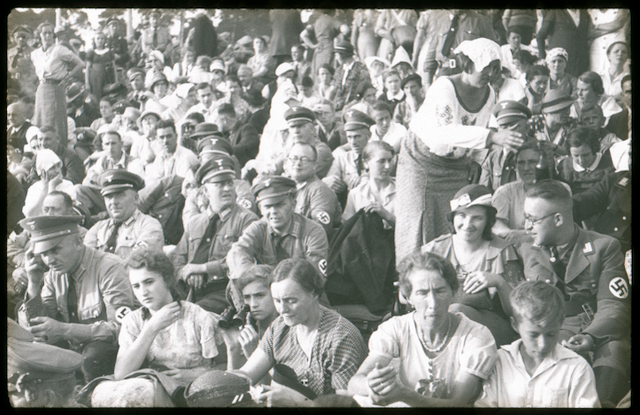
I’d noticed many years ago that the mental image most people had of the Wehrmacht was directly from Nazi propaganda films and photos, which emphasized the “mechanized might” of the modern German military machine … despite the fact that the Germans used many more horse-drawn carts than motorized vehicles all the way through the war. The images were striking — nobody said the Nazi propagandists were incompetent — and they also helped hide the fact that the French and British had been thoroughly trounced in 1940 despite their more heavily armed tanks outnumbering the lighter German panzers.


